10 minutes free every day
Continue audio lessons in the app
Word explanations appear automatically in sync with the audio.
No login required · synced translations · playback with the screen locked
Choose your learning language and open this lesson in the app.

About This Lesson
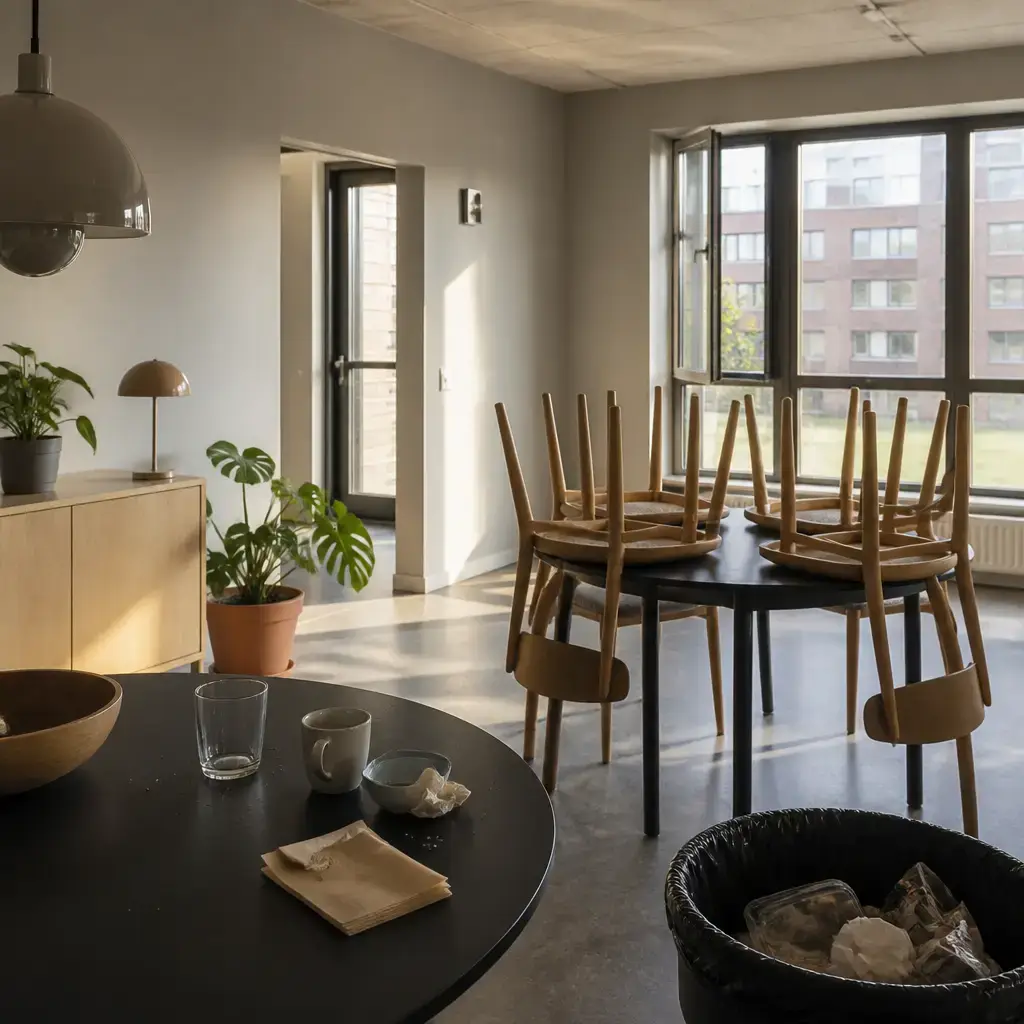
Use Cleaning up the common room to practice Danish conversation, pronunciation, vocabulary, grammar, and quizzes.
Dialogue
Vi brugte fællesrummet et stykke tid.
vee BROO-gduh FEL-uhs-ROM-uhth ehd STUHR-kuh TEEM. We used the common room for a while.Lad os rydde op, før vi går.
LEH-th ohs RUR-thuh OHB, fuhr vee GOH. Let's clean it up before we head out.Jeg sætter stolene tilbage, hvor de stod.
yai SED-uh STOH-luh-nuh teh-LEH-baih, voh dee STOHTH. I'll put the chairs back where they were.Jeg fjerner affaldet fra bordene.
yai FYER-nuh AF-al-uhth frah BOHR-nuh. I'll clear the trash from the tables.Skal vi også slukke lyset?
SKEL vee AW-suh SLOG-uh LÜÜ-suhth? Should we turn off the lights too?Sluk lyset.
SLOG LÜÜ-suhth. Turn off the lights.Luk vinduerne, før vi låser af.
LOOG VEN-oo-uh-nuh, fuhr vee LOH-suh EH. Close the windows before we lock up.Rummet ser klart ud til den næste gruppe.
ROM-uhth sair KLAHD ooth tell deh NES-tuh GROO-buh. The room looks ready for the next group.Så kan vi låse døren og gå.
soh ken vee LOH-suh DUHR-uhn oh GOH. Then we can lock the door and leave.Sentence explanations
Vi brugte fællesrummet et stykke tid.
We used the common room for a while.
- Vi
- we
- brugte
- used
- fællesrummet
- the common room
- et stykke tid
- for a while
More detail
Vi means “we”: a first-person plural subject pronoun. Danish subject pronouns include jeg (“I”), du (“you,” singular), and vi (“we”). Vi does not show the gender of the people included. brugte is the past-tense form of bruge, “to use.” It describes using something in the past; the subject here is vi, so the meaning is “we used.” Example: Jeg brugte telefonen. — “I used the phone.” fællesrummet means “the common room.” Its base noun is fællesrum; the ending -et marks the definite singular form, “the common room.” The compound combines fælles (“shared/common”) with rum (“room”). Example: Fællesrummet er stort. — “The common room is large.” et stykke tid is a fixed duration expression meaning “for a while.” It describes how long the use lasted. Although et is also an indefinite article, this expression does not by itself assert a numerical count; together, the words express an unspecified period of time. Example: Vi ventede et stykke tid. — “We waited for a while.” Together, Vi + brugte gives “we used,” fællesrummet identifies what was used, and et stykke tid gives its duration. The complete meaning is: “We used the common room for a while.”
Lad os rydde op, før vi går.
Let's clean it up before we head out.
- Lad os
- let’s
- rydde op
- clean up
- før
- before
- går
- go / head out
More detail
Lad os is the Danish way to make a “let’s …” suggestion. lad is the imperative of lade (“let/allow”), and os is the object form meaning “us”; together, Lad os + infinitive introduces an action proposed for the speaker and others. rydde op means “clean up” or “tidy up.” rydde is the infinitive of rydde (“clear/tidy”), and op is a particle that forms the useful verb combination rydde op. After Lad os, the verb stays in the infinitive: Lad os rydde op. — “Let’s clean up.” før means “before” and introduces a subordinate time clause. It places the event in that clause later than the event in the main clause, without by itself expressing obligation: før vi går means “before we go.” går is the present-tense form of gå (“go”). With vi (“we”), it means “we go”; in this sentence, the fixed translation gives the intended sense “we head out.” Danish uses the same present form for this kind of present or scheduled action: Vi går nu. — “We’re leaving now.” The sentence combines the suggestion Lad os rydde op with the time clause før vi går: “Let’s clean up before we head out.”
Jeg sætter stolene tilbage, hvor de stod.
I'll put the chairs back where they were.
- Jeg
- I
- sætter
- put
- stolene
- the chairs
- tilbage
- back
- hvor
- where
- de
- they
- stod
- were standing
More detail
Jeg means “I” here and identifies the speaker as the actor. Danish jeg is the first-person singular subject pronoun; it does not change for gender. sætter is the present-tense form of sætte, “to put” or “to set.” In this sentence, the present form refers to the speaker’s intended action, naturally translated as “I’ll put,” rather than necessarily an action happening at this exact moment. Compare jeg sætter bogen på bordet — “I put the book on the table.” stolene means “the chairs.” The base noun is stol, “chair,” and stolene is its definite plural form: stole means “chairs,” while the ending -ne marks “the chairs.” The noun is definite and plural; the form does not itself specify who owns the chairs. tilbage is the adverb “back,” indicating return to an earlier or expected place. It combines with sætter to give the reusable pattern sætte noget tilbage, “put something back.” hvor means “where” and introduces a clause describing a place. Here it connects the act of putting the chairs back with their prior location. de means “they” in this clause. It is a third-person plural subject pronoun and refers here to the chairs, as confirmed by the fixed translation. Danish de is distinct from singular den and det in contexts where a singular pronoun is required. stod is the past-tense form of stå, “to stand.” With chairs, it describes their previous position: “were standing” or simply “were.” The past form places that position before the putting-back action. Compare stolene står her — “the chairs are standing here” — with stolene stod her — “the chairs were standing here.” Together, stolene tilbage gives “the chairs back,” and hvor de stod gives “where they were.” The full sentence therefore means: “I’ll put the chairs back where they were.” The main clause uses present-form sætter for the speaker’s intended action, while the subordinate hvor-clause uses past stod for the chairs’ earlier position.
Jeg fjerner affaldet fra bordene.
I'll clear the trash from the tables.
- Jeg
- I
- fjerner
- remove; clear
- affaldet
- the trash
- fra
- from
- bordene
- the tables
More detail
Jeg is the first-person singular pronoun, meaning “I.” It identifies the speaker as the person carrying out the action. A useful contrast is jeg “I” versus vi “we”; the preceding sentence also uses Jeg, so the same speaker is involved there. fjerner means “remove” or, with affaldet, “clear away.” It is the present-tense form of fjerne (“to remove”). Danish present tense can describe a planned or imminent action when the context makes that timing clear; here, the surrounding cleanup actions support the future-oriented translation “I’ll clear.” For example, Jeg fjerner koppen. means “I’ll remove the cup” or “I’m removing the cup,” depending on context. affaldet means “the trash” here. Its base form is affald (“trash” or “waste”), and the ending -et marks the definite singular form: affald → affaldet. Affald is commonly treated as a mass noun, so this form refers to the waste as a substance or collection rather than asserting a particular numeric count. For example, Affaldet skal væk. means “The trash has to be removed.” fra is the preposition “from.” It marks the place or source from which something is removed. In the reusable pattern fjerne X fra Y, X is what is removed and Y is the place or source it is removed from. For example, Hun fjerner bogen fra hylden. means “She removes the book from the shelf.” bordene means “the tables.” Its base form is bord (“table”); the plural is borde, and the definite plural is bordene: bord → borde → bordene. The ending -ene marks “the” for a definite plural in this noun. Here it is the source location after fra, so the trash is removed from the tables. Together, Jeg fjerner gives “I’ll remove/clear,” affaldet identifies what is being removed, and fra bordene identifies where it is removed from. The complete meaning is “I’ll clear the trash from the tables.”
Skal vi også slukke lyset?
Should we turn off the lights too?
- Skal vi
- should we
- også
- too; also
- slukke
- turn off
- lyset
- the light
More detail
Skal vi is a reusable way to ask whether “we” should do something. skal is the present form of skulle, which can express obligation, recommendation, or a proposed action; here it forms a suggestion/question with vi (“we”). In a question, Danish places skal before the subject: Skal vi ...? = “Should we ...?” også means “also” or “too”. It adds this action to something already relevant, without changing who is expected to act. Its position here, before the main verb, is common: Vi skal også ... means “We should also ...”. slukke means “to turn off” or “to switch off”. It is the infinitive after skal; Danish uses the infinitive directly after this modal, without an English-style at: Vi skal slukke = “We should turn off.” The imperative in the related example Sluk lyset. uses sluk, the imperative form, not the infinitive slukke. lyset means “the light” here and is the definite form of lys (“light”). Danish commonly marks definiteness by a suffix: et lys = “a light”, lyset = “the light”. The fixed translation uses “the lights”; in this utterance, the Danish singular definite form is understood with that intended meaning, and the nearby example Sluk lyset. uses the same form. Together, Skal vi + også + slukke + lyset produces: “Should we turn off the lights too?” The utterance asks whether the speakers should jointly perform the action of turning off the light(s), while også signals that this action is an additional one.
Sluk lyset.
Turn off the lights.
- Sluk
- turn off
- lyset
- the light
More detail
Sluk is the imperative of slukke, “to turn off” or “to extinguish.” The imperative gives a direct instruction to the person addressed; the subject “you” is understood rather than stated. For example: Sluk radioen. — “Turn off the radio.” lyset is the definite singular form of lys, “light.” Danish commonly marks definiteness by a suffix: et lys means “a light,” while lyset means “the light.” Here, the fixed translation uses the natural English wording “the lights,” but the Danish form itself is singular and definite; it does not explicitly mark a plural. Together, Sluk + lyset form a direct instruction: “Turn off the light,” rendered in the fixed translation as “Turn off the lights.” The command is concise and suitable for an ordinary practical instruction.
Luk vinduerne, før vi låser af.
Close the windows before we lock up.
- Luk
- close
- vinduerne
- the windows
- før
- before
- låser af
- lock up
More detail
Luk is the imperative of lukke (“to close”). The imperative gives a direct instruction and normally has no written subject: Luk døren. = “Close the door.” The observed form therefore expresses the instruction to close, while the object appears in the next phrase. vinduerne means “the windows.” It is the definite plural form of vindue (“window”): et vindue → vinduer → vinduerne. The ending -ne marks definite plural here. Compare vinduer (“windows”) with vinduerne (“the windows”). før introduces the time relation “before.” It connects the instruction with a following clause: før vi går = “before we leave.” The event after før is the one that must happen later in the stated sequence. låser af is the verb construction låse af, meaning “to lock up” in this sentence. låser is the present-tense form of låse; with the subject vi, it means “we lock.” The particle af is part of the construction and contributes to the meaning “lock up,” rather than simply being an unrelated preposition. For example, Vi låser af klokken fem. = “We lock up at five.” Together, Luk vinduerne gives the instruction “Close the windows.” The clause før vi låser af specifies that this should happen before “we lock up.” The complete meaning is therefore: “Close the windows before we lock up.”
Rummet ser klart ud til den næste gruppe.
The room looks ready for the next group.
- Rummet
- the room
- ser … ud
- looks
- klart
- ready
- til
- for
- næste
- next
- gruppe
- group
More detail
Rummet means “the room.” It is the definite singular form of rum (“room”): et rum = “a room,” rummet = “the room.” In this sentence, the room is the subject. ser ... ud is a useful Danish construction meaning “looks” or “seems.” ser is the present-tense form of se (“to see”), while ud is a separate particle; together they form se ud. Example: Det ser godt ud. — “It looks good.” klart means “ready” here. It is the neuter singular form of the adjective klar (“ready”). The form is klart because it describes the neuter singular subject rummet; this is adjective agreement, not a change to the noun. Example: Alt er klart. — “Everything is ready.” til means “for” in this phrase and introduces the group that the room is ready for. Its meaning here is not the English direction “to.” den næste means “the next.” næste is the adjective “next”; in this definite noun phrase, den marks the singular common-gender noun phrase, and næste keeps this form. Example: den næste dag — “the next day.” gruppe means “group.” It is a common-gender singular noun: en gruppe = “a group,” gruppen = “the group.” Here, den næste gruppe means “the next group.” Together, Rummet ser klart ud says “The room looks ready,” and til den næste gruppe specifies who it is ready for. The complete meaning is: “The room looks ready for the next group.”
Så kan vi låse døren og gå.
Then we can lock the door and leave.
- Så
- then
- kan vi
- we can
- låse
- lock
- døren
- the door
- gå
- leave
More detail
Så means “then” here and links this sentence to the preceding situation. It can also introduce a conclusion or consequence: Så går vi. — “Then we’re leaving.” kan vi combines kan, the present form of kunne (“can, be able to”), with vi (“we”). The modal expresses that the group has the possibility or permission to do the actions. After kan, Danish uses the infinitive without at: Vi kan gå. — “We can leave.” Vi is the first-person plural pronoun, referring to the speaker together with one or more others; the sentence does not specify exactly who else is included. låse is the infinitive of låse (“to lock”). It is the first action governed by kan. With a modal, the infinitive remains unchanged: De kan låse døren. — “They can lock the door.” døren means “the door” in this sentence. It is the definite form of dør (“door”): dør → døren. The ending -en marks common-gender definiteness in this noun; it is the noun dør that carries this inflection. An indefinite form is en dør (“a door”), while døren refers to a specific door understood in the situation. gå is the infinitive of gå (“to go”); with the fixed translation, it means “leave” here. It is coordinated with låse by og, so both infinitives depend on kan: Vi kan låse døren og gå. — “We can lock the door and leave.” Together, Så kan vi (“Then we can”) introduces the available next actions. låse døren means “lock the door,” and og gå adds “and leave.” The complete utterance is therefore “Then we can lock the door and leave.”
Grammar Points
slukke → sluk
Sluk lyset.
SLOG LÜÜ-suhth.Turn off the light.
Imperativ bruges til kommandoer. Infinitiven slukke bliver til den korte form sluk.
Bestemt flertal: -ene
stolene, bordene, vinduerne
STOH-luh-nuh, BOHR-nuh, VEN-oo-uh-nuhthe chairs, the tables, the windows
Bestemt flertal dannes ofte med endelsen -ene efter substantivet.
Danish Vocabulary
- Gender
- neuter
Jeg fjerner affaldet fra bordene.
Vi brugte fællesrummet et stykke tid.
Vi brugte fællesrummet et stykke tid.
Jeg fjerner affaldet fra bordene.
- Gender
- neuter
Vi brugte fællesrummet et stykke tid.
Lad os rydde op, før vi går.
Lad os rydde op, før vi går.
Lad os rydde op, før vi går.
Jeg sætter stolene tilbage, hvor de stod.
- Gender
- common
Jeg sætter stolene tilbage, hvor de stod.
Jeg sætter stolene tilbage, hvor de stod.
Jeg sætter stolene tilbage, hvor de stod.
Quiz
Word Order
Arrange the words in the correct order.
We used the common room for a while.
Show Answer
Vi brugte fællesrummet et stykke tid.I'll clear the trash from the tables.
Show Answer
Jeg fjerner affaldet fra bordene.Should we turn off the lights too?
Show Answer
Skal vi også slukke lyset?Spelling
Tap the letters to spell the word.
the common room
Show Answer
fællesrummetput; place
Show Answer
sætterback
Show Answer
tilbageused