10 minutes free every day
Continue audio lessons in the app
Word explanations appear automatically in sync with the audio.
No login required · synced translations · playback with the screen locked
Choose your learning language and open this lesson in the app.

About This Lesson
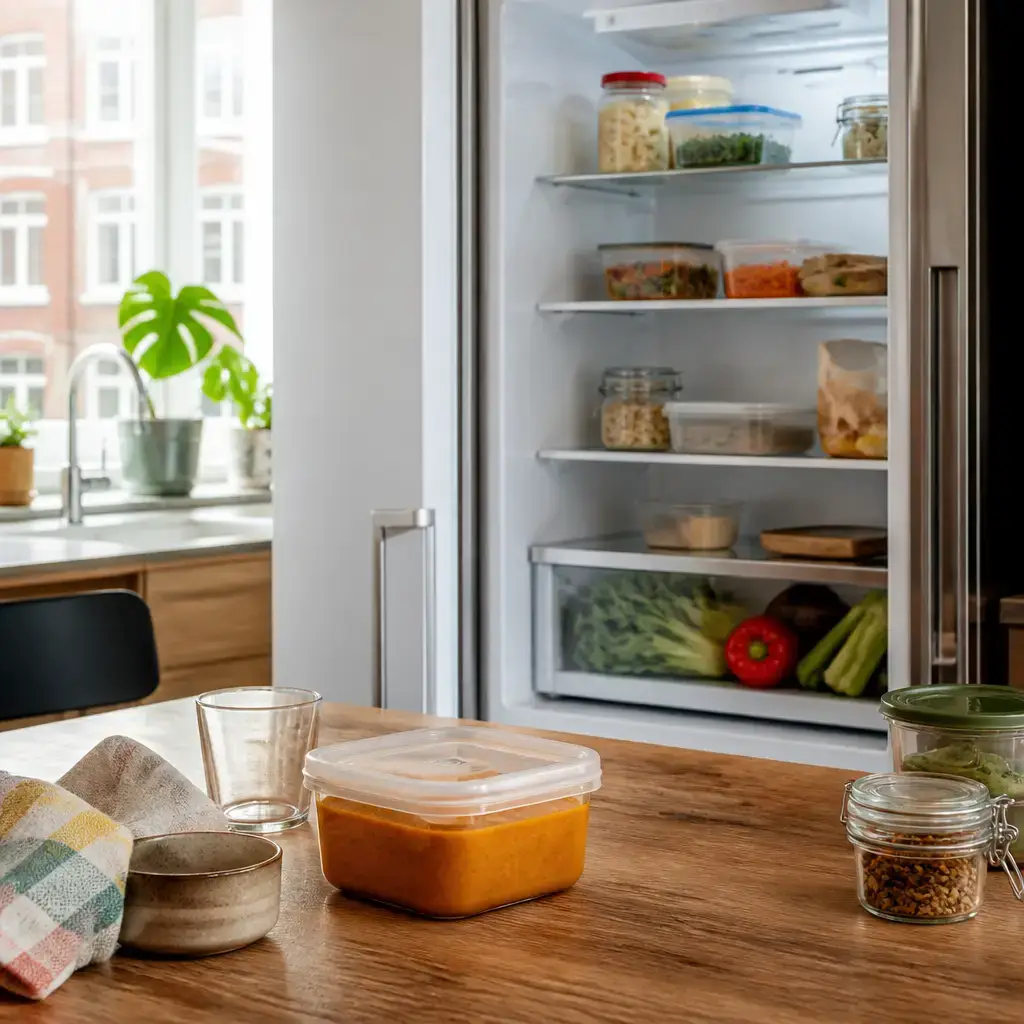
Use Labeling Food in a Shared Fridge to practice Danish conversation, pronunciation, vocabulary, grammar, and quizzes.
Dialogue
Må jeg sætte denne suppe i fælleskøleskabet?
moh yigh SET-uh DEN-uh SOH-buh ee FELL-uhs-KUR-luh-skab-uh? Can I put this soup in the shared fridge?Sæt et mærke på beholderen, før du lader den stå der.
SET uh MAYR-kuh poh beh-HOL-uh-ren, fur doo LAIR-uh den stoh dair. Label the container before you leave it there.Skal jeg også skrive datoen på den?
SKAL yigh OH-soh SKREE-vuh DAY-toh-en poh den? Should I write the date on it too?Så ved folk, hvor længe den har stået derinde.
soh vay folk, vor LENG-uh den har STOHT dair-IN-uh. That helps people know how long it has been inside.Hvilken hylde er til ens egen mad?
VIL-ken HIL-uh air til ens AY-en math? Which shelf is for personal food?Brug den øverste hylde, væk fra de fælles madvarer.
broo den UR-vuh-stuh HIL-uh, vek fra dee FELL-uhs math-VAIR-uh. Use the top shelf, away from the shared items.Jeg lader den stå der og tager den snart med hjem.
yigh LAIR-uh den stoh dair oh TAY-uh den snart meh yem. I'll keep it there and take it home soon.På den måde bliver køleskabet ikke fyldt med gammel mad.
poh den MOH-uh BLEE-er KUR-luh-SKAB-uh IK-uh FILLT meh GAM-uhl math. That way the fridge does not fill up with old food.Sentence explanations
Må jeg sætte denne suppe i fælleskøleskabet?
Can I put this soup in the shared fridge?
- Må jeg
- Can I? / May I?
- sætte
- put; place
- denne
- this
- suppe
- soup
- fælleskøleskabet
- shared fridge
More detail
Må jeg is a reusable Danish permission question: Må jeg + infinitive ...? means “May/Can I ...?” Here jeg is the subject, and må is the modal verb expressing permission. The following verb stays in the infinitive: Må jeg komme ind? means “May I come in?” sætte means “to put/place” something. It is the infinitive after the modal må; it does not take a present-tense ending here. Danish also uses other placement verbs in more specific situations, but sætte is the form used in this utterance for placing the soup in the fridge. denne means “this” and agrees with the noun it modifies. It is the singular common-gender form; the corresponding neuter singular form is dette, and the plural form is disse. In denne suppe, denne identifies the soup as a nearby or otherwise contextually identifiable single item. Example: denne bog means “this book.” suppe means “soup.” Its base noun form is suppe; with the indefinite article it is en suppe, showing that it is a common-gender noun. In the fixed utterance it appears without an article because the demonstrative phrase denne suppe already specifies the item. fælleskøleskabet means “the shared fridge.” It is a compound noun: fælles means “shared/common,” and køleskab means “fridge/refrigerator.” The ending -et marks the definite singular form of the neuter noun køleskab: et køleskab → køleskabet. Thus the word refers to an identifiable shared fridge, not merely any fridge. Together, Må jeg asks for permission, sætte names the placement action, denne suppe identifies what will be placed, and i fælleskøleskabet gives the destination. The whole utterance therefore means: “Can I put this soup in the shared fridge?”
Sæt et mærke på beholderen, før du lader den stå der.
Label the container before you leave it there.
- Sæt
- put; place
- mærke
- label; mark
- beholderen
- the container
- før
- before
- lader
- leave; let
- den
- it
- stå
- stand; remain
- der
- there
More detail
Sæt is the imperative of sætte, “to put/place”. The imperative addresses the listener directly and has no written subject: Sæt ... = “Put ...”. Example: Sæt koppen her. — “Put the cup here.” mærke means “label” or “mark”. Here it is a neuter noun: et mærke means “a label/a mark”; et is the indefinite article required by this noun’s grammatical gender, not a separate claim about quantity. The definite form is mærket — “the label”. beholderen means “the container”. It is the definite singular form of beholder (“container”): beholder → beholderen. Danish commonly marks definiteness with an ending rather than a separate word. The phrase et mærke på beholderen means “a label on the container”; på links the label to the container’s surface or location. før means “before” and introduces the action that must happen earlier. The following clause is du lader den stå der: “you leave it there.” Example: Vask hænderne, før du spiser. — “Wash your hands before you eat.” lader is the present-tense form of lade, which can mean “let” or “leave” when it describes allowing something to remain in a state or place. The present form is lader with different subjects: jeg lader, du lader, de lader. Here, lader combines with stå to express leaving something in place, matching the fixed translation “leave it there.” den is a singular common-gender pronoun meaning “it” in this use. Its specific referent is not separately identified by the fixed texts; the form itself gives the pronoun’s grammatical class, not a unique referent. Danish uses den with common-gender singular referents, while a neuter singular referent uses det. stå is the infinitive “stand” or “remain”. In lader den stå, it describes the state that the object is allowed to remain in: “let it stand/remain.” After lade, the infinitive appears without at in this construction. Example: Lad døren stå åben. — “Leave the door open.” der means “there”, pointing to a place understood from the situation. Together, stå der means “stand/remain there”; der does not itself identify the location. The sentence builds as Sæt et mærke på beholderen (“Put a label on the container”) + før du lader den stå der (“before you leave it there”). The imperative gives the requested action, and før places that action earlier than the leaving. The complete meaning is: “Label the container before you leave it there.”
Skal jeg også skrive datoen på den?
Should I write the date on it too?
- Skal jeg
- Should I ...?
- også
- also; too
- skrive
- write
- datoen
- the date
- på
- on
- den
- it
More detail
Skal jeg is a reusable way to ask whether the speaker should do something: skal is the present form of skulle, here expressing what is appropriate or expected, and jeg means “I.” Danish normally places the subject after skal in this yes/no question pattern: Skal jeg ...? — “Should I ...?” også means “also/too.” It adds this action to something already relevant, so the question asks whether writing is an additional step. Its position can change with emphasis, but here it comes before the main verb. skrive means “write.” This is the infinitive form, used after the modal verb skal: skal skrive = “should write.” For example, Skal jeg skrive mit navn? means “Should I write my name?” datoen means “the date.” The base noun is dato; datoen is its singular definite form, literally the form used for “the date.” Danish commonly marks definiteness by a suffix: en dato = “a date,” datoen = “the date.” på means “on” here and introduces the surface where something is written. In other contexts, på can have other meanings, so its exact English translation depends on the relation it expresses. den means “it” in this sentence. It is a third-person singular pronoun used here for the intended object—the container established by the surrounding context. Danish den is used with common-gender nouns; this pronoun’s form reflects the grammatical class of the referent, not the object’s physical size or location. The phrase på den therefore means “on it.” Together, Skal jeg skrive datoen på den? asks whether the speaker should add the date in writing on the container: “Should I write the date on it too?” The question keeps the action, object, surface, and additional-step meaning separate: skal + infinitive (skrive), the definite noun datoen, the preposition på, and the pronoun den.
Så ved folk, hvor længe den har stået derinde.
That helps people know how long it has been inside.
- Så
- that way; so
- ved
- knows
- folk
- people
- hvor længe
- how long
- den
- it
- har stået
- has been standing
- derinde
- in there; inside
More detail
Så means “that way” here, linking the sentence to the useful result of the preceding action. Danish så can also mean “then” or “so” in other contexts. ved is the present-tense form of vide, “to know”: vide → ved. Danish verbs do not change form for subject number or person, so jeg ved means “I know” and folk ved means “people know.” Do not confuse this ved with the preposition ved, which can mean “by” or “at” in other constructions. folk means “people” and refers here to people as a group. It is commonly used for a group of people; mennesker is another word for “people,” often referring more explicitly to human beings. Although folk denotes multiple people, the verb form ved is not a special plural form: Danish present-tense verbs generally do not mark person or number. hvor længe asks about duration: “how long.” It introduces the embedded question hvor længe den har stået derinde, rather than asking for a clock time. Compare hvor længe? (“how long?”) with hvornår? (“when?”). den is a singular common-gender pronoun meaning “it” here. The fixed meaning identifies it as the item being discussed; the pronoun itself marks grammatical gender and number, not the item’s identity. A singular neuter noun would normally be referred to with det instead. har stået is a perfect-tense form of stå, “to stand” or “be standing”: stå → stod (past tense) → har stået (perfect). The auxiliary har combines with the past participle stået. Here, the combination describes the item’s remaining in the inside location over a period of time. Example: Den har stået der hele dagen. — “It has been standing there all day.” derinde means “in there” or “inside,” referring to a location away from the speaker’s immediate position. It is a single adverb here, not an article plus a noun. The related form herinde means “in here,” closer to the speaker. Together, Så ved folk means “That way, people know.” The embedded question hvor længe den har stået derinde specifies what they know: “how long it has been inside.” The whole utterance therefore means: “That helps people know how long it has been inside.”
Hvilken hylde er til ens egen mad?
Which shelf is for personal food?
- Hvilken
- which
- hylde
- shelf
- er til
- is for
- ens egen
- one’s own; personal
- mad
- food
More detail
Hvilken means “which” when it modifies one singular common-gender noun. It agrees with hylde; compare hvilket with a singular neuter noun and hvilke with plural nouns. Example: Hvilken bog læser du? — “Which book are you reading?” hylde means “shelf.” Its base form is hylde; useful forms include hylden (“the shelf”) and hylder (“shelves”). In this sentence it is the singular noun being selected by hvilken. er til combines the present form er of være (“to be”) with til (“for” here). Together, the construction identifies the intended use or assignment of something: a shelf is designated for a particular purpose. Example: Denne kasse er til papir. — “This box is for paper.” ens egen expresses “one’s own” or “personal.” ens is a generic reflexive possessive meaning “one’s,” while egen emphasizes that the thing belongs to or is associated with that person rather than someone else. egen agrees with the noun: egen with a singular common-gender noun, eget with a singular neuter noun, and egne with plural nouns. Example: Man skal bruge sin egen nøgle. — “One should use one’s own key.” mad means “food.” It commonly refers to food as a substance or category rather than counting individual portions. In this utterance, ens egen mad means a person’s own food, contrasted with food shared by others. As a whole, Hvilken hylde er til ens egen mad? asks which shelf is intended for personal food: “Which shelf is for personal food?” The question pattern is reusable as Hvilken [singular common-gender noun] er til [purpose or thing]?.
Brug den øverste hylde, væk fra de fælles madvarer.
Use the top shelf, away from the shared items.
- Brug
- use
- den
- the
- øverste
- topmost
- hylde
- shelf
- væk fra
- away from
- de
- the
- fælles
- shared
- madvarer
- food items
More detail
Brug is the imperative of bruge, “to use.” It gives a direct instruction; Danish imperatives generally do not mark the addressee’s number. Example: Brug denne stol. — “Use this chair.” den øverste identifies a particular common-gender singular noun phrase as definite: “the topmost/top.” den is the definite determiner used here with hylde; it does not itself state a numerical quantity. øverste expresses the highest position in an ordered set. Compare øverste hylde — “top shelf” — with nederste hylde — “bottom shelf.” hylde means “shelf.” Its plural is hylder. In this sentence, the singular form is appropriate because the instruction refers to one shelf. væk fra is a reusable prepositional expression meaning “away from.” It describes separation or position relative to something. Example: Sæt den væk fra vinduet. — “Put it away from the window.” de fælles marks a definite plural group: “the shared/common.” de is the definite determiner used here with the plural noun madvarer. fælles describes something shared by several people or belonging to a common supply; in this sentence it modifies madvarer. madvarer means “food items” or “foodstuffs.” It is a plural form; the singular madvare means “food item.” The phrase de fælles madvarer therefore means “the shared food items.” Together, Brug den øverste hylde means “Use the top shelf,” and væk fra de fælles madvarer adds the positional restriction “away from the shared food items.” The complete utterance is: “Use the top shelf, away from the shared items.”
Jeg lader den stå der og tager den snart med hjem.
I'll keep it there and take it home soon.
- Jeg
- I
- lader
- leave; let
- den
- it
- stå
- stand; remain
- der
- there
- tager
- take
- snart
- soon
- med hjem
- home
More detail
Jeg is the first-person singular subject: “I.” This pronoun does not encode the speaker’s gender. Compare du (“you,” singular) and vi (“we”) when the subject changes. lader is the present-tense form of lade, “to let” or “to leave.” Here it is used with an infinitive in lader den stå: lade + object + infinitive means allowing or leaving something in a state or position. In this sentence, the natural meaning is “leave it” or “keep it.” Example: Jeg lader døren stå åben. — “I leave the door open.” den is a singular common-gender object pronoun, corresponding here to “it.” Its grammatical form is den; the particular thing it refers to is supplied by the surrounding situation rather than by the pronoun itself. The neuter singular counterpart is det. stå is the infinitive of stå, “to stand” or “to remain.” After lader, it describes the state in which the object is left. Thus lader den stå means “leave it standing” literally, or more naturally “leave it there/keep it there” in this context. The infinitive stays unchanged after lade. der means “there,” identifying the place where it remains. Together, lader den stå der means “leave it there” or “keep it there.” tager is the present-tense form of tage, “to take.” A useful form chain is tage (infinitive) – tager (present) – tog (past) – taget (past participle). Example: Jeg tager bogen med. — “I take the book with me.” snart means “soon,” indicating that the taking-home action is expected in the near future. Danish present tense can refer to a planned or expected future action when the context makes that clear. med hjem is a reusable adverbial combination meaning “home” or “to home” after a movement verb. med contributes the idea of taking something along, while hjem identifies the destination. tager den med hjem therefore means “take it home,” not merely “take it” and “home” as two unrelated actions. Example: Hun tager paraplyen med hjem. — “She takes the umbrella home.” The conjunction between the two parts links two actions performed by the same subject: Jeg lader den stå der + og + tager den snart med hjem. The first action is leaving it there for now; the second is taking it home soon. Together, the utterance means: “I’ll keep it there and take it home soon.”
På den måde bliver køleskabet ikke fyldt med gammel mad.
That way the fridge does not fill up with old food.
- På den måde
- that way
- bliver
- becomes; gets
- køleskabet
- the fridge
- ikke
- not
- fyldt med
- filled with
- gammel
- old
- mad
- food
More detail
På den måde means “that way” or “in that manner.” på is used here in a fixed manner expression, so the whole phrase points to the method just mentioned rather than naming a physical location. Example: Gør det på den måde. — “Do it that way.” bliver is the present-tense form of blive, “to become” or “to get.” Here it helps form a passive construction with fyldt: bliver fyldt means “gets filled” or “becomes filled.” The subject is the thing receiving the action, not the person or thing filling it. køleskabet means “the fridge.” Its base form is køleskab, “fridge”; the ending -et marks the definite singular form, “the fridge.” Example: Et køleskab står i køkkenet. — “A fridge is in the kitchen.” ikke is the ordinary Danish negation “not.” In this sentence it negates bliver fyldt, producing “does not get filled.” fyldt med means “filled with.” fyldt is the past participle of fylde, “to fill.” With bliver, the phrase is passive: bliver fyldt med X means “gets filled with X.” med introduces what fills the container. Example: Glasset bliver fyldt med vand. — “The glass gets filled with water.” gammel means “old.” It modifies mad here and has the form used with a singular common-gender noun such as mad; the neuter form is gammelt, as in gammelt brød — “old bread.” The form gammel is not the noun’s base form; it is the adjective agreeing with the noun in this phrase. mad means “food.” It is commonly used as a mass noun for food in general. Example: Der er mad på bordet. — “There is food on the table.” Together, På den måde sets the method or consequence being referred to. køleskabet bliver fyldt med gammel mad says that the fridge gets filled with old food, and ikke reverses that statement. The whole utterance therefore means: “That way the fridge does not fill up with old food.”
Grammar Points
lade + infinitiv
Lad suppen stå.
LAT SOO-buh stoh.Let the soup stand.
After lade, the following verb stays in the infinitive: lade suppen stå means allowing the soup to remain.
blive + perfektum participium
Fælleskøleskabet bliver fyldt med mad.
FELL-uhs-KUR-luh-SKAB-uh BLEE-er FILLT meh math.The shared fridge becomes filled with food.
Blive plus a past participle describes a change or result: bliver fyldt means becomes filled.
Danish Vocabulary
- Gender
- common
- Gender
- common
- Gender
- neuter
- Gender
- neuter
- Gender
- common
Quiz
Spelling
Tap the letters to spell the word.
label; mark
Show Answer
mærketo put; to place
Show Answer
sætteto let; to leave
Show Answer
ladercontainer