10 minutes free every day
Continue audio lessons in the app
Word explanations appear automatically in sync with the audio.
No login required · synced translations · playback with the screen locked
Choose your learning language and open this lesson in the app.

About This Lesson
Use Discussing a repair that needs more than a quick fix to practice Danish conversation, pronunciation, vocabulary, grammar, and quizzes.
Dialogue
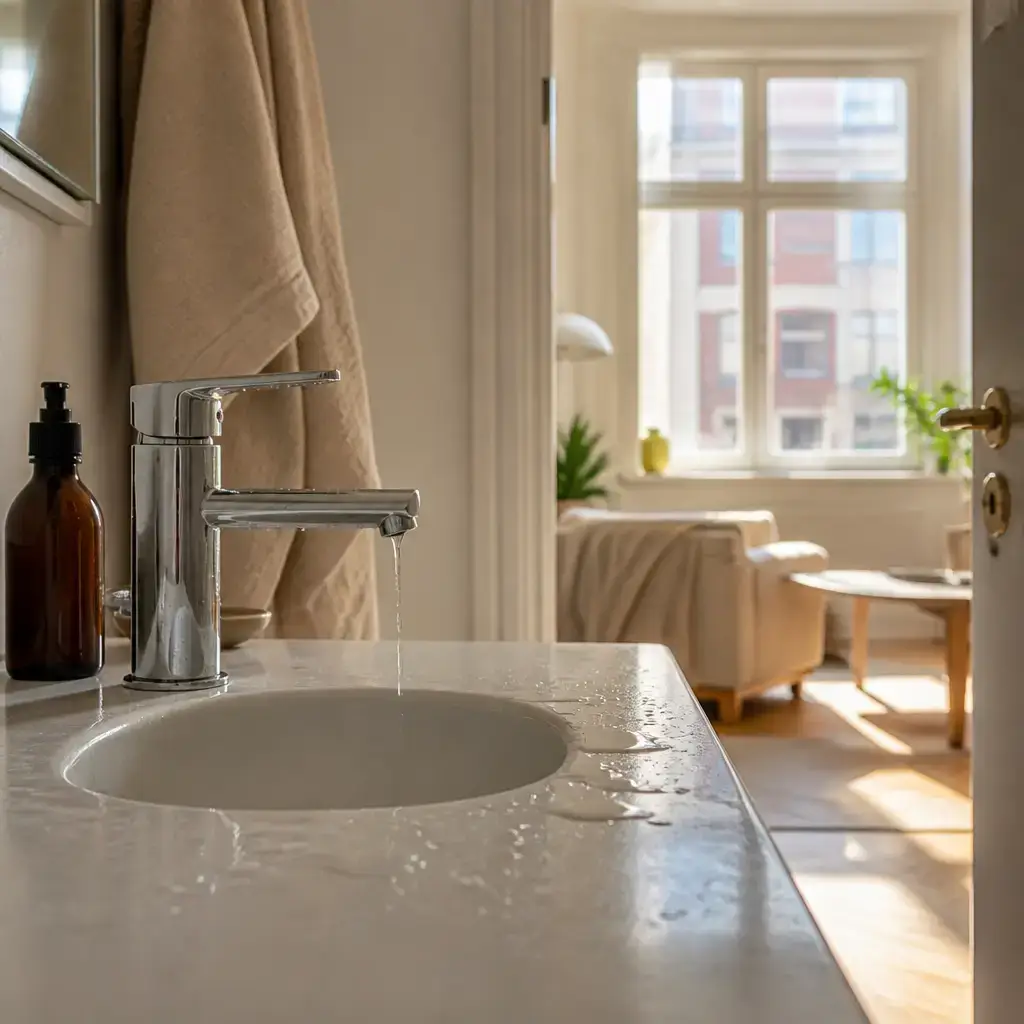
Vandhanen på badeværelset lækker igen, selv efter at jeg spændte den i går.
VAHN-hah-nen paw BEH-thuh-VAIR-uhl-suh LEK-er ee-YEN, sel EF-ter at yai SPEN-teh den ee GOHR. The bathroom tap is leaking again, even after I tightened it yesterday.Da det bliver ved med at ske, bør vi nok kontakte udlejeren.
Dah deh BLEE-er vay meh at SKEH, buhr vee nok kon-TAHG-teh OOTH-lye-er-en. Since it keeps happening, we should probably contact the landlord.Jeg kan sende et billede og forklare, at en midlertidig reparation ikke virkede.
YAI kan SEN-eh ed BEL-uh oh for-KLAIR-uh, at en MEL-uh-dee reh-pah-rah-SYOHN IK-uh VEER-keh. I can send a photo and explain that a temporary repair did not work.Nævn, at der bliver spildt vand, og at bordpladen bliver våd.
NEH-wn, at dair BLEE-er SBEELT vahn, oh at BOHR-plah-den BLEE-er VOHT. Mention that water is being wasted and the counter is getting wet.Skal vi sige, at vi ikke selv har forårsaget problemet?
Skal vee SEE-eh, at vee IK-uh selw har for-OR-sah-ed proh-BLAY-meh? Should we say that we did not cause the problem ourselves?Sørg for at få det tydeligt med, men hold en rolig tone.
SUR for at foh deh TEW-thuh-leh meh, men hol en ROH-lee TOH-nuh. Include that clearly, but keep the tone calm.Beskeden skal være høflig, men specifik, så der ikke opstår forvirring.
beh-SGAY-den skal VAIR-uh HUHF-lee, men speh-see-FEEK, soh dair IK-uh op-STOHR for-VEER-ing. The message should be polite but specific, so there is no confusion.Spørg, hvornår en blikkenslager kan komme, fordi morgener på hverdage er vanskelige for os.
SPUHRG, vorn-OR en BLEK-en-SLAIR-uh kan KOM-eh, for-DEE MOHR-ner paw VAIR-dah-eh air VAN-skeh-leh for ohs. Ask when a plumber could visit, because weekday mornings are difficult for us.Vi kan foreslå et fleksibelt tidsrum, hvor nogen kan være hjemme.
Vee kan foh-SLOH ed flek-see-BELT TEETS-room, vor NOH-en kan VAIR-uh YEM-uh. We can suggest a flexible time window when someone can be home.Det burde gøre det lettere for udlejeren at arrangere reparationen.
Deh BOO-uh GUH-uh deh LET-uh-ruh for OOTH-lye-er-en at ahn-ahr-SYAIR-uh reh-pah-rah-SYOHN-en. That should make it easier for the landlord to arrange the repair.Sentence explanations
Vandhanen på badeværelset lækker igen, selv efter at jeg spændte den i går.
The bathroom tap is leaking again, even after I tightened it yesterday.
- Vandhanen
- the tap
- badeværelset
- the bathroom
- lækker
- leaks
- igen
- again
- selv efter at
- even after
- jeg
- I
- spændte
- tightened
- den
- it
- i går
- yesterday
More detail
Vandhanen means “the tap” here. It is the definite singular form of vandhane (“tap”): en vandhane → vandhanen. Danish commonly marks definiteness by a suffix on the noun rather than by a separate word. badeværelset means “the bathroom.” The base noun is badeværelse, an et-word: et badeværelse → badeværelset. In the full sentence, på badeværelset means “in/on the bathroom” in the intended location sense; på is not included in this phrase entry. lækker describes what the tap is doing now: “leaks” or “is leaking.” It is the present form of lække. In this sentence, the present form presents the leaking as an ongoing current problem. Example: Røret lækker. — “The pipe is leaking.” igen means “again.” It shows that the leaking has happened before and has recurred. It modifies the situation described by lækker, rather than naming a separate action. selv efter at introduces a subordinate clause meaning “even after.” The at here links the following clause; it is followed by the finite verb spændte. This pattern highlights that the expected result did not last or occur: selv efter at [subject] [verb] ... — “even after [subject] [verb] ...”. jeg is the first-person singular pronoun “I.” It is the subject of the action in the following clause. Danish uses jeg for the speaker regardless of the grammatical gender of any noun involved. spændte means “tightened” in this sentence. It is the past-tense form of spænde (“to tighten”). The form spændte is used with jeg in the past: jeg spænder (“I tighten/am tightening”) → jeg spændte (“I tightened”). Example: Jeg spændte skruen. — “I tightened the screw.” den means “it” here and refers to the tap, as established by the fixed translation. It is a singular common-gender object pronoun. Danish also has det for a singular neuter referent, but the choice here is den because vandhane is an en-word. The pronoun is the object of spændte. i går means “yesterday,” a fixed time expression for the day before today. It places spændte in the past and does not itself mean “for one day.” Example: Jeg ringede i går. — “I called yesterday.” Together, Vandhanen på badeværelset identifies the bathroom tap, and lækker igen says that it is leaking again. selv efter at jeg spændte den i går adds that this recurrence happened despite the speaker’s tightening the tap yesterday. The complete meaning is: “The bathroom tap is leaking again, even after I tightened it yesterday.”
Da det bliver ved med at ske, bør vi nok kontakte udlejeren.
Since it keeps happening, we should probably contact the landlord.
- Da
- Since
- bliver ved med at ske
- keeps happening
- bør vi
- we should
- nok
- probably
- kontakte
- contact
- udlejeren
- the landlord
More detail
Da introduces the reason for the main clause. Here it means “since,” linking the repeated problem to the proposed action; Danish da can also mean “when” in other contexts, but the fixed translation and context support the causal reading here. The clause begins with Da det ..., where det is the subject referring to the situation that keeps occurring; the context identifies that situation as the bathroom tap leaking again. bliver ved med at ske expresses continuation: something keeps happening. bliver is the present form of blive (“become,” “stay,” or “remain,” depending on construction), while at ske is the infinitive “to happen.” The reusable pattern is blive ved med at + infinitive, meaning “keep on” doing something. Example: Hun bliver ved med at spørge. — “She keeps asking.” bør vi means “we should.” bør is the modal form of burde, used for advice, expectation, or an appropriate action; it is not an ordinary present-tense verb that changes according to the subject. vi means “we.” Because the subordinate clause comes first, the main clause has verb–subject order: bør vi ..., rather than vi bør .... The latter order is also possible when the sentence does not begin with another clause: Vi bør kontakte udlejeren. — “We should contact the landlord.” nok softens the recommendation and gives the intended “probably” or “I think ... should” nuance here. It does not mean that the action is certain. Together, bør vi nok is a reusable way to make a cautious recommendation: “we should probably.” kontakte means “contact.” It is the infinitive of kontakte, and it follows the modal bør without an infinitive marker: bør kontakte, “should contact.” Example: Du bør kontakte lægen. — “You should contact the doctor.” udlejeren means “the landlord.” The base noun is udlejer; the ending -en marks the definite singular form, referring to an identified landlord. Danish definite forms are built into the noun rather than normally using a separate word equivalent to English “the.” Example: Jeg ringer til udlejeren. — “I am calling the landlord.” The complete structure is Da ... , bør vi nok ...: “Since ..., we should probably ... .” The reason is that the problem continues to happen, and the recommended action is for “we” to contact the identified landlord. Thus the whole utterance means: “Since it keeps happening, we should probably contact the landlord.”
Jeg kan sende et billede og forklare, at en midlertidig reparation ikke virkede.
I can send a photo and explain that a temporary repair did not work.
- Jeg kan
- I can
- sende
- send
- billede
- photo; picture
- forklare
- explain
- midlertidig
- temporary
- reparation
- repair
- ikke
- not
- virkede
- worked
More detail
Jeg kan combines the pronoun jeg (“I”) with kan, the present-tense form of kunne (“can; be able to”). Danish kan is followed by an infinitive: Jeg kan sende = “I can send.” The form does not itself specify whether the ability is physical, practical, or permitted; here the translation supports ability to send. sende is the infinitive “to send.” After a modal such as kan, Danish uses the infinitive without an added infinitive marker: kan sende. Example: Hun kan hjælpe. — “She can help.” billede means “picture” or “photo” here. It is a neuter noun: et billede (“a picture”), billedet (“the picture”), and billeder (“pictures”). The supplied sentence uses et billede, an indefinite singular noun phrase; et marks the noun’s grammatical gender, not a stated numerical emphasis. forklare is the infinitive “to explain.” It is coordinated with sende after kan: kan sende ... og forklare ... means “can send ... and explain ...”. The conjunction og links two actions sharing the understood subject jeg; it does not make forklare finite. midlertidig means “temporary” in this sentence. It is the common-gender singular indefinite form of the adjective; with a neuter singular noun it would be midlertidigt, and with plural nouns it is midlertidige. Here it modifies reparation, which is common gender: en midlertidig reparation (“a temporary repair”). reparation means “repair.” It is a common-gender noun, as shown by en reparation; its definite singular form is reparationen, and its plural is reparationer. In this sentence it is the repair being described as temporary. ikke is the usual Danish negation “not.” In ikke virkede, it negates the claim that the repair worked. Its position immediately before the past-tense verb gives the chunk the meaning “did not work.” virkede is the past-tense form of virke, “to work” or “to function.” Here it describes whether the repair functioned successfully, not employment. A useful contrast is virker (“works/is working”) versus virkede (“worked/was working” in the past). Example: Løsningen virkede. — “The solution worked.” Together, Jeg kan sende et billede og forklare means “I can send a photo and explain.” The following at introduces what can be explained: at en midlertidig reparation ikke virkede — “that a temporary repair did not work.” The whole utterance is therefore: “I can send a photo and explain that a temporary repair did not work.”
Nævn, at der bliver spildt vand, og at bordpladen bliver våd.
Mention that water is being wasted and the counter is getting wet.
- Nævn
- mention
- der bliver spildt
- is being wasted
- vand
- water
- bordpladen
- the countertop
- våd
- wet
More detail
Nævn is the imperative of nævne, “to mention.” It gives a direct instruction to one or more listeners; the subject is understood rather than written. A reusable pattern is Nævn, at ... (“Mention that ...”). der bliver spildt expresses an ongoing passive event: water is being wasted. bliver is the present form of blive used here as a passive auxiliary, and spildt is the past participle of spilde (“waste” or “spill”). The der introduces the clause without naming the person responsible. This is different from bliver in bliver våd, where it means “becomes” rather than forming the passive. vand means “water.” It is commonly used as a mass noun, so this sentence does not specify a numerical amount. Example: Der er vand på gulvet. — “There is water on the floor.” bordpladen means “the countertop.” Its base form is bordplade; the ending -n marks the definite singular form. Danish uses the common-gender article pattern here: en bordplade (“a countertop”) becomes bordpladen (“the countertop”). våd means “wet.” In bliver våd, it describes a change of state: the countertop gets wet. Compare er våd (“is wet”), which describes the resulting state without focusing on the change. The adjective form agrees with the subject here: bordpladen is singular common gender, so the predicative form is våd; for example, Glasset bliver vådt. means “The glass gets wet.” The two at clauses are coordinated after the imperative: Nævn, at der bliver spildt vand, og at bordpladen bliver våd. The first clause states that water is being wasted, and the second states that the countertop is getting wet. Together, the utterance means: “Mention that water is being wasted and the counter is getting wet.”
Skal vi sige, at vi ikke selv har forårsaget problemet?
Should we say that we did not cause the problem ourselves?
- Skal vi
- Should we
- sige
- say
- ikke
- not
- selv
- ourselves
- forårsaget
- caused
- problemet
- the problem
More detail
Skal vi combines skal, the present form of skulle, with vi, “we.” Here skal is a modal expressing the proposal “should we…?”; the following verb stays in the infinitive. Compare Skal vi gå? — “Should we go?” sige is the infinitive of sige, “to say.” After the modal skal, it names the proposed action without an infinitive marker: Skal vi sige ...? means “Should we say ...?” ikke is the ordinary negation word “not.” In the subordinate clause introduced by at, it appears before the finite auxiliary phrase: at vi ikke ... — “that we do not/did not ...” selv means “ourselves” here and emphasizes that the subject, vi (“we”), is the agent. It is not the ordinary object pronoun for a separate affected person; it reinforces the subject’s responsibility or lack of responsibility. For example, Vi gjorde det selv means “We did it ourselves.” forårsaget is the past participle of forårsage, “to cause.” Together with har, it forms the present perfect har forårsaget, literally expressing that the causing has occurred and is relevant now; in this sentence the negated meaning is “have not caused.” The observed participle is forårsaget, not a form of problemet. problemet is the definite singular form of et problem: problem is the noun, and problemet means “the problem.” Danish marks definiteness on the noun here with -et; the ending is not a separate word. The full structure is Skal vi sige, at ...? (“Should we say that ...?”) followed by the subordinate clause vi ikke selv har forårsaget problemet (“we did not cause the problem ourselves”). Together, the utterance asks whether the speakers should state that they themselves were not the cause of the problem.
Sørg for at få det tydeligt med, men hold en rolig tone.
Include that clearly, but keep the tone calm.
- Sørg for at
- make sure to
- få … med
- include
- det
- that / it
- tydeligt
- clearly
- men
- but
- hold
- keep
- rolig
- calm
- tone
- tone
More detail
Sørg for at is a reusable way to give an instruction meaning “make sure to …”. Sørg is the imperative of sørge; the following at introduces the infinitive: Sørg for at læse det. — “Make sure to read it.” få and med work together in få ... med, meaning that something is included or taken along. The infinitive få follows at, and med can stand after the included item: Få navnet med. — “Include the name.” This is a construction, not simply the general meaning “get” of få. det is a neuter singular pronoun meaning “it” or “that.” The sentence and translation establish that it refers to something intended for inclusion, but they do not identify that item more specifically. In other contexts, det can refer to a neuter noun or to a previously mentioned situation. tydeligt tells how the inclusion should be made: clearly. It is related to the adjective tydelig (“clear”); tydeligt is the form used here as an adverb modifying the action. Skriv det tydeligt. — “Write it clearly.” men connects two instructions or requirements and means “but.” It marks a contrast between making the content clear and maintaining a calm tone. hold is the imperative of holde, “to keep” or “to hold.” Here it is an instruction to maintain a quality: Hold døren lukket. — “Keep the door closed.” rolig describes a calm, composed quality. It agrees with tone, which is a common-gender singular noun (en tone), so the phrase is en rolig tone. A useful contrast is en skarp tone — “a harsh or sharp tone.” tone means “tone,” especially the manner or emotional quality of communication. Its indefinite singular form is en tone; the definite form is tonen, “the tone.” Together, Sørg for at få det tydeligt med means “Make sure to include that clearly,” and men hold en rolig tone adds the contrasting instruction “but keep the tone calm.” The complete utterance therefore means: “Include that clearly, but keep the tone calm.”
Beskeden skal være høflig, men specifik, så der ikke opstår forvirring.
The message should be polite but specific, so there is no confusion.
- Beskeden
- the message
- skal være
- should be
- høflig
- polite
- specifik
- specific
- opstår
- arises
- forvirring
- confusion
More detail
Beskeden means “the message” here. It is the definite singular form of besked (“message”): besked = a message, beskeden = the message. Danish marks definiteness on the noun in this form with -en; this does not itself indicate a numeric count beyond identifying a particular message. skal være combines skal with the infinitive være (“to be”). In this sentence, skal expresses what the message is expected or required to be, so the combination means “should be.” The infinitive remains være after this modal. Example: Det skal være enkelt. — “It should be simple.” høflig describes the message as “polite.” It is an adjective used after være, and its form here agrees with the common-gender singular subject beskeden. It is not the noun’s base form: the adjective itself is høflig. men links two contrasting descriptions: “but.” Thus skal være høflig, men specifik says that the message should satisfy both qualities, with a contrast between politeness and specificity. specifik means “specific” or “precise.” Like høflig, it is a predicative adjective after være; it describes beskeden, rather than changing the noun. Example: Svaret skal være specifikt. — “The answer should be specific.” så der ikke opstår forvirring gives the purpose or intended result: “so that there is no confusion.” In this construction, der is an existential placeholder, and ikke negates the clause. opstår is the present-tense form of opstå (“to arise” or “to occur”): forvirring opstår means “confusion arises.” With ikke, it means that confusion does not arise. Example: Der opstår et problem. — “A problem arises.” forvirring means “confusion.” It is an abstract noun used here without a separate indefinite article in the expression “there is no confusion”; the negation is expressed by ikke, not by treating the noun as a stated number. Together, Beskeden skal være høflig, men specifik means “The message should be polite but specific.” The following purpose clause, så der ikke opstår forvirring, explains the intended result: the message should be written in that way so that confusion does not arise. The complete meaning is: “The message should be polite but specific, so there is no confusion.”
Spørg, hvornår en blikkenslager kan komme, fordi morgener på hverdage er vanskelige for os.
Ask when a plumber could visit, because weekday mornings are difficult for us.
- Spørg
- ask
- hvornår
- when
- blikkenslager
- plumber
- kan
- can
- komme
- come
- fordi
- because
- morgener
- mornings
- hverdage
- weekdays
- vanskelige
- difficult
- for os
- for us
More detail
Spørg is the imperative of spørge, “to ask.” It gives a direct instruction to one or more people; the subject is understood rather than written. Example: Spørg hende. — “Ask her.” hvornår means “when” and introduces the time being asked about. Here it begins an embedded question after Spørg: Spørg, hvornår ... — “Ask when ...”. This is different from asking the question directly with Hvornår ...?. blikkenslager means “plumber.” The phrase en blikkenslager means “a plumber,” with en marking an indefinite singular common-gender noun. The article does not by itself assert a numerical count; it presents an unspecified plumber as the person who may come. The plural is blikkenslagere. kan is the present form of the modal verb kunne. In this sentence, together with komme, it expresses that the plumber could or would be able to come at a certain time. Danish uses the infinitive after this modal: kan komme, not a separately conjugated form of komme. Example: Hun kan komme i morgen. — “She can come tomorrow.” komme is the infinitive “to come.” With kan, it describes the possible visit or arrival without carrying the tense or person marking itself. The reusable pattern is kan + infinitive: De kan vente. — “They can wait.” fordi means “because” and introduces the reason for the request. It connects the request about the plumber’s time with the difficulty described afterward. morgener is the indefinite plural of morgen, “morning”: morgen → morgener. In morgener på hverdage, it refers to mornings occurring on weekdays. The preposition på contributes the relation “on”; it is not part of the noun morgener. hverdage is the indefinite plural of hverdag, “weekday”: hverdag → hverdage. The phrase på hverdage means “on weekdays,” specifying which mornings are meant. Example: Jeg arbejder på hverdage. — “I work on weekdays.” vanskelige is the plural form of the adjective vanskelig, “difficult.” It describes morgener, which is plural, so the adjective takes its plural form. Compare en vanskelig morgen — “a difficult morning” — with vanskelige morgener — “difficult mornings.” The form vanskelige is the adjective’s form; it is not derived from the noun morgener. for os means “for us.” os is the object form of the first-person plural pronoun, corresponding to “us”; for links the difficulty to the people affected. Example: Det er vigtigt for os. — “It is important to us.” The pronoun’s grammatical role is clear here, while the sentence does not need to identify the individual members of “us.” Together, Spørg, hvornår en blikkenslager kan komme means “Ask when a plumber could visit.” The subordinate question identifies the time of the possible visit. fordi morgener på hverdage er vanskelige for os gives the reason: weekday mornings are difficult for us. Thus the complete utterance is: “Ask when a plumber could visit, because weekday mornings are difficult for us.”
Vi kan foreslå et fleksibelt tidsrum, hvor nogen kan være hjemme.
We can suggest a flexible time window when someone can be home.
- Vi kan
- we can
- foreslå
- suggest
- fleksibelt
- flexible
- tidsrum
- time window
- nogen
- someone
- være hjemme
- be home
More detail
Vi kan means “we can.” Vi is the first-person plural pronoun “we”; kan is the present form of kunne, used here as a modal meaning “can” or “are able to.” The subject is Vi, while kan expresses the present-tense modality. A modal is followed by an infinitive: Vi kan foreslå = “We can suggest.” foreslå means “to suggest.” This is the infinitive form, used after kan; the modal carries the present-tense marking in this clause. Example: De vil foreslå en løsning. — “They will suggest a solution.” fleksibelt means “flexible” in this sentence. The adjective is the neuter singular form of fleksibel, because it describes et tidsrum; et and the noun phrase show the relevant neuter singular agreement. Compare en fleksibel plan (“a flexible plan”) with et fleksibelt tidsrum (“a flexible time window”). tidsrum means “time period” or “time window.” Its base form is also tidsrum; the plural is tidsrum as well, so number is understood from the surrounding words. Here, et tidsrum refers to a proposed period without stating its exact length. Example: Vi aftaler et tidsrum. — “We agree on a time window.” nogen means “someone” here: an unspecified person who may be at home. It is an indefinite pronoun, not a word identifying a particular person. Example: Nogen venter udenfor. — “Someone is waiting outside.” være hjemme means “be at home.” være is the infinitive of være (“to be”), and hjemme is an adverb meaning “at home.” Together they name the state that the unspecified person can be in. After the modal, the infinitive appears: kan være hjemme = “can be at home.” hvor connects the proposed period with the situation associated with it. In this sentence it is naturally rendered as “when”: et fleksibelt tidsrum, hvor nogen kan være hjemme means “a flexible time window when someone can be home.” The comma introduces the clause describing the relevant time for someone to be at home. Putting the sentence together: Vi kan foreslå gives the possibility of making a suggestion; et fleksibelt tidsrum identifies what is suggested; and hvor nogen kan være hjemme specifies the time when the unspecified person can be at home. The complete meaning is: “We can suggest a flexible time window when someone can be home.”
Det burde gøre det lettere for udlejeren at arrangere reparationen.
That should make it easier for the landlord to arrange the repair.
- Det
- that / it
- burde
- should
- gøre
- make / do
- det
- it
- lettere
- easier
- udlejeren
- the landlord
- at arrangere
- to arrange
- reparationen
- the repair
More detail
Det at the start is the subject pronoun meaning “that” here, referring to the situation or action under discussion. Danish also uses det in impersonal and anticipatory constructions, so its exact referent is determined by context. burde means “should” here. It is the past-tense form of the Danish modal bør, but it commonly expresses an expected or advisable result in the present or future; it does not necessarily place the event in the past. After a modal such as burde, Danish uses the infinitive without at: burde gøre = “should make/do.” gøre is the infinitive of “to make” or “to do.” In this sentence it has the causative meaning “make,” because it is followed by det and the result description lettere: gøre det lettere = “make it easier.” Example: Det gør arbejdet lettere. — “It makes the work easier.” The second det is the object in the construction gøre det + adjective. Here it is not a newly identified concrete object; it forms part of the pattern that evaluates how easy the following action is. The pattern can be reused with other adjectives, for example gøre det tydeligere — “make it clearer.” lettere is the comparative form of let, “easy” or “light,” and means “easier” here. The comparison is carried by lettere, not by det: let → lettere → lettest (“easy” → “easier” → “easiest”). The alternative being compared with is understood rather than explicitly named. udlejeren means “the landlord.” Its base noun is udlejer; the ending -en marks singular definite form: udlejer can mean “a landlord,” while udlejeren means “the landlord.” at arrangere is the infinitive phrase “to arrange.” arrangere is the verb, and at marks the infinitive here. In for udlejeren at arrangere ..., it identifies the landlord as the person who is to arrange the repair. reparationen means “the repair.” Its base noun is reparation; the ending -en marks singular definite form. The definite form presents the repair as identifiable in the situation, while en reparation is an indefinite singular form meaning “a repair.” Together, Det burde gøre det lettere means “That should make it easier.” The pattern gøre det + comparative adjective + for + person + at + infinitive expresses making an action easier for someone: Det gør det lettere for hende at forstå. — “It makes it easier for her to understand.” Here for udlejeren at arrangere reparationen specifies that the action made easier is the landlord’s arranging of the repair. The complete utterance therefore means: “That should make it easier for the landlord to arrange the repair.”
Grammar Points
Bestemt ental: substantiv + -en/-et
Vandhanen lækker.
VAHN-hay-nen LEK-uh.The tap is leaking.
The suffix -en or -et marks a singular noun as definite: “the tap” or “the bathroom”.
Imperativ: verbets stamme
Spørg udlejeren.
SPUHRG OOTH-lye-er-en.Ask the landlord.
The imperative uses the verb stem without a subject, as in Spørg: “Ask!”
Danish Vocabulary
- Gender
- neuter
- Definite
- true
- Gender
- neuter
- Definite
- false
- Gender
- common
- Definite
- false
- Gender
- common
- Definite
- true
- Gender
- common
- Definite
- true
Quiz
Spelling
Tap the letters to spell the word.
tap
Show Answer
Vandhanenlandlord
Show Answer
udlejerento contact
Show Answer
kontakteto send