10 minutes free every day
Continue audio lessons in the app
Word explanations appear automatically in sync with the audio.
No login required · synced translations · playback with the screen locked
Choose your learning language and open this lesson in the app.

About This Lesson
Use A fair cleaning routine to practice Danish conversation, pronunciation, vocabulary, grammar, and quizzes.
Dialogue
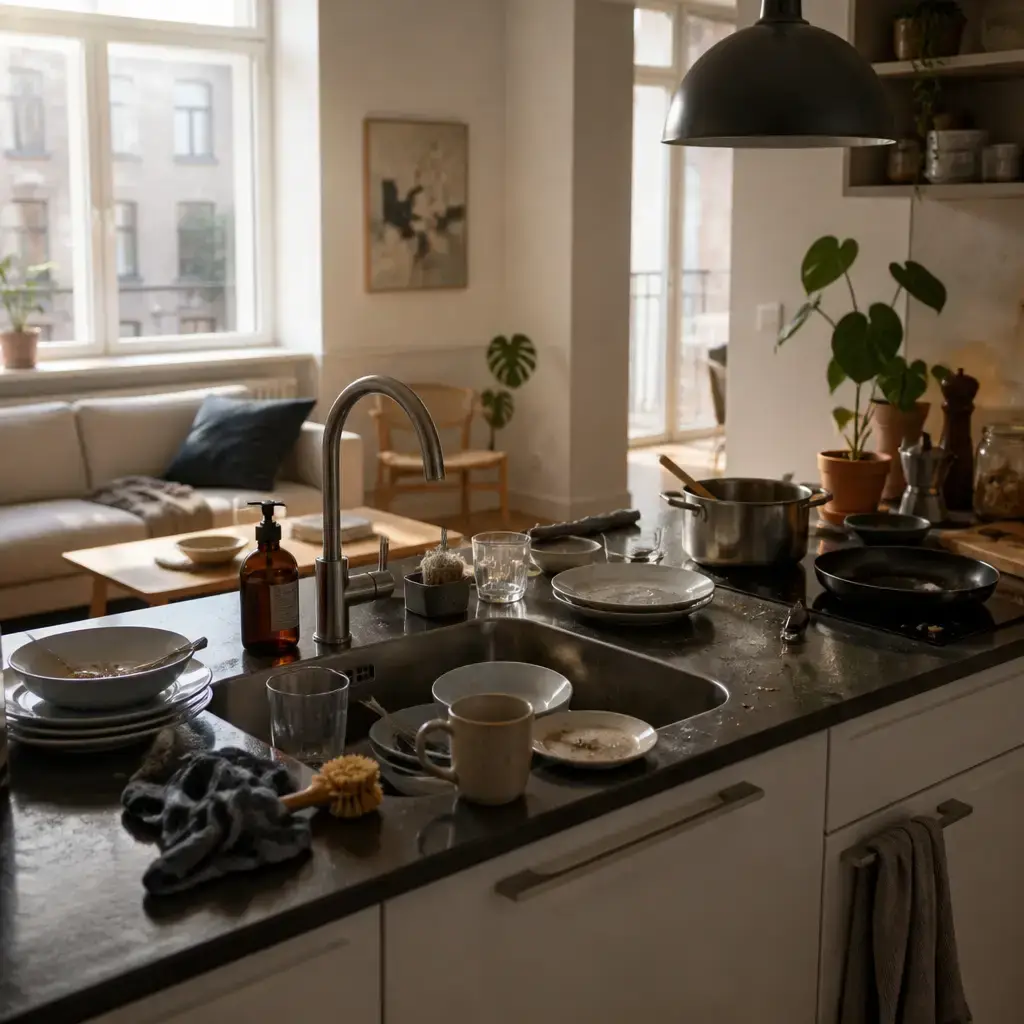
Vores rengøringsrutine fungerer ikke, og køkkenet bliver ved med at blive rodet.
VOH-uhs reng-GUR-ing-sroo-TEE-nuh foong-EH-uh IG-uh, oh KUR-guh-nuh BLEE-uh vay meh ah BLEE-uh ROH-thuh. Our cleaning routine is not working, and the kitchen keeps getting messy.Jeg tror ikke, at nogen af os gør det med vilje.
yai troh-uh IG-uh, at NOH-un ah ohs gur deh meh VIL-yuh. I do not think either of us is doing it on purpose.Måske har vi brug for en tydeligere standard, især for opvasken og komfuret.
MOH-sguh hah vee broo foh en TOO-thuh-lee-uh STAHN-dah-uh, ee-SAIR foh OB-vahs-gun oh kom-FOO-uh. Maybe we need a clearer standard, especially for dishes and the stove.Vi kunne skiftes til opgaverne hver uge, så den samme person ikke altid vasker gulv.
vee KOO-nuh SKEEF-dəs teel OB-gair-nuh vair OO-uh, soh den SAM-uh peh-SOHN IG-uh AL-dee VAS-guh goolw. We could rotate tasks weekly, so the same person does not always mop.Det lyder fair, selv om jeg foretrækker at gå ud med skraldet frem for at gøre badeværelset rent.
deh LOO-thuh fair, sel ohm yai foh-TREK-uh ah goh OO meh SKRAL-uh frem foh ah GUR-uh BAY-thuh-vair-ul-suth rehnt. That sounds fair, although I prefer taking out the trash to cleaning the bathroom.Det er fint at have præferencer, men de ubehagelige opgaver skal stadig deles.
deh air fint at hah-vuh pref-eh-REHN-suh, men dee oo-beh-HAH-guh-lee OB-gair-nuh skal STAY-thee DAY-ləs. Preferences are fine, but the unpleasant jobs still need to be shared.Hvis vi skriver det ned, kan vi undgå, at bitterheden bygger sig op senere.
ves vee SKREE-vuh deh nayth, kan vee oon-GOH, at BIT-uh-hay-thun BÜG-uh sai ohp SAY-nuh-ruh. If we write it down, we can keep resentment from building up later.Lad os lave et enkelt skema og gennemgå det, når vi har prøvet det i et stykke tid.
lah ohs LAH-vuh et ENG-kelt SKAY-mah oh GHEH-nuhm-GOH deh, nohr vee hah PROH-vuth deh ee et STOO-guh teed. Let's make a simple chart and review it after we try it for a while.Hvis det føles for strengt, kan vi justere det i stedet for at skændes.
ves deh FOH-ləs foh STREHNGT, kan vee yoo-STAY-uh deh ee STAY-thuh foh at SKEN-us. If it feels too strict, we can adjust it instead of arguing.Målet er et renere hjem, ikke et perfekt system.
MOH-luh air et RAY-nuh-ruh yem, IG-uh et peh-FEKT sew-STAYM. The goal is a cleaner home, not a perfect system.Sentence explanations
Vores rengøringsrutine fungerer ikke, og køkkenet bliver ved med at blive rodet.
Our cleaning routine is not working, and the kitchen keeps getting messy.
- Vores
- our
- rengøringsrutine
- cleaning routine
- fungerer ikke
- does not work
- køkkenet
- the kitchen
- bliver ved med at
- keeps; continues to
- blive
- become; get
- rodet
- messy
More detail
Vores means “our” and marks possession by the speaker together with at least one other person. It is a possessive form and does not change for the gender or number of the thing possessed. Example: vores bil means “our car,” while vores huse means “our houses.” rengøringsrutine is a compound noun meaning “cleaning routine”: rengøring is cleaning, and rutine is routine. Danish compounds are written as one word. Example: en fast rengøringsrutine means “a regular cleaning routine.” fungerer ikke means “does not work” here. fungerer is the present-tense form of fungere, “to work” or “to function”; ikke supplies the negation. Danish present tense does not change for the subject’s person or number: jeg fungerer, den fungerer, and de fungerer all use fungerer. køkkenet means “the kitchen.” The base noun is køkken, “kitchen,” and the ending -et marks definite singular for this neuter noun: et køkken is “a kitchen,” and køkkenet is “the kitchen.” The definite form is part of the noun form rather than a separate word. bliver ved med at is a reusable construction meaning “keeps” or “continues to.” It is followed by at and an infinitive, as in Hun bliver ved med at læse—“She keeps reading.” In this sentence, it introduces the continuing process rather than a single change. blive is the infinitive of blive, and bliver is its present-tense form. In this context, blive means “become” or “get.” The pattern blive + adjective describes entering or remaining in a state, for example blive træt, “get tired.” Here it combines with bliver ved med at to express repeatedly or continuously getting into the described state. rodet means “messy” here. It is the adjective used with køkkenet; its form is rodet in both singular common-gender and singular neuter contexts, while the plural form is rodede. Example: Værelset bliver rodet means “The room gets messy.” Together, Vores rengøringsrutine fungerer ikke says that the speakers’ cleaning routine is not working. og means “and,” and køkkenet bliver ved med at blive rodet says that the kitchen keeps getting messy. The complete utterance is therefore: “Our cleaning routine is not working, and the kitchen keeps getting messy.”
Jeg tror ikke, at nogen af os gør det med vilje.
I do not think either of us is doing it on purpose.
- Jeg tror ikke
- I do not think
- nogen af os
- either of us
- gør
- does; makes
- det
- it; that
- med vilje
- on purpose
More detail
Jeg tror ikke expresses “I do not think …”. tror is the present form of tro (“to think/believe”); the negation ikke comes after the verb here. This is a reusable pattern: Jeg tror ikke, at ... = “I do not think that ...”. For example: Jeg tror ikke, at hun kommer. — “I do not think she is coming.” nogen af os means “either of us” in this negative clause. nogen can mean “someone” or “anyone” in other contexts, but with ikke in this sentence it gives the intended “either” reading. os is the object form of vi (“we/us”), and af links the meaning to a group: “any/either one of us.” gør is the present form of gøre (“to do” or “to make”). Here it is used with det in the reusable combination gøre det, “do it.” The form gør does not show a different present-tense ending for the subject in this sentence. Example: Hvad gør du? — “What are you doing?” det is a singular neuter pronoun meaning “it” here. Its concrete referent is the action or situation being discussed, rather than a newly named object in this sentence. In gøre det, it lets the speaker refer back to that understood action without repeating it. med vilje is a fixed expression meaning “on purpose” or “intentionally.” vilje is a noun related to intention or will; the whole expression, rather than vilje alone, gives the adverbial meaning “deliberately.” It contrasts with ved et uheld (“by accident”) when that contrast is relevant. Example: Han gjorde det med vilje. — “He did it on purpose.” Together, Jeg tror ikke introduces the speaker’s negative opinion, nogen af os identifies either member of the group “us,” gør det refers to carrying out the understood action, and med vilje specifies that the action is intentional. The complete meaning is: “I do not think either of us is doing it on purpose.”
Måske har vi brug for en tydeligere standard, især for opvasken og komfuret.
Maybe we need a clearer standard, especially for dishes and the stove.
- Måske
- maybe
- har vi brug for
- need
- tydeligere
- clearer
- standard
- standard
- opvasken
- the dishes
- komfuret
- the stove
More detail
Måske means “maybe” and marks the statement as uncertain rather than definite. It can also appear later in a sentence, for example: Vi kommer måske i morgen. — “Maybe we are coming tomorrow.” har vi brug for is the reusable Danish construction for “need” or “be in need of.” Literally, it is built with har (“have”) + brug for (“need for”), but it functions as one expression. The subject is vi (“we”), and har is the present-tense form of have; Danish present tense does not change here for different subjects. For example: Jeg har brug for hjælp. — “I need help.” Because Måske comes first, har comes before the subject vi: Måske har vi .... This is the usual Danish verb-second pattern in a main clause after a fronted element. The sentence is a statement, not necessarily a question. tydeligere means “clearer” here. It is the comparative form of tydelig (“clear”): tydelig → tydeligere (“clearer”). The ending -ere marks comparison; the form describes standard, not brug or vi. For example: Denne forklaring er tydeligere. — “This explanation is clearer.” standard is a noun meaning “standard” or “criterion.” In this sentence it is the thing that is needed: a standard that is clearer than an unstated or previously understood standard. Danish nouns can have a common-gender indefinite form such as en standard; after the construction brug for, the noun phrase here is en tydeligere standard, with en marking an indefinite noun phrase rather than by itself asserting a numerical count. opvasken means “the dishes” in the fixed translation. It is the definite form of opvask, a common-gender noun referring to the dishes or dishwashing as a household task, depending on context. The ending -en marks definiteness in this form. Here for opvasken identifies one area for which the standard is especially relevant. komfuret means “the stove.” It is the definite form of komfur (“stove”): et komfur → komfuret. The ending -et marks definiteness for this neuter noun. Here it is coordinated with opvasken after for, so the standard concerns both the dishes and the stove. Putting the parts together, Måske har vi brug for en tydeligere standard says “Maybe we need a clearer standard.” især for opvasken og komfuret narrows that need to two household areas: “especially for the dishes and the stove.” The complete utterance therefore means: “Maybe we need a clearer standard, especially for dishes and the stove.”
Vi kunne skiftes til opgaverne hver uge, så den samme person ikke altid vasker gulv.
We could rotate tasks weekly, so the same person does not always mop.
- Vi kunne
- we could
- skiftes
- take turns; rotate
- opgaverne
- the tasks
- hver uge
- every week
- den samme
- the same
- person
- person
- ikke altid
- not always
- vasker
- mops; washes
- gulv
- floor
More detail
Vi kunne means “we could” here: vi is the first-person plural pronoun “we”, and kunne is the past form of kunne (“can/be able to”). With a following infinitive, this form often expresses a possible or suggested action rather than past time. Example: Vi kunne begynde nu. — “We could start now.” skiftes means “take turns” or “alternate”. It is a reciprocal verb: the participants share the action rather than one person simply replacing another. In this sentence, skiftes til opgaverne presents rotating responsibility among tasks. A reusable pattern is skiftes til at plus an infinitive, as in Vi skiftes til at lave mad. — “We take turns cooking.” opgaverne means “the tasks”. The base form is opgave (“task”); opgaver is plural, and the ending -ne marks definite plural: “the tasks”. The definite form suits a set of tasks already established by the household context. hver uge means “every week”. hver means “each/every”, and uge means “week”. This phrase gives the recurring time interval for the proposed rotation. Example: Vi mødes hver uge. — “We meet every week.” den samme means “the same”. samme identifies something as identical to the one already under discussion; it does not mean merely “a similar” one. Here it is part of the noun phrase den samme person. Example: Hun bruger den samme kop. — “She uses the same cup.” person means “person”. It is singular and indefinite here: the phrase says “the same person” without adding a separate plural ending or a numeral. The noun is the head of den samme person; den samme describes which person. ikke altid means “not always”. ikke negates the following idea, while altid means “always”. Together they state that the situation should not occur on every occasion, without claiming that it never occurs. Example: Han arbejder ikke altid hjemme. — “He does not always work at home.” vasker means “washes” and is the present-tense form of vaske (“wash”). The subject is den samme person, so this clause says that person performs the action. With gulv, the household-task meaning is naturally “mops”, even though the verb itself is the broader “wash”. Example: Hun vasker gulvet. — “She mops the floor.” gulv means “floor”. It is singular and appears without an article in the fixed expression vaske gulv, which describes the household chore in a general way. The form is not the definite gulvet (“the floor”) in this utterance. Example: Jeg skal vaske gulv. — “I have to mop the floor.” The whole utterance is assembled as Vi kunne skiftes til opgaverne (“We could rotate the tasks”) followed by så (“so”), then den samme person ikke altid vasker gulv (“the same person does not always mop”). Thus it proposes a weekly rotation intended to prevent one person from being the one who mops every time. The proposal is phrased conversationally and collaboratively through kunne.
Det lyder fair, selv om jeg foretrækker at gå ud med skraldet frem for at gøre badeværelset rent.
That sounds fair, although I prefer taking out the trash to cleaning the bathroom.
- Det lyder
- That sounds
- fair
- fair
- selv om
- although
- foretrækker
- prefer
- at gå ud med
- to take out
- skraldet
- the trash
- frem for
- rather than
- gøre
- do; make
- badeværelset
- the bathroom
- rent
- clean
More detail
Det lyder means “that sounds.” Det is a neuter singular pronoun meaning “it/that”; here, the fixed translation supports the reading “that,” referring to the proposal or idea under discussion. Lyder is the present form of lyde, “to sound”: jeg lyder = “I sound,” while det lyder = “it/that sounds.” Fair describes the proposal as fair. In this sentence it is an invariant descriptive word; it does not take a visible gender or number ending. A useful pattern is Det lyder + adjective, for example: Det lyder godt. — “That sounds good.” Selv om introduces a concession: “although/even though.” It connects the evaluation in the first part with a fact that might seem to pull in another direction. The following clause has its own subject, jeg (“I”). Foretrækker is the present form of foretrække, “to prefer.” Danish present-tense verbs do not change for person or number, so foretrækker has the same form with jeg, du, and other subjects. The construction is jeg foretrækker ... — “I prefer ...”. Danish uses foretrække A frem for B for preferring A to B. At gå ud med is an infinitive construction meaning “to take out” in this context. Gå is the infinitive of “to go,” and gå ud med literally involves going out with something, but together with household waste it means taking it out. The infinitive marker at is used before this verb phrase. For example: Jeg skal gå ud med posten. — “I have to take out the mail.” Skraldet means “the trash.” It is the definite singular form of skrald; the ending -et marks definiteness for this neuter noun. The form does not itself state how much trash there is. Skrald without the definite ending can refer to trash more generally, while skraldet refers to identified trash. Frem for means “rather than” or “instead of” when comparing two options. Here it introduces the alternative after the preferred activity. The reusable pattern is A frem for B: Jeg vælger te frem for kaffe. — “I choose tea rather than coffee.” Gøre is the infinitive of gøre, “to do” or “to make.” In gøre badeværelset rent, it is part of a result construction: “make the bathroom clean,” naturally “clean the bathroom.” Its meaning here is not the general “do” sense. Badeværelset means “the bathroom.” It is the definite singular form of the neuter noun badeværelse; the ending -et marks “the.” The noun is the object of gøre and the entity that becomes clean. Rent means “clean” here. It is the neuter singular form of the adjective ren, because it describes the neuter singular noun badeværelset. This is an adjective, not the base form of the noun: ren → rent in this agreement pattern. In gøre badeværelset rent, it appears after the object and describes the resulting state. For example: Hun gør køkkenet rent. — “She cleans the kitchen.” Together, Det lyder fair gives “That sounds fair.” Selv om jeg foretrækker ... adds “although I prefer ...”. The preferred activity is at gå ud med skraldet, “taking out the trash,” and it is compared with at gøre badeværelset rent, “cleaning the bathroom,” using frem for. The complete meaning is: “That sounds fair, although I prefer taking out the trash to cleaning the bathroom.”
Det er fint at have præferencer, men de ubehagelige opgaver skal stadig deles.
Preferences are fine, but the unpleasant jobs still need to be shared.
- Det er
- it is
- fint
- fine
- at have
- to have
- præferencer
- preferences
- men
- but
- de
- the (plural)
- ubehagelige
- unpleasant
- opgaver
- tasks
- skal
- need to
- stadig
- still
- deles
- be shared
More detail
Det er combines det (“it”) with er, the present form of være (“to be”). Here det is the anticipatory subject in “it is fine to …”; the activity introduced by at have supplies the content being evaluated. er is present tense. fint means “fine” here. It is the neuter singular form of fin: fin (common gender), fint (neuter singular), fine (plural and definite forms). The neuter form agrees with det in this construction. Example: Det er fint. — “It is fine.” at have is the infinitive “to have”: at marks the infinitive, and have is the base form of the verb. A useful pattern is Det er + adjective + at + infinitive, for example Det er godt at hvile. — “It is good to rest.” præferencer means “preferences” in this sentence. Its singular form is præference, and præferencer is the indefinite plural. Example: Jeg har flere præferencer. — “I have several preferences.” men means “but” and links the positive evaluation to a contrasting point. de is the definite plural determiner before ubehagelige opgaver, meaning “the” in this noun phrase. In other contexts, de can also be a standalone pronoun meaning “they”; its role here is determined by the following noun phrase. ubehagelige means “unpleasant.” Its base form is ubehagelig; ubehagelige is the form used with a plural or definite noun phrase. Here it describes opgaver, not the people performing them. Example: De ubehagelige opgaver tager tid. — “The unpleasant tasks take time.” opgaver means “tasks” or “jobs” here. Its singular is opgave, and opgaver is the plural. With de, the phrase de ubehagelige opgaver is definite: “the unpleasant tasks.” The noun itself does not carry a separate visible definite ending in this phrase because definiteness is expressed by the determiner and the accompanying adjective form. skal is the present form of the modal verb skulle. In this sentence it expresses a requirement or necessity, so skal + verb corresponds to “need to” or “must.” It is not merely a prediction here. Example: Opgaverne skal løses. — “The tasks need to be solved.” stadig means “still.” It indicates that the requirement remains in force despite the contrast introduced by men. deles means “be shared” here. It is the passive form of dele (“to share”): dele describes someone sharing something, while deles presents the tasks as receiving the sharing action. After the modal, deles is the infinitive form used in the passive construction. The sentence does not identify who must share the tasks. Example: Arbejdet skal deles. — “The work needs to be shared.” Together, Det er fint at have præferencer means “It is fine to have preferences.” Then men de ubehagelige opgaver skal stadig deles contrasts that permission or evaluation with an ongoing requirement: “but the unpleasant jobs still need to be shared.” The complete utterance is therefore: “Preferences are fine, but the unpleasant jobs still need to be shared.”
Hvis vi skriver det ned, kan vi undgå, at bitterheden bygger sig op senere.
If we write it down, we can keep resentment from building up later.
- Hvis
- if
- skriver det ned
- write it down
- kan vi
- we can
- undgå
- avoid
- bitterheden
- the resentment
- bygger sig op
- builds up
- senere
- later
More detail
Hvis introduces a condition: “if …”. It is reusable at the start of a conditional clause. Example: Hvis du kommer tidligt, spiser vi sammen. — “If you arrive early, we will eat together.” skriver det ned means “write it down.” skriver is the present form of skrive (“to write”), while det is a neuter singular pronoun meaning “it” here; the sentence does not identify a more specific referent. ned is a particle that contributes the “down” part of the writing-down construction. Example: Jeg skriver adressen ned. — “I write the address down.” kan vi expresses “we can.” kan is the present form of the modal verb kunne (“can, be able to”). After the initial conditional clause, the subject vi follows the modal: Hvis ..., kan vi .... A modal is followed by an infinitive without at, as in Vi kan skrive det ned. — “We can write it down.” undgå means “avoid.” It is the infinitive used after kan: kan ... undgå. The construction undgå, at ... can introduce an outcome that someone wants to prevent. Example: Vi vil undgå, at mødet bliver for langt. — “We want to avoid the meeting becoming too long.” bitterheden means “the resentment” in this sentence. It is the definite singular form of the noun bitterhed (“bitterness, resentment”): bitterhed → bitterheden. The ending -en marks definite singular for this noun. Here the fixed translation supports the sense “resentment,” rather than merely a taste-related sense of “bitterness.” bygger sig op means “builds up.” bygger is the present form of bygge (“build”), and sig is a reflexive pronoun referring back to the subject of this clause. Together with the particle op, bygge sig op describes something gradually accumulating; in the sentence, resentment is what accumulates. Example: Problemerne bygger sig op. — “The problems build up.” senere is the adverb “later,” placing the possible buildup at a later time. Example: Vi taler om det senere. — “We will talk about it later.” The full structure is Hvis ... , kan vi ...: “If [condition], we can [action].” The condition is vi skriver det ned; the possible action is avoiding at bitterheden bygger sig op senere, “the resentment building up later.” Thus the complete meaning is: “If we write it down, we can keep resentment from building up later.”
Lad os lave et enkelt skema og gennemgå det, når vi har prøvet det i et stykke tid.
Let's make a simple chart and review it after we try it for a while.
- Lad os
- let’s
- lave
- make
- enkelt
- simple
- skema
- chart
- gennemgå
- review
- det
- it
- når
- when
- har prøvet
- have tried
- et stykke tid
- a while
More detail
Lad os is the reusable Danish way to suggest a joint action: Lad os + an infinitive means “let’s …”. The infinitive comes next, but it is explained separately here. Example: Lad os vente. — “Let’s wait.” lave is the infinitive “make” here. Danish commonly uses the infinitive after Lad os; the form does not show a subject or tense by itself. Example: Vi vil lave en plan. — “We want to make a plan.” enkelt means “simple” here. It is the neuter singular form of the adjective enkel, agreeing with et skema, because skema is a neuter noun. The adjective’s base form is enkel; enkelt is not a form of the noun. Example: et enkelt svar — “a simple answer.” skema means “chart” here and can also mean a schedule or form in other contexts. Its indefinite form is et skema; a definite form is skemaet, “the chart/schedule.” The exact sense here is the thing the speakers propose to make and later review. gennemgå means “review” or “go through” something carefully. It is an infinitive, so it fits the same Lad os pattern: Lad os gennemgå planen. — “Let’s review the plan.” det is a neuter singular pronoun meaning “it” in this sentence. Its form reflects the grammatical class of the thing referred to, while the surrounding context supplies the specific referent; here it refers back to the thing being made and tried, understood through the discussion. Danish also uses den for a common-gender singular referent, but det is the form used here. når introduces a time clause and means “when.” It connects the later review with the condition that the speakers have tried the item for some time. Example: Vi taler sammen, når vi er klar. — “We talk together when we are ready.” har prøvet means “have tried.” har is the present form of have, used here as an auxiliary, and prøvet is the past participle of prøve, “try.” Together they form the perfect construction har prøvet, which presents the trying as completed before the later review. Example: Vi har prøvet metoden. — “We have tried the method.” et stykke tid is a fixed time expression meaning “a while” or “some time.” In i et stykke tid, i gives the duration: “for a while.” The expression does not specify an exact length. Example: Hun boede der i et stykke tid. — “She lived there for a while.” Together, Lad os lave et enkelt skema proposes that the speakers jointly make a simple chart. og gennemgå det adds a second coordinated action, reviewing it. når vi har prøvet det i et stykke tid places that review after the speakers have tried the item for a while. The whole utterance therefore means: “Let’s make a simple chart and review it after we try it for a while.”
Hvis det føles for strengt, kan vi justere det i stedet for at skændes.
If it feels too strict, we can adjust it instead of arguing.
- Hvis
- if
- det
- it
- føles
- feels
- for strengt
- too strict
- kan vi
- we can
- justere
- adjust
- i stedet for at
- instead of
- skændes
- argue
More detail
Hvis introduces a condition: “if.” The reusable pattern is Hvis + clause, ... for a possible condition and its consequence. Example: Hvis det regner, bliver vi hjemme. — “If it rains, we stay home.” det is the pronoun “it” here. Its grammatical form is a neuter singular pronoun, while the fixed translation leaves the exact thing referred to as simply “it”; the sentence does not require naming that referent. Danish det can also be used in other grammatical roles, so its function must be read from the sentence. føles means “feels” in this sentence. It is the s-form of føle used in the expression det føles ... (“it feels ...”); do not replace the observed form with føler. Danish verb forms do not change for the subject’s person or number in the way English feel/feels does. Example: Det føles godt. — “It feels good.” for strengt means “too strict.” for before a descriptive word can mark excess: for + adjective = “too ...”. The adjective is strengt, the neuter singular form of streng (“strict”); the -t belongs to the adjective, not to the pronoun. Compare en streng regel (“a strict rule”) with et strengt krav (“a strict requirement”). The comparative of streng is strengere (“stricter”), not strengt. kan vi gives the pattern “we can.” kan is the present form of the modal verb kunne (“can, be able to”), and it does not change here because the subject is vi (“we”). In the main clause after the opening conditional clause, Danish places the verb before the subject: kan vi .... After a modal such as kan, the next verb normally appears in the infinitive without at. justere means “adjust.” It is the infinitive after kan: kan justere = “can adjust.” The object det follows it in the sentence, so the fixed sentence says that “we” can adjust “it,” without identifying that object more specifically. i stedet for at is the construction “instead of” followed by an action. The pattern i stedet for at + infinitive contrasts one possible action with another. Example: Hun går i stedet for at køre. — “She walks instead of driving.” skændes means “argue” or “quarrel.” It is the action placed after at in i stedet for at skændes; the full construction means “instead of arguing.” This verb describes an argument or quarrel, whereas a verb such as diskutere can refer more neutrally to discussing a subject. Together, Hvis det føles for strengt means “If it feels too strict.” The main clause kan vi justere det means “we can adjust it,” and i stedet for at skændes specifies the alternative: “instead of arguing.” The complete utterance is: “If it feels too strict, we can adjust it instead of arguing.”
Målet er et renere hjem, ikke et perfekt system.
The goal is a cleaner home, not a perfect system.
- Målet
- the goal
- er
- is
- renere
- cleaner
- hjem
- home
- ikke
- not
- perfekt
- perfect
- system
- system
More detail
Målet means “the goal” here. It is the definite singular form of the neuter noun mål: et mål = “a goal,” målet = “the goal.” Danish marks definiteness on the noun itself rather than using a separate word like “the.” er is the present-tense form of være, “to be.” It connects the subject Målet with what the goal is: Målet er ... = “The goal is ...” renere means “cleaner.” It is the comparative form of ren, “clean”: ren → renere → renest (“clean,” “cleaner,” “cleanest”). A comparative can be used without naming the thing being compared when the comparison is understood from context. Example: Dette rum er renere. — “This room is cleaner.” hjem means “home.” In et hjem, it is a neuter singular noun with the indefinite article et. The phrase et renere hjem therefore means “a cleaner home”; the article belongs to hjem, while renere describes it. ikke negates the phrase that follows it. Here it rejects et perfekt system: “not a perfect system.” It does not negate the earlier goal; the sentence contrasts the desired cleaner home with what the goal is not. perfekt means “perfect” here. Before the neuter singular noun system, it appears in et perfekt system. This adjective has the same visible form in common-gender and neuter singular contexts, while a plural form is perfekte: en perfekt plan, et perfekt system, perfekte systemer. system means “system.” It is a neuter noun: et system = “a system,” systemet = “the system.” In this sentence it is indefinite because the phrase says “a perfect system,” not “the perfect system.” Together, Målet er gives “The goal is,” and et renere hjem identifies that goal as “a cleaner home.” The comma introduces a contrast: ikke et perfekt system adds “not a perfect system.” The complete meaning is “The goal is a cleaner home, not a perfect system.”
Grammar Points
blive ved med at + infinitiv
Vi bliver ved med at vaske gulv hver uge.
vee BLEE-uh vay meh at VAS-guh goolw vair OO-uh.We keep mopping the floor every week.
Use blive ved med at before an infinitive to show that an action continues.
selv om + helsætning
Selv om badeværelset er rodet, fungerer rengøringsrutinen.
sel ohm BAY-thuh-vair-ul-suh air ROH-thuh, reng-GUR-ing-sroo-TEE-nuh foong-EH-uh.Although the bathroom is messy, the cleaning routine works.
Selv om introduces a contrast or condition that does not change the main result.
Danish Vocabulary
køkkenet bliver ved med at blive rodet
rengøringsrutinen fungerer ikke
og komfuret
gør det med vilje
nogen af os gør det med vilje
skiftes til opgaverne
for opvasken
Vores rengøringsrutine fungerer ikke
køkkenet bliver ved med at blive rodet
skiftes til opgaverne
en tydeligere standard
en tydeligere standard
Quiz
Spelling
Tap the letters to spell the word.
to work; to function
Show Answer
fungerermessy; untidy
Show Answer
rodetdishes; washing-up
Show Answer
opvaskenstandard