10 minutes free every day
Continue audio lessons in the app
Word explanations appear automatically in sync with the audio.
No login required · synced translations · playback with the screen locked
Choose your learning language and open this lesson in the app.

About This Lesson
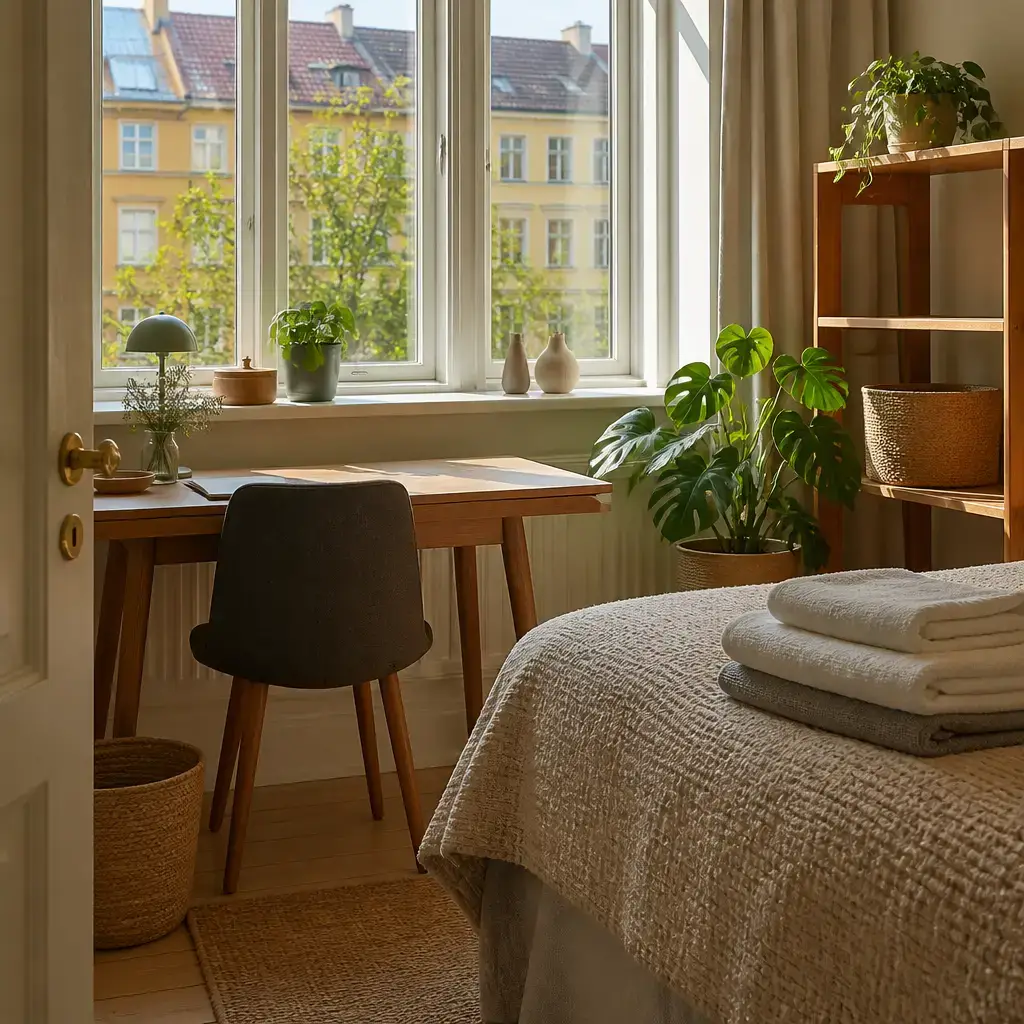
Use Preparing a Comfortable Guest Room to practice Danish conversation, pronunciation, vocabulary, grammar, and quizzes.
Dialogue
Min kusine kommer og skal bo hos os på et kort besøg.
min koo-SEE-nuh KUM-uh ow skal boh hohs ohs poh eth KORT beh-SUR My cousin is coming to stay with us for a short visit.Vi bør gøre gæsteværelset mere behageligt, før hun kommer.
vee bur KUR-uh GESS-tuh-VAIR-uh-luh more beh-HAH-uh-lee, fur hoon KUM-uh We should make the spare room more comfortable before she arrives.Lad mig rydde skrivebordet, så hun har plads til sin bærbare computer.
lath my RUR-thuh SKREE-vuh-bor-uh, soh hoon har plahs til sin BAIR-bah-ruh kom-POO-tuh Let me clear the desk so she has space for her laptop.Lad instruktionerne om internettet ligge et sted, hvor hun nemt kan finde dem.
lath in-strook-SHOWN-uh om en-tuh-NET-uth LIG-uh eth stayth, vor hoon NEMT kan FIN-uh dem Leave the internet instructions where she can find them easily.Skal vi lægge ekstra håndklæder på værelset eller vise hende skabet?
skal vee LEG-uh EKS-drah HON-kleh-uh poh VAIR-uh-luhth eller VEE-suh HEN-uh SGEH-buhth Should we put extra towels in the room, or show her the cupboard?Læg dem på værelset. Det giver gæster mere privatliv.
LEG dem poh VAIR-uh-luhth. deh GEE-vuh GESS-tuh more pree-VAHT-lee Put them in the room. It gives guests more privacy.Jeg vil gerne være en afslappet vært, ikke en, der forklarer hver eneste detalje.
yai vel YAIR-nuh VAI-uh en af-SLEH-buhth VAIRT, EG-uh en, dair for-KLAIR-uh vair EN-uh-stuh deh-TAIL-yuh I want to be a relaxed host, not someone who explains every detail.En kort besked er nok, især om nøgler, lys og morgenmad.
en KORT beh-SKAYTH air NOK, ee-SAIR-uh om NUR-gluh, loos ow MOR-un-math A short note is enough, especially for keys, lights, and breakfast.Hvis vi gør det klar på forhånd, behøver vi ikke skynde os senere.
ves vee KUR det klar poh for-HON, beh-HUR-vuh vee EG-uh SKUR-nuh sigh SAY-nuh-ruh Preparing it ahead of time would keep us from rushing later.Det får hende til at føle sig velkommen uden at gøre besøget for formelt.
deh fohr HEN-uh teel uh FUR-luh sigh vel-KOM-un OO-thun uh KUR-uh beh-SUR-uh for-MELT That will make her feel welcome without making the visit too formal.Sentence explanations
Min kusine kommer og skal bo hos os på et kort besøg.
My cousin is coming to stay with us for a short visit.
- Min
- my
- kusine
- cousin
- kommer
- is coming
- skal
- is going to
- bo
- stay
- hos os
- with us
- kort
- short
- besøg
- visit
More detail
Min means “my” here and is the possessive form used with a singular common-gender noun. Danish contrasts min with mit before a singular neuter noun and mine before plural nouns. Example: min bog means “my book,” while mit hus means “my house.” kusine means “cousin,” specifically a female cousin. Its base form is kusine; with the indefinite article, it is en kusine, and in the definite form it is kusinen. In this sentence, Min kusine is the subject: “my cousin.” kommer is the present-tense form of komme, “to come.” Danish present tense can describe an arrival that is expected or arranged in the near future, so the fixed translation naturally uses “is coming.” Example: Hun kommer i morgen. — “She is coming tomorrow.” skal is a present form of the modal verb skulle. With an infinitive, it expresses a planned, expected, or intended action; here it contributes “is going to” in skal bo. The subject is still Min kusine, not a newly introduced participant. bo means “to live” or “to stay,” and here it means “stay.” After the modal skal, it appears in the infinitive without at: skal bo, “is going to stay.” Example: Vi skal bo på et hotel. — “We are going to stay at a hotel.” hos os means “with us” in the sense of staying at our place or in our company. hos is a preposition, and os is the object form of vi, “we”: vi is used as a subject, while os is used after a preposition or as an object. The phrase does not by itself specify how many people “us” includes. kort means “short.” It is the common-gender singular indefinite form of the adjective; the neuter form is kort as well, while the definite and plural form is korte. In et kort besøg, it describes the neuter noun besøg, not the noun’s base form. Example: et kort møde — “a short meeting.” besøg means “visit.” It is a neuter noun: et besøg; its definite form is besøget. The phrase et kort besøg means “a short visit.” The indefinite article et marks the noun as indefinite and neuter; it does not by itself assert a numerical count. The sentence is assembled as Min kusine kommer (“My cousin is coming”) + og skal bo hos os (“and is going to stay with us”) + på et kort besøg (“for a short visit”). Together: “My cousin is coming to stay with us for a short visit.” This is a neutral, everyday way to describe an expected visit and accommodation.
Vi bør gøre gæsteværelset mere behageligt, før hun kommer.
We should make the spare room more comfortable before she arrives.
- Vi bør
- we should
- gøre
- make
- gæsteværelset
- the spare room
- mere behageligt
- more comfortable
- før
- before
- hun
- she
- kommer
- arrives
More detail
Vi bør means “we should” here. vi is the first-person plural subject, and bør is the present form of burde, expressing advice or obligation. Danish modal verbs such as bør are followed by an infinitive without at: Vi bør hvile means “We should rest.” gøre means “make” in the sense of causing something to have a quality. It is the infinitive of gøre; after bør, this infinitive appears directly, without at. A useful pattern is gøre + object + adjective: Hun gør rummet varmt means “She makes the room warm.” gæsteværelset means “the spare room” here. It is the definite singular form of gæsteværelse, a noun meaning “guest room”; the ending -et marks the definite form of this neuter noun. Danish often puts the definite article into the noun ending rather than using a separate word. For example, et værelse is “a room,” while værelset is “the room.” mere behageligt describes the resulting state as “more comfortable.” mere marks the comparative, while behageligt is the neuter form of behagelig in this construction, agreeing with the neuter singular object gæsteværelset. The useful comparison pattern is behagelig “comfortable,” mere behagelig or mere behageligt “more comfortable,” and mest behagelig or mest behageligt “most comfortable,” with the form depending on the adjective’s grammatical environment. For example, et behageligt værelse means “a comfortable room.” før introduces a time clause meaning “before.” In Ring, før du går, the calling happens before the leaving; thus the event in the main clause comes first, and the event named after før is the later reference point. The example means “Call before you leave.” hun is the third-person singular subject pronoun meaning “she.” In this supplied meaning, it refers to the female visitor identified by the fixed translation. Danish hun is used for a female person; its object form is hende, as in Jeg ser hende (“I see her”). kommer means “arrives” in this sentence. It is the present form of komme, “to come,” and the present tense can refer to an expected future event when the context makes that clear. kommer is used with both singular and plural subjects in the present: Hun kommer means “She is coming,” while De kommer means “They are coming.” Together, Vi bør gøre gæsteværelset mere behageligt says “We should make the spare room more comfortable.” The construction før hun kommer adds the time relation “before she arrives,” so the complete utterance means: “We should make the spare room more comfortable before she arrives.”
Lad mig rydde skrivebordet, så hun har plads til sin bærbare computer.
Let me clear the desk so she has space for her laptop.
- Lad mig
- let me
- rydde
- clear
- skrivebordet
- the desk
- så
- so that
- har
- has
- plads
- space
- sin
- her own
- bærbare
- portable
- computer
- computer
More detail
Lad mig combines the imperative lad (“let”) with mig (“me”) to make a first-person request or proposal: “let me …”. The following verb is in the infinitive, so the reusable pattern is Lad mig + infinitive. For example: Lad mig hjælpe. — “Let me help.” rydde is the infinitive “to clear” or “to tidy away.” The form after Lad mig stays infinitive; it is not marked for a separate subject here. In this sentence, the object being cleared is introduced by the next noun phrase. skrivebordet means “the desk.” It is the definite form of skrivebord (“desk”): et skrivebord is “a desk,” while skrivebordet refers to “the desk.” The ending belongs to the noun, not to rydde. så introduces the intended result or purpose here: “so that.” It connects clearing the desk with the situation that this action is meant to make possible. For example: Jeg åbner vinduet, så rummet får frisk luft. — “I open the window so that the room gets fresh air.” har is the present-tense form of have, “to have,” used here with the subject hun (“she”): hun har — “she has.” The present form har is used for all persons in the present tense; the subject identifies who has something. plads means “space” or “room,” in the sense of available physical room. Here it is what she has available for the laptop. For example: Der er plads på hylden. — “There is space on the shelf.” sin is a reflexive possessive meaning “her own” in this context. It refers back to the subject of its clause, hun, so sin bærbare computer means “her own laptop.” The choice of sin indicates that the possessor is the clause subject; it is not simply determined by the nearest noun. A non-reflexive possessive such as hendes can be used when the possessor is someone other than the subject. bærbare is the definite/attributive form of the adjective bærbar, “portable.” It describes computer: en bærbar computer is “a portable computer,” commonly “a laptop.” The adjective agrees with the noun phrase here; its form is not the noun’s base form. computer means “computer.” Together with bærbare, it forms bærbar computer, the ordinary expression for “laptop.” In sin bærbare computer, the possessive comes before the adjective and noun, and the whole phrase means “her own laptop.” As a whole, Lad mig rydde skrivebordet means “Let me clear the desk.” så hun har plads til sin bærbare computer adds the purpose/result: “so she has space for her own laptop.” The complete utterance is therefore: “Let me clear the desk so she has space for her laptop.”
Lad instruktionerne om internettet ligge et sted, hvor hun nemt kan finde dem.
Leave the internet instructions where she can find them easily.
- Lad
- leave; let
- instruktionerne
- the instructions
- internettet
- the internet
- ligge
- lie; be situated
- sted
- place
- hun
- she
- nemt
- easily
- kan
- can; be able to
- finde
- find
- dem
- them
More detail
Lad is the imperative of lade, “to let/leave.” In lad + infinitive, it tells someone to allow or arrange for something to be in a state: Lad døren stå. — “Leave the door open.” Here it introduces the request to leave the instructions in the location specified afterward. instruktionerne means “the instructions.” Its base noun is instruktion; -erne marks definite plural in Danish. The definite form presents these as identifiable instructions, rather than introducing unspecified instructions. om internettet means “about the internet.” om links the instructions to their topic. internettet is the definite form of internet, meaning “the internet” here; the ending -et marks singular definite form for this noun. ligge is the infinitive of ligge, “to lie” or “be situated.” After Lad, it describes the state the instructions should be left in: Lad bogen ligge på bordet. — “Leave the book on the table.” This is different from lægge, “to lay/put,” which describes placing something somewhere. et sted means “a place” or “somewhere.” sted is the noun “place,” and et is its indefinite singular article. The phrase does not state a numerical count; it identifies an unspecified location. With hvor, it becomes et sted, hvor ..., “a place where ...”. hvor introduces the description of that place: “where.” It connects the location with the action that can happen there. hun is the subject pronoun “she.” Danish hun is used for a female referent; the sentence and translation identify this person as the one who can find the instructions. nemt means “easily” in this sentence. It is the adverbial form used to describe how the finding can happen. The related adjective is nem, “easy”: Det er nemt. — “It is easy.” kan is a present-tense form of kunne, “can/be able to.” Danish uses kan with an infinitive to express ability or possibility: Hun kan læse det. — “She can read it.” The infinitive finde follows it. finde means “find.” It is the infinitive after kan: kan finde, “can find.” In finde dem, dem is the object pronoun “them,” referring here to instruktionerne, the instructions. Together, Lad instruktionerne om internettet ligge asks the listener to leave the internet instructions in a location rather than describing an action of putting them there. et sted, hvor hun nemt kan finde dem specifies that the location should be one where she can find them easily. The complete meaning is: “Leave the internet instructions where she can find them easily.”
Skal vi lægge ekstra håndklæder på værelset eller vise hende skabet?
Should we put extra towels in the room, or show her the cupboard?
- Skal vi
- should we
- lægge
- put; place
- ekstra
- extra
- håndklæder
- towels
- værelset
- the room
- vise
- show
- hende
- her
- skabet
- the cupboard
More detail
Skal vi combines skal with the subject pronoun vi. Here skal makes a suggestion or asks about a planned action, so the reusable question pattern is Skal vi + infinitive ...? (“Should we ...?”). vi means “we” and is the subject form; the object form is os. lægge means “put” or “place” here. It is the infinitive after skal. A useful Danish contrast is lægge for placing something somewhere and ligge for something being situated somewhere: Jeg lægger bogen på bordet means “I put the book on the table,” while Bogen ligger på bordet means “The book is on the table.” ekstra means “extra” or “additional.” It is unchanged here because it describes the quantity or addition, not a verb form. Example: Vi har ekstra tid — “We have extra time.” håndklæder is the plural of et håndklæde, “a towel.” The plural form refers to towels without stating a particular number. The definite plural is håndklæderne, “the towels.” værelset is the definite singular of et værelse, “a room”: et værelse → værelset. The ending marks one specific room in this context. Example: Gæsten er på værelset — “The guest is in the room.” eller connects the two alternatives: it means “or.” The first alternative is the action of placing the extra towels in the room; the second alternative begins with vise. vise means “show” or “display.” It is another infinitive coordinated with the first one and governed by the same skal: Skal vi vise ...? means “Should we show ...?” Example: Jeg viser dig køkkenet — “I show you the kitchen.” hende is the object form meaning “her.” It marks the person who is shown something. The corresponding subject form is hun, as in Hun viser os værelset — “She shows us the room.” The form hende does not itself identify who “her” is; that identity must come from context. skabet is the definite singular of et skab, “a cupboard” or “a cabinet”: et skab → skabet. The definite form presents one specific cupboard as the thing to be shown. Example: Jeg åbner skabet — “I open the cupboard.” Together, the utterance asks whether the speakers should carry out one of two actions: place additional towels in the room, or show the cupboard to the woman referred to by hende. The shared Skal vi applies to both alternatives, and eller presents them as the two choices.
Læg dem på værelset. Det giver gæster mere privatliv.
Put them in the room. It gives guests more privacy.
- Læg
- put
- dem
- them
- værelset
- the room
- giver
- gives
- gæster
- guests
- mere
- more
- privatliv
- privacy
More detail
Læg is the imperative of lægge, “to put/place,” used when someone is told to place something. A useful contrast is ligge, “to lie/be situated”: Læg bogen på bordet. — “Put the book on the table.” Lægge takes an object, while ligge describes the position without placing the object. dem is the plural object pronoun “them.” It comes after the imperative and identifies what is to be placed; the supplied sentence does not require a more specific referent. Danish object pronouns differ from subject pronouns: de means “they,” while dem means “them.” værelset means “the room.” Its base form is værelse; the ending -et marks the singular definite form, “the room.” Here, på værelset is the location expression translated as “in the room.” Together, Læg dem på værelset is an imperative: “Put them in the room.” The command has the pattern Læg + object + location. giver is the present-tense form of give, “to give.” The form is the same for different subjects; here, Det is the subject, so the English translation uses “it gives.” gæster means “guests.” It is the plural indefinite form of gæst, “guest”; the singular definite form is gæsten, “the guest.” Here the noun is the group receiving the benefit, expressed without a definite article. mere means “more.” It is used for a greater amount or degree; for example, Jeg vil have mere vand. means “I want more water.” It modifies the amount of privatliv here. privatliv means “privacy.” It is a mass-like abstract noun, so mere privatliv means “more privacy.” The second sentence has the pattern Det giver + recipient + mere + benefit: “It gives guests more privacy.” In the fixed utterance, Det presents the preceding situation as the source of that benefit. Taken as a whole, the two sentences say: “Put them in the room. It gives guests more privacy.” The first sentence gives the placement instruction; the second states the benefit of that arrangement.
Jeg vil gerne være en afslappet vært, ikke en, der forklarer hver eneste detalje.
I want to be a relaxed host, not someone who explains every detail.
- Jeg vil gerne
- I would like to / I want to
- være
- be
- afslappet
- relaxed
- vært
- host
- ikke en, der
- not someone who
- forklarer
- explains
- hver eneste
- every single
- detalje
- detail
More detail
Jeg vil gerne means “I would like to” here. The pattern jeg vil gerne + infinitive is a natural way to express the speaker’s wish or intention. vil is the present form of ville; gerne adds the sense of willingly or gladly. Example: Jeg vil gerne lære dansk. — “I would like to learn Danish.” være is the infinitive “to be.” It follows vil in this construction: vil være — “want/would like to be.” The infinitive form does not show the subject’s person or number here. afslappet means “relaxed” in this sentence. It is an adjective describing the speaker in the role of host. The form afslappet is used here with the singular common-gender noun vært, as in en afslappet vært — “a relaxed host.” vært means “host,” the person receiving or accommodating guests. Its definite form is værten — “the host.” The noun is part of en afslappet vært, where en introduces an unspecified singular host; it does not by itself assert a numerical count as the main point. ikke en, der introduces a contrast: “not someone who.” ikke negates the following alternative, while der introduces a relative clause referring to that unspecified person. The phrase does not identify a particular person; it describes the kind of host the speaker does not want to be. Example: Hun er ikke en, der klager. — “She is not someone who complains.” forklarer means “explains” here. It is the present-tense form of forklare, “to explain.” Danish present-tense verbs do not change for the subject’s person or number, so forklarer is not a person- or number-agreeing form; the singular interpretation comes from the person described by en, der. Example: Han forklarer reglen. — “He explains the rule.” hver eneste means “every single.” Together, these words emphasize that the speaker means each individual item, not merely details in general. hver alone means “every,” while hver eneste is stronger and more emphatic. Example: Hun læser hver eneste besked. — “She reads every single message.” detalje means “detail.” In hver eneste detalje, it is a singular noun after the distributive expression “every single”; the phrase therefore means “every single detail.” Its definite form is detaljen — “the detail,” while the plural is detaljer — “details.” Taken together, Jeg vil gerne være en afslappet vært says “I want to be a relaxed host.” ikke en, der forklarer hver eneste detalje contrasts that desired role with being someone who explains every single detail. The complete meaning is: “I want to be a relaxed host, not someone who explains every detail.”
En kort besked er nok, især om nøgler, lys og morgenmad.
A short note is enough, especially for keys, lights, and breakfast.
- kort
- short
- besked
- note; message
- er nok
- is enough
- især
- especially
- om
- for; about
- nøgler
- keys
- lys
- lights
- morgenmad
- breakfast
More detail
kort means “short” here and is the common-gender singular form agreeing with besked: en kort besked. The adjective has the same form with a neuter indefinite noun, as in et kort svar (“a short answer”), while the plural form is korte, as in korte beskeder (“short notes”). besked means “note” in this sentence. Its plural is beskeder, so en besked is “a note” and flere beskeder is “several notes.” er nok means “is enough.” er is the present form of være (“to be”), and nok supplies the idea of sufficiency. A reusable pattern is X er nok: Én sætning er nok. — “One sentence is enough.” især means “especially” and highlights the items that are particularly relevant. It does not change for number or gender. om is a preposition meaning “about” or, in this context, “for/regarding.” Here it introduces the topics the note should address: om nøgler, lys og morgenmad — “for keys, lights, and breakfast.” nøgler means “keys.” It is the plural of nøgle; the singular is en nøgle (“a key”). lys means “lights” here, as confirmed by the fixed translation. The plural of et lys (“a light”) is also lys, so this form does not show a plural ending. In other contexts, bare lys can refer to light as a mass noun, but the fixed sentence uses the plural count-noun meaning “lights.” morgenmad means “breakfast.” It is a noun for the meal. The indefinite form is morgenmad (“breakfast”), while the definite form is morgenmaden (“the breakfast”); the latter adds the definite ending -en. Together, En kort besked means “A short note,” and er nok says that this note suffices. især om then specifies the especially relevant topics, followed by the coordinated list nøgler, lys og morgenmad. The complete meaning is: “A short note is enough, especially for keys, lights, and breakfast.”
Hvis vi gør det klar på forhånd, behøver vi ikke skynde os senere.
Preparing it ahead of time would keep us from rushing later.
- Hvis
- if
- gør
- do; make
- det
- it
- klar
- ready
- på forhånd
- in advance
- behøver
- need
- ikke
- not
- skynde os
- hurry
- senere
- later
More detail
Hvis introduces a condition: “if.” The reusable pattern is Hvis + clause, ... (“If ..., ...”). This word alone does not say whether the condition has already happened. gør is a present-tense form of gøre, “do” or “make.” Here it contributes to the meaning “prepare” in the fixed chunk with det and klar. Example: Vi gør os klar. — “We get ready.” det is the object pronoun “it.” Its grammatical role is clear, but the fixed sentence does not identify exactly what “it” refers to. In this utterance, it is the thing being prepared. klar means “ready” here. Together with the surrounding words, it describes preparing the object so that it is ready. The target text uses the form klar; the reusable meaning to take from this chunk is “make it ready.” på forhånd is an adverbial expression meaning “in advance” or “ahead of time.” It places the preparation before the later situation. Example: Vi bestiller billetterne på forhånd. — “We order the tickets in advance.” behøver is the present-tense form of behøve, “need.” With ikke and an infinitive, behøver ikke ... means “do not need to ...” It expresses lack of necessity, not inability. ikke means “not.” With behøver, it forms the meaning “do not need to”; it is not simply a negation of the later action. skynde os means “hurry.” In this meaning, skynde is used with a reflexive pronoun: jeg skynder mig means “I hurry,” while vi skynder os means “we hurry.” After behøver, the infinitive construction gives vi behøver ikke skynde os — “we do not need to hurry.” senere is the adverb “later.” It places the hurrying at a later time without specifying exactly when. Example: Vi kan tale senere. — “We can talk later.” The first clause, Hvis vi gør det klar på forhånd, conveys “If we prepare it ahead of time.” The following clause, behøver vi ikke skynde os senere, conveys “we do not need to hurry later.” Because the conditional clause comes first, the main clause has the order behøver vi ..., with the finite verb before the subject. Altogether, the utterance means: “If we prepare it ahead of time, that would keep us from rushing later,” matching the fixed translation.
Det får hende til at føle sig velkommen uden at gøre besøget for formelt.
That will make her feel welcome without making the visit too formal.
- Det
- that
- får
- makes
- hende
- her
- til at føle sig
- to feel
- velkommen
- welcome
- uden at
- without
- gøre
- make
- besøget
- the visit
- for
- too
- formelt
- formal
More detail
Det is the Danish neuter singular pronoun meaning “that” here. The fixed translation identifies it as the thing or action under discussion, but does not specify exactly what that is. Danish pronouns such as det can refer to a previously mentioned situation or proposal, not only to a physical object. får is the present-tense form of få (“get,” “cause,” or “make” in this construction). The pattern få + object + til at + verb means “make someone/something do or experience something.” Danish present tense can express a result expected in the relevant situation, which is why the translation uses “will make.” hende means “her” as an object pronoun. It is the object of får, the person who is caused to feel welcome. Compare the subject form hun (“she”) with the object form hende (“her”): Hun kommer. means “She is coming,” while Jeg ser hende. means “I see her.” til at føle sig is the reusable part of the causative pattern: til at introduces the infinitive føle (“feel”), and sig is the reflexive pronoun referring back to the person who feels. Thus får hende til at føle sig ... means “makes her feel ...,” not “makes her feel herself.” A different subject or object can require a different reflexive form, for example Han får mig til at føle mig tryg. means “He makes me feel safe.” velkommen is the adjective “welcome” in the expression “feel welcome.” In this use it describes how hende feels. The form shown is the common-gender singular form; Danish adjectives can change according to the noun phrase they describe, so a neuter singular noun can instead take velkomment, as in et velkomment bidrag (“a welcome contribution”). uden at introduces an action that is not carried out: “without doing ...”. It is followed here by the infinitive rather than a finite verb. A reusable pattern is uden at + infinitive, as in Han gik uden at sige farvel. — “He left without saying goodbye.” gøre is the infinitive of “make” or “do.” Here it is the verb after uden at, and its object is besøget; it is not the causative verb governing hende. In the pattern gøre noget + adjective, it means “make something [adjective].” besøget means “the visit.” Its base noun is besøg (“visit”), and -et marks definite singular for this neuter noun: et besøg means “a visit,” while besøget means “the visit.” for means “too” before an adjective. It marks an excessive degree, so for formelt means “too formal,” not simply “formal.” formelt is the neuter singular form of the adjective formel (“formal”). It agrees with the neuter singular noun besøget: et formelt besøg. With a common-gender singular noun, the corresponding form is formel, as in en formel aftale (“a formal agreement”). Together, Det får hende til at føle sig velkommen means “That makes her feel welcome.” The following uden at gøre besøget for formelt adds the condition that this happens without making the visit excessively formal. The complete utterance therefore means: “That will make her feel welcome without making the visit too formal.”
Grammar Points
uden at + infinitiv
uden at skynde sig
OO-thun uh SKUR-nuh sighwithout hurrying
After uden at, use the infinitive form of the verb, such as skynde.
før + ledsætning
før du kommer
fur doo KUM-uhbefore you come
Før introduces a subordinate clause. The subject comes before the verb in the clause.
Danish Vocabulary
line_002
line_001
line_001
line_002
line_002
line_002
line_001
line_001
line_001
line_003
line_003
line_003
Quiz
Spelling
Tap the letters to spell the word.
visit
Show Answer
besøgcomfortable; pleasant
Show Answer
behageligtmake; do
Show Answer
gørecome