10 minutes free every day
Continue audio lessons in the app
Word explanations appear automatically in sync with the audio.
No login required · synced translations · playback with the screen locked
Choose your learning language and open this lesson in the app.

About This Lesson
Use Checking dietary needs before cooking to practice Danish conversation, pronunciation, vocabulary, grammar, and quizzes.
Dialogue
Før jeg laver aftensmad, bør jeg tjekke alles kostbegrænsninger.
fur yai LAIR-uh AF-den-smath, bur yai CHEK-uh AL-us KOST-beh-GRENZ-ning-er. Before I cook dinner, I should check everyone's dietary restrictions.Det er værd at tjekke, fordi den ene gæst undgår mælkeprodukter, og en anden ikke spiser svinekød.
deh air VAIR a CHEK-uh, for-DEE den EE-nuh GEST oon-GOR MEL-kuh-proh-DUK-ter, oh en AN-en IK-uh SPEE-suh SVEE-nuh-KURTH. It is worth checking, because one guest avoids dairy and another does not eat pork.Jeg havde planlagt at lave cremet pasta, så jeg har brug for et alternativ.
yai HAD-uh plah-LAHNGT a LAIR-uh KRAY-met PAS-dah, soh yai har BROO for et al-ter-na-TEEV. I was planning to make creamy pasta, so I need a substitute.Du kunne bruge olivenolie og grøntsager i stedet for en sauce lavet med mælk.
doo KUN-uh BROO-uh oh-LEE-ven-oh-LEE uh GRUN-sah-er ee STAY-thuh for en SOW-suh LAIR-eth meh MELK. You could use olive oil and vegetables instead of a milk-based sauce.Ville det stadig føles som et ordentligt måltid for gæsterne?
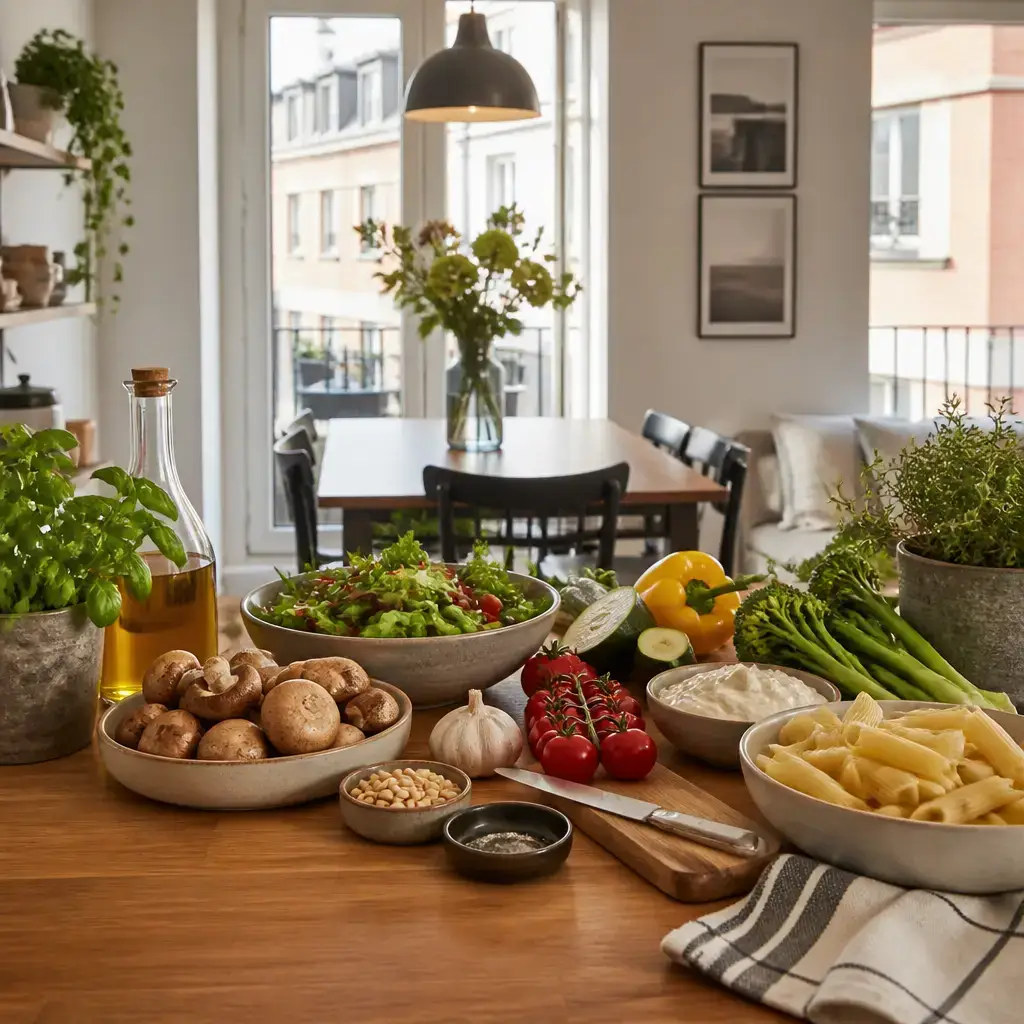
VEL-uh deh STAI-lee FURL-us som et OR-den-lee MAWL-teeth for GES-tuh-nuh? Would that still feel like a proper meal for guests?Det ville det, især hvis du tilføjer svampe og en frisk salat.
deh VEL-uh deh, ee-SAIR vis doo tel-FUR-yer SVAM-buh oh en FRESK sa-LAETH. It would, especially if you add mushrooms and a bright salad.Jeg vil sende en hurtig besked for at spørge om andre ønsker.
yai vel SEN-uh en HOOR-tee beh-SKAYTH for a SPUR-uh om AN-druh URN-sker. I will send a quick message asking about any other preferences.Hold spørgsmålet enkelt, ellers kan folk føle, at de er til besvær.
HOL SPUR-smol-et EN-kelt, EL-ers kan fohlk FURL-uh, a dee air tel beh-SVAIR. Keep the question simple, or people may feel they are causing trouble.Beskeden kan bare sige, at jeg gerne vil lave noget, der passer til alle.
beh-SKAY-den kan BAIR-uh SEE-uh, a yai YAIR-nuh vel LAIR-uh NOH-uth, dair PAS-uh tel AL-uh. The message can simply say I want to make something suitable for everyone.Det lyder hensynsfuldt og giver dem mulighed for at svare tydeligt.
deh LOO-er HEN-suns-foolt oh GEE-ver dem MOO-lee-hayth for a SVAIR-uh TOO-the-lee. That sounds considerate and gives them a chance to answer clearly.Sentence explanations
Før jeg laver aftensmad, bør jeg tjekke alles kostbegrænsninger.
Before I cook dinner, I should check everyone's dietary restrictions.
- Før
- before
- laver
- cook; make
- aftensmad
- dinner
- bør
- should; ought to
- tjekke
- check
- alles
- everyone’s; everyone’s own
- kostbegrænsninger
- dietary restrictions
More detail
Før introduces a time clause meaning that one event happens earlier than another. The reusable pattern is før + clause: Før jeg laver aftensmad means “before I cook dinner.” In this clause, jeg is the subject and laver comes after it, as is normal in this subordinate-clause pattern. Example: Ring, før du går. — “Call before you leave.” laver is the present-tense form of lave, “to make” or “to do”; with food, it means “cook/prepare.” The same form can therefore have different English translations depending on its object. Example: Jeg laver kaffe. — “I’m making coffee.” aftensmad is the noun “dinner,” literally the evening meal. It is a compound noun written as one word. Example: Vi spiser aftensmad klokken seks. — “We eat dinner at six.” bør expresses advice, obligation, or what is sensible to do; here, jeg bør means “I should.” It is a modal verb, and the following verb stays in the infinitive: bør + tjekke, without at. Because the time clause comes first, the main clause has verb–subject order: bør jeg tjekke. This is declarative word order here, not a question. Example: Du bør hvile. — “You should rest.” tjekke is the infinitive “to check.” It follows the modal bør, so bør tjekke means “should check.” The base form is also tjekke; unlike a finite present form, this infinitive does not mark the subject. alles marks possession: “everyone’s” or “belonging to everyone.” It is the possessive form associated with alle (“everyone/all”), and it comes before the noun it specifies: alles kostbegrænsninger means “everyone’s dietary restrictions.” This form identifies the people connected with the restrictions; it does not itself state a numerical count. kostbegrænsninger is the plural noun “dietary restrictions.” It is a compound of kost (“diet”) and begrænsninger (“restrictions”); the plural ending is on begrænsninger. The singular is kostbegrænsning, and the plural is kostbegrænsninger. Example: Hun har en kostbegrænsning. — “She has a dietary restriction.” Together, Før jeg laver aftensmad sets the time: the checking happens before dinner is prepared. bør jeg tjekke expresses the speaker’s recommendation or responsibility to check, and alles kostbegrænsninger specifies what should be checked—everyone’s dietary restrictions. The complete meaning is: “Before I cook dinner, I should check everyone’s dietary restrictions.”
Det er værd at tjekke, fordi den ene gæst undgår mælkeprodukter, og en anden ikke spiser svinekød.
It is worth checking, because one guest avoids dairy and another does not eat pork.
- Det er værd at
- it is worth
- tjekke
- check
- fordi
- because
- den ene
- one of them
- gæst
- guest
- undgår
- avoids
- mælkeprodukter
- dairy products
- en anden
- another one
- ikke
- not
- spiser
- eats
- svinekød
- pork
More detail
Det er værd at is a reusable Danish pattern meaning “it is worth …”. The following verb is in the infinitive: Det er værd at tjekke means that checking is worthwhile. This is an evaluation of the action, not a statement that someone has already checked. tjekke is the infinitive “to check”. Its present-tense form is tjekker: Jeg tjekker menuen. — “I check the menu.” After at in this pattern, Danish uses the infinitive form. fordi introduces the reason for the preceding statement and means “because”. It begins the explanation of why checking is worthwhile. den ene and en anden form a useful contrast: “one … and another …”. Here, with gæst, they distinguish one guest from another guest. This wording identifies at least two guests in the comparison, but it does not by itself say that there are only two guests. Den ene is the definite form “the one”, while en anden is “another one” with the common-gender form en. gæst means “guest”. Its indefinite plural is gæster, and its definite singular is gæsten. Example: En gæst kommer senere. — “A guest is coming later.” undgår is the present-tense form of undgå, “to avoid”. It means that the guest avoids dairy products here. Example: Hun undgår sukker. — “She avoids sugar.” mælkeprodukter means “dairy products”. It is a plural compound noun; the singular is et mælkeprodukt, “a dairy product”. The plural form has no article here because it refers to dairy products generally. ikke is the standard Danish negation, “not”. In en anden ikke spiser svinekød, it negates the verb phrase spiser svinekød, rather than the noun svinekød alone. spiser is the present-tense form of spise, “to eat”. Danish present-tense verbs do not change form for the subject’s person or number: jeg spiser, hun spiser, and de spiser all use spiser. Example: Jeg spiser frokost. — “I eat lunch.” svinekød means “pork”. It is a mass noun referring to pork as food, so the sentence uses it without an article. Example: Vi køber svinekød. — “We buy pork.” Together, Det er værd at tjekke says that checking is worthwhile. fordi then gives the reason: den ene gæst undgår mælkeprodukter means that one guest avoids dairy products, while en anden ikke spiser svinekød means that another guest does not eat pork. The whole utterance is therefore: “It is worth checking, because one guest avoids dairy and another does not eat pork.”
Jeg havde planlagt at lave cremet pasta, så jeg har brug for et alternativ.
I was planning to make creamy pasta, so I need a substitute.
- Jeg
- I
- havde
- had
- planlagt
- planned
- at lave
- to make
- cremet
- creamy
- pasta
- pasta
- så
- so
- jeg
- I
- har brug for
- need
- alternativ
- substitute
More detail
Jeg means “I” here. It is the first-person singular subject pronoun. Danish also has jeg in the lower-case form seen later in the sentence; capitalization here reflects its position at the start. havde is the past-tense form of have (“to have”). Together with the following participle planlagt, it forms the pluperfect: havde planlagt = “had planned.” This places the planning before the later situation described by har brug for. planlagt is the past participle of planlægge (“to plan”). In this construction, havde carries the finite tense while planlagt expresses the planned action. Example: Jeg har planlagt turen. — “I have planned the trip.” at lave means “to make.” lave is the infinitive of “to make/do,” and at marks the infinitive here. The pattern planlægge at lave ... is reusable for saying that someone planned to make something. Example: Hun planlægger at lave suppe. — “She is planning to make soup.” cremet describes the pasta as creamy. It is the adjective used here before the noun pasta; the phrase does not assert that the pasta has already been made. Example: en cremet suppe — “a creamy soup.” pasta is the noun “pasta.” In cremet pasta, it is modified by the adjective cremet. så connects the two parts with a result or consequence: “so.” The first part gives the earlier plan, and the second part states the resulting present need. jeg is again the first-person singular subject pronoun, now written in lower case because it occurs inside the sentence. It refers to the speaker, matching the earlier Jeg. har brug for is a fixed construction meaning “need” or “have a need for.” Its central verb is the present-tense form har, from have; brug is the noun “use,” and for is part of the construction. Example: Vi har brug for hjælp. — “We need help.” alternativ means “alternative” or, in this context, “substitute.” The full noun phrase is et alternativ; et is the indefinite article required with this noun in the singular, not a statement that there is a numerical count of one. Example: Vi finder et alternativ. — “We will find an alternative.” Taken together, Jeg havde planlagt at lave cremet pasta says “I had planned to make creamy pasta.” så jeg har brug for et alternativ adds the consequence: “so I need a substitute.” The complete utterance therefore means: “I was planning to make creamy pasta, so I need a substitute.”
Du kunne bruge olivenolie og grøntsager i stedet for en sauce lavet med mælk.
You could use olive oil and vegetables instead of a milk-based sauce.
- Du kunne
- you could
- bruge
- use
- olivenolie
- olive oil
- grøntsager
- vegetables
- i stedet for
- instead of
- sauce
- sauce
- lavet
- made
- mælk
- milk
More detail
Du kunne expresses the possibility or suggestion “you could” here. kunne is the past form of the Danish modal verb kunne, whose present form is kan. In this use, the past-form modal gives a tentative suggestion or possibility, so it does not necessarily refer to past time. Du is the second-person singular subject form “you.” Example: Du kunne vælge te. — “You could choose tea.” bruge is the infinitive “use.” It follows the modal kunne, so the modal carries the finite tense while the lexical verb remains in the infinitive. The pattern kunne + infinitive is reusable: Hun kunne komme senere. — “She could come later.” olivenolie means “olive oil.” It is a compound noun written as one word in Danish. In this sentence it is one of the things suggested for use. Example: Jeg køber olivenolie. — “I am buying olive oil.” grøntsager means “vegetables.” Its singular base form is grøntsag, and grøntsager is the plural form. Example: Vi spiser grøntsager. — “We eat vegetables.” i stedet for is the fixed prepositional construction “instead of.” It introduces what the suggested items would replace. Example: Hun drikker vand i stedet for juice. — “She drinks water instead of juice.” sauce means “sauce.” It is the noun naming the preparation that would be replaced in this sentence. Example: Saucen er varm. — “The sauce is hot.” lavet means “made.” It is the past participle of lave (“make”), and here it describes the sauce: en sauce lavet med mælk means “a sauce made with milk.” The phrase does not say who made it. Example: en kage lavet med æbler — “a cake made with apples.” mælk means “milk.” With med, the phrase med mælk means “with milk,” identifying an ingredient or material. Example: kaffe med mælk — “coffee with milk.” Together, Du kunne bruge gives the suggestion “you could use.” olivenolie og grøntsager names the proposed items, while i stedet for introduces what they would replace. The replaced item is en sauce lavet med mælk: a sauce made with milk. Thus the whole utterance means: “You could use olive oil and vegetables instead of a milk-based sauce.”
Ville det stadig føles som et ordentligt måltid for gæsterne?
Would that still feel like a proper meal for guests?
- Ville det
- Would that
- stadig
- still
- føles
- feel
- som
- like
- ordentligt
- proper; decent
- måltid
- meal
- gæsterne
- the guests
More detail
Ville det combines ville with the pronoun det. Here ville gives the hypothetical “would” meaning; it is the past form of vil used in this conditional-like construction. After a modal such as ville, the following verb appears without at. Det is a neuter singular pronoun meaning “that/it”; here it refers to the proposed result or arrangement under discussion, without specifying a more exact referent. Example: Ville det hjælpe? — “Would that help?” stadig means “still”. It marks the question as asking whether the relevant assessment remains true under the proposed change. føles is the form of føle used for “feel” here. The -s form is used in the impersonal construction det føles ..., “it feels ...”, and it also follows ville in this utterance: ville ... føles means “would feel”. Example: Det føles godt — “It feels good.” som introduces the comparison “like/as”. The reusable pattern is føles som + noun: Det føles som en fest — “It feels like a party.” ordentligt means “proper” or “decent” here. It is the neuter singular form of the adjective ordentlig, agreeing with et ... måltid; the adjective, not the noun, carries this form. Compare en ordentlig middag with et ordentligt måltid. måltid is the neuter noun “meal”. Its indefinite singular form appears after et: et måltid. Example: Vi spiser et måltid — “We are eating a meal.” gæsterne means “the guests”. Its base noun is gæst (“guest”); gæster is plural, and gæsterne is the definite plural form. Example: Gæsterne kommer snart — “The guests are coming soon.” Together, Ville det stadig føles som et ordentligt måltid for gæsterne? asks whether the proposed result would still feel like a proper meal for the guests. for gæsterne identifies the guests as the people for whom that assessment is relevant, while ville ... føles supplies the hypothetical “would feel” framing.
Det ville det, især hvis du tilføjer svampe og en frisk salat.
It would, especially if you add mushrooms and a bright salad.
- Det ville det
- It would
- især
- especially
- hvis
- if
- tilføjer
- add
- svampe
- mushrooms
- frisk
- fresh; bright
- salat
- salad
More detail
Det ville det is a compact affirmative response meaning “It would.” The two occurrences of det work together in this fixed response pattern: the first is the subject, while the second refers back to the situation being asked about. ville is the past-tense form of vil; in this construction it expresses the conditional idea “would,” rather than simply past time. A reusable pattern is Det ville det = “It would.” især means “especially” and highlights the condition that follows. It does not itself express the condition; it adds emphasis to hvis-clause information. hvis introduces a condition and commonly corresponds to “if.” For example: Hvis du kommer, spiser vi. — “If you come, we will eat.” tilføjer means “add” here. Its base form is tilføje, and tilføjer is a present-tense form. Danish present-tense verbs generally do not change for the subject’s person or number, so the same form can occur with different subjects. In the hvis-clause, it describes the possible addition. svampe means “mushrooms.” It is the plural form of svamp (“mushroom”); the ending marks more than one mushroom. For one item, use en svamp; for more than one, svampe. frisk describes salat here and is translated in the fixed translation as “bright.” Its basic meaning is “fresh,” with the context giving the salad a fresh or lively quality. The adjective is in the common-gender singular form used with en salat. Relevant forms include frisk with a common-gender singular noun, friskt with a neuter singular noun, and friske in plural or definite contexts. salat means “salad.” In en frisk salat, en marks an indefinite singular noun phrase; it does not by itself assert a numerical count as a separate point. The adjective comes before the noun and agrees with the noun phrase in the form required here. Together, især hvis du tilføjer svampe og en frisk salat means “especially if you add mushrooms and a bright salad.” The conjunction og joins the two things being added: svampe and en frisk salat. With the opening response, the whole utterance means: “It would, especially if you add mushrooms and a bright salad.”
Jeg vil sende en hurtig besked for at spørge om andre ønsker.
I will send a quick message asking about any other preferences.
- Jeg vil
- I will
- sende
- send
- hurtig
- quick
- besked
- message
- for at
- in order to
- spørge
- ask
- om
- about
- andre
- other
- ønsker
- preferences
More detail
Jeg vil expresses the speaker’s intention: “I will.” Jeg is the first-person singular pronoun “I”; vil is the present form of ville and is followed here by an infinitive. In this sentence, the fixed translation supports an intended future action, not a standalone meaning of “want.” Example: Jeg vil ringe. — “I will call.” sende means “to send.” It is the infinitive selected after vil, so the form does not show a separate present or past tense. Example: Vi vil sende en e-mail. — “We will send an email.” hurtig means “quick” here and describes besked. It is the singular common-gender form; Danish adjectives also have neuter singular and plural forms in other contexts, such as et hurtigt svar (“a quick answer”) and hurtige svar (“quick answers”). besked means “message.” It is a common-gender singular noun; its indefinite plural is beskeder. Example: Jeg sender en besked. — “I am sending a message.” for at introduces purpose: “in order to.” The verb after this construction is an infinitive. Example: Hun ringer for at spørge. — “She calls in order to ask.” spørge means “to ask.” Here it is the infinitive after for at, and it states the purpose of sending the message. Example: De skriver for at spørge om prisen. — “They write to ask about the price.” om means “about” in this construction. It introduces the topic being asked about; here it does not mean “if/whether.” andre means “other” and modifies the plural noun ønsker. In plural noun phrases, the adjective form is andre; the singular forms are anden with a common-gender noun and andet with a neuter noun. Example: andre muligheder — “other possibilities.” ønsker means “preferences” here. It is the plural indefinite form of the noun ønske (“wish” or “preference”), not the verb form in this sentence. The noun’s plural is formed with -r: et ønske, ønsker. Example: Vi samler alles ønsker. — “We collect everyone’s preferences.” Together, Jeg vil sende gives the intended action, en hurtig besked identifies what will be sent, and for at spørge om andre ønsker gives its purpose and topic. The whole utterance therefore means: “I will send a quick message asking about any other preferences.”
Hold spørgsmålet enkelt, ellers kan folk føle, at de er til besvær.
Keep the question simple, or people may feel they are causing trouble.
- Hold
- keep
- spørgsmålet
- the question
- enkelt
- simple
- ellers
- otherwise; or else
- kan
- may; can
- folk
- people
- føle
- feel
- er til besvær
- be causing trouble
More detail
Hold is the imperative of holde (“to keep/hold”). The imperative addresses the listener directly and has no visible subject: Hold ... = “Keep ...”. spørgsmålet means “the question” here. It is the definite singular form of et spørgsmål (“a question”): et spørgsmål → spørgsmålet. The ending -et marks this noun as common? No: here it is the form used with a neuter noun. Example: Jeg stiller et spørgsmål. — “I ask a question.” enkelt describes spørgsmålet as “simple”. Its form is the neuter singular form of the adjective enkel: en enkel løsning, et enkelt spørgsmål. The adjective agrees with the noun; enkelt is not a form of the noun. ellers links the two parts with the meaning “otherwise” or “or else”. It introduces the possible consequence of not keeping the question simple. kan is the modal verb kunne in the present tense. Here it expresses possibility: “may/can”. A modal verb is followed by an infinitive without at, so kan føle means “may feel”. folk means “people”. It is a plural noun and is the subject of the second clause. The form is not changed here to mark definiteness; Danish commonly uses folk for people in general. føle is the infinitive “feel”. With kan, it remains in the infinitive: folk kan føle = “people may feel”. Example: Hun kan føle sig træt. — “She may feel tired.” er til besvær is a fixed expression meaning “are causing trouble” or “are being a nuisance” in this context. er is the present form of være (“to be”), and til besvær completes the expression; it is not a literal instruction that the people should do something troublesome. de means “they” here and refers to the people introduced by folk. er is plural-compatible in this present-tense form, so the clause is de er til besvær — “they are causing trouble.” The whole utterance is assembled as Hold spørgsmålet enkelt (“Keep the question simple”) + ellers (“otherwise/or else”) + kan folk føle (“people may feel”) + at de er til besvær (“that they are causing trouble”). Thus it means: “Keep the question simple, or people may feel they are causing trouble.”
Beskeden kan bare sige, at jeg gerne vil lave noget, der passer til alle.
The message can simply say I want to make something suitable for everyone.
- Beskeden
- the message
- kan bare
- can simply
- sige
- say
- jeg gerne vil
- I would like to
- lave
- make
- noget
- something
- passer
- fits; is suitable
- alle
- everyone
More detail
Beskeden means “the message.” It is the definite singular form of besked (“message”): en besked is “a message,” while beskeden is “the message.” The ending -en marks definiteness for this common-gender noun. kan bare combines kan, the present form of kunne (“can”), with the adverb bare (“simply/just”). Together here they make the suggestion less elaborate: the message can simply say something. kan is followed by an infinitive, so the next verb is sige, not a finite form. sige means “say” and is the infinitive used after kan. A reusable pattern is kan + infinitive: Hun kan komme means “She can come.” jeg gerne vil expresses “I would like to” here. vil is the present form of ville (“want to”); gerne adds the sense of willing or pleased desire and makes the expression natural for “would like to.” The subject is jeg (“I”), and vil is followed by an infinitive. For example, Jeg vil læse means “I want to read,” while Jeg vil gerne læse means “I would like to read.” lave means “make” in this sentence and is the infinitive after vil. It can also mean “do” in other contexts, so its exact English equivalent depends on what follows. Here, the following noget supports the meaning “make something.” noget means “something.” It is an indefinite pronoun rather than a specific named object. For example, Jeg vil købe noget means “I want to buy something.” passer means “is suitable” here. It is the present form of passe (“fit; be suitable”), and the relative clause der passer til alle describes noget: “that is suitable for everyone.” In a physical context, passer can also mean “fits,” as in Skoen passer (“The shoe fits”). alle means “everyone” in this context. With til, the phrase til alle means “for everyone.” The form alle can also mean “all” when it refers to a group, but here the translation identifies a group of people viewed collectively. The structure is Beskeden kan bare sige (“The message can simply say”) followed by at jeg gerne vil lave noget (“that I would like to make something”). The relative clause der passer til alle then specifies what kind of thing it is: something suitable for everyone. Together, the utterance means: “The message can simply say I want to make something suitable for everyone.”
Det lyder hensynsfuldt og giver dem mulighed for at svare tydeligt.
That sounds considerate and gives them a chance to answer clearly.
- Det
- that
- lyder
- sounds
- hensynsfuldt
- considerate
- giver
- gives
- dem
- them
- mulighed
- chance
- for at
- to
- svare
- answer
- tydeligt
- clearly
More detail
Det means “that” here and refers to the situation or proposal understood from context. In Danish, det is also the neuter singular form used for a neuter referent; the fixed translation identifies its intended meaning here. It is the subject of both coordinated verbs. lyder is the present-tense form of lyde, “to sound.” The pattern det lyder + adjective describes how something seems or comes across: Det lyder godt. means “That sounds good.” hensynsfuldt means “considerate” here. Its base form is hensynsfuld; the -t form agrees with neuter singular det. With a common-gender singular noun, the adjective would normally be hensynsfuld, as in the example En hensynsfuld besked — “A considerate message.” giver is the present-tense form of give, “to give.” Here the subject det gives someone an opportunity, so Danish uses the reusable pattern give nogen mulighed for at + infinitive: “give someone the opportunity to + verb.” dem means “them.” It is the object form of the third-person plural pronoun and does not mark the gender of the people referred to. In giver dem, it identifies the recipients of the opportunity. mulighed means “opportunity” or “chance.” The construction mulighed for at is followed by an infinitive and names what the opportunity is for. Example: Hun får mulighed for at vælge. — “She gets an opportunity to choose.” for at introduces the purpose or action connected with the opportunity. In this sentence, for at svare means “to answer”; the following verb remains in the infinitive. svare is the infinitive form of svare, “to answer” or “to reply.” After for at, Danish uses this infinitive form: for at lære means “to learn,” and for at hjælpe means “to help.” tydeligt means “clearly” here. It is the adverb related to tydelig, “clear,” and describes how they answer. It is not the adjective modifying dem; it modifies the action svare. Together, Det lyder hensynsfuldt means “That sounds considerate.” The coordinated verb giver then adds a second result with the same subject: det giver dem mulighed for at svare tydeligt, “it gives them an opportunity to answer clearly.” The complete utterance is therefore: “That sounds considerate and gives them a chance to answer clearly.”
Grammar Points
værd at + infinitiv
Det er værd at tjekke.
deh air VAIR a CHEK-uh.It is worth checking.
Efter værd at står verbet i infinitiv. Udtrykket svarer til “worth doing” på engelsk.
alles + substantiv
alles ønsker
AL-us URN-skereveryone's wishes
Alles står foran substantivet og betyder “everyone's”. Dansk bruger ikke apostrof-s som engelsk.
Danish Vocabulary
Quiz
Spelling
Tap the letters to spell the word.
to check
Show Answer
tjekkeguest
Show Answer
gæstpork
Show Answer
svinekødavoids