10 minutes free every day
Continue audio lessons in the app
Word explanations appear automatically in sync with the audio.
No login required · synced translations · playback with the screen locked
Choose your learning language and open this lesson in the app.

About This Lesson
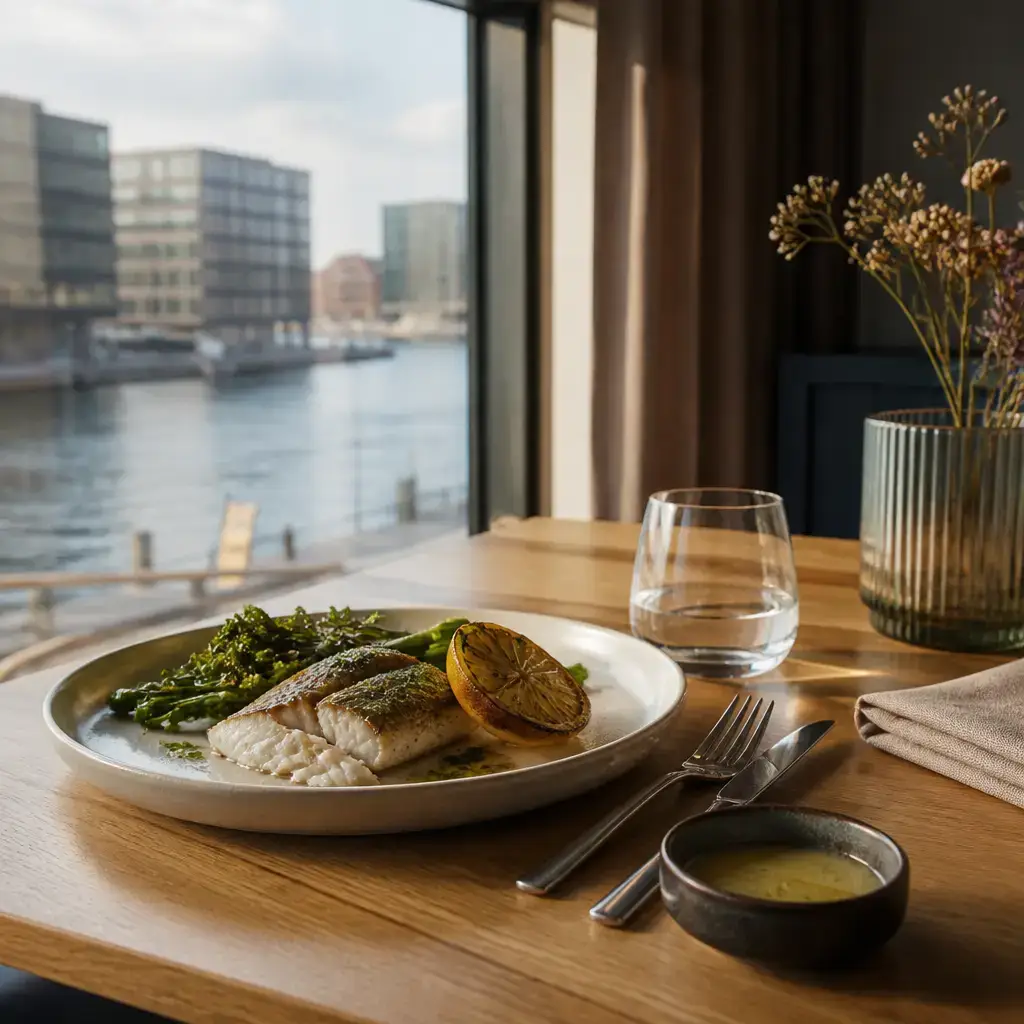
Use Politely discussing a disappointing fish dish to practice Danish conversation, pronunciation, vocabulary, grammar, and quizzes.
Dialogue
Undskyld, må jeg spørge om fisken? Den er lidt tør.
oon-SGILL, moh yai SPUR-uh om FESS-gun? den air lit tur. Excuse me, could I ask about the fish? It is a bit dry.Det er jeg ked af. Jeg tjekker det med køkkenet.
deh air yai KAY ahf. yai CHEK-er deh meh KUR-gun-uh. I'm sorry about that. I'll check with the kitchen.Smagen er god, men konsistensen er ikke, som jeg havde forventet.
SMEH-un air goh, men kon-sis-DEN-sun air IK-uh, som yai HAY-uh for-VEN-duh. The flavor is nice, but the texture is not what I expected.Lidt sauce ved siden af kunne måske hjælpe.
lit SOW-suh veh SEE-thun ahf KOO-nuh MOS-guh YELP-uh. A little sauce on the side might help.Vil du have, at jeg kommer med noget?
veel doo HAY-vuh, ad yai KOM-uh meh NOH-uh? Would you like me to bring some?Det ville hjælpe, så længe den ikke er for tung.
deh VEL-uh YELP-uh, soh LENG-uh den EG-uh air for TOONG. That would help, as long as it is not too heavy.Jeg kan komme med en lille skål sauce og give køkkenet besked.
yai kan KOM-uh meh en LIL-uh SKOHL SOW-suh oh GEE-vuh KUR-gun-uh beh-SGAYTH. I can bring a small dish of sauce and let the kitchen know.Jeg ville gerne nævne det, før jeg spiste mere af den.
yai VEL-uh GAIR-nuh NEV-nuh deh, fur yai SBEH-stuh MAY-uh ahf den. I wanted to mention it before I ate more of it.Sig endelig til, hvis den stadig er tør, efter du har prøvet saucen.
say EN-uh-lee til, vis den STAY-thee air tur, EF-ter doo har PRUR-vuh SOW-sun. Please tell me if it is still dry after you try the sauce.Vi kan finde en anden løsning.
vee kan FEN-uh en AN-un LURSS-ning. We can find another solution.Sentence explanations
Undskyld, må jeg spørge om fisken? Den er lidt tør.
Excuse me, could I ask about the fish? It is a bit dry.
- Undskyld
- Excuse me
- må jeg
- may I
- spørge om
- ask about
- fisken
- the fish
- Den
- it
- lidt
- a little
- tør
- dry
More detail
Undskyld is a polite way to get attention, meaning “excuse me” here. It can also mean “sorry” in other situations. The form is related to the verb undskylde; as an independent polite expression, it does not identify who is being addressed. må jeg combines the modal verb må with the subject pronoun jeg. Together here, it makes a polite request for permission: “may I…?” Må can also express permission or obligation in other contexts, so the following situation helps establish the intended request. Jeg means “I” and is the first-person singular pronoun. Example: Må jeg komme ind? — “May I come in?” spørge om means “ask about.” After the modal må, spørge is the infinitive form of spørge (“ask”), without an infinitive marker. The preposition om introduces the topic being asked about. This is different from simply asking a person: Jeg spørger ham. — “I ask him.” fisken means “the fish” in this utterance. Its base noun is fisk; fisken is the singular definite form, formed with the ending -en. Danish commonly marks definiteness on the noun itself rather than with a separate word. Example: Fisken er varm. — “The fish is hot.” Den is a third-person singular pronoun referring here to the fish. It is the common-gender singular form; Danish uses det for a neuter-gender singular referent. In this sentence, Den is the subject of the next sentence and is not a translation of an English-style generic “it” in all contexts; its form follows the grammatical gender of the referent. lidt means “a little” and softens the description. It is an adverb here, modifying tør, so it does not mark the fish's gender or number. Example: Kaffen er lidt varm. — “The coffee is a little hot.” tør means “dry” here, describing the fish. Its base form is tør. In this use it is the common-gender singular form; the neuter singular form is tørt, and the plural or definite form is tørre. Example: Brødet er tørt. — “The bread is dry.” Together, Undskyld politely gets the listener's attention. må jeg spørge om fisken? asks permission to raise the fish as a topic, and Den er lidt tør. then states that the fish is somewhat dry. The complete meaning is: “Excuse me, could I ask about the fish? It is a bit dry.” This is a polite way to report a mild problem while asking about it.
Det er jeg ked af. Jeg tjekker det med køkkenet.
I'm sorry about that. I'll check with the kitchen.
- Det er jeg ked af
- I'm sorry about that
- tjekker
- check
- det
- it/that
- køkkenet
- the kitchen
More detail
Det er jeg ked af is a fixed Danish way to apologize for a stated matter: “I’m sorry about that.” ked af is the adjective expression meaning “sorry” or “regretful”; af belongs to this expression. The word order places det (“that/it”) first, followed by er (“is/am”) and jeg (“I”), which is a normal Danish main-clause pattern when an element comes first. Example: Det er jeg ked af. — “I’m sorry about that.” tjekker is the present-tense form of tjekke, “to check.” Danish present tense can describe a planned near-future action, so Jeg tjekker ... can mean “I’ll check ...” in this context. Example: Jeg tjekker menuen. — “I’ll check the menu.” det is a neuter singular pronoun functioning here as the object of tjekker; it refers to the matter already under discussion and is rendered as “it” or “that.” Example: Jeg tjekker det. — “I’ll check it.” køkkenet means “the kitchen.” Its base form is køkken, “kitchen”; the ending -et marks the singular definite form, “the kitchen.” With med (“with”), med køkkenet means “with the kitchen,” as in the fixed translation. Example: Jeg taler med køkkenet. — “I’m speaking with the kitchen.” Together, Det er jeg ked af apologizes about the matter just mentioned. Jeg tjekker det med køkkenet then says that the speaker will check that matter with the kitchen. The full utterance is therefore: “I’m sorry about that. I’ll check with the kitchen.”
Smagen er god, men konsistensen er ikke, som jeg havde forventet.
The flavor is nice, but the texture is not what I expected.
- Smagen
- the flavor
- god
- good; nice
- konsistensen
- the texture
- er ikke
- is not
- forventet
- expected
More detail
Smagen means “the flavor” here. It is the definite singular form of smag (“flavor, taste”): the ending -en marks the common-gender definite form. Danish definite forms are often built on the noun itself, as in smag → smagen. god means “good” or “nice” here. It is the form of the adjective used with a common-gender singular noun such as smagen. A useful contrast is god with a common-gender noun and godt with a neuter noun; the choice depends on the noun’s grammatical gender, not simply on whether the noun is singular. konsistensen means “the texture” here. It is the definite singular form of konsistens (“consistency, texture”), again with -en marking a common-gender noun in the definite form. The definite form presents the texture as a specific one being discussed. er ikke means “is not.” er is the present form of være (“to be”), and ikke supplies the negation. For example, Maden er ikke varm means “The food is not hot.” The following words complete what is being denied in this sentence. forventet means “expected” here. It is the past participle of forvente (“to expect”), used in the clause som jeg havde forventet (“as I had expected”). The auxiliary havde plus forventet forms a past-perfect construction: the expectation is placed before the relevant comparison point. The participle forventet itself does not identify the person; jeg is the subject of the clause. Together, Smagen er god means “The flavor is nice.” men means “but,” introducing a contrast. konsistensen er ikke, som jeg havde forventet means “the texture is not what I expected,” literally describing it as not being in the way that I had expected. The complete utterance therefore says: “The flavor is nice, but the texture is not what I expected.”
Lidt sauce ved siden af kunne måske hjælpe.
A little sauce on the side might help.
- Lidt
- a little
- sauce
- sauce
- ved siden af
- on the side
- kunne
- could; might
- måske
- maybe
- hjælpe
- help
More detail
Lidt means “a little” here. It is used with an uncountable substance or mass, such as sauce, to indicate a small amount without specifying an exact quantity. A useful contrast is lidt “a little” versus meget “a lot/much.” Example: Jeg vil have lidt vand. — “I would like a little water.” sauce is the noun “sauce.” In this sentence it refers to the suggested substance, and lidt sauce forms a noun phrase meaning “a little sauce.” The noun itself is not marked for a special plural or gender distinction in this phrase. ved siden af is a reusable prepositional expression meaning “on the side” or “beside.” With food, it commonly indicates something served separately rather than mixed into the main item. Example: Risene kommer ved siden af. — “The rice comes on the side.” kunne is the form of the Danish modal verb kunne corresponding here to “could” or “might.” Although kunne is also related to the past form of kan (“can”), its function in this sentence is to express a possible result in a softened way, not a past event. After a modal verb, Danish normally uses the following verb in its infinitive form without at. måske means “maybe” and adds explicit uncertainty. Together, kunne måske presents the suggestion as a possibility rather than a definite promise or prediction. Example: Det kunne måske virke. — “That might work.” hjælpe is the infinitive “help.” Its base form is also hjælpe; here it follows the modal kunne, so there is no at before it. Example: Det kan hjælpe. — “It can help.” Together, Lidt sauce identifies a small amount of sauce, ved siden af specifies that it should be on the side, and kunne måske hjælpe says that this possibility might help. The complete meaning is: “A little sauce on the side might help.”
Vil du have, at jeg kommer med noget?
Would you like me to bring some?
- Vil du have
- would you like
- kommer med
- bring
- noget
- some; something
More detail
Vil du have is the Danish pattern for asking whether someone would like or want something. vil is the present form of ville; in this question it expresses the person's wish, not simply a future event. du is the second-person singular pronoun, and have is the infinitive after vil. A reusable pattern is Vil du have, at ...? = “Would you like ... to ...?” kommer med means “bring” here. The verb is kommer, the present form of komme, but after at it is used in a subordinate clause with the subject jeg (“I”). The combination komme med commonly means to bring something along; med contributes the idea of bringing it with oneself. Example: Jeg kommer med brød. — “I’ll bring bread.” noget is an indefinite pronoun meaning “something” or, in this translation, “some.” It refers to an unspecified thing rather than naming what it is. The form is also used in questions and statements when the exact thing is left open. Example: Vil du have noget? — “Would you like something?” Together, Vil du have, at jeg kommer med noget? asks whether the other person would like the speaker to bring some unspecified thing. The first part asks about the other person's preference; at jeg kommer med noget states what action is being proposed.
Det ville hjælpe, så længe den ikke er for tung.
That would help, as long as it is not too heavy.
- Det
- that; it
- ville
- would
- hjælpe
- help
- så længe
- as long as
- den
- it
- ikke
- not
- for
- too
- tung
- heavy
More detail
Det is a neuter singular pronoun meaning “that” or “it.” Here, as in the fixed translation, it expresses what would help, without the sentence itself specifying a more exact noun. Danish also uses det in other patterns, including impersonal expressions, so its exact referent or function depends on context. ville is the form of vil used here to express “would.” It is followed by the infinitive hjælpe: ville hjælpe = “would help.” Compare vil hjælpe = “will/wants to help” in an appropriate context; the change in ville gives this utterance conditional or hypothetical force rather than simply marking past time. Hjælpe is the infinitive “to help.” After modal verbs such as ville, Danish normally uses the infinitive without an English-style “to.” Example: Det vil hjælpe. = “That will help.” Så længe is a conjunction meaning “as long as.” It introduces a condition: the first part is presented as helpful only under the condition in the following clause. Example: Du kan blive, så længe du er stille. = “You can stay as long as you are quiet.” Den is a common-gender singular pronoun meaning “it” here. Its form marks its grammatical class and number; it is not interchangeable with neuter singular det in this pronoun use. The supplied texts do not uniquely identify what den refers to, so this explanation does not assign it to a particular nearby noun. Danish den can also function as a demonstrative before a noun, but that is not its role here. Ikke is the ordinary Danish negation “not.” In this clause it negates the adjective phrase for tung, producing the condition “is not too heavy.” For means “too” before an adjective when a quality exceeds an acceptable degree. It differs from meget, “very”: meget tung means “very heavy,” while for tung means “too heavy,” that is, heavier than acceptable for the relevant purpose. Tung is the common-gender singular form of the adjective meaning “heavy.” Its useful form chain is tung (common singular), tungt (neuter singular), and tunge (plural and definite forms in relevant uses). Here tung agrees with the common-gender singular pronoun den; it is not the form of the pronoun itself. Example: Tasken er for tung. = “The bag is too heavy.” Together, Det ville hjælpe means “That would help.” så længe den ikke er for tung adds the condition “as long as it is not too heavy”: den is the subject of er, and ikke for tung says that this subject must not exceed the acceptable weight. The complete utterance therefore means, “That would help, as long as it is not too heavy.”
Jeg kan komme med en lille skål sauce og give køkkenet besked.
I can bring a small dish of sauce and let the kitchen know.
- Jeg kan
- I can
- komme med
- bring
- lille
- small
- skål
- dish
- sauce
- sauce
- give
- give
- køkkenet
- the kitchen
- besked
- message
More detail
Jeg kan means “I can” here. kan is the present form of kunne, expressing ability or possibility. A modal such as kan is followed by an infinitive: Jeg kan komme = “I can come.” komme med is a reusable verb construction meaning “bring” in this sentence. The verb is komme; med adds the sense of coming while carrying or accompanying something. Example: Hun kommer med kaffe. — “She is bringing coffee.” lille describes the size of skål. Its base form is lille; a useful comparison is mindre (“smaller”), with mindst (“smallest”). The form here is the attributive form used before the noun. skål means “bowl” or, as in the fixed translation, “dish.” It is the container being brought. Example: En skål står på bordet. — “A bowl is on the table.” sauce means “sauce.” It is the substance contained in the dish. The word can also appear with the definite ending: saucen means “the sauce.” after og, give is another infinitive coordinated with komme: kan komme ... og give .... The modal kan therefore applies to both actions. The verb give normally means “give,” but in the construction give ... besked it participates in the meaning “notify” or “let ... know.” køkkenet means “the kitchen.” It is the definite singular form of køkken (“kitchen”): et køkken = “a kitchen,” køkkenet = “the kitchen.” Here it is the recipient of the information in the notification construction. besked means “message” or “notice.” Together with give in give køkkenet besked, it forms a common construction meaning “let the kitchen know.” The construction does not need to be understood as physically handing over a message. The utterance combines Jeg kan komme med (“I can bring”), en lille skål sauce (“a small dish of sauce”), and give køkkenet besked (“let the kitchen know”). The coordinated infinitives show two actions covered by kan: bringing the dish and notifying the kitchen. Thus the whole meaning is: “I can bring a small dish of sauce and let the kitchen know.”
Jeg ville gerne nævne det, før jeg spiste mere af den.
I wanted to mention it before I ate more of it.
- Jeg ville gerne
- I wanted to
- nævne
- mention
- det
- it
- før
- before
- jeg
- I
- spiste
- ate
- mere
- more
- af
- of
- den
- it
More detail
Jeg ville gerne is a reusable way to express a past wish or desire; with the fixed translation, it means “I wanted to” here. ville is the past form of vil (“want/will”), and gerne marks the desired or willing character of the action. In other contexts, Jeg ville gerne spørge. can mean “I would like to ask” or “I wanted to ask,” depending on the time frame. nævne means “to mention.” It is an infinitive after ville gerne; Danish infinitives commonly follow modal verbs such as vil, ville, and kan without a separate English-style “to” word. Example: Jeg vil nævne en detalje. — “I want to mention a detail.” det is a singular neuter pronoun meaning “it” here. Its specific referent is not identified by the fixed sentence, so the reusable point is its grammatical form: det is used for a neuter singular referent, while den is used for a common-gender singular referent. In this sentence, det is the object of nævne. før means “before.” Here it introduces the event that occurs later than the main-clause event in the time sequence. A useful pattern is før + subject + verb. Example: Ring, før du går. — “Call before you leave.” jeg means “I.” It is the first-person singular subject pronoun. Danish uses this form for the speaker with both present- and past-tense verbs. spiste means “ate” here. It is the past-tense form of spise (“eat”). This form does not show a separate first-person ending: jeg spiste means “I ate,” while de spiste means “they ate”; the subject identifies the person and number. Example: Jeg spiste tidligt. — “I ate early.” mere means “more.” It is the comparative form associated with meget (“much/a lot”): meget → mere → mest (“most”). Here it expresses a greater amount eaten, not the type or size of a noun. af means “of” in the quantity expression mere af ..., meaning “more of ...”. This pattern is useful for requesting or describing an additional amount of an already identified substance or thing: mere af suppen — “more of the soup.” den means “it” here and is a singular common-gender pronoun. In af den, it refers to an understood common-gender singular thing, but the fixed sentence does not name that thing explicitly. This differs grammatically from det, the neuter singular form. Together, Jeg ville gerne nævne det means “I wanted to mention it.” The clause før jeg spiste mere af den adds the time relation: the mentioning was placed before the speaker ate more of it. Thus the complete utterance means, “I wanted to mention it before I ate more of it.”
Sig endelig til, hvis den stadig er tør, efter du har prøvet saucen.
Please tell me if it is still dry after you try the sauce.
- Sig … til
- tell me / let me know
- endelig
- please
- hvis
- if
- den
- it
- stadig
- still
- tør
- dry
- efter
- after
- du har
- you have
- prøvet
- tried
- saucen
- the sauce
More detail
Sig ... til is a reusable Danish way to say “tell me” or “let me know.” Sig is the imperative of sige (“to say/tell”), and til completes this verb construction. The imperative addresses one person directly. Example: Sig til, hvis du har brug for hjælp. — “Let me know if you need help.” endelig adds a friendly request meaning “please” or “do feel free to.” In this sentence it is not the time adverb “finally”; its effect is encouraging the listener to report the result. hvis introduces a condition and means “if.” It begins the condition hvis den stadig er tør. den is a third-person singular pronoun used here as “it.” Its form is the common-gender singular form; the supplied sentence does not uniquely identify the specific thing it refers to. Example: Hvis den er klar, kan vi spise. — “If it is ready, we can eat.” stadig means “still,” indicating that the condition continues to hold at the relevant time. It modifies the adjective phrase rather than naming a separate action. tør means “dry” here and describes the thing referred to by den. It is the common-gender singular form of the adjective; the related forms are tørt for neuter singular and tørre for plural or definite forms. Example: Brødet er tørt. — “The bread is dry.” efter means “after” and introduces the later time or event. Here it is followed by the subordinate clause du har prøvet saucen, so the dryness is assessed after that trying event. du har means “you have.” Du is the second-person singular subject, and har is the present form of have, used here as an auxiliary. Together with the following past participle, it forms a perfect construction. prøvet is the past participle of prøve, “to try.” With har, har prøvet means “have tried.” Example: Du har prøvet retten. — “You have tried the dish.” saucen means “the sauce.” The noun is sauce; -en marks its singular definite form, so Danish places definiteness in the noun form here rather than using a separate word corresponding to “the.” Together, Sig endelig til gives the request “Please tell me” or “Do let me know.” The conditional clause hvis den stadig er tør means “if it is still dry,” and efter du har prøvet saucen specifies that this condition is considered after you have tried the sauce. The complete utterance therefore means: “Please tell me if it is still dry after you try the sauce.”
Vi kan finde en anden løsning.
We can find another solution.
- Vi kan
- we can
- finde
- find
- anden
- another
- løsning
- solution
More detail
Vi kan combines the subject vi (“we”) with kan, the present-tense form of kunne (“can; be able to”). In this sentence, kan expresses ability or possibility. After a modal such as kan, the following verb normally appears in the infinitive without at. Example: Vi kan vente. — “We can wait.” This uses the reusable pattern vi kan + infinitive. finde is the infinitive of finde (“find”). Here it is the action made possible by kan. The same infinitive can be used after other modal verbs, for example skal finde (“will/must find”), with the modal determining the additional meaning. anden means “another” here. It is the common-gender singular indefinite form used with løsning, which is a common-gender noun. Its related forms include andet with a neuter singular noun and andre in plural contexts. Example: en anden plan — “another plan.” løsning means “solution.” It is a noun related to the verb løse (“solve”), but the noun itself is the form used here. Its indefinite singular form is en løsning; a useful plural form is løsninger (“solutions”). Example: Vi har en løsning. — “We have a solution.” Together, the pattern Vi kan + infinitive gives “we can find.” The noun phrase en anden løsning means “another solution,” so the complete utterance means “We can find another solution.”
Grammar Points
så længe + helsætning
Så længe fisken er tør, kan jeg prøve.
soh LENG-uh FESS-gun air TUR, kan yai PRUR-vuh.As long as the fish is dry, I can try.
så længe introducerer en betingelse. I ledsætningen står verbet efter subjektet: fisken er.
før + helsætning
Før jeg prøver, tjekker jeg konsistensen.
fur yai PRUR-vuh, CHEK-er yai kon-sis-DEN-sun.Before I try, I check the texture.
før introducerer en tidsledsætning. Efter den kommer hovedsætningen med verbet på anden plads: tjekker jeg.
Danish Vocabulary
- Gender
- common
Må jeg spørge om fisken?
Som jeg havde forventet.
Det er jeg ked af.
- Gender
- common
Konsistensen er ikke, som jeg havde forventet.
- Gender
- neuter
Jeg tjekker det med køkkenet.
Den er lidt tør.
- Gender
- common
En lille skål sauce.
- Gender
- common
Smagen er god.
Må jeg spørge om fisken?
Jeg tjekker det med køkkenet.
Den er lidt tør.
Undskyld, må jeg spørge om fisken?
Quiz
Word Order
Arrange the words in the correct order.
We can find another solution.
Show Answer
Vi kan finde en anden løsning.Spelling
Tap the letters to spell the word.
flavor; taste
Show Answer
smagenexcuse me; sorry
Show Answer
undskyldfish
Show Answer
fiskenkitchen