10 minutes free every day
Continue audio lessons in the app
Word explanations appear automatically in sync with the audio.
No login required · synced translations · playback with the screen locked
Choose your learning language and open this lesson in the app.

About This Lesson
Use Planning meals for a busy week to practice Danish conversation, pronunciation, vocabulary, grammar, and quizzes.
Dialogue
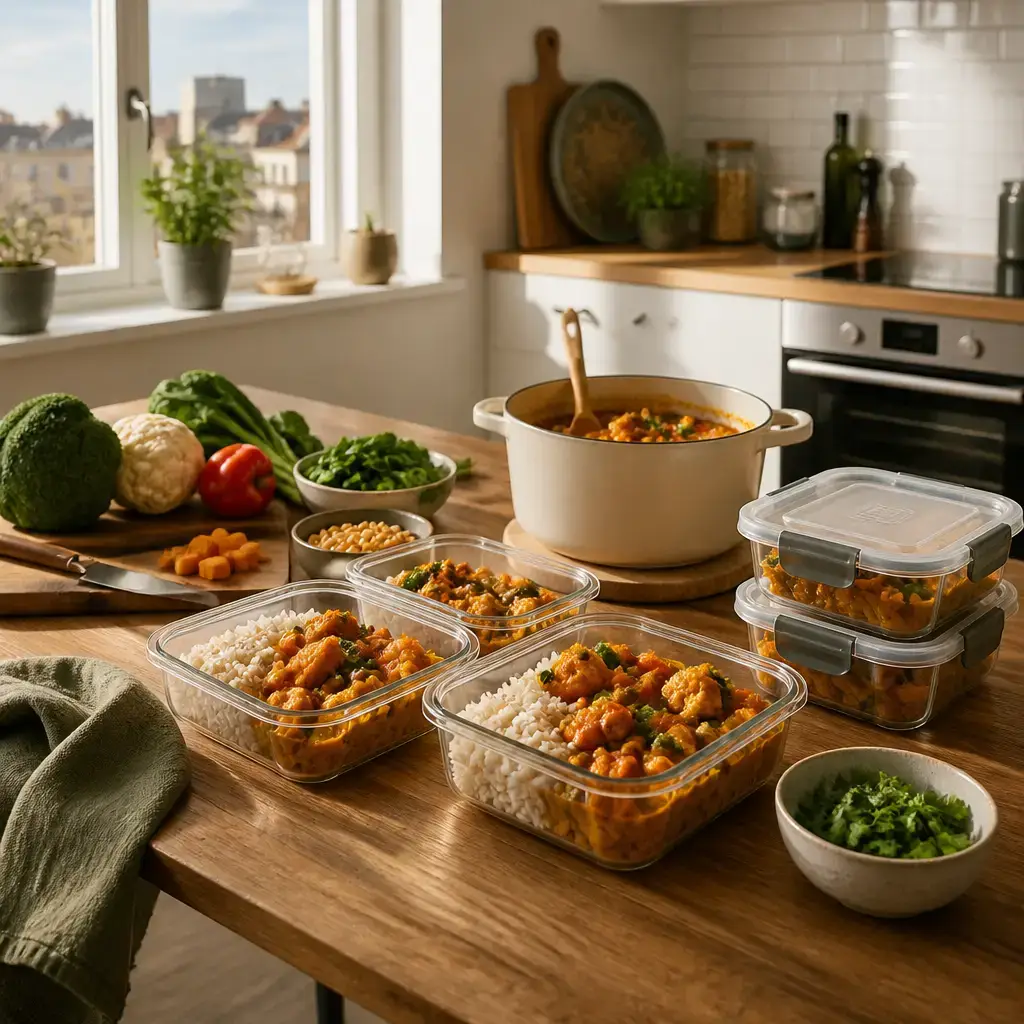
Næste uge ser travl ud, så det ville hjælpe at tilberede nogle måltider på forhånd.
NES-duh OO-uh SAIR TRAHVL oo, saw deh VELL-uh YEL-buh ah til-buh-RAY-thuh NOH-luh MOL-tee-thuh poh fohr-HOHN. Next week looks busy, so preparing some meals in advance would help.Madlavning på forhånd vil hjælpe, men undgå at spise det samme hver dag.
MAY-lahv-ning poh fohr-HOHN veel YEL-buh, men OON-gaw ah SPEE-suh deh SAM-uh vair DAIR. Meal prep will help, but avoid eating the same thing every day.Jeg tænkte på at lave en stor portion grøntsagscurry.
yai TENG-duh poh ah LAH-vuh uhn stohr pohr-SHOHN GURN-saks-KUR-ee. I was thinking of making a big batch of vegetable curry.Det fungerer, hvis du fordeler den i passende portioner og opbevarer den sikkert.
deh fong-GAIR, vess doo foh-DAY-luh den ee PASS-uh-nuh pohr-SHOH-nuh aw OB-vair-uh den SAY-guhd. That works if you portion it properly and store it safely.Skal jeg fryse noget af det ned og opbevare resten i køleskabet?
skel yai FROO-suh NOH-uth ah deh naith aw OB-vair-uh RESS-duhn ee KUR-luhs-SGAYB? Should I freeze some and keep the rest in the fridge?Frys nogle få portioner ned.
FROOS NOH-luh FOH pohr-SHOH-nuh naith. Freeze a few portions.Mærk hver beholder, så det er nemt at vælge.
MAIRG vair buh-HOH-luh, saw deh air NEMT ah VELL-uh. Label each container so it is easy to choose.Jeg har også brug for noget afbalanceret til frokost, ikke bare ris.
yai hah AW-suh broo fohr NOH-uth AHF-bah-lahn-SAIR-ud teel FROH-kost, EG-uh BAIR REES. I also need something balanced for lunch, not just rice.Tilføj æg, bønner eller kylling, alt efter hvad du har lyst til at spise.
teel-FOY AIR, BURN-uh, ELL-uh KULL-ing, ald EHF-duh veh doo hah LOOST teel ah SPEE-suh. Add eggs, beans, or chicken, depending on what you feel like eating.Hvis resterne virker kedelige, kan jeg ændre tilbehøret.
vess RESS-duh-nuh VAIR-guh KAY-thuh-lee, kan yai EN-ruh teel-buh-HURR. If the leftovers feel boring, I can change the side dish.Små ændringer gør det sjovere at spise måltider, der er lavet på forhånd.
smaw EN-reng-uh GURR deh SHOO-uh-ruh ah SPEE-suh MOL-tee-thuh, dair air LAY-vuth poh fohr-HOHN. Small changes make prepared meals more enjoyable.Sentence explanations
Næste uge ser travl ud, så det ville hjælpe at tilberede nogle måltider på forhånd.
Next week looks busy, so preparing some meals in advance would help.
- Næste
- next
- uge
- week
- ser … ud
- looks
- travl
- busy
- så
- so
- det ville
- it would
- hjælpe
- help
- tilberede
- prepare
- nogle
- some
- måltider
- meals
- på forhånd
- in advance
More detail
Næste means “next” here and modifies uge. Danish uses næste for the following item in a sequence: næste uge = “next week.” It does not itself show a grammatical gender or plural ending in this form. uge means “week.” Its plural is uger, as in to uger (“two weeks”). In the fixed sentence, næste uge is the time expression placed at the beginning: “next week.” ser ... ud is a discontinuous Danish construction meaning “looks” or “appears” when describing how something seems. ser is the present form of se (“see”), while ud completes this construction; here the combination is not simply “se” plus a separate direction. Example: Det ser godt ud. — “It looks good.” travl means “busy” here, describing the week’s expected character. It is an adjective. Example: Jeg er travl. is not the usual way to say that a person has a lot to do; Danish commonly uses Jeg har travlt. (“I am busy / I have a lot to do”), with the adjective form travlt in that expression. The fixed sentence instead has travl modifying uge. så means “so” in this sentence and links the busy-looking situation to its consequence. It introduces the result or helpful response that follows. det ville is a useful pattern: det functions as an anticipatory subject, and ville is the past form of vil used here to express a conditional or hypothetical “would.” The concrete activity supplied afterward is at tilberede nogle måltider på forhånd; the sentence presents that activity as something that would help. This is not the ordinary pronoun meaning “it” referring to a specifically identified object. Example: Det ville være godt at hvile. — “It would be good to rest.” hjælpe means “help.” It is the infinitive after ville; the same infinitive also appears in the reusable pattern ville hjælpe (“would help”). Example: Det hjælper at planlægge. — “It helps to plan.” tilberede means “prepare” in the food-related sense “prepare/cook.” It is an infinitive introduced by at in the full sequence at tilberede; at itself is not included in the selected quote. The form tilberede stays an infinitive after this construction. Example: Vi vil tilberede maden. — “We will prepare the food.” nogle means “some” here. It indicates an unspecified amount or selection, without stating an exact number. It modifies the plural noun måltider; an indefinite word such as nogle does not by itself tell us how many meals there are. måltider means “meals.” It is the plural of måltid (“meal”): et måltid / flere måltider. The plural form is appropriate because the sentence refers to some meals rather than one meal. på forhånd is a fixed adverbial expression meaning “in advance” or “ahead of time.” It describes when the meals are to be prepared: before the time when they will be needed or eaten. Example: Jeg bestiller billetter på forhånd. — “I book tickets in advance.” Together, Næste uge ser travl ud says “Next week looks busy.” så connects that situation to det ville hjælpe, “it would help.” The anticipatory det points forward to the activity named by the infinitive clause at tilberede nogle måltider på forhånd: preparing some meals in advance. The complete meaning is therefore: “Next week looks busy, so preparing some meals in advance would help.”
Madlavning på forhånd vil hjælpe, men undgå at spise det samme hver dag.
Meal prep will help, but avoid eating the same thing every day.
- Madlavning
- meal preparation
- på forhånd
- in advance
- hjælpe
- help
- undgå
- avoid
- spise
- eat
- samme
- same
- hver dag
- every day
More detail
Madlavning means cooking here, with the intended meal-preparation sense. It is a noun, and Danish commonly uses it for the activity of preparing food. In this sentence it is the subject: Madlavning på forhånd means preparing food in advance. Example: Madlavning tager tid. — “Cooking takes time.” på forhånd is a reusable adverbial meaning “in advance” or “beforehand.” It describes when the preparation happens. Example: Bestil billetterne på forhånd. — “Book the tickets in advance.” hjælpe means “to help.” After vil, it appears in the infinitive: vil hjælpe, “will help.” The form hjælpe is also used after other Danish modal verbs, such as kan in kan hjælpe, “can help.” Here, vil presents the help as something expected or intended in the future; the word hjælpe itself supplies the action “help.” undgå means “to avoid.” A useful Danish pattern is undgå at + infinitive: undgå at spise means “avoid eating.” The verb undgå is the form used after the implied subject “you” in this imperative-like instruction; Danish does not add a special imperative ending here. Example: Undgå at tale for højt. — “Avoid speaking too loudly.” spise means “to eat.” It is an infinitive after at in at spise. The same verb can occur in other forms, such as spiser for present-tense “eat/is eating” and spiste for past “ate.” In the fixed sentence, it names the action to avoid rather than a completed event. samme means “same.” In det samme it describes an unspecified thing understood as identical to something already relevant: literally, “the same.” Samme does not change form for the gender or number of the noun it can modify. Example: Vi valgte den samme løsning. — “We chose the same solution.” hver dag is a time expression meaning “every day.” hver means “each/every,” and dag means “day”; together they describe a repeated daily frequency. Compare hver uge, “every week.” Together, Madlavning på forhånd vil hjælpe means “Meal preparation in advance will help.” The conjunction men, “but,” then introduces the contrasting instruction undgå at spise det samme hver dag: avoid eating the same thing every day. Thus the whole utterance advises preparing food ahead of time while varying what is eaten from day to day.
Jeg tænkte på at lave en stor portion grøntsagscurry.
I was thinking of making a big batch of vegetable curry.
- Jeg
- I
- tænkte på
- was thinking of
- at lave
- to make
- stor
- big
- portion
- batch; portion
- grøntsagscurry
- vegetable curry
More detail
Jeg means “I” here. It is the first-person singular subject pronoun: use jeg when the speaker presents themself as the subject. For example: Jeg laver mad. — “I am making food.” tænkte på expresses having the idea or intention of doing something. tænkte is the past form of tænke (“think”); på is part of the construction used before the activity being considered. With an infinitive, the reusable pattern is tænke på at + verb: Jeg tænker på at rejse. — “I am thinking of travelling.” The past form in the fixed sentence places that thinking in the past; the English “was thinking” conveys the ongoing or tentative character in this context. at lave means “to make.” lave is the infinitive base form, introduced here by at. The pattern at + infinitive can name an intended activity after expressions such as tænke på: Hun tænkte på at lave suppe. — “She was thinking of making soup.” stor means “big” or “large” here. It is the adjective modifying portion. Danish adjectives can change form according to the noun they modify; with a singular common-gender noun such as portion, the form is stor, while a neuter singular noun commonly takes stort, and a plural noun takes store. For example: en stor portion — “a large portion”; store portioner — “large portions.” portion means “portion” or “batch.” In this sentence it refers to an amount of curry prepared as one quantity, not to a stated number of portions. Its plural is portioner: to portioner — “two portions.” grøntsagscurry means “vegetable curry.” It is a compound noun combining grøntsag (“vegetable”) with curry (“curry”); the compound as a whole names the dish. Danish compounds are generally written as one word, so do not split this observed noun into separate words when writing it. Example: Jeg laver grøntsagscurry. — “I am making vegetable curry.” Together, Jeg tænkte på at lave en stor portion grøntsagscurry means “I was thinking of making a big batch of vegetable curry.” The subject is Jeg; tænkte på at lave presents making the dish as the activity being considered; and en stor portion grøntsagscurry identifies the planned amount and dish. The construction is useful for expressing a past thought or tentative plan.
Det fungerer, hvis du fordeler den i passende portioner og opbevarer den sikkert.
That works if you portion it properly and store it safely.
- Det fungerer
- That works
- hvis
- if
- fordeler
- portion out; distribute
- passende
- suitable; appropriate
- portioner
- portions
- opbevarer
- store; keep
- sikkert
- safely
More detail
Det fungerer means “That works” here: fungere is the base form, and fungerer is its present-tense form. Det is the pronoun used for the situation or method being evaluated; the translation identifies it as “that.” A reusable pattern is Det fungerer + a condition: “That works if …”. hvis introduces the condition, “if.” It connects the main statement with what must happen for it to work. fordeler comes from fordele, “to distribute” or “to divide into portions.” Here it is present tense with du: “you portion out.” The object den means “it” in the supplied translation, referring to the food being divided. Example: Du fordeler suppen i skåle. — “You divide the soup into bowls.” passende means “suitable” or “appropriate.” It describes portioner, so passende portioner means “suitable portions.” The form passende is also used with plural nouns; the adjective does not take a separate plural ending here. portioner is the plural of portion, “portion.” The plural ending is -er. Example: Vi laver tre portioner. — “We make three portions.” opbevarer comes from opbevare, “to store” or “to keep.” It is present tense with du: “you store.” It is coordinated with fordeler, so the same subject performs both actions. Example: Jeg opbevarer maden koldt. — “I store the food in a cold place.” sikkert means “safely” here. It is the adverbial form related to sikker, “safe,” and describes how the storing is done. It does not mean that the food itself is necessarily safe as a permanent property; in this sentence it specifies safe storage. Together, hvis du fordeler den i passende portioner means “if you portion it into suitable portions,” and og opbevarer den sikkert adds “and store it safely.” The complete utterance is therefore: “That works if you portion it properly and store it safely.”
Skal jeg fryse noget af det ned og opbevare resten i køleskabet?
Should I freeze some and keep the rest in the fridge?
- Skal jeg
- Should I…?
- fryse … ned
- freeze
- noget af det
- some of it
- opbevare
- keep; store
- resten
- the rest
- i køleskabet
- in the fridge
More detail
Skal jeg asks whether the speaker should do something. skal is the present form of skulle; with a subject and an infinitive, skal jeg ...? is a reusable way to ask “Should I ...?” or “Am I to ...?” The subject is jeg (“I”), and the following verbs remain in the infinitive. fryse means “freeze.” The fixed sentence uses the construction fryse ... ned, where ned is a particle that completes the meaning “freeze something down.” The infinitive is fryse; a useful present-tense form is fryser. Example: Jeg fryser brødet ned. — “I freeze the bread.” noget af det means “some of it.” noget af expresses an unspecified part of a larger amount, while det is the pronoun “it.” The context supports this partitive reading, but the phrase itself does not state a numerical amount. Example: Jeg tager noget af det. — “I take some of it.” opbevare means “store” or “keep” in the sense of storing something. It is another infinitive governed by skal, coordinated with fryse: the speaker asks about two possible actions. Its present form is opbevarer. Example: Vi opbevarer maden koldt. — “We store the food in a cold place.” resten means “the rest” or “the remainder.” It refers to what remains after the part mentioned in noget af det; the definite form presents that remainder as the relevant remaining portion. Example: Jeg bruger noget nu og gemmer resten. — “I use some now and save the rest.” i køleskabet means “in the fridge.” i marks the location, and køleskabet is the definite form of køleskab (“fridge”): køleskab + the definite ending -et. Example: Mælken står i køleskabet. — “The milk is in the fridge.” Together, Skal jeg fryse noget af det ned asks whether the speaker should freeze part of the relevant item or amount, and og opbevare resten i køleskabet adds the coordinated action of storing what remains in the fridge. The complete meaning is: “Should I freeze some of it and keep the rest in the fridge?”
Frys nogle få portioner ned.
Freeze a few portions.
- Frys
- freeze
- nogle få
- a few
- portioner
- portions
More detail
Frys is the imperative of fryse (“to freeze”). It gives a direct instruction to one or more people; the form itself does not mark the number of addressees. The present-tense form is fryser, as in Jeg fryser suppen ned (“I am freezing the soup”). nogle få means “a few”: a small, indefinite number, without stating an exact count. nogle can mean “some,” while få narrows this to a small amount. Example: Der er nogle få portioner tilbage. — “There are a few portions left.” portioner is the plural of the noun portion, meaning “portion” or “serving.” The singular is en portion; portioner marks more than one portion. Example: Jeg laver to portioner. — “I am making two portions.” The separate particle ned completes the reusable expression fryse ... ned, meaning to freeze something for storage. Here, Frys supplies the command, nogle få portioner identifies a small unspecified number of portions as what should be frozen, and ned completes the freezing-for-storage construction. Together, Frys nogle få portioner ned. means “Freeze a few portions.”
Mærk hver beholder, så det er nemt at vælge.
Label each container so it is easy to choose.
- Mærk
- label
- hver
- each
- beholder
- container
- så
- so that
- det er nemt
- it is easy
- at vælge
- to choose
More detail
Mærk is the imperative of mærke, “to label” or “to mark.” It gives a direct instruction; the subject is understood as “you.” Example: Mærk kassen. — “Label the box.” hver means “each” and normally goes with a singular noun: hver beholder — “each container.” It focuses on the members one by one. This differs from alle, “all,” which normally presents the group as a whole and takes a plural noun: alle beholdere — “all containers.” beholder means “container.” Its plural is beholdere: en beholder — “a container”; flere beholdere — “several containers.” så introduces the purpose or result intended by the instruction here: “so that.” In the reusable pattern X, så Y, the second clause explains the intended outcome of X. Example: Skriv tydeligt, så alle kan læse det. — “Write clearly so that everyone can read it.” det er nemt means “it is easy.” Here det is an impersonal grammatical subject; the sentence does not identify a separate object called “it.” nemt is the form of nem, “easy,” used with the neuter det in this construction. The related comparative is nemmere, “easier.” at vælge is the infinitive “to choose,” from the verb vælge. Danish commonly uses at before an infinitive when it functions like “to choose.” Example: Det er svært at vælge. — “It is difficult to choose.” Together, Mærk hver beholder means “Label each container.” The purpose clause så det er nemt at vælge adds “so that it is easy to choose.” Thus the complete utterance is: “Label each container so it is easy to choose.” The instruction concerns labeling every container individually, with the goal of making a later choice easier.
Jeg har også brug for noget afbalanceret til frokost, ikke bare ris.
I also need something balanced for lunch, not just rice.
- Jeg
- I
- har … brug for
- need
- også
- also
- noget
- something
- afbalanceret
- balanced
- frokost
- lunch
- ikke bare
- not just
- ris
- rice
More detail
Jeg means “I,” the first-person singular subject pronoun. Its object form is mig, as in Hun ser mig (“She sees me”). har ... brug for is the reusable Danish construction meaning “need.” Har is the present form of have; the complete construction, rather than har alone, expresses need. For example, Jeg har brug for hjælp. means “I need help.” også means “also” or “too.” Here it adds this need to something already relevant. The sentence pattern Jeg har også brug for ... means “I also need ...”. noget means “something” here. It is an indefinite pronoun, not a stated numeric quantity. It can stand alone, as in Jeg vil have noget. — “I want something.” afbalanceret means “balanced” here and describes the unspecified food referred to by noget. It is the adjectival form related to afbalancere (“to balance”). In singular phrases, the form is afbalanceret with both common-gender and neuter nouns: en afbalanceret kost (“a balanced diet”) and et afbalanceret måltid (“a balanced meal”). With plural or definite nouns, it becomes afbalancerede, as in afbalancerede måltider (“balanced meals”). frokost means “lunch.” With til, the phrase til frokost means “for lunch” or “at lunchtime.” Example: Vi spiser suppe til frokost. — “We eat soup for lunch.” ikke bare means “not just” or “not merely.” Ikke provides the negation, while bare limits the item that follows. Example: Jeg drikker ikke bare kaffe. — “I do not drink only coffee.” ris means “rice.” In this use it refers to rice as food, without stating a number of portions or grains. Example: Vi serverer ris. — “We serve rice.” Together, Jeg har også brug for noget afbalanceret til frokost means “I also need something balanced for lunch.” The final ikke bare ris adds the contrast “not just rice.” The complete utterance is therefore: “I also need something balanced for lunch, not just rice.”
Tilføj æg, bønner eller kylling, alt efter hvad du har lyst til at spise.
Add eggs, beans, or chicken, depending on what you feel like eating.
- Tilføj
- add
- æg
- eggs
- bønner
- beans
- kylling
- chicken
- alt efter
- depending on
- har lyst til
- feel like
- spise
- eat
More detail
Tilføj is the imperative of tilføje, “to add.” It gives a direct instruction to add something. The imperative commonly has the same form as the verb stem used in this command: Tilføj salt. — “Add salt.” æg means “eggs” here. It is the indefinite plural of et æg (“an egg”): et æg → æg. The definite forms are ægget (“the egg”) and æggene (“the eggs”). bønner means “beans.” It is the indefinite plural of bønne (“bean”): en bønne → bønner. The form presents beans as one ingredient option in the list. kylling means “chicken.” In this food context it refers to chicken as an ingredient or food. Danish can also use kylling for a chicken animal; the intended food meaning is fixed here by the ingredient list and translation. alt efter is a reusable expression meaning “depending on.” It introduces a condition or choice that determines what happens. For example, Det varierer alt efter vejret. means “It varies depending on the weather.” hvad means “what” in the clause hvad du har lyst til at spise, “what you feel like eating.” It introduces the content of the preference. Unlike a question such as Hvad spiser du? (“What are you eating?”), this clause is embedded inside the larger expression alt efter hvad .... har lyst til literally contains har (“has/have”), lyst (“desire”), and til (“to/for”), but together it is the common Danish expression “feel like” or “want to” in the sense of having an inclination. Here har is the present form for du, “you”: du har lyst til ... — “you feel like ...”. It is followed by an activity with at plus the infinitive: Jeg har lyst til at gå. — “I feel like going.” spise is the infinitive “to eat.” In at spise, at marks the infinitive, while spise carries the lexical meaning. The phrase til at spise therefore contains the activity “to eat” after har lyst til. For example, Hvad har du lyst til at drikke? means “What do you feel like drinking?” Together, Tilføj æg, bønner eller kylling gives the instruction “Add eggs, beans, or chicken.” eller links the alternatives. alt efter hvad du har lyst til at spise adds the basis for choosing among them: the choice depends on what the addressee feels like eating. The complete utterance is therefore: “Add eggs, beans, or chicken, depending on what you feel like eating.”
Hvis resterne virker kedelige, kan jeg ændre tilbehøret.
If the leftovers feel boring, I can change the side dish.
- Hvis
- if
- resterne
- the leftovers
- virker
- seem
- kedelige
- boring
- kan jeg
- I can
- ændre
- change
- tilbehøret
- the side dish
More detail
Hvis introduces a condition: “if …”. It connects the situation in the first clause with what can happen in the main clause. A reusable pattern is Hvis + clause, followed by the result or response. resterne means “the leftovers” here. The base noun is rest (“leftover” or “remainder”); rester is its plural, and -ne marks the definite plural: “the leftovers.” virker is the present-tense form of virke, “to seem” or “to appear.” Here it presents the leftovers as seeming a certain way. For example: Det virker godt. — “It seems good.” kedelige is the form of the adjective kedelig, “boring.” It has the plural form kedelige because it describes the plural noun resterne. In the fixed sentence, it means “boring,” not “bored.” kan jeg combines kan, the present form of the modal verb kunne (“can” or “be able to”), with jeg (“I”). After the conditional clause, the main clause uses Danish verb-second order: the finite verb kan comes before the subject jeg. This is not specifically question word order. With a modal verb, the following verb normally stays in the infinitive: jeg kan ændre — “I can change.” ændre is the infinitive of the verb “to change” or “to alter.” Here it follows kan, so it does not take a present-tense ending. The pattern kan + infinitive is reusable for expressing ability or possibility, for example: Jeg kan vente. — “I can wait.” tilbehøret means “the side dish” here. Its base noun is tilbehør, “side dish” or “accompaniment”; -et marks the definite singular form. It is the object of ændre, so it is what is changed. Together, Hvis resterne virker kedelige means “If the leftovers seem boring.” The main clause kan jeg ændre tilbehøret means “I can change the side dish.” The complete fixed meaning is: “If the leftovers feel boring, I can change the side dish.”
Små ændringer gør det sjovere at spise måltider, der er lavet på forhånd.
Small changes make prepared meals more enjoyable.
- Små
- small
- ændringer
- changes
- gør
- make
- sjovere
- more enjoyable
- at spise
- to eat
- måltider
- meals
- lavet
- made; prepared
- på forhånd
- in advance
More detail
Små means “small” here and is the plural form of lille. The adjective is plural because it describes ændringer, which is plural. Compare en lille ændring (“a small change”) with små ændringer (“small changes”). ændringer means “changes” and is the plural of ændring. The related verb is ændre (“to change”); the noun names the changes themselves. For example: Jeg foreslår små ændringer. — “I suggest small changes.” gør is the present-tense form of gøre (“to make; to do”). In this sentence, gør expresses an effect: the small changes make something more enjoyable. For example: Det gør en forskel. — “It makes a difference.” sjovere is the comparative form of sjov (“fun; enjoyable”). It means “more enjoyable” here. The comparison is between the experience without the changes and the experience with them; it does not require a second comparison phrase. The basic chain is sjov → sjovere → sjovest (“fun” → “more fun” → “most fun”). at spise is the infinitive “to eat”: at marks the infinitive, and spise is the verb. The infinitive phrase is the activity whose experience becomes more enjoyable. For example: Det er let at spise her. — “It is easy to eat here.” måltider means “meals” and is the plural of måltid. The sentence refers to meals in general rather than stating a particular number. For example: Vi planlægger måltider. — “We plan meals.” lavet is the past participle of lave (“to make; to prepare”). With er, as in er lavet, it describes meals that have been prepared or are prepared. In this relative clause, lavet does not identify who prepared them. Compare the attributive form lavede måltider (“prepared meals”) with the predicate construction måltiderne er lavet (“the meals are prepared / have been made”). på forhånd is the fixed expression “in advance” or “ahead of time.” In lavet på forhånd, it says that the meals were prepared before the relevant eating time. For example: Vi bestilte billetter på forhånd. — “We booked tickets in advance.” The construction gør det sjovere at ... means “makes it more enjoyable to ...”: det is a formal element referring to the experience expressed by the following infinitive phrase, while sjovere describes that experience. The relative clause der er lavet på forhånd follows måltider and identifies meals prepared in advance. Together, Små ændringer gør det sjovere at spise måltider, der er lavet på forhånd. means “Small changes make prepared meals more enjoyable.”
Grammar Points
Bestemt form med endelsen -et
køleskabet
KUR-luhs-SGAY-buththe fridge
Danish often marks a singular definite noun with a suffix instead of a separate word like “the”.
Komparativ med -ere
sjovere
SHOO-uh-ruhmore fun
Many Danish adjectives form the comparative by adding -ere to the base adjective.
Danish Vocabulary
at lave en stor portion
- Gender
- neuter
- Gender
- common
tilberede nogle måltider på forhånd
det samme
en stor portion
at tilberede nogle måltider
ser travl ud
Jeg tænkte på
- Gender
- common
næste uge
undgå at spise
Quiz
Word Order
Arrange the words in the correct order.
Freeze a few portions.
Show Answer
Frys nogle få portioner ned.Spelling
Tap the letters to spell the word.
to think
Show Answer
tænktemeal
Show Answer
måltiderbusy
Show Answer
travlto avoid