10 minutes free every day
Continue audio lessons in the app
Word explanations appear automatically in sync with the audio.
No login required · synced translations · playback with the screen locked
Choose your learning language and open this lesson in the app.

About This Lesson
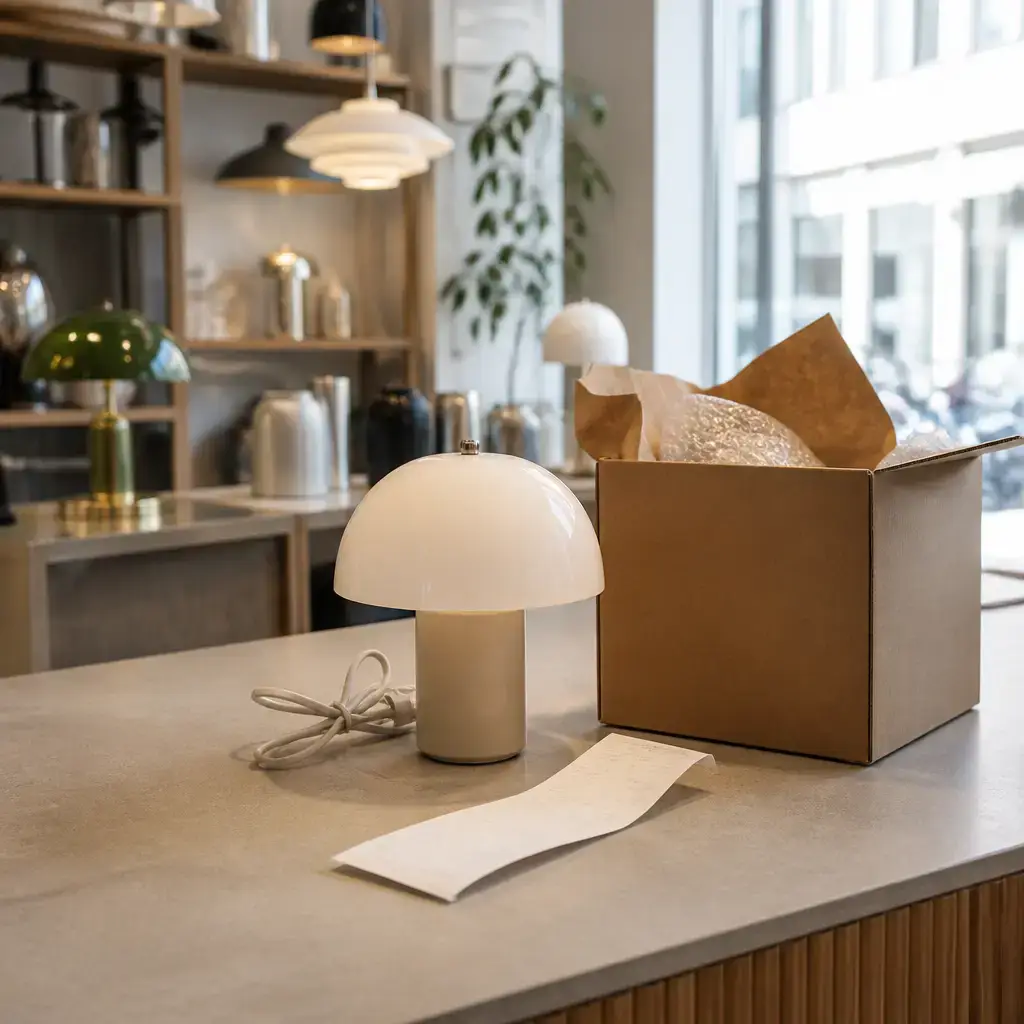
Use Requesting a replacement for a faulty lamp to practice Danish conversation, pronunciation, vocabulary, grammar, and quizzes.
Dialogue
Denne lampe holdt op med at virke efter kort tid.
DEN-uh LAM-buh holt OP meh ah VEH-guh EF-tuh gohrt TEETH. This lamp stopped working after a short time.Har du en kvittering med dig?
hah doo un kvee-TEH-ring meh dye? Do you have proof of purchase with you?Jeg har kvitteringen og den originale emballage.
yai hah kvee-TEH-ring-un oh den oh-ree-nah-leh em-bah-LAH-shuh. I have the receipt and the original packaging.Så kan vi tjekke, om en ombytning er mulig.
soh kan vee CHEK-uh, awm un AWm-BYOOT-ning air MOO-lee. Then we can check whether a replacement is possible.Jeg vil helst have en ombytning.
yai vel helst HEH-vuh un AWm-BYOOT-ning. I would prefer a replacement.Jeg har stadig brug for den samme type lampe.
yai hah SDEH-lee broo fohr den SAM-uh TYOO-buh LAM-buh. I still need the same type of lamp.Det lyder rimeligt. Vi bør teste varen først.
deh LOO-uh RAH-meh-lee. Vee boor TES-duh VAH-un FURST. That sounds reasonable. We should test the item first.Jeg tog også kablet med, hvis det hjælper.
yai toh OH-suh KAY-bluh meh, ves deh YEL-puh. I brought the cable as well, in case that helps.Så har vi det, vi skal bruge, for at bekræfte problemet og gennemføre ombytningen.
soh hah vee deh, vee skal BROO-uh, fohr ah beh-KREF-duh proh-BLEH-muhd oh GREH-mun-FUR-uh AWm-BYOOT-ning-un. That gives us what we need to confirm the problem and handle the exchange.Sentence explanations
Denne lampe holdt op med at virke efter kort tid.
This lamp stopped working after a short time.
- Denne
- this
- lampe
- lamp
- holdt op med at virke
- stopped working
- efter
- after
- kort
- short
- tid
- time
More detail
Denne means “this” here and is the singular common-gender form of the Danish demonstrative. It points to a specific item in the situation; the form agrees with the noun it accompanies. The corresponding form used with a neuter singular noun is dette, while plural is disse. lampe means “lamp.” It is a common-gender noun: en lampe means “a lamp,” and the definite form is lampen, “the lamp.” In this sentence, Denne lampe means “this lamp,” with denne identifying the particular lamp. holdt op med at virke is the Danish construction “stopped working.” holdt is the past tense of holde, “to hold.” In the construction holde op med at + infinitive, it means “stop doing something.” The infinitive virke means “work” or “function” here, and at virke is “to work/function.” For example: Hun holdt op med at læse. — “She stopped reading.” efter means “after” when it introduces the time following an event or period. Here it introduces the time that passed before the lamp stopped working: efter kort tid, “after a short time.” kort means “short” in this phrase. It describes the duration expressed by tid; the comparative is kortere, “shorter,” and the superlative is kortest, “shortest.” For example: Vi tog en kort pause. — “We took a short break.” tid means “time” here, specifically a period or duration rather than a clock reading. It is a common-gender noun: en tid; its definite form is tiden, “the time.” The phrase kort tid means “a short time.” Together, Denne lampe identifies the particular lamp. holdt op med at virke says that it ceased to function, and efter kort tid places that stopping after a short period. The complete meaning is: “This lamp stopped working after a short time.”
Har du en kvittering med dig?
Do you have proof of purchase with you?
- Har du
- Do you have
- kvittering
- receipt; proof of purchase
- med dig
- with you
More detail
Har du is the question pattern formed by har (“have”) before the subject du (“you”). In a main-clause yes/no question, Danish commonly uses this verb–subject order: Har du ...? = “Do you have ...?” The form har is the present tense of have; it is used with du here, while du har ... has the normal statement order “you have ...”. kvittering means “receipt” here, specifically proof of purchase. It is an indefinite singular noun: en kvittering means “a receipt,” without stating that there is numerically only one. Its definite form is kvitteringen, “the receipt,” as in the next sentence. The indefinite article en belongs with the noun and does not itself assert a quantity. med dig means “with you.” dig is the object form of the second-person singular pronoun corresponding to du; the form is used after the preposition med. The same pattern is reusable with other people, for example med mig = “with me” and med hende = “with her.” Together, Har du en kvittering med dig? asks whether the listener has a receipt or other proof of purchase in their possession. The question’s present-tense har and the phrase med dig together give the intended meaning “Do you have proof of purchase with you?”
Jeg har kvitteringen og den originale emballage.
I have the receipt and the original packaging.
- Jeg har
- I have
- kvitteringen
- the receipt
- originale
- original
- emballage
- packaging
More detail
Jeg har means “I have.” Jeg is the first-person singular subject pronoun “I”; its object form is mig (“me”). Har is the present-tense form of have (“to have”): jeg har = “I have.” Example: Jeg har tid. — “I have time.” kvitteringen means “the receipt.” Its base form is kvittering (“receipt”), and the ending -en marks the definite singular form: en kvittering = “a receipt,” kvitteringen = “the receipt.” The form used here therefore identifies a particular receipt, consistent with the fixed translation. originale means “original.” The base adjective is original. In den originale emballage, the adjective has the -e form used in a definite noun phrase introduced by den; this form is not an inflection of emballage. Example: den originale vare — “the original item.” emballage means “packaging.” It is a noun used here after den originale, with the noun remaining in its uninflected form in this construction. Danish can use emballage for the material or wrapping that contains a product. Example: Emballagen er beskadiget. — “The packaging is damaged.” Here emballagen is the definite form of the same noun. Together, Jeg har kvitteringen og den originale emballage means “I have the receipt and the original packaging.” og joins the two objects of har: the specific receipt and the original packaging. The second noun phrase uses den plus the adjective originale and the noun emballage; this is the Danish pattern for a definite noun phrase with an adjective.
Så kan vi tjekke, om en ombytning er mulig.
Then we can check whether a replacement is possible.
- Så
- then
- kan vi
- we can
- tjekke
- check
- om
- whether
- ombytning
- replacement
- er
- is
- mulig
- possible
More detail
Så means “then” here, linking this proposal to the preceding situation. It can also mean “so” in other contexts; the surrounding sentence determines which connection is intended. kan vi combines the modal verb kan with the subject vi. Kan is the present-tense form of kunne (“can, be able to”), and vi means “we.” With a modal verb, the following lexical verb is in the infinitive: kan vi tjekke = “we can check.” tjekke is the infinitive “to check.” After kan, Danish uses this infinitive without an English-style infinitive marker. The same verb can appear in the present as tjekker: Vi tjekker kvitteringen. = “We check the receipt.” om introduces an embedded yes/no question and means “whether” in this sentence. Pattern: tjekke, om ... = “check whether ...” It is different from the preposition om in meanings such as “about” or “around”; the clause that follows shows its function here. ombytning is the noun “replacement” in this context. Its base form is ombytning; the indefinite singular form in the full sentence is en ombytning, while the definite form is ombytningen (“the replacement”). The preceding article en marks this noun as a common-gender indefinite singular noun; it does not itself assert a numerical count beyond the grammar of the noun phrase. er is the present-tense form of være, “to be.” Here it links ombytning with the description mulig: “a replacement is possible.” mulig means “possible.” As a predicative adjective, it agrees with the singular common-gender noun phrase en ombytning, so the form here is mulig. Other forms include muligt with a singular neuter noun and mulige in plural or definite noun phrases; these are forms of the adjective mulig, not of ombytning. Together, kan vi tjekke expresses the ability or practical possibility to check something, and om en ombytning er mulig specifies what is being checked: whether a replacement is possible. The whole utterance therefore means, “Then we can check whether a replacement is possible.”
Jeg vil helst have en ombytning.
I would prefer a replacement.
- Jeg
- I
- vil
- would like
- helst
- preferably
- have
- have
- ombytning
- replacement
More detail
Jeg means “I” here. It is the first-person singular subject pronoun. It identifies the speaker as the person expressing the preference; it does not by itself indicate whether the speaker is male or female. vil is the present-tense form of ville. In this sentence, ville works with the following infinitive to express what the speaker would like or prefers, rather than simply stating a future event. A useful pattern is jeg vil + infinitive: “I want/would like to …”. helst means “preferably” or “rather”. Together with vil, it strengthens the preference: vil helst means “would prefer to” or “would rather”. Compare Jeg vil have ... (“I want/would like ...”) with Jeg vil helst have ... (“I would preferably like ...”). have is the infinitive “to have”. It follows vil, so it remains in the infinitive instead of carrying present-tense marking. In this utterance, have introduces what the speaker wants to receive or obtain. ombytning is a noun meaning “replacement” or “exchange” in this context. The indefinite noun phrase is en ombytning; en marks the noun as common gender, but it does not by itself assert a numerical count in the English sense. The noun’s definite form is ombytningen, and its plural is ombytninger. The structure is Jeg + vil helst + have + en ombytning: “I would prefer to have a replacement.” The speaker expresses a preference to receive a replacement, without specifying further details about the replacement in this sentence.
Jeg har stadig brug for den samme type lampe.
I still need the same type of lamp.
- Jeg
- I
- har stadig brug for
- still need
- den
- the
- samme
- same
- type
- type
- lampe
- lamp
More detail
Jeg means “I” here, the first-person singular subject pronoun. It identifies the speaker as the person who has the need. A useful contrast is du for “you” (singular) and vi for “we”. har stadig brug for is a reusable Danish construction meaning “still need”. Its central pattern is have brug for + noun: Jeg har brug for hjælp. — “I need help.” Har is the present-tense form of have (“to have”), and stadig adds the meaning that the need continues. The words har brug for should be learned together as the usual construction for “need”; brug by itself does not mean “need” in this sentence. den is the definite singular determiner “the” in this noun phrase. It agrees with type, which is a common-gender noun: en type, den type. It is not itself a marker of a numerical count; definiteness here presents the type as identifiable in the intended context. samme means “same”. It is used before a definite noun phrase, as in den samme (“the same”). In modern Danish, samme does not change for grammatical gender or number in this use. Compare the reusable pattern den samme bog — “the same book”. type means “type” or “kind”. It is a common-gender noun: en type; with definiteness, typen means “the type”. In type lampe, it specifies what kind of item is meant: a type of lamp. The noun type is separate from lampe, which names the item belonging to that type. lampe means “lamp”. It is a common-gender noun: en lampe — “a lamp”; lampen — “the lamp”. Here it follows type in the compact pattern type + noun, corresponding to “type of lamp”. Together, Jeg har stadig brug for den samme type lampe. means “I still need the same type of lamp.” The structure is I + still need + the same type of lamp: Jeg is the subject, har stadig brug for expresses the continuing need, and den samme type lampe identifies the kind of lamp needed. This wording can be reused by replacing lampe, for example Jeg har stadig brug for den samme type kabel. — “I still need the same type of cable.”
Det lyder rimeligt. Vi bør teste varen først.
That sounds reasonable. We should test the item first.
- Det lyder
- That sounds
- rimeligt
- reasonable
- Vi bør
- we should
- teste
- test
- varen
- the item
- først
- first
More detail
Det lyder means “that sounds” here. Det is a neuter singular pronoun functioning as the subject; the fixed translation identifies it as “that,” referring to the proposal or idea being assessed, without specifying a particular noun. Lyder is the present form of lyde (“to sound”). Danish present forms do not change for the subject’s person or number. Example: Det lyder godt. — “That sounds good.” Rimeligt means “reasonable” in this sentence. It is the neuter singular form of the adjective rimelig; the ending agrees with neuter singular det. With a common-gender singular noun, the form is rimelig, as in en rimelig løsning (“a reasonable solution”). The sentence therefore evaluates the proposal as reasonable rather than describing a person or object with a different adjective form. Vi bør gives the reusable pattern “we should.” Vi is the subject pronoun “we.” Bør is the present form of the modal verb burde, used here to express advice or an appropriate action. After bør, the next verb is normally in the infinitive without at: Vi bør vente. — “We should wait.” Teste means “to test.” It is the infinitive of teste, and it follows the modal bør directly. The same infinitive can be used after other modal verbs, for example Vi kan teste varen. — “We can test the item.” Varen means “the item.” It is the definite singular form of the noun vare (“item” or “product”): vare is indefinite singular, while varen is definite singular. The ending -en marks definiteness for this noun; it does not itself state a quantity. Example: Jeg tester varen. — “I am testing the item.” Først means “first” here, placing the testing before another relevant action or step. It is an adverb and does not change form. Compare Vi tester varen først. — “We test the item first.” Together, Det lyder rimeligt says that the proposal or idea sounds reasonable. Vi bør teste varen først says that testing the item should be the action taken before the other implied step. The full utterance is therefore: “That sounds reasonable. We should test the item first.”
Jeg tog også kablet med, hvis det hjælper.
I brought the cable as well, in case that helps.
- Jeg
- I
- tog … med
- brought along
- også
- also; as well
- kablet
- the cable
- hvis
- if; in case
- det
- it; that
- hjælper
- helps
More detail
Jeg means “I” here, the first-person singular subject. The same form is used regardless of the speaker’s gender. Example: Jeg kommer nu. — “I’m coming now.” tog ... med is a reusable Danish pattern meaning “brought/took along” in this sentence. tog is the past-tense form of tage (“take”); med adds the idea of bringing or taking something along. The two parts are separated here by også and kablet, so the construction is discontinuous in the sentence. Example: Hun tog sin taske med. — “She brought her bag along.” også means “also” or “as well.” It adds this item or action to something already relevant, without itself specifying what that earlier item is. Its position can vary, but here it occurs inside the verb phrase. kablet means “the cable.” It is the definite singular form of kabel (“cable”): kabel → kablet. Danish commonly marks definiteness on the noun itself rather than using a separate word equivalent to “the” in this form. Example: Jeg fandt kablet. — “I found the cable.” hvis introduces a condition and can mean “if” or, as in the fixed translation, “in case.” It links the possible condition to the following clause. Example: Ring, hvis du har brug for hjælp. — “Call if you need help.” det is a neuter singular pronoun meaning “it” or “that” in this clause. The fixed translation supports the reading “that” in in case that helps; it does not by itself identify a separate named participant. Danish pronoun form depends on the grammatical features of its referent or use, and det is the neuter singular form. Example: Det virker. — “It works.” hjælper is the present-tense form of hjælpe (“help”). In this clause it means “helps.” Danish present-tense verbs generally do not change for the subject’s person or number, so the same form can occur with different subjects. Example: Det hjælper meget. — “That helps a lot.” Together, Jeg tog ... med says “I brought ... along”; også adds “as well,” and kablet supplies the object, “the cable.” The conditional clause hvis det hjælper means “in case that helps.” The complete utterance therefore means: “I brought the cable as well, in case that helps.”
Så har vi det, vi skal bruge, for at bekræfte problemet og gennemføre ombytningen.
That gives us what we need to confirm the problem and handle the exchange.
- Så
- so / then
- har vi
- we have
- det, vi skal bruge
- what we need
- for at
- in order to
- bekræfte
- confirm
- problemet
- the problem
- gennemføre
- carry out
- ombytningen
- the exchange
More detail
Så links this statement to the preceding situation as a result: “so.” In this sentence it is not primarily a time word meaning “then.” har vi contains the present-tense form har of have and the subject pronoun vi, “we.” Since Så is an adverbial placed first in the main clause, Danish main-clause word order puts the finite verb before the subject: Så har vi .... The phrase means “so we have” here. det, vi skal bruge is the reusable Danish pattern for “what we need.” det introduces the thing being referred to, while vi is the subject of the following clause. In this context, skal bruge means “need” or “need to use.” skal can also express a plan or obligation in other contexts, so its exact meaning comes from the combination and context. The referent is not specified more narrowly than “what we need.” for at introduces an infinitive purpose clause, “in order to.” Here it is followed by two coordinated actions: bekræfte ... og gennemføre .... The understood subject of both actions is the same as in the main clause, vi. bekræfte is the infinitive “confirm.” It remains in the infinitive after for at; the present-tense form is bekræfter, as in Vi bekræfter problemet — “We confirm the problem.” problemet means “the problem.” The indefinite noun is et problem, and the definite singular form adds -et: problemet. The ending belongs to the noun, not to bekræfte. gennemføre is an infinitive meaning “carry out,” “complete,” or “see through.” Here it is coordinated with bekræfte, so the single for at applies to both verbs. For example, Vi gennemfører planen means “We carry out the plan.” ombytningen means “the exchange” in this context. It is the definite singular of the common-gender noun en ombytning; the definite form uses -en: ombytningen. The noun refers to the exchange being carried out, without adding details about its exact procedure. Taken together, Så har vi det, vi skal bruge says “So we have what we need.” for at then gives the purpose, and its two coordinated infinitives are bekræfte problemet (“confirm the problem”) and gennemføre ombytningen (“carry out the exchange”). The whole utterance therefore means: “So we have what we need to confirm the problem and handle the exchange.”
Grammar Points
Bestemt form med endelsen -en eller -et
kvitteringen og emballagen
kvee-TEH-ring-un oh em-bah-LAH-shunthe receipt and the packaging
Danish often marks “the” by adding -en or -et to the noun instead of using a separate word.
om + sætning
tjekke, om ombytningen er mulig
CHEK-uh, awm AWm-BYOOT-ning-un air MOO-leecheck whether the replacement is possible
Use om before an indirect yes/no question, meaning “whether” or “if” in English.
Danish Vocabulary
- Gender
- common
- Gender
- common
- Gender
- common
- Gender
- common
Quiz
Word Order
Arrange the words in the correct order.
Do you have proof of purchase with you?
Show Answer
Har du en kvittering med dig?I would prefer a replacement.
Show Answer
Jeg vil helst have en ombytning.Spelling
Tap the letters to spell the word.
receipt
Show Answer
kvitteringencheck
Show Answer
tjekkepackaging
Show Answer
emballagenpossible