10 minutes free every day
Continue audio lessons in the app
Word explanations appear automatically in sync with the audio.
No login required · synced translations · playback with the screen locked
Choose your learning language and open this lesson in the app.

About This Lesson
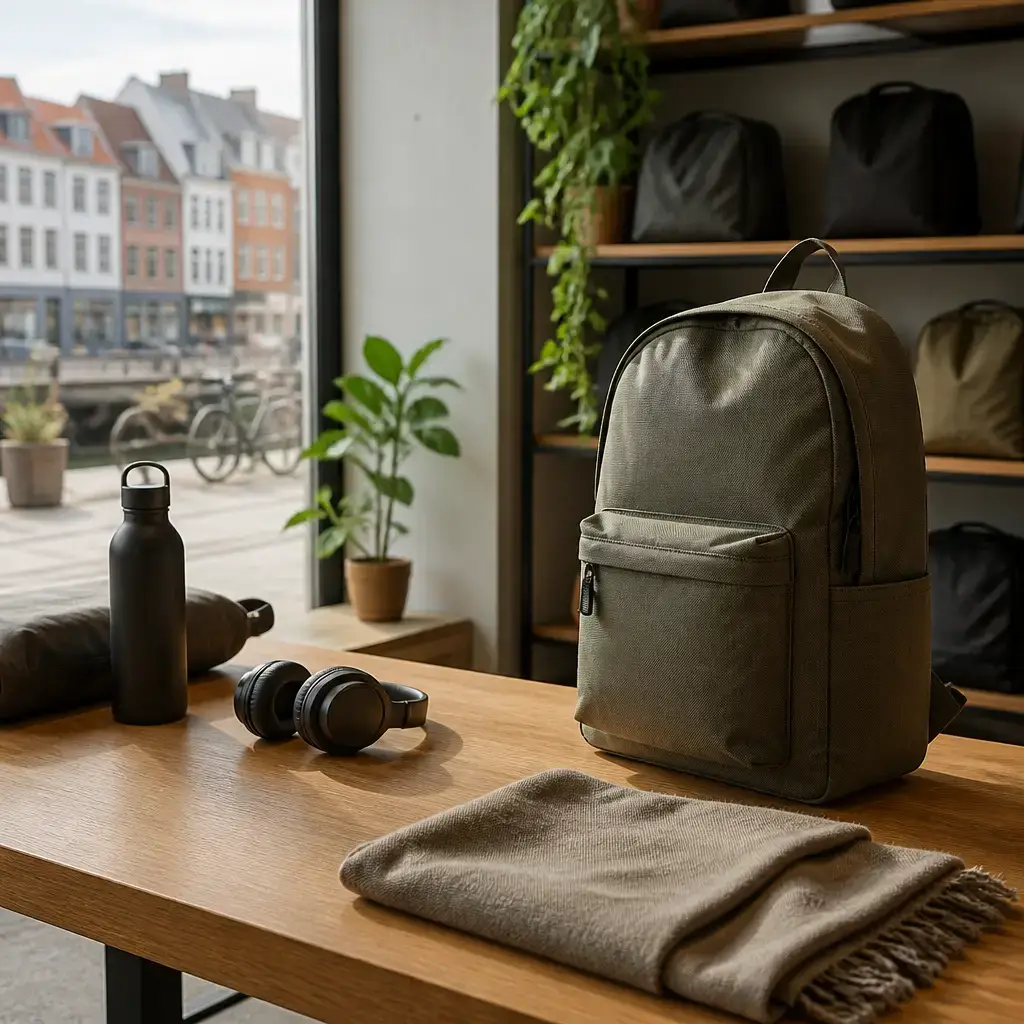
Use Comparing a Backpack Online and in the Shop to practice Danish conversation, pronunciation, vocabulary, grammar, and quizzes.
Dialogue
Onlineannoncen er nyttig.
OHN-line an-ON-suh-n er NUR-dee. The online listing is helpful.Men jeg vil prøve rygsækken i butikken.
Men yai veel PRUR-vuh RURK-sake-en ee boo-DEG-en. But I want to try the backpack in person.I butikken kan du undersøge stropperne, lynlåsen og materialet grundigt.
Ee boo-DEG-en kan doo ON-suh-yuh STROHP-er-nuh, LUN-lohs-en oh ma-teh-ree-ELL-et GROON-dee. In the shop, you can check the straps, zipper, and material closely.Flere anmeldelser nævner svage lynlåse, så jeg vil teste den del grundigt.
FLAY-uh AN-mel-əl-suh-r nehvn-uh SVAY-uh LUN-lohs-uh, soh yai veel TES-duh den dayl GROON-dee. Several reviews mention weak zippers, so I want to test that part carefully.Så prøv at åbne den et par gange.
Soh PROOV ad AW-bnuh den ed PAHR GANG-uh. Then try opening it a few times.Spørg om reglerne for ombytning, før du beslutter dig.
SPURK om RAY-luh-nuh for OM-boo-tning, fur doo beh-SLUT-uh sai. Ask about the exchange policy before you decide.Den her føles stærkere, selv om hjemmesiden viser farvemulighederne tydeligere.
Den hair FUR-luhs STAIR-uh, selv om YEM-uh-see-duh-n VEE-suh FAR-vuh-moo-LEE-uhd-er-nuh TOO-duh-LEE-uh. The one here feels stronger, though the website shows the color options more clearly.Brug hjemmesiden til at se mulighederne.
BROO YEM-uh-see-duh-n teel ad say moo-LEE-uhd-er-nuh. Use the website for the options.Brug besøget i butikken til at vurdere kvaliteten.
BROO beh-SUR-yed ee boo-DEG-en teel ad vur-DAY-uh kwa-lee-TAYD-en. Use the shop visit to judge the quality.Det giver mig en tydeligere måde at sammenligne dem på.
Deh GEE-vuh mai en TOO-duh-LEE-uh MOH-thuh ad suh-men-LEE-nuh dem poh. That gives me a clearer way to compare them.Vælg den, der føles pålidelig og stadig har den stil, du gerne vil have.
Vail den, dair FUR-luhs poh-LEE-thuh-lee oh STAH-dee har den steel, doo YAR-nuh veel HAY-vuh. Choose the one that feels reliable and still has the style you want.Sentence explanations
Onlineannoncen er nyttig.
The online listing is helpful.
- Onlineannoncen
- the online listing
- nyttig
- helpful; useful
More detail
Onlineannoncen means “the online listing” here. It is a compound: online + annonce (“listing” or “advertisement”). The ending in annoncen marks the definite singular form, so en annonce is “a listing,” while annoncen is “the listing.” Danish commonly writes such compounds as one word. nyttig means “helpful” or “useful” in this sentence. It is the positive form of the adjective; the comparative is nyttigere (“more useful”) and the superlative is nyttigst (“most useful”). Danish adjectives can change according to the noun or construction: compare en nyttig annonce, et nyttigt råd, and nyttige annoncer. In this sentence, nyttig follows er and describes the subject. Together, Onlineannoncen er nyttig. has the structure “The online listing is useful/helpful”: the definite noun phrase Onlineannoncen is the subject, er is the present form of “to be,” and nyttig is the adjective describing it.
Men jeg vil prøve rygsækken i butikken.
But I want to try the backpack in person.
- Men
- but
- jeg vil
- I want to
- prøve
- try
- rygsækken
- the backpack
- butikken
- the shop
More detail
Men is a conjunction meaning “but.” It links this utterance to a contrasting idea. Example: Jeg vil købe den, men den er dyr. — “I want to buy it, but it is expensive.” jeg vil contains jeg, “I,” and vil, the present-tense form of ville. Here vil expresses desire: “want to.” With a following verb, Danish uses vil plus the infinitive without at: Jeg vil vente. — “I want to wait.” In other contexts, vil can also contribute a future meaning, but the fixed translation establishes desire here. prøve is the infinitive “to try.” After vil, it remains in this form: jeg vil prøve. The form prøver is present tense, as in Jeg prøver rygsækken. — “I am trying the backpack.” rygsækken means “the backpack” here. Its base noun is rygsæk, “a backpack.” The definite singular ending is -en; in this spelling, the final k is doubled before that ending: en rygsæk — “a backpack,” rygsækken — “the backpack.” Here it is the object of prøve. butikken means “the shop” or “the store.” The base noun is butik, “a shop.” Its definite singular form is butikken, with the final k doubled before the -en ending: en butik — “a shop,” butikken — “the shop.” With the preposition i, i butikken means “in the shop.” Example: Hun er i butikken. — “She is in the shop.” Together, jeg vil prøve rygsækken means “I want to try the backpack,” and i butikken adds the place: “in the shop.” The complete utterance is therefore “But I want to try the backpack in person”; the shop setting supplies the in-person sense, contrasted with trying to assess it through an online listing. The reusable pattern is Jeg vil prøve [object] i [place] — “I want to try [object] in [place].”
I butikken kan du undersøge stropperne, lynlåsen og materialet grundigt.
In the shop, you can check the straps, zipper, and material closely.
- butikken
- the shop
- kan du
- you can
- undersøge
- check
- stropperne
- the straps
- lynlåsen
- the zipper
- materialet
- the material
- grundigt
- closely
More detail
butikken means “the shop” here. Its base form is butik (“shop”), and the ending -ken marks the definite singular form: en butik = “a shop”, butikken = “the shop”. In I butikken, I means “in” and the whole phrase gives the place where the action can happen. kan du combines the modal verb kan (“can/be able to”) with the subject pronoun du (“you”). kan is the present form of kunne; after a modal such as kan, the following verb stays in the infinitive. Here this is a statement about what you are able or permitted to do, not a question, because the sentence has ordinary statement word order. undersøge is the infinitive “to examine/check”. After kan du, it names the action that is possible: du kan undersøge ... = “you can check ...”. For example, Du kan undersøge tasken. means “You can examine the bag.” stropperne means “the straps”. Its base noun is strop (“strap”); stropper is its plural, and the definite plural form is stropperne. The definite form identifies the straps as the relevant set in this situation. A corresponding indefinite contrast is stropper (“straps” or “some straps”). lynlåsen means “the zipper”. The base noun is lynlås; lynlåsen is its definite singular form, with -en marking definiteness. The nearby context also concerns zippers, but this form itself is singular: “the zipper”. materialet means “the material”. Its base noun is materiale (“material”); materialet is its definite singular form, with -et. Danish uses different definite singular endings with different nouns, so the ending must be learned with the noun rather than inferred from meaning alone. grundigt means “thoroughly” or, in this translation, “closely”. It is related to the adjective grundig (“thorough”). Here grundigt is an adverb modifying undersøge, so it describes how the checking is done. For example, Hun undersøger varen grundigt. means “She examines the item thoroughly.” Together, I butikken sets the location, kan du undersøge expresses that you can perform the checking, and stropperne, lynlåsen og materialet lists what you can check. grundigt says that the checking should be careful and thorough. The complete meaning is: “In the shop, you can check the straps, zipper, and material closely.”
Flere anmeldelser nævner svage lynlåse, så jeg vil teste den del grundigt.
Several reviews mention weak zippers, so I want to test that part carefully.
- Flere
- several
- anmeldelser
- reviews
- nævner
- mention
- svage
- weak
- lynlåse
- zippers
- så
- so
- jeg vil
- I want to
- teste
- test
- den
- that/the
- del
- part
- grundigt
- thoroughly
More detail
Flere means “several” here and stands before the plural noun anmeldelser. It is also used for “more” in comparisons, so context distinguishes the meanings. Example: Flere kunder kommer. — “Several customers are coming.” anmeldelser is the plural of anmeldelse, “review.” The form is an indefinite plural; the definite singular is anmeldelsen, and the definite plural is anmeldelserne. nævner means “mention” in this sentence. Its base form is nævne; nævner is the present-tense form, which does not change for person or number in Danish. Example: Hun nævner prisen. — “She mentions the price.” svage means “weak” and describes the plural noun lynlåse. The adjective’s base form is svag; useful comparison forms are svagere (“weaker”) and svagest (“weakest”). The ending in svage marks the plural or definite form here, not the noun’s gender. lynlåse means “zippers.” It is the plural of lynlås; lynlåsen is the definite singular “the zipper.” Example: Jeg reparerer to lynlåse. — “I am repairing two zippers.” så links the two clauses with the result or consequence “so.” It connects the reviews’ mention of weak zippers with the speaker’s decision to test that part. jeg vil is the reusable pattern “I want to / I intend to.” jeg is the first-person singular pronoun “I,” and vil is the present form of ville. In this use, vil is followed directly by an infinitive: jeg vil teste — “I want to test.” teste is the infinitive “to test.” After vil, Danish uses the infinitive without at: Jeg vil teste den. — “I want to test it.” The related noun test means “test,” but it is not the base form of this verb; the verb is teste. den means “that” in the object phrase den del. It is a singular common-gender demonstrative form and points to the part identified in the fixed translation. In this sentence, the translation specifies that the part is what will be tested; the form itself does not add a plural meaning. del means “part.” In den del, it names the specific part being tested. Danish commonly uses a demonstrative such as den before this kind of singular noun phrase: den del — “that part.” grundigt means “thoroughly” and describes how the testing is done. It is the adverbial form related to the adjective grundig (“thorough”); the -t form is used here as an adverb. Example: Hun undersøger tasken grundigt. — “She examines the bag thoroughly.” Together, Flere anmeldelser nævner svage lynlåse means “Several reviews mention weak zippers.” The conjunction så then introduces the consequence, jeg vil teste den del grundigt: “I want to test that part thoroughly.” The complete utterance therefore means: “Several reviews mention weak zippers, so I want to test that part carefully.”
Så prøv at åbne den et par gange.
Then try opening it a few times.
- Så
- then
- prøv
- try
- åbne
- open
- den
- it
- et par gange
- a few times
More detail
Så means “then” here and links this instruction to what has just been said. It can also mean “so” in other contexts, but this sentence uses it as a sequence marker. prøv is the imperative of prøve (“to try”). The imperative addresses one or more people in the same form; context determines whether the addressee is singular or plural. Danish commonly forms this kind of command with the verb in the imperative: Prøv! = “Try!” at åbne contains at plus the infinitive åbne (“to open”). After prøv, Danish uses prøv at + infinitive for “try to do something.” The at here marks the infinitive; it is not the English preposition “at.” Example: Prøv at læse den. = “Try to read it.” den is a singular common-gender object pronoun meaning “it” here. In the supplied context, it refers to the part being tested, identified previously as den del; the pronoun itself does not repeat that noun. Danish also uses det for a singular neuter referent, so the choice between den and det follows the grammatical gender of the noun being replaced, not simply its meaning as an object. et par gange means “a few times” here. et par expresses a small number, and gange is the plural of gang (“time” in the sense of an occurrence). This is a quantity expression for repetition: Læs den et par gange. = “Read it a few times.” Together, Så prøv at åbne den et par gange. means “Then try opening it a few times.” Så connects the suggestion to the preceding point; prøv at åbne gives the instruction; den is the object; and et par gange says to repeat the opening a small number of times. The imperative makes this a direct but ordinary instruction.
Spørg om reglerne for ombytning, før du beslutter dig.
Ask about the exchange policy before you decide.
- Spørg om
- ask about
- reglerne
- the rules
- ombytning
- exchange
- før
- before
- du beslutter dig
- you decide
More detail
Spørg om is a reusable way to tell one person to ask about something. Spørg is the imperative of spørge (“ask”); the imperative addresses the listener directly. om means “about” in this construction. Example: Spørg om prisen. — “Ask about the price.” reglerne means “the rules” here. Its base noun is regel (“rule”); regler is the plural, and the ending -ne marks definite plural, “the rules.” The definite form presents the rules as an identifiable set in the situation. ombytning is the noun for an exchange or replacement. It is the activity referred to after for in reglerne for ombytning, literally “the rules for exchange.” Example: Læs reglerne for ombytning. — “Read the rules for exchange.” før means “before.” Here it introduces a following clause, so it links two events in time: the asking comes first, and the deciding comes afterward. Example: Ring, før du går. — “Call before you leave.” du beslutter dig means “you decide.” du is the second-person singular pronoun “you.” beslutter is the present-tense form of beslutte (“decide”), and dig is the reflexive form referring back to du. Together, beslutte sig is the construction used for deciding. In this sentence, the present form appears in the clause after før even though the decision is later relative to the asking. Example: Du beslutter dig senere. — “You decide later.” Together, Spørg om reglerne for ombytning gives the imperative “Ask about the rules for exchange.” Adding før du beslutter dig places that action before the listener decides: “Ask about the exchange policy before you decide.”
Den her føles stærkere, selv om hjemmesiden viser farvemulighederne tydeligere.
The one here feels stronger, though the website shows the color options more clearly.
- Den her
- this one here
- føles
- feels
- stærkere
- stronger
- selv om
- although
- hjemmesiden
- the website
- viser
- shows
- farvemulighederne
- the color options
- tydeligere
- more clearly
More detail
Den her means “this one here.” It is a demonstrative expression: den is the form used with a singular common-gender referent, while her adds the location “here.” The supplied sentence does not identify the referent more specifically. Compare the reusable patterns den her “this one here,” det her “this one here” with a neuter referent, and de her “these here.” føles comes from føle and is the present-tense form used here for how something is experienced by touch or impression: “feels.” Example: Stoffet føles blødt. — “The fabric feels soft.” stærkere is the comparative form of stærk, “strong.” The useful comparison chain is stærk — stærkere — stærkest: “strong” — “stronger” — “strongest.” Here it compares this item with another understood option; it does not itself specify what kind of strength is being judged. Example: Denne løsning virker stærkere. — “This solution seems stronger.” selv om introduces a concessive clause, meaning “although” or “even though.” It presents the following information as a contrast to the main statement. Example: Jeg går ud, selv om det regner. — “I am going out even though it is raining.” hjemmesiden is the definite singular form of hjemmeside, “website”: en hjemmeside — “a website,” hjemmesiden — “the website.” The ending -en marks definiteness for this noun; it does not by itself state a numerical count beyond the singular form of the noun. viser comes from vise, “show,” and is its present-tense form. In this sentence, the website is the subject and the color options are what it shows. Example: Billedet viser en løsning. — “The picture shows a solution.” farvemulighederne means “the color options.” It is the definite plural form of farvemulighed, “color option”: farvemulighed — singular, farvemuligheder — plural, farvemulighederne — definite plural. The compound combines farve “color” with mulighed “option” or “possibility.” tydeligere is the comparative form of tydelig, “clear” or “clearly” depending on its function. Here it modifies the verb viser, so it means “more clearly”: the website displays the options in a clearer way. Its comparison chain is tydelig — tydeligere — tydeligst, “clear” — “clearer/more clearly” — “clearest/most clearly.” Do not confuse it with stærkere, which compares the strength of the item rather than the clarity of the display. Together, Den her føles stærkere says “This one here feels stronger.” selv om hjemmesiden viser farvemulighederne tydeligere adds the contrast “although the website shows the color options more clearly.” The complete utterance is therefore: “The one here feels stronger, though the website shows the color options more clearly.”
Brug hjemmesiden til at se mulighederne.
Use the website for the options.
- Brug
- use
- hjemmesiden
- the website
- til at
- to; in order to
- se
- see; view
- mulighederne
- the options
More detail
Brug is the imperative of bruge, “to use”. It addresses one or more people without stating a subject: Brug hjemmesiden. = “Use the website.” The present form is bruger, as in Jeg bruger hjemmesiden. (“I use the website.”) hjemmesiden means “the website”. It is the definite singular form of hjemmeside: en hjemmeside = “a website”, hjemmesiden = “the website”. The ending -en marks definiteness for this noun. til at introduces an intended action after an expression such as “use X”. The reusable pattern is bruge X til at + infinitive: Brug appen til at finde adressen. = “Use the app to find the address.” Here, til at links the website with the purpose expressed by se. se is the infinitive “to see” or “to view”. After til at, Danish uses the infinitive: til at se. In this sentence, viewing information on the website is the intended action; se does not necessarily mean physically looking at an object. mulighederne means “the options”. It is the definite plural of mulighed: en mulighed = “an option”, muligheder = “options”, mulighederne = “the options”. The plural ending is -er, and -ne marks the plural as definite. Together, Brug hjemmesiden gives the instruction “Use the website”, and til at se mulighederne gives its purpose, “to see the options”. The whole utterance therefore means “Use the website to see the options.”
Brug besøget i butikken til at vurdere kvaliteten.
Use the shop visit to judge the quality.
- Brug
- use
- besøget
- the visit
- i butikken
- in the shop
- til at
- to / for
- vurdere
- assess
- kvaliteten
- the quality
More detail
Brug is the imperative of bruge, “to use.” The imperative addresses the reader directly and has the same form for singular and plural addressees. The present-tense form is bruger; for example, Brug hjemmesiden means “Use the website.” besøget means “the visit.” It is the definite singular form of the neuter noun besøg: et besøg = “a visit,” besøget = “the visit.” The definite ending identifies one visit as a particular relevant activity, without stating how many people made it. i butikken means “in the shop.” butikken is the definite singular form of butik: en butik = “a shop,” butikken = “the shop.” Here i places the visit in the shop; it does not by itself express movement into the shop. til at introduces a purpose or intended use when it is followed by an infinitive. The pattern bruge X til at + infinitive means “use X to do something.” For example, Jeg bruger kameraet til at tage billeder means “I use the camera to take pictures.” vurdere is the infinitive “to assess” or “to judge.” It follows til at in the purpose construction. The related noun is en vurdering, “an assessment,” but vurdere itself is the verb used here. kvaliteten means “the quality.” It is the definite singular form of the common-gender noun kvalitet: en kvalitet = “a quality,” kvaliteten = “the quality.” The definite form presents the quality as the particular aspect being assessed, rather than asserting a quantity of quality. Together, besøget i butikken is the resource being used, and til at vurdere kvaliteten states its purpose. The complete utterance is an imperative: “Use the shop visit to judge the quality.”
Det giver mig en tydeligere måde at sammenligne dem på.
That gives me a clearer way to compare them.
- Det
- that
- giver
- gives
- mig
- me
- tydeligere
- clearer
- måde
- way
- sammenligne
- compare
- dem
- them
More detail
Det is the subject here and means “that.” Danish det can function as a pronoun referring to something already understood; its exact referent is not stated inside this sentence. Do not confuse it with den, which is used in other grammatical environments. giver is the present-tense form of give (“to give”). Danish verbs generally do not change form for the subject’s person or number, so giver can be used with several subjects. The pattern give someone something is visible here: Det giver mig ... means “That gives me ...”. mig means “me” as an object. Compare subject jeg (“I”) with object mig (“me”): Jeg sammenligner dem means “I compare them,” while Det giver mig ... means “That gives me ...”. tydeligere means “clearer” here. It is the comparative form of tydelig (“clear”): tydelig, tydeligere, tydeligst = “clear,” “clearer,” “clearest.” The comparison applies to måde, so the sentence presents this as a clearer way than another understood way. The comparative form does not itself identify what the other way is. måde means “way” or “manner.” Its common reusable form is en måde; the plural is måder. Danish commonly uses the pattern en måde at ... på for “a way to ...”: en måde at lære på means “a way to learn.” sammenligne is the infinitive “to compare,” from the verb sammenligne. It normally takes the things being compared as an object, as in sammenligne to muligheder (“compare two possibilities”). dem means “them” as a plural object pronoun. It refers to the things being compared in this sentence, without the sentence itself specifying their identity. Compare object dem with subject de (“they”): De sammenligner dem means “They compare them.” Together, Det giver mig means “That gives me,” and en tydeligere måde at sammenligne dem på means “a clearer way to compare them.” The final på completes the Danish måde at ... på construction, so the whole utterance is: “That gives me a clearer way to compare them.”
Vælg den, der føles pålidelig og stadig har den stil, du gerne vil have.
Choose the one that feels reliable and still has the style you want.
- Vælg den
- choose the one
- der
- that / which
- føles
- feels
- pålidelig
- reliable
- stadig
- still
- har
- has
- den
- the
- stil
- style
- du
- you
- gerne vil have
- would like to have
More detail
Vælg den begins with Vælg, the imperative of vælge (“to choose”). The imperative directly addresses the listener: “Choose …”. den is a singular common-gender pronoun meaning “the one” here; the specific item is not named in this sentence. Example: Vælg den blå. — “Choose the blue one.” der introduces the relative clause describing which one to choose. In this sentence it corresponds to “that” in “the one that …”. Danish der is a common relative pronoun for a subject in a relative clause; it does not itself identify the referent. føles is the present form of føle (“to feel”). Here it describes how the chosen item seems or feels: “feels”. Example: Det føles godt. — “It feels good.” pålidelig means “reliable” or “dependable”. It describes the item’s perceived reliability in føles pålidelig: “feels reliable”. The adjective has the same form with a common-gender singular noun; other noun forms can require different agreement in Danish. stadig means “still”, indicating that the following property remains true as part of the requested choice. It is separate from pålidelig: the sentence asks for something that feels reliable and still has the desired style. har is the present form of have (“to have”). In har den stil, it means “has”. Example: Hun har en bil. — “She has a car.” The second den belongs with stil in den stil, meaning “the style”. This den is a determiner before a singular common-gender noun, not the standalone pronoun den meaning “the one”. Danish can also mark definiteness by a noun ending, as in stilen (“the style”); den stil uses the separate determiner instead. stil means “style”. It is a common-gender noun: en stil (“a style”), stilen (“the style”). Here it is the thing the chosen item has. du is the second-person singular pronoun “you”. It is the subject of the final clause, so the desired style is associated with the person being addressed. gerne vil have is a reusable construction meaning “would like to have”. vil is the present form of ville (“to want / will”), and have is the infinitive “to have”. gerne adds the meaning “willingly” and makes vil have express a polite or softened desire: Jeg vil have kaffe. — “I want coffee”; Jeg vil gerne have kaffe. — “I would like coffee.” Together, den, der føles pålidelig means “the one that feels reliable”. og stadig har den stil, du gerne vil have adds a second requirement: it must also have the style you would like to have. The complete utterance is therefore: “Choose the one that feels reliable and still has the style you want.”
Grammar Points
før + ledsætning
før du beslutter dig
fur doo beh-SLUT-er saibefore you decide
før introduces a subordinate clause. The subject comes before the verb: før du beslutter dig.
Adjektiv + -ere
stærkere materiale
STAIR-uh-uh ma-teh-ree-ELLstronger material
Many Danish comparatives add -ere: stærk becomes stærkere. The comparative form stays unchanged before a noun.
Danish Vocabulary
- Gender
- common
- Gender
- common
- Gender
- common
- Gender
- neuter
Onlineannoncen er nyttig.
- Gender
- common
Jeg vil prøve rygsækken.
- Gender
- common
- Gender
- common
Du kan undersøge materialet grundigt.
Quiz
Word Order
Arrange the words in the correct order.
The online listing is helpful.
Show Answer
Onlineannoncen er nyttig.Use the website for the options.
Show Answer
Brug hjemmesiden til at se mulighederne.Spelling
Tap the letters to spell the word.
backpack
Show Answer
rygsækkentry
Show Answer
prøvestrap
Show Answer
stroppernezipper