10 minutes free every day
Continue audio lessons in the app
Word explanations appear automatically in sync with the audio.
No login required · synced translations · playback with the screen locked
Choose your learning language and open this lesson in the app.

About This Lesson
Use Staying focused on needed purchases to practice Danish conversation, pronunciation, vocabulary, grammar, and quizzes.
Dialogue
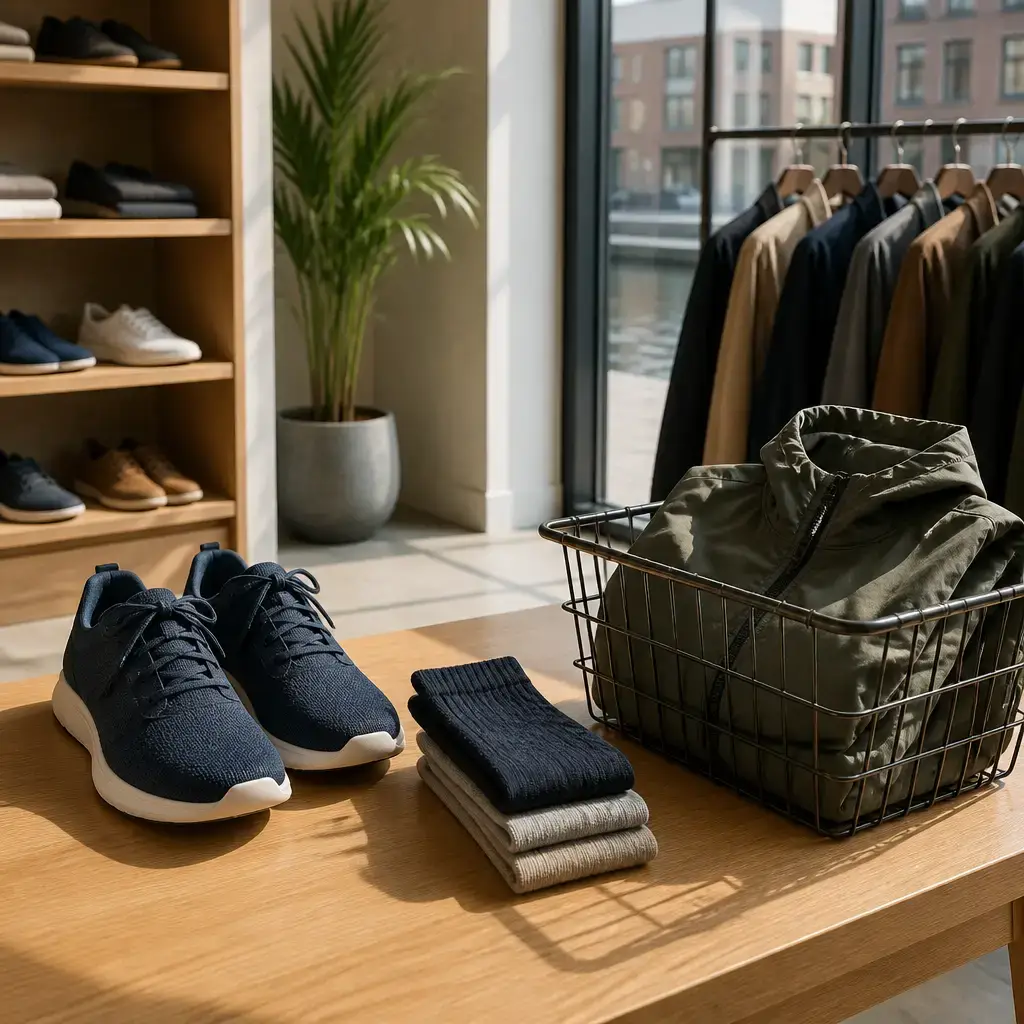
Jeg kom efter sko, men de andre varer, der står fremme, distraherer mig.
YAI kom EF-tuh SGOH, men dee OW-thruh VAIR-uh, dair stohr FREM-uh, dis-trah-HAIR-uh MYAI. I came for shoes, but the other items on display are distracting me.Start med det, du kom efter, før du vælger noget andet.
STAHRT med deh, doo kom EF-tuh, fohr doo VEL-yuh NOH-uhd EN-uhd. Start with what you came for before adding anything else.Skoene er nødvendige, men jakken frister mig bare.
SGOH-uh-nuh air NUR-ven-dee-uh, men YAH-gun FRES-duh MYAI BAH-uh. The shoes are necessary, but the jacket is only tempting.Så lad jakken blive ude af kurven indtil videre.
Soh lah YAH-gun BLEE-vuh OO-thuh ow KUR-vun in-TEEL VEE-thuh-ruh. Then keep the jacket out of your basket for now.De her sokker passer til skoene og kan erstatte mit slidte par.
Dee hair SOHG-uh pass-uh teel SGOH-uh-nuh oh kan uh-STAHD-uh meet SLEE-thuh PAHR. These socks would match the shoes and replace my worn pair.De passer bedre ind i din plan end jakken gør.
Dee PAS-uh BEDH-ruh en ee deen plan en YAH-gun guhr. They fit your plan better than the jacket.Jeg tager skoene og sokkerne, og så går jeg.
YAI TAI-uh SGOH-uh-nuh oh SOHG-uh-nuh, oh soh guhr YAI. I'll take the shoes and socks, then head out.Det gør din indkøbstur fokuseret og praktisk.
Deh guhr deen in-KURBS-toor foh-koo-SAIR-uhd oh PRAHG-tisk. That keeps your shopping trip focused and practical.Sentence explanations
Jeg kom efter sko, men de andre varer, der står fremme, distraherer mig.
I came for shoes, but the other items on display are distracting me.
- kom efter
- came for
- sko
- shoes
- de andre
- the other
- varer
- items
- står fremme
- are on display
- distraherer
- distracts
More detail
kom efter means “came for” here: kom is the past form of komme (“to come”), and efter expresses what the person came to get in this construction. The present form is kommer: Jeg kommer efter sko = “I am coming for shoes.” This is different from komme efter meaning “come after” when the context is about following in time or position. sko means “shoes.” It is the plural form of sko; Danish uses the same written form for the indefinite singular and plural of this noun, so the intended number here comes from the context and meaning rather than from a visible ending. The fixed translation identifies the intended plural reading. de andre means “the other” before the plural noun varer; together, de andre varer means “the other items.” andre is the plural form used with de of anden (“other/another”). Compare en anden vare (“another item”) with de andre varer (“the other items”). varer means “items” here, specifically goods or merchandise. It is the plural of vare (“item, product, goods”). The noun’s plural ending is -r: vare → varer. står fremme means “are on display” here. står is the present form of stå (“stand”); fremme is an adverb meaning that something is out and available to be seen, so the combination describes items positioned out in view. Danish can use a posture verb such as stå for an object’s displayed position; this does not mean that the items are literally standing like people. Example: Bøgerne står fremme. = “The books are out on display.” distraherer means “distracts” in the present tense. It is the present form of distrahere; the form does not show the subject’s person or number. In this sentence, de andre varer ... distraherer mig means “the other items ... are distracting me.” mig is the object form of jeg (“me”), although it is not included in the selected phrase. The sentence first gives the purpose of the visit: Jeg kom efter sko (“I came for shoes”). After men (“but”), de andre varer, der står fremme identifies other goods that are displayed; der introduces the relative clause describing those goods. The clause distraherer mig says that they are distracting the speaker. Together: “I came for shoes, but the other items on display are distracting me.”
Start med det, du kom efter, før du vælger noget andet.
Start with what you came for before adding anything else.
- Start
- start
- med det
- with that
- du kom efter
- you came for
- før
- before
- du vælger
- you choose
- noget andet
- something else
More detail
Start is the imperative of starte (“to start”). It gives a direct instruction to begin. The infinitive is at starte, and the imperative is Start! (“Start!”). med det means “with that.” med means “with,” and det is the neuter singular pronoun used here. The following relative clause, du kom efter, identifies what det refers to in this utterance, so the combined meaning is “with what you came for.” du kom efter means “you came for.” du is the second-person singular subject. kom is the past form of komme (“come”), while efter completes the expression komme efter (“come for” or “come to get”). Example: Jeg kom efter mine sko. — “I came for my shoes.” før means “before” and marks the order between two events. In this sentence, the choosing happens after the instructed starting point. Example: før du går — “before you leave.” du vælger means “you choose.” vælger is the present form of vælge (“choose”), used with the subject du. Example: Du vælger en bog. — “You choose a book.” noget andet means “something else.” noget means “something,” and andet is the neuter singular form of anden (“other/another”), matching noget. Example: Vil du have noget andet? — “Do you want something else?” Together, Start med det, du kom efter means “Start with what you came for.” The relative clause du kom efter specifies the intended meaning of det. før du vælger noget andet adds the sequence: begin with that intended item or goal before choosing something else. The whole utterance means: “Start with what you came for before adding anything else.”
Skoene er nødvendige, men jakken frister mig bare.
The shoes are necessary, but the jacket is only tempting.
- Skoene
- the shoes
- nødvendige
- necessary
- jakken
- the jacket
- frister
- tempts
- mig
- me
- bare
- only
More detail
Skoene means “the shoes” here. It is the definite plural form of sko (“shoe”), with -ene marking definite plural in this form. Example: Skoene står ved døren. — “The shoes are by the door.” nødvendige means “necessary.” The adjective has its -e form because it occurs with a definite noun phrase, and it also agrees with the plural noun skoene. The same form appears with a definite singular noun: den nødvendige ting (“the necessary thing”), while an indefinite singular form is en nødvendig ting (“a necessary thing”). The -e ending belongs to the adjective, not to the noun. jakken means “the jacket.” It is the definite singular form of jakke, formed with the ending -en. Example: Jakken er varm. — “The jacket is warm.” frister means “tempts” in this sentence. It is the present-tense form of friste (“to tempt”). Danish present tense does not change for the subject’s person: jeg frister, du frister, and den frister all use frister. Here jakken is the subject—the thing doing the tempting—while mig identifies the person affected. mig means “me.” It is the object form of the first-person pronoun; compare subject jeg (“I”) with object mig (“me”). Example: Hun ser mig. — “She sees me.” bare means “only” here. It limits the statement by presenting the jacket as tempting, without asserting that it is necessary. In other contexts, bare can also mean “just,” but “only” is the supported meaning here. The full sentence has the pattern X er Y, men Z frister mig bare: Skoene er nødvendige (“The shoes are necessary”), followed by men (“but”), then jakken frister mig bare (“the jacket only tempts me”). Together, the fixed utterance means: “The shoes are necessary, but the jacket is only tempting.”
Så lad jakken blive ude af kurven indtil videre.
Then keep the jacket out of your basket for now.
- Så
- then
- lad … blive
- keep … / let … remain
- jakken
- the jacket
- ude af
- out of
- kurven
- the basket
- indtil videre
- for now
More detail
Så means “then” here and links this utterance to the preceding situation. It can also mean “so” in other contexts, but the fixed translation supports the time/sequence meaning here. lad is the imperative of lade, “to let” or “allow.” In the reusable pattern lad + noun/pronoun + infinitive, it tells someone to allow the named person or thing to do something or remain in a state. The imperative addresses the listener; the subject is understood rather than stated. jakken is the definite form of jakke, “jacket”: en jakke means “a jacket,” while jakken means “the jacket.” The definite ending identifies a particular jacket in this utterance, consistent with the fixed translation and the previous sentence. blive is the infinitive of blive, “remain/stay” or “become,” depending on context. In lad jakken blive, it means “let the jacket remain.” The combination lade + noun + infinitive is useful for expressing “let/keep [someone or something] do or remain [something].” Example: Lad døren stå åben. — “Leave the door open.” ude af expresses being outside or excluded from something: literally, “out of.” Here it describes the jacket’s location in relation to the basket. The preposition af is part of this useful directional or relational pattern; it is not the same as simply saying that something is ude (“outside”) without specifying what it is outside of. kurven is the definite form of kurv, “basket”: en kurv means “a basket,” and kurven means “the basket.” In ude af kurven, it names the container from which the jacket is to remain excluded. indtil videre is a fixed time expression meaning “for now” or “until further notice.” It limits the instruction to the present period rather than stating that the jacket must remain out permanently. Together, Så lad jakken blive ude af kurven indtil videre. means “Then keep the jacket out of your basket for now.” The sequence is: Så (“then”), the imperative pattern lad + jakken + blive (“let the jacket remain”), the location relation ude af kurven (“out of the basket”), and the time limit indtil videre (“for now”).
De her sokker passer til skoene og kan erstatte mit slidte par.
These socks would match the shoes and replace my worn pair.
- De her
- these
- sokker
- socks
- passer til
- match / go with
- skoene
- the shoes
- kan
- can
- erstatte
- replace
- mit
- my
- slidte
- worn
- par
- pair
More detail
De her identifies a nearby group as “these.” De is the plural form of the demonstrative, while her adds the meaning of proximity. The phrase therefore agrees with the plural noun sokker, rather than with a singular noun. Example: De her bøger er nye. — “These books are new.” sokker means “socks” here. Its base form is sok (“sock”), and sokker is the ordinary plural form. Example: Jeg vasker sokker. — “I wash socks.” passer til is a reusable construction meaning that one thing matches, suits, or goes with another. passer is the present-tense form of passe; it does not change here for the plural subject. The preposition til is part of this meaning, so passer til is not just the same as passer. Example: Farven passer til jakken. — “The color goes with the jacket.” skoene means “the shoes.” The noun is sko, whose plural is also sko; the definite plural form adds -ene, giving skoene. In this sentence, it is the thing that the socks match. Example: Jeg pudser skoene. — “I polish the shoes.” kan expresses possibility or ability: “can.” It is a present-tense modal form, and the following verb stays in the infinitive. Here the combination presents replacing the pair as a possible option, corresponding to the fixed translation’s “would replace.” Example: Vi kan vente. — “We can wait.” erstatte means “to replace.” It is the infinitive used after the modal kan; the form does not take a personal ending here. Example: Hun kan erstatte den gamle del. — “She can replace the old part.” mit means “my” before a singular neuter noun. The possessive form agrees with the possessed noun, not with the possessor: mit is used with an et-word, while min is used with a common-gender singular noun and mine with plural nouns. Example: mit hus — “my house,” but min bil — “my car.” slidte means “worn” in this noun phrase. Its base form is slidt; slidte is the adjective form used with a definite noun phrase such as mit slidte par. The adjective describes par, not mit. Example: et slidt par — “a worn pair”; mit slidte par — “my worn pair.” par means “pair.” It is a neuter singular noun (et par), which explains the use of mit; the word itself does not identify a pair of any particular item without context. Here the surrounding reference to socks makes “my worn pair” understood as a worn pair of socks. Example: Jeg købte et par. — “I bought a pair.” Together, De her sokker means “these socks,” and passer til skoene says that they match or go with the shoes. kan erstatte presents replacement as a possible action, while mit slidte par identifies the worn pair being replaced. The complete meaning is: “These socks would match the shoes and replace my worn pair.”
De passer bedre ind i din plan end jakken gør.
They fit your plan better than the jacket.
- De
- they
- passer
- fit
- bedre
- better
- ind i
- into
- plan
- plan
- end
- than
- jakken
- the jacket
- gør
- does
More detail
De is the subject pronoun meaning “they” here. The immediately preceding context identifies the referent as the socks. As a useful contrast, de is used for a subject, while dem is used for an object: De kommer. — “They are coming.” passer is the present-tense form of passe. In this sentence, passe means “fit” or “suit”; the form does not show whether the subject is singular or plural. A useful pattern is noget passer til noget for something matching or suiting something, while passe ind i emphasizes fitting into a larger plan, arrangement, or context. bedre is the comparative form of god (“good”): god → bedre → bedst (“good” → “better” → “best”). Here it compares how well the socks fit with how well the jacket fits. ind i means “into” in the figurative pattern passe ind i noget, “fit into something.” The following din plan supplies what the items fit into. din means “your,” and plan is the noun “plan”; plan has the definite form planen, “the plan.” end introduces the second side of a comparison, meaning “than.” The pattern is A passer bedre ... end B, “A fits better ... than B.” jakken means “the jacket.” It is the definite singular form of jakke: jakke → jakken, “jacket” → “the jacket.” The ending -en marks definiteness for this noun; it is not a separate word. gør is the present-tense form of gøre, “do/make.” In jakken gør, it stands for the previously stated verb phrase, so the sentence does not need to repeat passer bedre ind i din plan. This is a common way to avoid repetition in a comparison: Hun arbejder mere end han gør. — “She works more than he does.” Together, De passer bedre ind i din plan means “They fit into your plan better.” end jakken gør adds the comparison “than the jacket does,” with gør referring back to fitting into the plan. The whole utterance therefore means: “They fit your plan better than the jacket.”
Jeg tager skoene og sokkerne, og så går jeg.
I'll take the shoes and socks, then head out.
- Jeg
- I
- tager
- take
- skoene
- the shoes
- sokkerne
- the socks
- og så
- and then
- går
- head out
More detail
Jeg means “I” and is the first-person singular subject pronoun. It identifies the speaker; the form does not change for grammatical gender. Danish commonly repeats the subject when a new verb follows: Jeg tager ... og så går jeg (“I take ... and then I go ...”). tager is the present form of tage, “to take”. The present tense can describe a current action or a planned action, so the English future-like “I’ll take” is compatible with this form in the fixed sentence. Example: Jeg tager bussen. — “I’m taking the bus.” skoene means “the shoes”. It is the definite plural form of sko (“shoe/shoes” in this context): sko → skoene. The ending -ene marks definite plural here. This is a noun phrase, and its definite meaning is part of the observed form rather than a separate word. sokkerne means “the socks”. It is the definite plural form of sok (“sock”): sok → sokker (plural) → sokkerne (definite plural). The plural ending and the definite ending are both carried by this noun form. og så combines “and” with “then”. It links the two actions and places the second one after the first. så can have other meanings in Danish, but here the intended meaning is temporal sequence. går is the present form of gå, “to go” or “to walk”. In this sentence it refers to leaving or heading out, as reflected by the fixed translation. The form itself does not contain a separate word meaning “out”; that meaning comes from the use of gå in this context. Example: Vi går nu. — “We’re leaving now.” Together, Jeg tager skoene og sokkerne says that the speaker will take the shoes and socks. og så går jeg then says that the speaker heads out afterward. The repeated jeg makes the speaker the subject of both actions, and the whole utterance means: “I’ll take the shoes and socks, then head out.”
Det gør din indkøbstur fokuseret og praktisk.
That keeps your shopping trip focused and practical.
- Det
- that
- gør
- makes; keeps
- din
- your
- indkøbstur
- shopping trip
- fokuseret
- focused
- praktisk
- practical
More detail
Det is the subject meaning “that” here. In this context, it points back to the preceding action or plan, rather than naming a new participant. Danish det is a neuter singular pronoun/demonstrative; its grammatical form does not identify the exact thing referred to by itself. gør is the present-tense form of gøre, “to make” or “to do.” In this sentence, gør has the causative sense “makes/keeps”: it presents the subject as causing the shopping trip to have the stated qualities. Danish present-tense verbs generally do not change for the subject’s person or number. Example: Det gør arbejdet lettere. — “That makes the work easier.” din means “your” and agrees with the possessed noun. With a common-gender singular noun, Danish uses din; compare dit with a neuter singular noun and dine with plural nouns. Here it belongs with indkøbstur, not with fokuseret or praktisk. indkøbstur is a compound noun meaning “shopping trip.” Its useful base noun is tur, “trip,” while indkøb means “shopping” or “purchases.” The compound treats the whole outing as one trip. Example: Jeg planlægger en indkøbstur. — “I am planning a shopping trip.” fokuseret means “focused” here. It is a past-participial adjective related to fokusere, “to focus,” and describes the resulting state of din indkøbstur after gør. In this position, it is an adjective complement after the object: gør X fokuseret means “makes X focused.” The form fokuseret is also used with a neuter singular noun; plural and definite contexts use fokuserede. praktisk means “practical” here and is coordinated with fokuseret by the conjunction og (“and”). It gives a second description of the same shopping trip. praktisk has the same visible form with common-gender and neuter singular nouns; plural and definite forms are praktiske. Example: Planen gør dagen praktisk. — “The plan makes the day practical.” The structure is Det gør [din indkøbstur] [fokuseret og praktisk]: “That makes/keeps your shopping trip focused and practical.” The two adjectives describe the result caused by det; the fixed translation naturally expresses this result as “keeps your shopping trip focused and practical.”
Grammar Points
lad + infinitiv
Lad varer blive ude.
LAH VAIR-uh BLEE-vuh OO-thuh.Let items stay out.
After the imperative lad, the following verb stays in the infinitive form: blive.
adjektiv i flertal: -e
slidte sokker
SLEE-thuh SOHG-uhworn socks
Before a plural noun, many Danish adjectives take the ending -e: slidt becomes slidte.
Danish Vocabulary
- Gender
- common
Quiz
Spelling
Tap the letters to spell the word.
jacket
Show Answer
jakkenitem
Show Answer
varerdistract
Show Answer
distrahererchoose