10 minutes free every day
Continue audio lessons in the app
Word explanations appear automatically in sync with the audio.
No login required · synced translations · playback with the screen locked
Choose your learning language and open this lesson in the app.

About This Lesson
Use Asking about delivery and stock to practice Danish conversation, pronunciation, vocabulary, grammar, and quizzes.
Dialogue
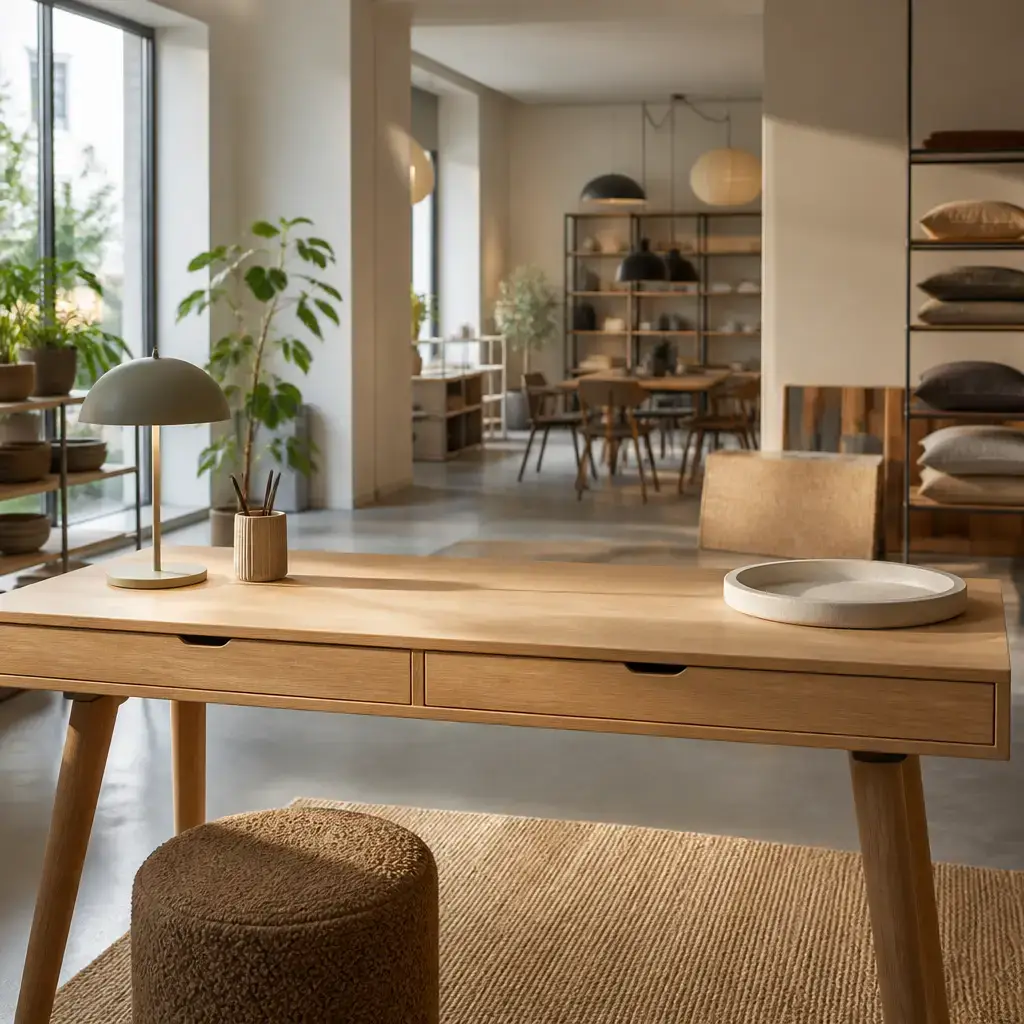
Jeg kan godt lide dette skrivebord, men jeg kan ikke bære det hjem alene.
yai kan gohd LEE-thuh DEH-duh SGREE-vuh-bohr, men yai kan EG-uh BAIR-uh deh YEM uh-LEH-nuh. I like this desk, but I can't carry it home by myself.Vi kan arrangere levering, hvis det stadig er på lager.
VEE kan uh-rung-SAIR-uh LEH-vuh-ring, VEHS deh STAY-thee air poh LAIR. We can arrange delivery if it's still in stock.Kan du tjekke, om lageret har et, der er tilgængeligt?
kan doo TJEK-uh, ohm LAIR-uhd har ehd, dair air tuh-LENG-uh-lee? Could you check whether the warehouse has one available?Jeg tjekker lagerlisten nu.
yai TJEK-uh LAIR-uh-LES-dun noo. I'll check the stock record now.Hvis det er tilgængeligt, hvilke leveringsmuligheder tilbyder du?
VEHS deh air tuh-LENG-uh-lee, VEL-guh LEH-vuh-rings-MOO-lee-heh-thuh OHF-dyoo-uh? If it is available, what delivery options do you offer?Standardlevering vil bringe det hjem til dig.
STAN-dahr-LEH-vuh-ring vel BREN-guh deh YEM til DAI. Standard delivery would bring it to your home.Er montering inkluderet, eller er det kun levering til døren?
air moh-NAIR-ing en-kloo-DAIR-uhd, EL-uh air deh KOON LEH-vuh-ring til DUHR-en? Does that include assembly, or only delivery to the door?Montering skal bestilles separat, men at bære det op ad trappen er inkluderet.
moh-NAIR-ing skal beh-STEL-uhs seh-puh-RAID, men ad BAIR-uh deh ohb ad TRAP-uhn air en-kloo-DAIR-uhd. Assembly is a separate request, but carrying it upstairs is included.Tilføj venligst levering. Jeg kan selv montere det.
tuh-FOY VEN-lest LEH-vuh-ring. yai kan selv moh-NAIR-uh deh. Please add delivery. I can assemble it myself.Jeg bekræfter lagerstatus og tilføjer leveringsanmodningen, før jeg behandler ordren.
yai beh-KREHF-tuh LAIR-uh-STAY-toos oh tuh-FOY-uh LEH-vuh-rings-an-MOHT-ning-en, FUHR yai beh-HAN-dluh OR-n. I'll confirm the stock and add the delivery request before processing the order.Sentence explanations
Jeg kan godt lide dette skrivebord, men jeg kan ikke bære det hjem alene.
I like this desk, but I can't carry it home by myself.
- Jeg
- I
- kan godt lide
- like
- dette
- this
- skrivebord
- desk
- men
- but
- kan ikke
- cannot
- bære
- carry
- det
- it
- hjem
- home
- alene
- by myself
More detail
Jeg means “I” here: it is the first-person singular subject pronoun. It is used for the speaker, while du is the ordinary singular “you.” Example: Jeg kommer. — “I’m coming.” kan godt lide is the Danish expression for “like.” The verb phrase is built from kan (“can”) + lide (“like”), with godt as part of this idiomatic expression; do not translate it here as a separate literal “well.” In the present tense, kan has the same form with different subjects: jeg kan, du kan, vi kan. Example: Jeg kan godt lide kaffe. — “I like coffee.” dette means “this” and is the singular neuter form of the demonstrative. It agrees with skrivebord, which is neuter: et skrivebord, “a desk.” A corresponding common-gender form is denne, as in denne stol — “this chair.” skrivebord means “desk.” It is a compound noun: skrive relates to writing and bord means “table,” but the complete word means the piece of furniture “desk.” Its indefinite form is et skrivebord, and its definite form is skrivebordet, “the desk.” Example: Skrivebordet står her. — “The desk is here.” men means “but.” It connects two contrasting parts of the utterance. Example: Jeg vil komme, men jeg har ikke tid. — “I want to come, but I don’t have time.” kan ikke means “cannot” or “can’t.” kan is the present-tense form of kunne, “can/be able to,” and ikke places negation on the ability expressed by kan. Danish modal verbs are followed by an infinitive without at: Jeg kan bære — “I can carry.” bære means “carry” in this sentence. It is the infinitive after the modal kan; the modal carries the present-tense marking, so bære itself does not change here. Do not confuse it with bære in contexts where the meaning is “wear” or “bear”; the surrounding object and situation determine the intended sense. Example: Hun kan bære kassen. — “She can carry the box.” det means “it” here and refers to the desk identified by the translation. It is the singular neuter object pronoun, matching the neuter noun skrivebord; the common-gender counterpart is den. Example: Jeg ser bordet. Jeg flytter det. — “I see the table. I move it.” hjem means “home” and functions as a direction adverb after bære: bære det hjem means “carry it home.” Danish commonly uses hjem directly for movement toward home, without a preposition. Compare Jeg er hjemme. — “I am at home,” where hjemme describes location rather than movement toward home. alene means “alone” or “by oneself.” Here it describes how the speaker would carry the desk: without another person’s help. Example: Hun gjorde det alene. — “She did it by herself.” Together, Jeg kan godt lide dette skrivebord means “I like this desk.” men introduces a contrast, and jeg kan ikke bære det hjem alene means “I can’t carry it home by myself”: the speaker likes the desk but lacks the ability to carry it home alone. The full utterance is therefore: “I like this desk, but I can’t carry it home by myself.”
Vi kan arrangere levering, hvis det stadig er på lager.
We can arrange delivery if it's still in stock.
- Vi kan
- we can
- arrangere
- arrange
- levering
- delivery
- hvis
- if
- det
- it
- stadig
- still
- er
- is
- på lager
- in stock
More detail
Vi kan means “we can” here. kan is the present-tense form of kunne (“can/be able to”), and it does not change for person or number in Danish. After a modal such as kan, the next verb is normally the infinitive without at: Vi kan arrangere = “We can arrange.” arrangere is the infinitive “to arrange.” It is a regular verb; the same form is used after kan, while present tense outside that pattern is commonly arrangerer: Vi arrangerer levering = “We arrange delivery.” levering is the noun “delivery.” Danish nouns can be used without an article when they refer to an activity or service in a general way, as here. An example with a specific delivery is Leveringen kommer i morgen. — “The delivery arrives tomorrow.” hvis introduces a condition and means “if.” It connects the possible arrangement with the condition that follows. A reusable pattern is X, hvis Y = “X if Y.” det is a neuter singular pronoun, corresponding here to “it.” The fixed translation identifies it as the item whose availability is being checked. Danish pronouns must fit the grammatical form required by their referent, but this sentence itself does not name that item. stadig means “still,” showing that the condition may continue to hold at the relevant time. For example, Er den stadig ledig? means “Is it still available?” er is the present-tense form of være (“to be”). It is used with both singular and plural subjects, so its form does not by itself show the number of the subject. Here it links det with its current status. på lager is a fixed expression meaning “in stock,” especially for goods available for sale or dispatch. The preposition på is part of this expression; translating it separately as “on” would not give the intended English meaning. For example, Varen er på lager. — “The item is in stock.” Together, Vi kan arrangere levering expresses the possible service: “We can arrange delivery.” The conditional clause hvis det stadig er på lager adds the condition “if it is still in stock.” Thus the complete utterance means: “We can arrange delivery if it’s still in stock.”
Kan du tjekke, om lageret har et, der er tilgængeligt?
Could you check whether the warehouse has one available?
- Kan du
- Could you
- tjekke
- check
- lageret
- the warehouse
- har
- has
- et
- one
- der er
- that is
- tilgængeligt
- available
More detail
Kan du is a reusable Danish way to ask whether the listener can do something: literally, “can you”. Kan is the present form of kunne (“to be able to/can”), and du is the second-person singular pronoun. Danish normally places the modal before the subject in a question, as in Kan du ...? tjekke is the infinitive “to check”. It follows kan without an infinitive marker: kan tjekke = “can check”. The same pattern works with other actions, for example Kan du ringe? = “Can you call?” lageret means “the warehouse” here. lager is the base noun, and -et marks the definite singular form for this noun: lageret = “the warehouse”. Depending on context, lager can also refer to stock or inventory; the fixed translation selects the warehouse reading here. har means “has” in this sentence. It is the present form of have and does not change for the subject’s person or number: jeg har = “I have”, du har = “you have”, and de har = “they have”. et means “one” here: it stands for an omitted neuter singular item that the warehouse may have. As a separate word, et can also be the indefinite article before a neuter singular noun, but in this sentence it functions independently because the noun is left unstated. der er introduces the relative clause “that is”. der links the clause to the omitted item represented by et, and er is the present form of være (“to be”). The pattern et, der er ... can be reused when describing one neuter item without repeating its noun. tilgængeligt means “available” here. The adjective’s base form is tilgængelig; tilgængeligt is its neuter singular form, agreeing with the neuter item represented by et. Other useful forms are tilgængelig with a common-gender singular noun and tilgængelige with plural or definite forms. For comparison, Danish commonly uses mere tilgængelig (“more available”) and mest tilgængelig (“most available”). Together, Kan du tjekke asks the listener to check something. om introduces the matter being checked, namely whether lageret har et—whether the warehouse has one—and der er tilgængeligt specifies that the one is available. The complete meaning is: “Could you check whether the warehouse has one available?”
Jeg tjekker lagerlisten nu.
I'll check the stock record now.
- Jeg
- I
- tjekker
- check / am checking
- lagerlisten
- the stock list
- nu
- now
More detail
Jeg is the first-person singular subject pronoun, meaning “I.” It identifies the speaker as the person doing the checking. A useful contrast is du, meaning “you” when addressing one person. tjekker is the present-tense form of tjekke, “to check.” In Danish, this present form does not change for person: jeg tjekker and du tjekker both use tjekker; the subject shows who is acting. In this sentence, the present form describes an action being undertaken now and is rendered by the fixed translation as “I’ll check.” Example: Hun tjekker beskeden. — “She checks the message.” lagerlisten means “the stock list” or, in this context, “the stock record.” It is the definite singular form of lagerliste (“stock list”): lagerliste is an indefinite singular form, while lagerlisten marks one specific list as “the” list. The ending belongs to the noun, rather than being a separate word for “the.” The compound combines lager (“stock” or “inventory”) with liste (“list”). nu is the adverb “now.” It places the checking at the present time and combines with the present-tense verb to make the immediate timing clear. Together, Jeg tjekker lagerlisten nu. has the structure “I + check + the stock list/record + now.” Its complete meaning is “I’ll check the stock record now,” with the speaker undertaking that check at this point. The wording is a direct, ordinary statement about an immediate action.
Hvis det er tilgængeligt, hvilke leveringsmuligheder tilbyder du?
If it is available, what delivery options do you offer?
- Hvis
- if
- det
- it
- er
- is
- tilgængeligt
- available
- hvilke
- which
- leveringsmuligheder
- delivery options
- tilbyder
- offer
- du
- you
More detail
Hvis introduces a condition: “if.” It commonly starts a subordinate clause. Example: Hvis du har tid, kommer jeg. — “If you have time, I’ll come.” det is a third-person singular pronoun. Here it means “it,” with the specific thing left implicit in the supplied sentence and translation. Danish pronouns distinguish forms such as det for neuter singular and den for common-gender singular; the correct form depends on the noun or reference, not simply on whether the referent is singular. er is the present-tense form of være, “to be.” It is used with singular and plural subjects in the present: jeg er — “I am,” de er — “they are.” tilgængeligt means “available” here. It is the neuter singular form of the adjective tilgængelig, agreeing with det. Danish adjectives can show forms such as tilgængelig (common singular), tilgængeligt (neuter singular), and tilgængelige (plural or definite contexts). Example: Produktet er tilgængeligt. — “The product is available.” hvilke asks “which” before a plural noun. The related forms are hvilken with a common-gender singular noun, hvilket with a neuter singular noun, and hvilke with a plural noun. Example: Hvilke dage passer dig? — “Which days suit you?” leveringsmuligheder means “delivery options.” It is a compound noun: levering means “delivery,” and mulighed means “option” or “possibility”; the observed form is plural. Danish compounds are written as one word, and the final element determines the main noun behavior. Example: Vi har flere leveringsmuligheder. — “We have several delivery options.” tilbyder is the present-tense form of tilbyde, “to offer.” In the question, it describes what the addressee offers. Example: Butikken tilbyder gratis levering. — “The shop offers free delivery.” du is the second-person singular subject pronoun, “you.” It is used for one addressee; Danish does not use a separate formal second-person pronoun in this ordinary form. Together, Hvis det er tilgængeligt means “If it is available.” The comma then introduces the question hvilke leveringsmuligheder tilbyder du? — “what delivery options do you offer?” Because the question begins with hvilke leveringsmuligheder, the finite verb tilbyder comes before the subject du. The complete utterance therefore asks which delivery options the addressee offers, on the condition that the relevant thing is available.
Standardlevering vil bringe det hjem til dig.
Standard delivery would bring it to your home.
- Standardlevering
- standard delivery
- vil
- would
- bringe
- bring
- det
- it
- hjem
- home
- til dig
- to you
More detail
Standardlevering means “standard delivery.” It is a compound noun: levering means “delivery,” and standard- specifies the type. The same pattern can be reused with another delivery type, for example ekspreslevering = “express delivery.” vil is a modal verb. Here, together with the following infinitive, it presents the delivery as something that would bring the item. A useful pattern is vil + infinitive: Det vil hjælpe. = “It will help.” The exact English choice between “will” and “would” depends on the surrounding situation; in this fixed translation, vil bringe is rendered as “would bring.” bringe is the infinitive “to bring.” After vil, Danish uses the infinitive without an equivalent of English “to”: vil bringe = “will/would bring.” The verb describes causing something to arrive at a destination, rather than merely carrying it in an unspecified direction. det is a neuter singular pronoun meaning “it” here. The fixed translation identifies its referent as the item being delivered. Danish pronoun forms are selected partly by grammatical features such as noun gender and number; det is the neuter singular form. Example: Jeg ser det. = “I see it.” hjem means “home.” With a movement verb such as bringe, it functions as the destination “home”: bringe det hjem = “bring it home.” In this sentence, “home” is part of the delivery destination, not a separate object being brought. til dig means “to you.” til marks the destination or recipient, while dig is the object form of the second-person singular pronoun “you.” Example: Jeg sender pakken til dig. = “I send the package to you.” Together, vil bringe det hjem til dig forms the predicate: the delivery would bring the item home to the person addressed. With Standardlevering as the subject, the complete utterance means: “Standard delivery would bring it to your home.”
Er montering inkluderet, eller er det kun levering til døren?
Does that include assembly, or only delivery to the door?
- montering
- assembly
- inkluderet
- included
- levering
- delivery
- døren
- the door
More detail
montering means “assembly” here. It is a noun, and its definite form is monteringen. Example: Montering skal bestilles separat. — “Assembly must be ordered separately.” inkluderet means “included.” It is the past participle of inkludere, “to include,” and here it functions as a predicate describing whether assembly is part of what is offered. Example: Levering er inkluderet. — “Delivery is included.” levering means “delivery.” It is a noun; its definite form is leveringen. Example: Levering til døren er inkluderet. — “Delivery to the door is included.” døren means “the door.” It is the definite singular form of en dør (“a door”): en dør → døren. In til døren, til means “to,” so the phrase specifies delivery to the door. At the beginning, Er montering inkluderet? uses er (“is”) before the subject montering, which is the normal order for a yes-or-no question in Danish. The second question, eller er det kun levering til døren?, contrasts that possibility with kun levering til døren, “only delivery to the door.” Here det means “that/it” in the intended context, referring to what is included or provided; its exact grammatical form is not determined by the nearby noun levering. Together, the utterance asks whether assembly is included, or whether the service consists only of delivery to the door: “Does that include assembly, or only delivery to the door?”
Montering skal bestilles separat, men at bære det op ad trappen er inkluderet.
Assembly is a separate request, but carrying it upstairs is included.
- Montering
- assembly
- skal bestilles
- must be ordered
- separat
- separately
- at bære
- to carry
- det
- it
- op ad
- up along
- trappen
- the stairs
- inkluderet
- included
More detail
Montering means assembly here and is a noun. Its indefinite form is montering; the definite form is monteringen. Danish nouns often mark definiteness on the noun itself, rather than with a separate word. skal bestilles says that the assembly must be ordered or requested. skal is the present form of skulle and expresses a requirement here. bestilles is the passive form of bestille (“to order/request”): the thing to be ordered is the grammatical subject, while the person placing the order is not stated. For example, Det skal bestilles separat means “It must be ordered separately.” separat means separately, indicating that the assembly request is not part of the ordering of the main item. It is the same form whether it modifies this verb phrase or describes a singular neuter item; the sentence uses it adverbially. at bære introduces the infinitive clause “to carry”. at is the infinitive marker, and bære is the base form. Its useful forms include bærer (present), bar (past), and båret (past participle). For example, Jeg bærer kassen means “I am carrying the box.” det is the singular neuter object pronoun “it”. In this sentence, the fixed translation identifies it as the item being carried. The pronoun is the object of bære; it does not itself indicate who carries the item. op ad expresses upward movement along or via something. Here it combines with trappen to mean “up the stairs”. op by itself means “up”, while ad helps mark the route or surface followed. For example, Hun går op ad bakken means “She walks up the hill.” trappen means “the stairs” here. It is the definite singular form of trappe (“stair” or “stairway”): trappe → trappen. Danish can use the singular definite form for a stairway or staircase as a whole, so the form does not assert that there is only one individual step. inkluderet means included. It is related to the verb inkludere (“to include”) and is used here as a predicative participial adjective after er (“is”). The form inkluderet is the neuter singular form; inkluderede is used with plural or definite noun phrases in relevant adjective positions. In this sentence, the included service is the whole activity expressed by the infinitive clause, not merely the carrying person or the stairs. Together, Montering skal bestilles separat states that assembly has to be requested separately. The conjunction men means “but” and contrasts that with at bære det op ad trappen er inkluderet: carrying the item upstairs is included. The complete meaning is therefore “Assembly is a separate request, but carrying it upstairs is included.”
Tilføj venligst levering. Jeg kan selv montere det.
Please add delivery. I can assemble it myself.
- Tilføj
- add
- venligst
- please
- levering
- delivery
- Jeg kan
- I can
- selv
- myself
- montere
- assemble
- det
- it
More detail
Tilføj is the imperative of tilføje, “to add.” The imperative addresses the listener directly and is useful for a request or instruction. Compare the infinitive tilføje in a construction such as at tilføje (“to add”). venligst means “please” and softens the request. It does not itself express the action or the object being added. levering means “delivery.” It is a noun: en levering is “a delivery,” while leveringen is “the delivery.” In this utterance, it names delivery as the service to add; the indefinite article is not present here, so the sentence does not assert a numerical count. Jeg kan combines the first-person singular pronoun jeg (“I”) with the modal verb kan, the present form of kunne (“can; be able to”). kan is followed by an infinitive without at: Jeg kan montere means “I can assemble.” The ability is attributed to the speaker. selv means “myself” here and emphasizes that the speaker will carry out the action personally. It is an adverb in this use, not the object of montere. For example, Jeg gør det selv means “I do it myself.” montere is an infinitive meaning “to assemble” or “to install,” depending on the object and situation. After the modal kan, it remains in the infinitive: kan montere, not a past or finite form. The preceding context distinguishes this action from carrying the item upstairs, so this sentence says the speaker can perform the assembly. det is a third-person singular neuter pronoun meaning “it” here. Its referent is the object understood in the fixed translation and context; the form itself marks neuter singular, not a person. In montere det, it is the object of montere: “assemble it.” Together, Tilføj venligst levering forms a polite imperative: “Please add delivery.” The second sentence, Jeg kan selv montere det, states that the speaker is able to assemble the object personally. The whole utterance therefore requests delivery while stating that the speaker can assemble the object personally.
Jeg bekræfter lagerstatus og tilføjer leveringsanmodningen, før jeg behandler ordren.
I'll confirm the stock and add the delivery request before processing the order.
- Jeg
- I
- bekræfter
- confirm
- lagerstatus
- stock status
- tilføjer
- add
- leveringsanmodningen
- the delivery request
- før
- before
- behandler
- process
- ordren
- the order
More detail
Jeg means “I” and identifies the speaker as the subject of both actions in the sentence. Danish has a separate object form, mig; jeg is the subject form used here. bekræfter means “confirm” here. Its base form is bekræfte; bekræfter is the present-tense form. Danish verbs do not change their form according to the subject, so the same present form can occur with jeg, du, or de. Danish present tense can also describe a planned or imminent action, which fits the fixed translation “I’ll confirm” in this context. Example: Jeg bekræfter aftalen. — “I confirm the agreement.” lagerstatus means “stock status” or “inventory status.” It is a compound noun: lager refers to stock or inventory, and status means status. The compound is written as one word in Danish. Example: Vi tjekker lagerstatus. — “We check the stock status.” tilføjer means “add.” Its base form is tilføje; tilføjer is the present-tense form. Example: Jeg tilføjer en note. — “I add a note.” leveringsanmodningen means “the delivery request.” It is a definite singular noun: leveringsanmodning means “delivery request,” and the ending -en marks the definite form “the.” The first part, leverings-, specifies that the request concerns delivery. Example: Jeg sender leveringsanmodningen. — “I send the delivery request.” før means “before” and introduces a time relationship. It can introduce a clause with its own subject and finite verb, as here. Example: Ring, før du kommer. — “Call before you come.” behandler means “process” in this context, meaning handle or deal with an order. Its base form is behandle; behandler is the present-tense form. Example: Jeg behandler sagen. — “I process the case.” ordren means “the order.” The indefinite singular noun is ordre, and ordren is its definite singular form, marked by -n. Example: Jeg ændrer ordren. — “I change the order.” Together, Jeg bekræfter lagerstatus means “I confirm the stock status,” and og tilføjer leveringsanmodningen adds the second action: “and add the delivery request.” The clause før jeg behandler ordren means “before I process the order,” with før linking the two actions in time. The complete utterance is: “I’ll confirm the stock status and add the delivery request before processing the order.”
Grammar Points
bestilles separat
Montering bestilles separat.
moh-NAIR-ing beh-STEL-uhs seh-puh-RAID.Assembly must be ordered separately.
The -s ending forms a passive verb: the action must happen, but the person doing it is not named.
Danish Vocabulary
Quiz
Word Order
Arrange the words in the correct order.
I'll check the stock record now.
Show Answer
Jeg tjekker lagerlisten nu.Spelling
Tap the letters to spell the word.
check
Show Answer
tjekkedelivery
Show Answer
leveringalone; by oneself
Show Answer
alenethe warehouse