10 minutes free every day
Continue audio lessons in the app
Word explanations appear automatically in sync with the audio.
No login required · synced translations · playback with the screen locked
Choose your learning language and open this lesson in the app.

About This Lesson
Use Efficient business-trip packing to practice Danish conversation, pronunciation, vocabulary, grammar, and quizzes.
Dialogue
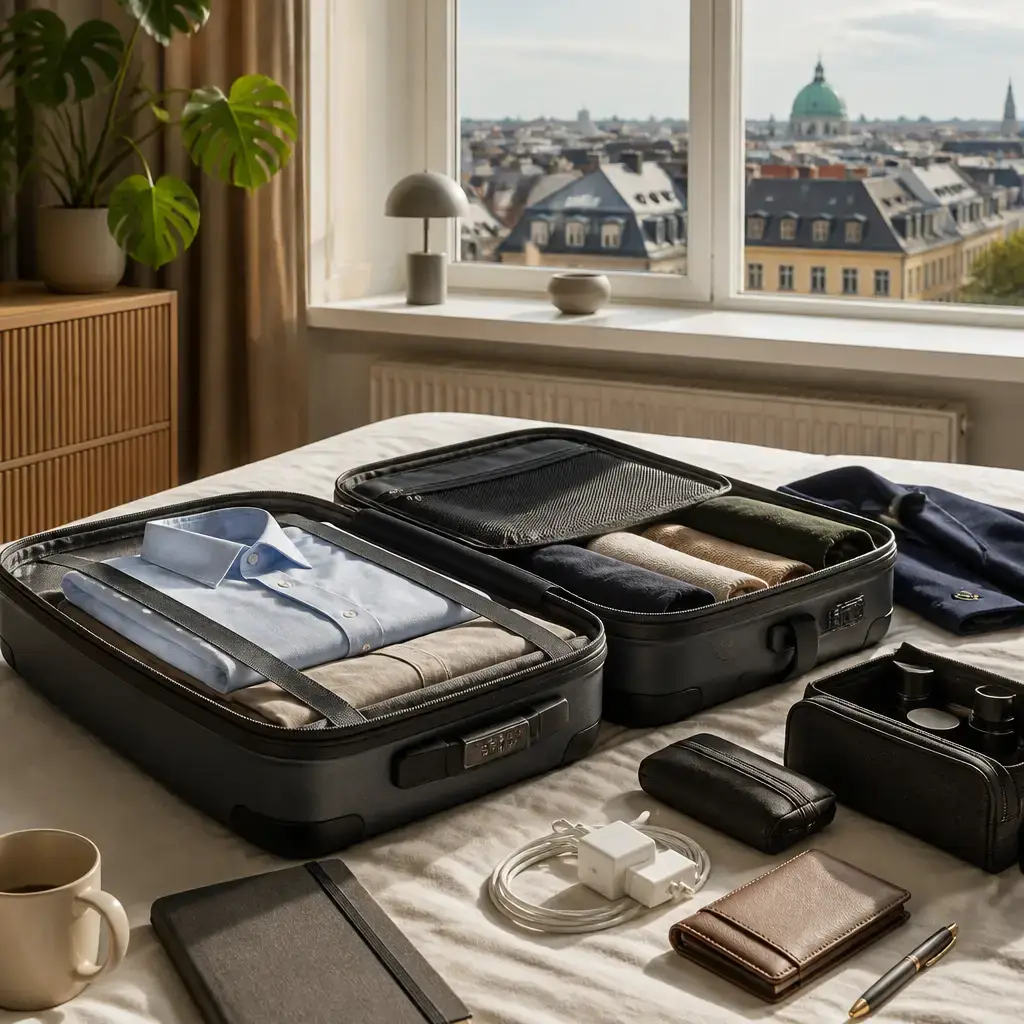
Jeg vil kun tage en håndbagagetaske med på forretningsrejsen.
yai VIL koon TAY-uh en HAWN-bah-gah-tehs-keh meh poh foh-REH-dnings-RY-sun. I want to take only a carry-on bag for the business trip.Så planlæg ud fra tøjet til mødet, og begræns det ekstra til et minimum.
soh plan-LEHL oo FRAH TOY-ehd til MUR-deh, oh beh-GRENS deh EHK-strah til et MEE-nee-moom. Then plan around the meeting outfit and keep extras to a minimum.Jeg har ét møde og en afslappet middag på programmet.
yai har ayt MUR-deh oh en ahf-SLAH-bet MEE-dah poh proh-GRAM-et. I have one meeting and one casual dinner on the itinerary.Pak tøj, der kan bruges til begge dele.
PAK TOY, dair kan BROO-es til BEH-guh DAY-luh. Pack pieces that can work for both.Ellers bliver tasken hurtigt fyldt.
EL-ers BLEE-uh TAH-sken HUR-tigt FOOLT. Or the bag will fill up fast.Jeg er bekymret for, at min skjorte bliver krøllet før mødet.
yai air beh-KUHM-ret for, eh min SHYOR-tuh BLEE-uh KRUHL-et for MUR-deh. I'm worried my shirt will wrinkle before the meeting.Rul den forsigtigt sammen, og pak den ud, så snart du når frem til hotellet.
ROOL den foh-SIG-tigt sah-MEN, oh PAK den OOD, soh snart doo nor frem til hoh-TEL-et. Roll it carefully, then unpack it as soon as you reach the hotel.Skal opladere og dokumenter ligge i den forreste lomme?
skahl oh-PLAH-thuh oh doh-koo-MENT-er LEE-eh ee den FOH-reh-steh LOM-eh? Should chargers and documents go in the front pocket?Læg ting, du hurtigt skal kunne få fat i, der sammen med en ekstra kopi af dagsordenen.
lay teeng, doo HUR-tigt skahl KOO-neh foh FAT ee, dair sah-men med en EHK-strah koh-PEE ahv DAYS-or-den-en. Keep quick-access items there, along with a backup copy of the agenda.Så behøver jeg ikke åbne hele tasken i lufthavnen.
soh beh-HUH-veh yai IG-eh OHB-neh HAY-leh TAH-sken ee LOOFT-hown-en. Then I won't have to open the whole bag at the airport.Det bliver nemmere i sikkerhedskontrollen, når de ting er lige ved hånden.
deh BLEE-uh NEH-meh-reh ee SIG-eh-hays-kohn-TROHL-en, nor deh teeng air LEE-eh veh HOHN-en. Security will be easier when those things are close at hand.Sentence explanations
Jeg vil kun tage en håndbagagetaske med på forretningsrejsen.
I want to take only a carry-on bag for the business trip.
- Jeg vil
- I want to
- kun
- only
- tage
- take
- håndbagagetaske
- carry-on bag
- med på
- along on
- forretningsrejsen
- the business trip
More detail
Jeg vil means “I want to.” Jeg is the first-person singular pronoun “I”. vil is the present form of ville, which commonly expresses wanting to do something; with an infinitive, the reusable pattern is Jeg vil + infinitive: Jeg vil læse. — “I want to read.” kun means “only” and limits what is being taken in this sentence. Its position before tage makes the restriction apply to the taking action and its complement: the speaker wants to take only a carry-on bag. tage means “take.” It is the infinitive form, used after the modal verb vil. The form chain is tage (infinitive) — tager (present) — tog (past). Example: Jeg tager bogen. — “I am taking the book.” håndbagagetaske means “carry-on bag.” It is a compound noun: håndbagage refers to cabin or hand luggage, and taske means “bag.” In this sentence it is the object of tage. Example: En håndbagagetaske er nok. — “One carry-on bag is enough.” Here en marks the noun as common gender and singular; it does not by itself assert a numerical count in every possible use. med på is a reusable combination meaning “along on” when something is taken on a trip or other destination-based activity. med contributes the idea of bringing something along, while på introduces the trip or activity in this pattern. Example: Tag en jakke med på turen. — “Take a jacket along on the trip.” forretningsrejsen means “the business trip.” The noun is the definite singular form of forretningsrejse: forretningsrejse — “business trip”; forretningsrejsen — “the business trip.” Danish commonly marks definiteness by a suffix on the noun, here -en, rather than by a separate word corresponding to “the.” Together, Jeg vil + kun + tage expresses “I want to take only,” en håndbagagetaske supplies the thing being taken, and med på forretningsrejsen specifies that it is being taken along on the business trip. The complete meaning is: “I want to take only a carry-on bag for the business trip.”
Så planlæg ud fra tøjet til mødet, og begræns det ekstra til et minimum.
Then plan around the meeting outfit and keep extras to a minimum.
- Så
- then
- planlæg
- plan
- ud fra
- based on
- tøjet
- the clothes
- mødet
- the meeting
- begræns
- limit
- det ekstra
- the extras
- et minimum
- a minimum
More detail
Så means “then” here and links this instruction to what has just been established. It can also introduce a result or consequence in other sentences, so its exact English equivalent depends on context. planlæg means “plan” here. It is the imperative of planlægge (“to plan”): planlægge → planlægger (present) → planlæg (imperative). The imperative directly tells the addressee what to do. Example: Planlæg turen i god tid. — “Plan the trip well in advance.” ud fra is a reusable preposition-like construction meaning “based on” or “using ... as the basis.” In planlæg ud fra ..., it identifies the information that should guide the planning. Example: Vælg sko ud fra vejret. — “Choose shoes based on the weather.” tøjet is the definite form of the noun tøj, “clothing” or “clothes.” The ending -et marks the definite form of this neuter noun: tøj → tøjet. In this sentence, it refers to the clothing intended for the meeting, matching the fixed translation’s “meeting outfit.” mødet is the definite form of møde, “meeting”: et møde → mødet. The indefinite article et belongs to the base noun phrase and marks its grammatical gender; it does not by itself state a numerical count. In tøjet til mødet, til means “for,” so the phrase is “the clothes for the meeting.” begræns means “limit” here. It is the imperative of begrænse (“to limit”): begrænse → begrænser (present) → begræns (imperative). The instruction starts a second coordinated action after og: the addressee should limit something. Example: Begræns tiden til en time. — “Limit the time to one hour.” det ekstra is a substantivized adjective phrase meaning “the extra” or “extra items.” det is the neuter singular form used with this definite, substantivized expression; ekstra itself does not change here. The phrase refers broadly to additional things beyond what is needed, rather than naming a particular item. et minimum means “a minimum.” minimum is a neuter noun, shown by the indefinite article et; the article does not itself mean “one” in this phrase. The construction begrænse ... til et minimum is reusable for saying that something should be kept at the lowest practical level. Example: Hold støjen på et minimum. — “Keep the noise to a minimum.” Together, Så planlæg ud fra tøjet til mødet means “Then plan based on the clothes for the meeting,” and og begræns det ekstra til et minimum adds “and limit the extras to a minimum.” The whole utterance is therefore: “Then plan around the meeting outfit and keep extras to a minimum.” The two imperative verbs, planlæg and begræns, give two coordinated instructions.
Jeg har ét møde og en afslappet middag på programmet.
I have one meeting and one casual dinner on the itinerary.
- Jeg
- I
- har
- have
- ét
- one
- møde
- meeting
- afslappet
- casual
- middag
- dinner
- på programmet
- on the itinerary
More detail
Jeg is the first-person singular pronoun, “I.” It identifies the speaker without specifying a name. Example: Jeg er klar. — “I am ready.” har is the present-tense form of have, “to have.” Danish present-tense har stays the same across persons: jeg har “I have,” du har “you have,” and so on. Example: Jeg har tid. — “I have time.” ét is the neuter form of the numeral én/ét, “one.” The accent emphasizes the exact count here: one meeting. Danish uses én with common-gender nouns and ét with neuter nouns. The noun møde is neuter, as shown by et møde “a meeting.” møde means “meeting.” Here it is singular and indefinite after the numeral ét; its definite singular form is mødet “the meeting,” and its plural is møder “meetings.” afslappet means “casual” or “relaxed” here. It describes middag, “dinner.” The adjective form is afslappet in singular indefinite noun phrases; in plural or definite contexts, the form is commonly afslappede, as in afslappede middage “casual dinners.” middag means “dinner.” It is a common-gender noun: en middag “a dinner,” middagen “the dinner,” and middage “dinners.” In en afslappet middag, en is the indefinite article, while afslappet describes the dinner. The article itself does not assert a numerical count; the fixed translation renders this dinner as “one casual dinner” in the intended itinerary. på programmet is a reusable expression meaning “on the program,” “on the schedule,” or, in this context, “on the itinerary.” Programmet is the definite singular form of the neuter noun program, “program/schedule”; på means “on.” Example: Det står på programmet. — “It is on the schedule.” Together, Jeg har gives “I have,” ét møde gives “one meeting,” and en afslappet middag gives “a casual dinner.” Adding på programmet says that these plans are on the itinerary: “I have one meeting and one casual dinner on the itinerary.”
Pak tøj, der kan bruges til begge dele.
Pack pieces that can work for both.
- Pak
- pack
- tøj
- clothes
- kan bruges
- can be used
- begge dele
- both things
More detail
Pak is the imperative of pakke, “to pack.” The imperative gives a direct instruction and normally has no written subject: Pak tøjet. means “Pack the clothes.” tøj means “clothes” or “clothing.” It is generally a mass noun in Danish, so it does not normally take a plural ending when referring to clothing as a category. In this sentence, it is what should be packed. der introduces a relative clause describing tøj: “that …” or “which …”. Here it links the clothing to its useful property rather than adding a separate action by the speaker. kan bruges combines kan, “can,” with bruges, the passive form of bruge, “to use.” The result is “can be used.” Danish -s in bruges marks the passive here: the clothing can be used, without naming the person who uses it. A reusable pattern is kan + passive verb, as in Det kan åbnes. — “It can be opened.” begge dele means “both things” or, in this context, “both purposes/occasions.” begge means “both,” while dele is the plural of del, “part” or “thing.” The phrase refers to the two uses mentioned in the surrounding context: the meeting and the casual dinner. It does not mean that two individual clothing items are necessarily being packed. Together, Pak tøj gives the instruction “Pack clothes,” and der kan bruges til begge dele narrows this to clothes suitable for both purposes. The whole utterance therefore means: “Pack clothes that can work for both.”
Ellers bliver tasken hurtigt fyldt.
Or the bag will fill up fast.
- Ellers
- otherwise; or
- bliver
- becomes; gets
- tasken
- the bag
- hurtigt
- quickly; fast
- fyldt
- filled; full
More detail
Ellers means “otherwise” or “or else” here. It introduces the alternative outcome if the packing described earlier is not done. It is a useful sentence connector: Skynd dig, ellers bliver vi forsinkede. — “Hurry up, otherwise we will be late.” bliver is the present-tense form of blive, “to become” or “to get.” In this sentence, the present form describes a future result; Danish often uses the present for a future event when the context makes the time clear. Blive can also be used with a past participle to describe a change into a result: Døren bliver lukket. — “The door is being closed” or “The door gets closed.” tasken means “the bag.” It is the definite singular form of taske, “bag”: en taske — “a bag,” tasken — “the bag.” The ending -en marks definite singular for this noun. The fixed translation identifies the referent as a bag. hurtigt means “quickly” or “fast” in this sentence and modifies the change described by bliver fyldt. The related adjective is hurtig, “quick/fast”; hurtigt is the adverbial form used here. Bilen kører hurtigt. — “The car is driving fast.” fyldt means “filled” or “full” here. It is the past participle of fylde, “to fill,” and it describes the resulting state after the bag fills. With blive, the pattern blive + past participle presents a change or process leading to that result. Glasset bliver fyldt med vand. — “The glass is filled with water.” Together, bliver tasken fyldt means “the bag will become filled” or naturally “the bag will fill up.” Hurtigt adds the speed of that result, and ellers connects it as the alternative consequence: “Or otherwise, the bag will fill up fast.”
Jeg er bekymret for, at min skjorte bliver krøllet før mødet.
I'm worried my shirt will wrinkle before the meeting.
- Jeg
- I
- bekymret
- worried
- for
- about
- min
- my
- skjorte
- shirt
- bliver
- becomes
- krøllet
- wrinkled
- før
- before
- mødet
- the meeting
More detail
Jeg is the first-person singular subject pronoun, “I.” It identifies the speaker as the experiencer of the worry. Compare du (“you,” singular) when addressing one person. bekymret means “worried” here. It is an adjective related to the verb bekymre (“worry”), but the useful expression is være bekymret (“be worried”). For example, Jeg er bekymret. means “I am worried.” for is “about” in the pattern være bekymret for .... When what follows is a clause, Danish commonly uses for, at ...: Jeg er bekymret for, at han kommer sent. means “I am worried that he is coming late.” The word for itself does not mean “that”; at introduces the following clause. min means “my” before a singular common-gender noun. Danish possessives distinguish this from mit before a singular neuter noun and mine before plural nouns. Here it agrees with skjorte. skjorte means “shirt.” It is a common-gender noun: en skjorte means “a shirt,” while skjorten means “the shirt.” bliver is the present form of blive, “become” or “get.” With the participle krøllet, it forms the idea “gets wrinkled.” In this context, the present form describes a future result inside the clause introduced by at; it does not mean that the wrinkling is happening at the moment of speaking. krøllet means “wrinkled” here. It is the past participle of krølle, “crumple” or “wrinkle,” and it can describe the resulting state of the shirt. The construction blive + past participle presents the subject as undergoing a change: Papiret bliver krøllet. means “The paper gets crumpled.” før means “before” and introduces a time relation. It places the event or state in its clause earlier than the event named in the following phrase. mødet means “the meeting.” It is the definite singular form of møde: et møde is “a meeting,” and mødet is “the meeting.” The form -et marks singular definiteness for this neuter noun. Together, Jeg er bekymret for, at ... means “I am worried that ...”. The clause min skjorte bliver krøllet says that the speaker’s shirt gets wrinkled, and før mødet sets the deadline or comparison point as the meeting. The complete utterance therefore means: “I’m worried my shirt will wrinkle before the meeting.”
Rul den forsigtigt sammen, og pak den ud, så snart du når frem til hotellet.
Roll it carefully, then unpack it as soon as you reach the hotel.
- Rul … sammen
- roll up
- den
- it
- forsigtigt
- carefully
- pak den ud
- unpack it
- så snart
- as soon as
- du
- you
- når frem
- reach, arrive
- hotellet
- the hotel
More detail
Rul is the imperative of rulle, “to roll.” The imperative gives a direct instruction and is useful as the base form for commands: Rul den sammen. — “Roll it up.” sammen adds the idea of bringing the object into a rolled-up form; together, Rul ... sammen means “roll ... up.” den is the object pronoun “it.” Here it refers to the item being rolled, but the sentence itself does not identify that item by name. Danish object pronouns differ from subject pronouns: du means “you” as the person carrying out the action, while den means “it” as the affected object. forsigtigt means “carefully” or “gently.” It is an adverb describing how the rolling should be done. The related adjective is forsigtig, “careful”; forsigtigt is the form used here to modify the action. pak den ud means “unpack it.” pak is the imperative of pakke, “to pack,” and ud changes the construction to the opposite direction: taking something out of its packing. The object pronoun den comes between the verb and ud in this construction. Example: Pak den ud. — “Unpack it.” så snart introduces a time condition meaning “as soon as.” It links an event to the earliest point when another event occurs. Example: Ring, så snart du er hjemme. — “Call as soon as you are home.” du is the second-person singular subject pronoun, “you.” It is the subject of the following clause, the person who reaches the hotel. In Danish, the present-tense verb form does not change according to this subject: du når means “you reach,” while jeg når means “I reach.” når frem is a fixed verb-particle construction meaning “reach” or “arrive at a destination.” når is the present form of nå, “to reach,” and frem contributes the sense of getting through to the destination. Example: Vi når frem i morgen. — “We will arrive tomorrow.” hotellet means “the hotel.” It is the definite singular form of hotel: hotel = “a hotel” or “hotel” in an indefinite context, hotellet = “the hotel.” The ending -et marks this noun as definite singular; it is the noun, not an adjective or the verb, that carries this form. The utterance gives two instructions to the same understood person: first, roll the item up carefully; then unpack that item upon arrival. og connects the instructions. så snart du når frem til hotellet specifies when the second action should happen: as soon as you reach the hotel. Thus the whole sentence means, “Roll it carefully, then unpack it as soon as you reach the hotel.”
Skal opladere og dokumenter ligge i den forreste lomme?
Should chargers and documents go in the front pocket?
- Skal
- should
- opladere
- chargers
- dokumenter
- documents
- ligge
- lie; be placed
- forreste
- frontmost; front
- lomme
More detail
Skal expresses the intended recommendation or question about what is appropriate: “should.” In a question, it comes before the subject: Skal ...? Danish modal verbs are followed by an infinitive without at. Skal can have other meanings in other contexts, such as “shall” or “must,” but “should” fits this sentence. opladere means “chargers” here. Its singular form is oplader, and the ending -e marks the plural in this form. The indefinite plural does not specify how many chargers there are. dokumenter means “documents.” Its singular form is dokument; this plural also has the ending -er. Together with opladere, it forms the subject of the question: chargers and documents. ligge is the infinitive of ligge, “to lie” or, for an object, “to be situated/kept.” After Skal, it remains in the infinitive: Skal ... ligge ...? A useful contrast is lægge, “to put/place,” which describes someone putting something somewhere, while ligge describes the thing’s resulting position. Example: Dokumenterne ligger i tasken. — “The documents are in the bag.” forreste describes the location as the frontmost or front one among relevant spaces. In den forreste lomme, the adjective has the definite form forreste, used with den and the definite noun phrase. It is not the noun’s form: lomme is the noun, while forreste is the adjective. Example: den forreste række — “the front row.” lomme means “pocket.” It is a common-gender noun, so its definite singular form is lommen (“the pocket”); here the separate word den is used before the adjective in the definite phrase den forreste lomme. The structure is Skal + subject (opladere og dokumenter) + infinitive (ligge) + location (i den forreste lomme). Thus the whole utterance asks whether the chargers and documents should be placed or kept in the front pocket: “Should chargers and documents go in the front pocket?”
Læg ting, du hurtigt skal kunne få fat i, der sammen med en ekstra kopi af dagsordenen.
Keep quick-access items there, along with a backup copy of the agenda.
- Læg
- put / place
- ting
- things / items
- hurtigt
- quickly
- skal kunne
- should be able to
- få fat i
- get hold of / access
- der
- there
- sammen med
- together with / along with
- ekstra
- extra
- kopi
- copy
- dagsordenen
- the agenda
More detail
Læg is the imperative of lægge, “to put/place.” It tells the listener to place something. Do not confuse it with ligge, which describes something being situated or lying somewhere. Example: Læg bogen her. — “Put the book here.” ting means “things/items” here and is the plural of ting; the singular is en ting. The word is broad, so the exact items come from the surrounding context rather than from ting itself. hurtigt is an adverb meaning “quickly.” It modifies the access expressed by få fat i: the intended idea is that the items can be reached quickly, not that they must be placed quickly. skal kunne combines skal with kunne. Here skal expresses a requirement or expectation, while kunne expresses ability: “need to be able to.” The subject of this combination is du, meaning “you,” in the embedded clause. Danish places the infinitive kunne after the modal skal without an infinitive marker. få fat i is a fixed expression meaning “get hold of” or, in this context, “access/reach.” Its words work together as a construction rather than as a literal instruction to grasp something. Example: Jeg skal kunne få fat i passet. — “I need to be able to access the passport.” Together, ting, du hurtigt skal kunne få fat i means “items that you need to be able to access quickly.” The clause beginning with du identifies which items are meant; it does not say that all things must be quickly accessible. der means “there” in this sentence. It gives the placement location indicated by the fixed translation. It is separate from the preceding clause: the items are to be put there, and the following phrase adds what they should be placed along with. sammen med is the reusable prepositional construction “together with/along with.” It introduces an additional item placed with the previously mentioned items. Example: Hun kom sammen med sin ven. — “She came together with her friend.” ekstra is an adjective meaning “extra” or “additional.” It describes kopi; it does not itself specify a number beyond indicating that this is an additional copy. kopi is a noun meaning “copy.” Its common singular indefinite form is en kopi; the plural is kopier. Here the noun appears in the singular form in en ekstra kopi. The indefinite article en is part of the singular indefinite noun phrase, but an indefinite article by itself should not be treated as a numerical count. dagsordenen means “the agenda.” It is the definite form of dagsorden: dagsorden = “an agenda,” dagsordenen = “the agenda.” The ending -en marks definiteness on this common-gender noun; it is not a separate word. The whole utterance is assembled as: Læg (“put”) + ting (“items”) qualified by du hurtigt skal kunne få fat i (“that you need to be able to access quickly”) + der (“there”) + sammen med en ekstra kopi af dagsordenen (“along with an extra copy of the agenda”). Thus it means: “Keep quick-access items there, along with a backup copy of the agenda.”
Så behøver jeg ikke åbne hele tasken i lufthavnen.
Then I won't have to open the whole bag at the airport.
- Så
- then
- behøver
- need; have to
- jeg
- I
- ikke
- not
- åbne
- open
- hele
- whole; entire
- tasken
- the bag
- i
- at; in
- lufthavnen
- the airport
More detail
Så means “then” here, linking this sentence to the situation just mentioned. It can also mean “so” in other contexts, but “then” is the relevant meaning here. behøver is the present-tense form of behøve, “to need.” Danish present-tense verbs generally have the same form with different subjects, so behøver is not a special form created by jeg. With ikke and a following infinitive, behøver ikke åbne expresses that the speaker does not have to open something. The infinitive appears directly here, without at. jeg is the first-person singular pronoun “I.” It identifies the speaker as the person who does not need to open the bag. ikke negates the need expressed by behøver: the speaker is not required to carry out the opening. In behøver ikke + infinitive, it contributes “does not have to,” rather than simply saying that the action never happens. åbne is the infinitive “to open.” It follows behøver ikke in the reusable pattern behøver ikke åbne (“doesn’t have to open”). The same infinitive can occur in other constructions; for example, Jeg skal åbne døren means “I have to open the door.” hele means “the whole” or “the entire” here. It modifies tasken. Compare en hel taske (“a whole bag”) with hele tasken (“the whole bag”); hel is the base form, while hele is used in this definite form. With a singular neuter noun, the corresponding form is helt, as in et helt hus (“a whole house”). tasken means “the bag.” It is the definite singular form of taske, “bag”: en taske means “a bag,” while tasken means “the bag.” Here, hele tasken refers to the entire bag as the object of åbne. i is the preposition “in” or “at.” With a place, as in i lufthavnen, it marks the location where the situation occurs. Its English rendering depends on the place: i huset is “in the house,” while i lufthavnen is naturally “at the airport.” lufthavnen means “the airport.” It is the definite singular form of lufthavn, “airport”: en lufthavn is “an airport,” and lufthavnen is “the airport.” Together, Så (“then”) and behøver jeg ikke åbne (“I do not need to open”) express that, as a consequence of the relevant arrangement, the speaker will not have to open hele tasken (“the whole bag”) i lufthavnen (“at the airport”). The complete meaning is: “Then I won’t have to open the whole bag at the airport.”
Det bliver nemmere i sikkerhedskontrollen, når de ting er lige ved hånden.
Security will be easier when those things are close at hand.
- Det
- it
- bliver
- becomes; gets
- nemmere
- easier
- sikkerhedskontrollen
- the security check
- når
- when
- de
- those
- ting
- things
- lige ved hånden
- close at hand
More detail
Det is the subject of the first clause. Here it is a broad, situation-focused “it,” referring to how the security-check process will be, rather than to a specifically named object. Danish can use det this way when English may express the idea with a more explicit subject. bliver is the present-tense form of blive, “become” or “get.” With nemmere, it describes a change toward an easier state: blive + adjective means “become/get + adjective.” The present form can also describe a future result when the time is understood from context; it does not itself have a special future ending. nemmere is the comparative form of nem, “easy”: nem → nemmere (“easier”) → nemmest (“easiest”). The comparative here makes a relative claim that the situation will be easier; no comparison target is stated in this sentence. In this position after bliver, it is a predicative adjective describing the resulting state. Danish nemmere can also be used adverbially in other sentences, with the same form, so the form alone does not establish the category. sikkerhedskontrollen means “the security check.” It is built from sikkerhedskontrol, “security check,” with the definite ending -en: sikkerhedskontrol → sikkerhedskontrollen. The ending shows that the noun is definite; the noun itself, not nemmere, carries this marking. når introduces the time condition “when.” The clause after it gives the situation under which the change described in the first clause applies. A reusable pattern is X bliver Y, når ... — “X becomes/is Y when ...”. de means “those” in de ting. It is the plural form used with the plural noun ting; its number agrees with that noun. The form alone does not identify exactly which things they are, but the translation establishes the intended demonstrative meaning here. ting means “things.” Its singular and plural indefinite forms are both ting: en ting (“a thing”), ting (“things”); the definite forms are tingen and tingene. In this sentence, de makes the group plural and definite in meaning. lige ved hånden is the idiomatic expression “close at hand” or “within easy reach.” Literally, it contains lige (“right/just”), ved (“by/at”), and hånden (“the hand”), but the expression as a whole describes convenient physical availability. A reusable example is Nøglerne er lige ved hånden. — “The keys are close at hand.” Together, Det bliver nemmere says that the situation gets easier, i sikkerhedskontrollen specifies where this applies, and når de ting er lige ved hånden gives the condition: when those things are close at hand. The complete meaning is “Security will be easier when those things are close at hand.”
Grammar Points
Imperativ: planlæg + ...
Planlæg ud fra programmet.
PLAN-lehl oo FRAH proh-GRAM-et.Plan based on the itinerary.
I imperativ står verbet uden pronomen: planlæg betyder “planlæg!”.
Komparativ: nem → nemmere
Begge dele er nemmere.
BEH-guh DAY-luh air NEH-meh-reh.Both things are easier.
Komparativformen nemmere bruges, når én ting sammenlignes med en anden.
Danish Vocabulary
en afslappet middag
kan bruges til begge dele
begræns det ekstra
- Gender
- common
på forretningsrejsen
- Gender
- common
en håndbagagetaske
- Gender
- common
en afslappet middag
til et minimum
- Gender
- neuter
tøjet til mødet
Så planlæg ud fra tøjet til mødet
- Gender
- neuter
på programmet
- Gender
- neuter
Pak tøj, der kan bruges til begge dele
planlæg ud fra tøjet
Quiz
Word Order
Arrange the words in the correct order.
Or the bag will fill up fast.
Show Answer
Ellers bliver tasken hurtigt fyldt.Spelling
Tap the letters to spell the word.
casual; relaxed
Show Answer
afslappetminimum
Show Answer
minimumplan
Show Answer
planlæglimit; restrict