10 minutes free every day
Continue audio lessons in the app
Word explanations appear automatically in sync with the audio.
No login required · synced translations · playback with the screen locked
Choose your learning language and open this lesson in the app.

About This Lesson
Use Reporting a Lost Wallet Safely to practice Danish conversation, pronunciation, vocabulary, grammar, and quizzes.
Dialogue
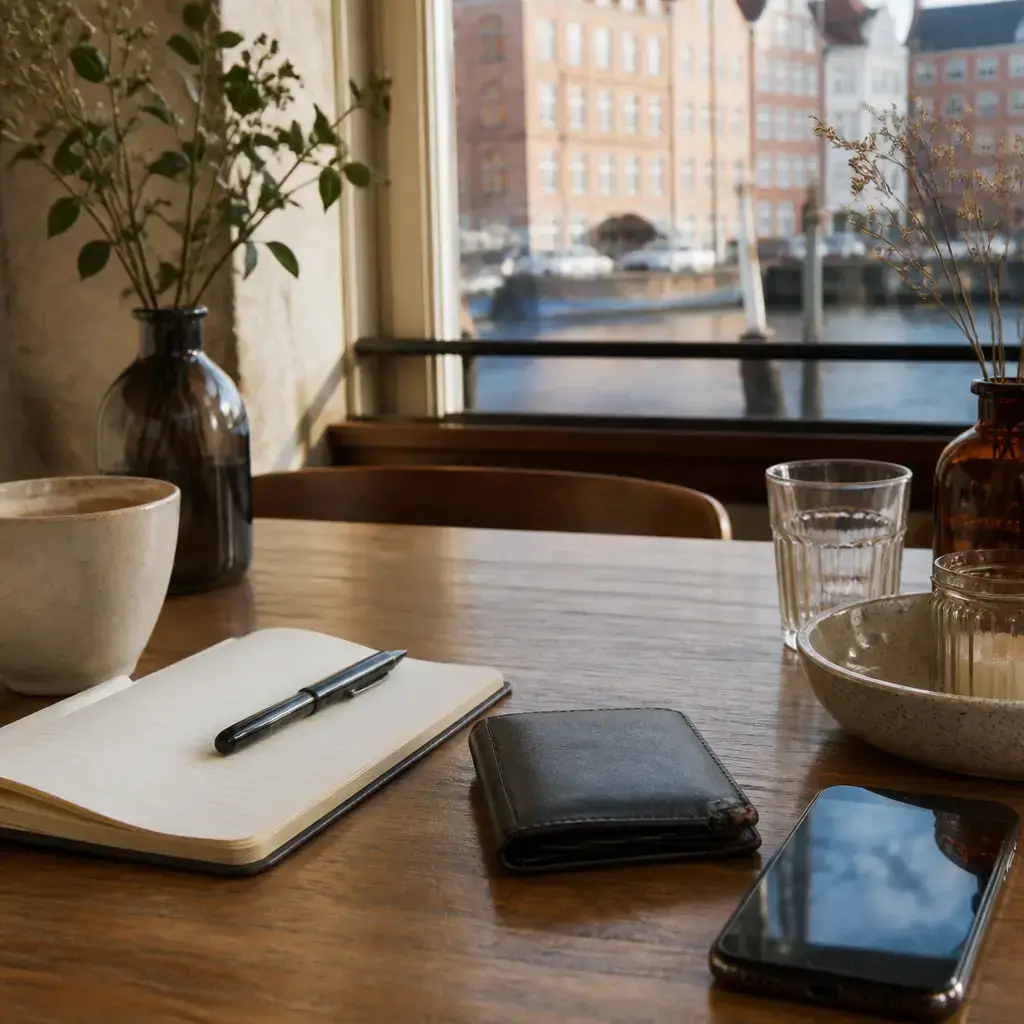
Jeg kan ikke finde min pung, og jeg havde den sidst på caféen.
yai kan IK-uh FIN-uh meen poong, oh yai HAE-vuh dehn sist poh ka-FAY-uhn. I can't find my wallet, and I last had it at the cafe.Før du ringer, så lav en beskrivelse af, hvordan pungen ser ud.
fur doo RING-uh, soh laow uhn beh-SKREE-vuhl-suh ah, voh-DAN POONG-uhn sair OOTH. Before you call, prepare a description of what the wallet looks like.Det er en lille sort pung med et slidt hjørne.
deh air uhn LIL-uh sohrt poong meh ed sleet YUR-nuh. It's a small black wallet with a worn corner.Det burde hjælpe personalet med at tjekke den uden at spørge efter private oplysninger.
deh BOO-thuh YEL-buh peh-soh-NAH-leh meh CHEK-uh dehn OO-thuhn ah SPUR-uh EF-tuh PREE-vah-tuh ohp-LOOS-ning-uh. That should help the staff check without asking for private details.Jeg ringer og forklarer, hvornår jeg opdagede, at den manglede.
yai RING-uh oh for-KLAIR-uh, voh-NAIR yai OHP-dah-eh, at dehn MANG-luh-deh. I'll call and explain when I noticed it was missing.Nævn nogle få ting, der er i den, men del ikke oplysninger fra personlige dokumenter.
NEVN NOH-luh foh ting, thair air ee dehn, meh(n) dehl IK-uh ohp-LOOS-ning-uh frah peh-SOHRN-lee-uh doh-koo-MEN-tuh. Mention a few items inside, but don't share details from personal documents.Der er et foto og en sammenfoldet seddel i den.
thair air ed FOH-toh oh uhn sa-muhn-FOL-ded SED-uhl ee dehn. It has a photo and a folded note inside.De detaljer burde være nok til at identificere den på en sikker måde.
dee dee-TAI-luh BOO-thuh VAIR-uh nohg teel at ee-den-tee-fee-SAIR-uh dehn poh uhn SEE-kuh MOH-thuh. Those details should be enough to identify it safely.Hvis de har den, kan jeg aftale et tidspunkt, hvor jeg kan hente den.
viss dee har dehn, kan yai AHF-tah-luh ed TEETHS-poongd, voh yai kan HEN-tuh dehn. If they have it, I can arrange a time to pick it up.Ring nu, så tjekker jeg din taske igen, mens du venter.
reng noo, soh CHEK-uh yai deen TAS-kuh ee-GEN, mens doo VEN-tuh. Call now, and I'll check your bag again while you wait.Sentence explanations
Jeg kan ikke finde min pung, og jeg havde den sidst på caféen.
I can't find my wallet, and I last had it at the cafe.
- Jeg kan ikke
- I cannot
- finde
- find
- min
- my
- pung
- wallet
- havde
- had
- den
- it
- sidst
- last
- på
- at
- caféen
- the café
More detail
Jeg kan ikke means “I cannot” here. Jeg is the first-person singular pronoun “I”. kan is the present form of kunne, “can/be able to”. Danish places the infinitive after a modal: kan finde = “can find”. ikke negates the clause, so kan ikke finde means “cannot find”, not merely “can find” with an added word. finde is the infinitive “find”. After kan, Danish uses the infinitive without an infinitive marker: kan finde. For example, Jeg kan se means “I can see.” min means “my” before a singular common-gender noun. Danish possessives also distinguish mit before a singular neuter noun and mine before plural nouns; min is the form used with pung here. pung means “wallet”. It is a common-gender noun: en pung is “a wallet”, and pungen is “the wallet”. In the supplied follow-up, pungen uses the same noun with the definite ending. havde is the past form of have, “have”. In this sentence, havde means “had”, referring to possession at an earlier time. For example, Jeg havde en nøgle means “I had a key.” den means “it” here and refers to the wallet identified in the fixed translation. It is a singular common-gender object pronoun; Danish uses det for a neuter singular referent and dem for a plural referent. The pronoun does not itself mean “wallet”; its referent comes from the surrounding meaning. sidst means “last” in this time expression, identifying the last occasion on which the speaker had the wallet. It functions here as an adverb rather than describing the wallet. på is the preposition “at/on” in this location expression. With a place such as caféen, på caféen means “at the café”. caféen means “the café”. The noun is café; caféen adds the definite singular ending -en, giving “the café”. The accent and spelling in the source are preserved. For example, på caféen means “at the café.” Together, Jeg kan ikke finde min pung says “I cannot find my wallet.” The conjunction og links this to jeg havde den sidst på caféen, “I last had it at the café.” Here the second clause explicitly contains jeg (“I”); den refers back to the wallet. The complete utterance is therefore: “I can't find my wallet, and I last had it at the cafe.”
Før du ringer, så lav en beskrivelse af, hvordan pungen ser ud.
Before you call, prepare a description of what the wallet looks like.
- Før
- before
- ringer
- call
- lav
- prepare
- beskrivelse
- description
- hvordan … ser ud
- what ... looks like
- pungen
- wallet
More detail
Før introduces a time clause and means “before” here. It is followed by the event that must happen later: før X = “before X.” Example: Før du går, sluk lyset. — “Before you leave, turn off the light.” ringer is the present-tense form of ringe, “to call.” With du, it means “you call”; Danish present-tense verbs generally do not change for person, so the same form is used with other subjects as well: jeg ringer = “I call,” de ringer = “they call.” Here du ringer is the event placed after “before.” lav is the imperative of lave, “to make/do.” It gives the instruction “make” or, in this context, “prepare.” The imperative commonly has the same short form as the verb stem: lave → lav. Example: Lav en liste. — “Make a list.” beskrivelse means “description.” It is a noun related to describing something. In en beskrivelse the indefinite article presents a description without asserting a numerical count; the phrase means “a description” as an unspecified description. The preposition af connects it to what is being described: en beskrivelse af X = “a description of X.” hvordan ... ser ud is a reusable construction meaning “what ... looks like” or “how ... looks.” hvordan asks about the manner or appearance, while ser ud is the separated form of se ud, “look/appear.” In this sentence, hvordan pungen ser ud is a subordinate clause functioning as the content of the description. Example: Jeg ved, hvordan huset ser ud. — “I know what the house looks like.” pungen means “the wallet.” Its base form is pung; the ending -en marks the definite singular form: pung = “a wallet” or “wallet” in an indefinite noun phrase, pungen = “the wallet.” The preceding context identifies this as the speaker’s wallet, and the following context describes it as small and black. Together, Før du ringer means “Before you call.” så lav en beskrivelse gives the instruction “prepare a description,” and af, hvordan pungen ser ud specifies that the description should concern the wallet’s appearance. The whole utterance therefore means: “Before you call, prepare a description of what the wallet looks like.”
Det er en lille sort pung med et slidt hjørne.
It's a small black wallet with a worn corner.
- Det er
- It is
- lille
- small
- sort
- black
- pung
- wallet
- med
- with
- slidt
- worn
- hjørne
- corner
More detail
Det er is a reusable Danish pattern meaning “it is” or “that is.” Here det is the subject, and er is the present form of være (“to be”): jeg er (“I am”), du er (“you are”), det er (“it is”). In this sentence, the pattern introduces a description of the wallet. lille means “small” here. Its base form is lille for a singular noun; the plural form is små, as in små punge (“small wallets”). The form lille does not itself show whether a singular noun is common gender or neuter gender. sort means “black.” It is the singular indefinite form used with both common-gender and neuter nouns: en sort pung (“a black wallet”) and et sort hjørne (“a black corner”). With a definite or plural noun, the form is sorte, for example den sorte pung (“the black wallet”). pung means “wallet.” Its common-gender indefinite article is en: en pung (“a wallet”); its definite form is pungen (“the wallet”). The preceding context identifies this wallet as the thing being described, while the sentence itself presents it with the indefinite phrase en lille sort pung. med means “with” and introduces something included in or associated with the item being described. A reusable pattern is X med Y, meaning “X with Y”; for example, en taske med en lomme means “a bag with a pocket.” slidt means “worn” here. It is the singular indefinite form of slidt (“worn”), used with both genders: en slidt pung (“a worn wallet”) and et slidt hjørne (“a worn corner”). The form slidt is also related to the verb slide (“to wear out”); here it functions as a descriptive participial adjective, not as a finite verb. hjørne means “corner.” It is a neuter-gender noun, so the indefinite phrase is et hjørne (“a corner”), and the definite form is hjørnet (“the corner”). The neuter article et and the adjective form slidt combine in et slidt hjørne. Together, en lille sort pung means “a small black wallet.” The prepositional phrase med et slidt hjørne adds the feature “with a worn corner.” Thus the whole utterance means: “It’s a small black wallet with a worn corner.”
Det burde hjælpe personalet med at tjekke den uden at spørge efter private oplysninger.
That should help the staff check without asking for private details.
- Det burde
- That should
- hjælpe
- help
- personalet
- the staff
- med at
- with ...ing
- tjekke
- check
- den
- it
- uden at
- without ...ing
- spørge
- ask
- private
- private
- oplysninger
- details
More detail
Det burde combines det, a neuter singular pronoun, with burde, the past-tense form of the modal verb bør. Here, det is rendered as “that”; the supplied context does not uniquely identify what “that” refers to. Burde expresses an expectation or recommendation, not a firm future promise. Danish commonly places a modal directly before an infinitive: burde hjælpe = “should help.” hjælpe is the infinitive of hjælper (“helps”) and means “to help” here. After a modal such as burde, Danish uses the bare infinitive, without at. Example: Det bør virke. — “It should work.” personalet means “the staff.” It is the definite singular form of personale; the ending -et marks the definite form. This noun can refer to staff collectively, so the sentence does not need a plural noun form here. med at introduces an activity that is helped or enabled: hjælpe nogen med at ... means “help someone with ...ing” or “help someone to ...”. The following verb remains in the infinitive: hjælpe personalet med at tjekke = “help the staff check.” tjekke is the infinitive “to check.” The same form is used after at and after a modal; the surrounding construction shows its role. Example: Hun skal tjekke brevet. — “She has to check the letter.” den is a common-gender singular object pronoun, translated here as “it.” In the bounded context, it refers to the wallet mentioned in the previous and next sentences. As the object of tjekke, it is the thing the staff are to check. uden at introduces an action that does not take place: uden at + infinitive means “without ...ing.” Thus uden at spørge means “without asking.” Example: Han gik uden at sige noget. — “He left without saying anything.” spørge is the infinitive “to ask.” With efter, as in the full expression spørge efter, it means “ask for” or “request.” The phrase spørge efter private oplysninger therefore means “ask for private details.” private is the plural form of the adjective privat (“private”). In private oplysninger, it agrees with the plural noun oplysninger; this phrase is not definite merely because the adjective has the same form as in a definite phrase. Compare en privat oplysning (“a private detail”) with private oplysninger (“private details”). oplysninger is the plural of oplysning, meaning “detail” or “information” in this context. Its plural form refers to private details here. Taken together, Det burde hjælpe says “That should help”; personalet med at tjekke den specifies that the help enables the staff to check it; and uden at spørge efter private oplysninger adds that they can do so without asking for private details. The complete meaning is: “That should help the staff check it without asking for private details.”
Jeg ringer og forklarer, hvornår jeg opdagede, at den manglede.
I'll call and explain when I noticed it was missing.
- Jeg
- I
- ringer
- call
- forklarer
- explain
- hvornår
- when
- opdagede
- noticed
- den
- it
- manglede
- was missing
More detail
Jeg means “I.” Danish subject pronouns distinguish person and number; jeg is the first-person singular form. ringer means “call” here. It is the present-tense form of ringe: jeg ringer = “I call / I am calling.” Danish present tense does not change for the subject, so the same form can occur with other subjects as well. forklarer means “explain.” It is the present-tense form of forklare. The two present-tense verbs are joined by og: jeg ringer og forklarer = “I’ll call and explain.” In this context, the present forms express the speaker’s planned actions; the English “I’ll” is the natural translation of that intention. hvornår means “when” and introduces the time information for the following clause. It is different from hvorfor (“why”): hvornår asks about or identifies time, while hvorfor concerns a reason. opdagede means “noticed” here. It is the past-tense form of opdage, “notice” or “discover.” The past tense places the noticing before the call and explanation described in the main clause. Example: Jeg opdagede fejlen. — “I noticed the error.” den means “it” here. It is a third-person singular pronoun used for a common-gender noun in Danish; the supplied sentence does not identify the exact referent. Its grammatical form is independent of the verb’s tense. manglede means “was missing” here. It is the past-tense form of mangle, “be missing” or “lack.” With den, den manglede means “it was missing.” Example: Nøglen manglede. — “The key was missing.” The structure is Jeg ringer og forklarer + hvornår + jeg opdagede + at den manglede. The second jeg is the subject of opdagede; Danish normally states it again rather than leaving it out. at introduces the content of what was noticed: at den manglede = “that it was missing.” Together, the utterance means: “I’ll call and explain when I noticed it was missing.”
Nævn nogle få ting, der er i den, men del ikke oplysninger fra personlige dokumenter.
Mention a few items inside, but don't share details from personal documents.
- Nævn
- mention
- få
- few
- ting
- items; things
- er
- are
- i den
- inside it
- del
- share
- oplysninger
- details; information
- personlige
- personal
- dokumenter
- documents
More detail
Nævn is the imperative of nævne, “to mention/name.” It gives a direct instruction to one or more people; Danish imperative forms do not mark the addressee’s number here. Example: Nævn tre eksempler. — “Mention three examples.” nogle få means “a few”: it presents a small, unspecified number, not an exact count. Nogle ting means “some things,” while nogle få ting emphasizes that the number is small. ting is the plural of ting, “thing/item.” The same form is used for singular and plural in this noun: en ting — “one thing,” flere ting — “several things.” Here it refers to items in the container established by the surrounding context. er is the present-tense form of være, “to be.” In der er ..., it introduces what exists or is located somewhere; here der er i den is part of the relative clause “that are inside it.” The plural meaning comes from ting, while er itself does not change for number. i den means “inside it.” i means “in/inside,” and den is a singular common-gender pronoun meaning “it” in this use. The fixed translation identifies the intended referent as the relevant container, but does not specify it further. Example: Bogen er i den. — “The book is inside it.” del is the imperative of dele, “to share” or “divide.” Here it means “share,” and the following ikke turns the instruction into a prohibition: Del ikke ... — “Do not share ...” Example: Del ikke billedet. — “Do not share the picture.” oplysninger is a plural noun meaning “information” or “details.” It is the object of del; the sentence prohibits sharing such information. The singular form oplysning can mean “piece of information,” while oplysninger commonly refers to information or details collectively. personlige is the form of the adjective personlig, “personal,” used with a plural noun such as dokumenter. The -e ending marks the adjective’s plural form here; it is not an inflection of the noun. Compare et personligt dokument — “a personal document” and personlige dokumenter — “personal documents.” dokumenter is the plural of dokument, “document.” The phrase personlige dokumenter therefore means “personal documents.” fra links these documents to the information: the information is from, or comes from, personal documents. Together, Nævn nogle få ting, der er i den means “Mention a few items that are inside it.” The relative clause beginning with der specifies which things are meant. After men (“but”), del ikke oplysninger fra personlige dokumenter adds the prohibition “don’t share details from personal documents.” The whole utterance is thus: “Mention a few items inside, but don’t share details from personal documents.”
Der er et foto og en sammenfoldet seddel i den.
It has a photo and a folded note inside.
- Der er
- there is/are
- foto
- photo
- sammenfoldet
- folded
- seddel
- note
- i den
- inside it
More detail
Der er introduces something that exists or is present: “there is/are.” er is the present form of være (“to be”); der is the existential placement word, not a concrete participant. Danish uses the same construction with singular and plural nouns: Der er et foto (“There is a photo”) and Der er to fotos (“There are two photos”). foto means “photo” here. It is a neuter noun, shown by the indefinite article et: et foto. Its plural is commonly fotos, as in to fotos (“two photos”). The article marks the noun’s grammatical gender, not a specific numerical claim beyond the singular form used in this sentence. sammenfoldet means “folded” here and describes seddel. It is the participial/adjectival form related to the verb sammenfolde, “to fold together.” The sentence presents the note as already folded; it does not say who folded it. For example: Papiret er sammenfoldet. — “The paper is folded.” seddel means “note” here, specifically a small written piece of paper in this context. It is a common-gender noun: en seddel. A useful plural is sedler: to sedler — “two notes.” In en sammenfoldet seddel, the adjective comes before the noun and identifies which note is being mentioned. i den means “inside it.” i is the preposition “in/inside,” and den is a singular common-gender pronoun functioning as the object of that preposition. Its specific referent is supplied by the surrounding context and is not named in this sentence; the phrase states the location relative to that already identified thing. Compare i det for a neuter singular referent when Danish requires that form. Together, Der er et foto og en sammenfoldet seddel i den says that a photo and a folded note are inside the contextually identified object. The existential construction presents the two items as present, og links them, and i den gives their shared location.
De detaljer burde være nok til at identificere den på en sikker måde.
Those details should be enough to identify it safely.
- De
- those
- detaljer
- details
- burde
- should; ought to
- være
- be
- nok
- enough
- identificere
- identify
- den
- it
- sikker
- safe; secure
- måde
- way; manner
More detail
De is the plural demonstrative meaning “those” here. It agrees with the plural noun detaljer; the form is not the singular demonstrative used with a singular noun. detaljer means “details”. Its singular is detalje, and its plural is detaljer. Danish commonly forms the definite plural as detaljerne (“the details”), while the form here is indefinite plural. burde expresses an expectation: “should” or “ought to”. It is the preterite form of bør, but here it does not simply place the situation in the past; it presents the expected result as applying now or later. Compare skal (“must; shall”), which is generally more forceful. In this sentence, burde makes the claim an expectation rather than a certainty. være is the infinitive “to be”. After the modal burde, Danish uses the infinitive: burde være means “should be”. nok means “enough” in this construction. The pattern nok til at means “enough to”, followed here by the infinitive clause identificere .... identificere is the infinitive “to identify”. Danish uses the infinitive after til at in this pattern. Example: Det er svært at identificere personen. — “It is difficult to identify the person.” den is a singular common-gender pronoun meaning “it” here. The fixed translation establishes that the details can identify an already understood object, but it does not specify that object by name. The pronoun’s form reflects its grammatical class; its specific referent comes from the surrounding context. på en sikker måde is a phrase meaning “safely” or “in a safe manner”. sikker is the adjective “safe; secure”; its base form is used here. måde means “way; manner”. In en sikker måde, the adjective has the common-gender singular form agreeing with måde; en is the corresponding indefinite article and does not itself state a numerical count. Danish often uses på plus en ... måde to express how an action is carried out. Example: Hun løste opgaven på en sikker måde. — “She solved the task safely.” Together, De detaljer means “those details”. burde være nok til at identificere den says that they are expected to be sufficient to identify it, and på en sikker måde specifies that the identification can be done safely. The whole utterance therefore means: “Those details should be enough to identify it safely.”
Hvis de har den, kan jeg aftale et tidspunkt, hvor jeg kan hente den.
If they have it, I can arrange a time to pick it up.
- Hvis
- if
- har
- have
- kan jeg
- I can
- aftale
- arrange
- tidspunkt
- time
- hvor
- when
- hente
- pick up
More detail
Hvis introduces a condition: “if.” It is reusable at the beginning of a conditional clause. Example: Hvis du venter, kommer jeg. — “If you wait, I will come.” har is the present-tense form of have (“to have”). In this sentence, de har den means “they have it.” The subject is de (“they”), and den is the object pronoun “it”; the fixed translation identifies it as the item being referred to. Example: De har nøglen. — “They have the key.” kan jeg combines the modal verb kan (“can; be able to”) with jeg (“I”). Danish places the modal before the subject here because this clause follows the initial conditional clause: Hvis ..., kan jeg .... The following verb stays in the infinitive without at: kan hente means “can pick up.” aftale means “arrange” here, especially arrange or agree on something such as a time. After kan, it is an infinitive and has no visible ending change. Example: Vi kan aftale et møde. — “We can arrange a meeting.” et tidspunkt means “a time” or “a specific time.” tidspunkt is an et-word, so its indefinite article is et; that article marks the noun’s grammatical gender, not a stated numerical count. The definite form is tidspunktet (“the time”). hvor introduces the clause describing the time: et tidspunkt, hvor ... means “a time when ...” In other contexts, hvor can introduce a place-related clause meaning “where,” but its intended role here is temporal. Example: Vi finder et tidspunkt, hvor alle kan komme. — “We will find a time when everyone can come.” hente means “pick up” or “collect.” It is the infinitive after the modal kan; the second den is again “it,” referring to the same item as the object of har in this sentence. The sentence is built as Hvis [condition], kan jeg [main action]: Hvis de har den means “If they have it,” and kan jeg aftale et tidspunkt means “I can arrange a time.” The relative clause hvor jeg kan hente den specifies what that time is for: it is a time when I can pick it up. Together: “If they have it, I can arrange a time to pick it up.”
Ring nu, så tjekker jeg din taske igen, mens du venter.
Call now, and I'll check your bag again while you wait.
- Ring
- call
- nu
- now
- så
- then
- tjekker
- check
- din
- your
- taske
- bag
- igen
- again
- mens
- while
- venter
- wait
More detail
Ring is the imperative of ringe (“to call”). The imperative gives a direct instruction and normally has no written subject: Ring nu. — “Call now.” The present form is ringer, as in Jeg ringer. — “I am calling / I call.” nu means “now” and places the requested action at the present time. It does not by itself express a particular duration. så links the instruction to the next action. Here it means “then” or “so”: after the call, the speaker will check the bag. In Ring, så hjælper jeg dig. — “Call, and then I will help you,” the same connector links an instruction with its consequence or next step. tjekker is the present form of tjekke, “to check.” Danish present forms can describe an action happening now, a regular action, or—when the context makes this clear—a planned action. Here, after så, it describes what the speaker will do next. Jeg tjekker dokumentet. — “I am checking the document.” din means “your” before a singular common-gender noun. Its form agrees with the possessed noun, not with the owner: din taske but dit pas (neuter singular) and dine tasker (plural). The possessive does not itself state how many owners there are. taske means “bag.” It is a common-gender noun: en taske is the indefinite singular, tasken the definite singular, and tasker the plural. In din taske, the noun is singular and indefinite in form. igen means “again.” It shows that the checking is repeated, without by itself saying when the earlier check happened. Hun læser bogen igen. — “She is reading the book again.” mens introduces an action occurring during another action and means “while.” It begins the subordinate clause mens du venter. venter is the present form of vente, “to wait.” With du, it means “you wait” or, in this context, “you are waiting.” Jeg venter her. — “I am waiting here.” The first part, Ring nu, is the instruction “Call now.” så tjekker jeg din taske igen adds the speaker’s next action: “then I will check your bag again.” Danish uses the present form tjekker here because the sequence and context give it a future interpretation. Finally, mens du venter says that the waiting takes place during the checking: “while you wait.” Together, the utterance means: “Call now, and I’ll check your bag again while you wait.”
Grammar Points
Bestemt form: substantiv + -en/-et
caféen og personalet
ka-FAY-uhn oh peh-soh-NAH-lehthe café and the staff
Danish often marks definite nouns with a suffix: café → caféen and personale → personalet.
Imperativ: verbstamme uden endelse
Lav en beskrivelse.
LAH-wuh uhn beh-SKREE-vuhl-suhMake a description.
The imperative often uses the verb stem without its infinitive ending: lave → lav, nævne → nævn.
Danish Vocabulary
- Gender
- common
- Gender
- common
- Gender
- common
- Gender
- neuter
Quiz
Spelling
Tap the letters to spell the word.
find
Show Answer
findedescription
Show Answer
beskrivelselast
Show Answer
sidstcafe