10 minutes free every day
Continue audio lessons in the app
Word explanations appear automatically in sync with the audio.
No login required · synced translations · playback with the screen locked
Choose your learning language and open this lesson in the app.

About This Lesson
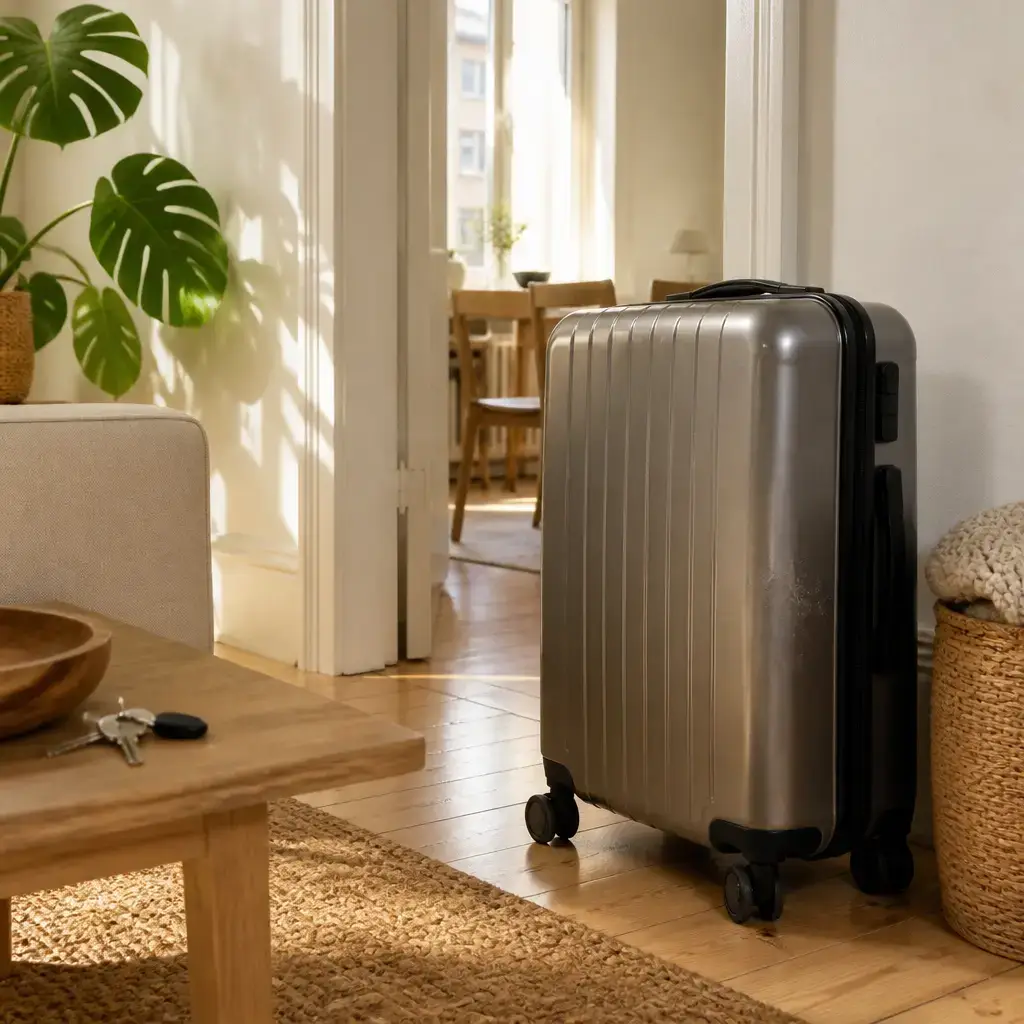
Use Borrowing a Suitcase and Agreeing on Its Care to practice Danish conversation, pronunciation, vocabulary, grammar, and quizzes.
Dialogue
Må jeg låne din mellemstore kuffert til min rejse i næste uge?
moh yai LOH-nuh deen mel-um-STOH-ruh KOO-fud tehl meen RY-suh ee NESS-duh OO-uh? Could I borrow your medium suitcase for my trip next week?Det må du godt, men vær forsigtig med håndtaget, fordi det er lidt skrøbeligt.
deh moh doo goht, men vair foh-SIK-tee meh HON-tay-guh, for-DEE deh air leet SKRUR-beh-lit. You can, but be careful with the handle because it's a little fragile.Det vil jeg huske, og jeg vil undgå at pakke for meget i den.
deh veel yai HOOS-kuh, oh yai veel oon-GOH eh PAK-uh for MAY-uh ee den. I'll keep that in mind and avoid overpacking it.Den har også en ridse på siden.
den hah OH-soh en RESS-uh poh SEE-thuh. It also has a scratch on the side.Vil du have, at jeg tager et billede, før jeg bruger den?
veel doo HAY-vuh, eh yai TAY-uh et BEE-luh-thuh, fur yai BROO-uh den? Would you like me to take a photo before I use it?Et billede vil gøre dens tilstand tydelig for os begge.
et BEE-luh-thuh veel GUR-uh dens TEHL-stan TOO-theh-lee for ohs BEH-guh. A photo would make the condition clear for both of us.Jeg afleverer den dagen efter, at jeg er kommet hjem.
yai ah-fleh-VAIR-uh den DAY-en EF-tuh, eh yai air KOM-it yem. I'll return it the day after I get back.Tør hjulene af, før du tager den med indenfor.
tur YOO-luh-nuh ah, fur doo TAY-uh den meh in-uh-FOHR. Please wipe the wheels before bringing it inside.Jeg gør det udenfor, før jeg tager den med tilbage.
yai GUR deh OO-en-fohr, fur yai TAY-uh den meh teh-BYE-uh. I'll do that outside before I bring it back.Lad mig vide, hvis håndtaget giver dig problemer under rejsen.
lah my VEE-thuh, ves HON-tay-guh GEE-vuh dye proh-BLAY-muh OON-uh RY-sen. Let me know if the handle gives you trouble during the trip.Sentence explanations
Må jeg låne din mellemstore kuffert til min rejse i næste uge?
Could I borrow your medium suitcase for my trip next week?
- Må jeg
- Could I…?
- låne
- borrow
- din
- your
- mellemstore
- medium-sized
- kuffert
- suitcase
- til
- for; to
- min
- my
- rejse
- trip; journey
- næste
- next
- uge
- week
More detail
Må jeg combines the modal må with the subject pronoun jeg. Here it forms a polite request for permission: “Could I …?” The same pattern is reusable: Må jeg komme ind? — “May I come in?” Må can also express permission in a reply, but its exact meaning depends on the surrounding construction. låne is the infinitive of låne, “to borrow.” After the modal må, Danish uses the infinitive without an infinitive marker: Må jeg låne ...? “Could I borrow ...?” Do not confuse låne with låne ud, “lend”; the borrower låner something, while the owner can låne noget ud. din means “your” and refers to one owner. It is the possessive form used with a common-gender singular noun, as in din kuffert. With a neuter singular noun, use dit; with plural nouns, use dine. The form marks the possessor, not the thing possessed. mellemstore describes kuffert as medium-sized. Its base form is mellemstor; the observed -e form is used here in the possessive noun phrase din mellemstore kuffert. A useful contrast is en mellemstor kuffert — “a medium-sized suitcase” — and et mellemstort ... with a neuter singular noun. The adjective agrees with the noun phrase, while din separately marks the possessor. kuffert is the common-gender singular noun “suitcase.” Its plural is kufferter: to kufferter — “two suitcases.” In this sentence it is the thing the speaker asks to borrow. til introduces the purpose or destination of something. Here, til min rejse means “for my trip,” identifying the purpose of borrowing the suitcase. For example, en taske til arbejdet means “a bag for work.” min means “my” with a common-gender singular noun, here rejse. Compare mit with a neuter singular noun and mine with plural nouns. Like din, it expresses possession rather than a numeric quantity. rejse is the common-gender singular noun “trip” or “journey.” Its plural is rejser: to rejser — “two trips.” In this utterance it names the trip for which the suitcase is needed. næste means “next” in the time expression næste uge, “next week.” It is also used in expressions such as næste gang — “next time.” uge means “week.” Its plural is uger: tre uger — “three weeks.” In næste uge, it is singular and refers to the week following the current one in the intended time frame. Putting the parts together: Må jeg låne asks for permission to borrow; din mellemstore kuffert identifies the owner’s medium-sized suitcase; and til min rejse i næste uge gives the purpose and time. The complete meaning is: “Could I borrow your medium suitcase for my trip next week?”
Det må du godt, men vær forsigtig med håndtaget, fordi det er lidt skrøbeligt.
You can, but be careful with the handle because it's a little fragile.
- Det må du godt
- You may / That is allowed
- forsigtig
- careful
- håndtaget
- the handle
- fordi
- because
- lidt
- a little / slightly
- skrøbeligt
- fragile
More detail
Det må du godt is a reusable Danish way to grant permission. In this exchange, Det is a neutral pronoun referring to the requested action, and du is the second-person singular subject. må is the present form of måtte; here it means “may/be allowed to,” not “must.” godt adds an affirmative “okay” sense in this construction, rather than its usual adverbial sense “well.” forsigtig means careful or cautious. In vær forsigtig, it follows the imperative vær, the form of være (“to be”) used to tell one person to be something. The adjective appears in its basic form here. Danish also has forsigtigt for neuter singular use and forsigtige for plural or definite use. Example: Vær forsigtig med glasset. — “Be careful with the glass.” håndtaget means the handle. Its base noun is håndtag; the ending -et marks the definite singular form of this neuter noun: et håndtag means “a handle,” while håndtaget means “the handle.” Example: Jeg tager fat i håndtaget. — “I take hold of the handle.” fordi introduces a reason and corresponds to “because.” It links the warning to the explanation that follows. Example: Jeg bliver hjemme, fordi jeg er træt. — “I am staying home because I am tired.” lidt means “a little” or “slightly” here. It modifies the adjective skrøbeligt, so it expresses a small degree, not a small quantity of an object. Do not confuse it with lille, the adjective “small”: en lille taske means “a small bag,” whereas lidt skrøbeligt means “slightly fragile.” skrøbeligt means fragile in this sentence. Its base form is skrøbelig; skrøbeligt is the neuter singular form agreeing with det, whose referent here is the handle. The basic form is skrøbelig, as in en skrøbelig genstand (“a fragile object”), while skrøbeligt is used with a neuter noun or a neuter pronoun. Together, the first chunk grants permission for the action requested in the preceding question. The warning then tells the listener to handle the object carefully, and fordi det er lidt skrøbeligt gives the reason: the handle is somewhat fragile. The whole utterance therefore means that the action is allowed, but care is needed because the handle could be damaged.
Det vil jeg huske, og jeg vil undgå at pakke for meget i den.
I'll keep that in mind and avoid overpacking it.
- Det
- that
- vil jeg
- I will
- huske
- remember; keep in mind
- undgå
- avoid
- pakke
- pack
- for meget
- too much
- den
- it
More detail
Det means “that” here and points to something already established in the conversation. Danish has two singular third-person forms for this kind of pronoun: det for a neuter-gender noun and den for a common-gender noun. The form itself identifies the grammatical gender, but the supplied sentence does not require naming the exact thing referred to by Det. vil jeg is the modal construction “I will”: vil is the present-tense form of ville (“to want; will”), and jeg means “I.” Because Det is placed at the beginning as the object, the finite verb comes before the subject: Det vil jeg ... rather than the neutral order Jeg vil .... The following infinitive says what will happen: vil jeg huske. huske is the infinitive “to remember.” In this sentence, huske combines with vil to express the intention or future action of keeping something in mind. A reusable pattern is Jeg vil huske ... — “I will remember ...” undgå is the infinitive “to avoid.” After the coordinated jeg vil, it is another action governed by vil: jeg vil undgå ... means “I will avoid ...” The coordination og jeg starts a second clause with its own subject and modal verb. pakke is the infinitive “to pack.” The marker at introduces it after undgå: undgå at pakke means “avoid packing.” Here pakke is not a finite verb; undgå carries the clause’s tense. for meget means “too much.” It expresses an excessive amount, not simply an unspecified amount. In pakke for meget, it modifies the amount being packed. Compare for lidt — “too little.” den means “it” here and is the object of the preposition i in i den, “into it/in it.” Unlike Det, den is the common-gender singular form of this pronoun; Danish uses den and det according to the grammatical gender of the noun being referred to. The fixed translation supports the intended object reading without requiring a more specific identification. Together, Det vil jeg huske means “I’ll keep that in mind.” The second coordinated clause, og jeg vil undgå at pakke for meget i den, means “and I will avoid packing too much into it.” The complete utterance is therefore: “I’ll keep that in mind and avoid overpacking it.”
Den har også en ridse på siden.
It also has a scratch on the side.
- Den
- it
- har
- has
- også
- also
- ridse
- scratch
- siden
- the side
More detail
Den is the Danish singular pronoun used here for “it.” The form is used for a common-gender singular referent, but the supplied text does not identify exactly what that referent is. Danish also uses det for a corresponding neuter singular form. har is the present-tense form of have, “to have.” It does not change for singular versus plural: jeg har means “I have,” while de har means “they have.” også means “also” and adds this fact to information already being discussed. In this sentence it occurs after the verb: Den har også ... = “It also has ...”. ridse means “scratch,” a mark or narrow damage on a surface. In en ridse, ridse is the noun and en is its indefinite article. The article introduces an unspecified scratch; it does not by itself assert a numeric count. The definite form is ridsen, “the scratch.” Example: Der er en ridse på bordet. — “There is a scratch on the table.” siden means “the side.” It is the definite form of side, formed with the definite suffix -en: side → siden. The preceding preposition på supplies the relation “on,” giving the reusable pattern på siden — “on the side.” Together, Den har også en ridse på siden says that the relevant object has an additional feature: a scratch located on its side. The present-tense form har presents the object as having that feature in the situation described.
Vil du have, at jeg tager et billede, før jeg bruger den?
Would you like me to take a photo before I use it?
- Vil du have
- Would you like
- tager
- take
- billede
- photo; picture
- før
- before
- bruger
- use
- den
- it
More detail
Vil du have is the reusable Danish pattern “would you like …?” Literally, it is built from vil (“want/would like”), du (“you”), and have (“have”), but together it introduces a desired action. In this sentence, at jeg tager ... specifies that action. Example: Vil du have, at jeg åbner vinduet? — “Would you like me to open the window?” tager is the present-tense form of tage, “to take.” Here it means “take” in the established expression tage et billede, “take a photo.” Danish present-tense verbs do not change according to the subject’s person or number: jeg tager and du tager both use tager. Example: Jeg tager et billede. — “I am taking a photo.” billede means “picture” or “photo” here. The preceding et is the indefinite article used with this noun; the noun itself is billede. Danish nouns can take different indefinite articles, so the article belongs to the noun phrase rather than expressing a numeric count here. Example: Et billede hænger på væggen. — “A picture is hanging on the wall.” før means “before” and introduces the time relation between two actions. The clause after it, jeg bruger den, describes the action that happens later than taking the photo. Example: Vask hænderne, før du spiser. — “Wash your hands before you eat.” bruger is the present-tense form of bruge, “to use.” Its subject here is jeg, but the verb form itself is not specially marked for first person; Danish present forms generally stay the same across subjects. Example: Jeg bruger telefonen. — “I use the phone.” den is a singular common-gender Danish pronoun used here as the object of bruger; in this translation it corresponds to “it.” Its specific referent is the item under discussion, but the sentence does not name that item. Example: Jeg finder bogen og bruger den. — “I find the book and use it.” The structure is Vil du have, at ...? + an action clause: jeg tager et billede (“I take a photo”) + før (“before”) + jeg bruger den (“I use it”). Together, the utterance asks whether the listener would like the speaker to take a photo before the speaker uses the item. The repeated jeg makes the speaker the agent of both actions, while den is the item used afterward.
Et billede vil gøre dens tilstand tydelig for os begge.
A photo would make the condition clear for both of us.
- billede
- photo; picture
- vil
- would
- gøre
- make
- dens
- its
- tilstand
- condition; state
- tydelig
- clear
- os begge
- both of us
More detail
billede means “picture” or “photo” here. Its base form is billede; with the indefinite article, Danish uses et billede, because this noun is neuter. Example: Jeg ser et billede. — “I am looking at a picture.” vil is the present form of the modal verb ville. In this sentence, the fixed translation gives it the hypothetical sense “would,” rather than “want to.” The modal is followed by the infinitive gøre, without an infinitive marker. The same form can also mean “will” in a different context, so the surrounding meaning determines the reading. gøre is the infinitive “make” or “do”; here it means “make” in the causative pattern gøre + object + adjective: make something clear. Example: Det gør forskellen tydelig. — “It makes the difference clear.” dens is the possessive form meaning “its.” It marks possession by a singular third-person referent; the fixed translation identifies what is possessed as the condition. Danish also has sin/sit/sine for a reflexive “one’s own” possession, but dens is not reflexive. tilstand means “condition” or “state.” The form is singular and indefinite here, but the preceding dens makes the phrase definite in reference: “its condition.” Example: Hans tilstand er stabil. — “His condition is stable.” tydelig means “clear” or “evident.” It is an adjective used after gøre to describe the resulting state of dens tilstand. The form agrees with a common-gender singular noun; the neuter singular form is tydeligt, and the plural form is tydelige. Example: Forklaringen er tydelig. — “The explanation is clear.” os begge means “both of us.” os is the object form of first-person plural “we,” and begge specifies that the reference is to the two members of that group. Example: Læreren hjalp os begge. — “The teacher helped both of us.” Together, Et billede is the subject, vil gøre expresses the intended “would make,” dens tilstand is the object whose condition is affected, and tydelig describes the resulting clarity. for os begge identifies the two people for whom that condition would be clear. The whole utterance therefore means: “A photo would make its condition clear for both of us.”
Jeg afleverer den dagen efter, at jeg er kommet hjem.
I'll return it the day after I get back.
- Jeg
- I
- afleverer
- return; hand in
- den
- it
- dagen
- the day
- efter
- after
- er kommet hjem
- have got back home
More detail
Jeg means “I” and is the first-person singular subject form. It is used for the speaker; the corresponding object form is mig (“me”). afleverer is the present-tense form of aflevere, “to hand in” or “to return.” In this sentence it describes the speaker’s planned or scheduled return of an item. The present form can be used for a future action when the time is clear from context. Example: Jeg afleverer bogen i morgen. — “I’ll return the book tomorrow.” den is the object pronoun “it.” Here, the fixed translation identifies it as the item being returned. Den is used for a singular common-gender noun; it does not itself identify the item’s name. The context also contains den in dens, but that possessive form is not the same word or grammatical role. dagen is the definite singular form of dag, “day”: en dag means “a day,” while dagen means “the day.” In the construction dagen efter, it forms the time expression “the day after.” efter means “after.” Here it links dagen to the following event, so dagen efter at ... means “the day after ...”. The word can also introduce a noun phrase, as in efter frokost — “after lunch.” er kommet hjem means “have got back home” in this sentence. It is built from komme (“to come/get”) in the past participle kommet, with the present form er of være (“to be”): er kommet. Danish commonly uses være with movement verbs such as komme in this perfect construction. Hjem means “home” and indicates the destination or state of being back home; it is not preceded by an article in this expression. Example: Hun er kommet hjem. — “She has got home.” Together, Jeg afleverer den means “I’ll return it,” and dagen efter, at jeg er kommet hjem specifies when: “the day after I get back.” The whole utterance is therefore: “I’ll return it the day after I get back.”
Tør hjulene af, før du tager den med indenfor.
Please wipe the wheels before bringing it inside.
- Tør … af
- wipe off
- hjulene
- the wheels
- før
- before
- tager … med
- bring along
- indenfor
- inside
More detail
Tør ... af is the imperative construction from at tørre (“to wipe”): tør gives the instruction, while af contributes the sense of wiping something off. Danish commonly places a particle like af after the object: Tør bordet af means “Wipe the table.” In this sentence, the object is expressed by hjulene. hjulene means “the wheels.” Its base form is hjul (“wheel”); hjulene is the definite plural form, referring to wheels identified in the situation. For comparison, et hjul is “a wheel,” hjul can mean “wheels” without definiteness, and hjulene means “the wheels.” før introduces the event that must happen later than the wiping: “before.” It introduces the subordinate clause før du tager den med indenfor. Example: Vask hænderne, før du spiser. — “Wash your hands before you eat.” tager ... med is based on the present form tager of at tage (“to take”). Together with med, tage med means taking or bringing something along. Here du is the subject (“you”), and den is a singular common-gender pronoun meaning “it”; the supplied translation identifies it as the item being brought, without specifying the item's identity. Example: Jeg tager bogen med. — “I’ll bring the book along.” indenfor is an adverb meaning “inside” or “indoors.” It describes the destination of the bringing action, so tager den med indenfor means “bring it inside.” Indenfor is written as one word here. Together, the instruction is: wipe the wheels off first, and do so before you bring the item inside. The imperative applies to the understood listener, while du tager ... states the later action carried out by “you.”
Jeg gør det udenfor, før jeg tager den med tilbage.
I'll do that outside before I bring it back.
- Jeg
- I
- gør
- do
- det
- that; it
- udenfor
- outside
- før
- before
- jeg
- I
- tager
- take
- den
- it
- med
- with
- tilbage
- back
More detail
Jeg means “I” and is the subject pronoun for the speaker. It is used with the same form regardless of the speaker’s gender. Example: Jeg kommer nu. — “I’m coming now.” gør is the present-tense form of gøre, “to do” or “to make.” Here it means “do,” referring to the action expressed as det. Danish present-tense verbs generally do not change for the subject: jeg gør, du gør, hun gør. Example: Hvad gør du? — “What are you doing?” det is a singular neuter object pronoun. Here the fixed translation identifies its meaning as “that,” referring to an understood action or thing without naming it again. It is different from den, the singular common-gender object pronoun used later in the sentence. Example: Jeg gør det i morgen. — “I’ll do that tomorrow.” udenfor is an adverb meaning “outside.” It describes where the action happens. Example: Børnene leger udenfor. — “The children are playing outside.” før means “before” and introduces the event that occurs later in the time sequence. In før jeg tager ..., it links the first action with the later action. Example: Ring, før du går. — “Call before you leave.” The second jeg is again the first-person singular subject pronoun “I.” It is the subject of the clause introduced by før, so it is not a different form from the first Jeg. tager is the present-tense form of tage, “to take.” In the construction tage ... med, it contributes to the meaning “take or bring something along,” rather than simply describing removal. The present form is used with different subjects without a person ending: jeg tager, du tager, de tager. Example: Jeg tager en paraply med. — “I’m bringing an umbrella along.” den is a singular common-gender object pronoun meaning “it” here. The fixed translation supports that object reading, but the supplied utterance does not identify the object by name. Its form contrasts with neuter det; the choice depends on the grammatical gender of the noun it replaces, not on whether the object is singular alone. med means “with” on its own. Here it is part of tage ... med, a reusable construction meaning to take or bring something along. Example: Tag nøglen med. — “Bring the key along.” tilbage means “back” and adds the idea of returning the item. tage den med tilbage therefore means “bring it back,” not merely “take it.” Example: Hun tager bogen tilbage. — “She takes the book back.” The sentence is assembled as Jeg gør det (“I’ll do that”) + udenfor (“outside”) + før (“before”) + jeg tager den med tilbage (“I bring it back”). In the fixed meaning, the speaker will do the understood task outside and will bring the referenced item back afterward. The clause after før states the later action in the time relationship.
Lad mig vide, hvis håndtaget giver dig problemer under rejsen.
Let me know if the handle gives you trouble during the trip.
- Lad mig vide
- let me know
- hvis
- if
- håndtaget
- the handle
- giver
- gives
- dig
- you
- problemer
- problems
- under
- during
- rejsen
- the trip
More detail
Lad mig vide is a reusable Danish way to say “let me know.” Lad is the imperative of lade (“let”); mig is the object form of jeg (“I”), and vide is the infinitive “know.” The pattern lad + person + infinitive can be used with another verb: Lad ham komme. — “Let him come.” hvis introduces a condition and means “if” here. It introduces the situation under which the request applies: “if the handle gives you trouble.” håndtaget means “the handle” here. Its base form is håndtag; -et marks the definite singular form of this neuter noun. The noun is the subject of the conditional clause, so it is the handle that causes the problem. giver is the present-tense form of give (“to give”). In this sentence, giver ... problemer is the useful pattern “gives ... problems” or, naturally, “causes ... trouble.” The present form is used for a possible situation during the trip. dig is the object form of du (“you”). In giver dig problemer, you are the person who experiences the problems; the handle is the subject that gives them. problemer is the plural indefinite form of problem, meaning “problems.” The plural presents trouble generally rather than naming one specific problem. In the fixed sentence it belongs to the pattern give someone problems. under means “during” in this time expression. It places the possible trouble within the period described by the following noun phrase. rejsen means “the trip.” Its base form is rejse; -n marks the definite singular form. Thus under rejsen means “during the trip,” referring to the particular trip understood in the sentence. Together, Lad mig vide makes the request “let me know.” hvis håndtaget giver dig problemer adds the condition “if the handle gives you trouble,” and under rejsen specifies when that trouble may occur. The complete meaning is: “Let me know if the handle gives you trouble during the trip.”
Grammar Points
Adjektivets bøjning: mellemstor → mellemstore, skrøbelig → skrøbeligt
Det mellemstore håndtag er skrøbeligt.
deh mel-um-STOH-ruh HON-tay-guh air SKRUR-beh-lit.The medium-sized handle is fragile.
Adjektivet ændrer endelse efter substantivets køn og tal: -e i bestemt form og flertal, -t ved intetkøn.
Tørre af i imperativ: Tør ... af
Tør håndtaget af.
tur HON-tay-guh ah.Wipe the handle.
I imperativ står tørre som Tør, mens af bliver stående efter det, man tørrer.
Danish Vocabulary
- Gender
- neuter
- Gender
- common
- Plural
- kufferter
- Gender
- common
- Plural
- rejser
- Gender
- neuter
Quiz
Spelling
Tap the letters to spell the word.
fragile
Show Answer
skrøbeligtsuitcase
Show Answer
kufferthandle
Show Answer
håndtagettrip; journey