10 minutes free every day
Continue audio lessons in the app
Word explanations appear automatically in sync with the audio.
No login required · synced translations · playback with the screen locked
Choose your learning language and open this lesson in the app.

About This Lesson
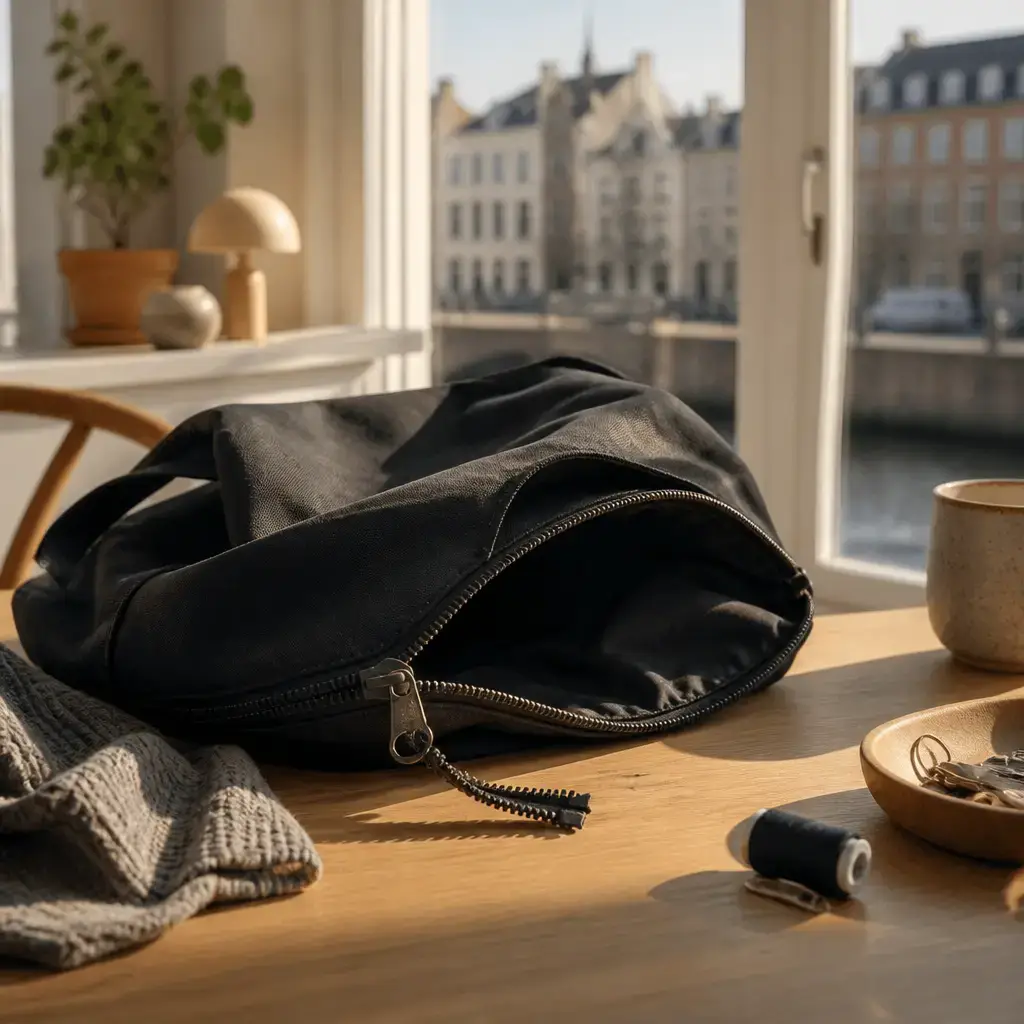
Use Explaining damage to a borrowed bag to practice Danish conversation, pronunciation, vocabulary, grammar, and quizzes.
Dialogue
Jeg er nødt til at fortælle dig noget om den taske, jeg lånte.
yai air NURD tehl uh for-TELL-uh dai NOH-uh ohm then TAS-kuh, yai LON-duh I need to tell you something about the bag I borrowed.Skete der noget med den under din rejse?
SGAY-duh dair NOH-uh meh then OO-nuh deen RY-suh? Did something happen to it during your trip?Lynlåsen satte sig fast, og en del af den gik løs.
LOON-loh-sun SAD-uh say fast, oh en DEHL uh then geek LURSS. The zipper got stuck, and part of it came loose.Var lynlåsen allerede beskadiget?
Vahr LOON-loh-sun AL-uh-ray-uh beh-SGAY-uh? Was the zipper already damaged?Eller gik den i stykker, mens du brugte den?
ELL-uh geek then ee STOO-kuh, mens doo BROOG-duh then? Or did it break while you were using it?Den virkede fin før, så jeg vil tage ansvar.
Then VAIR-kuh feen fuh, soh yai veel TAY-uh un-SVAHR. It seemed fine before, so I want to take responsibility.Jeg sætter pris på din ærlighed. Den kan måske stadig repareres.
yai SET-uh preess poh deen AIR-lee-heth. Then kan MAW-skeh STAY-lee reh-pah-RAY-uhs. I appreciate your honesty. It may still be repairable.Jeg kan få den repareret eller erstatte tasken, hvis det er nødvendigt.
yai kan foh then reh-pah-RAY-uth oh-ler air-STAT-uh TAS-kuhn, vis deh air NURD-ven-lee. I can arrange the repair or replace the bag if needed.Lad os tage den med til et reparationsværksted, før vi beslutter os.
Lath ohs TAY-uh then meh tehl ed reh-pah-rah-SHOHNS-vairg-steth, fur vee beh-SLOOT-uh ohs. Let's take it to a repair shop before deciding.Jeg er ked af, at jeg ikke fortalte dig det, så snart det skete.
yai air KAY uh, uh yai IG-uh for-TEL-duh dai deh, soh SNAHRT deh SGAY-duh. I'm sorry I didn't tell you as soon as it happened.Du siger det nu, og det hjælper. Vi får se, hvad de siger.
Doo SEE-uh deh NOO, oh deh YEL-buh. Vee foh SAY, vah deh SEE-uh. You brought it up now, and that helps. We'll see what they say.Sentence explanations
Jeg er nødt til at fortælle dig noget om den taske, jeg lånte.
I need to tell you something about the bag I borrowed.
- Jeg er nødt til
- I need to
- fortælle
- tell
- dig
- you
- noget
- something
- om
- about
- den
- the
- taske
- bag
- lånte
- borrowed
More detail
Jeg er nødt til expresses necessity: “I need to” or “I have to.” The fixed phrase contains Jeg (“I”), er (“am”), and nødt til (“obliged/forced to”). In Danish, nødt til at is a reusable pattern for saying that the subject must do something: Jeg er nødt til at gå means “I have to leave.” The infinitive marker at introduces the action that is necessary. fortælle means “to tell” and is the infinitive after at. Its base form is fortælle; the sentence does not use a past or present-tense form of this verb. A useful pattern is fortælle nogen noget, “tell someone something,” as in Hun fortæller ham nyheden — “She tells him the news.” dig means “you” here as the person receiving the information. It is the object form of the singular second-person pronoun; the subject form is du: Du fortæller mig noget means “You tell me something.” noget means “something.” It is an indefinite pronoun used when the thing is not specified more precisely. For example, Jeg har noget til dig means “I have something for you.” om means “about” here and introduces the topic of the telling. The pattern fortælle nogen noget om noget means “tell someone something about something.” In this sentence, dig is the recipient, noget is the information, and den taske is its topic. den is the form used before the common-gender singular noun taske to identify a particular bag. In den taske, it functions as a demonstrative determiner; the intended meaning here is “the bag,” as established by the translation. It should not be treated as an independent noun. Danish also has the related demonstrative det for neuter singular nouns, but the choice depends on the noun’s grammatical gender, not simply on the meaning “the.” taske means “bag.” It is a common-gender singular noun. Without a determiner, the indefinite form is en taske, “a bag”; the definite form is tasken, “the bag.” In this utterance, den taske identifies the particular bag being discussed rather than using the ordinary suffixal definite form. lånte means “borrowed” here. It is the past-tense form of låne, “borrow.” Danish uses the same form lånte with different subjects: Jeg lånte bogen means “I borrowed the book,” while de lånte bogen means “they borrowed the book.” The clause jeg lånte comes after taske and describes the bag: den taske, jeg lånte means “the bag that I borrowed.” Danish can omit the object relative pronoun in this kind of relative clause; the bag is understood as the thing borrowed. Together, Jeg er nødt til at fortælle dig noget means “I need to tell you something.” Adding om den taske gives “about the bag,” and jeg lånte identifies that bag as the one the speaker borrowed. The complete utterance therefore means: “I need to tell you something about the bag I borrowed.”
Skete der noget med den under din rejse?
Did something happen to it during your trip?
- Skete
- happened
- noget
- something
- den
- it
- under
- during
- din
- your
- rejse
- trip
More detail
Skete is the past-tense form of ske, “to happen.” The present form is sker, and the past form is skete: Der sker noget = “Something is happening”; Der skete noget = “Something happened.” In this question, Skete der ...? is the usual Danish question pattern for asking whether something happened. Der is a grammatical placeholder in this construction, while noget supplies the meaning “something.” Noget means “something” here. It is an indefinite pronoun used when the thing is not specified. Compare noget = “something” with ikke noget = “nothing” in a negative sentence: Der skete ikke noget = “Nothing happened.” Den means “it” here and refers to the previously mentioned bag; the following context also describes parts of that same object. Danish den is used for a singular common-gender noun, while det is used for a singular neuter noun. The form of the pronoun is determined by the noun’s grammatical gender, not by the object’s physical characteristics. Under means “during” when it introduces a period or event. Thus under din rejse means “during your trip.” It can also mean “under” in a spatial sense, but the time meaning is the one used here. Din means “your” before one singular common-gender noun. It agrees with rejse, whose base form is rejse and which is a common-gender noun: en rejse, din rejse. With a singular neuter noun, Danish uses dit; with a plural noun, it uses dine. Rejse means “trip” here. The noun phrase en rejse is “a trip,” and rejsen is “the trip.” The related verb rejse means “to travel” or “to leave,” so the noun and verb should be distinguished by their role in the sentence. Together, Skete der noget asks whether anything happened, med den specifies that it happened to the previously mentioned bag, and under din rejse places the event during the listener’s trip. The complete meaning is: “Did something happen to it during your trip?”
Lynlåsen satte sig fast, og en del af den gik løs.
The zipper got stuck, and part of it came loose.
- Lynlåsen
- the zipper
- satte sig fast
- got stuck
- en del
- a part
- af den
- of it
- gik løs
- came loose
More detail
Lynlåsen means “the zipper” here. It is the definite singular form of lynlås (“zipper”): the ending -en marks a common-gender singular noun as definite. A useful pattern is en lynlås = “a zipper” and lynlåsen = “the zipper.” satte sig fast expresses that something became stuck. satte is the past form of sætte (“set” or “put”), and sig is the reflexive pronoun referring back to the zipper; together with fast, this is the established expression for getting stuck. The past form places the event in the past. For example: Døren satte sig fast. — “The door got stuck.” en del means “a part” or “a portion.” del is a common-gender noun, so its indefinite singular form is en del; the article does not by itself state a numerical count. The same noun can be definite as delen (“the part”). af den means “of it” in this sentence. af introduces what the part belongs to or comes from, and den is the common-gender singular form of the pronoun used here. The fixed translation identifies den as referring to the zipper, so en del af den means “part of the zipper.” gik løs means “came loose.” gik is the past form of gå (“go”), while løs describes the resulting state of no longer being attached or tight. The combination is a common way to describe something becoming detached. For example: Knappen gik løs. — “The button came loose.” The first clause, Lynlåsen satte sig fast, says that the zipper got stuck. og then joins a second past-tense clause: en del af den gik løs, “part of it came loose.” Together, the utterance means: “The zipper got stuck, and part of it came loose.”
Var lynlåsen allerede beskadiget?
Was the zipper already damaged?
- Var
- was
- lynlåsen
- the zipper
- allerede
- already
- beskadiget
- damaged
More detail
Var is the past-tense form of Danish være (“to be”) for all persons in the simple past. In this question, it comes first because Danish places the finite verb before the subject in a neutral yes/no question: Var ...? means “Was ...?” lynlåsen means “the zipper.” Its base form is lynlås; the ending -en marks the definite singular form for this noun. The word refers to the zipper discussed in the supplied context. allerede means “already.” It places the condition before the relevant reference point in time: the question asks whether the zipper was damaged at that earlier point, rather than asking only whether it is damaged now. beskadiget means “damaged” here. It is the past participle of beskadige (“to damage”) and is used with være to describe a resulting condition: være beskadiget = “be damaged.” As an adjective, it can also describe a noun directly, for example en beskadiget lynlås — “a damaged zipper.” Together, Var + lynlåsen forms the yes/no-question frame, while allerede beskadiget describes the zipper’s condition at the relevant earlier time. The complete utterance asks: “Was the zipper already damaged?”
Eller gik den i stykker, mens du brugte den?
Or did it break while you were using it?
- Eller
- Or
- gik … i stykker
- broke
- den
- it
- mens
- while
- du
- you
- brugte
- used
More detail
Eller means “or” here and links this question to an alternative possibility. It is the same conjunction used to offer a choice between clauses, as in Vil du have te eller kaffe? — “Would you like tea or coffee?” gik i stykker is a fixed Danish expression meaning “broke” or “stopped working.” Its first word, gik, is the past form of gå (“go”), but the whole expression—not a literal movement—describes something becoming damaged or nonfunctional. i stykker is part of this expression and should be kept with it. For a different tense, Danish uses forms such as går i stykker (“breaks/is breaking”) and er gået i stykker (“has broken/is broken”). den is a third-person singular pronoun for a common-gender referent. Here it refers to the item under discussion, the zipper in the supplied context. Danish uses det for a neuter-gender singular referent; the choice is grammatical, not a statement about the item’s size or importance. mens introduces an overlapping time period and commonly translates as “while.” It introduces the subordinate clause describing what was happening at the time of the breaking: mens .... du is the second-person singular pronoun, “you,” used for one person. Its form does not change according to grammatical gender. brugte is the past form of bruge, “use.” With du, the clause du brugte den means “you were using it” in this context. Danish past tense does not itself create a separate progressive form; the combination of past tense and mens supplies the sense of an activity in progress. Compare Jeg brugte den — “I used it” — where brugte stays the same while the subject changes. Together, gik i stykker gives the event “broke,” and mens du brugte den gives the simultaneous activity “while you were using it.” With Eller, the complete utterance asks: “Or did it break while you were using it?” It presents that event-and-time relationship as an alternative question.
Den virkede fin før, så jeg vil tage ansvar.
It seemed fine before, so I want to take responsibility.
- Den
- it
- virkede
- seemed
- fin
- fine
- før
- before
- så
- so
- jeg vil
- I want to
- tage ansvar
- take responsibility
More detail
Den is the Danish singular common-gender pronoun meaning “it” here. It refers to the item already under discussion, without the sentence itself specifying its identity. Danish contrasts den for common-gender singular reference with det for neuter singular reference and de for plural reference. virkede is the past form of virke, “to seem” or “to work/function.” In this sentence, the intended meaning is “seemed”: Den virker fin = “It seems fine,” while Den virkede fin places that assessment in the past. The adjective after virke describes how something appears or functions. fin means “fine” here. Its basic form is fin; Danish adjective forms include fint with a neuter singular noun and fine in plural or definite contexts. For example, Bilen virker fin means “The car seems fine,” whereas Huset virker fint means “The house seems fine.” før means “before” or “previously.” Here it refers generally to an earlier time: Den virkede fin før = “It seemed fine before.” It does not by itself specify exactly when that earlier time was. så links the two parts with the meaning “so” or “therefore” here. It introduces the consequence or response to the preceding assessment. For example, Det regner, så jeg bliver hjemme means “It is raining, so I am staying home.” jeg vil means “I want to” in this sentence. jeg is the first-person singular pronoun “I,” and vil is the present form of ville, whose meanings include “want” and “will”; the fixed translation selects “want” here. Jeg vil lære dansk means “I want to learn Danish.” tage ansvar is the reusable expression “take responsibility.” tage is the infinitive of “to take,” and ansvar is the noun “responsibility.” The same pattern appears in Hun vil tage ansvar = “She wants to take responsibility.” Together, Den virkede fin før means “It seemed fine before.” så connects that earlier assessment to the speaker’s intended response, jeg vil tage ansvar, “I want to take responsibility.” The complete utterance therefore means: “It seemed fine before, so I want to take responsibility.”
Jeg sætter pris på din ærlighed. Den kan måske stadig repareres.
I appreciate your honesty. It may still be repairable.
- Jeg sætter pris på
- I appreciate
- ærlighed
- honesty
- Den
- it
- kan
- may
- måske
- perhaps
- stadig
- still
- repareres
- be repaired
More detail
Jeg sætter pris på is a reusable Danish expression meaning “I appreciate.” The verb form sætter is present tense of sætte; in this expression, the words work together rather than meaning literally “put.” The pattern is jeg sætter pris på + noun/pronoun: “I appreciate …” ærlighed means “honesty.” It is a noun; the related adjective is ærlig, “honest.” For example: Jeg værdsætter din ærlighed. — “I value your honesty.” Den is a singular common-gender pronoun, corresponding here to “it.” Its grammatical form does not by itself identify the thing being discussed. Danish uses den with common-gender singular nouns and det with neuter singular nouns. The context and meaning determine the referent. kan is the present-tense form of the modal verb kunne. It can express ability or possibility. Here, together with måske, it presents repair as a possibility: “may/can perhaps be repaired,” rather than asserting that repair will happen. måske means “perhaps” or “maybe.” It marks uncertainty. For example: Måske kommer hun senere. — “Perhaps she will come later.” stadig means “still,” indicating that the possibility remains at this point. For example: Det virker stadig. — “It still works.” repareres comes from reparere, “to repair.” The -s form marks the passive: the subject receives the action instead of carrying it out. After the modal kan, it forms the passive infinitive in kan repareres, “can/may be repaired.” Compare the active pattern Jeg kan reparere den. — “I can repair it.” The sentence combines these parts in the order Den + kan + måske + stadig + repareres: “It” + “may/can” + “perhaps” + “still” + “be repaired.” Together with the first sentence, Jeg sætter pris på din ærlighed. Den kan måske stadig repareres. means: “I appreciate your honesty. It may still be repairable.”
Jeg kan få den repareret eller erstatte tasken, hvis det er nødvendigt.
I can arrange the repair or replace the bag if needed.
- Jeg kan
- I can
- få den repareret
- have it repaired
- eller
- or
- erstatte
- replace
- tasken
- the bag
- hvis det er nødvendigt
- if necessary
More detail
Jeg kan means “I can.” Jeg is the first-person singular subject, “I.” kan is the present form of kunne, the modal verb “can / be able to.” Danish normally places an infinitive after this modal: Jeg kan ... = “I can ...”; the modal itself does not take an ending for the subject. få den repareret means “have it repaired” here. få is the infinitive of få; in this pattern, få noget repareret, it expresses arranging or causing something to be repaired rather than simply stating that the speaker personally repairs it. den is a singular common-gender object pronoun, and in this utterance it refers to the bag identified by the fixed translation and context. repareret is the past participle of reparere, “repair,” used here after få in the construction få + object + past participle. Example: Jeg får cyklen repareret. — “I’m having the bicycle repaired.” The object comes between få and the participle. eller means “or.” It connects the two alternatives: arranging the repair and replacing the bag. erstatte means “replace.” It is an infinitive, coordinated with the preceding infinitive phrase after kan: Jeg kan ... eller erstatte ... = “I can ... or replace ...”. The infinitive is erstatte; unlike the first option, this verb directly takes its object in the sentence. tasken means “the bag.” It is the definite singular form of taske, “bag”: en taske = “a bag,” tasken = “the bag.” The ending -en marks the singular definite form of this common-gender noun. Here it is the object of erstatte. hvis det er nødvendigt means “if necessary” here. hvis introduces a condition, “if.” In det er nødvendigt, det is the neuter singular pronoun/form used as the subject of this impersonal “it is necessary” expression; it does not identify a separate object in the sentence. nødvendigt is the neuter form of the adjective nødvendig, “necessary,” used with det. Example: Vi bliver hjemme, hvis det er nødvendigt. — “We will stay home if necessary.” Taken together, Jeg kan få den repareret presents arranging the bag’s repair as one option. eller erstatte tasken adds replacing the bag as the second option, and hvis det er nødvendigt limits these options with the condition “if necessary.” The complete meaning is: “I can arrange the repair or replace the bag if needed.”
Lad os tage den med til et reparationsværksted, før vi beslutter os.
Let's take it to a repair shop before deciding.
- Lad os
- let's
- tage
- take
- den
- it
- med
- along
- til
- to
- reparationsværksted
- repair shop
- før
- before
- vi
- we
- beslutter os
- decide
More detail
Lad os is the standard Danish way to suggest an action involving the speaker and others: “let’s …”. It is followed by the infinitive, so the next verb is tage, not a finite present form. Example: Lad os gå. — “Let’s go.” tage means “take” here. Its infinitive is tage; useful forms include tager (present), tog (past), and taget (past participle). In tage ... med, the verb means taking something along rather than merely moving it. den is a singular common-gender pronoun. In this sentence, the fixed translation identifies it as “it”; the wording does not require naming the object more specifically. Danish contrasts den for common-gender singular reference with det for neuter singular reference and de for plural reference. med contributes “along” in the construction tage noget med — “take something along.” For example, Tag paraplyen med. — “Take the umbrella along.” The following til gives the destination, so tage den med til ... means “take it along to …”. til is the preposition used here for movement toward a destination: “to.” It introduces et reparationsværksted, the place where the object is to be taken. reparationsværksted is a compound noun meaning “repair workshop” or “repair shop.” The first part relates to repair, and værksted means “workshop.” Danish commonly combines such parts into one written noun. The indefinite article et before it marks one nonspecific singular noun; it does not by itself add a counted quantity to the sentence. før introduces a time clause meaning “before.” The clause after it is vi beslutter os, so the taking is presented as happening before the deciding. Example: Ring, før du kommer. — “Call before you come.” vi is the first-person plural pronoun “we.” It is the subject of the subordinate clause introduced by før, and it refers to the speaker together with at least one other participant in that clause. beslutter os is the reflexive construction beslutte sig, meaning “decide” or “make a decision.” beslutter is the present form of beslutte; os is the reflexive form used with the subject vi. Example: Vi beslutter os i morgen. — “We’ll decide tomorrow.” The reflexive construction differs from beslutte noget, which can mean “decide something.” Taken together, Lad os tage den med til et reparationsværksted means “Let’s take it along to a repair shop.” før vi beslutter os adds “before we decide,” giving the complete meaning: “Let’s take it to a repair shop before deciding.”
Jeg er ked af, at jeg ikke fortalte dig det, så snart det skete.
I'm sorry I didn't tell you as soon as it happened.
- er ked af
- am sorry
- fortalte
- told
- så snart
- as soon as
- skete
- happened
More detail
er ked af expresses “am sorry” here. The reusable pattern is være ked af + ... (“be sorry about ...”); er is the present form of være and is used with all subjects in the present, including jeg. ked is an adjective in the fixed expression, and af introduces what the feeling concerns. In another sentence, Jeg er ked af forsinkelsen means “I am sorry about the delay.” fortalte means “told” in this sentence. It is the past form of fortælle (“tell”): fortælle → fortalte. This verb form does not change for person or number in the Danish past tense. The nearby jeg is the teller, while dig is the person told; det is the thing or information told. The separate ikke negates the telling, so jeg ikke fortalte dig det means “I did not tell you that/it.” så snart is a reusable time-linking construction meaning “as soon as.” It introduces an event that sets the timing for another event. For example, Jeg ringer, så snart jeg kommer hjem means “I’ll call as soon as I get home.” skete means “happened” here. It is the past form of ske (“happen”): ske → skete; like fortalte, this past-tense form does not vary with the subject. In det skete, det is the subject pronoun corresponding to “it,” and the clause means “it happened.” The sentence begins with the speaker’s apology: Jeg er ked af. The at clause states what the apology concerns: at jeg ikke fortalte dig det, “that I did not tell you.” The final time clause, så snart det skete, says that the relevant telling was not done as soon as the event happened. Together, the utterance means: “I’m sorry I didn’t tell you as soon as it happened.”
Du siger det nu, og det hjælper. Vi får se, hvad de siger.
You brought it up now, and that helps. We'll see what they say.
- Du
- you
- siger
- say
- det
- it; that
- nu
- now
- hjælper
- helps
- Vi får se
- we’ll see
- hvad
- what
- de
- they
More detail
Du means “you” here. It is the subject pronoun for the person being addressed; Danish du is singular and informal. The plural form is I, used for more than one person. siger is the present-tense form of sige, “to say.” In this sentence, Du siger det literally presents the saying as happening now; the fixed translation renders the contextually intended act as “you brought it up.” Example: Hun siger sandheden. — “She tells the truth.” det is the Danish neuter singular pronoun “it/that.” As the object of siger, it refers to the matter being mentioned, but the supplied text does not specify that matter by name. The same form appears later as the subject of hjælper; there it refers to the preceding fact or action and means “that/it” as the thing that helps. Danish pronouns can therefore have the same form in different grammatical roles. nu means “now” and places siger in the present situation. In Du siger det nu, it combines with the present form to mean that the mentioning is taking place now. hjælper is the present-tense form of hjælpe, “to help.” Here det is its subject, so det hjælper means “that helps.” The form hjælper does not show whether the subject is singular or plural; the subject identifies who or what helps. Example: Det hjælper meget. — “That helps a lot.” Vi får se is a fixed, commonly used construction meaning “we’ll see.” vi is “we,” and får is the present form of få, “to get,” but in this construction it belongs with se, “to see,” rather than being understood as a literal getting. The construction expresses a future assessment or outcome without stating what that outcome will be. Example: Vi får se, om det virker. — “We’ll see whether it works.” hvad means “what” and introduces the content of what will be seen. In hvad de siger, it functions as a question word inside the clause, not as a question that needs a separate answer. A related contrast is hvem, “who,” when the unknown element is a person rather than a thing or content. de means “they,” the plural subject of siger in the subordinate clause. It is distinct from singular du (“you”) and han/hun (“he”/“she”). The text does not identify who de refers to. Together, Du siger det nu, og det hjælper means “You brought it up now, and that helps”: the first det is the matter mentioned, and the second det refers to the preceding fact or action as helpful. Vi får se, hvad de siger means “We’ll see what they say”: vi får se supplies the main construction, while hvad de siger states what will be seen. The full utterance connects the helpful present action with waiting to learn what de say.
Grammar Points
er nødt til at + infinitiv
Vi er nødt til at erstatte lynlåsen.
vee air NURD tehl uh air-STAT-uh LOON-loh-sun.We need to replace the zipper.
Udtrykket er en fast måde at sige, at noget er nødvendigt eller obligatorisk.
-s-passiv
Lynlåsen repareres.
LOON-loh-sun reh-pah-RAY-uhs.The zipper is repaired.
Endelsen -s kan danne passiv på dansk: fokus er på det, der bliver repareret.
Danish Vocabulary
- Gender
- common
- Gender
- common
Quiz
Word Order
Arrange the words in the correct order.
Was the zipper already damaged?
Show Answer
Var lynlåsen allerede beskadiget?Spelling
Tap the letters to spell the word.
tell
Show Answer
fortællethe zipper
Show Answer
lynlåsentrip; journey
Show Answer
rejsehappened