10 minutes free every day
Continue audio lessons in the app
Word explanations appear automatically in sync with the audio.
No login required · synced translations · playback with the screen locked
Choose your learning language and open this lesson in the app.

About This Lesson
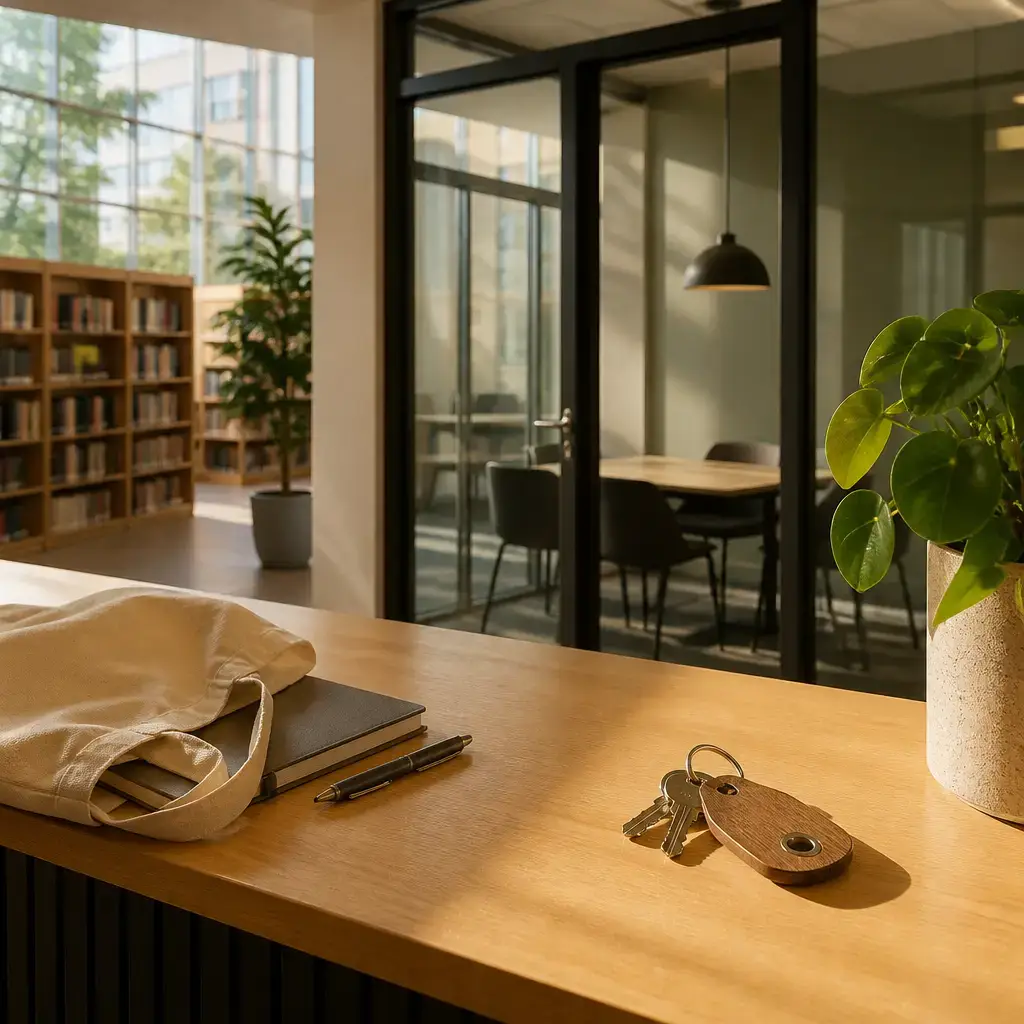
Use Reserve a study room and follow the rules to practice Danish conversation, pronunciation, vocabulary, grammar, and quizzes.
Dialogue
Jeg vil gerne reservere et studierum til et gruppearbejde.
yai vel YAIR-nuh reh-suh-VEH-ruh eh stoo-dee-uh-ROOM tel eh GROOB-uh-ar-BYE-thuh I'd like to reserve a study room for a group project.Hvor stort et rum har du brug for?
voh STOHT eh ROHM ha doo BROO FOHR What size room do you need?Hvornår vil du bruge det?
voh-NAWR vel doo BROO-uh deh When do you want to use it?Vi har brug for et stille rum i eftermiddag til fire personer.
vee ha BROO FOHR eh STEL-uh ROHM ee EF-tuh-meh-DAH tel FEE-uh peh-SOH-nuh We need a quiet room this afternoon for four people.Der er et ledigt rum i to timer i eftermiddag.
dair air eh LAY-thuhd ROHM ee toh TEE-muh ee EF-tuh-meh-DAH There is one available for two hours this afternoon.Det giver os nok tid til at gennemgå slidesene og beslutte, hvem der skal præsentere hver del.
deh GEE-vuh ohs nok teel eh GEN-uhm-GOH SLYE-suh-nuh oh beh-SLOO-duh vem dair skal preh-sen-TEH-ruh vair del That gives us enough time to review the slides and decide who will present each part.Jeg reserverer det på din bibliotekskonto.
yai reh-suh-VEH-uh deh paw deen bee-blee-oh-TEHG-sgohn-toh I'll reserve it under your library account.Du kan aflyse online, hvis planerne ændrer sig.
doo kan ow-LEE-suh on-LYNE, ves PLAY-nuh-nuh EN-druh SAI You can cancel online if plans change.Henter vi nøglen ved denne skranke?
HEN-tuh vee NUR-luhn veh DEN-uh SGRAHNG-uh Do we pick up the key at this desk?Hent den her, og aflever den så, før den næste reservation begynder.
HEN den hair, oh ow-LEE-vuh den soh, fur den NESS-duh reh-suh-vah-SHOHN beh-GUN-uh Pick it up here, then return it before the next booking starts.Vi holder rummet rent og går til tiden.
vee HOL-uh ROH-muth RENT oh goh tel TEE-thun We'll keep the room clean and leave on time.På den måde kan den næste gruppe begynde uden at vente.
paw den MOH-thuh kan den NESS-duh GROOB-uh beh-GUN-uh OO-thuhn eh VEN-duh That way, the next group can start without waiting.Sentence explanations
Jeg vil gerne reservere et studierum til et gruppearbejde.
I'd like to reserve a study room for a group project.
- Jeg vil gerne
- I'd like
- reservere
- reserve
- studierum
- study room
- gruppearbejde
- group project
More detail
Jeg vil gerne means “I’d like to” here. Jeg is the first-person singular pronoun, “I.” The construction vil gerne + infinitive is a common way to express a wish or polite request. vil is the present form of ville; with gerne, it expresses willingness or desire rather than simply future time. Example: Jeg vil gerne læse. — “I’d like to read.” reservere means “to reserve.” This is the infinitive form, used after vil gerne. Example: Vi vil gerne reservere et bord. — “We’d like to reserve a table.” studierum means “study room.” It is a compound noun: studie relates to studying and rum means “room.” In this sentence it appears with the neuter indefinite article et: et studierum, “a study room.” gruppearbejde means “group project” here. It is also a compound noun, built from gruppe (“group”) and arbejde (“work”). It appears with the neuter indefinite article et: et gruppearbejde, “a group project.” The remaining small words connect the nouns: et marks an indefinite singular noun, and til introduces the purpose or intended use. Thus et studierum til et gruppearbejde means “a study room for a group project.” Taken together, Jeg vil gerne reservere et studierum til et gruppearbejde. means “I’d like to reserve a study room for a group project.” The pattern Jeg vil gerne + infinitive can be reused with other actions, such as Jeg vil gerne spørge. — “I’d like to ask.”
Hvor stort et rum har du brug for?
What size room do you need?
- Hvor stort
- how large
- rum
- room
- har … brug for
- need
More detail
Hvor stort asks about size: “how large” or “what size.” Stort is the neuter singular form of stor (“large”), because it describes et rum; with a common-gender noun, the form is stor, as in en stor sal (“a large hall”). The comparative is større (“larger”), while størst means “largest.” Rum means “room.” Its plural is rum as well, so context distinguishes singular from plural; here, et rum is understood as “a room” through the neuter indefinite article et. Har ... brug for is the reusable Danish construction for “need,” literally expressing having use for something. Har is the present form of have (“to have”), and brug is a noun meaning “use.” In a statement, the same construction can be used as Jeg har brug for et rum (“I need a room”). In the question, du is the subject, and the verb comes before it: har du .... Together, Hvor stort et rum means “what size room” or “how large a room,” and har du brug for asks what size the listener needs. The complete utterance therefore means: “What size room do you need?”
Hvornår vil du bruge det?
When do you want to use it?
- Hvornår
- when
- vil du
- do you want
- bruge
- use
- det
- it
More detail
Hvornår means “when” and asks about the time of an event. It is a question word; compare hvor “where” and hvordan “how”. Example: Hvornår kommer du? — “When are you coming?” vil du combines vil, the present form of ville, with du, the second-person singular pronoun “you”. Here, vil expresses wanting, so vil du ...? is the reusable question pattern “do you want to ...?” In a question, vil comes before the subject du. Example: Vil du vente? — “Do you want to wait?” bruge is the infinitive “use”. After vil, Danish places the following verb in the infinitive without at: vil bruge, “want to use”. The infinitive is unchanged for the subject. Example: Jeg vil bruge computeren. — “I want to use the computer.” det is a neuter singular pronoun meaning “it” here. Its specific referent is not identified by the supplied sentence or translation, so the pronoun can be understood without naming what it refers to. The form det can also function as a neuter singular demonstrative meaning “that”, but its meaning here is the pronoun “it”. Together, Hvornår asks for the time, vil du asks about the addressee’s desire, bruge names the intended action, and det is the object of that action. The whole utterance therefore means: “When do you want to use it?”
Vi har brug for et stille rum i eftermiddag til fire personer.
We need a quiet room this afternoon for four people.
- Vi har brug for
- we need
- stille
- quiet
- rum
- room
- i eftermiddag
- this afternoon
- fire
- four
- personer
- people
More detail
Vi har brug for is the fixed Danish construction meaning “we need.” Literally, it is built around har (“have”) plus brug for (“use/need”), but the whole construction expresses necessity or need. The subject form vi means “we”; compare jeg har brug for (“I need”) and de har brug for (“they need”). Example: Jeg har brug for hjælp. — “I need help.” stille means “quiet” here. It is an adjective placed before the noun it describes. In et stille rum, stille has the same written form with the neuter singular noun rum; the article et marks that noun phrase as indefinite singular neuter. Example: et stille sted — “a quiet place.” rum means “room.” Its indefinite singular form is et rum; its definite singular form is rummet (“the room”), and its plural is rum (“rooms”), so the form does not always show number by an ending. Here, the surrounding phrase identifies one room through et. i eftermiddag means “this afternoon.” The preposition i is part of this time expression. It places the need in the afternoon of the relevant day, rather than naming a general afternoon habit. Example: Vi mødes i eftermiddag. — “We are meeting this afternoon.” fire is the cardinal number “four.” It does not change form for grammatical gender in this phrase. It specifies the number associated with the following noun phrase, while the indefinite article et earlier marks rum as singular; these are separate parts of the sentence. personer means “people” and is the plural of person (“person”). The plural ending -er is visible here. Example: Tre personer venter. — “Three people are waiting.” Together, Vi har brug for gives the need, et stille rum gives the requested item, i eftermiddag gives the time, and til fire personer gives the intended capacity or group size. The complete meaning is: “We need a quiet room this afternoon for four people.”
Der er et ledigt rum i to timer i eftermiddag.
There is one available for two hours this afternoon.
- Der er
- there is
- ledigt
- available
- rum
- room
- to
- two
- timer
- hours
- i eftermiddag
- this afternoon
More detail
Der er is the Danish existential pattern meaning “there is/are.” It presents something as existing or being available. The form er is the present tense of være (“to be”); the pattern is reusable with singular or plural nouns: Der er et problem means “There is a problem,” while Der er flere muligheder means “There are several possibilities.” ledigt means “available” here. It is the neuter singular form of the adjective ledig because it describes rum, which is a neuter noun. The useful forms are ledig with a common-gender singular noun, ledigt with a neuter singular noun, and ledige with plural or definite noun phrases. Example: Et ledigt sæde means “An available seat,” whereas Et ledigt rum means “An available room.” rum means “room.” Its plural is also rum, so number is shown by the surrounding words rather than by a changed noun form in this example. Here et marks a singular neuter noun phrase. Although the fixed translation uses “one,” et is an indefinite article and does not by itself assert a numerical count; the sentence introduces an available room. to means “two.” It is the cardinal number used to state the duration or span in the following time expression. timer means “hours.” It is the plural of time (“hour”): en time is “an hour,” and to timer is “two hours.” The plural form is required because the number is greater than one. Example: Mødet varer to timer means “The meeting lasts two hours.” i eftermiddag is the time expression “this afternoon.” In this sentence it locates the availability in the afternoon of the relevant day. The preposition i is part of this temporal expression; it is not the Danish word for the English letter or pronoun “I.” Example: Vi ses i eftermiddag means “See you this afternoon.” Together, Der er et ledigt rum says that an available room exists, i to timer specifies a two-hour period, and i eftermiddag places that period this afternoon. The complete utterance means: “There is an available room for two hours this afternoon.”
Det giver os nok tid til at gennemgå slidesene og beslutte, hvem der skal præsentere hver del.
That gives us enough time to review the slides and decide who will present each part.
- Det
- That
- giver
- gives
- os
- us
- nok
- enough
- tid
- time
- til at
- to
- gennemgå
- review
- slidesene
- the slides
- beslutte
- decide
- hvem
- who
- skal
- will
- præsentere
- present
- hver
- each
- del
- part
More detail
Det is the standalone demonstrative pronoun “that.” In this sentence, the fixed translation supports a reference to something already established, rather than identifying a new participant. Danish det is also used in other grammatical roles, so its form alone does not specify every possible reference. giver is the present-tense form of give and means “gives” here. A useful form chain is give (infinitive) → giver (present). The subject is Det, while os is the object: the thing referred to as “that” gives something to “us.” os is the first-person plural object pronoun, “us.” It contrasts with subject vi, “we”: Vi har tid. — “We have time.” nok means “enough” here. It indicates that the amount of tid meets the needed requirement; it is not itself a numeric count. tid means “time.” In nok tid, it names the available amount of time without a separate indefinite article. Example: Vi har tid. — “We have time.” til at introduces an infinitive complement expressing what the time is sufficient for. The reusable pattern is nok [noun] til at [infinitive]: “enough [noun] to [verb].” gennemgå is the infinitive “review” or “go through.” Here it refers to reviewing the slides. Its infinitive form follows at; the same verb can be used in a present-tense clause as gennemgår. slidesene means “the slides.” It is the definite plural form of slide: plural slides plus the definite ending -ene. The ending marks a specific set of slides, not just slides in general. beslutte is the infinitive “decide.” It is coordinated with gennemgå, so the available time is for two activities: reviewing the slides and deciding. Example: Vi skal beslutte. — “We have to decide.” hvem is the question word “who.” In beslutte, hvem ..., it introduces an embedded question about the person who will present; it is not a direct question standing alone. skal is the present form of the modal verb skulle. With the infinitive præsentere, it expresses the future or expected action here, matching “will present.” skal can also express obligation in other contexts, so the intended “will” reading comes from this sentence’s meaning. præsentere is the infinitive “present.” It follows skal, which is a modal construction: skal + infinitive. Example: Hun skal præsentere planen. — “She will present the plan.” hver means “each” and distributes the action over individual items. It normally combines with a singular noun, as in hver del, rather than a plural noun. del means “part.” In hver del, it is the singular noun selected by the distributive hver: each individual part is presented. Together, Det giver os nok tid means “That gives us enough time.” The infinitive phrase til at gennemgå slidesene og beslutte specifies what this time is enough for: reviewing the slides and deciding. The embedded question hvem der skal præsentere hver del identifies what must be decided—who will present each individual part. The complete meaning is: “That gives us enough time to review the slides and decide who will present each part.”
Jeg reserverer det på din bibliotekskonto.
I'll reserve it under your library account.
- Jeg
- I
- reserverer
- reserve
- det
- it
- på
- under
- din
- your
- bibliotekskonto
- library account
More detail
Jeg means “I.” It is the first-person singular subject pronoun: the speaker presents themself as the person carrying out the action. For comparison, du means “you” when addressing one person. reserverer is the present-tense form of reservere, “to reserve.” The ending -r marks the present form, and this form is used with different subjects: jeg reserverer means “I reserve/am reserving,” while du reserverer means “you reserve/are reserving.” Example: Jeg reserverer et bord. — “I reserve a table.” det is the Danish neuter singular pronoun meaning “it” here. Its exact referent is not named in this sentence, but the fixed translation establishes that it is the thing being reserved. Example: Jeg finder det. — “I find it.” på is a preposition meaning “under” in this account-related expression. Here it links the reservation to the account where it is recorded. Its meaning is context-sensitive; in other settings, på can also correspond to “on” or “at.” din means “your” before a singular common-gender noun. It agrees with the noun it describes, not with the owner: din konto means “your account,” whereas dit is used with a singular neuter noun and dine with plural nouns. Example: din bog — “your book.” bibliotekskonto means “library account.” It is a compound noun: bibliotek means “library” and konto means “account,” but the observed form is one compound word. The common-gender form is shown by din in din bibliotekskonto. Together, Jeg reserverer det says “I’ll reserve it” in this context; Danish present tense can describe a planned or immediate action that English naturally renders with “I’ll.” på din bibliotekskonto specifies where the reservation will be recorded: “under your library account.” The complete utterance therefore means: “I’ll reserve it under your library account.”
Du kan aflyse online, hvis planerne ændrer sig.
You can cancel online if plans change.
- Du kan
- you can
- aflyse
- cancel
- online
- online
- hvis
- if
- planerne
- the plans
- ændrer sig
- change
More detail
Du kan combines Du (“you”) with the modal verb kan (“can/be able to”). kan is the present form of kunne; it is followed by the infinitive without at: Du kan aflyse = “You can cancel.” The subject is the person addressed, as confirmed by the translation. aflyse means “cancel” here, especially canceling a reservation, appointment, or planned activity. It is an infinitive after kan. The present form is aflyser, as in Jeg aflyser reservationen (“I am cancelling the reservation”). online is an adverb meaning “online.” It specifies how the cancellation can be made; it does not itself express who cancels it. hvis introduces a condition and means “if.” A reusable pattern is X, hvis Y = “X if Y.” The clause after hvis gives the condition under which the main clause applies. planerne means “the plans.” It is the definite plural form of plan: planer = “plans,” planerne = “the plans.” The definite ending -ne marks plural definiteness here; it does not mean that there is a particular number beyond the plural meaning. ændrer sig means “change” in this sentence. ændrer is the present form of ændre (“change”), and sig is a reflexive pronoun used with this verb construction when the subject undergoes the change. Thus planerne ændrer sig literally presents the plans as changing themselves or changing state, and naturally means “the plans change.” Compare Planen ændrer sig (“The plan changes”), where planen is singular definite. Together, Du kan aflyse online says that the addressed person has the ability or permission to cancel online. hvis planerne ændrer sig supplies the condition: this option applies if the plans change. The complete meaning is “You can cancel online if plans change.” This is a neutral, practical way to state a conditional option.
Henter vi nøglen ved denne skranke?
Do we pick up the key at this desk?
- Henter
- pick up; collect
- vi
- we
- nøglen
- the key
- ved
- at; by
- denne
- this
- skranke
- desk; counter
More detail
Henter is the present-tense form of hente, “to fetch/pick up.” In this question it means picking up or collecting something. Danish yes/no questions commonly place the finite verb before the subject: Henter vi ...? = “Are we picking up ...?” The same form can also be used in a statement, for example: Vi henter nøglen. — “We pick up the key.” vi means “we” and identifies the subject—the people who would pick up the key. In the question pattern Henter vi ...?, the subject follows the verb; this word order marks a yes/no question rather than changing the meaning of vi. nøglen means “the key” here. Its base form is nøgle (“key”), and the final -n marks the definite singular form: nøgle → nøglen. Danish often marks definiteness on the noun itself rather than with a separate word. For example: Jeg finder nøglen. — “I find the key.” ved means “at” or “by” in the location phrase ved denne skranke. It places the pickup location at or beside the desk/counter. Do not confuse this location use with other possible uses of the same written form in Danish; here the following place expression establishes the location meaning. denne means “this” before a singular common-gender noun. It agrees with skranke in the phrase denne skranke; it does not itself mean “desk.” A corresponding neuter singular form is dette, as in the example dette sted — “this place.” skranke means “desk” or “counter,” especially a service or reception counter. Its definite form is skranken, while denne skranke means “this desk/counter” with the demonstrative placed before the noun. Example: Skranken er åben. — “The desk is open.” Together, Henter vi forms the yes/no question “Are we picking up,” nøglen supplies the object “the key,” and ved denne skranke gives the location “at this desk.” The complete utterance therefore means: “Do we pick up the key at this desk?”
Hent den her, og aflever den så, før den næste reservation begynder.
Pick it up here, then return it before the next booking starts.
- Hent
- pick up
- den her
- this one here
- aflever
- return
- så
- then
- før
- before
- den næste
- the next one
- reservation
- booking
- begynder
- starts
More detail
Hent is the imperative of hente, “to pick up” in this sentence. The imperative gives a direct instruction and normally has the same form for singular and plural addressees. Example: Hent nøglen. — “Pick up the key.” den her means “this one here.” den is a singular common-gender form used for the object, while her adds the meaning “here,” indicating something nearby or present in the situation. The exact object is understood from the situation and is not named in this sentence. aflever is the imperative of aflevere, “to hand in” or “to return.” It is a separate verb from hente. Example: Aflever kortet. — “Return the card.” så means “then” here. It links the second instruction to the first in sequence: first pick the item up, then return it. før introduces a time clause and means “before.” The event after før is the time limit for the returning action. Example: Gå, før mødet begynder. — “Leave before the meeting starts.” den næste means “the next.” In den næste reservation, den is the definite marker used with the singular common-gender noun, while næste is the adjective meaning “next.” The phrase is not a pronoun meaning “the next one” by itself here; the following noun specifies what is next. reservation means “booking” or “reservation.” It is a singular noun; the phrase den næste reservation means “the next booking.” begynder is the present-tense form of begynde, “to start” or “to begin.” It agrees with the singular subject den næste reservation; Danish present-tense verbs do not change for subject person or number. Example: Filmen begynder nu. — “The film starts now.” Together, Hent den her gives the first instruction, “Pick this one up here.” og aflever den så adds the sequence “and then return it,” where the second den refers back to the item being picked up. før den næste reservation begynder sets the deadline: “before the next booking starts.” The complete meaning is: “Pick it up here, then return it before the next booking starts.”
Vi holder rummet rent og går til tiden.
We'll keep the room clean and leave on time.
- Vi
- we
- holder
- keep
- rummet
- the room
- rent
- clean
- går
- leave
- til tiden
- on time
More detail
Vi is the Danish first-person plural pronoun, “we.” It refers to the speaker together with at least one other person. The same form is used as the subject regardless of the group’s gender. holder is the present-tense form of holde, “to keep” or “to hold.” Here, holde has the reusable pattern holde + object + adjective: it means to keep something in a stated condition. Example: Vi holder døren åben. — “We keep the door open.” rummet means “the room.” Its base form is rum; rummet is the definite singular form, literally “the room.” The ending -et marks this noun as neuter and definite. Example: Rummet er stort. — “The room is large.” rent is the neuter singular form of the adjective ren, “clean.” The forms are ren (common-gender singular), rent (neuter singular), and rene (plural and definite attributive use). In this sentence, rent agrees with the neuter noun rummet and describes the condition in which the room is kept. Example: Vi holder huset rent. — “We keep the house clean.” går is the present-tense form of gå, “to go” or “to walk.” In this sentence, the intended meaning is “leave” or “depart,” as specified by the translation and context. Its past form is gik: Vi går nu. — “We are leaving now” or “We are going now,” depending on context. Danish present tense can also refer to a planned future action, which supports the translation “we’ll leave” here. til tiden is a fixed expression meaning “on time.” It describes the timing of the leaving action, not the room. Example: Toget kommer til tiden. — “The train arrives on time.” The conjunction og links the two actions. First, Vi holder rummet rent uses holde + object + adjective to mean “we keep the room clean.” Then går til tiden has the same subject, Vi, understood again: “and leave on time.” Together, the utterance means: “We’ll keep the room clean and leave on time.”
På den måde kan den næste gruppe begynde uden at vente.
That way, the next group can start without waiting.
- På den måde
- that way
- kan
- can
- næste
- next
- gruppe
- group
- begynde
- start
- uden at
- without
- vente
- wait
More detail
På den måde means “that way” or “in that manner.” It refers to a way of doing something established by the situation; it does not by itself identify a particular action. Example: På den måde bliver det lettere. — “That way, it becomes easier.” kan is the present-tense form of kunne, “can / be able to.” It is a modal verb, so the following verb appears in the infinitive: kan begynde = “can start.” Example: Hun kan komme senere. — “She can come later.” næste means “next.” In den næste gruppe, it describes gruppe; den marks the noun phrase as definite, while næste itself does not change for this singular form. Example: Den næste bus er her. — “The next bus is here.” gruppe means “group.” Its indefinite form is en gruppe, and its definite singular form is gruppen. Here, den næste gruppe identifies the next group as the subject of the clause. begynde means “start” or “begin.” It is the infinitive used after the modal kan; the finite verb is kan, not begynde. Example: Vi kan begynde nu. — “We can start now.” uden at introduces an action that does not take place: “without” + an infinitive construction. In this sentence, uden at vente means “without waiting.” vente means “wait.” After uden at, it remains in the infinitive. The understood subject of vente is the same group that is the subject of begynde, so the meaning is that the next group can start without waiting. Together, På den måde kan den næste gruppe begynde uden at vente. means “That way, the next group can start without waiting.” The pattern kan + infinitive expresses ability or possibility, and uden at + infinitive adds an action that is omitted.
Grammar Points
ændre sig
Planerne ændrer sig.
PLAY-nuh-nuh EN-druh SAIThe plans change.
The verb uses the reflexive pronoun sig when the subject changes itself or changes state.
uden at + infinitiv
uden at vente
OO-thuhn eh VEN-duhwithout waiting
Use uden at followed by the infinitive to express that an action does not happen.
Danish Vocabulary
- Gender
- neuter
- Gender
- neuter
- Gender
- neuter
- Gender
- neuter
- Gender
- neuter
- Gender
- neuter
Quiz
Word Order
Arrange the words in the correct order.
When do you want to use it?
Show Answer
Hvornår vil du bruge det?I'll reserve it under your library account.
Show Answer
Jeg reserverer det på din bibliotekskonto.Do we pick up the key at this desk?
Show Answer
Henter vi nøglen ved denne skranke?Spelling
Tap the letters to spell the word.
gladly; would like to
Show Answer
gernequiet
Show Answer
stillelarge; big
Show Answer
stortstudy room