10 minutes free every day
Continue audio lessons in the app
Word explanations appear automatically in sync with the audio.
No login required · synced translations · playback with the screen locked
Choose your learning language and open this lesson in the app.

About This Lesson
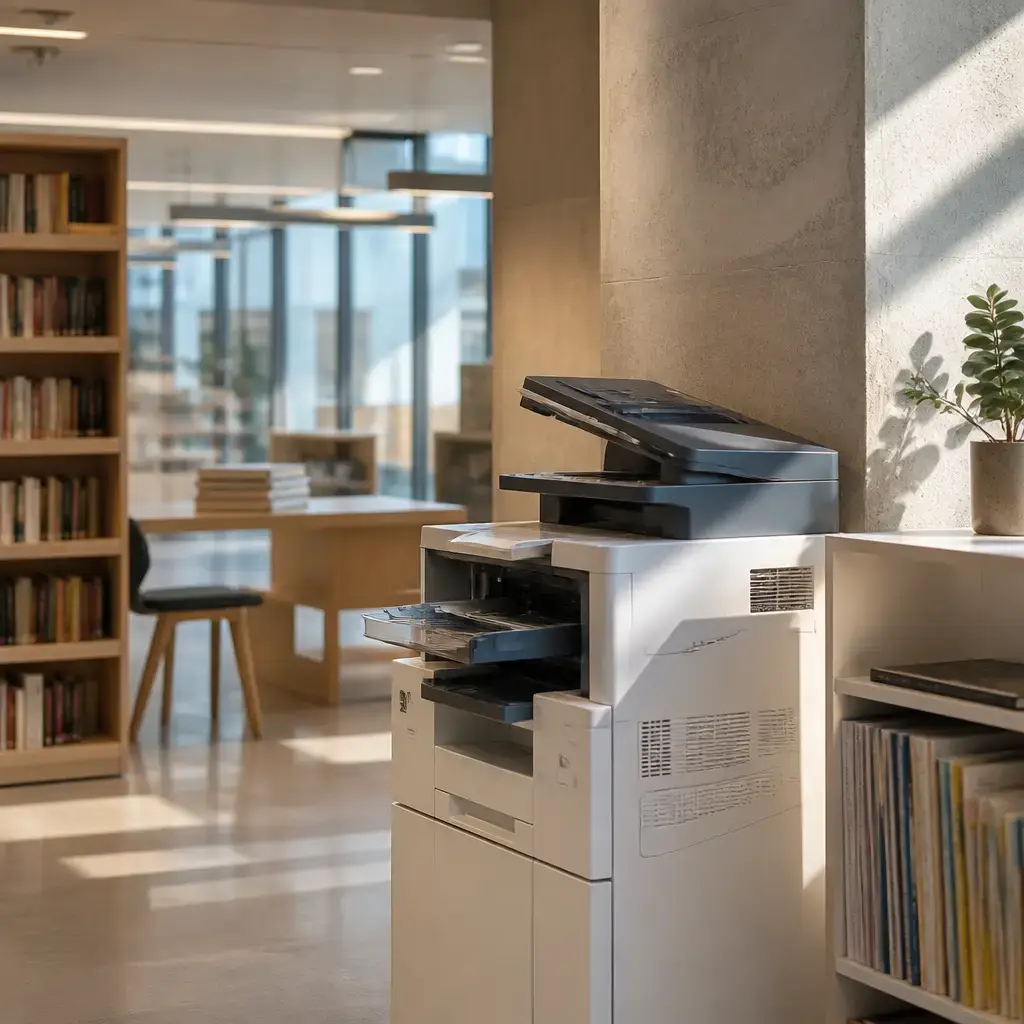
Use Fixing a stuck print job in the library to practice Danish conversation, pronunciation, vocabulary, grammar, and quizzes.
Dialogue
Mit dokument sidder fast i printerkøen, og der kommer ikke noget ud.
meht doh-koo-MEHNT SEH-thuh FAST een PRIN-tuh-kur-en, oh thahr KOH-muh eeg-uh NOH-th ood My document is stuck in the printer queue, and nothing is coming out.Lad os tjekke skærmen, før vi sender jobbet igen.
lah oss CHEH-guh SKAIR-men, fur vee SEN-uh YOH-buhd ee-GEN Let's check the screen before sending the job again.Jeg valgte dobbeltsidet udskrivning, men displayet viser en fejl.
yai VAL-duh DOB-uhl-SEE-thuhd ood-SKREEV-ning, men dee-SPLAY-uhd VEE-suh en FILE I chose double-sided printing, but the display shows an error.Der kan være papirstop, så lad knapperne være lige nu.
dah kan VAIR-uh PAH-peer-stohb, saw lahd KNEB-uh-nuh VAIR-uh lee-uh noo There may be a paper jam, so leave the controls alone for now.Jeg vil ikke sende det igen og tilføje endnu et job til køen.
yai veel EH-guh SEN-uh deh eeg-uh oh teel-FUR-uh EN-noo eht YOHB teel KUR-en I do not want to resend it and add another job to the queue.Jeg kan annullere det mislykkede job, før du prøver igen.
yai kan ah-noo-LAIR-uh deh mee-SLEEK-uh-thuh YOHB, fur doo PROH-vuh eeg-uh I can cancel the failed job before you try again.Kunne du tjekke printeren, før jeg sender noget andet?
KOO-nuh doo CHEH-guh PRIN-tuh-ren, fur yai SEN-uh NOH-uh AHT-uh Could you check the printer before I send anything else?Jeg vil kigge på den, men åbn ikke selv maskinen.
yai veel KEE-guh paw den, men ohbn EH-guh selv mah-SKEE-nen I'll take a look, but please do not open the machine yourself.Jeg venter her, mens du tjekker den.
yai VEN-tuh hair, mens doo CHEH-guh den I'll wait here while you check it.Det vil hjælpe os med at løse problemet uden at tilføje flere udskriftsjob.
deh veel YEL-puh oss med uh LUR-suh proh-bleh-muhd oo-then ah teel-FUR-uh FLAIR-uh ood-SKREEFS-yohb That will help us clear the problem without adding more print jobs.Sentence explanations
Mit dokument sidder fast i printerkøen, og der kommer ikke noget ud.
My document is stuck in the printer queue, and nothing is coming out.
- Mit
- my
- dokument
- document
- sidder fast
- is stuck
- printerkøen
- the printer queue
- kommer … ud
- comes out
- ikke
- not
- noget
- anything
More detail
Mit means “my” here and belongs with the singular neuter noun dokument. Danish possessives agree with the possessed noun: min is used with common-gender singular nouns, mit with neuter singular nouns, and mine with plural nouns. Example: min bog — “my book”; mit brev — “my letter.” dokument means “document.” Its definite singular form is dokumentet — “the document”; the indefinite form used here is et dokument — “a document.” sidder fast means “is stuck.” The verb sidder is the present form of sidde, literally “sit,” but in this expression it describes something being unable to move or proceed. fast contributes the idea of being held in place. Example: Bilen sidder fast i sneen. — “The car is stuck in the snow.” printerkøen means “the printer queue.” It is the definite singular form of printerkø (“printer queue”): printerkø + the definite ending -en. Danish often marks definiteness on the noun itself rather than with a separate word. Example: Jobbet er i printerkøen. — “The job is in the printer queue.” kommer ... ud is the separable verb pattern komme ud, “come out.” In the present tense, kommer appears in the clause while ud remains later in the clause. Example: Papiret kommer ud. — “The paper comes out.” The fixed sentence places ikke and noget between these two parts. ikke means “not” and supplies the negation. Here it negates the event described by kommer ... ud; it does not belong inside the meaning of noget itself. noget means “anything” in this negative sentence. By itself, it can also mean “something,” but after negation the natural English rendering is “anything.” Example: Jeg ser ikke noget. — “I do not see anything.” der introduces the clause der kommer ikke noget ud. In this use it is a grammatical introductory element, while noget is the thing that is not coming out. The clause therefore says that nothing is coming out, without identifying a more specific item. Together, Mit dokument sidder fast i printerkøen says “My document is stuck in the printer queue.” The following clause, der kommer ikke noget ud, says “nothing is coming out.” Combined, the utterance means: “My document is stuck in the printer queue, and nothing is coming out.”
Lad os tjekke skærmen, før vi sender jobbet igen.
Let's check the screen before sending the job again.
- Lad os
- let's
- tjekke
- check
- skærmen
- the screen
- før
- before
- sender
- send
- jobbet
- the job
- igen
- again
More detail
Lad os is the reusable Danish pattern for “let’s …”. It combines lad (“let”) with os (“us”) and is followed by an infinitive: Lad os vente. — “Let’s wait.” The construction proposes an action for the speaker and at least one other person; it is not a statement that the action has already happened. tjekke is the infinitive “to check”. After Lad os, Danish uses the infinitive without an infinitive marker: Lad os tjekke … — “Let’s check …”. The infinitive is the base form; a finite present-tense form is tjekker: Vi tjekker skærmen. — “We check the screen.” skærmen means “the screen” here. Its base form is the common-gender noun skærm; skærmen is its singular definite form, formed with -en. The definite form presents the screen as identifiable in the situation. An indefinite singular form is en skærm, “a screen”. før means “before” and introduces a clause describing an earlier time relative to another action. The clause after it has its own subject and finite verb. In this sentence, før vi sender … means “before we send …”. sender is the present-tense form of sende, “to send”. Here it appears with the subject vi, “we”, in the clause introduced by før: vi sender. Danish present tense commonly has the same form across persons, so sender can be used with different subjects; the subject identifies who sends. In this sentence, the fixed translation identifies the subject as “we”. jobbet means “the job”. Its base form is the neuter noun job; jobbet is the singular definite form, with -et. The indefinite form is et job, “a job”. igen means “again” and indicates that the sending is repeated. It modifies the sending event rather than changing the noun form: Vi sender filen igen. — “We send the file again.” Together, Lad os tjekke skærmen means “Let’s check the screen”. The clause før vi sender jobbet igen means “before we send the job again”: før links the earlier checking action to the later sending action, vi sender supplies the subject and verb of the subordinate clause, and igen marks the sending as a repeat. The complete utterance is therefore “Let’s check the screen before sending the job again.”
Jeg valgte dobbeltsidet udskrivning, men displayet viser en fejl.
I chose double-sided printing, but the display shows an error.
- Jeg
- I
- valgte
- chose
- dobbeltsidet
- double-sided
- udskrivning
- printing
- men
- but
- displayet
- the display
- viser
- shows
- fejl
- error
More detail
Jeg means “I” here, the first-person singular subject. Danish subject pronouns include jeg “I”, du “you” (singular), and vi “we”. valgte is the past-tense form of vælge, “to choose”. Danish verbs generally do not change their form for person or number in the past: jeg valgte and vi valgte use the same verb form. Example: Jeg valgte den blå. — “I chose the blue one.” dobbeltsidet describes something with two sides used or printed on; here it means “double-sided”. It is a compound adjective built from dobbelt “double” and sidet “sided”. Its meaning is reusable in combinations such as dobbeltsidet papir, “double-sided paper”. udskrivning is the noun “printing” or “printout-related printing”, here naming the selected print option. It is related to the verb udskrive, “to print”. The noun can also occur in farveudskrivning, “colour printing”. men links two contrasting statements and means “but”. It signals that the second clause presents a result or situation contrasting with the first choice. displayet means “the display”. display is the noun, and the ending -et marks definite singular for this noun: et display means “a display”, while displayet means “the display”. The supplied context supports the display as the screen or display being checked, but the form itself mainly marks definiteness. viser is the present-tense form of vise, “to show” or “display”. In Danish, the present form normally does not change according to the subject, so displayet viser uses the same present form that can occur with other subjects. Example: Skærmen viser en besked. — “The screen shows a message.” fejl means “error” here. The words en fejl form an indefinite singular noun phrase: en marks an unspecified singular countable item, while fejl names the error. This does not by itself specify how many errors there are beyond the one item presented in this noun phrase. The definite form is fejlen, “the error”. Together, Jeg valgte dobbeltsidet udskrivning means “I chose double-sided printing”. men contrasts that choice with the current information, displayet viser en fejl, “the display shows an error”. The complete utterance therefore means: “I chose double-sided printing, but the display shows an error.”
Der kan være papirstop, så lad knapperne være lige nu.
There may be a paper jam, so leave the controls alone for now.
- Der kan være
- there may be
- papirstop
- paper jam
- lad … være
- leave ... alone
- knapperne
- the controls
- lige nu
- for now
More detail
Der kan være expresses possibility: “there may be …”. Here, der is an introductory/existential element, kan is the present form of kunne (“can; may”), and være is the infinitive of “be”. Together, kan være presents the situation as possible, not certain. Example: Der kan være en fejl. — “There may be an error.” papirstop means “paper jam” here. It is a compound noun made from papir (“paper”) and stop (“stop; blockage”), written as one word in Danish. In this sentence it names the possible problem without an article; the definite form is papirstoppet (“the paper jam”). lad ... være is an imperative construction meaning “leave … alone” or “let … be”. lad is the imperative of lade (“let; leave”), and være is the infinitive. The two parts can surround what should be left alone. Example: Lad døren være. — “Leave the door alone.” knapperne means “the controls” here, referring to the buttons or controls that should not be operated. Its base noun is knap (“button”); knapper is the plural, and knapperne is the definite plural, “the buttons”. The translation uses “controls” because that is the intended meaning in this equipment context. lige nu means “right now” and can correspond to “for now” when the instruction is limited to the present situation. Example: Det sker lige nu. — “It is happening right now.” The connector så means “so”, linking the possible problem to the instruction. Together, Der kan være papirstop says that a paper jam is possible; så lad knapperne være tells the listener not to operate the controls; and lige nu limits that instruction to the current situation. The whole utterance therefore means: “There may be a paper jam, so leave the controls alone for now.”
Jeg vil ikke sende det igen og tilføje endnu et job til køen.
I do not want to resend it and add another job to the queue.
- Jeg vil
- I want to
- ikke
- not
- sende
- send
- det
- it
- igen
- again
- og
- and
- tilføje
- add
- endnu et
- another
- job
- job
- køen
- the queue
More detail
Jeg vil introduces the speaker’s wish or intention: jeg is “I,” and vil is the present form of ville, “to want” or “will,” depending on context. Here the fixed translation selects the volitional meaning “want.” Danish commonly places an infinitive after this form: Jeg vil lære means “I want to learn.” ikke is the ordinary negation word “not.” In this utterance it negates the speaker’s wanting, so Jeg vil ikke sende ... means “I do not want to send ...” rather than changing sende into a negative verb form. sende is the infinitive “to send.” It follows vil; the modal/volitional verb carries the finite tense, while sende remains in the infinitive. The same pattern is reusable in Jeg vil vente — “I want to wait.” det means “it” here, with the intended object supplied by the fixed translation and context. It is the neuter singular form of the Danish third-person pronoun; its form should not be treated as proof that every possible referent is neuter in English. igen means “again.” With sende, sende det igen means “send it again,” so the sentence concerns repeating the sending action. igen can also occur with other verbs, as in Prøv igen — “Try again.” og connects the two coordinated infinitive actions. Here it links sende and tilføje, both governed by the preceding vil ikke construction. tilføje means “to add,” literally introducing something in addition to what is already present. It is an infinitive like sende, and it remains unchanged after vil: Jeg vil tilføje en note means “I want to add a note.” endnu et means “another,” referring here to an additional job. et is the indefinite singular article used with the neuter noun job; in this phrase it presents an additional singular item, while endnu contributes the sense “more/additional.” job means “job” here, specifically an item of work handled by the queue. Danish uses the neuter article with this noun: et job; its definite form is jobbet, “the job.” køen means “the queue.” The base noun is kø, and the ending -en marks its definite singular form: kø → køen. The preposition til before it gives til køen, “to the queue.” Taken together, Jeg vil ikke expresses the speaker’s lack of desire, while sende det igen and tilføje endnu et job til køen are the two coordinated actions that the speaker does not want to perform. The complete meaning is: “I do not want to resend it and add another job to the queue.”
Jeg kan annullere det mislykkede job, før du prøver igen.
I can cancel the failed job before you try again.
- Jeg kan
- I can
- annullere
- cancel
- det
- the (neuter singular)
- mislykkede
- failed
- job
- job
- før
- before
- prøver igen
- try again
More detail
Jeg kan combines Jeg (“I”) with kan, the present form of kunne (“can; be able to”). Danish places the infinitive after this modal: Jeg kan annullere = “I can cancel.” The modal expresses ability or possibility here; the fixed translation supports the ability reading. annullere is the infinitive “to cancel.” After kan, Danish uses the infinitive without an equivalent of English “to”: Jeg kan annullere .... In det mislykkede job, det is a neuter singular definite determiner, roughly “the” here. It agrees with the neuter noun job; it is not the standalone pronoun “it” in this noun phrase. As a standalone pronoun, det can mean “it” in other contexts. mislykkede means “failed” in this noun phrase. Its base form is mislykket. The ending -e is used with definite noun phrases and with plural forms, so det mislykkede job is the definite phrase “the failed job.” The adjective is the word carrying this form; job is not its base form. Example: Det mislykkede forsøg means “the failed attempt.” job is the noun “job.” Danish uses et job for an indefinite singular job and jobbet for “the job.” In the fixed sentence, det ... job forms a definite singular neuter noun phrase. før means “before” and introduces the event that occurs later than the event in the main clause. It can connect a main clause with a subordinate clause: før du prøver igen = “before you try again.” prøver igen means “try again.” prøver is the present-tense form of prøve (“try”), with du as its subject; igen adds the meaning “again.” Example: Du prøver igen means “You try again.” Together, Jeg kan annullere det mislykkede job says “I can cancel the failed job.” The clause før du prøver igen places the trying again after the cancellation in the stated temporal relation: “before you try again.” The complete utterance therefore means, “I can cancel the failed job before you try again.”
Kunne du tjekke printeren, før jeg sender noget andet?
Could you check the printer before I send anything else?
- Kunne du
- Could you…?
- tjekke
- check
- printeren
- the printer
- før
- before
- jeg
- I
- sender
- send
- noget andet
- anything else
More detail
Kunne du is a polite way to ask someone to do something. Kunne is the form of kunne used here with du; although it resembles a past form, in this request it softens the question rather than placing the action in the past. A useful pattern is Kunne du + infinitive? — “Could you …?” tjekke means “to check.” It is the infinitive form, used after the modal verb kunne. The same verb appears as tjekker in the present tense: Jeg tjekker printeren. — “I am checking the printer.” printeren means “the printer.” Printer is the noun, and the ending -en marks the common-gender definite form in Danish. Compare en printer — “a printer” — with printeren — “the printer.” The definite form identifies the printer intended in this situation; it does not by itself explain how many printers there are. før means “before” and introduces the event that sets the time condition for the main request. A reusable pattern is før + clause: Ring, før du går. — “Call before you leave.” jeg means “I” and is the subject of the clause after før. Danish uses this form for the first-person singular subject; it does not change according to the noun mentioned in the other clause. sender means “send” here. It is the present-tense form of sende, used with the subject jeg: Jeg sender filen. — “I send the file” or, depending on context, “I am sending the file.” Danish present tense can cover both readings. noget andet means “anything else” in this question. Noget means “something” or “anything” in suitable contexts, and andet is the neuter singular form of anden, “other,” used with noget. Together they form a useful expression for an additional, different thing: Vil du have noget andet? — “Would you like anything else?” Together, Kunne du tjekke printeren asks politely for the listener to check the printer. før jeg sender noget andet sets the timing: that check should happen before the speaker sends anything else. The complete meaning is: “Could you check the printer before I send anything else?”
Jeg vil kigge på den, men åbn ikke selv maskinen.
I'll take a look, but please do not open the machine yourself.
- Jeg vil
- I will / I want to
- kigge på
- look at
- den
- it
- men
- but
- åbn
- open
- ikke
- not
- selv
- yourself
- maskinen
- the machine
More detail
Jeg vil expresses the speaker’s intention: “I will” or “I want to.” Here vil is the present form of ville, followed by an infinitive. A useful pattern is jeg vil + infinitive, for example: Jeg vil vente. — “I will wait.” kigge på means “look at” in this sentence. Kigge is the infinitive; på is part of the construction and should be retained when identifying what someone looks at. Example: Hun kigger på billedet. — “She is looking at the picture.” den is a pronoun meaning “it” here. It refers to the relevant object already understood in the conversation, without the sentence itself specifying that object by name. Danish pronouns such as den can replace a noun phrase, so the following noun maskinen should not automatically be treated as its referent. men connects two contrasting parts and means “but.” It introduces the second instruction after the speaker’s stated intention. åbn is the imperative of åbne, “to open.” It gives a direct instruction to the person addressed. The imperative is formed here as åbn; for example: Åbn døren. — “Open the door.” ikke negates the instruction. In åbn ikke, it changes “open” into “do not open.” Example: Gå ikke nu. — “Do not go now.” selv means “yourself” in this sentence. It emphasizes that the addressee should not carry out the action personally or independently; the exact practical implication comes from the situation. The form is not a verb inflection and does not change to match åbn. maskinen means “the machine.” It is the definite form of maskine: en maskine — “a machine,” maskinen — “the machine.” The ending marks definiteness on the noun itself. Example: Maskinen virker. — “The machine works.” Together, Jeg vil kigge på den means “I’ll take a look at it.” men contrasts that intention with åbn ikke selv maskinen, “but please do not open the machine yourself.” The complete utterance therefore means: “I’ll take a look, but please do not open the machine yourself.”
Jeg venter her, mens du tjekker den.
I'll wait here while you check it.
- Jeg
- I
- venter
- wait
- her
- here
- mens
- while
- du
- you
- tjekker
- check
- den
- it
More detail
Jeg is the first-person singular pronoun, “I.” It is used for the speaker, regardless of the speaker’s gender. Compare du, “you,” later in the sentence. venter means “wait” here. It is the present-tense form of vente (“to wait”): jeg venter = “I wait / I am waiting.” Danish present tense can also describe an intended near-future action, which is why this fixed sentence is naturally translated “I’ll wait.” her means “here,” referring to the place relevant in the situation. It is an adverb, so it does not change for number or gender. For example, Jeg arbejder her. means “I work here.” mens introduces a simultaneous time relation: “while.” It links the main clause with the activity that happens during it. The reusable pattern is A, mens B = “A while B.” du is the second-person singular pronoun, “you.” It addresses one person directly. Danish uses du for both masculine and feminine singular addressees. tjekker means “check” here. It is the present-tense form of tjekke: du tjekker = “you check / you are checking.” The form is not changed for the addressee’s gender. For example, Du tjekker døren. means “You check the door.” den is the singular object pronoun meaning “it” here. Its form is used for a common-gender singular referent; as an object pronoun, it comes after tjekker in this clause. The fixed translation identifies the intended meaning as checking an already understood thing, without naming that thing in this sentence. Together, Jeg venter her means “I’ll wait here,” and mens du tjekker den means “while you check it.” The comma separates the main clause from the mens clause, whose subject is du and whose present-tense verb is tjekker. The complete utterance is therefore: “I’ll wait here while you check it.”
Det vil hjælpe os med at løse problemet uden at tilføje flere udskriftsjob.
That will help us clear the problem without adding more print jobs.
- Det vil
- That will
- hjælpe
- help
- os
- us
- med
- with
- at løse
- to solve
- problemet
- the problem
- uden at tilføje
- without adding
- flere
- more
- udskriftsjob
- print job(s)
More detail
Det vil combines det and vil. Here det is a neuter singular pronoun meaning “that”; the fixed translation supports this reading, without identifying exactly what “that” refers to. Vil is the present form of ville and, with an infinitive, can express a future prediction or intention. Here it presents the helping as a future result. After a modal such as vil, Danish uses the infinitive without at. Hjælpe is the infinitive of hjælpe, “to help.” A useful reusable pattern is hjælpe nogen med at gøre noget: “help someone do something.” Example: Hun hjælper mig med at skrive. — “She helps me write.” Os means “us.” It is the first-person plural object form; the corresponding subject form is vi (“we”). Example: Han ser os. — “He sees us.” Med means “with.” In hjælpe nogen med at ..., it introduces the activity connected with the help, rather than simply naming a physical object accompanied by someone. At løse contains the infinitive marker at and the infinitive løse, “solve.” The pattern at + infinitive is used after many verbs and expressions when an action is presented as an infinitive. Example: Det er svært at løse opgaven. — “It is difficult to solve the task.” Problemet means “the problem.” Its base noun is problem; the ending -et marks the definite singular form of this neuter noun. Thus et problem means “a problem,” while problemet means “the problem.” The article et here marks the noun’s grammatical gender, not a numerical count. Uden at tilføje means “without adding.” Uden introduces an action that does not happen, and at tilføje is an infinitive clause. Tilføje is the infinitive of “add.” Example: Hun gik uden at sige noget. — “She left without saying anything.” Flere means “more” or “additional” with plural countable things. It is a comparative quantity form related to mange (“many”): mange → flere. In this sentence it signals that the print jobs would be additional ones, not one singular job. Udskriftsjob means “print job(s).” It is a compound noun built from udskrift (“printout” or “printing”) and job (“job”). In this sentence, flere makes the intended meaning plural; the noun itself has no visible plural ending here. Example: Vi har flere udskriftsjob. — “We have several print jobs.” Together, Det vil hjælpe os means “That will help us.” Med at løse problemet specifies what the help will enable: solving the problem. Uden at tilføje flere udskriftsjob states the condition or manner—this will happen without adding additional print jobs. The complete meaning is: “That will help us clear the problem without adding more print jobs.”
Grammar Points
Bestemt form: -en, -et eller -ene
Printerkøen viser en fejl.
PRIN-tuh-kur-en VEE-suh en FILEThe printer queue shows an error.
Danish often marks a definite noun by adding -en, -et, or -ene to the noun.
mens + sætning
Maskinen venter, mens displayet viser en fejl.
mah-SKEE-nen VEN-tuh, mens dee-SPLAY-uhd VEE-suh en FILEThe machine waits while the display shows an error.
mens introduces a time clause meaning “while”; the following clause has its own subject and verb.
Danish Vocabulary
- Gender
- neuter
- Gender
- neuter
- Gender
- neuter
- Gender
- common
- Gender
- common
- Gender
- common
Quiz
Spelling
Tap the letters to spell the word.
send
Show Answer
sendercheck
Show Answer
tjekkeprinter queue
Show Answer
printerkøenjob