10 minutes free every day
Continue audio lessons in the app
Word explanations appear automatically in sync with the audio.
No login required · synced translations · playback with the screen locked
Choose your learning language and open this lesson in the app.

About This Lesson
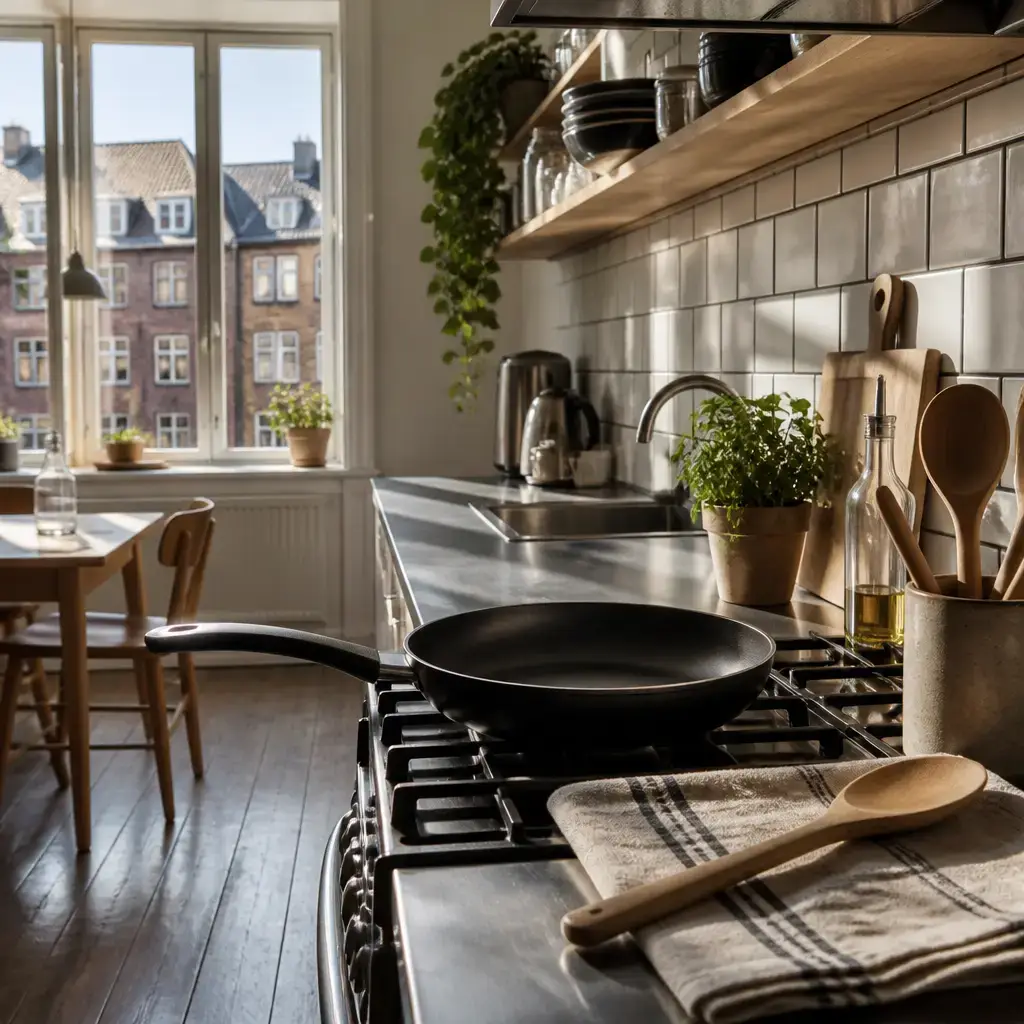
Use Borrowing and caring for a non-stick pan to practice Danish conversation, pronunciation, vocabulary, grammar, and quizzes.
Dialogue
Må jeg låne din slip-let-pande til noget, jeg er ved at lave?
moh yai LOH-nuh deen slip-let-PAN-uh tel NOH-uh, yai air vay uh LAH-wuh? Can I borrow your non-stick pan for something I am cooking?Det må du gerne, men brug venligst ikke metalredskaber på den.
day moh doo YAIR-nuh, men broo VEN-lest IK-uh meh-TEL-red-skah-wuh poh den. You can, but please do not use metal utensils on it.Jeg vil bruge en træske, så jeg ikke ridser overfladen.
yai vil BROO-uh en TREH-skay, soh yai IK-uh RETH-suh OH-vuh-FLEH-thun. I will use a wooden spoon so I do not scratch the surface.Hold også varmen på middel, fordi høj varme kan beskadige belægningen.
hol OH-soh VAR-mun poh METH-ul, fee-THEE hoy VAR-muh kan buh-SKEH-thuh buh-LEH-ning-un. Keep the heat at medium too, because high heat can damage the coating.Jeg vil hellere spørge nu end at gætte og ødelægge den.
yai vil HEL-uh-ruh SPUR-uh noo en uh GET-uh oh-uh-LEG-uh den. I would rather ask now than guess and ruin it.Det hjælper. Den holder længere, hvis man behandler den forsigtigt.
day YEL-buh. den HOL-uh LENG-uh-ruh, vis man buh-HAN-luh den for-SEG-duh. That helps. It should last longer if it is handled carefully.Skal jeg vaske den i hånden i stedet for at sætte den i opvaskemaskinen?
skal yai VAS-guh den ee HON-un ee STAY-thun for uh SET-uh den ee OH-vahs-guh-mash-EE-nun? Should I wash it by hand instead of putting it in the dishwasher?Vask den forsigtigt i hånden, og tør den, før du tager den med tilbage.
VASK den for-SEG-duh ee HON-un, oh TUR den, fur doo TAY-uh den may tee-LEH. Wash it gently by hand and dry it before you bring it back.Jeg afleverer den ren, når jeg er færdig med at lave mad.
yai AF-lay-vuh den RAIN, nor yai air FAIR-dee may uh LAH-wuh math. I will return it clean after I finish cooking.Sig til mig, hvordan retten bliver.
say tel my, voh-DAN RED-un BLEE-vuh. Let me know how the dish turns out.Sentence explanations
Må jeg låne din slip-let-pande til noget, jeg er ved at lave?
Can I borrow your non-stick pan for something I am cooking?
- Må jeg
- Can I …?
- låne
- borrow
- din
- your
- slip-let-pande
- non-stick pan
- til noget
- for something
- jeg
- I
- er ved at
- am in the process of …
- lave
- cook
More detail
Må jeg is a reusable Danish way to ask permission: literally, “May I …?” Må is the present form of måtte and expresses permission here, not a statement that something is certain. The subject jeg follows it because this is a question. For example: Må jeg komme ind? — “May I come in?” låne means “borrow,” that is, use something temporarily with the intention of returning it. It is the infinitive after må: Må jeg låne ...? — “May I borrow ...?” Danish uses the infinitive without an English-style “to” after må. din means “your” before a singular common-gender noun. It agrees with the possessed noun, not with the person who owns it. Compare din pande (“your pan”) with dit glas (“your glass”) and dine pander (“your pans”). slip-let-pande is a hyphenated compound meaning “non-stick pan.” The whole compound names the object being borrowed; pande is the noun “pan.” Danish compounds commonly place their defining element before the main noun, so this form can be reused for a particular type of pan. til noget means “for something” in this sentence. noget is an indefinite pronoun meaning “something”; it does not itself state a numeric quantity. Here til introduces the purpose or intended use: the pan is being borrowed for something the speaker is making. jeg is the first-person singular pronoun, “I.” It is the subject of the following clause and refers to the speaker. Danish uses the same form jeg regardless of whether the speaker is male or female. er ved at is a construction meaning that an activity is in progress: er ved at + infinitive, “am/is/are in the process of …” In this sentence, er is the present form used with jeg; Danish present-tense er does not change for the subject’s person or number. For example: Jeg er ved at læse. — “I am reading.” lave is the infinitive of lave, “to make/do.” In this context, the cooking-related meaning “cook” is intended because the object is a pan and the translation says “something I am cooking.” The same verb can have the broader meaning “make” or “do” in other contexts, so the surrounding words determine the sense. The sentence is assembled as Må jeg låne (“Can I borrow”) + din slip-let-pande (“your non-stick pan”) + til noget (“for something”) + jeg er ved at lave (“I am in the process of cooking”). Together: “Can I borrow your non-stick pan for something I am cooking?”
Det må du gerne, men brug venligst ikke metalredskaber på den.
You can, but please do not use metal utensils on it.
- Det må du gerne
- you may; that is allowed
- men
- but
- brug
- use
- venligst
- please
- ikke
- not
- metalredskaber
- metal utensils
- på den
- on it
More detail
Det må du gerne is a common Danish way to grant permission: “You may” or “You can.” Here, det refers to the requested action, not specifically to the pan. må is the modal verb måtte in the present form; it expresses permission here. It does not change for person or number. gerne adds the approving sense “willingly/gladly” and is part of this permission pattern. Example: Du må gerne komme. — “You may come.” men means “but” and links the permission to a restriction. It introduces a contrast rather than changing the permission into a refusal. brug is the imperative of bruge, “to use.” The imperative addresses one person and gives an instruction. Example: Brug en træske. — “Use a wooden spoon.” venligst is a polite adverb meaning “please.” It softens the instruction without changing its grammatical force. In brug venligst ..., it makes the request courteous. ikke is the standard negation word “not.” In this clause it negates the instruction: brug ... ikke means “do not use ...”. metalredskaber means “metal utensils/tools.” It is a compound noun: metal specifies the material, and redskaber is the plural of redskab, “utensil” or “tool.” The form is plural and indefinite; a definite plural would be metalredskaberne (“the metal utensils”). Example: Jeg bruger redskaber. — “I use utensils/tools.” på den means “on it” here. på is the preposition “on,” and den is a singular common-gender pronoun. In this context, supported by the preceding reference to the non-stick pan and the fixed translation, den refers to that pan. Example: Sæt skeen på den. — “Put the spoon on it.” Together, Det må du gerne grants permission for the action under discussion. men brug venligst ikke metalredskaber på den then adds the polite prohibition: “but please do not use metal utensils on it.”
Jeg vil bruge en træske, så jeg ikke ridser overfladen.
I will use a wooden spoon so I do not scratch the surface.
- Jeg vil
- I will
- bruge
- use
- en træske
- a wooden spoon
- så
- so
- ikke
- not
- ridser
- scratch
- overfladen
- the surface
More detail
Jeg vil contains Jeg, “I,” and vil, the present form of ville used here to express a future intention or decision. After vil, Danish uses the infinitive: Jeg vil bruge = “I will use” / “I want to use,” with the intended future meaning supplied by the sentence. bruge is the infinitive “to use.” The same verb has the present form bruger: Jeg bruger en træske = “I use a wooden spoon.” The infinitive is required after vil. en træske means “a wooden spoon.” træske is a compound noun: træ means “wood” and ske means “spoon.” The indefinite article en belongs to this noun’s grammatical gender; here it does not by itself assert a numeric count. så introduces the intended purpose or result, “so that.” It links the planned action to the following clause. ikke is the negation “not.” In så jeg ikke ridser ..., it negates the following clause’s action, not the choice of spoon. ridser is the present form of ridse, “to scratch.” Danish present-tense verbs generally do not change for the subject: jeg ridser, du ridser, and de ridser use the same verb form. Here the form is in the subordinate clause after så. overfladen means “the surface.” It is the definite singular form of overflade, formed with the ending -en; the definite form refers to the particular surface intended in this situation. Putting the parts together: Jeg vil bruge en træske states the speaker’s intention to use a wooden spoon. så jeg ikke ridser overfladen gives the purpose: “so that I do not scratch the surface.” The complete utterance is therefore “I will use a wooden spoon so I do not scratch the surface.”
Hold også varmen på middel, fordi høj varme kan beskadige belægningen.
Keep the heat at medium too, because high heat can damage the coating.
- Hold
- keep; maintain
- også
- also; too
- varmen
- the heat
- på middel
- at medium
- fordi
- because
- høj
- high
- varme
- heat
- kan
- can
- beskadige
- damage
- belægningen
- the coating
More detail
Hold is the imperative of holde (“to keep” or “to hold”). It gives a direct instruction; the implied subject is “you.” For example: Hold døren åben. — “Keep the door open.” også means “also” or “too.” Here it adds this instruction to another relevant instruction, without changing the action itself. varmen means “the heat.” The base form is varme; varmen is the definite singular form, used for heat treated as a specific setting or quantity in the situation. Danish commonly marks definiteness by a suffix: en varme is indefinite, while varmen is definite. på middel is a compact setting pattern meaning “at medium” or “on medium.” With controls or levels, på can introduce the selected setting: Sæt den på lav. — “Set it to low.” Here middel names the medium level. fordi introduces the reason for the instruction and means “because.” It introduces a subordinate clause: fordi ... — “because ...”. høj means “high.” It is the adjective describing varme, not the noun's base form. Its basic comparison is høj (“high”), højere (“higher”), højest (“highest”); the form here simply describes the heat level. varme means “heat.” In this clause it is an indefinite singular noun, referring to high heat in general rather than to a separately identified portion of heat. In høj varme, the adjective comes before the noun. kan means “can” and is the present-tense form of the modal verb kunne. It expresses possibility or capability here. After a modal such as kan, the following verb normally appears in its infinitive form without at. beskadige means “damage.” It is the infinitive following kan: kan beskadige — “can damage.” For example: Vand kan beskadige træet. — “Water can damage the wood.” belægningen means “the coating.” The base noun is belægning, and the ending in belægningen marks definite singular: a specific coating relevant in the situation. The word is the object of beskadige, so the clause says what high heat can damage. Together, Hold også varmen på middel means “Keep the heat at medium too.” fordi høj varme kan beskadige belægningen gives the reason: “because high heat can damage the coating.” The complete utterance is therefore: “Keep the heat at medium too, because high heat can damage the coating.”
Jeg vil hellere spørge nu end at gætte og ødelægge den.
I would rather ask now than guess and ruin it.
- Jeg vil hellere
- I would rather
- spørge
- ask
- nu
- now
- end at
- than to
- gætte
- guess
- ødelægge
- ruin
- den
- it
More detail
Jeg vil hellere expresses a preference: “I would rather…”. vil is the present form of ville, which can express “would” in this pattern, and hellere is the preference form meaning “rather”. A reusable pattern is Jeg vil hellere X end Y (“I would rather X than Y”). spørge is the infinitive “to ask”. After vil, Danish uses the infinitive without an English-style “to”: Jeg vil spørge means “I want/will ask” or, in this preference pattern, “I would rather ask”. nu means “now” and places the asking at the present time. end at introduces the alternative being compared: end at X means “than to X”. The at belongs with the following infinitive; it is not part of the meaning of end alone. gætte is the infinitive “to guess”. Here it is the alternative to asking. In end at gætte og ødelægge den, the conjunction og connects two infinitives, so both gætte and ødelægge belong to the alternative introduced by end at. ødelægge is the infinitive “to ruin” or “to destroy”. Its base form is also ødelægge; unlike an English past-tense form, this form does not itself mark past time. The time and preference come from the surrounding construction. den is a singular common-gender object pronoun, meaning “it” here. In the supplied context, it refers to the coating mentioned as belægningen; the following den continues the same reference. Danish pronouns must fit the grammatical form of their referent, and den is used with common-gender singular referents. Together, Jeg vil hellere spørge nu gives “I would rather ask now”. end at gætte og ødelægge den gives “than guess and ruin it”: asking is preferred to the combined alternative of guessing and thereby ruining the item. The complete meaning is “I would rather ask now than guess and ruin it.”
Det hjælper. Den holder længere, hvis man behandler den forsigtigt.
That helps. It should last longer if it is handled carefully.
- Det
- That
- hjælper
- helps
- Den
- it
- holder
- lasts
- længere
- longer
- hvis
- if
- man
- one
- behandler
- handles
- den
- it
- forsigtigt
- carefully
More detail
Det is the neuter singular form used here for “that,” the subject of the first clause. Danish uses den for a common-gender singular referent and det for a neuter singular referent; these forms are grammatical choices, not interchangeable versions of the same pronoun. The fixed translation supports the meaning “that” here without naming exactly what “that” refers to. hjælper is the present-tense form of hjælpe, “to help.” The present form can describe a current effect: Det hjælper. means “That helps.” Example: Det hjælper meget. — “That helps a lot.” Den is a singular common-gender pronoun meaning “it” here. The supplied translation and context use it for the item being discussed, but they do not name that item. Its form differs from the neuter det in the first clause; choose the form required by the referent’s grammatical gender, not simply by its English translation. holder is the present-tense form of holde. In this sentence, holde means “last” or “remain usable,” rather than “hold” in the physical sense. Example: Denne taske holder længe. — “This bag lasts a long time.” længere expresses a comparison of duration: “longer.” It is the comparative form related to længe, “for a long time.” Here it says that the item will last for a longer time than under some understood alternative or baseline; the sentence does not specify that comparison explicitly. Example: Batteriet holder længere nu. — “The battery lasts longer now.” hvis introduces a condition and corresponds to “if.” It links the condition to the result: the careful handling is the condition for the item lasting longer. Example: Hvis du venter, hjælper det. — “If you wait, that helps.” man is the generic subject pronoun “one” or, naturally in many English translations, “you.” It does not identify a particular person. With behandler, it presents careful handling as a general action rather than assigning it to a named actor. behandler is the present-tense form of behandle, “to handle” or “to treat.” In this clause, man behandler den literally has a generic active structure, “one handles it”; English naturally renders the same idea as “it is handled.” Example: Man behandler glasset forsigtigt. — “One handles the glass carefully.” The second den is the object pronoun “it,” referring in the supplied meaning to the item being handled. It remains singular and common-gender in form; its position after behandler marks it as the handled object in this clause. forsigtigt is an adverb meaning “carefully” or “gently.” It describes how the handling is done. It is related to the adjective forsigtig, “careful,” while forsigtigt is the form used adverbially here. Example: Åbn den forsigtigt. — “Open it carefully.” Together, Det hjælper gives “That helps.” The next clause, Den holder længere, says that the item lasts longer, and hvis man behandler den forsigtigt adds the condition “if one handles it carefully.” The complete utterance therefore means: “That helps. It should last longer if it is handled carefully.”
Skal jeg vaske den i hånden i stedet for at sætte den i opvaskemaskinen?
Should I wash it by hand instead of putting it in the dishwasher?
- Skal jeg
- Should I
- vaske
- wash
- den
- it
- i hånden
- by hand
- i stedet for
- instead of
- sætte
- put
- opvaskemaskinen
- dishwasher
More detail
Skal jeg asks whether the speaker should perform an action. Skal is the present form of skulle; with jeg in a question, this construction commonly corresponds to “Should I …?” or “Shall I …?” Example: Skal jeg åbne vinduet? — “Should I open the window?” vaske is the infinitive of vaske, “to wash.” After skal, Danish uses the infinitive without putting at before it: Skal jeg vaske …? The same verb can appear in the present as vasker (“wash/am washing”) and in the imperative as vask (“wash!”). den is a singular common-gender pronoun meaning “it” here. Its grammatical form identifies the pronoun class, but the supplied sentence does not uniquely identify the object it refers to. Example: Jeg vasker den. — “I wash it.” i hånden is the reusable expression “by hand.” hånden is the definite singular form of hånd (“hand”); the fixed expression describes the method of washing. Example: Jeg vasker koppen i hånden. — “I wash the cup by hand.” i stedet for introduces an alternative: “instead of.” Here it is followed by at plus an infinitive, forming the pattern i stedet for at + verb: “instead of doing …” Example: Hun går i stedet for at tage bussen. — “She walks instead of taking the bus.” sætte is the infinitive of sætte, which in this context means “to put” or “to place.” The following den is the object being placed, and i opvaskemaskinen gives its destination. Example: Sæt bogen på bordet. — “Put the book on the table.” opvaskemaskinen means “the dishwasher.” It is the definite singular form of opvaskemaskine; the ending -en marks the definite form of this common-gender noun. The preposition i makes the destination “in the dishwasher.” Together, Skal jeg vaske den i hånden asks whether the speaker should wash the object by hand. i stedet for at sætte den i opvaskemaskinen contrasts that action with putting the same object in the dishwasher. The whole question therefore means: “Should I wash it by hand instead of putting it in the dishwasher?”
Vask den forsigtigt i hånden, og tør den, før du tager den med tilbage.
Wash it gently by hand and dry it before you bring it back.
- Vask
- wash
- den
- it
- forsigtigt
- gently
- i hånden
- by hand
- tør
- dry
- før
- before
- du tager … med tilbage
- you bring back
More detail
Vask is the imperative of vaske (“to wash”). The imperative addresses the listener directly: Vask hænderne. — “Wash your hands.” den is the Danish singular common-gender object pronoun, meaning “it” here. Its specific referent is the item being washed and returned; the form itself does not identify that referent. Compare det, used for a singular neuter-gender noun: Vask det. — “Wash it.” forsigtigt is the adverb “gently” or “carefully.” It describes how the washing is carried out. The related adjective is forsigtig (“careful”): Vær forsigtig. — “Be careful.” i hånden is the reusable expression “by hand,” literally “in the hand.” It specifies the method of washing rather than a machine method: Jeg vasker skjorten i hånden. — “I wash the shirt by hand.” tør is the imperative of tørre (“to dry”). It gives a second direct instruction: Tør glasset. — “Dry the glass.” In another context, tør can also be the present-tense form of turde (“to dare”); at turde is its infinitive. That is a different use from the imperative here. før introduces a time clause meaning “before.” The clause after it describes the later action: Tør den, før du går. — “Dry it before you leave.” In du tager ... med tilbage, du is “you,” and tager is the present-tense form of tage (“to take”). med tilbage adds the idea of taking something back, so the combined meaning here is “bring it back.” The object pronoun den appears between tager and med tilbage: Du tager bogen med tilbage. — “You bring the book back.” Together, Vask den forsigtigt i hånden gives the first instruction, “Wash it gently by hand.” og tør den adds “and dry it,” repeating the same object pronoun. før du tager den med tilbage means “before you bring it back.” The complete utterance is therefore: “Wash it gently by hand and dry it before you bring it back.”
Jeg afleverer den ren, når jeg er færdig med at lave mad.
I will return it clean after I finish cooking.
- afleverer
- return; hand back
- den
- it
- ren
- clean
- når
- when
- færdig
- finished; done
- lave
- cook; make
- mad
- food
More detail
afleverer is the present-tense form of aflevere, meaning “to hand in, hand back, or return.” Danish present tense can also refer to a future action; with jeg and the fixed translation, jeg afleverer means “I will return” here. den is the common-gender singular object pronoun “it.” The supplied sentence does not identify the item more specifically. det is the corresponding neuter singular form. ren means “clean” here. It is the common-gender singular form of the adjective; the neuter form is rent. In afleverer den ren, it is a predicative complement describing the item's condition when it is returned. når introduces a time clause meaning “when.” In this sentence, the time clause gives the point after which the return will happen, matching the fixed translation “after I finish cooking.” færdig means “finished” or “done.” The reusable pattern være færdig med at means “be finished with doing something,” followed by an infinitive. er is the present form of være (“to be”) and does not change for the subject in the present tense. Example: Jeg er færdig med at læse. — “I have finished reading.” lave is the infinitive of lave, “to make” or “to do.” In at lave mad, it is used in the expression for cooking. Example: Jeg laver mad. — “I am cooking.” mad is the noun “food.” Together, lave mad is the usual expression “cook” or “prepare food”; at lave mad means “to cook.” Together, Jeg afleverer den ren means “I will return it clean,” with ren describing the item's state at return. når jeg er færdig med at lave mad means “after I finish cooking.” The whole utterance is: “I will return it clean after I finish cooking.”
Sig til mig, hvordan retten bliver.
Let me know how the dish turns out.
- Sig til mig
- let me know
- hvordan
- how
- retten
- the dish
- bliver
- turns out
More detail
Sig til mig is a request meaning “let me know.” Sig is the imperative of sige (“to say” or “tell”). The imperative form is used to address the listener directly; Danish uses this form for a direct request without marking whether the addressee is singular or plural. til mig identifies the person who should receive the information: “to me.” Example: Sig til mig, hvad du synes. — “Let me know what you think.” hvordan means “how” and introduces a clause describing the way something develops or the result it has. Example: Hvordan går det? — “How is it going?” retten means “the dish” here. It is the definite singular form of ret, “dish” or “course.” The ending -en is the definite singular ending used with a common-gender noun. en ret means “a dish,” while retten means “the dish.” bliver is the present-tense form of blive, “to become” or, in this context, “to turn out.” Here it describes the eventual result of the dish, not a passive action performed on it. Example: Maden bliver god. — “The food turns out well.” Together, hvordan retten bliver means “how the dish turns out,” and Sig til mig makes this a request to report that result. The complete utterance therefore means: “Let me know how the dish turns out.”
Grammar Points
i stedet for at + infinitiv
Vaske i hånden i stedet for at sætte den i opvaskemaskinen.
VAS-kuh ee HON-un ee STAY-thun for uh SET-uh den ee OH-vahs-guh-mash-EE-nun.Wash by hand instead of putting it in the dishwasher.
Efter i stedet for bruger man at + verbets infinitiv, når man sammenligner to handlinger.
før + ledsætning
Tør den, før du tager den tilbage.
TUR den, fur doo TAY-uh den tee-LEH.Dry it before you take it back.
Før introducerer en handling, der sker tidligere end hovedsætningen.
Danish Vocabulary
- Gender
- neuter
- Gender
- common
- Gender
- common
- Gender
- common
- Gender
- common
Quiz
Word Order
Arrange the words in the correct order.
Let me know how the dish turns out.
Show Answer
Sig til mig, hvordan retten bliver.Spelling
Tap the letters to spell the word.
gladly; please
Show Answer
gernesomething
Show Answer
nogetborrow
Show Answer
lånescratch