10 minutes free every day
Continue audio lessons in the app
Word explanations appear automatically in sync with the audio.
No login required · synced translations · playback with the screen locked
Choose your learning language and open this lesson in the app.

About This Lesson
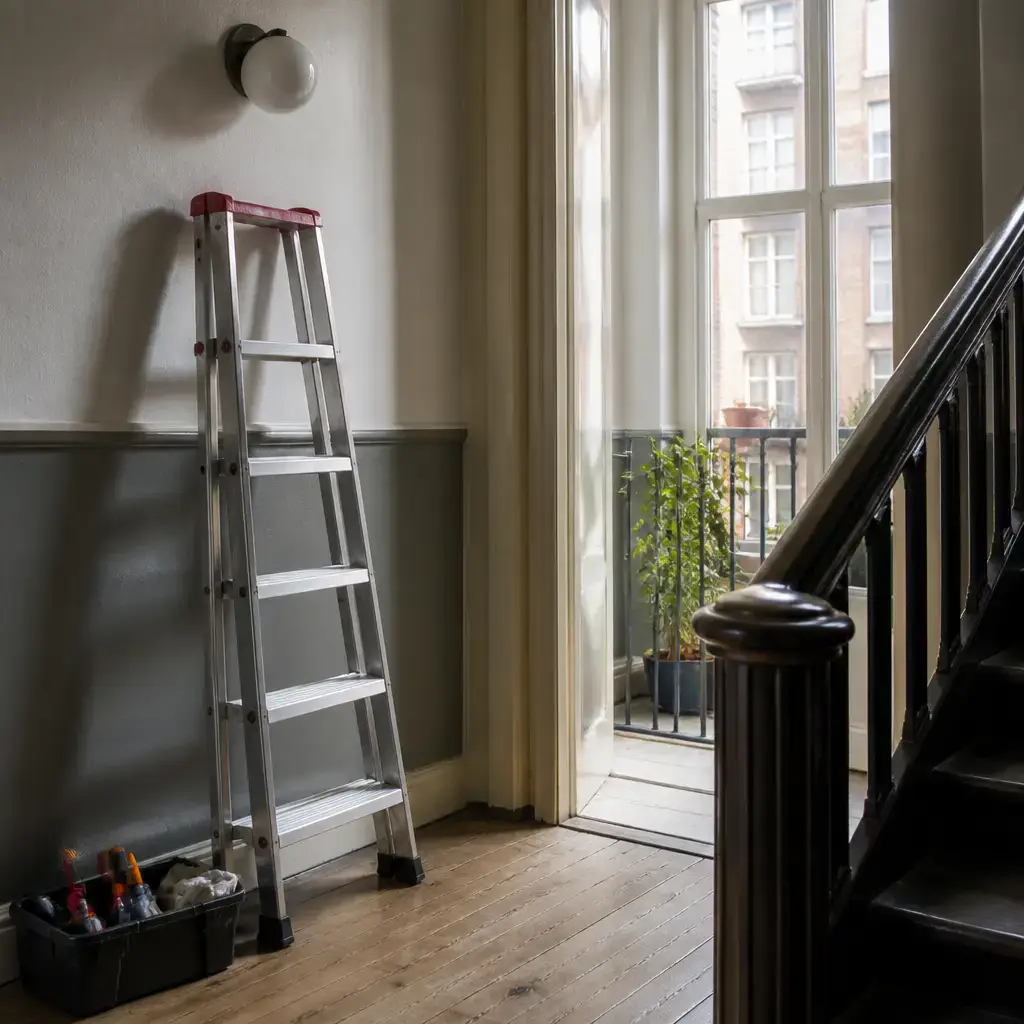
Use Borrowing a ladder safely to practice Danish conversation, pronunciation, vocabulary, grammar, and quizzes.
Dialogue
Må jeg bruge din stige til at skifte en loftslampe?
moh yai BROO-eh deen STEE-eh teel eh SGEF-deh en LOHFDs-LAM-beh? Can I use your ladder to change a ceiling light?Det må du gerne, men få nogen til at blive i nærheden, mens du bruger den.
deh moh doo GAIR-neh, men foh NOH-en teel eh BLEE-vuh ee NAIR-hay-thən, mens doo BROO-er den. You can, but have someone stay nearby while you use it.Min bror kan holde fast i bunden, så den står stabilt.
meen brohr kan HUL-leh FAST ee BOHN-en, soh den stohr stah-BEELT. My brother can hold the bottom so it stays stable.Det burde hjælpe.
deh BOOR-thuh YEL-beh. That should help.Stigen er solid, men du skal stadig være forsigtig.
STEE-en air soh-LEEL, men doo skal STAH-thee VAIR-eh for-SIG-dee. The ladder is sturdy, but you still need to be careful.Jeg har kun brug for den i kort tid, og jeg skal nok være forsigtig.
yai har koon BROO for den ee kort teeth, oh yai skal nok VAIR-eh for-SIG-dee. I only need it for a short time, and I'll be careful.Tag den tid, du har brug for.
TAY den teeth, doo har BROO for. Take the time you need.Undgå at bruge den udenfor, hvis jorden er våd.
oon-GOH eh BROO-eh den OO-en-fohr, ves YOH-en air vohth. Avoid using it outside if the ground is wet.Jeg bruger den indenfor og tager den tilbage, når jeg er færdig.
yai BROO-er den EN-en-fohr oh TAY-er den teh-BAI-eh, nohr yai air FAIR-dee. I will use it indoors and bring it back when I am finished.Hvis jeg ikke er hjemme, så stil den ved siden af min dør.
ves yai EG-eh air YEM-eh, soh SDEEL den veh SEE-en eh meen DOHR. If I am not home, leave it beside my door.Okay, jeg stiller den ved siden af din dør, hvis du ikke er hjemme.
oh-KAY, yai SDEE-leh den veh SEE-en eh deen DOHR, ves doo EG-eh air YEM-eh. Okay, I'll leave it beside your door if you're out.Fokuser på sikkerheden, også selvom det tager længere tid.
foh-goo-SAIR poh SIG-er-hay-thən, OH-soh SEL-om deh TAY-er LENG-er teeth. Focus on safety, even if it takes longer.Sentence explanations
Må jeg bruge din stige til at skifte en loftslampe?
Can I use your ladder to change a ceiling light?
- Må jeg
- May I
- bruge
- use
- din
- your
- stige
- ladder
- til at
- to
- skifte
- change
- loftslampe
- ceiling light
More detail
Må jeg means “Can I…?” or, more literally, “May I…?” Here må is the present form of måtte, used to ask for permission, and jeg means “I.” This is a reusable request pattern: Må jeg + verb ...? For example, Må jeg komme ind? means “May I come in?” bruge means “use.” It is the infinitive form, and it follows the modal verb må without an infinitive marker: Må jeg bruge ...? means “Can I use ...?” In Danish, modal verbs such as må commonly combine directly with an infinitive. din means “your.” It is the form used with a singular common-gender noun, as in din stige (“your ladder”). With a singular neuter noun, Danish uses dit, and with plural nouns it uses dine: dit hus (“your house”), dine bøger (“your books”). These forms express possession; the sentence does not itself state how many owners there are. stige means “ladder.” It is a singular common-gender noun: en stige (“a ladder”), stigen (“the ladder”). In this sentence, din identifies it as the listener’s ladder. til at introduces an intended action after a phrase such as “use something for…” or “have something to…”. Here til at skifte ... means “to change ...”. The at belongs with the following infinitive skifte; it is not part of the meaning of til alone. skifte means “change” here, specifically replace a ceiling light. It is the infinitive form. The same verb can describe changing clothes or changing from one thing to another, depending on its object and context. Example: Jeg skal skifte pære. — “I need to change the bulb.” loftslampe means “ceiling light.” It is a compound noun: loft means “ceiling” and lampe means “lamp,” but the complete compound is the natural noun for the light fixture here. Its indefinite singular form is en loftslampe, and its definite form is loftslampen (“the ceiling light”). Together, Må jeg bruge din stige asks permission to use the listener’s ladder. til at skifte en loftslampe states the purpose: changing a ceiling light. The whole utterance therefore means, “Can I use your ladder to change a ceiling light?”
Det må du gerne, men få nogen til at blive i nærheden, mens du bruger den.
You can, but have someone stay nearby while you use it.
- Det
- it; that
- må du gerne
- you may; you can
- få
- get; have
- nogen
- someone
- til at blive
- to stay
- i nærheden
- nearby
- mens
- while
- bruger
- use
- den
- it
More detail
Det is the pronoun used in the fixed permission expression Det må du gerne. Here the whole expression corresponds to “you can” or “you may”; the translation and the preceding question show that permission to use the ladder is intended. Det is not the word that identifies the ladder later in the sentence. må du gerne is a common Danish way to grant permission. må is the present form of måtte, “may / be allowed to”; du is the second-person singular pronoun “you”; and gerne makes the permission affirmative, roughly “gladly” in its literal sense but naturally “yes, you may” here. Compare Må jeg ...? (“May I ...?”) with Du må gerne ... (“You may ...”). få is the imperative of få, “get” or “have”. In this sentence it introduces a causative pattern: få nogen til at ... means “have someone ...” or “get someone to ...”. The imperative makes this a request or instruction to the listener. nogen means “someone” or “somebody”. It is an indefinite pronoun, so the sentence does not identify which person. In få nogen til at ..., it is the person who is to carry out the following action. til at blive is the construction “to stay / remain”. blive is the infinitive of “stay, remain” in this use. After få nogen til at, the infinitive describes the action that the other person is caused or instructed to perform. Thus få nogen til at blive means “have someone stay”, not simply “get someone”. i nærheden means “nearby” or “in the vicinity”. i means “in”, and nærheden is the noun-based expression for the surrounding vicinity. For example, Bliv i nærheden. means “Stay nearby.” mens introduces a time clause meaning “while”. It links an action that is happening during another action. For example, Mens jeg arbejder, kan du læse. means “While I work, you can read.” bruger is the present form of bruge, “use”. The subject is the already expressed du, so du bruger means “you use / you are using”. Danish present forms do not add a separate ending here for this second-person subject: jeg bruger, du bruger, and de bruger all use bruger. den is a singular common-gender pronoun meaning “it” here. The fixed translation and the preceding question identify its referent as the ladder. Its grammatical form agrees with the noun’s gender and number; it is not the form used for a neuter singular noun, for which Danish uses det. Together, Det må du gerne grants permission. men introduces the condition or safety instruction, and få nogen til at blive i nærheden says to have someone remain nearby. The final clause, mens du bruger den, specifies when: while you are using the ladder. The complete meaning is: “You can, but have someone stay nearby while you use it.”
Min bror kan holde fast i bunden, så den står stabilt.
My brother can hold the bottom so it stays stable.
- Min
- my
- bror
- brother
- kan
- can
- holde fast
- hold firmly
- bunden
- the bottom
- så
- so
- den
- it
- står
- stands; stays
- stabilt
- stably; stable
More detail
Min means “my” here and is the possessive form used with a singular common-gender noun such as bror. Compare mit with a singular neuter noun and mine with plural nouns. bror means “brother”. Its plural is brødre; the possessive relationship is expressed by min before it. kan is the present-tense form of kunne, “can; be able to”. A modal such as kan is followed by an infinitive: kan holde means “can hold”. holde fast is a reusable expression meaning to hold something firmly or keep it secured. holde is the infinitive, and holder is its present-tense form. fast adds the idea of firmness. Example: Hold fast i rækværket. — “Hold firmly onto the railing.” bunden means “the bottom” here. It is the definite singular form of bund (“bottom”): en bund is “a bottom”, while bunden is “the bottom”. The preposition i makes the phrase holde fast i bunden, “hold the bottom firmly”. så links the action to its result: “so that” or “so”. In this sentence it introduces the result clause den står stabilt. den is a third-person singular pronoun for a common-gender referent. Here it means “it”, referring to the thing being used and held, as supported by the fixed translation and context. The pronoun’s grammatical form does not by itself identify a more specific noun. står is the present form of stå, “stand”. With an object or thing, stå can describe remaining upright or staying in a position, so står contributes “stays” here. Example: Glasset står på bordet. — “The glass is standing on the table.” stabilt means “stably” here. It is the -t form associated with the adjective stabil, used adverbially with står to describe the stable way the thing remains positioned. The pattern stå stabilt means “stay stable”. Together, Min bror kan holde fast i bunden says “My brother can hold the bottom firmly”. så den står stabilt adds the result: “so it stays stable”. The complete utterance is therefore: “My brother can hold the bottom so it stays stable.”
Det burde hjælpe.
That should help.
- Det burde
- That should
- hjælpe
- help
More detail
Det burde combines the subject pronoun det with the modal verb burde. Here det means “that,” referring to the relevant situation or measure identified by the fixed translation; its specific noun referent is not named in this sentence. Danish det is the neuter singular form, while den is used for a common-gender singular referent in the corresponding pronoun distinction. Burde is the modal form meaning “should” or “ought to.” It is related to present-tense bør, but burde is commonly used for a present expectation or a qualified recommendation, not only for past time. Danish modal verbs do not take different person endings here: jeg burde, du burde, and det burde all use burde. A useful pattern is [subject] burde + infinitive. hjælpe means “help” here. It is the infinitive form, and after the modal burde Danish uses the infinitive directly, without at. For example: Det burde virke. — “That should work.” Together, Det burde hjælpe. means “That should help.” The subject is the intended “that,” burde expresses an expectation or qualified confidence, and hjælpe names the expected result. The sentence therefore presents help as likely or expected rather than as a certain fact.
Stigen er solid, men du skal stadig være forsigtig.
The ladder is sturdy, but you still need to be careful.
- Stigen
- the ladder
- er
- is
- solid
- sturdy
- du skal
- you need to
- stadig
- still
- være
- be
- forsigtig
- careful
More detail
Stigen means “the ladder” here. It is the definite singular form of stige (“ladder”): en stige is “a ladder,” while stigen is “the ladder.” The definite form identifies a particular ladder in this utterance. er is the present-tense form of være (“to be”). Here it links the subject to a description. Example: Døren er åben. — “The door is open.” solid describes the ladder as sturdy or solid. It is an adjective in the common-gender singular form used after er with stigen; the neuter singular form is solidt, and the plural/definite form is solide. Example: Bordet er solidt. — “The table is sturdy.” du skal combines du (“you”) with the present form skal of skulle. In this sentence, skal expresses that you need to or are expected to do something, rather than simply describing a future event. It is followed by the infinitive være. Example: Du skal vente. — “You need to wait.” stadig means “still”: the need for care remains in force despite the ladder being sturdy. Example: Hun er stadig her. — “She is still here.” være is the infinitive of er and means “to be.” After the modal skal, Danish uses the infinitive: skal være, “need to be.” forsigtig means “careful” in the expression være forsigtig, “be careful.” It is the common-gender singular form; forsigtigt is the neuter singular form and forsigtige is used with plural or definite noun phrases. Example: Vær forsigtig med glasset. — “Be careful with the glass.” Together, Stigen er solid says “The ladder is sturdy,” and men adds a contrast: du skal stadig være forsigtig says that you still need to be careful. The complete utterance is therefore: “The ladder is sturdy, but you still need to be careful.”
Jeg har kun brug for den i kort tid, og jeg skal nok være forsigtig.
I only need it for a short time, and I'll be careful.
- Jeg
- I
- har
- have
- kun
- only
- brug for
- need
- den
- it
- i
- for
- kort
- short
- tid
- time
- skal nok
- will ... / be sure to
- være
- be
- forsigtig
- careful
More detail
Jeg means “I” here and is the subject of the sentence. It is the first-person singular personal pronoun. Example: Jeg er klar. — “I am ready.” har is the present-tense form of have (“to have”). In har brug for, it combines with brug for to form the reusable expression “need”; it expresses need here, not ordinary possession. Example: Jeg har brug for hjælp. — “I need help.” kun means “only.” Here it limits the extent of the speaker’s need: the need is limited to the short period expressed later in the sentence. brug for is part of the Danish construction have brug for noget, meaning “need something.” The full construction supplies this meaning; brug is not functioning alone as the verb “use” here. den is a singular object pronoun meaning “it” in this translation. Its form is used for a singular common-gender referent, while the supplied sentence does not identify what that referent is. It is the object of har brug for. i introduces the duration expression i kort tid. In this context, the whole expression means “for a short time,” not a location. kort means “short.” Here it describes tid, producing kort tid, “short time.” The form kort is used with singular indefinite common- or neuter-gender nouns; korte is used with plural or definite nouns. Example: en kort pause — “a short break.” tid means “time.” In kort tid, it refers to a limited duration rather than a particular clock time. Example: Jeg bliver her i lang tid. — “I will stay here for a long time.” skal nok is a useful Danish pattern for a confident assurance about what the subject will do. In this sentence, nok adds reassurance, so jeg skal nok ... means “I’ll be sure to ...” or naturally “I’ll ...,” rather than simply “I must.” være is the infinitive “to be,” used after skal. The pattern skal + infinitive expresses the future-oriented or modal part of the clause; here skal være contributes “will be.” forsigtig means “careful” or “cautious.” With være, it describes the subject’s behavior or state: være forsigtig means “be careful.” In this sentence, forsigtig is the singular common-gender form agreeing with the subject; the first-person pronoun itself does not specify the speaker’s gender. Danish uses forsigtigt with a singular neuter subject and forsigtige with a plural or definite subject. Example: Hun er forsigtig. — “She is careful.” Together, Jeg har kun brug for den says “I only need it.” i kort tid adds the limited duration, “for a short time.” The coordinated clause og jeg skal nok være forsigtig says “and I’ll be careful,” with skal nok presenting this as a confident assurance. The complete meaning is: “I only need it for a short time, and I’ll be careful.”
Tag den tid, du har brug for.
Take the time you need.
- Tag
- take
- tid
- time
- du
- you
- har brug for
- need
More detail
Tag is the imperative of tage (“to take”). It addresses the listener directly, so Danish does not need an expressed subject here. For example, Tag bogen. means “Take the book.” den tid means “the time.” Here den is the definite determiner used with the singular common-gender noun tid; it is not the English quantity “one.” The noun tid means “time” in this context. Its meaning can refer to an amount or period of time, as in Jeg har tid. — “I have time.” du is the second-person singular subject pronoun, “you.” It is the subject of the following clause, not the subject of the imperative Tag. har brug for is the Danish construction meaning “need.” Literally, it contains the present form har of have and brug for, but it should be learned as a reusable expression: Jeg har brug for hjælp. — “I need help.” The form har is used here with du as well as with jeg in the present tense. The relative clause du har brug for describes den tid: “that you need.” Danish can leave the object of har brug for unexpressed when it is understood from the preceding noun, while keeping for at the end of the clause. Thus den tid, du har brug for corresponds to “the time that you need.” Together, Tag den tid, du har brug for. means “Take the time you need.” It is a direct but natural imperative, telling the listener to take the amount of time that is necessary for them.
Undgå at bruge den udenfor, hvis jorden er våd.
Avoid using it outside if the ground is wet.
- Undgå
- avoid
- at bruge
- to use
- den
- it
- udenfor
- outside
- hvis
- if
- jorden
- the ground
- er
- is
- våd
- wet
More detail
Undgå means “avoid” here. It is the imperative form of undgå, used for a direct instruction. Example: Undgå sukker. — “Avoid sugar.” at bruge means “to use”. bruge is the infinitive, and at marks the infinitive in this construction. The pattern undgå at + infinitive means “avoid doing something”: Undgå at løbe. — “Avoid running.” den is a singular common-gender object pronoun, meaning “it” here. Its specific referent is not named in the fixed sentence; the translation identifies it only as the object being used. Danish also uses det for a singular neuter-gender referent, while den is used with common-gender referents. The form den itself does not identify the referent. udenfor means “outside”. It is written as one word here and functions as a place adverb. Example: Katten er udenfor. — “The cat is outside.” hvis introduces a condition and means “if”. The pattern hvis + clause presents the condition under which the main instruction applies. Example: Ring, hvis du har brug for hjælp. — “Call if you need help.” jorden means “the ground”. It is the definite singular form of jord: jord = “ground/soil”, jorden = “the ground”. The ending marks definiteness, not plurality. er means “is” in this sentence. It is the present-tense form of være (“to be”); the same present form is used with different subjects, such as jeg er (“I am”) and de er (“they are”). våd means “wet”. It is the common-gender singular form used predicatively with jorden, a common-gender noun. The related forms are vådt with a singular neuter-gender noun and våde with plural or definite forms in relevant constructions. Example: Græsset er vådt. — “The grass is wet.” Together, Undgå at bruge den gives “Avoid using it”. The conditional clause hvis jorden er våd adds “if the ground is wet”. Thus the complete utterance is: “Avoid using it outside if the ground is wet.”
Jeg bruger den indenfor og tager den tilbage, når jeg er færdig.
I will use it indoors and bring it back when I am finished.
- Jeg
- I
- bruger
- use
- den
- it
- indenfor
- indoors
- tager
- take / bring
- tilbage
- back
- når
- when
- er
- am / is / are
- færdig
- finished
More detail
Jeg means “I” and is the first-person singular subject. It identifies the speaker as the person doing both actions. Danish subject pronouns do not change according to the speaker’s gender. bruger is the present form of bruge, “to use”: jeg bruger = “I use.” In this sentence, the Danish present tense expresses the planned action translated as “I will use.” The same form can describe a current or habitual action when the context calls for that meaning. den is a singular common-gender pronoun meaning “it” here. The fixed translation establishes that it refers to the object being used and brought back. Danish contrasts singular den with neuter det and plural dem; the choice depends on the grammatical gender and number of the noun being replaced, not on the pronoun’s position next to another word. indenfor means “indoors” or “inside.” It specifies the place of using the object. Danish also uses the written form inden for in some usage; the source form is the single word indenfor and should not be silently changed. tager is the present form of tage, whose basic meaning is “to take.” With tilbage and the object den, the intended meaning here is “bring/take it back.” The exact English choice depends on the direction and viewpoint; the fixed translation selects “bring it back” in this utterance. tilbage means “back,” indicating return to an earlier or relevant place or situation. The reusable pattern tage noget tilbage can mean “take something back”; in this sentence, den fills the “something” position: tager den tilbage = “bring it back.” når introduces a time clause meaning “when.” It connects an action with the time or condition at which another event occurs. A useful contrast is hvis, “if,” which introduces a condition rather than simply identifying the time of an event. er is the present form of være, “to be.” Danish uses er for all persons in the present tense: jeg er, du er, and de er. Here it links jeg with the adjective færdig. færdig means “finished” or “done.” It is the common-gender singular form of the adjective; its neuter form is færdigt, and its plural/definite form is færdige. In jeg er færdig, the speaker says that the speaker is done, without the form identifying the speaker’s gender. Together, Jeg bruger den indenfor means “I will use it indoors.” og tager den tilbage adds the coordinated action “and bring it back.” The clause når jeg er færdig means “when I am finished” and gives the time for bringing it back. Thus the complete utterance is: “I will use it indoors and bring it back when I am finished.”
Hvis jeg ikke er hjemme, så stil den ved siden af min dør.
If I am not home, leave it beside my door.
- Hvis
- if
- jeg
- I
- er hjemme
- am at home
- så
- then
- stil
- leave; place
- den
- it
- ved siden af
- beside; next to
- min
- my
- dør
- door
More detail
Hvis introduces a condition: “if.” A reusable pattern is Hvis [condition], ... for a situation whose result is described afterward. Danish can also place the hvis clause after the main clause, as in the supplied next sentence. jeg means “I” and is the first-person singular pronoun. Here it is the subject of er. It is not the subject of stil: the imperative has an understood second-person subject, “you.” For example: Jeg er hjemme. — “I am at home.” er hjemme means “am at home.” er is the present form of være (“to be”); hjemme is an adverb meaning “at home,” not a noun that receives an article in this expression. jeg er hjemme is therefore “I am at home,” while jeg ikke er hjemme is “I am not at home.” så means “then” in this conditional pattern. Together, Hvis ..., så ... gives the reusable structure “If ..., then ...”: the second part states what should happen under the condition. stil means “leave/place” here. It is the imperative singular form of stille, “to put, place, or set.” The imperative directly gives an instruction; the subject “you” is understood rather than written. For example: Stil koppen her. — “Put the cup here.” den is the object pronoun “it” in the intended translation. Its grammatical form is the Danish common-gender singular object form; the supplied texts identify the object as “it” but do not identify what physical item it is. In stil den, it is the thing being placed. Do not confuse this object pronoun with det, which is used for neuter singular referents in relevant contexts. ved siden af is the fixed prepositional expression “beside” or “next to.” It describes the location of something relative to a reference point. For example: Tasken står ved siden af stolen. — “The bag is beside the chair.” min means “my” before the singular common-gender noun dør. Danish possessives agree with the possessed noun’s grammatical gender and number: min is used with a singular common-gender noun, while mit is used with a singular neuter noun and mine with plural nouns. Here, dør is common gender, so the phrase is min dør. dør means “door.” Its base form is dør; a useful form contrast is en dør (“a door”) and døren (“the door”). In the fixed sentence, min dør means “my door,” with possession supplied by min. The chunks combine as Hvis jeg ikke er hjemme (“If I am not at home”) + så (“then”) + stil den (“leave/place it”) + ved siden af min dør (“beside my door”). The complete utterance is therefore: “If I am not home, leave it beside my door.”
Okay, jeg stiller den ved siden af din dør, hvis du ikke er hjemme.
Okay, I'll leave it beside your door if you're out.
- jeg
- I
- stiller
- leave; place
- den
- it
- ved siden af
- beside; next to
- din
- your
- dør
- door
- hvis
- if
- du
- you
- ikke
- not
- er hjemme
- be at home
More detail
jeg means “I” and is the subject of the main clause. Danish subject pronouns include jeg “I,” du “you,” and vi “we.” Unlike English, Danish present-tense verbs generally do not change for the subject: jeg stiller and du stiller both use stiller. stiller is the present form of stille, “to place” or “to put.” Here it describes the speaker’s intended act of leaving the item in a place. Danish present tense can describe a planned future action when the context makes the intention clear. Do not confuse stille with stå “to stand/be standing”: stille focuses on putting something somewhere, while stå describes its position. den is an object pronoun meaning “it” here. It is the common-gender singular form; the supplied translation identifies the meaning as “it,” but does not specify the referent. A useful contrast is den “it” for common-gender singular nouns and det “it” for neuter singular nouns. ved siden af is a fixed prepositional construction meaning “beside” or “next to.” It introduces the location of the object. Example: Bogen ligger ved siden af døren. — “The book is beside the door.” din means “your” and agrees with the noun it determines. In this sentence it is the singular possessive form used with dør, a common-gender noun. Danish possessives distinguish forms such as din with a common-gender singular noun, dit with a neuter singular noun, and dine with plural nouns. The choice is determined by the possessed noun, not by the owner. dør means “door.” Its indefinite form is en dør, and its definite form is døren “the door.” In the sentence, din dør means “your door”; the possessive already makes the noun phrase definite in meaning. hvis introduces a condition and means “if.” The pattern hvis ... sets the condition under which the main clause applies. In this sentence, the condition comes after the main clause: the speaker will place the item beside the door if the addressee is not at home. du means “you” and is the subject of the conditional clause. It is the ordinary singular or plural second-person subject pronoun in Danish; the form itself does not identify whether one person or more than one person is addressed. ikke is the usual Danish negation word, “not.” It negates the predicate here, so ikke er hjemme means “are not at home.” er hjemme means “are at home.” er is the present form of være, “to be,” and hjemme is the adverb “at home.” The form er is used with jeg, du, and other subjects in the present: jeg er “I am,” du er “you are.” Example: Jeg er hjemme. — “I am at home.” Together, jeg stiller den ved siden af din dør means “I’ll place it beside your door.” The present form stiller presents this as the speaker’s intended action, while hvis du ikke er hjemme adds the condition “if you’re not at home.” Thus the complete utterance means: “Okay, I’ll leave it beside your door if you’re out.”
Fokuser på sikkerheden, også selvom det tager længere tid.
Focus on safety, even if it takes longer.
- Fokuser
- focus
- på
- on
- sikkerheden
- the safety
- også selvom
- even if
- det
- it
- tager
- takes
- længere
- longer
- tid
- time
More detail
Fokuser is the imperative of fokusere (“to focus”). It gives a direct instruction to one or more people; a reusable pattern is fokuser på + noun or fokuser på + clause. For example, Fokuser på opgaven. means “Focus on the task.” på is the preposition used with fokusere: fokusere på noget means “to focus on something.” Here it introduces what the instruction is directed toward. sikkerheden means “the safety” in this sentence. It is the definite singular form of sikkerhed (“safety” or “security”); the ending -en marks definiteness for this noun. sikkerhed can refer to safety generally, while sikkerheden refers to the relevant safety as a defined concern. sikker is a related adjective meaning “safe,” but it is not the base form of the noun sikkerheden. også selvom introduces a condition that remains relevant despite the main instruction: “even if” or “even though.” selvom alone means “although/even though,” while også selvom forms the stronger concessive expression “even if.” For example, Jeg går, også selvom det regner. means “I am going, even if it rains.” det is a neuter singular pronoun functioning as the subject of tager here. In the pattern det tager + time expression, it is part of an impersonal construction about how much time something requires; it does not by itself identify a particular named object. Danish det can also have other neuter-singular subject uses, so its grammatical form alone does not identify a specific referent. tager is the present-tense form of tage (“to take”). In det tager + time expression, it describes how much time something requires: Det tager en time. means “It takes an hour.” The present form can describe a general or expected time requirement; it does not itself specify a future tense. længere means “longer” here. It is the comparative form of lang (“long”): lang → længere (“longer”). In længere tid, it describes a greater duration; the sentence does not state exactly what the comparison point is. tid means “time.” In tager længere tid, it is part of the reusable expression for requiring more time: Det tager længere tid. means “It takes longer.” The noun is used without an article here; the phrase expresses duration rather than naming a particular clock time. Together, Fokuser på sikkerheden means “Focus on safety.” også selvom det tager længere tid adds the concession “even if it takes longer.” The complete utterance is therefore an instruction to prioritize safety despite the possibility that doing so will require more time.
Grammar Points
få nogen til at + infinitiv
Få nogen til at skifte loftslampen.
foh NOH-en teel eh SGEF-deh LOHFDs-LAM-benHave someone change the ceiling light.
Mønsteret få nogen til at + infinitiv betyder at få eller bede en person om at gøre noget.
Danish Vocabulary
til at blive i nærheden
Må jeg bruge din stige?
- Gender
- common
holde fast i bunden
få nogen til at blive i nærheden
Det må du gerne.
holde fast i bunden
blive i nærheden
- Gender
- common
en loftslampe
få nogen til at blive
til at skifte en loftslampe
så den står stabilt
- Gender
- common
Stigen er solid.
Quiz
Word Order
Arrange the words in the correct order.
That should help.
Show Answer
Det burde hjælpe.Spelling
Tap the letters to spell the word.
stay; become
Show Answer
bliveladder
Show Answer
stigenchange
Show Answer
skiftegladly; willingly