10 minutes free every day
Continue audio lessons in the app
Word explanations appear automatically in sync with the audio.
No login required · synced translations · playback with the screen locked
Choose your learning language and open this lesson in the app.

About This Lesson
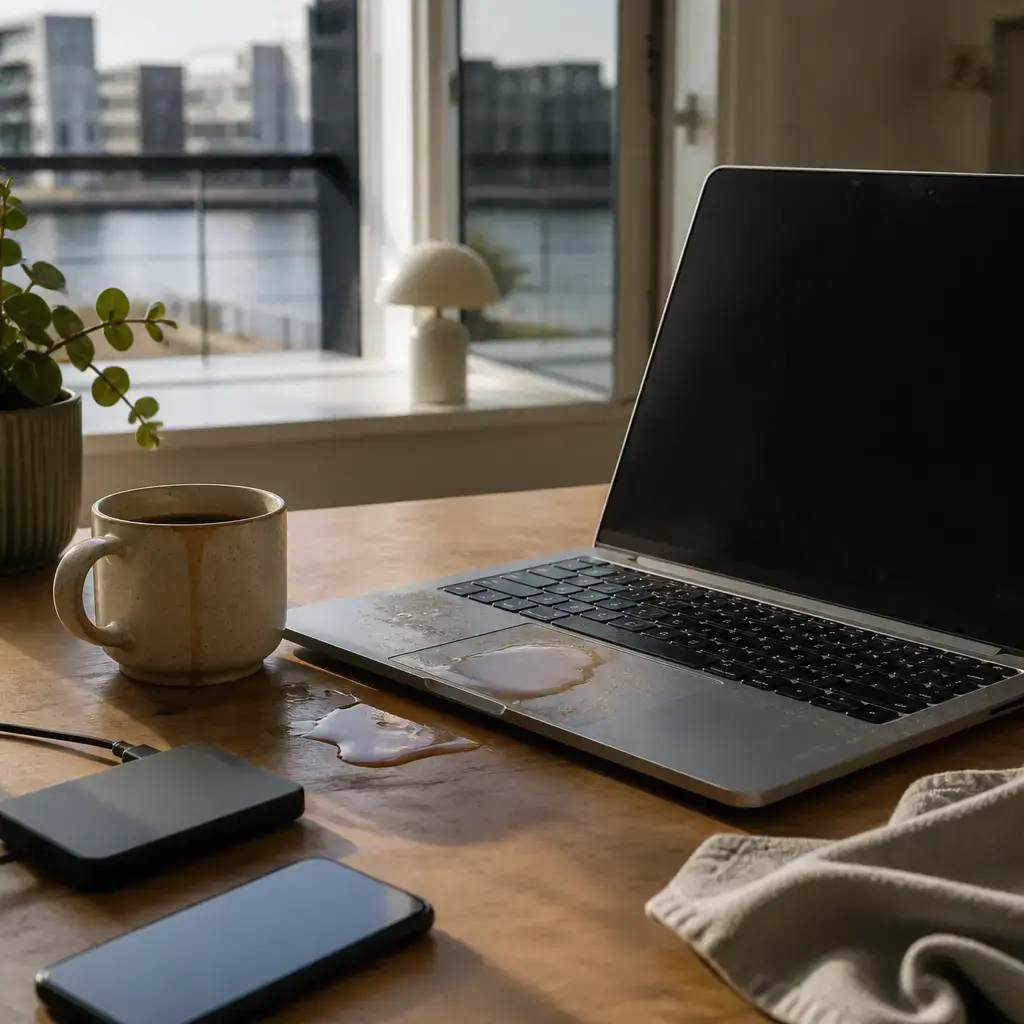
Use Coffee Spill on a Laptop to practice Danish conversation, pronunciation, vocabulary, grammar, and quizzes.
Dialogue
Jeg spildte kaffe i nærheden af min bærbare computer, og der kom noget væske ind under tastaturet.
yai SPELL-tuh KAF-uh ee NAIR-hay-den ahv mee BAIR-bah cohm-POO-ter, oh dair kohm NOH-uh VES-kuh en OON-uh tas-too-uhd. I spilled coffee near my laptop, and some liquid went under the keyboard.Tag stikket ud med det samme, og sluk den, hvis den stadig kører.
TAY STEG-uh OOTH meh deh SAM-uh, oh SLOOG den, viss den STAI-lee KUR-uh. Unplug it immediately and turn it off if it is still running.Skal jeg prøve at tørre den med en hårtørrer?
sgal yai PRUH-vuh eh TUR-uh den meh en HAWR-TUR-uh? Should I try to dry it with a hair dryer?Varme kan gøre skaden værre. Lad en tekniker se på den.
VAR-muh kan GUR-uh SKAY-then VAIR-uh. LAY en tek-NEE-kur say paw den. Heat can cause more damage. Let a technician check it.Jeg er bekymret, fordi mine projektfiler ligger på den.
yai air beh-KOOM-uhd, for-THEE MEE-nuh proh-YEGT-fee-luh LIG-uh paw den. I am worried because my project files are on it.Tjek din sikkerhedskopi i skyen fra en anden enhed, før du rører ved den bærbare computer igen.
chek deen SIG-uh-haits-koh-pee ee SKOO-en fra en AN-en AYN-hayth, fur doo RUR-uh vay den BAIR-bah cohm-POO-ter ee-YEN. Check your cloud backup from another device before you touch the laptop again.De fleste af filerne var allerede synkroniseret.
dee FLAY-stuh ahv FEE-luh-nuh var all-RAY-thuh sink-roh-nee-SAY-uhd. Most of the files were already synced.Lad den bærbare computer være slukket, og prøv ikke at starte den for tidligt.
LAY den BAIR-bah cohm-POO-ter VAIR-uh SLOO-kud, oh PRUH EG-uh eh STAR-duh den fohr TEE-lee. Keep the laptop off, and do not try to start it too soon.Jeg tager den med til en tekniker og spørger om det næste skridt.
yai TAY-uh den meh teel en tek-NEE-kur oh SPUR-uh om deh NESS-duh SKREHD. I will take it to a technician and ask about the next step.En tekniker kan se på den uden at gøre skaden værre.
en tek-NEE-kur kan say paw den OO-thun eh GUR-uh SKAY-then VAIR-uh. A technician can check it without making the damage worse.Sentence explanations
Jeg spildte kaffe i nærheden af min bærbare computer, og der kom noget væske ind under tastaturet.
I spilled coffee near my laptop, and some liquid went under the keyboard.
- Jeg
- I
- spildte
- spilled
- kaffe
- coffee
- i nærheden af
- near
- min
- my
- bærbare
- portable
- computer
- computer
- kom
- came
- noget
- some
- væske
- liquid
- ind under
- underneath
- tastaturet
- the keyboard
More detail
Jeg is the first-person singular pronoun, “I.” It identifies the speaker as the actor of spildte; Danish does not change this pronoun for grammatical gender. spildte is the past-tense form of spilde, “to spill.” The useful chain is spilde → spilder (present) → spildte (past) → spildt (past participle). Here the past form presents the spilling as completed. Example: Jeg spilder vand. — “I spill water.” kaffe means “coffee.” It is commonly used as a mass noun, so this sentence refers to coffee as a substance rather than specifying individual servings. Example: Jeg drikker kaffe. — “I drink coffee.” i nærheden af is a reusable prepositional construction meaning “near” or “in the vicinity of.” It expresses location relative to something that follows it. Example: Bogen ligger i nærheden af døren. — “The book is near the door.” min is the first-person singular possessive, “my.” It agrees with the possessed noun: min is used with a singular common-gender noun, mit with a singular neuter noun, and mine with a plural noun. In this phrase, min belongs with computer, not with the speaker. bærbare is the form of the adjective bærbar, “portable,” used in min bærbare computer, “my portable computer.” The adjective is not based on computer; bærbar is its own base form. The -e form occurs in this possessive noun phrase, whose adjective has definite-style agreement. Example: min bærbare radio — “my portable radio.” computer means “computer.” The noun is used here after the possessive and adjective to identify the object located near the spilled coffee. Example: Min computer er på bordet. — “My computer is on the table.” kom is the past-tense form of komme, “to come.” The useful chain is komme → kommer (present) → kom (past) → kommet (past participle). In the following clause, it describes liquid moving into a location; the directional meaning is supplied by ind under. noget means “some” here, referring to an unspecified amount. With the mass noun væske, it does not assert a specific quantity. The same form can also occur with a singular neuter noun, but here its relevant role is quantifying an unspecified amount of liquid. væske means “liquid.” It is a mass noun in this sentence, so noget væske means “some liquid,” without counting separate units. Example: Der er væske i glasset. — “There is liquid in the glass.” ind under is a directional construction meaning “in under” or “into the space beneath.” ind contributes movement inward, while under identifies the lower position. This differs from a purely locational expression such as under tastaturet, “under the keyboard,” which describes where something is rather than the movement into that place. tastaturet means “the keyboard.” It is the definite form of the noun tastatur; the ending -et marks the definite singular form of this neuter noun. Example: Tastaturet er sort. — “The keyboard is black.” Together, Jeg spildte kaffe i nærheden af min bærbare computer says that the speaker spilled coffee near their portable computer. The next clause begins with der, an existential or presentational subject, and kom noget væske ind under tastaturet: some liquid moved into the space beneath the keyboard. The past forms spildte and kom place both events in the past, producing the complete meaning: “I spilled coffee near my laptop, and some liquid went under the keyboard.”
Tag stikket ud med det samme, og sluk den, hvis den stadig kører.
Unplug it immediately and turn it off if it is still running.
- Tag
- take
- stikket
- the plug
- ud
- out
- med det samme
- immediately
- sluk
- turn off
- den
- it
- hvis
- if
- stadig
- still
- kører
- is running
More detail
Tag is the imperative of tage (“to take”). By itself, Tag! can mean “Take!”, but together with stikket and ud it forms the reusable pattern tage noget ud: “take something out”; for a plug, this means “unplug something.” stikket is the definite singular form of et stik (“a plug”): et stik → stikket. The definite ending identifies a particular plug in the situation. Example: Tag stikket ud. — “Unplug it.” ud means “out” and completes the directional construction tage ... ud. It is placed after the object here, so Tag stikket ud means “Take the plug out,” naturally “Unplug it.” med det samme is a fixed expression meaning “immediately” or “right away.” Example: Kom med det samme. — “Come immediately.” sluk is the imperative of slukke, “to turn off.” The imperative gives a direct instruction. Example: Sluk lyset. — “Turn off the light.” Slukke is different from lukke, which commonly means “to close.” den means “it” here. It is the singular common-gender form of the Danish third-person pronoun. In this sentence, the first occurrence is the object of sluk, while the later occurrence is the subject of kører; the form itself is unchanged in these two roles. Danish also has det for neuter singular referents, so the pronoun form depends on the relevant noun’s grammatical gender. hvis introduces a condition and means “if.” It begins the subordinate clause hvis den stadig kører, which states the condition for the instruction in the preceding clause. Example: Ring, hvis du har brug for hjælp. — “Call if you need help.” stadig means “still,” indicating that a situation continues at the relevant time. Example: Hun sover stadig. — “She is still sleeping.” kører is the present-tense form of køre, “to run” or “to operate” in this context. With a device as its subject, it means that the device is operating. The form also has other uses, such as “drives” or “travels,” depending on context. Example: Computeren kører stadig. — “The computer is still running.” The whole utterance consists of two direct instructions joined by og (“and”). Tag stikket ud med det samme means “Unplug it immediately.” Sluk den, hvis den stadig kører means “Turn it off if it is still running.” Together: “Unplug it immediately and turn it off if it is still running.”
Skal jeg prøve at tørre den med en hårtørrer?
Should I try to dry it with a hair dryer?
- Skal jeg
- Should I …?
- prøve
- try
- at tørre
- to dry
- den
- it
- med
- with
- hårtørrer
- hair dryer
More detail
Skal jeg combines skal with jeg to ask whether the speaker should do something: “Should I …?” Here, skal expresses a proposed or expected action, not simple present-time “must.” The same pattern is reusable with another verb: Skal jeg ringe? means “Should I call?” prøve means “try” here. It is the infinitive after skal; the modal skal carries the finite verb function, while prøve stays in the infinitive. A useful pattern is prøve at + infinitive, meaning “try to do something.” at tørre means “to dry.” at marks the infinitive, and tørre is the verb’s base form. In this sentence, drying is the action being tried. For example, Jeg prøver at åbne døren. means “I am trying to open the door.” den is a singular common-gender object pronoun meaning “it” here. Its specific referent is the item already under discussion; the form itself does not identify that item. Danish also uses det for a singular neuter referent, so the choice between den and det depends on the grammatical gender of the noun being replaced, not merely on its being singular. med means “with.” It introduces the means or instrument used for an action. In tørre den med ..., it tells us what the speaker proposes to use for drying. hårtørrer means “hair dryer.” It is a compound noun: hår means “hair” and tørrer is the dryer element in this established compound. The preceding en shows that this is an indefinite singular common-gender noun: “a hair dryer.” The article does not by itself assert a numerical contrast; it presents an unspecified instrument. For example, med en klud means “with a cloth.” Together, skal jeg prøve at tørre den asks whether the speaker should try to dry the item, and med en hårtørrer specifies the proposed instrument. The complete meaning is: “Should I try to dry it with a hair dryer?”
Varme kan gøre skaden værre. Lad en tekniker se på den.
Heat can cause more damage. Let a technician check it.
- Varme
- heat
- kan
- can; be able to
- gøre
- make; cause
- skaden
- the damage
- værre
- worse
- Lad
- let; allow
- tekniker
- technician
- se på
- check; look at
- den
- it
More detail
Varme means “heat” here. The noun is used without an article to state the substance or condition in general. Example: Varme kan skade huden. — “Heat can damage the skin.” kan expresses possibility or ability; in this sentence it says that heat is capable of causing the result. It is the modal verb, and the following verb remains in its base form: kan gøre, not an inflected form after the modal. gøre means “make” or “cause” here. Its base form is gøre; after modal verbs such as kan, Danish uses this form. In gøre ... værre, it introduces a change that makes something worse. Example: Røgen kan gøre problemet værre. — “The smoke can make the problem worse.” skaden means “the damage.” It is the definite form of skade: skade = “damage,” skaden = “the damage.” The definite form presents the damage as an identifiable matter in this situation; it does not itself specify a quantity. værre means “worse.” It is the comparative form related to slem (“bad”): slem → værre (“bad” → “worse”). In this sentence it describes the resulting state of skaden, giving the pattern gøre noget værre — “make something worse.” Lad means “let” or “allow” here. It is the imperative form of lade, used to request or instruct someone to allow an action. The following en tekniker identifies the person who is to carry out that action. Example: Lad hende tale. — “Let her speak.” tekniker means “technician.” The form quoted is the indefinite singular noun; with the indefinite article it appears as en tekniker. The article marks the noun phrase as indefinite, but it does not by itself assert a numerical count in the translation. se på is a two-word verb construction meaning “look at” or, in this context, “check” something. se is the base form used after the imperative Lad; på belongs to the construction and helps specify what is being examined. Example: Teknikeren ser på maskinen. — “The technician is checking the machine.” den is a pronoun meaning “it” here. Its form is a common-gender singular form, but the supplied sentence and translation do not uniquely identify a specific noun that it refers to. In the first sentence, the object of gøre is skaden; in the second, den is the thing the technician is asked to check. The pronoun’s exact referent is supplied by the situation rather than by its form alone. Together, Varme kan gøre skaden værre means “Heat can cause more damage,” literally expressing that heat can make the damage worse. Lad en tekniker se på den asks or instructs someone to let a technician check it. The complete utterance therefore gives a warning about heat and recommends having a technician examine the relevant thing.
Jeg er bekymret, fordi mine projektfiler ligger på den.
I am worried because my project files are on it.
- Jeg er
- I am
- bekymret
- worried
- fordi
- because
- mine
- my
- projektfiler
- project files
- ligger
- are located
- på
- on
- den
- it
More detail
Jeg er means “I am”: jeg is the first-person singular pronoun, and er is the present form of være (“to be”). This combination introduces a current state. Example: Jeg er klar. — “I am ready.” bekymret describes the speaker’s state here: “worried” or “concerned.” It is the adjective related to bekymre (“to worry”), and it follows er as a predicative adjective. Example: Hun er bekymret. — “She is worried.” fordi introduces the reason for the preceding statement and means “because.” It introduces a subordinate clause. In the fixed sentence, that clause explains why the speaker is worried. mine means “my” before a plural noun. Its base possessive is min; the form changes to mine with a plural possessed noun. Example: mine bøger — “my books.” This form marks possession, not the number of the possessor. projektfiler means “project files.” It is a compound noun: projekt specifies the type or purpose of the filer. The form is plural; the singular is projektfil. Example: Jeg gemmer projektfiler. — “I save project files.” ligger means “is/are located” here. It is the present form of ligge (“to lie; to be situated”) and is used for the location of the files. Danish uses the same present form with a singular or plural subject: Filen ligger her. — “The file is here”; Filerne ligger her. — “The files are here.” på means “on” in this location expression. It is a preposition, so på den forms the phrase “on it.” The exact referent of den is not uniquely identified by the supplied sentence and translation; its grammatical form is singular common gender. den means “it” here and is a third-person singular common-gender pronoun. In på den, it is the object of the preposition and refers to the intended singular item understood from the context. The form itself does not identify that item uniquely. Together, fordi mine projektfiler ligger på den means “because my project files are on it.” The complete utterance is Jeg er bekymret (“I am worried”) followed by the reason introduced with fordi: the speaker is worried because the project files are located on that contextually understood item. The wording is neutral and reusable for describing concern about where something is stored.
Tjek din sikkerhedskopi i skyen fra en anden enhed, før du rører ved den bærbare computer igen.
Check your cloud backup from another device before you touch the laptop again.
- Tjek
- check
- din
- your
- sikkerhedskopi
- backup
- skyen
- cloud
- anden
- another
- enhed
- device
- før
- before
- rører ved
- touch
- bærbare
- portable
- computer
- computer
- igen
- again
More detail
Tjek is the imperative of tjekke (“to check”). It gives a direct instruction to one or more people; the subject is normally understood rather than stated. Compare tjekker (“check/checks” in the present tense): Du tjekker sikkerhedskopien. — “You check the backup.” din means “your” and agrees with the possessed noun, not with the possessor. Here it is the form used with the singular common-gender noun sikkerhedskopi. The basic contrast is din with one common-gender noun, dit with one neuter noun, and dine with a plural noun. sikkerhedskopi means “backup,” a stored copy of data. Its definite form is sikkerhedskopien (“the backup”); the ending -en marks singular definiteness for this common-gender noun. In this sentence, the backup is the object being checked. skyen means “the cloud.” It is the definite singular form of sky (“cloud”), with -en marking definiteness. In i skyen, the preposition i makes the phrase mean “in the cloud”; this identifies where the backup is stored, not a new object being checked. anden means “another” here. It is the common-gender singular form used before enhed. The related forms are andet with a singular neuter noun and andre with a plural noun: en anden enhed — “another device”; andre enheder — “other devices.” enhed means “device” or, more generally, “unit.” Its plural is enheder. The phrase en anden enhed means “another device”: en is an indefinite article, while anden distinguishes this device from the one already being used or understood in the situation; it does not by itself state a numeric count. før means “before” and introduces the time condition for the instruction. In før du rører ved ..., the event in the subordinate clause—touching—comes after the action in the main clause: check first, then touch. A reusable pattern is før + subject + verb: Læs beskeden, før du svarer. — “Read the message before you reply.” rører ved is the fixed verb combination “touch.” rører is the present-tense form of røre (“to touch”), and ved is part of the construction; rører alone should not be treated as the complete equivalent of “touch” in this use. The clause du rører ved ... means “you touch ...”; du is the second-person singular subject and rører is the present form. bærbare means “portable” here and describes the laptop. It is the definite-form adjective after den: Danish adjectives commonly take -e in this environment, so bærbar is the base form and bærbare is the form used in den bærbare computer. The word is not the noun “computer”; it specifically describes its portability. For example, en bærbar computer means “a laptop,” while den bærbare computer means “the laptop.” computer means “computer.” In den bærbare computer, the preceding den marks the singular common-gender noun phrase as definite, while the adjective carries the definite adjective form bærbare; the noun itself remains in the form computer. The fixed translation identifies this particular computer as “the laptop.” igen means “again.” It indicates that touching the laptop would be a repeated action, without specifying when the earlier touch occurred. For example, Prøv igen. means “Try again.” Together, Tjek din sikkerhedskopi i skyen fra en anden enhed means “Check your cloud backup from another device”: the imperative Tjek supplies the instruction, din sikkerhedskopi names what to check, i skyen locates the backup, and fra en anden enhed gives the device from which to perform the check. før du rører ved den bærbare computer igen adds the time condition “before you touch the laptop again,” so the checking is to happen first and the repeated touching afterward. The complete utterance is therefore: “Check your cloud backup from another device before you touch the laptop again.”
De fleste af filerne var allerede synkroniseret.
Most of the files were already synced.
- De fleste
- most
- filerne
- the files
- var
- were
- allerede
- already
- synkroniseret
- synced
More detail
De fleste means “most” here: it identifies a majority of a known or contextually relevant set, not necessarily every item. The pattern de fleste af + plural noun is reusable: De fleste af bøgerne means “most of the books.” The following af links this majority expression to the set being counted; it is not included in the selected phrase quote. filerne means “the files.” Its base noun is fil (“file”), and the ending -erne marks definite plural, giving “the files.” Compare en fil (“a file”), filer (“files”), and filerne (“the files”). var is a past-tense form of være (“to be”). In this sentence it places the syncing state in the past. Danish uses var for past “was/were” across subjects, so the English translation’s “were” reflects the plural subject, while the Danish verb form itself does not change to a separate plural form here. allerede means “already.” It says that the relevant state had been reached by the past time being discussed. For example, Filen var allerede klar means “The file was already ready.” synkroniseret is the form related to synkronisere (“to synchronize”) and means “synced” in this construction. Together with var, it describes the files as being in a completed synchronization state at that past point. In the passive/state pattern være + past participle, the participle expresses the result or condition; for example, Døren var lukket means “The door was closed.” As a whole, De fleste af filerne var allerede synkroniseret. assembles as “Most of the files were already synced.” The majority expression selects the files, var ... synkroniseret presents their past synced state, and allerede indicates that this state had been reached by then.
Lad den bærbare computer være slukket, og prøv ikke at starte den for tidligt.
Keep the laptop off, and do not try to start it too soon.
- Lad
- keep; leave
- den
- the
- bærbare
- portable
- computer
- computer
- være
- be
- slukket
- off
- prøv
- try
- ikke
- not
- at starte
- to start
- den
- it
- for tidligt
- too soon
More detail
Lad is the imperative of lade, used here in the construction lad + object + infinitive: “keep/let something be …”. In this sentence it gives an instruction about the laptop’s state. Compare the ordinary present form lader (“lets/leaves”) and the infinitive lade. den bærbare computer means “the laptop”. Here den is the Danish definite article for a common-gender singular noun, and the following adjective takes the definite form bærbare. Danish commonly uses this pattern with an article plus adjective and an otherwise indefinite-looking noun: den røde bil = “the red car”. Bærbare is the form of bærbar (“portable”); in this noun phrase it agrees with the definite singular, while computer names the device. være is the infinitive of “be”. With lad, it introduces the state that the object is to remain in: lad døren være åben = “leave the door open.” slukket means “switched off” here. It is the past participle of slukke (“switch off”), used here as a result-state adjective after være: Skærmen er slukket = “The screen is switched off.” This describes the laptop’s state, rather than giving a separate command to switch it off at this point. prøv is the imperative of prøve, “try”. The negative command is formed with prøv ikke: “do not try”. The verb prøve can introduce an action with at: Prøv at læse det = “Try to read it.” at starte is the infinitive of starte, “start”. In this context it means starting the laptop. The infinitive marker at belongs to starte, not to the preceding imperative prøv; the reusable pattern is prøv at + infinitive. The second den is a pronoun meaning “it”. Its common-gender singular form matches the intended laptop reference established by the fixed translation; it is the object of starte. Danish den can also function as the definite article, as in the first den, so its role is determined by its position and the words around it. for tidligt means “too soon” or “too early”. Tidligt is the adverbial form related to tidlig (“early”); for makes the degree excessive for the relevant time: Du kom for tidligt = “You came too early.” Together, Lad den bærbare computer være slukket instructs the listener to keep the laptop switched off. og prøv ikke at starte den for tidligt adds a coordinated negative instruction: do not try to start it too soon. The complete meaning is therefore: “Keep the laptop off, and do not try to start it too soon.”
Jeg tager den med til en tekniker og spørger om det næste skridt.
I will take it to a technician and ask about the next step.
- Jeg
- I
- tager … med
- take along
- den
- it
- til
- to
- en
- a/an
- tekniker
- technician
- spørger … om
- ask about
- det
- the (neuter)
- næste
- next
- skridt
- step
More detail
Jeg means “I.” It is the first-person singular subject pronoun. Danish uses the same form whether the speaker is male or female. Example: Jeg kommer senere. — “I am coming later.” tager is the present-tense form of tage, “to take.” In this sentence, tager ... med means “take along,” so med adds the idea that the object goes with the speaker. The present form can also refer to a planned future action when the context makes that clear. Example: Jeg tager bogen med. — “I will take the book along.” den is a singular common-gender pronoun meaning “it” here. The supplied context identifies the thing as the laptop, but the form itself is a pronoun rather than a repeated noun. Danish uses den for a common-gender singular referent and det for a neuter singular referent. In tager den med, den is the object of tager, while med completes the reusable “take it along” pattern. til means “to” and introduces the destination or person receiving the object. Here, til en tekniker means that the laptop will be taken to a technician. en is the indefinite article used with a common-gender singular noun. It presents tekniker as one unspecified technician, but the article by itself does not assert a numerical count as the main point. Danish also has the neuter indefinite article et. tekniker means “technician.” It is a common-gender noun: en tekniker, “a technician,” and teknikeren, “the technician.” Example: Teknikeren undersøger computeren. — “The technician examines the computer.” spørger is the present-tense form of spørge, “to ask.” The second coordinated clause has no repeated subject: Jeg ... og spørger ... means “I ... and ask ...,” with Jeg understood as the subject of both verbs. Example: Jeg spørger læreren. — “I ask the teacher.” om after spørger introduces the topic being asked about. The construction spørge om + noun means “ask about + noun,” as in Hun spørger om planen. — “She asks about the plan.” Here, spørger om det næste skridt means “ask about the next step.” det is the neuter singular definite article in det næste skridt; it means “the” here, not “it.” It agrees with the neuter noun skridt. The pronoun det can also mean “it” in other constructions, but its role here is article-like because it comes before the adjective and noun. næste means “next.” It is the adjective modifying skridt. In this use, næste has the same form with common-gender and neuter singular nouns: den næste and det næste; it also appears with plural nouns, as in de næste skridt. Example: Vi taler om den næste opgave. — “We are talking about the next task.” skridt means “step.” It is a neuter noun: et skridt, “a step,” and det næste skridt, “the next step.” Its plural is also skridt, so the article or another determiner helps show whether it is singular or plural. In this sentence it is singular because of det. Together, Jeg tager den med til en tekniker says “I will take it to a technician,” with den referring to the laptop in the supplied context. og spørger om det næste skridt adds a second action by the same speaker: “and ask about the next step.” The complete utterance is therefore: “I will take it to a technician and ask about the next step.”
En tekniker kan se på den uden at gøre skaden værre.
A technician can check it without making the damage worse.
- tekniker
- technician
- kan
- can; be able to
- se på
- check; look at
- den
- it
- uden at
- without
- gøre
- make; do
- skaden
- the damage
- værre
- worse
More detail
tekniker means “technician” here. The form is singular and indefinite; en marks the noun phrase as indefinite, but does not by itself assert a numerical count. The same noun can be definite as teknikeren (“the technician”) or plural as teknikere (“technicians”). Example: En tekniker kommer. — “A technician is coming.” kan expresses ability or possibility: “can.” It is the present form of kunne. Danish modal verbs such as kan are followed by an infinitive without at: kan se means “can check/look.” Example: Hun kan hjælpe. — “She can help.” se på is the reusable verb construction “look at” or, in this context, “check.” se is the verb’s infinitive form, and på specifies what is being inspected. The meaning here is not simply “see”; it is an intentional inspection. Example: Jeg ser på maskinen. — “I am checking the machine.” den is a Danish singular common-gender pronoun meaning “it” in this sentence. The supplied texts do not identify its specific referent; they support its role as the thing being checked. Danish also uses det for singular neuter-gender referents, while den is used for common-gender referents. Example: Jeg reparerer den. — “I am repairing it.” uden at introduces an action that is avoided: “without doing …” The following verb stays in the infinitive, so uden at gøre means “without making/doing.” This is distinct from the modal pattern kan gøre, which has no at after the modal. Example: Han gik uden at tale. — “He left without speaking.” gøre means “make” here, specifically in the pattern gøre noget værre, “make something worse.” Its base form is gøre; the present form is gør. The construction takes an object plus a description of the resulting state: gøre døren ren means “make the door clean.” skaden means “the damage.” It is the definite singular form of the noun skade (“damage” or “injury”): en skade → skaden. Here it is the object whose condition could be changed. Example: Skaden er lille. — “The damage is minor.” værre means “worse.” It is the comparative form related to dårlig (“bad”): dårlig → værre → værst (“worst”). In gøre skaden værre, it describes the result of the action: the damage would become worse. Example: Det kunne gøre problemet værre. — “That could make the problem worse.” Together, En tekniker names the person who can act; kan se på den says that this person can check it; and uden at gøre skaden værre adds that the checking is done without making the damage worse. The whole utterance therefore means: “A technician can check it without making the damage worse.”
Grammar Points
uden at + infinitiv
Sluk uden at røre ved tastaturet.
SLOOG OO-thun eh RUR-uh vay tas-too-uhd.Turn it off without touching the keyboard.
Efter uden at bruges infinitiv med at. På engelsk bruges normalt without + -ing.
Danish Vocabulary
min bærbare computer
i nærheden af min bærbare computer
Jeg spildte kaffe
den stadig kører
med det samme
prøve at tørre den
sluk den
Jeg spildte kaffe
hvis den stadig kører
Tag stikket ud med det samme
under tastaturet
noget væske
Quiz
Spelling
Tap the letters to spell the word.
keyboard
Show Answer
tastaturetturn off
Show Answer
slukliquid
Show Answer
væskecoffee