10 minutes free every day
Continue audio lessons in the app
Word explanations appear automatically in sync with the audio.
No login required · synced translations · playback with the screen locked
Choose your learning language and open this lesson in the app.

About This Lesson
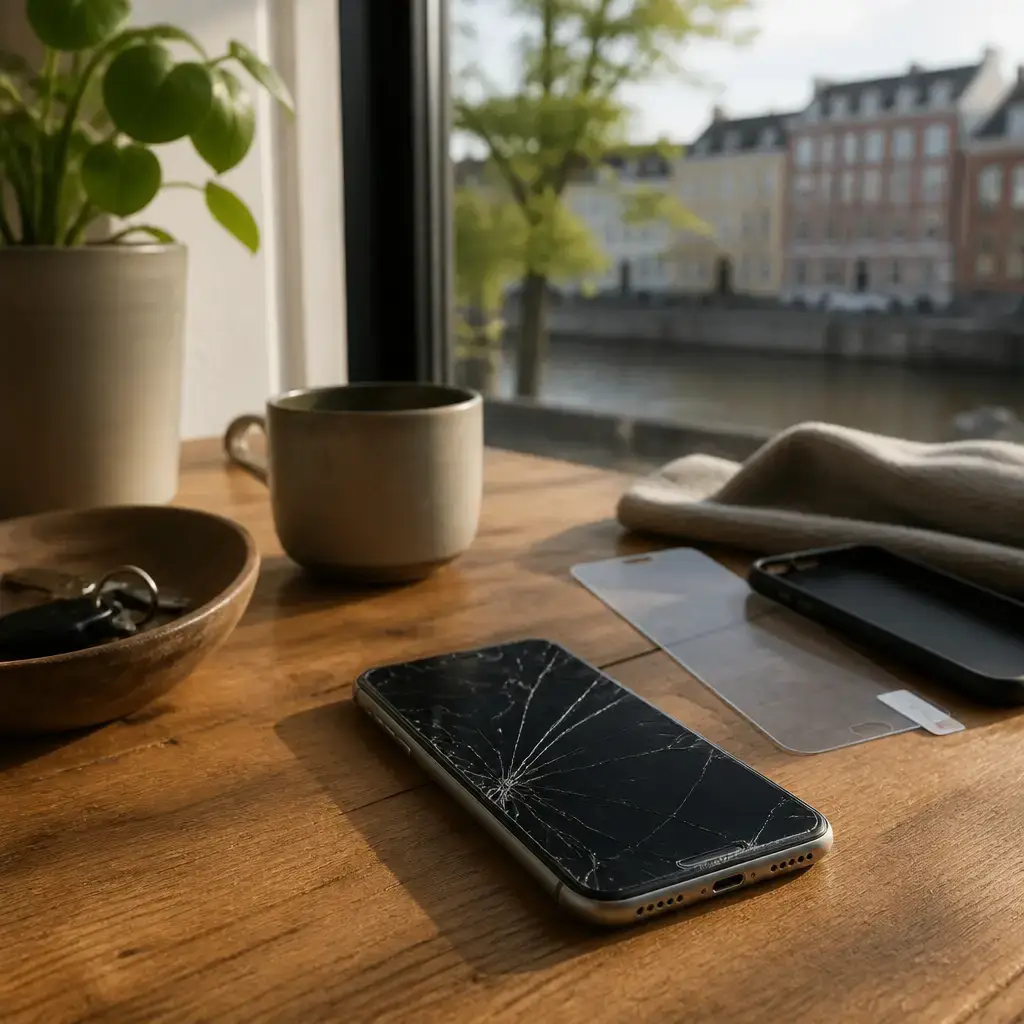
Use Dealing with a Cracked Phone Screen to practice Danish conversation, pronunciation, vocabulary, grammar, and quizzes.
Dialogue
Jeg tabte min telefon, og skærmen er revnet, men den virker stadig.
yai TAB-duh my teh-leh-FOHN, oh SKAIR-men air RAYV-nud, men den VEER-ker STAY-thee. I dropped my phone, and the screen is cracked but still works.Lav en sikkerhedskopi af dine data, før skaden bliver værre.
low en SEE-kuh-hayth-sko-PEE ahv DEE-nuh DAY-tah, fur SKAY-uhn BLEE-wuh VAIR-uh. Back up your data before the damage gets worse.Det gør jeg nu. Det knuste glas gør mig nervøs.
deh gur yai noo. deh KNOO-stuh glass gur my nah-VURS. I will do that now. The broken glass is making me nervous.Sæt en midlertidig skærmbeskytter på, og undgå at trykke hårdt på den.
set en MEED-luh-tee-thee SKAIR-muh-BES-kud-er poh, oh oon-GOH eh TRUK-uh hohrt poh den. Put on a temporary screen protector and avoid pressing hard on it.Skal jeg blive ved med at bruge den, indtil et værksted tjekker den?
skahl yai BLEE-wuh vay meh eh BROO-uh den, in-DEEL et VAREKS-stayth CHEK-er den? Should I keep using it until a repair service checks it?Brug den kun til enkle opgaver, fordi løst glas kan skære dig i fingeren.
broo den koon teel EN-luh OH-pah-vuh, foh-THEE lurst glass kan SKAIR-uh dye ee FENG-uh-ren. Use it only for simple tasks, because loose glass can cut your finger.Jeg kan have den i et etui og bære den forsigtigt.
yai kan HAY-vuh den ee et-oo-EE oh BAIR-uh den for-SIG-tit. I can keep it in a case and carry it carefully.Det burde mindske risikoen, mens du aftaler reparationen.
deh BOO-thuh MIN-skeh ree-SKO-en, mens doo AHF-tay-luh reh-pah-rah-SHOH-nen. That should lower the risk while you arrange the repair.Jeg bestiller en reparation i stedet for at vente.
yai beh-STIL-uh en reh-pah-rah-SHOH-nen ee STAY-theh for eh VEN-tuh. I will book a repair instead of waiting.Små revner kan brede sig, hvis du bliver ved med at bruge telefonen.
smoh RAYV-ner kan BRAY-theh sigh, vis doo BLEE-wuh vay meh eh BROO-uh teh-leh-FOH-nen. Small cracks can spread if you keep using the phone.Sentence explanations
Jeg tabte min telefon, og skærmen er revnet, men den virker stadig.
I dropped my phone, and the screen is cracked but still works.
- Jeg
- I
- tabte
- dropped
- min
- my
- telefon
- phone
- skærmen
- the screen
- revnet
- cracked
- den
- it
- virker
- works
- stadig
- still
More detail
Jeg means “I” here, the first-person singular subject pronoun. It is the form used for the speaker, regardless of the speaker’s gender. Example: Jeg arbejder. — “I work.” tabte is the past-tense form of tabe, meaning “dropped” in this sentence. The verb can also mean “lost” in other contexts, so the intended meaning here comes from the phone context and the fixed translation. The past form marks the dropping as completed. Example: Jeg tabte min nøgle. — “I dropped my key.” min means “my” before a singular common-gender noun. It agrees with the possessed noun, not with the person who possesses it. The corresponding form before a singular neuter noun is mit, and the plural form is mine. Example: min telefon — “my phone”; mit hus — “my house.” telefon means “phone.” In min telefon, it is a singular indefinite-form noun after the possessive; the possessive phrase as a whole identifies the speaker’s phone. Example: Min telefon er her. — “My phone is here.” skærmen means “the screen.” The base noun is skærm; the ending -en marks its singular definite form. Danish commonly places this definiteness ending on the noun itself: en skærm means “a screen,” while skærmen means “the screen.” revnet means “cracked” here. It is the past participle of revne, “to crack” or “split,” and appears with er to describe the screen’s resulting state: skærmen er revnet — “the screen is cracked.” This is distinct from revet, which is a form of rive, “tear” or “rip.” den means “it” here. It is a singular common-gender pronoun. In the intended reading given by the fixed translation, it continues the screen as the thing that still works; skærm is a common-gender noun, so den is the matching form. det is used for a singular neuter referent. Example: Telefonen er ny. Den virker godt. — “The phone is new. It works well.” virker is the present-tense form of virke, meaning “works” or “functions” here. The present form is used for the screen’s current condition. Example: Min computer virker stadig. — “My computer still works.” stadig means “still.” It indicates that the working condition continues despite the screen being cracked. It is an adverb and does not change for gender or number. Example: Hun er stadig hjemme. — “She is still at home.” The sentence first states Jeg tabte min telefon, “I dropped my phone.” og connects that event with skærmen er revnet, “the screen is cracked.” men introduces the contrast: den virker stadig, “it still works.” Together, the utterance says that the speaker dropped their phone, its screen is cracked, but the screen still functions, matching the fixed translation’s intended meaning.
Lav en sikkerhedskopi af dine data, før skaden bliver værre.
Back up your data before the damage gets worse.
- Lav
- make; do
- sikkerhedskopi
- backup
- dine
- your
- data
- data
- før
- before
- skaden
- the damage
- bliver
- gets; becomes
- værre
- worse
More detail
Lav is the imperative of lave, “to make/do.” It addresses one or more people directly and gives a practical instruction. Example: Lav en kopi. — “Make a copy.” sikkerhedskopi means “backup,” specifically a copy kept for safety. With lav en sikkerhedskopi, Danish uses the reusable pattern “make a backup,” not a separate verb meaning “to back up.” Example: Jeg laver en sikkerhedskopi. — “I am making a backup.” dine means “your” before a plural noun. Its form agrees with the possessed noun, not with the person who owns it: din is used with a common-gender singular noun, dit with a neuter singular noun, and dine with a plural noun. Here it modifies data. data means “data.” In this sentence it is the thing being backed up. Example: Mine data er gemt. — “My data are saved.” før means “before” and introduces the condition that should be earlier in time. Here it connects the backup instruction with the later possibility that the damage becomes worse. Example: Ring, før du går. — “Call before you leave.” skaden means “the damage.” The base noun is skade; skaden is its definite singular form, “the damage.” The definite form presents a particular damage situation, which is compatible with the surrounding context. Example: Skaden er stor. — “The damage is extensive.” bliver is the present-tense form of blive, “to become” or “to get.” In bliver værre, it expresses a change of state: the damage gets worse. Example: Vejret bliver bedre. — “The weather is getting better.” værre means “worse,” the comparative form related to dårlig, “bad.” The corresponding positive form is dårlig, and the superlative is værst, “worst.” Here værre compares the damage with its earlier or current condition; the sentence does not state a numerical amount of damage. Together, Lav en sikkerhedskopi af dine data means “Back up your data.” The prepositional phrase af dine data identifies what the backup is made from. før skaden bliver værre adds the time limit: do it before the damage gets worse. The complete utterance is therefore: “Back up your data before the damage gets worse.”
Det gør jeg nu. Det knuste glas gør mig nervøs.
I will do that now. The broken glass is making me nervous.
- Det gør jeg
- I will do that
- nu
- now
- Det
- the
- knuste
- broken
- glas
- glass
- gør
- makes
- mig
- me
- nervøs
- nervous
More detail
Det gør jeg means “I will do that” here. Det is a neuter singular pronoun referring to the action being agreed to, while jeg is the first-person singular subject “I.” Danish places the verb before the subject when another element such as Det comes first: Det gør jeg. Gør is the present-tense form of gøre (“do/make”); Danish present tense can describe an action intended for the immediate future, so the fixed translation uses “will.” Example: Det gør jeg i morgen. — “I will do that tomorrow.” nu means “now” and places the action at the present moment. Together, Det gør jeg nu means “I will do that now.” In Det knuste glas, Det has a different role from the pronoun in the first sentence: it is the neuter singular definite article introducing the noun phrase “the broken glass.” Danish uses det before a singular neuter noun when an adjective stands before the noun, as in det lille hus — “the small house.” knuste is the adjective “broken” here, from knuse (“crush; break”). The underlying participial adjective is knust; knuste is the definite form used after det in this noun phrase. This is not the past-tense form of gøre, and the adjective’s form should not be attributed to glas. Example: det knuste vindue — “the broken window.” glas is a neuter noun meaning “glass.” In this sentence it refers to the broken glass identified by the fixed translation, without requiring a more specific interpretation such as a drinking glass or a pane. With an adjective in a definite noun phrase, Danish commonly keeps the noun in its basic-looking form: det knuste glas. gør appears again, but here it has the “makes” meaning of gøre, not the “do” meaning in the first sentence. A reusable pattern is gøre + object + adjective, meaning “make someone or something [adjective].” mig is the first-person singular object pronoun “me.” It contrasts with jeg, which is the corresponding subject form: Jeg gør ... — “I do ...”; ... gør mig ... — “... makes me ...”. nervøs is the adjective “nervous.” In gør mig nervøs, it describes the state that the glass causes me to have. Example: Det gør mig glad. — “It makes me happy.” The second sentence assembles as Det knuste glas (“the broken glass”) + gør (“makes”) + mig (“me”) + nervøs (“nervous”), giving “The broken glass is making me nervous.” The two occurrences of Det gør are therefore different combinations: the first is “that [I] do,” while the second uses det as the article and gør as “makes.”
Sæt en midlertidig skærmbeskytter på, og undgå at trykke hårdt på den.
Put on a temporary screen protector and avoid pressing hard on it.
- Sæt
- put/place
- midlertidig
- temporary
- skærmbeskytter
- screen protector
- på
- on
- undgå
- avoid
- trykke
- press
- hårdt
- hard
- den
- it
More detail
Sæt is the imperative of sætte, “to put/place.” It gives a direct instruction, addressed to the listener. The imperative does not distinguish singular and plural addressees. Example: Sæt koppen på bordet. — “Put the cup on the table.” midlertidig means “temporary” here. It is an adjective describing skærmbeskytter; its form is compatible with the common-gender singular noun introduced by en. The useful opposite is permanent (“permanent”). skærmbeskytter is a compound noun meaning “screen protector.” Danish compounds are written as one word. Here it is the object being put on. Example: Jeg køber en skærmbeskytter. — “I am buying a screen protector.” på means “on” in this placement pattern. sætte ... på expresses placing something onto or against a target. The target of this placement is not overtly named in the fixed sentence. The indefinite article en introduces an unspecified screen protector; it does not by itself assert a numerical count as a special point. undgå is another imperative, from undgå (“to avoid”). It introduces the action that should not be carried out. Danish commonly uses undgå at followed by an infinitive: Undgå at røre ved glasset. — “Avoid touching the glass.” trykke is the infinitive “to press.” After at, it names the action to avoid. Its base form is also trykke; the form does not show a subject or tense here. Example: Prøv at trykke let. — “Try pressing lightly.” hårdt means “hard” or, with the verb trykke, “forcefully.” It describes how the pressing is done. The corresponding adverb for a gentle action is forsigtigt (“carefully/gently”) in a suitable context. Example: Tryk ikke hårdt. — “Do not press hard.” den is the singular common-gender object pronoun “it.” It marks the pronoun’s grammatical class and object role, but this form alone does not identify what it refers to. In the fixed sentence, the translation supports the general meaning “it”; the exact referent need not be named to understand the instruction. Together, Sæt en midlertidig skærmbeskytter på gives the placement instruction “Put on a temporary screen protector”; the target onto which it is placed is not overtly stated in the target-language sentence. og undgå at trykke hårdt på den adds the coordinated instruction “and avoid pressing hard on it.” The complete utterance is therefore: “Put on a temporary screen protector and avoid pressing hard on it.”
Skal jeg blive ved med at bruge den, indtil et værksted tjekker den?
Should I keep using it until a repair service checks it?
- Skal jeg
- Should I…?
- blive ved med at bruge
- keep using
- den
- it
- indtil
- until
- et værksted
- a repair service
- tjekker
- checks
- den
- it
More detail
Skal jeg begins a yes/no question. skal is the present form of skulle, used here for “should” or asking what is advisable; jeg is the first-person singular subject. In a question, the finite verb comes before the subject: Skal jeg ...? means “Should I ...?” blive ved med at bruge is a reusable construction meaning “keep using” or “continue to use.” blive is the infinitive after skal; bruge is also an infinitive after at. The pattern blive ved med at + infinitive can be reused with another action, for example: Hun bliver ved med at ringe. — “She keeps calling.” den is a singular common-gender object pronoun, meaning “it” here. The translation and surrounding context identify it as the object being used and checked; the form itself marks neither a person nor a specific object by itself. The same form appears again later because the object remains the one being checked. indtil introduces the endpoint of the continued action: “until.” It is followed here by a clause, et værksted tjekker den, rather than by a bare noun. et værksted means “a workshop” or, in this context, “a repair service.” værksted is a neuter noun, which is why the indefinite article is et rather than en. The article does not by itself assert a numerical count; it presents the service as an indefinite singular referent. tjekker means “checks” here. Its base form is tjekke, and tjekker is the present-tense form. Danish present-tense verbs generally do not change according to the subject’s person or number, so the same form can occur with jeg, du, or de; the subject in this clause is et værksted. The final den is the object of tjekker, again referring to the item identified by the fixed translation and context. Thus et værksted tjekker den means “a repair service checks it.” Taken together, Skal jeg asks for advice, blive ved med at bruge den asks whether continued use should continue, and indtil et værksted tjekker den sets the stopping point. The whole utterance therefore means: “Should I keep using it until a repair service checks it?”
Brug den kun til enkle opgaver, fordi løst glas kan skære dig i fingeren.
Use it only for simple tasks, because loose glass can cut your finger.
- Brug
- use
- den
- it
- kun
- only
- enkle
- simple
- opgaver
- tasks
- fordi
- because
- løst
- loose
- glas
- glass
- kan
- can
- skære
- cut
- dig
- you
- fingeren
- finger
More detail
Brug is the imperative of bruge (“to use”). It addresses an understood singular “you”: Brug ... means “Use ...”. Compare the ordinary present form bruger: Jeg bruger den means “I use it.” den is the singular common-gender object pronoun “it” here. The fixed translation and context identify it as the item being used, kept, checked, and carried; Danish pronouns must match the grammatical properties of their referents, but this form itself does not name the item. kun means “only” and limits the permitted use: use it for simple tasks, and not for other tasks. enkle is the plural form of the adjective enkel, “simple.” It agrees with the plural noun opgaver; the adjective’s relevant chain is enkel (singular), enkelt (neuter singular), enkle (plural or definite). opgaver is the plural of opgave, “task.” For example, Det er en enkel opgave means “It is a simple task.” fordi introduces the reason clause “because.” It links the instruction to the reason that follows. The word itself does not mean “therefore”; it marks the reason rather than the result. løst is the neuter singular form of løs, “loose.” It agrees with glas, which is neuter here: løs, løst, løse correspond to common-gender singular, neuter singular, and plural/definite forms. In this sentence, løst glas means loose glass, as in glass that can move or be exposed rather than securely held. glas means “glass” here as a material. Danish uses the same visible form in some number contexts, so the form alone does not establish a numeric count. The fixed translation supports the material reading in this sentence rather than a drinking vessel. kan is the modal verb “can” and is unchanged for person and number. It is followed directly by the infinitive skære, without at: kan skære means “can cut.” Skære is the infinitive of “to cut”; after a modal, the infinitive states the possible action. For example, Glas kan skære means “Glass can cut.” dig is the object form of “you.” It is the person affected by the cutting, not the grammatical subject: the loose glass is the possible cutter, and “you” are the person it can cut. Compare the subject form du: Du kan skære dig means “You can cut yourself.” fingeren is finger (“finger”) with the definite singular ending -en, literally “the finger.” In the fixed translation, the affected finger is understood as the listener’s, giving “your finger.” The phrase skære dig i fingeren expresses cutting you in the finger; i marks the location of the injury. Together, Brug den kun til enkle opgaver gives “Use it only for simple tasks.” The following fordi clause gives the reason: løst glas kan skære dig i fingeren means “loose glass can cut your finger.” The whole utterance is therefore: “Use it only for simple tasks, because loose glass can cut your finger.”
Jeg kan have den i et etui og bære den forsigtigt.
I can keep it in a case and carry it carefully.
- Jeg kan
- I can
- have
- keep; have
- den
- it
- i
- in
- etui
- case
- bære
- carry
- forsigtigt
- carefully
More detail
Jeg kan gives the reusable pattern “I can …”. kan is the present form of kunne and expresses ability or possibility here. After kan, the next verb stays in the infinitive: Jeg kan bære den = “I can carry it.” The subject form Jeg means “I”; it is not changed for grammatical gender. have means “keep” in this sentence: the speaker can keep the item in a case. It is the infinitive of have, used after kan. Danish have can also mean “have” in the possession sense, so the surrounding words determine the intended meaning here. den is the Danish common-gender singular object pronoun, meaning “it” here. It refers to the item understood from the fixed translation and context, while etui is the place where it can be kept; the pronoun’s form itself does not identify the item by name. A neuter singular object pronoun is det, but den is the form used for this referent here. i means “in” and introduces the location. In i et etui, it tells where the item is kept. etui is a noun meaning “case”. Its indefinite form is et etui: et is the indefinite article used with this noun, and it does not by itself state a numerical count. A useful pattern is i et + noun, meaning “in a [neuter noun]”. bære means “carry”. It is the infinitive used after the modal kan, so kan bære means “can carry”. The two verbs are separate actions joined by og: the speaker can have the item in a case and can bære it carefully. forsigtigt means “carefully” here and modifies bære, describing how the carrying is done. It is also the form used for a neuter singular adjective, but in this sentence it functions adverbially. The related adjective form forsigtig means “careful”, as in Hun er forsigtig — “She is careful.” Together, Jeg kan have den i et etui means “I can keep it in a case”. og bære den forsigtigt adds a second coordinated action: “and carry it carefully”. The complete utterance is therefore “I can keep it in a case and carry it carefully.”
Det burde mindske risikoen, mens du aftaler reparationen.
That should lower the risk while you arrange the repair.
- Det
- that; it
- burde
- should; ought to
- mindske
- lower; reduce
- risikoen
- the risk
- mens
- while
- du
- you
- aftaler
- arrange
- reparationen
- the repair
More detail
Det means “that” here and is the subject of the first clause, matching the fixed translation. As a Danish pronoun, this form is used for a neuter singular referent; the specific referent is not named in this sentence. burde expresses “should” or “ought to.” It is a modal verb, and the following verb remains in the infinitive: burde mindske = “should reduce.” A useful contrast is skal (“must/is going to”), which generally expresses a stronger requirement or expectation than burde. mindske means “to reduce” or “to lower.” This is the infinitive form selected after burde. Example: Det kan mindske støjen. — “That can reduce the noise.” risikoen means “the risk.” The base noun is risiko; risikoen is its singular definite form, “the risk.” The ending belongs to the noun, not to the preceding verb. Example: Risikoen er lille. — “The risk is small.” mens introduces a simultaneous subordinate clause and means “while.” It connects the main event with an action happening at the same time. du is the second-person singular pronoun “you,” used here as the subject of the subordinate clause. In contemporary Danish, du is the ordinary form for addressing one person; De is a formal alternative in contexts where that distinction is maintained. The sentence itself does not establish anything about the listener beyond the intended second-person reference. aftaler means “arrange” here. It is the present-tense form of aftale; Danish verbs do not change form for the subject, so the same present form can occur with other subjects as well as du: du aftaler = “you arrange.” Aftale can also mean “agree” or “make an appointment,” but “arrange” is the sense supported by the fixed translation in this sentence. reparationen means “the repair.” The base noun is reparation; reparationen is its singular definite form. The definite ending marks a particular repair understood in the situation, rather than introducing the noun as indefinite. Together, Det burde mindske risikoen means “That should lower the risk.” Mens du aftaler reparationen adds the simultaneous activity “while you arrange the repair.” The complete utterance therefore means: “That should lower the risk while you arrange the repair.”
Jeg bestiller en reparation i stedet for at vente.
I will book a repair instead of waiting.
- Jeg
- I
- bestiller
- book; order
- reparation
- repair
- i stedet for at
- instead of
- vente
- wait
More detail
Jeg means “I” and is the first-person singular subject pronoun. It identifies the speaker as the person carrying out the action. Example: Jeg venter. — “I am waiting.” bestiller is the present-tense form of bestille, “to order” or “to book.” In this sentence, the intended action is booking a repair. Danish present tense can also describe a planned or imminent action, so the fixed translation’s “will book” fits the context; the form itself is present tense, not a separate future form. Example: Jeg bestiller en tid. — “I am booking an appointment.” reparation is a noun meaning “repair.” Its base form is reparation; with the indefinite article, Danish uses en reparation. The noun refers here to the repair being booked, consistent with the surrounding context about arranging a repair. Example: En reparation kan tage tid. — “A repair can take time.” i stedet for at is a reusable pattern meaning “instead of” before an infinitive clause. The following at marks the infinitive vente, so the pattern contrasts booking the repair with waiting. Example: Hun ringer i stedet for at skrive. — “She calls instead of writing.” vente is the infinitive form of the verb meaning “to wait.” After i stedet for at, it appears as at vente; it is not inflected for the speaker in this construction. Example: Vi vælger at vente. — “We choose to wait.” Together, Jeg bestiller en reparation means “I book a repair,” and i stedet for at vente contrasts that action with waiting. The complete utterance therefore means: “I will book a repair instead of waiting.”
Små revner kan brede sig, hvis du bliver ved med at bruge telefonen.
Small cracks can spread if you keep using the phone.
- Små
- small
- revner
- cracks
- kan
- can
- brede sig
- spread
- hvis
- if
- bliver ved med at
- keep on
- bruge
- use
- telefonen
- the phone
More detail
Små means “small” here and is the plural form of lille. It agrees with the plural noun revner; små is also used with definite plural nouns. Revner means “cracks” and is the plural of revne. The phrase små revner therefore means “small cracks.” Example: En revne bliver større. — “A crack becomes bigger.” Kan expresses ability or possibility: “can.” It is the present-tense form of kunne and does not change for the subject. After kan, the next verb appears in the infinitive: kan brede sig — “can spread.” Brede sig means “spread” or “expand.” Brede is the infinitive, and sig is the reflexive element belonging to this construction. Together they describe something extending or becoming wider, rather than someone spreading another object. Example: Ilden kan brede sig. — “The fire can spread.” Hvis introduces a condition and means “if.” It connects the possible result to the condition that follows: hvis ... — “if ...”. Bliver ved med at is a reusable construction meaning “keep on” or “continue to.” It contains the present form bliver of blive and is followed by med at plus an infinitive. Here, the continuing activity is supplied by bruge. Bruge is the infinitive “use.” With bliver ved med at, it means continuing to use something: du bliver ved med at bruge ... — “you keep using ...”. Example: Hun bliver ved med at læse. — “She keeps reading.” Telefonen means “the phone.” It is the definite singular form of telefon: en telefon — “a phone,” telefonen — “the phone.” The definite ending identifies the phone as a particular one in the situation; it does not itself state how many phones there are. Taken together, Små revner kan brede sig says that small cracks can spread. Hvis du bliver ved med at bruge telefonen gives the condition: if you continue using the phone. The complete meaning is: “Small cracks can spread if you keep using the phone.”
Grammar Points
blive ved med at + infinitiv
Telefonen bliver ved med at virke.
teh-leh-FOH-nen BLEE-wuh vay meh eh VEER-kuh.The phone keeps working.
Efter blive ved med at står verbet i infinitiv. Udtrykket viser, at en handling fortsætter.
i stedet for at + infinitiv
Bestil reparation i stedet for at vente.
beh-STIL reh-pah-rah-SHOHN ee STAY-theh for eh VEN-tuh.Order a repair instead of waiting.
i stedet for at bruges til at sammenligne to handlinger. Verbet efter at står i infinitiv.
Danish Vocabulary
- Gender
- common
- Gender
- common
- Gender
- common
Jeg tabte min telefon.
- Gender
- common
Quiz
Spelling
Tap the letters to spell the word.
to work; to function
Show Answer
virkercracked
Show Answer
revnetdata
Show Answer
datastill