10 minutes free every day
Continue audio lessons in the app
Word explanations appear automatically in sync with the audio.
No login required · synced translations · playback with the screen locked
Choose your learning language and open this lesson in the app.

About This Lesson
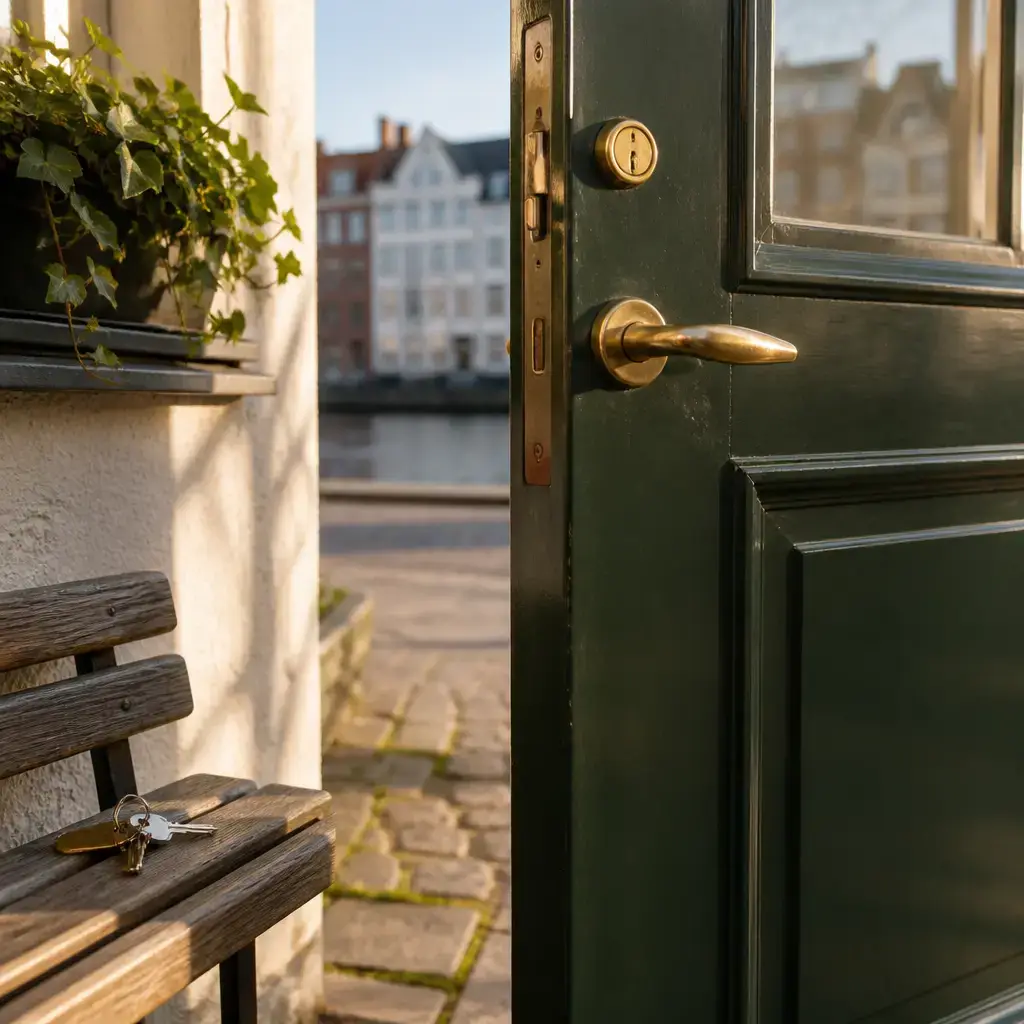
Use Making a plan after being locked out to practice Danish conversation, pronunciation, vocabulary, grammar, and quizzes.
Dialogue
Jeg er låst ude, og min ekstranøgle ligger inde i lejligheden.
yai er LOST OO-theh, uh meen EK-strah-NUR-luh LIG-uh EN-uh ee LIE-lee-heh-en. I am locked out, and my spare key is inside the apartment.Prøv først at kontakte udlejeren.
PRURV FURST uhd kun-TAHG-duh oo-TH-LIE-er-en. Try the landlord first.Ring derefter efter en låsesmed, hvis du ikke snart kan få hjælp.
RENG DAY-uh-EF-duh EF-ter en LOH-suh-SMEH-th, ves doo IG-uh SNAHD ken foh YELB. Then call a locksmith if you cannot get help soon.Jeg har lagt en besked, men udlejeren har ikke svaret endnu.
yai hair LAHGD en beh-SKAY-th, men oo-TH-LIE-er-en hair IG-uh SVAH-uh-th EN-noo. I left a message, but the landlord has not replied yet.Vent lidt endnu, medmindre du har brug for at komme ind med det samme.
VEN(T) lit EN-noo, meh-MEN-uh doo hair BROO foh uhd KUM-uh EN meh deh SAH-muh. Wait a little longer unless you need to get in right away.Jeg skal måske bevise, at jeg bor her, hvis der kommer nogen for at hjælpe.
yai skel MOHS-kuh beh-VEE-suh, uhd yai bohr hair, ves dair KUM-uh NOH-en foh uhd YEL-buh. I may need to prove I live here if someone comes to help.Hav din legitimation klar, og vent et varmt sted.
HAH din leh-gee-tee-mah-SHOWN klah, uh VEN(T) et vahmd STAY-th. Keep your identification ready and wait in a warm place.Jeg vil ikke ringe efter en låsesmed, medmindre det er nødvendigt.
yai vel IG-uh RENG EF-ter en LOH-suh-SMEH-th, meh-MEN-uh deh air nur-th-VEN. I do not want to call a locksmith unless it is necessary.Hvis udlejeren stadig ikke svarer, så ring efter en låsesmed og forklar situationen.
ves oo-TH-LIE-er-en STAI-lee IG-uh SVAH-er, soh RENG EF-ter en LOH-suh-SMEH-th uh fuh-KLAH-uh see-too-ah-SHOWN. If the landlord still does not reply, call one and explain the situation.Jeg kan sidde i lobbyen og have min telefon tændt.
yai ken SEDH-uh ee LOH-bee-en uh HAH-veh meen teh-leh-FOHN TENT. I can sit in the lobby and keep my phone on.Du kan holde dig varm der, mens du giver udlejeren lidt mere tid.
doo ken HOL-uh sai VAHM dair, mens doo GEE-vuh oo-TH-LIE-er-en lit MAIR TEEDH. You can stay warm there while you give the landlord a little more time.Sentence explanations
Jeg er låst ude, og min ekstranøgle ligger inde i lejligheden.
I am locked out, and my spare key is inside the apartment.
- Jeg er
- I am
- låst ude
- locked out
- min
- my
- ekstranøgle
- spare key
- ligger
- lies / is located
- inde i
- inside
- lejligheden
- the apartment
More detail
Jeg er means “I am”: jeg is the first-person singular pronoun, and er is the present-tense form of være (“to be”). The same form er is also used with other singular and plural subjects in the present: Hun er hjemme means “She is at home.” låst ude means “locked out” here. låst is the past participle of låse (“to lock”), and with er it describes the speaker’s resulting situation; ude adds the idea of being outside. The combination være låst ude is a reusable way to say that someone cannot get in because they are locked out. Example: Han er låst ude — “He is locked out.” min means “my” before a singular common-gender noun. It agrees with the possessed noun, not with the speaker: min nøgle means “my key,” while a neuter singular noun uses mit, as in mit hus (“my house”). ekstranøgle means “spare key.” It is a compound noun: ekstra means “extra/spare,” and nøgle means “key.” Danish commonly writes such noun compounds as one word. Example: Jeg har en ekstranøgle — “I have a spare key.” ligger means “lies” or, more naturally in this context, “is located.” It is the present-tense form of ligge (“to lie; be situated”). Danish uses ligge for the location of something that is resting in a place. Example: Bogen ligger på bordet — “The book is on the table.” inde i means “inside” or “in.” inde specifies an interior location, and i introduces the place. Example: Nøglen ligger inde i tasken — “The key is inside the bag.” lejligheden means “the apartment.” lejlighed is the noun “apartment,” and the ending -en marks singular definite form: lejligheden = “the apartment.” The indefinite singular is en lejlighed = “an apartment.” Together, Jeg er låst ude says that the speaker is locked out. min ekstranøgle identifies the speaker’s spare key, and ligger inde i lejligheden says that this key is located inside the apartment. The whole utterance therefore means: “I am locked out, and my spare key is inside the apartment.”
Prøv først at kontakte udlejeren.
Try the landlord first.
- Prøv
- try
- først
- first
- kontakte
- contact
- udlejeren
- the landlord
More detail
Prøv means “try” here. It is the imperative of prøve (“to try”): prøv addresses one or more people directly and gives advice or an instruction. A useful pattern is Prøv at + infinitive, meaning “try to …”. Example: Prøv at ringe. — “Try calling.” først means “first” and places this action before another possible action in the sequence. In this utterance, it applies to trying to contact the landlord; the later context presents calling a locksmith as a subsequent option. Example: Spis først. — “Eat first.” kontakte means “to contact” and is the infinitive after at in Prøv at kontakte. The same verb can be used for contacting a person or an organization: Jeg vil kontakte lægen. — “I want to contact the doctor.” udlejeren means “the landlord” here. udlejer is the noun “landlord,” and udlejeren is its singular definite form, formed with the definite ending -en. The definite form presents the landlord as a specific person known or identifiable in the situation; it does not itself state the landlord’s gender. Together, Prøv at kontakte udlejeren means “try to contact the landlord.” With først, the complete utterance is: “Try to contact the landlord first.” It is a direct piece of advice or an instruction, with the landlord as the person to contact and this action placed before the later suggested option.`
Ring derefter efter en låsesmed, hvis du ikke snart kan få hjælp.
Then call a locksmith if you cannot get help soon.
- Ring
- call
- derefter
- then; afterwards
- en låsesmed
- a locksmith
- hvis
- if
- du
- you
- ikke
- not
- snart
- soon
- kan
- can
- få
- get; receive
- hjælp
- help
More detail
Ring is the imperative of ringe, “to call.” The imperative addresses the listener directly and gives an instruction. In Danish, the imperative is often formed from the verb stem: ringe → ring. Example: Ring til lægen. — “Call the doctor.” derefter means “then” or “afterwards” and places this action after an earlier action. It is an adverb, so it does not change for person or number. Example: Prøv igen derefter. — “Try again afterwards.” en låsesmed means “a locksmith.” låsesmed is a compound noun: lås refers to a lock and smed to a smith or metalworker, but the compound functions as one noun meaning “locksmith.” The form en is the indefinite article used with this noun; here it introduces the locksmith as a type of service provider and does not by itself assert a numeric count. Example: Jeg ringer efter en låsesmed. — “I am calling a locksmith.” hvis introduces a condition and means “if.” The clause after it states the condition under which the instruction applies. Example: Ring, hvis du har brug for hjælp. — “Call if you need help.” du is the second-person singular subject pronoun, “you.” It identifies the person being addressed in this sentence. Danish uses du for one informal or neutral addressee; the form itself does not indicate the addressee’s gender. ikke is the ordinary negation word “not.” Here it negates the ability expressed by kan få: the condition is that the addressee cannot get help soon. Its exact effect comes from its combination with the following verb phrase, rather than from ikke alone. snart means “soon,” referring to a short time from the relevant moment. It is an adverb and does not inflect. Example: Hun kommer snart. — “She is coming soon.” kan is the present-tense form of the modal verb kunne, “can; be able to.” Danish modal verbs are followed by an infinitive without at: kan få means “can get” or “is able to get.” Example: Du kan vente her. — “You can wait here.” få is the infinitive of the verb få, which has several uses; here it means “get” or “obtain” help. After kan, it remains in the infinitive form. The same verb can also mean “receive” in suitable contexts, but the fixed sentence concerns obtaining assistance. Example: Jeg vil få hjælp. — “I will get help.” hjælp is a noun meaning “help” or “assistance.” In this expression, få hjælp is a useful pattern meaning “get help” or “receive assistance.” Example: De søger hjælp. — “They are seeking help.” Together, Ring derefter means “Then call,” and en låsesmed supplies the person to call. The conditional clause hvis du ikke snart kan få hjælp means “if you cannot get help soon”: du is the subject, ikke negates the modal phrase, kan expresses ability, and få hjælp expresses obtaining assistance. The complete utterance is therefore: “Then call a locksmith if you cannot get help soon.”
Jeg har lagt en besked, men udlejeren har ikke svaret endnu.
I left a message, but the landlord has not replied yet.
- Jeg har
- I have
- lagt
- left
- besked
- message
- men
- but
- udlejeren
- the landlord
- ikke
- not
- svaret
- replied
- endnu
- yet
More detail
Jeg har means “I have” here and begins a Danish perfect construction. The subject is jeg (“I”), and har is the present form of have. With a past participle, har helps express a completed action viewed as relevant to the present. lagt is the past participle of lægge (“to put/place”). In lagt en besked, the fixed meaning is “left a message”; this is a useful way to describe leaving a message. The main forms are lægge (base form) – lagde (past tense) – lagt (past participle). Example: Jeg lagde en besked. — “I left a message.” besked means “message.” In en besked, en is the indefinite article and besked is an indefinite singular noun. The article marks the noun as indefinite; it does not by itself assert a numerical count as a separate piece of information. men means “but” and links the first statement with a contrasting one. udlejeren means “the landlord.” It is the definite singular form of udlejer (“landlord”): udlejer → udlejeren. The ending -en marks the definite form for this noun. Example: Udlejeren svarer. — “The landlord replies.” ikke is the ordinary Danish negation “not.” In har ikke svaret, it makes the clause negative: the landlord has not replied. svaret is the past participle of svare (“reply”). The form chain is svare – svarede – svaret. Together with har, it forms the perfect har svaret (“has replied”). Example: Hun har svaret. — “She has replied.” endnu means “yet” in this sentence. With negation, ikke ... endnu says that something has not happened up to the relevant time: har ikke svaret endnu means “has not replied yet.” The first clause, Jeg har lagt en besked, states that I have left a message. men introduces the contrast. The second clause, udlejeren har ikke svaret endnu, states that the landlord has not replied yet. Together: “I left a message, but the landlord has not replied yet.”
Vent lidt endnu, medmindre du har brug for at komme ind med det samme.
Wait a little longer unless you need to get in right away.
- Vent
- wait
- lidt endnu
- a little longer
- medmindre
- unless
- du har brug for
- you need
- at komme ind
- to get in
- med det samme
- right away
More detail
Vent is the imperative of vente (“to wait”). It directly tells the listener to wait; the subject is understood as “you.” Compare vente (infinitive) with Vent! (command). Example: Vent her. — “Wait here.” lidt endnu adds duration: lidt means “a little,” while endnu here means “still” or “longer.” Together they mean that the waiting should continue for a short additional time. Endnu also appears in Jeg venter endnu. — “I am still waiting.” medmindre introduces the exception “unless.” The general instruction is stated first, and the condition that cancels or limits it follows. Example: Jeg kommer, medmindre jeg bliver syg. — “I will come unless I get sick.” du har brug for is the reusable Danish pattern have brug for (“need”). In this sentence, du is the second-person singular subject and har is the present form of have; brug for belongs to the fixed expression, so it is not best understood as a literal quantity of “use.” Example: Jeg har brug for hjælp. — “I need help.” at komme ind is an infinitive phrase meaning “to get in.” at marks the infinitive, komme is the infinitive of “come/get,” and ind indicates movement inward. Example: Hun prøver at komme ind. — “She is trying to get in.” med det samme is a fixed expression meaning “right away” or “immediately.” Here it modifies komme ind, so the getting in is to happen immediately if it is needed. Example: Ring med det samme. — “Call right away.” Taken together, Vent lidt endnu gives the main instruction: “Wait a little longer.” medmindre then introduces the exception, du har brug for at komme ind med det samme: “unless you need to get in right away.” The complete meaning is therefore: “Wait a little longer unless you need to get in right away.”
Jeg skal måske bevise, at jeg bor her, hvis der kommer nogen for at hjælpe.
I may need to prove I live here if someone comes to help.
- Jeg skal
- I need to / I am to
- måske
- maybe
- bevise
- prove
- bor
- live
- her
- here
- hvis
- if
- kommer
- comes
- nogen
- someone
- for at
- in order to
- hjælpe
- help
More detail
Jeg skal contains the subject pronoun jeg (“I”) and the present-tense modal verb skal, whose base form is skulle. In this sentence, the fixed translation gives it the meaning “need to / may have to,” rather than a simple future reading. Skal is followed by an infinitive: Jeg skal vente means “I need to wait.” måske is an adverb meaning “maybe” or “perhaps.” Its position after Jeg skal makes the need or obligation uncertain: the speaker may need to do the action. bevise is the infinitive of bevise, “to prove.” After skal, Danish uses the infinitive without at: Jeg skal bevise ... means “I need to prove ...”. bor is the present form of bo, “to live.” Danish present-tense verbs do not change for the subject’s person or number, so jeg bor uses the same verb form as, for example, de bor (“they live”). In at jeg bor her, the subject jeg comes before the finite verb bor, as is normal in this subordinate clause. Example: Jeg bor her. — “I live here.” her is the place adverb “here.” Together, jeg bor her means “I live here”; it identifies the place from the speaker’s viewpoint without naming that place. hvis introduces a condition and means “if.” The clause beginning with it gives the condition under which the main situation may occur. Example: Hvis det regner, bliver jeg hjemme. — “If it rains, I stay home.” kommer is the present form of komme, “to come.” As with bor, the present form does not change for person or number in Danish. Here it appears in the conditional clause after hvis: hvis nogen kommer means “if someone comes.” nogen is an indefinite pronoun meaning “someone” in this affirmative context. It does not identify who the person is. Example: Nogen ringer. — “Someone is calling.” for at hjælpe expresses purpose: “in order to help.” Hjælpe is the infinitive of hjælpe, “to help,” and for at is followed by that infinitive. The understood person who helps is the person introduced by nogen: someone comes with the purpose of helping. Example: Hun kommer for at hjælpe. — “She comes to help.” Putting the parts together, Jeg skal måske bevise means “I may need to prove,” at jeg bor her specifies what must be proved, and hvis der kommer nogen for at hjælpe adds the condition “if someone comes to help.” The complete utterance is therefore: “I may need to prove I live here if someone comes to help.”
Hav din legitimation klar, og vent et varmt sted.
Keep your identification ready and wait in a warm place.
- Hav
- have
- din
- your
- legitimation
- identification
- klar
- ready
- vent
- wait
- varmt
- warm
- sted
- place
More detail
Hav is the imperative of have (“to have”). Here, with din legitimation klar, it contributes to the instruction “keep your identification ready.” The present form is har, as in Du har legitimationen (“You have the identification”). din means “your” before a singular common-gender noun. It agrees with the possessed noun, not with the possessor: din legitimation uses din, while a neuter noun takes dit, as in dit sted (“your place”). legitimation means “identification” or “ID” here. Its indefinite singular form is en legitimation; the definite form is legitimationen (“the identification”). klar means “ready” in this sentence. It describes the state of legitimation in the construction have something ready. With a common-gender singular noun, the form is klar; with a neuter singular noun, it is klart. For example, Dokumentet er klart means “The document is ready.” vent is the imperative of vente (“to wait”). The present form is venter, as in Du venter her (“You wait here” or “You are waiting here”). varmt means “warm.” It is the neuter singular form of varm, because it describes the neuter noun sted. The common-gender form is varm, as in en varm dag (“a warm day”). sted means “place.” It is a neuter noun, shown by the article et: et sted (“a place”). Its definite form is stedet (“the place”). The first instruction combines the imperative Hav with the object din legitimation and the adjective klar: Hav ... klar means “keep ... ready” in this context. The conjunction og means “and” and links the two instructions. In the second instruction, vent gives the command to wait, while et varmt sted identifies the location understood in the fixed translation as “a warm place.” The source wording contains no i, so it should not be presented as though that preposition were present. Together, Hav din legitimation klar, og vent et varmt sted. means “Keep your identification ready and wait in a warm place.”
Jeg vil ikke ringe efter en låsesmed, medmindre det er nødvendigt.
I do not want to call a locksmith unless it is necessary.
- Jeg vil ikke
- I do not want to
- ringe efter
- call for
- låsesmed
- locksmith
- medmindre
- unless
- nødvendigt
- necessary
More detail
Jeg vil ikke expresses “I do not want to.” vil is the present form of ville, which here means “want” and is followed by an infinitive. ikke negates the wanting. This construction is reusable: Jeg vil ikke vente. — “I do not want to wait.” ringe efter means “call for” someone or something. ringe is the infinitive of “to call”; efter is part of this expression and signals that the call is made to obtain the person or service. The object can follow: Hun ringer efter en læge. — “She is calling for a doctor.” låsesmed is the noun “locksmith.” It is a compound word: lås means “lock” and smed means “smith,” but låsesmed should be learned as the ordinary word for this service provider. In the sentence, en låsesmed means “a locksmith”; the indefinite article does not by itself assert a numerical count. medmindre introduces the condition “unless.” It connects the main statement with the condition that would make it different. A reusable pattern is Jeg gør ikke X, medmindre ... — “I do not do X unless ...” nødvendigt means “necessary” in det er nødvendigt, literally “it is necessary.” The form nødvendigt is the neuter form of the adjective nødvendig, selected because the subject det is neuter in this impersonal expression. The adjective is not an inflection of det. For comparison, Det er nødvendigt. means “It is necessary,” while Det er ikke nødvendigt. means “It is not necessary.” Together, Jeg vil ikke ringe efter en låsesmed means “I do not want to call for a locksmith.” medmindre det er nødvendigt adds the exception “unless it is necessary.” The complete utterance therefore means: “I do not want to call a locksmith unless it is necessary.”
Hvis udlejeren stadig ikke svarer, så ring efter en låsesmed og forklar situationen.
If the landlord still does not reply, call one and explain the situation.
- Hvis
- if
- udlejeren
- the landlord
- stadig
- still
- ikke
- not
- svarer
- replies
- så
- then
- ring efter
- call for
- låsesmed
- locksmith
- forklar
- explain
- situationen
- the situation
More detail
Hvis introduces a condition: “if …”. It commonly begins a conditional clause. Example: Hvis du har tid, så ring. — “If you have time, then call.” udlejeren means “the landlord” here. The noun is udlejer (“landlord”); udlejeren is its definite singular form, with -en marking “the” for this noun. Example: Jeg taler med udlejeren. — “I am speaking with the landlord.” stadig means “still”: the situation continues to hold at the relevant time. It is different from igen, which means “again” and describes repetition. ikke negates the following proposition. Here it makes udlejeren svarer mean “the landlord does not reply.” svarer is the present-tense form of svare, “to reply” or “to answer.” In this sentence, the subject is udlejeren, so the form describes that the landlord still does not reply. Example: Hun svarer ikke. — “She does not reply.” så means “then” in this conditional pattern. Together, Hvis ..., så ... gives the reusable structure “If ..., then ...”. Danish can also omit så in some conditional sentences, but it is present here and clearly links the condition to the instruction. ring efter is a reusable construction meaning “call for” someone or something, usually by telephone when requesting that person or service. The verb is ringe; ring is its imperative form. Danish imperative forms do not mark a singular-versus-plural addressee distinction here. This is distinct from simply ringe til, which commonly means “call” a person or number without the same “call for/request” emphasis. Example: Ring efter en læge. — “Call for a doctor.” låsesmed means “locksmith.” The phrase uses en låsesmed, an indefinite singular noun phrase: “a locksmith.” The noun itself is låsesmed; the article en marks the noun phrase as indefinite, not a stated numerical count. forklar is the imperative form of forklare, “to explain.” It gives the instruction “explain,” with the understood addressee as the person being addressed. Example: Forklar problemet. — “Explain the problem.” situationen means “the situation.” Its base noun is situation; situationen is the definite singular form, with -en marking “the.” The full structure is Hvis + condition (udlejeren stadig ikke svarer) + så + instructions (ring efter en låsesmed and forklar situationen). Thus the utterance means: “If the landlord still does not reply, call a locksmith and explain the situation.” The two imperative verbs are coordinated, so both instructions apply under the stated condition.
Jeg kan sidde i lobbyen og have min telefon tændt.
I can sit in the lobby and keep my phone on.
- Jeg kan
- I can
- sidde
- sit
- lobbyen
- the lobby
- have
- have
- telefon
- phone
- tændt
- on
More detail
Jeg kan combines the pronoun jeg (“I”) with kan, the present-tense form of kunne (“can; be able to”). With kan, the following verb stays in the infinitive without at: Jeg kan sidde means “I can sit.” This expresses ability or possibility here, not a command. Example: Jeg kan komme i morgen. — “I can come tomorrow.” sidde means “sit” and describes being in a seated position. Its contrast with sætte sig is useful: Jeg sidder på stolen. — “I am sitting on the chair”; Jeg sætter mig på stolen. — “I sit down on the chair.” In the fixed sentence, sidde is the infinitive required after kan. lobbyen means “the lobby.” The noun is lobby; the ending -en marks the definite singular form: en lobby — “a lobby,” lobbyen — “the lobby.” Here it follows i, so i lobbyen means “in the lobby.” have is the infinitive of har (“have”). In have min telefon tændt, it does more than indicate possession: it forms the pattern have + object + adjective/participle to describe the object’s maintained state. Thus have ... tændt means “keep ... switched on.” Example: Jeg har døren lukket. — “I keep the door closed.” telefon means “phone.” In the fixed phrase, min means “my” and comes before the noun: min telefon — “my phone.” Because telefon is a common-gender singular noun, the possessive is min; the possessive itself supplies the determiner, so the noun is not preceded by an indefinite article. tændt means “switched on” here. It is the participle/adjectival form related to tænde (“switch on, turn on”), and it describes the state of telefon after have: have min telefon tændt — “keep my phone switched on.” The form is tændt with both common-gender and neuter singular nouns; the plural form is tændte. Example: Lyset er tændt. — “The light is on.” Taken together, Jeg kan sidde i lobbyen gives “I can sit in the lobby.” og have min telefon tændt adds a second infinitive coordinated with sidde: “and keep my phone switched on.” The complete utterance therefore means: “I can sit in the lobby and keep my phone on.”
Du kan holde dig varm der, mens du giver udlejeren lidt mere tid.
You can stay warm there while you give the landlord a little more time.
- Du kan
- you can
- holde dig
- stay / keep yourself
- varm
- warm
- der
- there
- mens
- while
- giver
- give
- udlejeren
- the landlord
- lidt
- a little
- mere
- more
- tid
- time
More detail
Du kan means “you can.” kan is the present form of kunne, used here for ability or a possible course of action. The subject du is second-person singular; the form does not change for gender. holde dig means “stay / keep yourself.” holde is the infinitive after the modal kan. The reflexive pronoun dig refers back to du: Danish uses holde sig when the person keeps themselves in a condition. For example, Jeg holder mig indendørs means “I stay indoors.” varm means “warm.” It describes the condition that dig is kept in. The reusable pattern is holde sig + adjective, such as holde sig rolig (“stay calm”). der means “there,” referring to a place understood in the situation. It is a place adverb, not a form that agrees with a noun. mens introduces an activity happening at the same time as the main activity: “while.” It connects holde dig varm der with the following clause. giver means “give” here. It is the present-tense form of give; with du, the present form is still giver, as it is with other subjects. For example, Hun giver ham tid means “She gives him time.” In this sentence, du is the subject of giver and is explicitly stated after mens; it is also the subject of the first clause. udlejeren means “the landlord.” The base noun is udlejer (“landlord”), and the ending -en marks the definite singular form: “the landlord.” This noun is the recipient of the time being given. lidt means “a little” or “a small amount.” With the mass noun tid, it expresses a limited amount rather than a precise numerical count. Lidt tid means “a little time.” mere means “more.” It is the comparative form related to meget (“much / a lot”) and is used here to indicate an amount greater than an already understood amount. mere tid means “more time.” tid means “time.” It is a mass noun in this use, so lidt tid describes an amount of time rather than a counted number of items. Together, Du kan holde dig varm der says “You can stay warm there.” mens du giver udlejeren lidt mere tid says “while you give the landlord a little more time.” The whole utterance is therefore: “You can stay warm there while you give the landlord a little more time.”
Grammar Points
-en som bestemt endelse
lejligheden
LIE-lee-heh-enthe apartment
Danish often marks a definite noun by adding -en to the noun instead of using a separate word like “the”.
Imperativ uden subjekt
Vent!
VENTWait!
The imperative uses the verb form alone; the subject “you” is normally omitted.
Danish Vocabulary
- Gender
- common
- Gender
- common
- Gender
- common
Jeg er låst ude.
- Gender
- common
Quiz
Word Order
Arrange the words in the correct order.
Try the landlord first.
Show Answer
Prøv først at kontakte udlejeren.Spelling
Tap the letters to spell the word.
spare key
Show Answer
ekstranøgleapartment
Show Answer
lejlighedencontact
Show Answer
kontaktetry