10 minutes free every day
Continue audio lessons in the app
Word explanations appear automatically in sync with the audio.
No login required · synced translations · playback with the screen locked
Choose your learning language and open this lesson in the app.

About This Lesson
Use Checking travel bags before leaving to practice Danish conversation, pronunciation, vocabulary, grammar, and quizzes.
Dialogue
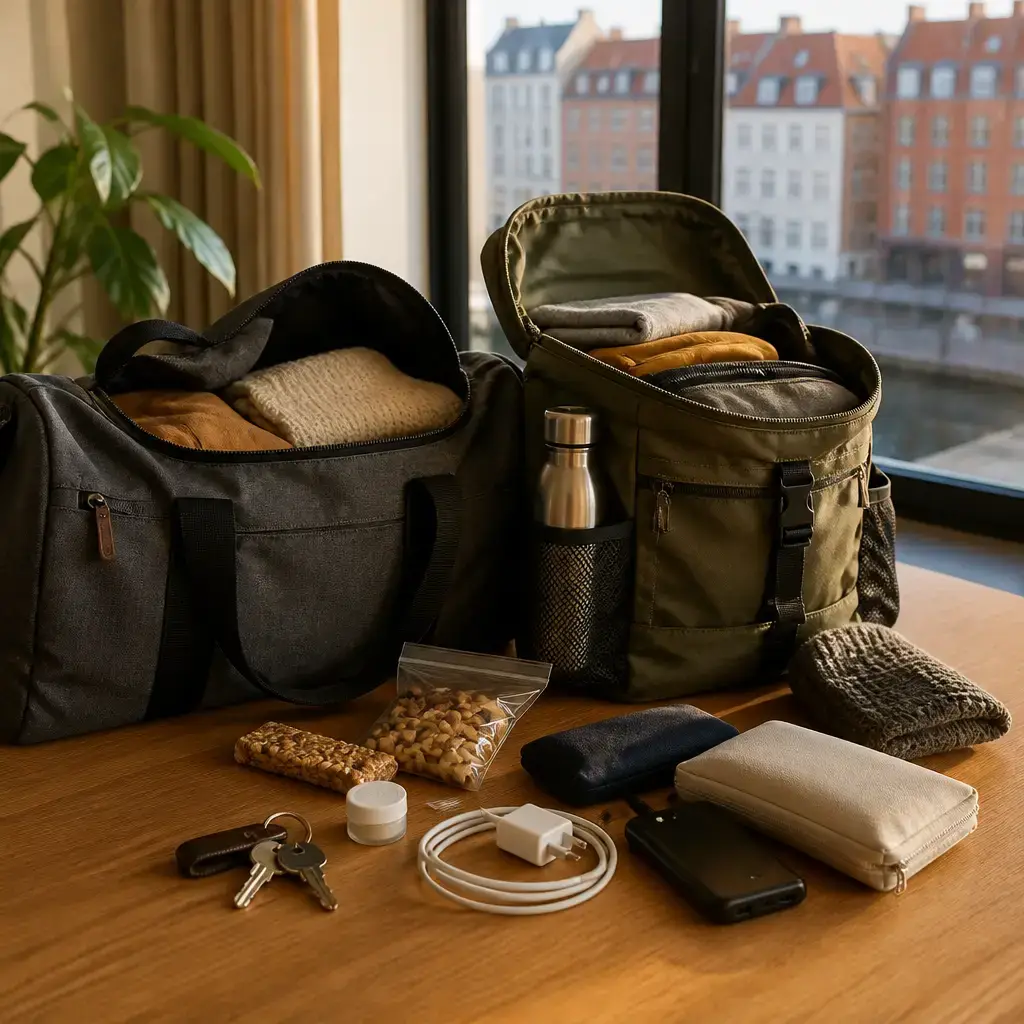
Vores rejsetasker skal tjekkes en sidste gang, før vi tager af sted.
VOH-uhs RYE-suh-TES-guhs SGEL CHEH-guhs uhn SEHS-duh GAHNG, FUHR VEE TAIR-uh eh STAY. Our travel bags need a final check before we go.Begynd med de ting, du får brug for under rejsen.
beh-GURN meh DEE TENG, doo FAWR BROO foh OH-nuh RYE-suhn. Start with the items you need during the journey.Jeg har mine nøgler, medicin og et varmt lag tøj.
YAI HAHR MEE-nuh NUHR-luh, meh-deh-SEEN oh ehd VAHRMD LAIR TOY. I have my keys, medicine, and a warm layer.Er snacks og vand nemme at få fat i?
AIR SNEKS oh VAHND NEHM-uh ehd FAW FAHD ee? Are snacks and water easy to reach?De ligger i sidelommen.
DEE LEH-guh ee SEE-duh-LOM-uhn. They are in the side pocket.Hvad med opladere og små ting til ekstra komfort?
VAH meh OH-pleh-thuh oh SMAWR TENG tehl EHGSDRAH kum-FAWRD? What about chargers and small comfort items?Jeg har pakket dem sammen, så de er nemme at finde.
YAI HAHR PAH-guhd dehm SAH-muhn, saw dee AIR NEHM-uh tehl FEH-nuh. I packed them together so they are easy to find.Det burde gøre rejsen mere rolig, hvis planerne ændrer sig.
Deh BOOR-thuh KUHR-uh RYE-suhn MAIR-uh ROH-lee, vehss PLEH-nuh-nuh EHN-ruh sigh. That should make the trip calmer if plans change.Jeg har også ladet der være ekstra plads til ting, vi får fat i.
YAI HAHR AW-suh LAH-thuhd dair VAIR-uh EHGSDRAH PLESS tehl TENG, vee FAWR FAHD ee. I also left extra space for anything we pick up.Så burde vi kunne tage af sted uden at pakke om på stationen.
Saw BOOR-thuh vee KUN-uh TAIR-uh eh STAY OO-thuhn ehd PAH-guh OHM paw stah-SHOH-nuhn. Then we should be able to leave without repacking at the station.Sentence explanations
Vores rejsetasker skal tjekkes en sidste gang, før vi tager af sted.
Our travel bags need a final check before we go.
- Vores
- our
- rejsetasker
- travel bags
- skal
- need to; must
- tjekkes
- be checked
- en
- a; an
- sidste
- last; final
- gang
- time; occasion
- før
- before
- vi
- we
- tager af sted
- leave; go away
More detail
Vores means “our” here. It is a possessive form that does not change for the gender or number of the thing possessed: vores taske can mean “our bag,” while vores tasker means “our bags.” The possessive identifies the bags as belonging to or being associated with the speaker and others. rejsetasker means “travel bags.” It is a compound noun: rejse relates to travel, and tasker is the plural of taske (“bag”). The plural form is appropriate because the sentence refers to more than one bag. Danish compounds are written as one word, so this is not two separate words in the target sentence. skal is a modal verb. With a following passive infinitive, as here, it expresses that something is to be done or needs to be done: skal tjekkes = “needs to be checked” / “is to be checked.” In other contexts, skal can also express an obligation or a planned future action; the fixed translation supports the “need to” reading here. tjekkes is the passive infinitive of tjekke, “to check.” The ending -s marks passive voice in this form: the bags receive the checking rather than performing it. Compare active vi skal tjekke taskerne (“we need to check the bags”) with passive taskerne skal tjekkes (“the bags need to be checked”). en sidste gang forms the reusable expression “a final time.” en is an indefinite article, sidste is the adjective meaning “last” or “final,” and gang is the noun meaning “time” in the sense of an occasion or instance. Here en marks an indefinite singular noun phrase; it does not by itself assert a numerical count of one. sidste modifies gang; it is not the base form of a noun. Example: Læs det en sidste gang. — “Read it a final time.” før introduces a time relation meaning “before.” It connects the checking with the later action in vi tager af sted: the checking happens earlier. Example: Ring, før du går. — “Call before you leave.” vi is the first-person plural pronoun, “we.” It is the subject of tager af sted, so the people who leave are the speaker together with at least one other person. Danish vi itself does not indicate gender. tager af sted is a fixed expression meaning “leave” or “go away.” The verb form tager is the present tense of tage (“take”), but in this expression the whole combination has the movement meaning “leave”; it should not be translated word by word as “take away.” Example: Vi tager af sted nu. — “We are leaving now.” Together, Vores rejsetasker is the subject, and skal tjekkes says that the bags need to undergo checking. en sidste gang specifies that this should happen a final time. The subordinate clause før vi tager af sted places that final check before the group leaves. Thus the whole utterance means: “Our travel bags need a final check before we go.”
Begynd med de ting, du får brug for under rejsen.
Start with the items you need during the journey.
- Begynd med
- start with
- ting
- things; items
- får brug for
- need
- under
- during
- rejsen
- the journey
More detail
Begynd med means “start with.” Begynd is the imperative of begynde (“to begin”); it gives a direct instruction. med means “with” here and introduces what the instruction starts with. For example: Begynd med første punkt. — “Start with the first point.” ting means “things” or, in this context, “items.” Here it is plural because de ting refers to multiple items, while the noun form ting is also used for singular indefinite “a thing”; the surrounding words show the number. The preceding de makes de ting definite: “the things/items.” får brug for is the Danish construction få brug for, meaning “need.” Here får is the present-tense form of få, and du is the subject, so the meaning is “you need.” This construction expresses needing something, rather than simply possessing it: Jeg har en nøgle. means “I have a key,” whereas Jeg får brug for en nøgle. can mean “I will need a key” when the context is future-oriented. under means “during” in this sentence and introduces the period when the items will be needed. For example: under mødet — “during the meeting.” rejsen means “the journey.” It is the definite singular form of rejse (“journey/trip”): en rejse means “a journey,” while rejsen means “the journey.” Together, Begynd med de ting gives “Start with the items,” du får brug for specifies that these are the items you need, and under rejsen specifies when you need them. The complete utterance therefore means: “Start with the items you need during the journey.”
Jeg har mine nøgler, medicin og et varmt lag tøj.
I have my keys, medicine, and a warm layer.
- Jeg har
- I have
- mine
- my
- nøgler
- keys
- medicin
- medicine
- varmt
- warm
- lag
- layer
- tøj
- clothing
More detail
Jeg har means “I have” here. har is the present-tense form of have (“to have”); the subject Jeg is “I”. In Danish, the present form har is used with different subjects: jeg har = “I have”, while de har = “they have”. Example: Jeg har tid. — “I have time.” mine means “my” before the plural noun nøgler. Danish possessives distinguish number and, for singular nouns, grammatical gender: min is used with a singular common-gender noun, mit with a singular neuter noun, and mine with plural nouns. The form mine itself does not identify a specific number of keys beyond plurality. Example: mine bøger — “my books.” nøgler means “keys” here. Its base form is the singular nøgle (“key”); nøgler is the plural form. The possessive phrase mine nøgler therefore means “my keys.” medicin means “medicine” here. It is commonly used as a mass or uncountable noun when referring to medicine generally, so it has no plural marker in this sentence. Example: Jeg tager medicin. — “I take medicine.” varmt means “warm” and describes lag. The adjective’s base form is varm; varmt is the form used with the singular neuter noun lag, introduced by et. The comparison chain is varm (“warm”), varmere (“warmer”), varmest (“warmest”). Example: et varmt rum — “a warm room.” lag means “layer” here. It is a singular neuter noun, as shown by et lag. In et varmt lag tøj, it refers to one layer of clothing rather than to clothing in general. tøj means “clothing” here. It is a neuter mass noun and specifies what the layer consists of: et lag tøj means “a layer of clothing.” The article and adjective agree with lag, not with tøj. Together, Jeg har + the listed objects gives “I have”. The list is mine nøgler (“my keys”), medicin (“medicine”), and et varmt lag tøj (“a warm layer of clothing”). The complete utterance therefore means: “I have my keys, medicine, and a warm layer.”
Er snacks og vand nemme at få fat i?
Are snacks and water easy to reach?
- Er
- are
- snacks
- snacks
- vand
- water
- nemme
- easy
- at få fat i
- to get hold of; to reach
More detail
Er is the present-tense form of være (“to be”). In this yes/no question, it comes before the coordinated subject: Er ...? corresponds to “Are ...?” rather than the statement order ... er .... snacks means “snacks.” It is a plural noun here. vand means “water”; Danish uses this noun as a mass substance, so the sentence does not specify a number of portions or containers. Together, snacks og vand is the subject joined by og (“and”). nemme means “easy” here. It is the plural form of the adjective nem, agreeing with the coordinated subject snacks og vand. The adjective describes how accessible the items are, not their physical size or quality. A useful contrast is svære (“difficult”): De er nemme at finde means “They are easy to find,” while De er svære at finde means “They are difficult to find.” at få fat i is a reusable Danish construction meaning “to get hold of,” “to obtain,” or, in this context, “to access/reach.” at få is the infinitive of få (“to get/receive”), and the whole expression should be learned as a unit rather than translated word by word. After an adjective, nem at ... or nemme at ... can describe something as easy to do or obtain. For example, Bogen er nem at få fat i means “The book is easy to obtain.” The structure is Er + subject + adjective + at-construction?: Er snacks og vand nemme at få fat i? The question asks whether snacks and water are readily accessible or obtainable. In a natural English rendering, this is “Are snacks and water easy to reach?”
De ligger i sidelommen.
They are in the side pocket.
- De
- they
- ligger
- are located
- i
- in
- sidelommen
- the side pocket
More detail
De is a plural personal pronoun meaning “they” here. It refers to the intended plural participants, but this sentence does not identify exactly which people or things they are. Compare den for a singular common-gender referent and det for a singular neuter referent. ligger is the present-tense form of ligge, “to lie” or “to be situated.” For objects, Danish commonly uses it to describe where something is located. The present form does not change for person or number: jeg ligger, de ligger. Example: Bogen ligger på bordet. — “The book is on the table.” i is the preposition “in.” It introduces the place containing or enclosing something. Example: Nøglerne er i tasken. — “The keys are in the bag.” sidelommen means “the side pocket.” It is a compound of side (“side”) and lomme (“pocket”); the observed form is definite singular, with -en marking “the” for this noun. The indefinite singular is en sidelomme (“a side pocket”), the plural is sidelommer (“side pockets”), and the definite plural is sidelommerne (“the side pockets”). Together, De ligger says that the plural referents are situated somewhere, and i sidelommen gives their location. The complete utterance therefore means: “They are in the side pocket.”
Hvad med opladere og små ting til ekstra komfort?
What about chargers and small comfort items?
- Hvad med
- What about
- opladere
- chargers
- små
- small
- ting
- things; items
- ekstra
- extra
- komfort
- comfort
More detail
Hvad med is a reusable Danish way to ask about or suggest an option: “What about …?” For example, Hvad med kaffe? means “What about coffee?” opladere means “chargers” here. It is the plural of oplader (“charger”). The plural form refers to more than one charger without stating a particular number. små means “small” here and describes the plural noun ting. Its base form is lille; useful comparison forms are mindre (“smaller”) and mindst (“smallest”). små is the form used with plural nouns. ting means “things” or “items” here. It is the plural of ting, and the singular and plural have the same written form. For example, en ting means “a thing,” while flere ting means “several things.” The indefinite article en does not by itself assert the number one. ekstra means “extra” and describes komfort, adding the idea of additional comfort. It does not itself state a number. For example, ekstra tid means “extra time.” komfort means “comfort.” In til ekstra komfort, til (“for” or “for the purpose of”) presents the purpose: the items are for additional comfort. komfort is a noun and is not marked for plural in this phrase. Together, opladere og små ting means “chargers and small items.” og means “and” and joins the two categories. til ekstra komfort adds the purpose of the small items, producing the whole question: “What about chargers and small comfort items?” The question asks whether these categories should also be considered; it does not assert that any particular items have been packed.
Jeg har pakket dem sammen, så de er nemme at finde.
I packed them together so they are easy to find.
- Jeg har
- I have
- pakket
- packed
- dem
- them
- sammen
- together
- så
- so
- de er
- they are
- nemme
- easy
- at finde
- to find
More detail
Jeg har is the first-person singular present form of have, used here as an auxiliary. With the following past participle, it forms the perfect: “I have …” for a completed action viewed as relevant now. The subject is jeg (“I”); har does not change for this subject pattern in the same way a lexical verb may in other languages. pakket is the past participle of pakke (“to pack”). The useful chain is pakke → pakket: the first is the infinitive/base form, while the second combines with har to express the completed packing. Example: Jeg har pakket tasken. — “I have packed the bag.” dem is an object pronoun meaning “them.” It refers to the plural things being packed, without the sentence specifying those things inside this utterance. Compare dem (“them,” object) with de (“they,” subject): Jeg ser dem. — “I see them”; De kommer. — “They are coming.” sammen means “together.” With an action such as packing, it indicates that the objects were put together rather than separately. Example: Læg bøgerne sammen. — “Put the books together.” så introduces the result or purpose expressed in the next clause: “so.” Here it connects the packing with the resulting ease of finding the objects. It is not the English word “so” as an intensifier; its role here is to link two clauses. de er means “they are.” de is the subject pronoun for plural “they,” and er is the present form of være (“to be”). In this sentence, de is the subject of the second clause, while dem is the object of the first clause; their forms reflect those different roles. nemme means “easy” here. It is the plural form of the adjective nem: nem with common-gender singular nouns, nemt with neuter singular nouns, and nemme with plural nouns or definite noun phrases. The plural form agrees with the plural subject de; it does not come from finde. at finde means “to find.” at marks the infinitive, and finde is the infinitive/base form of the verb. The construction nem at finde means “easy to find,” with the finding understood as the relevant activity. Example: Bogen er nem at finde. — “The book is easy to find.” Together, Jeg har pakket dem sammen says that I have packed the things together. så de er nemme at finde gives the result: they are easy to find. The complete meaning is that the speaker packed the objects together so that finding them would be easy.
Det burde gøre rejsen mere rolig, hvis planerne ændrer sig.
That should make the trip calmer if plans change.
- Det
- that
- burde
- should
- gøre
- make
- rejsen
- the trip
- mere
- more
- rolig
- calm
- hvis
- if
- planerne
- the plans
- ændrer sig
- change
More detail
Det means “that” here as the subject of the sentence, referring to an understood situation or action rather than identifying a noun in the sentence itself. Danish det can serve in this kind of subject role; its exact referent is supplied by the surrounding meaning. burde expresses “should” or an expected result. It is the past-form/modal form of bør, but with this use it commonly expresses what is advisable or reasonably expected, not necessarily a past event. The modal is followed by the infinitive gøre. gøre means “make” here: it presents the subject as causing a change in something. Its base form is also used after modal verbs. For example, Det kan gøre en forskel means “That can make a difference.” rejsen means “the trip.” It is the definite singular form of en rejse (“a trip”): rejse + -n gives rejsen. The ending marks definiteness, not a separate meaning such as “journey” in every context. mere means “more” and forms a comparison. In mere rolig, it increases the degree of the adjective that follows. Danish can also form many comparisons with an ending, so the choice between an analytic form such as mere rolig and another comparative form depends on the adjective and usage. rolig means “calm” here. Its base meaning describes a lack of disturbance or agitation. In this sentence it describes the resulting state of rejsen after gøre; mere rolig means “calmer,” not simply “calm.” An example is Vandet blev mere roligt — “The water became calmer.” hvis introduces a condition and means “if.” It starts the subordinate clause that states the circumstance under which the expected result applies. For example, Hvis tiden ændrer sig, ringer jeg means “If the time changes, I will call.” planerne means “the plans.” It is the definite plural of en plan: planer is the plural and planerne adds definite marking. The form refers to the plans intended in the fixed meaning; the plural marking does not by itself specify how many plans there are. ændrer sig is the reusable pattern “change” when the subject undergoes the change itself. ændrer is the present form of ændre (“change”); Danish verbs do not change this form for different subjects. sig is the reflexive pronoun associated with the subject planerne, so the plans are described as changing, rather than changing some separately stated object. Compare Planerne ændrer sig (“The plans change”) with Planerne ændrer planen (“The plans change the plan”), where the latter has an explicit object. Together, Det burde gøre rejsen mere rolig means “That should make the trip calmer”: an understood situation or action is expected to produce a calmer trip. hvis planerne ændrer sig adds the condition “if the plans change.” The complete utterance therefore means: “That should make the trip calmer if the plans change.”
Jeg har også ladet der være ekstra plads til ting, vi får fat i.
I also left extra space for anything we pick up.
- Jeg har
- I have
- også
- also
- ladet
- left
- der være
- be there
- ekstra
- extra
- plads
- space
- ting
- things
- vi får fat i
- we pick up
More detail
Jeg har introduces a first-person singular statement. har is the present form of have; here it is the auxiliary in the perfect construction har + past participle. The same form is also used with several other subjects, for example du har means “you have.” også means “also” and adds this action to something already being considered. It does not change the tense or the participants. ladet is the past participle of lade. In this sentence, lade means to let or leave something in a certain state, not to depart. The useful pattern is lade + der være + noun: “leave/allow there to be [noun].” For example, Hun lod der være plads. means “She left room.” der være is an existential construction in the infinitive. der is a grammatical placeholder introducing what exists, while være is the infinitive “be.” Compare present der er plads (“there is room”) with the form after lade: der være plads. ekstra describes an amount beyond what is usual or already provided. It is normally unchanged when it modifies different nouns: ekstra tid means “extra time,” and ekstra stole means “extra chairs.” plads is the noun “space” or “room.” In this use it refers to available room for items, and it is commonly treated as an uncountable amount. mere plads means “more space,” while en plads can mean “a place” or “a seat” in a more countable use. ting is a noun meaning “things” or “items.” The form ting can also be the singular indefinite form after en: en ting means “a thing,” while ting is also the plural form. Here the surrounding meaning and the fixed translation use it generically for items that may be picked up. vi får fat i is a reusable expression meaning “we get hold of” or, in this context, “we pick up.” vi is the subject “we,” and får is the present form of få (“get”); its past form is fik. The words fat i complete the expression, so it is not best understood by translating each word separately. Example: Vi får fat i billetter. means “We get hold of tickets.” The sequence ting, vi får fat i identifies the items: “things that we pick up.” Danish can omit an object relative marker here; vi remains the subject of får fat i, and the things are what that expression refers to. The preposition til connects these items with the space: plads til ting means “space for things.” Together, the sentence says that the speaker has also left extra space for anything they pick up: “I also left extra space for anything we pick up.”
Så burde vi kunne tage af sted uden at pakke om på stationen.
Then we should be able to leave without repacking at the station.
- Så
- then
- burde vi
- we should
- kunne
- be able to
- tage af sted
- leave; depart
- uden at
- without doing something
- pakke om
- repack
- stationen
- the station
More detail
Så means “then” here and links this conclusion to the preceding context. It can also mean “so” in other sentences, but this occurrence presents the result as following from what was just said. burde vi expresses “we should.” burde is the past-form counterpart of bør, but it commonly expresses present or future advice, expectation, or likelihood rather than past time. Here, together with kunne, it contributes to “should be able to.” vi is the first-person plural pronoun “we.” Because Så is first in the clause, the finite verb comes before the subject in this sentence: Så burde vi .... kunne means “be able to” in this context. It is the infinitive form of kan and follows the modal burde: burde kunne = “should be able to.” Compare kan “can / am able to” with kunne after another modal or in other infinitive environments. Example: Vi burde kunne hjælpe. — “We should be able to help.” tage af sted is a fixed verb expression meaning “leave” or “depart.” Its parts form the expression here rather than an ordinary “take” plus an independently chosen destination phrase. tage is infinitive because it follows kunne. Example: De tager af sted nu. — “They are leaving now.” uden at introduces an action that is not carried out: uden at + infinitive means “without doing something.” The infinitive after it normally has the same understood subject as the surrounding clause unless the context indicates otherwise. Example: Hun gik uden at sige farvel. — “She left without saying goodbye.” pakke om means “repack.” It is a verb-particle expression: pakke is the verb “pack,” and om changes the action to packing again or differently. Here, pakke is infinitive after at, while om remains part of the expression. Example: Vi må pakke om. — “We have to repack.” stationen means “the station.” The noun is station; -en marks singular definite form, so stationen means “the station,” not simply “a station.” The preposition på before this noun gives the location phrase “at the station” in the fixed translation. Together, Så burde vi kunne tage af sted means “Then we should be able to leave.” uden at pakke om specifies that they leave without repacking, and på stationen places that repacking at the station. The complete utterance therefore means: “Then we should be able to leave without repacking at the station.”
Grammar Points
få brug for + substantiv
Jeg får brug for medicin.
YAI FAWR BROO foh meh-deh-SEEN.I will need medicine.
The fixed expression få brug for means “need” and is followed directly by the thing needed.
ændre sig
Planerne ændrer sig.
PLEH-nuh-nuh EHN-ruh sigh.The plans change.
The reflexive pronoun sig is part of the verb and refers back to the subject.
Danish Vocabulary
Begynd med de ting.
du får brug for under rejsen
et varmt lag tøj
Jeg har mine nøgler, medicin og et varmt lag tøj.
Jeg har mine nøgler.
under rejsen
Vores rejsetasker skal tjekkes.
en sidste gang
før vi tager af sted
de ting, du får brug for
Vores rejsetasker skal tjekkes.
- Gender
- neuter
et varmt lag tøj
Quiz
Word Order
Arrange the words in the correct order.
They are in the side pocket.
Show Answer
De ligger i sidelommen.Spelling
Tap the letters to spell the word.
key
Show Answer
nøglerthings; items
Show Answer
tingcheck
Show Answer
tjekkesjourney; trip