10 minutes free every day
Continue audio lessons in the app
Word explanations appear automatically in sync with the audio.
No login required · synced translations · playback with the screen locked
Choose your learning language and open this lesson in the app.

About This Lesson
Use Checking presentation equipment before a meeting to practice Danish conversation, pronunciation, vocabulary, grammar, and quizzes.
Dialogue
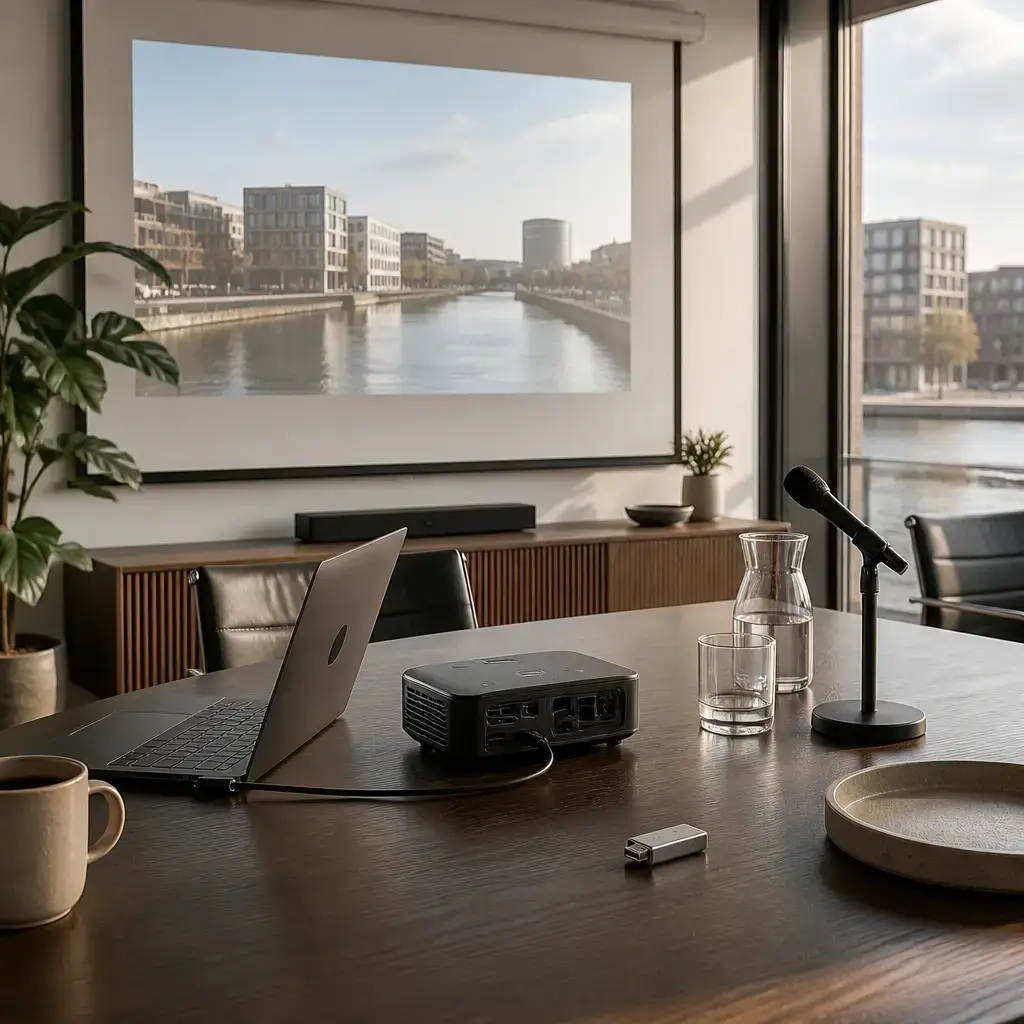
Vi bør tjekke præsentationsudstyret, før kunderne kommer.
vee BUHR CHEK-uh preh-sen-ta-SHOHNS-ood-stur, FUHR KUN-uh-neh KOM-uh. We should check the presentation equipment before the clients arrive.Jeg kan tilslutte den bærbare computer til projektoren først.
yai kan til-SLOO-tuh den BAIR-ba-reh kom-POO-ter til proh-yek-TOH-ren FURST. I can connect the laptop to the projector first.Billedet vises, men det ser lidt strukket ud.
BIL-uh VEE-ses, men deh sair lit STROOK-et ood. The image is showing, but it looks a little stretched.Jeg kan justere skærmindstillingerne og teste slidesene igen.
yai kan yoo-STAIR-uh SKAIR-min-STIL-ing-er-neh oh TES-teh SLYDE-suh-neh ee-YEN. I can adjust the display settings and test the slides again.Kan du også tjekke mikrofonens lydstyrke?
kan doo OH-soh CHEK-uh mee-kroh-FOH-nens LOOD-stur-keh? Could you also check the microphone volume?Det lyder klart, men den bagerste række har måske brug for mere lydstyrke.
deh LOO-thuh klahrt, men den BAI-uh-steh RAI-keh har MOH-skeh broo for MOH-uh LOOD-stur-keh. It sounds clear, but the back row may need more volume.Jeg tog slidesene med på et backupdrev.
yai toh SLYDE-suh-neh meh poh ed BAK-up-drayv. I brought the slides on a backup drive.Lad os lave en hurtig prøve med den første slide.
lad ohs LAI-vuh en HOOR-dee PRUH-vuh meh den FUR-steh SLYDE. Let's do a quick rehearsal with the opening slide.Den første slide virkede, så alt ser ud til at være klar nu.
den FUR-steh SLYDE VEER-kuh, soh ALT sair ood til ed VAIR-uh klahrt noo. The opening slide worked, so everything seems ready now.Dette teknikcheck giver os én ting mindre at bekymre os om.
DES-tuh tek-NEEK-chek GEE-vuh ohs ayn TING MIN-ruh ed bee-KOOM-ruh ohs ohm. This tech check gives us one less thing to worry about.Sentence explanations
Vi bør tjekke præsentationsudstyret, før kunderne kommer.
We should check the presentation equipment before the clients arrive.
- Vi bør
- we should
- tjekke
- check
- præsentationsudstyret
- the presentation equipment
- før
- before
- kunderne
- the clients
- kommer
- arrive
More detail
Vi bør combines Vi (“we”) with bør (“should/ought to”). Vi is a first-person plural pronoun. Bør is a modal verb; it is followed by an infinitive, so the next verb appears as tjekke, not as a finite form. A useful pattern is Jeg/vi bør + infinitive: “I/we should …”. tjekke means “to check” here. It is the infinitive form used after the modal bør; the infinitive marker at is not used after this modal. For example: Vi bør tjekke døren. — “We should check the door.” præsentationsudstyret means “the presentation equipment”. It is a compound: præsentation means “presentation”, and udstyr means “equipment”. The definite ending is attached to the complete compound, giving præsentationsudstyret; it presents the equipment as identified rather than asserting a numerical count. Udstyr is a mass noun, so this form is not a plural form. The next context sentence uses related equipment vocabulary, but it does not change the meaning of this word here. før introduces a time relation meaning “before”. It can introduce a clause: før + subject + finite verb. In før kunderne kommer, the clause says when the checking should take place. kunderne means “the clients”. Its base form is kunde (“client/customer”); kunder is the plural, and kunderne is the definite plural. Thus the ending marks a known or identifiable group of clients, not a singular client. kommer is the present-tense form of komme, “to come”. In this subordinate clause, the present form refers to the clients’ later arrival: “before the clients arrive”. The same form can describe coming in other contexts, but arrive is the intended meaning here. Together, Vi bør tjekke præsentationsudstyret means “We should check the presentation equipment”. The clause før kunderne kommer adds the deadline “before the clients arrive”. The complete utterance therefore means: “We should check the presentation equipment before the clients arrive.”
Jeg kan tilslutte den bærbare computer til projektoren først.
I can connect the laptop to the projector first.
- Jeg kan
- I can
- tilslutte
- connect
- bærbare
- portable
- computer
- computer
- projektoren
- the projector
- først
- first
More detail
Jeg kan means “I can” here. Jeg is the first-person singular subject, “I,” and kan is the present-tense form of kunne, “can/be able to.” In Danish, kan is followed by an infinitive without at: Jeg kan tilslutte ... = “I can connect ...”. This expresses ability or possibility; the sentence does not by itself say whether the connection has already happened. tilslutte means “connect.” It is the infinitive form, used after the modal verb kan. A useful pattern is kan + infinitive, for example: Jeg kan hjælpe. — “I can help.” bærbare is the form of the adjective bærbar, “portable.” In den bærbare computer, it describes the noun computer and has the definite singular form bærbare, because the noun phrase is introduced by den. The same adjective form can also occur with plural nouns, so this form alone does not establish plurality. Example: en bærbar computer — “a portable computer”; den bærbare computer — “the portable computer.” computer means “computer.” It is the noun being described by bærbare. In the phrase den bærbare computer, den marks a definite common-gender singular noun phrase, corresponding here to “the portable computer.” projektoren means “the projector.” It is the definite singular form of the noun projektor: en projektor = “a projector,” projektoren = “the projector.” The preposition til before it is not included in the selected quote; together, til projektoren means “to the projector.” først means “first” in this sentence. It places the connecting action before other possible actions in the relevant sequence. Example: Jeg tjekker kablet først. — “I will check the cable first.” Together, Jeg kan tilslutte den bærbare computer til projektoren først means “I can connect the laptop to the projector first.” The structure is subject + kan + infinitive + object + destination + først: Jeg is the subject, kan tilslutte expresses the ability or possibility to connect, den bærbare computer is what is connected, til projektoren gives the destination, and først indicates that this action comes first.
Billedet vises, men det ser lidt strukket ud.
The image is showing, but it looks a little stretched.
- Billedet
- the image
- vises
- is shown
- det
- it
- ser … ud
- looks
- lidt
- a little
- strukket
- stretched
More detail
Billedet means “the image” here. It is the definite singular form of billede (“image”): et billede → billedet. Danish marks definiteness on the noun in this form rather than using a separate word equivalent to “the.” vises means “is shown.” It is the present passive form of vise (“show”), so the image is presented or visible without naming who is showing it. Compare active viser (“shows”) with passive vises (“is shown”). det is a neuter singular pronoun meaning “it” in this sentence, referring to the image. Its grammatical form agrees with the neuter noun billede; the pronoun itself does not identify a new participant. ser ... ud is a two-part Danish construction meaning “looks” when describing appearance. ser is the present form of se (“see”), while ud is a particle. The construction is reusable: Det ser godt ud means “It looks good.” lidt means “a little” or “slightly.” It weakens the description that follows, so the image is only slightly stretched rather than strongly stretched. strukket is the adjective-like form meaning “stretched” here. In ser ... strukket ud, it describes the image’s apparent shape or appearance. It is placed before the particle ud as the predicative description in this construction. Together, Billedet vises says “the image is shown,” and men introduces a contrast: “but.” Then det ser lidt strukket ud says that the image looks slightly stretched. The complete meaning is: “The image is showing, but it looks a little stretched.”
Jeg kan justere skærmindstillingerne og teste slidesene igen.
I can adjust the display settings and test the slides again.
- Jeg kan
- I can
- justere
- adjust
- skærmindstillingerne
- the display settings
- teste
- test
- slidesene
- the slides
- igen
- again
More detail
Jeg kan means “I can” here. Jeg is the first-person singular pronoun “I”. kan is the present form of kunne (“can, be able to”). As a modal verb, kan is followed by an infinitive without at: Jeg kan justere = “I can adjust.” justere is the infinitive “to adjust”. In this sentence it follows kan, so it stays in the infinitive. A useful form chain is justere (infinitive), justerer (present), justerede (past). Example: Hun justerer skærmen. — “She adjusts the screen.” skærmindstillingerne means “the display settings”. It is a compound noun: skærm means “screen/display”, and indstillinger means “settings”. The ending -ne marks definite plural here, so the form contrasts with skærmindstillinger (“display settings”, indefinite plural). Danish commonly forms compounds by writing their parts together. teste is the infinitive “to test”. Like justere, it follows the modal kan without at. Its present form is tester, and its past form is testede. Example: Vi tester forbindelsen. — “We test the connection.” slidesene means “the slides”. slides is the plural of the loanword slide, and -ene marks the definite plural: slidesene = “the slides”. The indefinite plural is slides, as in Jeg viser slides. — “I show slides.” igen is the adverb “again”. It shows that the testing is being repeated, rather than done for the first time. Together, Jeg kan justere skærmindstillingerne gives “I can adjust the display settings”, and og teste slidesene igen adds “and test the slides again”. The complete utterance is therefore: “I can adjust the display settings and test the slides again.”
Kan du også tjekke mikrofonens lydstyrke?
Could you also check the microphone volume?
- Kan du
- could you
- også
- also
- tjekke
- check
- mikrofonens
- the microphone’s
- lydstyrke
- volume
More detail
Kan du is a reusable way to ask someone to do something: literally, “can you …?” In this request, the English “could you” is the natural polite translation. du is the second-person singular pronoun “you”; it addresses one person, but it does not by itself specify the person’s identity. også means “also” and adds this request to another relevant task. Its position here places the addition before the action being requested. tjekke is the infinitive “to check.” After the modal verb kan, Danish uses the infinitive without an infinitive marker: kan tjekke = “can check.” The same pattern is reusable with other verbs, for example Kan du justere indstillingerne? = “Could you adjust the settings?” mikrofonens means “the microphone’s” or “of the microphone.” It is formed from mikrofon (“microphone”), its definite form mikrofonen (“the microphone”), and possessive -s: mikrofonens. The possessive links the microphone to the following noun. lydstyrke means “volume” or “volume level.” It is the noun being checked: the request concerns how loud the microphone output is. In mere lydstyrke (“more volume”) in the following context, the same noun refers to a greater volume level. Together, Kan du også tjekke mikrofonens lydstyrke? asks one person whether they can additionally check the microphone’s volume. The structure is reusable as Kan du også + infinitive + object: “Could you also [do something]?”
Det lyder klart, men den bagerste række har måske brug for mere lydstyrke.
It sounds clear, but the back row may need more volume.
- Det
- it
- lyder
- sounds
- klart
- clear
- måske
- perhaps
- den
- the
- bagerste
- back; rearmost
- række
- row
- har … brug for
- needs
- mere
- more
- lydstyrke
- volume
More detail
Det is a neuter singular pronoun. Here it is the “it” in “it sounds clear”; the supplied translation supports that general reading without identifying a more specific referent. Danish pronouns must fit the relevant grammatical conditions, but this form does not by itself name what “it” refers to. lyder comes from lyde, “to sound.” It is present tense, so Det lyder means “it sounds.” The form lyder can be used with different singular subjects; the subject’s form, rather than a special English-style ending on the verb, carries the relevant agreement information. Example: Det lyder godt. — “That sounds good.” klart is the form of klar, “clear,” used here with the neuter singular Det. It describes how the sound comes across in this utterance. The form klar is the common-gender singular form, while klart is the neuter singular form; this is adjective inflection, not an inflection of lyder. måske means “perhaps” or “may.” It makes the following statement uncertain rather than definite. In this sentence it applies to the claim that the back row needs more volume. den is the definite article used with a singular common-gender noun. In den bagerste række, it marks the noun phrase as definite: “the back row.” It does not itself express a numerical count. bagerste means “backmost” or, in this noun phrase, “back.” It is the definite form of the superlative bagerst, “furthest back.” The definite form appears with den ... række; it is not a form of the noun række. Example: den bagerste stol — “the backmost chair.” række means “row.” It is a common-gender noun, and its definite singular form is rækken, as in “the row.” Here the separate article den combines with the adjective and noun phrase to give “the back row.” har brug for is a reusable Danish construction meaning “needs” or literally “has need for.” It uses har, the present form of have, with brug for; the following noun phrase identifies what is needed. Example: Vi har brug for hjælp. — “We need help.” mere means “more.” With the mass noun lydstyrke, it requests a greater amount or level, rather than naming an exact quantity. Mere is the comparative form used for an uncounted amount; a plural countable noun commonly uses flere instead. Example: Jeg vil have mere vand. — “I want more water.” lydstyrke is a compound noun meaning “volume,” specifically sound level. Its first part relates to sound, and its second part relates to strength, but the compound is learned and used as one noun. The preceding mere makes the needed amount “more volume.” Together, Det lyder klart means “It sounds clear.” Men links this with a contrast: den bagerste række har måske brug for mere lydstyrke means “the back row may need more volume.” The complete utterance is therefore: “It sounds clear, but the back row may need more volume.”
Jeg tog slidesene med på et backupdrev.
I brought the slides on a backup drive.
- Jeg
- I
- tog … med
- brought along
- slidesene
- the slides
- på
- on
- et
- a
- backupdrev
- backup drive
More detail
Jeg means “I” here: the speaker is the agent of the action. Danish uses this form for the first-person singular subject. tog med is the useful pattern for “brought/took along.” tog is the past form of tage (“take”), and med adds the idea that something is taken along with the person. In this sentence, the fixed translation supports “brought” rather than a simple unrelated sense of “took.” Example: Jeg tager en paraply med. — “I’m bringing an umbrella.” slidesene means “the slides.” slide is a borrowed noun; slides is its plural, and the ending -ene marks definite plural: “the slides.” The related forms are en slide (“a slide”), slides (“slides”), and slidesene (“the slides”). på means “on” in the storage-medium expression used here. Danish also uses på in other spatial expressions, but its concrete effect here is to present the drive as the medium on which the slides were brought or stored. et is the indefinite article used with the neuter noun drev. It signals an unspecified drive, not a stated numerical count. Compare et drev (“a drive”) with the definite form drevet (“the drive”). backupdrev is a compound noun meaning “backup drive”: backup specifies the drive’s purpose, while drev is “drive.” The compound is written as one word in the observed sentence. Example: Filerne ligger på et backupdrev. — “The files are on a backup drive.” Together, Jeg tog ... med says that the speaker brought something along; slidesene identifies what was brought; and på et backupdrev identifies the backup drive involved. The whole utterance therefore means: “I brought the slides on a backup drive.”
Lad os lave en hurtig prøve med den første slide.
Let's do a quick rehearsal with the opening slide.
- Lad os
- let's
- lave
- do; make
- hurtig
- quick
- prøve
- rehearsal; test
- første
- first
- slide
- slide
More detail
Lad os is the reusable Danish way to suggest an action involving the speaker and others: “let’s …”. It is followed here by the infinitive lave. The subject is the understood group “we”; os is the object form used in this construction. lave is the infinitive of “do” or “make”. In Lad os lave ..., it means “do” and names the proposed action. Example: Lad os starte. — “Let’s start.” hurtig means “quick” here and describes prøve. Its form agrees with the noun it modifies: en hurtig prøve, but et hurtigt ... with a neuter singular noun and hurtige in plural or definite noun phrases. The observed form is not the noun’s form; hurtig is the adjective. prøve is a common-gender noun meaning “test” or, in this context, a “rehearsal” or run-through. Its indefinite form is en prøve; its definite singular form is prøven. The intended rehearsal meaning is supported by the presentation context, while the same noun can also refer to a test in another context. Example: Vi tager en prøve. — “We are taking a test.” første is the ordinal “first”. It identifies the slide as number one in an order. Unlike a cardinal such as én (“one”), it is an ordinal adjective; første commonly remains unchanged across the relevant singular and plural noun phrases. Example: Hun kom på første plads. — “She came in first place.” slide is a presentation slide, a loanword used as a noun in Danish. In this phrase it is a common-gender singular noun: en slide; its definite form is sliden. The words den første slide form a definite noun phrase: den marks the specific slide, while første gives its order and slide names the item. The chunks combine as Lad os + lave (“let’s do”) + en hurtig prøve (“a quick rehearsal”) + med den første slide (“with the opening/first slide”). Thus the whole utterance means: “Let’s do a quick rehearsal with the opening slide.”
Den første slide virkede, så alt ser ud til at være klar nu.
The opening slide worked, so everything seems ready now.
- første
- first
- slide
- slide
- virkede
- worked
- så
- so
- alt
- everything
- ser ud til at være
- seems to be
- klar
- ready
- nu
- now
More detail
første means “first” here: it identifies the slide as the opening one in an order. It is an ordinal form, not a quantity word. Danish ordinals can be used before a noun, as in den første slide (“the first slide”). slide is the noun “slide.” Here it is the presentation slide that worked. The reading “opening slide” comes from første together with the supplied translation; the noun alone means “slide.” virkede means “worked” here, in the sense “functioned successfully.” Its base form is virke; virkede is its past-tense form. For example, Planen virkede means “The plan worked.” så connects the successful result with its consequence: “so” or “therefore.” Here it introduces the conclusion that everything now appears ready. This is the conjunction så in this sentence. alt means “everything.” It refers generally to the relevant things in the situation rather than naming them individually. In Danish, alt is a singular neuter pronoun, but Danish present-tense verbs do not change for subject number, so ser is not selected because of a special singular verb ending. ser ud til at være is a reusable construction meaning “seems to be” or “appears to be.” It consists of ser (“looks”), ud (“out”), and til at være (“to be”), but together they express appearance or an inference rather than literal visual looking out. The base form of ser is se; være is the infinitive “to be.” For example, Det ser ud til at være rigtigt means “It seems to be correct.” klar means “ready” here. It describes the state expressed in the conclusion. It can also mean “clear” in other contexts, so the surrounding construction helps identify the intended sense. For example, Jeg er klar means “I am ready.” nu means “now,” locating the apparent readiness at the current time. It modifies the conclusion as a whole rather than changing the meaning of klar itself. Together, Den første slide virkede means “The opening slide worked.” The conjunction så links that result to alt ser ud til at være klar nu, “everything seems ready now.” The complete utterance therefore means: “The opening slide worked, so everything seems ready now.”
Dette teknikcheck giver os én ting mindre at bekymre os om.
This tech check gives us one less thing to worry about.
- Dette
- this
- teknikcheck
- tech check
- giver
- gives
- os
- us
- én
- one
- ting
- thing
- mindre
- less; smaller
- bekymre os om
- worry about
More detail
Dette means “this” here and is the singular neuter form of the Danish demonstrative. Its form agrees with the neuter noun teknikcheck; the demonstrative itself does not identify a different participant. teknikcheck is a compound noun meaning a technical check or tech check. The compound combines teknik (“technology/technical matters”) with check (“check”); learn the complete compound as the reusable noun here. Example: Et teknikcheck er hurtigt. — “A tech check is quick.” giver is the present-tense form of give, “to give.” Danish present tense commonly uses the same verb form across subjects: jeg giver (“I give”), de giver (“they give”). Here the check is presented as providing a result or benefit to someone. os means “us,” the first-person plural object pronoun. In giver os, it marks the people receiving the result. The same form also appears in the reflexive construction bekymre os, where it refers back to the plural subject understood in that construction. én means the explicitly counted number “one.” The accent helps distinguish this numeric use from the unstressed article forms en and et. It states that there is one thing, not merely that the noun is indefinite. ting means “thing.” Its singular form is ting, and its plural is also ting; the number can therefore be shown by surrounding words, as in én ting (“one thing”) versus flere ting (“several things”). mindre means “less” here, not physically “smaller.” It is a comparative form used for a reduced amount or number: én ting mindre means “one thing less.” Danish also uses mindre for smaller size in suitable contexts, so the surrounding noun and meaning determine which comparison is intended. Example: Vi har én opgave mindre. — “We have one fewer task.” bekymre os om is the reusable Danish pattern “worry about.” The infinitive marker at before it introduces the activity: at bekymre os om ... (“to worry about ...”). om introduces what the worry concerns. Example: Jeg vil ikke bekymre mig om det. — “I do not want to worry about it.” The reflexive form changes with the subject, for example mig with jeg and os with vi. Together, Dette teknikcheck is the subject, and giver os says that it provides something for us. én ting mindre at bekymre os om means “one less thing to worry about”: the check reduces the set of matters that concern us. The complete utterance therefore means, “This tech check gives us one less thing to worry about.”
Grammar Points
før + ledsætning
Før kunderne kommer
FUHR KUN-uh-neh KOM-uhBefore the clients arrive
før introducerer en ledsætning om noget, der sker tidligere.
bekymre sig om + substantiv
bekymre os om teknikcheck
bee-KOOM-ruh ohs ohm tek-NEEK-chekworry about the tech check
Det refleksive pronomen ændres efter personen: sig, os, dig osv.
Danish Vocabulary
- Gender
- neuter
- Gender
- neuter
Quiz
Word Order
Arrange the words in the correct order.
Could you also check the microphone volume?
Show Answer
Kan du også tjekke mikrofonens lydstyrke?Spelling
Tap the letters to spell the word.
connect
Show Answer
tilsluttecheck
Show Answer
tjekkearrive; come
Show Answer
kommerprojector