10 minutes free every day
Continue audio lessons in the app
Word explanations appear automatically in sync with the audio.
No login required · synced translations · playback with the screen locked
Choose your learning language and open this lesson in the app.

About This Lesson
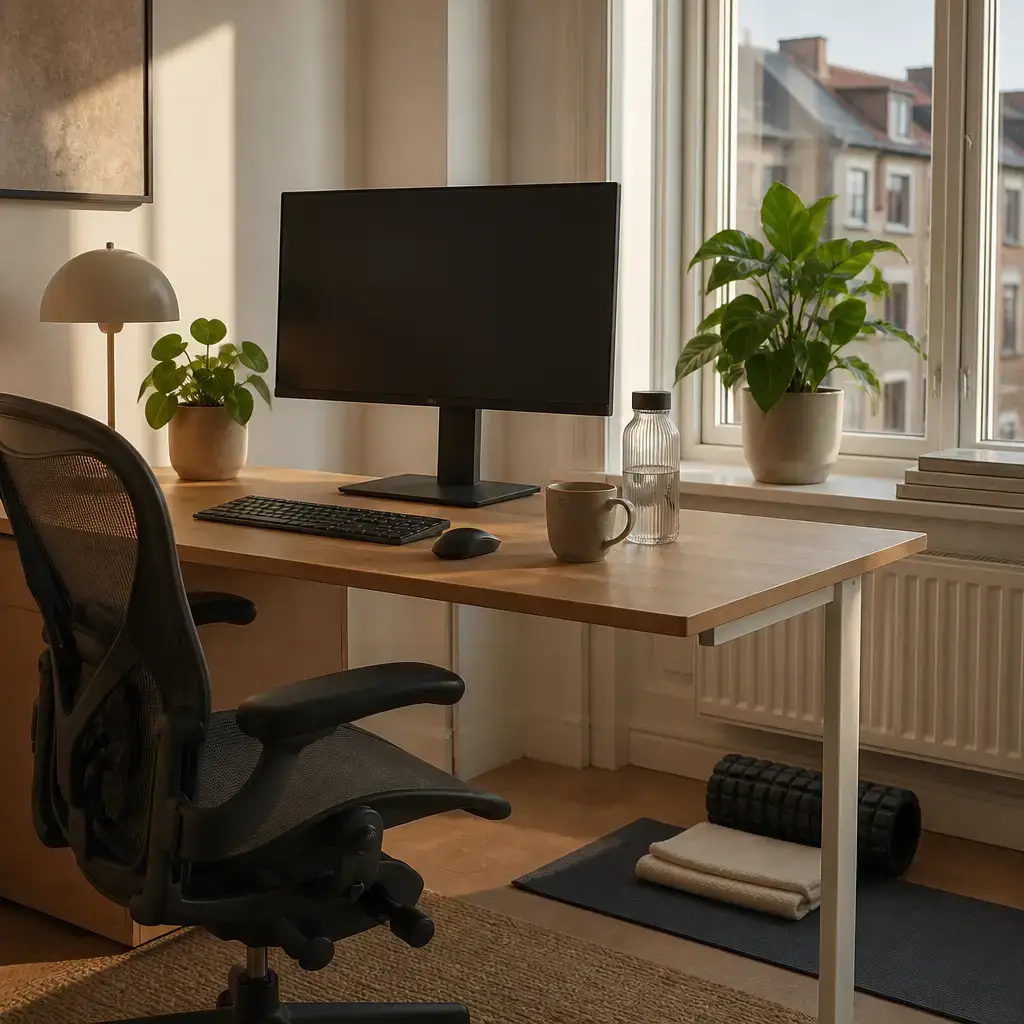
Use Managing Back Pain from Desk Work to practice Danish conversation, pronunciation, vocabulary, grammar, and quizzes.
Dialogue
Min lænd gør ondt efter at have siddet ved mit skrivebord hele dagen.
men LEND guh ont EF-tuh ahv HAY-vuh SID-uh veh meet SKREE-vuh-bor HAY-luh DAY-en My lower back hurts after sitting at my desk all day.Din stol giver dig måske ikke nok støtte.
deen STOHL GHEE-vuh dai MOH-skeh IG-uh noh(k) STUH-duh Your chair might not be giving you enough support.Jeg læner mig også frem, fordi min skærm er for langt væk.
yai LAY-nuh my OH-soh frem foh-DEE men skairm air foh lahngd vek I also lean forward because my monitor is too far away.Hvis du flytter skærmen tættere på, kan det måske tage noget af presset fra din ryg.
ves doo FLUH-duh skair-men TED-uh-ruh poh kan deh MOH-skeh DAY-uh NOH-uh ahv PRES-uh frah deen rue Moving the screen closer could take some pressure off your back.Jeg tænkte på at strække ud i korte pauser.
yai TENG-duh poh ah STREK-uh ood ee KOR-duh POW-suh I was thinking about stretching during short breaks.Forsigtig udstrækning kan måske hjælpe, men stop, hvis det gør smerten værre.
foh-STIG-tig OOD-strek-ning kan moh-SGAY YEL-puh men STOHB ves deh guh SMER-den VAIR-uh Gentle stretching may help, but stop if it increases the pain.Hvis det fortsætter, bør jeg nok tale med en fagperson.
ves deh foh-TSED-uh buh yai noh(k) TAY-luh meh en FAY-pohr-son If it continues, I should probably see a professional.Især hvis smerten breder sig eller begynder at påvirke din søvn.
ee-SAIR ves SMER-den BRAY-uh sai EL-uh beh-GUH-nuh ah poh-VAIR-guh deen surn Especially if the pain spreads or starts affecting your sleep.I denne uge kan jeg lave små ændringer og holde øje med, om de hjælper.
ee DEN-uh OO-uh kan yai LAY-vuh smoh EN-dring-uh oh HOL-duh OY-uh meh om dee YEL-puh This week, I can make small adjustments and track whether they help.Det er som regel lettere at vurdere konsekvente ændringer end én stor ændring.
deh air som RAY-sul LET-uh-ruh ah vooh-DAIR-uh kon-seh-GVEN-duh EN-dring-uh en ain stohr EN-dring Consistent changes are usually easier to judge than one big change.Sentence explanations
Min lænd gør ondt efter at have siddet ved mit skrivebord hele dagen.
My lower back hurts after sitting at my desk all day.
- Min
- my
- lænd
- lower back
- gør ondt
- hurts
- efter at have siddet
- after sitting
- ved
- at; by
- mit skrivebord
- my desk
- hele dagen
- all day
More detail
Min means “my” here and is the possessive form used with a common-gender singular noun. Danish also has mit with a neuter singular noun and mine with plural nouns. In this sentence, min agrees with lænd, not with the speaker. lænd means “lower back.” It is a noun referring to the lower part of the back. The possessive phrase min lænd therefore means “my lower back.” gør ondt is the Danish expression for experiencing pain: literally, the body part “does hurt.” The verb is gøre; gør is its present-tense form. A useful pattern is [body part] gør ondt, for example: Min arm gør ondt. — “My arm hurts.” The fixed expression should be learned as a unit rather than translated word for word. efter at have siddet means “after sitting.” siddet is the past participle of sidde (“sit”), and have siddet forms a perfect infinitive. With efter at, this construction places the sitting before the pain being described: efter at have siddet = “after having sat” or, naturally here, “after sitting.” ved means “at” or “by” when it places someone or something beside or at a location. Here it introduces the location of the sitting: ved mit skrivebord means “at my desk.” mit skrivebord means “my desk.” skrivebord is a neuter singular noun, so the possessive is mit, not min. The form skrivebord combines the idea of writing with bord (“table”), but it should be learned as the ordinary word for “desk.” hele dagen means “all day” or “the whole day.” hele means “whole” and agrees with the singular noun dagen; dagen is the definite form of dag (“day”). The phrase describes how long the sitting lasted. Together, efter at have siddet ved mit skrivebord hele dagen gives the time relationship and setting: the sitting occurred at the speaker’s desk throughout the day, and the lower-back pain is described as occurring afterward. The main clause Min lænd gør ondt says that the speaker’s lower back hurts. Thus the complete utterance means: “My lower back hurts after sitting at my desk all day.”
Din stol giver dig måske ikke nok støtte.
Your chair might not be giving you enough support.
- Din
- your
- stol
- chair
- giver
- gives; provides
- dig
- you
- måske
- maybe
- ikke
- not
- nok
- enough
- støtte
- support
More detail
Din means “your” here and agrees with the singular common-gender noun stol. Danish uses dit with a singular neuter noun and dine with plural nouns: din stol, dit bord, dine stole. stol means “chair.” Its indefinite singular form is en stol, and its plural is stole. In this sentence, the chair is the thing providing support. giver is the present-tense form of give, “to give” or “to provide.” The present form can describe what something currently provides: Stolen giver støtte means “The chair provides support.” dig is the object form of the second-person singular pronoun, “you.” The subject is din stol, while dig is the person receiving the support. Danish contrasts subject du (“you”) with object dig (“you”): Du sidder means “You are sitting,” while Stolen støtter dig means “The chair supports you.” måske means “maybe” or “perhaps.” Here it makes the statement uncertain, giving the sense “might.” It does not itself mark a past or future tense. ikke means “not.” In this sentence it negates the verb phrase: giver dig ikke means “does not give/provide you.” With måske, the meaning is “might not provide,” rather than a definite claim that it does not. nok means “enough” in nok støtte. It indicates that the amount of support may be insufficient. For example, Jeg har ikke nok tid means “I do not have enough time.” støtte means “support” here. It is a noun; the same spelling can also occur in expressions where support is understood more generally, but here it is the support provided by the chair. nok støtte is “enough support,” with nok placed before the noun. Together, Din stol is “your chair,” giver dig is “provides you,” and måske ikke nok støtte is “perhaps not enough support.” The whole utterance therefore means: “Your chair might not be giving you enough support.”
Jeg læner mig også frem, fordi min skærm er for langt væk.
I also lean forward because my monitor is too far away.
- Jeg læner mig
- I lean
- også
- also
- frem
- forward
- fordi
- because
- skærm
- screen
- for langt væk
- too far away
More detail
Jeg læner mig means “I lean” here. læner is the present-tense form of læne (“to lean”), and mig is the first-person singular reflexive pronoun, referring back to jeg. Danish uses this reflexive form when the subject leans themself. Example: Jeg læner mig tilbage. — “I lean back.” også means “also” and adds this action to something already relevant. Its position can change with emphasis, but here it comes directly after the reflexive verb phrase: Jeg læner mig også ... Example: Hun kommer også. — “She is coming too.” frem specifies the direction: forward. Together with læner mig, it gives the reusable pattern læne sig frem (“lean forward”); sig is the reflexive form used with third-person subjects, while mig is used with jeg. Example: Han læner sig frem. — “He leans forward.” fordi introduces the reason for the preceding statement. It corresponds to “because” and introduces a subordinate clause. In this sentence, the reason is min skærm er for langt væk. skærm is the noun “screen” or “monitor.” Its definite form is skærmen (“the screen”), formed by adding -en; its indefinite form here is en skærm (“a screen”). The possessive min means “my” and agrees with this common-gender noun: min skærm. Example: Min skærm står på bordet. — “My screen is on the desk.” for langt væk means “too far away.” for marks an excessive degree (“too”), while langt væk is the expression for being far away. Here langt functions adverbially in this distance expression; it is not the noun skærm that carries this meaning. Example: Tasken står for langt væk. — “The bag is too far away.” The full structure is Jeg læner mig også frem (“I also lean forward”) + fordi (“because”) + min skærm er for langt væk (“my monitor is too far away”). Thus the speaker says that they, like something already under discussion, lean forward, and gives the monitor’s excessive distance as the reason.
Hvis du flytter skærmen tættere på, kan det måske tage noget af presset fra din ryg.
Moving the screen closer could take some pressure off your back.
- Hvis
- if
- du flytter
- you move
- skærmen
- the screen
- tættere på
- closer
- kan det
- it can
- måske
- perhaps
- tage
- take
- noget af
- some of
- presset
- the pressure
- ryg
- back
More detail
Hvis introduces a condition: “if …”. Example: Hvis du har tid, kan vi tale. — “If you have time, we can talk.” du flytter means “you move” here. flytter is the present form of flytte; Danish present-tense verbs do not change for person or number, so the same form is used with other subjects as well. Danish present tense can describe a possible future action when the context supports it. skærmen means “the screen”. It is the definite singular form of skærm: en skærm “a screen” → skærmen “the screen”. The ending -en belongs to the noun. tættere på means “closer”. tættere is the comparative of tæt “close”: tæt → tættere. på belongs to this directional expression. Example: Flyt stolen tættere på. — “Move the chair closer.” kan det combines kan, the present form of kunne “can/could”, with det, “it”. After the initial conditional clause, kan det puts the finite verb before the subject, as required in this Danish main-clause structure. Here det refers to the possible situation or result described by the sentence, not to a separately named concrete object. måske means “perhaps” or “maybe”; it makes the result less certain. tage is the infinitive of tage, “take”. After kan, the infinitive is used: kan tage means “can/could take”. In tage noget af ..., it expresses reducing or removing part of something. Example: Det kan tage noget af støjen. — “It can reduce some of the noise.” noget af means “some of” or “part of”. noget indicates an unspecified amount, while af links it to the whole it is taken from; no precise quantity is stated. presset means “the pressure”. It is the definite singular form of the neuter noun pres: et pres → presset. The ending -et belongs to this noun. In tage noget af presset, the pressure is treated as something that can be reduced. ryg is the noun “back”. In the full phrase din ryg, din means “your”, but the quoted noun itself means “back”. Example: Min ryg gør ondt. — “My back hurts.” Together, Hvis du flytter skærmen tættere på means “If you move the screen closer”. kan det måske tage noget af presset fra din ryg says that this could perhaps reduce some pressure on your back. The whole utterance means: “Moving the screen closer could take some pressure off your back.”
Jeg tænkte på at strække ud i korte pauser.
I was thinking about stretching during short breaks.
- Jeg
- I
- tænkte på
- thought about
- strække ud
- stretch
- korte
- short
- pauser
- breaks
More detail
Jeg is the first-person singular pronoun, meaning “I.” It identifies the speaker as the person having the thought. Danish also has du for “you” when addressing one person. tænkte på contains the past form tænkte of tænke (“think”) and the preposition på (“about” here). Together, tænke på means “think about.” The past form presents the thinking as occurring in the past. A useful pattern is tænke på at + infinitive: “think about doing something.” strække ud is the infinitive expression “stretch” in the physical sense. After at, at strække ud means “to stretch.” The two words form a reusable verb expression; ud is part of this expression rather than a separate movement that should be translated on its own here. Relatedly, the noun udstrækning means “stretching” or “a stretch,” but it is not the form used in the fixed sentence. korte is the plural form of the adjective kort, “short.” It describes pauser, which is plural, so the adjective takes the plural form korte. For example, en kort pause means “a short break,” while korte pauser means “short breaks.” pauser is the plural of the noun pause, “break.” The singular–plural pair is pause → pauser. Here it refers to breaks in general, without stating how many there are. The structure Jeg tænkte på at strække ud means “I was thinking about stretching”: tænkte på introduces what the speaker was considering, and at strække ud names the contemplated activity. i korte pauser adds when or under what circumstances—during short breaks. Together, the utterance means: “I was thinking about stretching during short breaks.”
Forsigtig udstrækning kan måske hjælpe, men stop, hvis det gør smerten værre.
Gentle stretching may help, but stop if it increases the pain.
- Forsigtig
- gentle
- udstrækning
- stretching
- kan måske
- may perhaps
- hjælpe
- help
- stop
- stop
- hvis
- if
- det
- it
- gør
- makes
- smerten
- the pain
- værre
- worse
More detail
Forsigtig describes udstrækning here: the stretching is gentle rather than forceful. It is the common-gender singular form of the adjective; useful related forms are forsigtigt for a neuter singular context and forsigtige for plural or definite contexts. Example: Lav en forsigtig bevægelse. — “Make a gentle movement.” udstrækning means stretching as an activity. The related verb is strække ud, “to stretch,” while udstrækning is the noun for the activity. Example: Udstrækning kan være nyttig. — “Stretching can be useful.” kan måske combines kan, the present form of kunne (“can/may”), with måske, “perhaps.” Together they express a tentative possibility: the stretching may help, not a certainty. Example: Det kan måske vente. — “It may perhaps wait.” hjælpe is the infinitive “to help.” After the modal kan, Danish uses the infinitive without an infinitive marker: kan hjælpe, “may/can help.” Example: Det kan hjælpe. — “It may help.” stop is the imperative of stoppe, “to stop.” It gives a direct instruction to stop; the subject is understood as “you.” Example: Stop med det samme. — “Stop immediately.” hvis introduces a condition and means “if.” It introduces the condition under which the instruction applies. Example: Stop, hvis det gør ondt. — “Stop if it hurts.” det is a neuter singular pronoun. In this sentence it refers to the stretching activity or situation as a whole, expressed in the translation as “it”; it is not being used to identify a particular person. The pronoun's grammatical form does not by itself name a more specific referent. gør is the present form of gøre, “to do” or “to make.” In gør ... værre, it has the causative meaning “makes ... worse,” so it describes an effect rather than simply an action. Example: Det gør problemet værre. — “It makes the problem worse.” smerten is the definite singular form of smerte, “pain”: smerte → smerten, “the pain.” The ending -en marks definiteness for this common-gender noun. Example: Smerten er væk. — “The pain is gone.” værre is the comparative form meaning “worse.” Its usual base form is dårlig, “bad,” with the comparison chain dårlig → værre → værst (“bad” → “worse” → “worst”). Here it describes an increase in the pain's severity. Together, Forsigtig udstrækning is “gentle stretching.” kan måske hjælpe says that this activity may help. men contrasts that possibility with the instruction stop, and hvis det gør smerten værre gives the condition: stop if the activity makes the pain worse. The complete meaning is: “Gentle stretching may help, but stop if it increases the pain.”
Hvis det fortsætter, bør jeg nok tale med en fagperson.
If it continues, I should probably see a professional.
- Hvis
- if
- fortsætter
- continues
- bør jeg
- I should
- nok
- probably
- tale
- talk; speak
- med
- with
- fagperson
- professional
More detail
Hvis introduces a condition: it means “if” and is followed here by the conditional situation. A reusable pattern is Hvis + clause, ... (“If ..., ...”). Example: Hvis du har tid, kan vi tale. — “If you have time, we can talk.” fortsætter means “continues” here. Its base form is fortsætte; fortsætter is the present-tense form. Danish present-tense verbs generally do not change according to the subject’s person or number, so the same form can occur with different subjects. In this sentence, det fortsætter means “it continues”; the pronoun’s specific referent is supplied by the context rather than by the verb ending. bør jeg expresses “I should” or “I ought to”. bør is a modal verb, and jeg is the first-person singular pronoun “I”. After bør, the following verb is in the infinitive, as in bør tale (“should talk”). The modal bør itself does not change to agree with jeg. nok means “probably” in this sentence. Together, bør jeg nok presents the action as a likely or sensible recommendation, without making it an absolute requirement. Its position after the modal phrase is part of this sentence’s natural word order. tale is the infinitive “to talk” or “to speak”. Its base form is tale, and here it follows the modal bør without an infinitive marker. Example: Jeg bør tale med hende. — “I should talk to her.” med is the preposition “with”. It introduces the person one talks to: tale med ... means “talk to ...” or literally “talk with ...” in this use. Example: Han taler med lægen. — “He is talking to the doctor.” fagperson means “professional” in the sense of a person with relevant professional expertise. It is a noun; its plural is fagpersoner. In the sentence, en fagperson means “a professional”, with en marking an indefinite singular noun phrase rather than stating a numerical count. The word can be used for different kinds of qualified professionals depending on the context. Together, Hvis det fortsætter means “If it continues”. The conditional clause comes first and sets the condition. bør jeg nok tale med en fagperson means “I should probably see a professional”: Danish uses tale med (“talk with/to”) for this intended contact, while the fixed English translation expresses the same situation with “see”. The complete utterance therefore means, “If it continues, I should probably see a professional.”
Især hvis smerten breder sig eller begynder at påvirke din søvn.
Especially if the pain spreads or starts affecting your sleep.
- Især
- especially
- hvis
- if
- smerten
- the pain
- breder sig
- spreads
- eller
- or
- begynder
- begins; starts
- at påvirke
- to affect
- din
- your
- søvn
- sleep
More detail
Især means “especially” and highlights the condition that follows. It can also appear before another focused element, but here it emphasizes the whole hvis-clause. hvis introduces a condition: “if.” A reusable pattern is hvis + clause, as in Hvis det fortsætter — “If it continues.” smerten means “the pain.” Its base form is smerte (“pain”); smerten is the definite singular form, formed with the ending -en. The definite form refers to a particular pain understood in the situation, rather than asserting a quantity. breder sig means “spreads” or “extends.” The verb is brede sig; breder is its present-tense form, and sig is the reflexive element that belongs to this use. In this sentence, the pain is the thing that spreads. Example: Rødmen breder sig. — “The redness is spreading.” eller connects alternatives and means “or.” Here it joins two possible developments involving smerten: it may spread, or it may begin to affect the listener’s sleep. begynder means “begins” or “starts.” Its base form is begynde; begynder is present tense. A common reusable pattern is begynde at + infinitive, meaning “begin to do something.” at påvirke means “to affect.” påvirke is the infinitive after at; the verb is not conjugated here because it follows begynder at. Example: Det påvirker min søvn. — “It affects my sleep.” din means “your” and is the singular possessive form used with a common-gender singular noun such as søvn. Possessives agree with the possessed noun’s grammatical form, not with the owner. For example, din bil means “your car,” while dit hus uses dit with the neuter noun hus. søvn means “sleep.” It is a noun and appears here without a definite ending because din already identifies whose sleep it is. The phrase påvirke din søvn therefore means “affect your sleep.” Together, smerten breder sig gives “the pain spreads,” while smerten begynder at påvirke din søvn gives “the pain starts affecting your sleep.” eller presents these as two alternatives, and især hvis makes this condition especially noteworthy. The complete utterance means: “Especially if the pain spreads or starts affecting your sleep.”
I denne uge kan jeg lave små ændringer og holde øje med, om de hjælper.
This week, I can make small adjustments and track whether they help.
- I denne uge
- this week
- kan jeg
- I can
- lave
- make
- små
- small
- ændringer
- adjustments
- holde øje med
- keep track of
- om
- whether
- de
- they
- hjælper
- help
More detail
I denne uge means “this week.” uge is the noun “week”; denne is a singular demonstrative meaning “this” and agrees with the singular noun. The phrase places the action in the current week. Example: denne måned means “this month.” kan jeg means “I can.” kan is the present-tense form of kunne (“can, be able to”) and does not change for person or number. Danish main clauses commonly put the finite verb before the subject when another element, such as I denne uge, comes first: I denne uge kan jeg .... lave means “make” here. It is the infinitive of lave, used after the modal kan: kan + infinitive expresses ability or possibility. Example: Jeg kan lave en plan. — “I can make a plan.” små means “small.” It is the form of lille used with a plural noun here. The useful comparison chain is lille (“small”), mindre (“smaller”), mindst (“smallest”). ændringer means “adjustments” or “changes” here. It is the plural indefinite form of ændring (“change, adjustment”); the singular indefinite form is en ændring, and the plural definite form is ændringerne (“the changes”). Together, små ændringer describes several small changes without specifying them as already identified. Example: Vi laver små ændringer. — “We make small changes.” holde øje med is a reusable idiom meaning “keep track of” or “monitor.” Its literal parts are not best translated separately in this use. The verb holde is the infinitive after kan, and the construction is followed here by om plus a clause: holde øje med, om ... — “monitor whether ...”. Example: Jeg holder øje med tiden. — “I keep track of the time.” om introduces an embedded yes-or-no clause and means “whether” here. It is not the same use as the preposition “about”; the following clause, de hjælper, supplies the matter being checked. de means “they” here and refers to the plural små ændringer. It is a plural personal pronoun; its form does not identify a particular gender for the things referred to. In this sentence it is the subject of the embedded clause. hjælper means “help” here. It is the present-tense form of hjælpe (“to help”). Danish present-tense verbs generally do not change for person or number, so the same form can occur with a singular or plural subject: ændringen hjælper (“the change helps”) and ændringerne hjælper (“the changes help”). Together, I denne uge kan jeg lave små ændringer means “This week, I can make small adjustments.” og holde øje med, om de hjælper adds a coordinated action: “and track whether they help.” The whole utterance therefore means: “This week, I can make small adjustments and track whether they help.”
Det er som regel lettere at vurdere konsekvente ændringer end én stor ændring.
Consistent changes are usually easier to judge than one big change.
- Det er
- it is
- som regel
- usually
- lettere
- easier
- at vurdere
- to judge
- konsekvente
- consistent
- ændringer
- changes
- end
- than
- én
- one
- stor
- big
- ændring
- change
More detail
Det er begins an impersonal pattern. Here, det does not identify a particular thing; the following infinitive phrase expresses what is easier. A reusable pattern is Det er + adjective + at + verb, meaning that it is [adjective] to do something. som regel is a fixed expression meaning “usually” or “as a rule.” It presents the statement as a general tendency, not as something that is true without exception. lettere is the comparative form of let (“easy”): let → lettere → lettest (“easiest”). In this sentence it compares the ease of judging the two kinds of changes. The comparison is expressed later with end, so the phrase means “easier than.” at vurdere is the infinitive “to judge” or “to assess.” Danish commonly uses at before an infinitive when it is the complement of a construction such as Det er lettere at .... The present-tense form is vurderer, as in Jeg vurderer ændringen (“I assess the change”). konsekvente describes ændringer as consistent. It is the form used with a plural noun here; the singular indefinite form is konsekvent, as in en konsekvent ændring. The adjective agrees with the noun’s number in this contrast. ændringer means “changes” and is the plural of ændring. The singular is ændring, while the plural form used here is ændringer. Thus konsekvente ændringer is a reusable noun phrase meaning “consistent changes.” end introduces the second side of a comparison and means “than.” A useful pattern is lettere end ... (“easier than ...”). It connects konsekvente ændringer with the alternative that follows. én means “one” here and explicitly marks a single item. The accent can help distinguish the numeral én from the article or pronoun forms en in writing. It modifies the singular noun ændring in én stor ændring. stor means “big” or “large.” Its common-gender singular indefinite form is stor, as in en stor ændring; other forms include stort with a neuter singular noun and store in plural or definite contexts. Here it describes the singular change. ændring means “change” in the singular. Compare én ændring (“one change”) with ændringer (“changes”). In the sentence, it is the noun at the end of the comparison phrase, and stor describes it. Putting the parts together: Det er ... lettere at vurdere says that assessing something is easier; som regel makes this a usual tendency; konsekvente ændringer names the first group; and end én stor ændring supplies the comparison. The complete meaning is: “Consistent changes are usually easier to judge than one big change.”
Grammar Points
gøre ondt
Min lænd gør ondt.
men LEND guh ontMy lower back hurts.
Danish uses gøre ondt literally “do pain”; the body part is the grammatical subject.
læne sig frem
Jeg læner mig frem.
yai LAY-nuh my fremI lean forward.
Reflexive verbs use a pronoun matching the subject: jeg takes mig, while the infinitive uses sig.
Danish Vocabulary
Hvis du flytter skærmen tættere på
Min lænd gør ondt
- Gender
- common
Min lænd gør ondt
Jeg læner mig også frem
- Gender
- neuter
- Definite
- singular
noget af presset fra din ryg
- Gender
- common
fra din ryg
efter at have siddet ved mit skrivebord
- Gender
- neuter
ved mit skrivebord
- Gender
- common
min skærm er for langt væk
- Gender
- common
Din stol giver dig måske ikke nok støtte
- Gender
- common
nok støtte
flytter skærmen tættere på
Quiz
Spelling
Tap the letters to spell the word.
to move
Show Answer
flytterlower back
Show Answer
lændto sit
Show Answer
siddetsupport