10 minutes free every day
Continue audio lessons in the app
Word explanations appear automatically in sync with the audio.
No login required · synced translations · playback with the screen locked
Choose your learning language and open this lesson in the app.

About This Lesson
Use Improving sleep habits to practice Danish conversation, pronunciation, vocabulary, grammar, and quizzes.
Dialogue
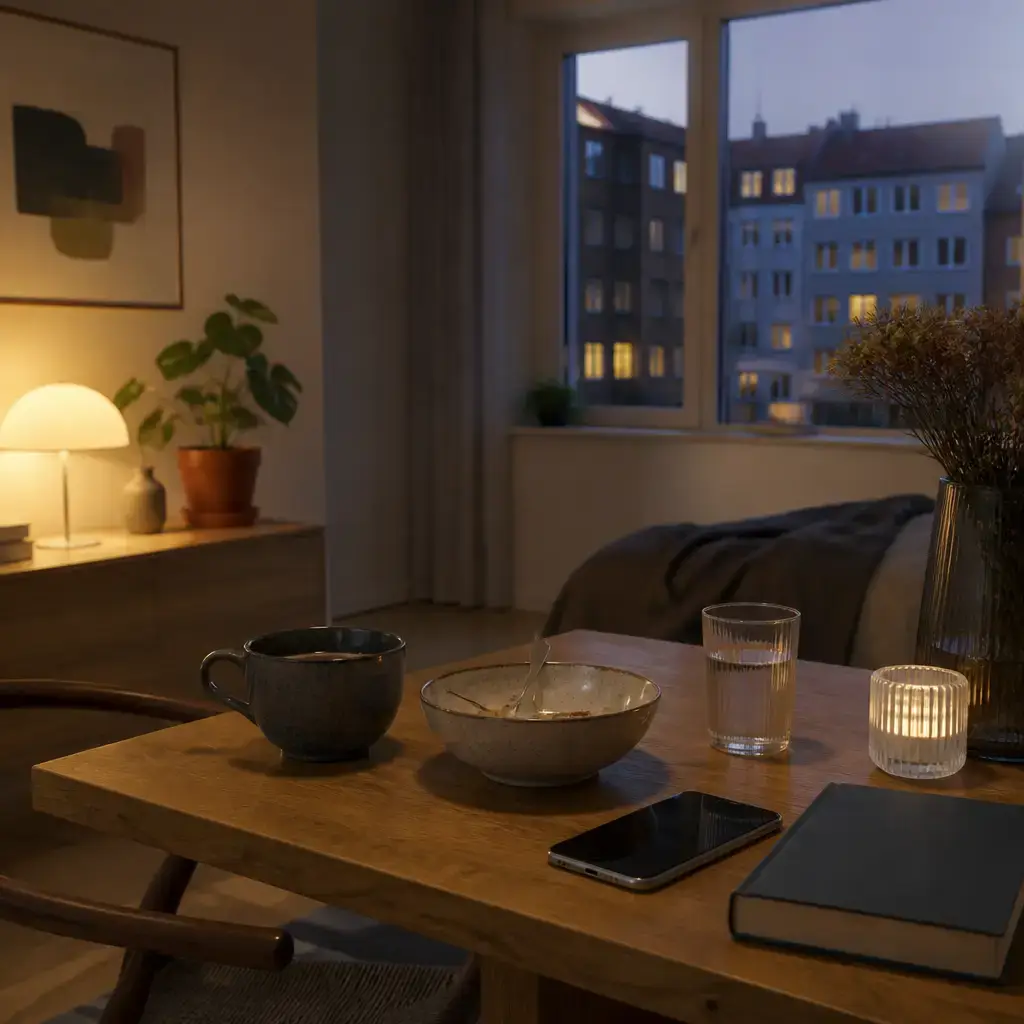
Min søvnkvalitet har været dårlig, selv når jeg går tidligt i seng.
min SUHN-kvah-lee-TEHT hah VEH-uhd DAW-lee, selv nawr yai gohr TEE-lee i seng. My sleep quality has been poor even when I go to bed early.Hvordan ser din aftenrutine ud?
VOH-dan sair deen AF-tun-roo-TEE-nuh ood? What does your evening routine look like?Jeg drikker kaffe efter aftensmaden og tjekker min telefon i sengen.
yai DRIK-uh KAF-uh EF-tuh AF-tuns-MAH-then oh CHEK-uh min teh-foh-LOHN i seng-en. I drink coffee after dinner and check my phone in bed.Både koffein og skærmtid kan gøre det sværere at falde til ro.
BOH-thuh koh-feh-EEN oh SKAIR-mteed kan GUH-uh deth SVAIR-uh-uh at FAL-uh til ROH. Both caffeine and screen time can make it harder to wind down.Jeg kan ikke ændre alt på én gang.
yai kan IK-uh EN-druh aldt poh ain gang. I cannot change everything at once.Begynd med én realistisk ændring, for eksempel at lade være med at drikke kaffe efter aftensmaden.
beh-GUHN meh ain ray-ah-LIS-disg EN-dring, foh eks-EM-bul at LA-thuh VAIR meh at DRIK-uh KAF-uh EF-tuh AF-tuns-MAH-then. Start with one realistic change, like skipping coffee after dinner.Så kan jeg erstatte tiden på telefonen med at læse, før jeg går i seng.
soh kan yai air-STAT-uh TEE-then poh teh-foh-LOHN meh at LAY-suh, fuhr yai gohr i seng. Then I can replace phone time with reading before bed.En rutine, du kan holde fast i, betyder mere end en perfekt rutine.
en roo-TEE-nuh, doo kan HOL-uh fast i, beh-TUE-uh MAIR-uh end en pair-FEKT roo-TEE-nuh. A routine you can keep matters more than a perfect one.Jeg kan prøve det i en kort periode, før jeg vurderer resultatet.
yai kan PROH-vuh deth i en kohrt peh-ree-OH-thuh, fuhr yai VUHR-thuh-uh reh-sul-TAH-thuh. I can test that for a short period before judging the result.Det giver din krop tid nok til at tilpasse sig.
deh GEE-vuh deen krop teed nohg til-PAS-uh sai. That gives your body enough time to adjust.Sentence explanations
Min søvnkvalitet har været dårlig, selv når jeg går tidligt i seng.
My sleep quality has been poor even when I go to bed early.
- Min
- my
- søvnkvalitet
- sleep quality
- har været
- has been
- dårlig
- poor
- selv når
- even when
- går
- go
- tidligt
- early
- i seng
- to bed
More detail
Min means “my” and marks possession. It agrees with the thing possessed: min is used with a common-gender singular noun, while mit is used with a neuter singular noun and mine with plural nouns. Example: min bog = “my book”; mit hus = “my house.” søvnkvalitet is a compound noun meaning “sleep quality”: søvn is “sleep” and kvalitet is “quality.” Danish commonly forms compounds by joining nouns, and the whole compound behaves as one noun. Here it is singular and definite in meaning through the possessive min, without a separate definite article. har været expresses “has been.” It is the present perfect: the auxiliary har plus the past participle været, the form of være (“be”). Danish har does not change for person or number. Compare jeg har været = “I have been” and de har været = “they have been.” dårlig means “poor” here, describing the quality. Its base form is dårlig; the related neuter form is dårligt, and the plural/definite form is commonly dårlige. In this sentence, dårlig agrees with singular common-gender søvnkvalitet after været. Example: Kvaliteten er dårlig. = “The quality is poor.” selv når introduces a condition or time situation that makes the statement notable: “even when.” selv adds the idea “even,” while når introduces “when.” Example: Jeg er træt, selv når jeg sover længe. = “I am tired even when I sleep for a long time.” går means “go” in this sentence. It is the present-tense form of gå (“go”); Danish present forms generally do not change according to the subject, so jeg går is “I go,” while de går is “they go.” In går i seng, the verb is part of the ordinary expression for going to bed. tidligt means “early” and modifies the action går; it is an adverb here. It is related to the adjective tidlig (“early”), but its -t form in this use should not be treated as an adjective agreeing with jeg. Example: Hun kommer tidligt. = “She arrives early.” i seng means “to bed.” Literally, i is “in/to” and seng is “bed,” but together with gå the phrase expresses the destination or activity of going to bed. Example: Jeg går i seng klokken ti. = “I go to bed at ten.” Putting the parts together, Min søvnkvalitet har været dårlig means “My sleep quality has been poor.” The subordinate clause selv når jeg går tidligt i seng adds the condition “even when I go to bed early.” Thus the complete utterance means: “My sleep quality has been poor even when I go to bed early.”
Hvordan ser din aftenrutine ud?
What does your evening routine look like?
- Hvordan
- how
- ser … ud
- looks like
- din
- your
- aftenrutine
- evening routine
More detail
Hvordan means “how” and asks about the manner, form, or characteristics of something. It commonly begins a question: Hvordan har du det? means “How are you?” ser ... ud is the Danish construction meaning “look” or “look like.” The verb is se (“to see”); ser is its present-tense form, used here with the subject din aftenrutine. The separate particle ud completes this construction, so it should not be translated as an independent “out” here. A reusable pattern is Hvordan ser X ud? — “What does X look like?” or “What is X like?” din means “your” when addressing one person and modifying a singular common-gender noun. Danish possessives agree with the possessed noun: din with common-gender singular, dit with neuter singular, and dine with plural nouns. The form expresses possession, not a number by itself beyond the singular form of the noun it modifies. aftenrutine is a compound noun meaning “evening routine.” Its parts are aften (“evening”) and rutine (“routine”), but the complete compound is the natural word for the repeated activities or pattern associated with someone’s evening. It is a common-gender noun: en aftenrutine; its plural is aftenrutiner. Together, Hvordan + ser ... ud asks what something is like, while din aftenrutine identifies the thing being asked about. The complete utterance therefore means: “What does your evening routine look like?” In this question, “look like” asks for a description of the routine, not necessarily its visual appearance.
Jeg drikker kaffe efter aftensmaden og tjekker min telefon i sengen.
I drink coffee after dinner and check my phone in bed.
- drikker
- drink
- kaffe
- coffee
- efter
- after
- aftensmaden
- the evening meal
- tjekker
- check
- telefon
- phone
- sengen
- the bed
More detail
drikker is the present-tense form of drikke, “to drink.” Danish present-tense verbs do not change according to the subject: jeg drikker means “I drink,” while de drikker means “they drink.” Here it states a present-tense routine, not a command. kaffe means “coffee.” It is commonly used as an uncountable substance noun, so this sentence does not specify one cup or a particular number of cups. For a countable serving, Danish can use en kop kaffe, “a cup of coffee.” efter means “after” and introduces what follows in time. The pattern efter + noun is reusable: efter arbejde means “after work.” aftensmaden means “the evening meal” or, naturally here, “dinner.” It is the definite singular form of aftensmad: aftensmad is “evening meal,” while aftensmaden is “the evening meal.” The ending -en marks common-gender definite singular in this noun. Example: Efter aftensmaden læser jeg. — “After dinner, I read.” tjekker is the present-tense form of tjekke, “to check.” Like drikker, it has the same present form with different subjects: jeg tjekker and hun tjekker both mean “I/she checks” according to the subject. In this sentence, it introduces the second activity joined to the first one. telefon means “phone” or “telephone.” In the sentence, min telefon means “my phone”: min is the possessive word, while telefon is the noun. Example: Jeg tjekker min telefon. — “I check my phone.” sengen means “the bed.” It is the definite singular form of seng: seng is “bed,” and sengen is “the bed.” The preposition i before it creates i sengen, “in bed.” In this fixed sentence, sengen is definite because the phrase refers to the bed as a familiar setting, while the translation’s “in bed” is the natural English rendering. The first chunk, Jeg drikker kaffe efter aftensmaden, means “I drink coffee after dinner.” Jeg is the subject, drikker expresses the drinking activity, kaffe is what is consumed, and efter aftensmaden places it after dinner. The conjunction og then joins a second coordinated action: tjekker min telefon i sengen, “check my phone in bed.” Together, the utterance says: “I drink coffee after dinner and check my phone in bed.”
Både koffein og skærmtid kan gøre det sværere at falde til ro.
Both caffeine and screen time can make it harder to wind down.
- Både
- both
- koffein
- caffeine
- skærmtid
- screen time
- kan
- can
- gøre
- make; do
- sværere
- harder
- falde til ro
- wind down; settle down
More detail
Både introduces two coordinated items and means that the statement applies to each of them: både A og B = “both A and B.” It is used together with og, which appears after koffein. koffein means caffeine here. It is a mass noun, so it names the substance rather than one countable item. Example: Koffein kan holde mig vågen. — “Caffeine can keep me awake.” skærmtid is a compound noun: skærm means “screen” and tid means “time,” giving “screen time.” Danish compounds are written as one word. Example: Min skærmtid er høj om aftenen. — “My screen time is high in the evening.” kan is the modal verb “can” in the present tense. It is followed by the infinitive without at, as in kan gøre (“can make”). The same form is used with different subjects; the subject is identified by the surrounding sentence, not by a special ending on kan. gøre is the infinitive of gøre, “to do” or “to make.” In this sentence it is causative: it means “make” in the pattern gøre det + adjective + at-clause — “make it [adjective] to …” Example: Det gør arbejdet lettere. — “It makes the work easier.” sværere is the comparative form of the adjective svær, “difficult” or “hard”: svær → sværere → sværest (“hard” → “harder” → “hardest”). Here it compares the action of winding down with a more difficult alternative. The following at-clause states what is difficult. falde til ro is an idiomatic verb phrase meaning “to settle down” or “to wind down.” falde itself means “fall,” but in this expression the combined meaning is not a literal physical fall. In the sentence, at before the phrase marks the infinitive: at falde til ro = “to wind down.” Example: Jeg prøver at falde til ro. — “I am trying to wind down.” Together, både koffein og skærmtid is the coordinated subject: both caffeine and screen time are included. kan gøre det sværere says that they can make something more difficult, with det functioning in the Danish “make it … to …” construction. Finally, at falde til ro identifies the affected activity. The complete meaning is: “Both caffeine and screen time can make it harder to wind down.”
Jeg kan ikke ændre alt på én gang.
I cannot change everything at once.
- Jeg
- I
- kan
- can; be able to
- ikke
- not
- ændre
- change
- alt
- everything
- på én gang
- at once
More detail
Jeg means “I” here: it is the first-person singular subject pronoun. Danish subject pronouns change with person and number; for example, jeg is “I,” while vi is “we.” kan is the present-tense form of kunne, “can” or “be able to.” In this sentence it expresses ability or possibility. A modal such as kan is followed by an infinitive without at: Jeg kan ændre ... means “I can change ...” Example: Jeg kan hjælpe. — “I can help.” ikke is the ordinary negation word “not.” In this main clause it follows the finite modal kan: kan ikke. Together, kan ikke means “cannot” in the fixed sentence. Example: Jeg kan ikke komme. — “I cannot come.” ændre is the infinitive of “to change” or “to alter.” It follows kan without at. The infinitive itself does not show the subject; kan carries the present-tense form in this construction. Example: Vi kan ændre planen. — “We can change the plan.” alt means “everything” here. It is a standalone pronoun referring broadly to all relevant things, not to a specifically named object. A useful contrast is alle, which is used for all people or plural countable things, whereas alt is used for “everything” as a whole. Example: Hun ved alt. — “She knows everything.” på én gang is a reusable expression meaning “at once” or “all at the same time.” The én spelling emphasizes “one” in this expression, but the complete phrase describes simultaneity rather than adding a separate object. Example: Gør ikke alt på én gang. — “Do not do everything at once.” The sentence assembles as Jeg + kan ikke + ændre + alt + på én gang: “I cannot change everything at once.” The subject is the speaker, kan ikke ændre expresses inability to change, alt is what cannot all be changed, and på én gang specifies that the changes cannot happen simultaneously.
Begynd med én realistisk ændring, for eksempel at lade være med at drikke kaffe efter aftensmaden.
Start with one realistic change, like skipping coffee after dinner.
- Begynd
- begin
- én
- one
- realistisk
- realistic
- ændring
- change
- for eksempel
- for example
- lade være med
- refrain from
- drikke
- drink
- kaffe
- coffee
- aftensmaden
- the dinner
More detail
Begynd is the imperative of begynde (“to begin”). It gives a direct instruction or suggestion. Danish imperatives do not mark the person or number of the person addressed. Example: Begynd nu. — “Start now.” én means “one” here and emphasizes a single change. The accent distinguishes this numeral from the common-gender indefinite article en, as in en ændring (“a change”). én states the number; the article alone does not. realistisk means “realistic” here and describes ændring. The form is the same with a singular common-gender noun and a singular neuter noun. In plural or definite forms, the adjective is commonly realistiske, depending on the construction. ændring means “change” and is a noun related to the verb ændre (“to change”). Its indefinite singular form is en ændring, and its definite singular form is ændringen (“the change”). These are different grammatical forms of a noun and a verb, even though they belong to the same word family. for eksempel is the expression “for example.” It introduces a concrete instance of the broader idea. Example: Prøv en ny vane, for eksempel at gå en tur. — “Try a new habit, for example going for a walk.” lade være med is a reusable construction meaning “refrain from” or “not do.” It is followed by at plus an infinitive: lade være med at + verb. Here, lade være med at drikke means “refrain from drinking,” matching “skip drinking” in the fixed translation. drikke is the infinitive “to drink” after at. Its present-tense form is drikker, not drikke: Jeg prøver at drikke mere vand. — “I try to drink more water.” kaffe means “coffee.” It appears without an article here because the sentence refers to coffee as a drink in general rather than to one separately counted serving. Example: Jeg drikker kaffe om morgenen. — “I drink coffee in the morning.” aftensmaden means “the dinner” or “the evening meal.” It is the definite singular form of aftensmad: aftensmad means “dinner/evening meal,” while aftensmaden refers to the meal as definite. With efter, efter aftensmaden means “after dinner.” The utterance begins with Begynd med (“Start with”), then specifies én realistisk ændring (“one realistic change”). for eksempel introduces the example at lade være med at drikke kaffe efter aftensmaden (“skipping coffee after dinner”). Together, the sentence means: “Start with one realistic change, like skipping coffee after dinner.”
Så kan jeg erstatte tiden på telefonen med at læse, før jeg går i seng.
Then I can replace phone time with reading before bed.
- Så
- then
- kan jeg
- I can
- erstatte
- replace
- tiden
- the time
- telefonen
- the phone
- at læse
- to read; reading
- før
- before
- går
- go
- i seng
- to bed
More detail
Så means “then” here and links this sentence to a consequence or next step. It can also mean “so” in other contexts, but this sentence uses it as a time or sequence marker. kan jeg combines the modal verb kan (“can”) with the subject jeg (“I”). Danish main clauses normally place the finite verb in the second position, so after initial Så, the order is kan jeg, not jeg kan. kan is the present form of kunne; it expresses ability or possibility here. erstatte is the infinitive “replace”. After the modal kan, Danish uses the infinitive without another infinitive marker: kan jeg erstatte (“I can replace”). A useful reusable pattern is erstatte X med Y, meaning “replace X with Y”. tiden means “the time” in this sentence. The ending -en marks the common-gender definite singular form of tid (“time”): en tid means “a time”, while tiden means “the time”. Here it refers to the time spent on the phone, not to a specific clock time. telefonen means “the phone”. It is the definite singular form of telefon: en telefon → telefonen. Together with the preceding preposition, tiden på telefonen means “the time on the phone” or, more naturally, “phone time”. The noun telefonen itself names the phone; the surrounding phrase gives the intended relation to the time. at læse consists of the infinitive marker at and læse, “read”. The whole infinitive phrase functions as the replacement activity: “reading”. The verb læse keeps this form after at; for example, Jeg kan lide at læse means “I like reading.” før means “before” and introduces the time clause that follows. It can connect one event to another: før jeg går means “before I go”. går is the present form of gå, “go”. With the subject jeg, it means “I go” here. Danish uses the present form in this subordinate time clause even though the larger sentence describes a future or intended routine: før jeg går i seng means “before I go to bed”. i seng is the usual expression for “to bed”. The preposition i literally relates to being “in”, while seng means “bed”; together, gå i seng is the ordinary phrase “go to bed”. It does not identify a particular bed beyond the situation’s intended bedtime routine. The sentence builds as Så + kan jeg + erstatte X med Y + før jeg går i seng: “Then I can replace X with Y before I go to bed.” Here X is tiden på telefonen (“phone time”), and Y is at læse (“reading”), so the complete meaning is: “Then I can replace phone time with reading before bed.”
En rutine, du kan holde fast i, betyder mere end en perfekt rutine.
A routine you can keep matters more than a perfect one.
- rutine
- routine
- du kan
- you can
- holde fast i
- keep to
- betyder
- means
- mere end
- more than
- perfekt
- perfect
More detail
rutine means “routine” here: a repeated way of doing something. It is a common-gender noun, so the indefinite article is en: en rutine. The same noun appears again at the end; English can avoid repetition with “one,” but Danish repeats rutine here. du kan means “you can.” du is the subject form for “you” when addressing one person, and kan is the present-tense form of kunne (“can; be able to”). After a modal such as kan, Danish uses the infinitive without at: du kan holde, “you can keep to.” holde fast i is a reusable expression meaning “keep to” or “stick to” something. Its literal parts are holde (“hold”), fast (“firm/tight”), and i (“to/in”), but together they express continuing to follow or maintain something. Example: Jeg holder fast i planen. — “I’m sticking to the plan.” The clause du kan holde fast i is placed between commas after rutine and describes which routine is meant: a routine that you are able to stick to. The relative word is not stated separately; the clause directly follows the noun it describes. betyder means “means” or, in this comparison, “matters.” It is the present-tense form of betyde. Danish present-tense verbs do not change form for singular versus plural subjects, so betyder is compatible with the singular subject En rutine ...; the form itself does not mark that number. mere end introduces a comparison: “more than.” mere is the comparative form of meget (“much/a lot”); the useful chain is meget → mere → mest (“much” → “more” → “most”). Here it compares the value of a routine that can be maintained with the value of a perfect routine. perfekt means “perfect.” In en perfekt rutine, it describes the noun rutine; perfekt has no extra ending with this singular common-gender noun. With a plural noun, Danish commonly uses perfekte, as in perfekte rutiner (“perfect routines”). The full structure is En rutine, [du kan holde fast i], betyder mere end en perfekt rutine: “A routine [you can stick to] matters more than a perfect routine.” The first noun is specified by the embedded clause, and the comparison then sets it against en perfekt rutine. The fixed translation’s “one” refers to the repeated idea of a routine; the Danish sentence expresses that idea by repeating the noun.
Jeg kan prøve det i en kort periode, før jeg vurderer resultatet.
I can test that for a short period before judging the result.
- Jeg kan
- I can
- prøve
- test; try
- det
- that; it
- i
- for (a period of time)
- kort
- short
- periode
- period
- før
- before
- vurderer
- judge; assess
- resultatet
- the result
More detail
Jeg kan combines the first-person pronoun Jeg (“I”) with the modal verb kan, the present form of kunne (“can; be able to”). After kan, Danish normally uses an infinitive without at: Jeg kan prøve means “I can test/try.” prøve is the infinitive “to try” or “to test.” Here it means testing something in practice. The same form can introduce an attempt more generally, for example Jeg vil prøve igen — “I will try again.” det is a neuter singular pronoun meaning “it” or “that.” In this sentence it refers to the thing being tested, without naming that thing. Its grammatical form is neuter singular; the form itself does not identify a more specific referent. i introduces the duration of the trial: i en kort periode means “for a short period.” Danish also uses i for many time spans, as in i to uger — “for two weeks.” kort means “short.” It modifies periode here and has the form kort with this noun. Its comparison is kort (short), kortere (shorter), kortest (shortest): en kortere periode means “a shorter period.” periode is the noun “period” or “period of time.” Its base form is periode; the indefinite singular is en periode, and the definite singular is perioden, “the period.” før means “before” and introduces the later event used as the time reference. It can connect two clauses: Læs instruktionerne, før du begynder — “Read the instructions before you begin.” vurderer is the present-tense form of vurdere, “to assess” or “to judge.” With the subject jeg, it means “I assess/judge.” Danish present tense does not add a special ending here for first person: jeg vurderer, du vurderer, and de vurderer use the same present form. resultatet means “the result.” The base noun is resultat; resultatet is its definite singular form, marked by -et. The sentence therefore refers to assessing the result as a specific result, rather than merely assessing results in general. Together, Jeg kan prøve det says “I can test that,” and i en kort periode specifies the duration. før jeg vurderer resultatet says that the assessment happens afterward: “before I judge the result.” The complete utterance is: “I can test that for a short period before judging the result.”
Det giver din krop tid nok til at tilpasse sig.
That gives your body enough time to adjust.
- Det
- that
- giver
- gives
- din
- your
- krop
- body
- tid
- time
- nok
- enough
- til at
- to
- tilpasse sig
- adjust
More detail
Det means “that” here and functions as the subject. Danish det is the singular neuter form; in this sentence, the translation identifies its intended meaning as “that”. giver is the present-tense form of give, “to give”. Danish present tense commonly uses the same verb form across subjects: jeg giver = “I give”, de giver = “they give”. din means “your” before a singular common-gender noun. It agrees with krop in number and noun gender; it is not the form used before a singular neuter noun. For example, din bog means “your book”, while dit hus means “your house”. krop means “body”. Its indefinite form is en krop, and its definite form is kroppen, “the body”. tid means “time”. In this sentence it refers to an uncounted amount of time, not a particular counted occasion. tid nok is the reusable pattern “enough time”, with nok following the noun here. Example: Jeg har tid nok. means “I have enough time.” nok means “enough” in this phrase. Here it expresses that the amount of tid is sufficient. til at introduces an infinitive clause after an expression such as tid nok: tid nok til at ... means “enough time to ...”. at marks the infinitive, while til links the time to the activity. tilpasse sig means “adjust” or “adapt”. This is an infinitive reflexive construction: tilpasse is the verb, and sig is the reflexive pronoun for the subject of the infinitive clause. Example: Kroppen skal tilpasse sig. means “The body must adjust.” Together, Det giver means “That gives”, din krop means “your body”, and tid nok til at tilpasse sig means “enough time to adjust”. The complete utterance therefore means: “That gives your body enough time to adjust.”
Grammar Points
lade være med at + infinitiv
Lad være med at drikke kaffe efter aftensmaden.
LA-thuh VAIR meh at DRIK-uh KAF-uh EF-tuh AF-tuns-MAH-then.Refrain from drinking coffee after dinner.
This fixed expression means “refrain from” and is followed by med at plus the infinitive.
Når + sætning, verballed + subjekt
Når du går i seng, drikker du ikke kaffe.
Nawr doo gohr i seng, DRIK-uh doo IK-uh KAF-uh.When you go to bed, you do not drink coffee.
After a fronted når-clause, Danish uses V2 word order: the verb comes before the subject.
Danish Vocabulary
- Gender
- common
- Gender
- common
- Gender
- common
- Gender
- common
Quiz
Word Order
Arrange the words in the correct order.
What does your evening routine look like?
Show Answer
Hvordan ser din aftenrutine ud?Spelling
Tap the letters to spell the word.
even
Show Answer
selvpoor; bad
Show Answer
dårlighow
Show Answer
hvordandrink