10 minutes free every day
Continue audio lessons in the app
Word explanations appear automatically in sync with the audio.
No login required · synced translations · playback with the screen locked
Choose your learning language and open this lesson in the app.

About This Lesson
Use A calm message about shared kitchen rules to practice Danish conversation, pronunciation, vocabulary, grammar, and quizzes.
Dialogue
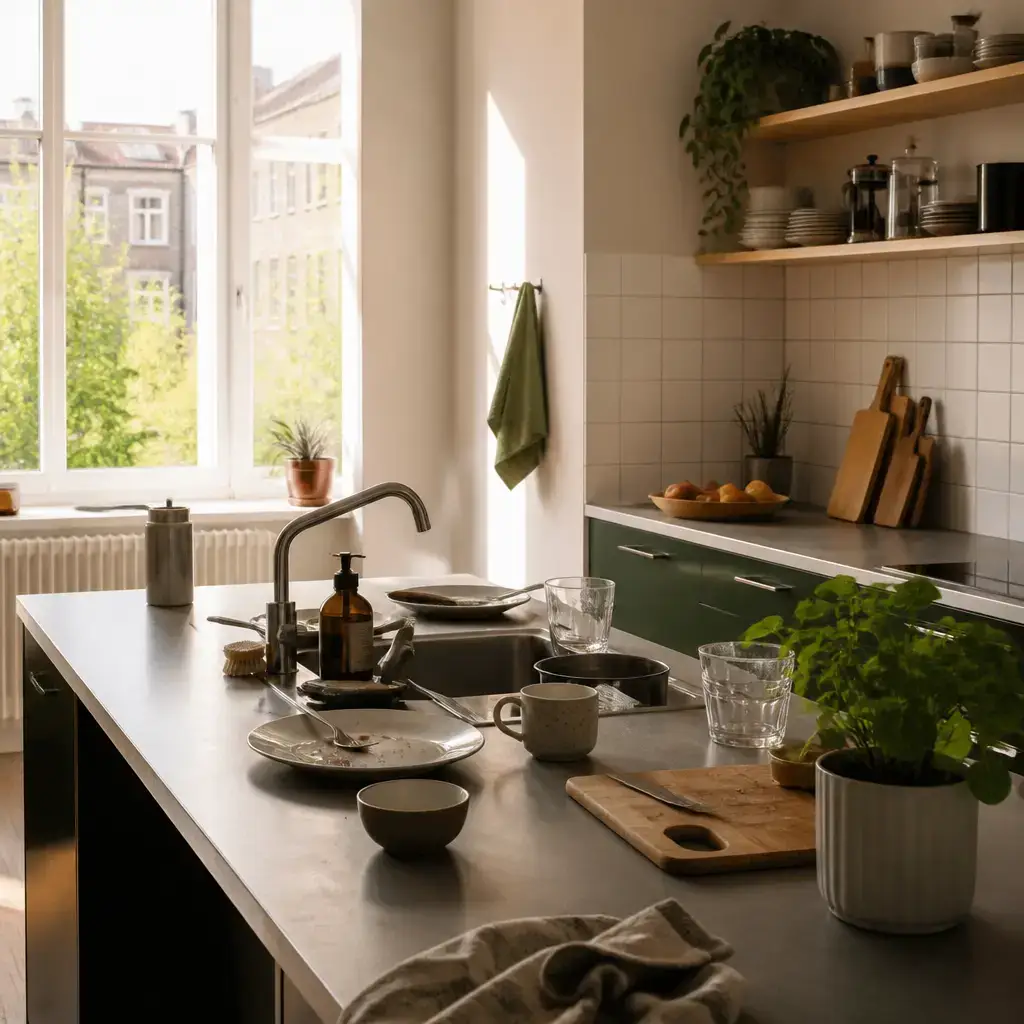
Det fælles køkken blev igen efterladt rodet efter aftensmaden.
deh FEL-uhs KUR-gən bleh weer-EN EF-tuh-lath ROH-uhth EF-tuh AWF-tens-MAY-un. The shared kitchen was left messy again after dinner.Vi bør tage det op uden at give én person skylden.
vee BUR TAY-uh deh OHB OO-un eh GEE-vuh ayn peh-SOHN SGUL-un. We should bring it up without blaming one person.Måske ville en påmindelse om rengøringsansvaret hjælpe.
MOH-sguh VIL-uh en paw-MIN-uhl-suh ohm RANG-uh-rings-ahn-SVAH-uh YEL-buh. Maybe a reminder about cleaning responsibilities would help.Gør den konkret ved at nævne opvasken, køkkenbordene og skraldet.
GUR dehn kon-KRAYD veh eh NEV-nuh OHB-vahs-kən, KUR-gən-BOR-də-nuh aw SGRAHL-uh. Make it specific by mentioning dishes, counters, and trash.Skal vi lægge en rengøringsplan op eller tage det op i gruppechatten først?
sgal vee LEG-uh en RANG-uh-rings-PLAhn ohb EL-uh TAY-uh deh OHB ee GROO-buh-chat-un furst? Should we post a schedule or talk in the group chat first?Start med en rolig besked, så den ikke virker aggressiv.
stahd meh en ROH-lee beh-SGAYD, soh dehn IK-uh VEER-kuh ah-greh-SEEW. Start with a calm message so it does not feel aggressive.Beskeden kan bede alle om at respektere fællesområdet.
beh-SGAY-un kan BAY-uh AL-uh ohm eh reh-spehk-TAY-uh FEL-uhs-OM-roh-uh. The message can ask everyone to respect the shared space.Brug rolige formuleringer, og undgå ord som altid og aldrig.
broo ROH-lee-uh for-moo-LAY-rin-uh, aw OON-goh oh som AL-tee aw AL-dree. Use calm wording and avoid words like always and never.På den måde lyder beskeden ikke som et angreb.
poh dehn MOH-uh LOO-uh beh-SGAY-un IK-uh som ed AN-grehb. That keeps the message from sounding like an attack.Klare køkkenregler virker bedre, når tonen forbliver respektfuld.
KLAY-uh KUR-gən-RAY-luh VEER-kuh BEH-duh, nawr TOH-nun for-BLEE-vuh reh-spehk-FOOL. Clear kitchen rules work better when the tone stays respectful.Sentence explanations
Det fælles køkken blev igen efterladt rodet efter aftensmaden.
The shared kitchen was left messy again after dinner.
- Det
- the
- fælles
- shared
- køkken
- kitchen
- blev … efterladt
- was left
- igen
- again
- rodet
- messy
- efter
- after
- aftensmaden
- dinner
More detail
Det is the definite article used before an adjective in this noun phrase. With a neuter singular noun such as køkken, Danish uses det: det store køkken means “the big kitchen.” Here it is not a standalone pronoun; it helps make the whole phrase definite. fælles means “shared” here. It is an adjective that can describe something used or belonging to more than one person. Its form stays fælles in this phrase; the noun’s gender is shown by det, not by a change in fælles. køkken means “kitchen.” It is a neuter noun, as shown by det. The definite form without a preceding adjective is køkkenet, “the kitchen”; after det plus an adjective, the noun remains in the form køkken, as in det fælles køkken. blev and efterladt form a past passive construction. blev is the past form of blive, and efterladt is the past participle of efterlade, “leave.” Together, blev efterladt means “was left.” The passive states what happened to the kitchen without identifying who left it that way. Compare present passive bliver efterladt, “is left,” with the past form used here. igen means “again.” It says that the leaving in this sentence happened again, without specifying in this sentence how many earlier occurrences there were. rodet means “messy” here. It describes the resulting condition of køkken after it was left. The adjective form is also rodet with a neuter singular noun: et rodet køkken, “a messy kitchen.” With a common-gender noun, the same form is used in the basic singular: en rodet stue, “a messy living room.” efter means “after” when it introduces a later time in relation to an event or period. It is a preposition here, linking the situation to aftensmaden. aftensmaden means “dinner” or “the evening meal.” It is the definite form of aftensmad: the suffix -en marks a common-gender singular noun as definite. Thus aftensmad is “dinner” as a meal, while aftensmaden refers to the relevant dinner or evening meal in this sentence. The chunks combine as det fælles køkken (“the shared kitchen”) + blev efterladt (“was left”) + igen (“again”) + rodet (“messy”) + efter aftensmaden (“after dinner”). The complete meaning is: “The shared kitchen was left messy again after dinner.”
Vi bør tage det op uden at give én person skylden.
We should bring it up without blaming one person.
- Vi bør
- we should
- tage det op
- bring it up
- uden at
- without …ing
- give
- give
- én
- one
- person
- person
- skylden
- the blame
More detail
Vi bør means “we should.” Vi is the first-person plural pronoun “we.” Bør expresses present advice, duty, or what is advisable; it does not change for person or number. Its related past-form modal is burde, as in Vi burde tale om det — “We ought to talk about it.” tage det op is a reusable expression meaning to raise or address an issue. Tage is the infinitive of tage (“take”), while det is the neuter singular pronoun “it” and op is a particle. Together, they do not mean a literal physical act here. Example: Hun tager problemet op — “She raises the problem.” uden at introduces an action that is avoided: “without doing …”. Danish uses at plus the infinitive after uden at, rather than changing the verb to a special “-ing” form. Example: Han gik uden at sige noget — “He left without saying anything.” give is the infinitive of give (“give”). In the construction give nogen skylden, the person receiving the blame is expressed as nogen, and the construction means “blame someone.” Example: De gav ham skylden — “They blamed him.” én means “one” here and emphasizes a single person. The accent distinguishes this numeral from the unstressed article-like form en in contexts where that distinction matters. It states the number one in én person; it does not by itself identify who that person is. person means “person.” It is a common-gender noun: en person means “a person,” personen means “the person,” and personer means “people/persons.” The noun’s form, not én, marks the noun’s grammatical gender. skylden means “the blame” in this expression. It is the definite form of skyld, “blame” in this sense: skyld → skylden. The definite form fits the established construction give nogen skylden; it is not the same as simply using an indefinite noun. The structure is Vi bør + tage det op + uden at + give + én person + skylden: “We should bring it up without blaming one person.” The subject is “we,” bør gives the recommendation, tage det op identifies what should be addressed, and uden at give … skylden specifies the way to do it without assigning blame to a single person.
Måske ville en påmindelse om rengøringsansvaret hjælpe.
Maybe a reminder about cleaning responsibilities would help.
- Måske
- maybe
- ville
- would
- påmindelse
- reminder
- rengøringsansvaret
- the cleaning responsibility
- hjælpe
- help
More detail
Måske means “maybe” and marks the statement as uncertain rather than asserting that the reminder will help. It can also begin other sentences: Måske kommer hun i morgen. — “Maybe she is coming tomorrow.” ville is the form of vil used here with a following infinitive to express “would”: ville hjælpe means “would help.” In this construction, ville presents the result as hypothetical or tentative. Danish also uses vil in other contexts for meanings such as “will” or “want,” so the surrounding infinitive and the context determine the reading here. påmindelse means “reminder.” It is a common-gender noun, so its indefinite singular form appears with en: en påmindelse. This article marks an indefinite noun, not a stated numerical count. The definite singular form is påmindelsen. Example: Jeg sender en påmindelse. — “I am sending a reminder.” rengøringsansvaret is the definite form of the compound noun rengøringsansvar, meaning “cleaning responsibility” or “responsibility for cleaning.” The compound’s head is ansvar; the ending -et marks its definite singular form, giving the intended meaning “the cleaning responsibility.” The first part, rengørings-, specifies the area of responsibility. Example: Vi deler rengøringsansvaret. — “We share the cleaning responsibility.” hjælpe is the infinitive “help.” After the modal ville, Danish uses the infinitive without an infinitive marker: ville hjælpe — “would help.” The same verb can occur independently in a present-tense form such as hjælper: En kort besked hjælper. — “A short message helps.” The connector om links en påmindelse to what the reminder concerns: en påmindelse om rengøringsansvaret means “a reminder about the cleaning responsibility.” The complete structure is Måske + ville + subject noun phrase + hjælpe: “Maybe a reminder about the cleaning responsibilities would help.” It presents the reminder as a possible useful measure, without asserting that it definitely will help.
Gør den konkret ved at nævne opvasken, køkkenbordene og skraldet.
Make it specific by mentioning dishes, counters, and trash.
- Gør
- make
- den
- it
- konkret
- specific
- ved at
- by
- nævne
- mention
- opvasken
- dishes
- køkkenbordene
- counters
- skraldet
- trash
More detail
Gør is the imperative of gøre (“to make/do”). Here it tells the addressee to make something more specific. The imperative is used for a direct instruction; for example, Gør det enkelt. means “Make it simple.” Den is the singular common-gender object pronoun meaning “it” here. The fixed translation identifies the intended object as “it”; the pronoun itself does not name that object. Danish uses den for a common-gender singular referent and det for a neuter singular referent. Konkret means “specific” or “concrete.” With gøre, the pattern gøre noget konkret means “make something specific/concrete.” The adjective is konkret; it is not derived from the nearby pronoun. Example: Vi gør planen konkret. — “We make the plan specific.” Ved at introduces the method used to achieve something: “by …-ing.” It is followed here by an infinitive. The reusable pattern is ved at + infinitive, as in Hun lærer ved at øve sig. — “She learns by practising.” Nævne is the infinitive of nævne, “to mention.” In this sentence, ved at nævne means “by mentioning.” Example: Prøv at nævne tre eksempler. — “Try to mention three examples.” Opvasken is the definite singular form of opvask, referring here to “the dishes” as a household task or body of dishes. The ending -en marks definite common-gender singular: opvask → opvasken. This is different from the indefinite form en opvask, which means “a load/batch of dishes” rather than asserting a specific quantity in general. Køkkenbordene is the definite plural of køkkenbord (“kitchen counter”): køkkenbord → køkkenborde → køkkenbordene. The ending -ene marks definite plural. Thus it refers to the kitchen counters as specific items, translated here as “counters.” Skraldet is the definite singular form of skrald, “trash” or “rubbish”: skrald → skraldet. The ending -et marks definite singular for this neuter noun. In this utterance it names the trash as another concrete topic to mention. Together, Gør den konkret means “Make it specific.” Ved at nævne gives the method, “by mentioning,” and the three definite noun forms list concrete examples: opvasken, køkkenbordene and skraldet. The whole utterance therefore means: “Make it specific by mentioning dishes, counters, and trash.”
Skal vi lægge en rengøringsplan op eller tage det op i gruppechatten først?
Should we post a schedule or talk in the group chat first?
- Skal vi
- shall we
- lægge … op
- post / put up
- rengøringsplan
- cleaning schedule
- tage … op
- discuss / bring up
- gruppechatten
- the group chat
- først
- first
More detail
Skal vi asks about a joint action: “shall/should we …?” Skal is the present form of skulle, used here with the infinitive to express a proposal or question about what to do. Vi means “we”; together, the phrase is a reusable way to suggest an action involving the speaker and others. lægge ... op is a separable verb construction. The base verb is lægge (“put/place”), and op adds the idea of putting something up or posting it. In this sentence, lægge follows skal, so it remains in the infinitive. The object en rengøringsplan comes between the two parts: lægge en rengøringsplan op. Example: Vi lægger beskeden op. — “We post the message.” Rengøringsplan is a compound noun meaning a plan or schedule for cleaning. Its parts are rengøring (“cleaning”) and plan (“plan”), but the compound functions as one noun. En is an indefinite article; here it presents a cleaning schedule without asserting a numerical count. Tage ... op is another separable construction. Tage is the infinitive of tage (“take”), and op gives the expression the meaning “bring up” or “discuss” when the topic is an issue. The pronoun det appears between the two parts: tage det op. Here it refers to the topic under discussion without the supplied sentence identifying a more specific noun. Example: Vi tager problemet op. — “We discuss the problem.” Gruppechatten means “the group chat.” The noun is gruppechat with the definite ending -en, which marks it as definite. The first part, gruppe, specifies the type of chat; the full compound is the noun being referred to. Først means “first” and places one proposed action before the other in sequence. It applies to the alternatives joined by eller: posting a cleaning schedule or discussing the matter in the group chat. Assembled, Skal vi lægge en rengøringsplan op eller tage det op i gruppechatten først? asks whether the participants should post a cleaning schedule or discuss the matter in the group chat first. The question presents two possible actions and asks which should happen first.
Start med en rolig besked, så den ikke virker aggressiv.
Start with a calm message so it does not feel aggressive.
- Start
- start
- med
- with
- rolig
- calm
- besked
- message
- så
- so that
- den
- it
- ikke
- not
- virker
- feels
- aggressiv
- aggressive
More detail
Start is the imperative of starte (“to start”). It gives a direct instruction. The present-tense form is starter: Jeg starter nu means “I am starting now.” med means “with” and introduces what the action begins with. Here it combines with en rolig besked: “with a calm message.” rolig means “calm” here and describes besked. The noun besked is common gender, shown by en besked, so the adjective has the common-gender singular form rolig. With a neuter singular noun, the form is generally roligt, and with plural nouns it is rolige. besked means “message.” Its plural is beskeder: to beskeder means “two messages.” The indefinite article en marks this as an indefinite noun phrase; it does not by itself state a numerical count. så introduces the result or purpose clause “so that …”. A reusable pattern is ..., så [clause], as in Tal roligt, så alle kan høre dig. — “Speak calmly so everyone can hear you.” den is a third-person singular pronoun with common-gender form. In this sentence, it refers to besked, so the clause says that the message does not seem aggressive. Danish uses den for a common-gender singular referent and det for a neuter singular referent; the choice follows the grammatical gender of the referent, not simply its physical identity. ikke is the ordinary negation word “not.” It negates the following proposition here: the message does not seem aggressive. Its scope is understood from the clause den ikke virker aggressiv. virker is the present-tense, third-person singular form of virke, “to seem” or “to appear” in this use. Den virker rolig means “It seems calm.” The same verb can also mean “work” in another context, but the adjective aggressiv makes the “seem” meaning relevant here. aggressiv means “aggressive” and describes how the message appears. In this clause it is a predicative adjective after virker, rather than an adjective placed directly before a noun. Its common-gender singular form is aggressiv; useful related forms include neuter singular aggressivt and plural aggressive. Together, Start med en rolig besked means “Start with a calm message.” The clause så den ikke virker aggressiv adds the intended result: “so it does not seem aggressive.” The complete utterance is therefore: “Start with a calm message so it does not feel aggressive.”
Beskeden kan bede alle om at respektere fællesområdet.
The message can ask everyone to respect the shared space.
- Beskeden
- the message
- kan
- can; is able to
- bede
- ask; request
- alle
- everyone
- om at
- to; in order to
- respektere
- respect
- fællesområdet
- the shared space
More detail
Beskeden means “the message” here. It is the definite singular form of besked (“message”): en besked = “a message”, beskeden = “the message”. The ending -en marks definiteness for this common-gender noun. kan expresses present ability or possibility: “can” or “is able to”. It is a modal verb, and the following verb appears in the infinitive without at: kan bede = “can ask”. For example, Hun kan hjælpe. means “She can help.” bede is the infinitive of “to ask/request”. A useful pattern is bede nogen om at gøre noget, literally “ask someone to do something”. In this sentence, the person or group being asked is introduced by alle, while om at respektere ... states the requested action. alle means “everyone” here. It refers to all relevant people as a group and does not itself state a particular numerical count. It can also occur in a pattern such as Alle kommer. — “Everyone is coming.” om at introduces the action requested after bede: bede ... om at respektere ... = “ask ... to respect ...”. The at belongs with the following infinitive, while om is part of the verb pattern bede om. respektere is the infinitive “to respect”. It follows the modal kan indirectly through the infinitival request construction: kan bede ... om at respektere .... For example, De beder os om at lytte. means “They ask us to listen.” fællesområdet means “the shared space” here. It is the definite singular form of the compound noun fællesområde: et fællesområde = “a shared space”, fællesområdet = “the shared space”. The neuter noun uses -et for definiteness; this is the noun’s form, not an inflection of fælles. Together, Beskeden kan bede alle om at respektere fællesområdet means “The message can ask everyone to respect the shared space.” The structure is subject + modal + infinitive + people asked + bede om at + requested action + object: Beskeden + kan bede + alle + om at respektere fællesområdet.
Brug rolige formuleringer, og undgå ord som altid og aldrig.
Use calm wording and avoid words like always and never.
- Brug
- use
- rolige
- calm
- formuleringer
- wording
- undgå
- avoid
- ord
- words
- altid
- always
- aldrig
- never
More detail
Brug is the imperative of bruge, “to use.” The imperative gives a direct instruction and normally has no stated subject: Brug korte sætninger. — “Use short sentences.” rolige means “calm” here. It is the form of the adjective rolig used with the plural noun formuleringer; Danish adjectives also use this form with definite noun phrases. Compare rolig with a singular indefinite noun: en rolig formulering — “a calm formulation.” formuleringer is the plural of formulering, meaning “formulation” or “wording.” The plural ending -er is visible here. Rolige formuleringer therefore refers to calm ways of phrasing something, rather than to a single formulation. undgå is the imperative of undgå, “to avoid.” It introduces something the speaker instructs the listener not to use or do: Undgå lange forklaringer. — “Avoid long explanations.” ord means “words.” Its form is the same for singular indefinite and plural indefinite, so the surrounding meaning identifies the plural here: et ord — “a word,” but flere ord — “several words.” altid is the adverb “always,” expressing that something applies every time or without exception. Example: Skriv ikke altid det samme. — “Do not always write the same thing.” aldrig is the adverb “never,” expressing that something does not happen at any time. It is stronger than simply saying that something does not happen once: Brug aldrig den formulering. — “Never use that formulation.” The two imperatives are coordinated: Brug ... tells the listener what to use, while undgå ... tells the listener what to avoid. Within the second instruction, ord som altid og aldrig means “words such as ‘always’ and ‘never’”; som introduces examples of the category ord, rather than asserting that these are the only words to avoid. Together, the utterance means: “Use calm wording and avoid words like always and never.”
På den måde lyder beskeden ikke som et angreb.
That keeps the message from sounding like an attack.
- På den måde
- in that way
- lyder
- sounds
- beskeden
- the message
- ikke som
- not like
- angreb
- attack
More detail
På den måde means “in that way” and points to a manner already understood from the situation. Måde is a common-gender noun: en måde “a way” and den måde “the way.” The form den agrees with this noun; it does not by itself identify a particular person or object. Lyder is the present-tense form of lyde, “to sound.” Danish present-tense verbs generally do not change for the subject’s person or number, so lyder can be used with both singular and plural subjects. In this sentence, it describes how something comes across, not the act of producing a physical sound. Example: Det lyder godt. — “That sounds good.” Beskeden is the definite singular form of besked, “message”: en besked → beskeden. The ending -en marks common-gender definiteness here. The noun is the subject of lyder in the fixed sentence. Example: Beskeden er kort. — “The message is short.” Ikke som combines the negation ikke with som, which can mean “like/as” when comparing how something appears or sounds. The construction lyde ikke som ... means “not sound like ...”; ikke negates the comparison, rather than negating the existence of the message. Angreb means “attack.” In the full noun phrase et angreb, et is the indefinite article used with this neuter noun; it does not by itself assert a numerical count. The indefinite form is et angreb, while the definite form is angrebet. Example: Det lyder som et angreb. — “It sounds like an attack.” Together, På den måde sets the manner, beskeden is what is being evaluated, and lyder ikke som et angreb says that the message does not come across as an attack. Thus the whole utterance means: “That keeps the message from sounding like an attack.”
Klare køkkenregler virker bedre, når tonen forbliver respektfuld.
Clear kitchen rules work better when the tone stays respectful.
- Klare
- clear
- køkkenregler
- kitchen rules
- virker
- work
- bedre
- better
- når
- when
- tonen
- the tone
- forbliver
- stays
- respektfuld
- respectful
More detail
Klare means “clear” here and describes køkkenregler. It is the plural form of klar: klar (common-gender singular), klart (neuter singular), klare (plural and definite forms). In Danish, the adjective agrees with the noun it describes, so the plural noun requires klare. køkkenregler means “kitchen rules.” It is a compound noun: køkken means “kitchen” and regler is the plural of regel, “rule.” Danish compounds are written as one word. Example: Der er mange regler. — “There are many rules.” virker means “works” in this sentence. It is the present-tense form of virke, “to work” or “to function.” The present form is used for a general statement, and virker does not change according to the subject’s number in this construction. Example: Denne løsning virker. — “This solution works.” bedre means “better.” It is the comparative form of god/godt, “good,” and compares the effectiveness of the kitchen rules with some other option or situation. The comparison is understood from context; no explicit comparison word is needed here. The useful chain is god/godt → bedre → bedst (“good” → “better” → “best”). når introduces a time condition meaning “when.” It links the main statement to the situation in which it applies. Example: Jeg arbejder bedre, når der er ro. — “I work better when it is quiet.” tonen means “the tone.” It is the definite singular form of tone: en tone means “a tone,” while tonen means “the tone.” The definite ending is attached to the noun rather than expressed by a separate word. Here, the fixed translation identifies the tone as the thing that remains respectful, but it does not specify whose tone it is. forbliver means “stays” or “remains” here. It is the present-tense form of forblive, “to remain.” The subject is tonen, so the clause says that the tone continues to have the property described next. Example: Prisen forbliver den samme. — “The price remains the same.” respektfuld means “respectful.” It is an adjective in common-gender singular form, agreeing with tonen, which is a common-gender singular noun. The form is respektfuld with a common-gender singular noun, respektfuldt with a neuter singular noun, and respektfulde with a plural or definite noun. Example: Hun skriver en respektfuld besked. — “She writes a respectful message.” Together, Klare køkkenregler is the subject: “clear kitchen rules.” virker bedre says that they work better. når tonen forbliver respektfuld adds the condition “when the tone stays respectful.” The complete meaning is therefore: “Clear kitchen rules work better when the tone stays respectful.”
Grammar Points
Bestemt form med endelse
Vi respekterer fællesområdet.
vee reh-spehk-TAY-uh FEL-uhs-OM-roh-uh.We respect the shared space.
Dansk laver ofte bestemt form ved at sætte en endelse på substantivet: fællesområde → fællesområdet.
Adverbierne altid og aldrig
Vi nævner aldrig rengøringsansvaret.
vee NEV-nuh AL-dree RANG-uh-rings-ahn-SVAH-uh.We never mention the cleaning responsibility.
Altid og aldrig står normalt efter subjektet og før det almindelige verbum i en hovedsætning.
Danish Vocabulary
Quiz
Spelling
Tap the letters to spell the word.
reminder
Show Answer
påmindelseleave behind
Show Answer
efterladtdinner
Show Answer
aftensmadenshared