10 minutes free every day
Continue audio lessons in the app
Word explanations appear automatically in sync with the audio.
No login required · synced translations · playback with the screen locked
Choose your learning language and open this lesson in the app.

About This Lesson
Use Using the Shared Laundry Room Fairly to practice Danish conversation, pronunciation, vocabulary, grammar, and quizzes.
Dialogue
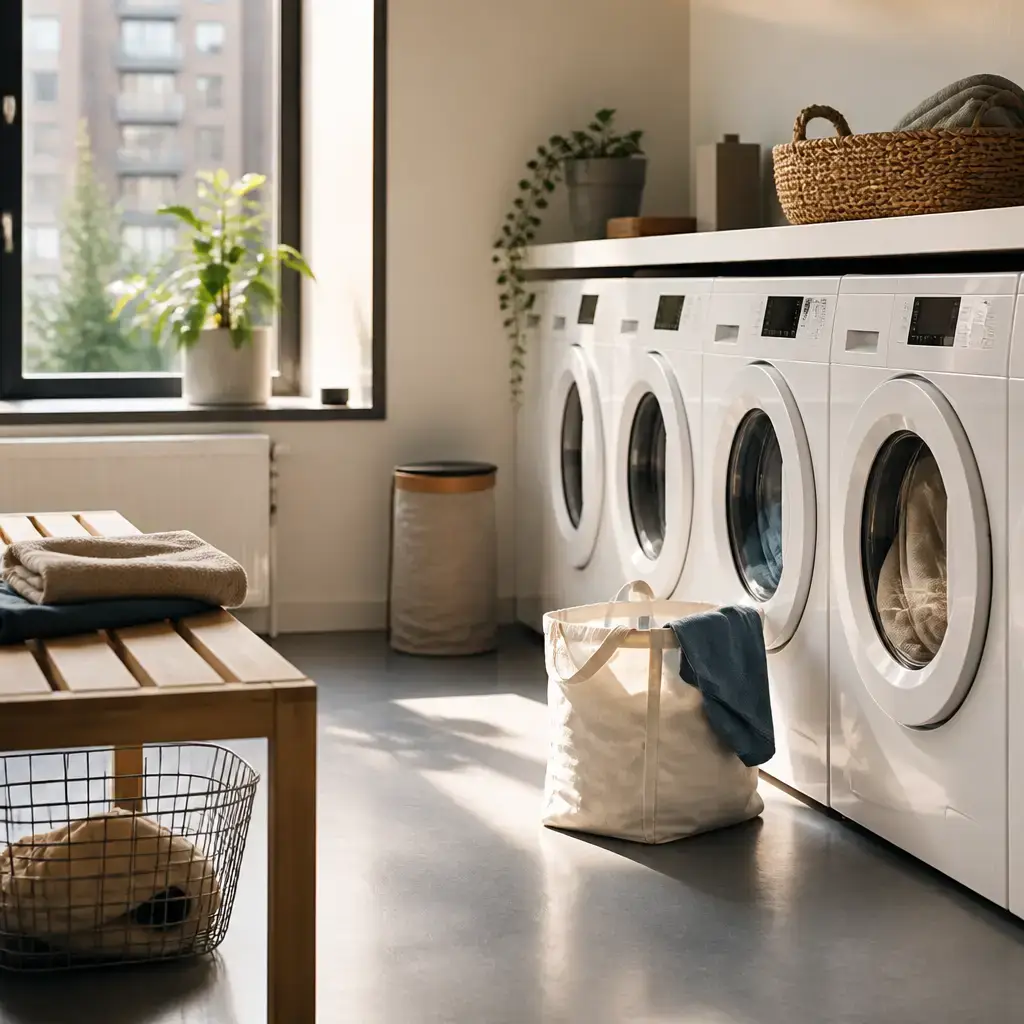
Alle vaskemaskinerne er optaget igen.
AL-uh VAS-guh-mah-SKEE-nuh-nuh air OHB-dayth ee-YEN. All the washing machines are full again.Tjek planen og se, hvornår den næste vask er færdig.
CHEK PLAH-nun oh SAY, vohr-NAWR den NESS-duh VAS air FAIR-dee. Check the schedule and see when the next load finishes.En af maskinerne burde snart være færdig, men den person, der satte den i gang, er her ikke.
EN ow mah-SKEE-nuh-nuh BOO-uh snart VAIR FAIR-dee, men den pair-SOHN, dair SAH-duh den ee GAHNG, air hair EG-uh. One should be done soon, but the person who started it isn't around.Giv personen et par minutter, før du flytter deres vasketøj.
GEEV pair-SOH-nun et par mee-NOOT-er, fur doo FLUR-duh dair-us VAS-kuh-toy. Give them a few minutes before moving their laundry.Hvor længe er det rimeligt at vente, før jeg flytter det?
vohr LANG-uh air deh REE-meh-lit at VEN-duh, fur yai FLUR-duh deh? How long is fair before I move it?En kort ekstra ventetid er nok, hvis andre venter.
EN kort EKS-drah VEN-duh-TEED air NOK, vis AHN-druh VEN-duh. A short grace period is enough if other people are waiting.Jeg sætter en påmindelse, så jeg kommer tilbage, så snart min vask er færdig.
yai SET-uh en poh-MEN-el-suh, soh yai KUM-uh beh-TAI-luh, soh snart min VAS air FAIR-dee. I'll set a reminder so I come back as soon as my load is done.Så er det lettere at bede alle andre om at gøre det samme.
soh air deh LED-uh-ruh at BAY-uh AL-uh AHN-druh ohm at GUH-uh deh SAM-uh. That makes it easier to ask the same of everyone else.Jeg kan ikke klage over efterladt vasketøj, hvis jeg også lader mit blive liggende der.
yai kan EG-uh KLAIR-uh OH-vuh EF-duh-LAID VAS-kuh-toy, vis yai AW-suh LAIR mit BLEE-vuh LIG-uh-nuh dair. I can't complain about abandoned laundry if I leave mine there too.Fællesvaskeriet fungerer bedre, når folk holder øje med vasketiderne.
FELL-us-VAS-guh-REE-et FOONG-uh BED-ruh, nor fohlk HOL-uh UH-yuh med VAS-guh-TEER-nuh. Shared laundry goes more smoothly when people watch the cycle times.Sentence explanations
Alle vaskemaskinerne er optaget igen.
All the washing machines are full again.
- Alle
- all
- vaskemaskinerne
- the washing machines
- optaget
- full
- igen
- again
More detail
Alle means “all” and refers to the whole set. With a definite plural noun, the pattern alle + definite plural noun corresponds to “all the …”: alle bøgerne = “all the books.” vaskemaskinerne means “the washing machines.” It is the definite plural form of vaskemaskine (“washing machine”): vaskemaskiner is plural, and -ne marks the definite plural. Danish commonly places definiteness on the noun itself rather than using a separate word equivalent to “the.” optaget means “full” here: the machines are occupied and therefore unavailable. The same word can also describe a person who is busy or a place that is occupied; the fixed translation and the washing-machine context support the “full/unavailable” meaning here. In the reusable pattern X er optaget, optaget describes X’s current occupied or unavailable state. igen means “again.” It marks a repeated state: the washing machines are full now, as they were at an earlier point. It does not itself specify when the earlier state occurred. Together, Alle vaskemaskinerne identifies the complete set of washing machines, er optaget states their current unavailable/full condition, and igen says that this condition has returned. The whole utterance therefore means: “All the washing machines are full again.”
Tjek planen og se, hvornår den næste vask er færdig.
Check the schedule and see when the next load finishes.
- Tjek
- check
- planen
- the schedule
- se
- see
- hvornår
- when
- næste
- next
- vask
- load
- færdig
- finished
More detail
Tjek is the imperative of tjekke, “to check.” Danish imperatives commonly use the short verb form: Tjek planen. = “Check the schedule.” The same form is also used in the fixed sentence as a direct instruction. planen is the definite singular form of plan: en plan = “a schedule/plan,” planen = “the schedule/plan.” The ending -en marks a common-gender noun as definite singular. Example: Jeg følger planen. — “I follow the schedule.” se means “see” here and is the short form used in the coordinated instruction og se. Danish uses se both as the infinitive and as the imperative form in this pattern. Example: Se her! — “Look here!” hvornår is the question word “when” for asking about a time. It introduces the embedded question hvornår den næste vask er færdig, “when the next load is finished.” Compare hvor = “where” and hvordan = “how”; these ask about different kinds of information. næste means “next” and appears before the noun in den næste vask. In this definite noun phrase, the adjective has the -e form. næste is the useful form to learn for “next”; for example, næste uge means “next week.” vask means “load” here, specifically a load of laundry, rather than the activity of washing. It is a common-gender noun: en vask = “a load/wash,” and vasken = “the load/wash.” Example: Vasken er færdig. — “The load is finished.” færdig means “finished” or “done.” It is an adjective describing the state of den næste vask; in the clause, er færdig means “is finished.” Example: Maden er færdig. — “The food is ready.” Together, Tjek planen gives the first instruction, “Check the schedule.” og se adds a second coordinated instruction, “and see.” The question word hvornår introduces the time being checked, while den næste vask means “the next load” and er færdig says that the load has reached a finished state. The whole utterance therefore means: “Check the schedule and see when the next load finishes.”
En af maskinerne burde snart være færdig, men den person, der satte den i gang, er her ikke.
One should be done soon, but the person who started it isn't around.
- En af
- one of
- maskinerne
- the machines
- burde
- should
- snart
- soon
- være
- be
- færdig
- done
- person
- person
- satte den i gang
- started it
- er her ikke
- isn't here
More detail
En af introduces one member of a larger group: “one of …”. The noun after af is plural, so En af maskinerne means one machine from among the machines. This identifies a single member without saying which one. Example: En af bøgerne er ny. — “One of the books is new.” maskinerne is the definite plural of maskine (“machine”): en maskine → maskiner → maskinerne. The ending -ne marks definite plural here, meaning “the machines.” burde expresses “should” here: an expectation or reasonable likelihood. It is the preterite form of bør, but Danish commonly uses burde for present- or future-oriented “should” as well. After it, the next verb is infinitive: burde være — “should be.” Example: Hun burde komme snart. — “She should come soon.” snart means “soon,” referring to a time not far from now. være is the infinitive of the verb whose present form is er; it means “be.” After the modal burde, Danish uses the infinitive være, not a finite form. In være færdig, it contributes the meaning “be done/finished.” færdig is the adjective “done” or “finished.” Here it describes the expected state of the machine. In this predicative use, it agrees with the common-gender singular subject maskine; the form is færdig. A neuter singular example is Arbejdet er færdigt. — “The work is finished.” person means “person.” In den person, it is the noun in the phrase “the person”; den is separate from the noun. The relative clause beginning with der identifies this person as the one who started the machine. satte den i gang means “started it.” satte is the past form of sætte (“put” or “set”), and sætte … i gang is the reusable construction “start/set … going.” In this sentence, den is the singular common-gender pronoun “it,” referring to the machine in the intended reading. Example: Hun satte motoren i gang. — “She started the motor.” er her ikke means “is not here” or “isn’t around.” er is the present form of være; her means “here”; and ikke means “not.” In this clause pattern, ikke follows the finite verb: er her ikke. Together, En af maskinerne burde snart være færdig says that one machine among the machines is expected to be done soon. men contrasts this with den person, der satte den i gang, er her ikke: the person who started that machine is not here/around. The full utterance means: “One should be done soon, but the person who started it isn’t around.”
Giv personen et par minutter, før du flytter deres vasketøj.
Give them a few minutes before moving their laundry.
- Giv
- give
- personen
- the person
- et par minutter
- a few minutes
- før
- before
- flytter
- move
- deres
- their
- vasketøj
- laundry
More detail
Giv is the imperative of give, used here as a direct instruction. The understood subject is “you.” Danish examples: Giv mig et øjeblik. — “Give me a moment.” The present form is giver, as in Hun giver ham nøglen. — “She gives him the key.” personen means “the person” here. Its base noun is person; personen is the definite singular form, formed with the ending -en. The definite form identifies a particular person relevant to the situation, while en person means “a person.” et par minutter is the compact expression “a few minutes.” Minutter is the plural of minut; et par literally contains the noun par (“pair”), but this expression normally indicates a small, non-exact amount rather than exactly two minutes. Example: Vent et par minutter. — “Wait a few minutes.” før introduces the time clause “before …”. In this sentence, the action in the før clause—moving the laundry—comes after the main action, giving the person time. Example: Ring, før du går. — “Call before you leave.” flytter is the present form of flytte, “to move.” Here it means physically moving the laundry. Danish present tense can describe a future action when the timing is clear from context, as it is after før: Jeg flytter bilen senere. — “I’ll move the car later.” deres expresses possession, intended here as “their.” It is an independent possessive form and does not change to agree with the possessed noun vasketøj. Danish also has forms such as hans (“his”) and hendes (“her”); deres is the form used for “their” in this utterance. vasketøj means “laundry,” referring to clothes or other items being washed or ready to be washed. It is a mass noun here, so the sentence treats it as an amount of laundry rather than specifying individual items. Example: Jeg henter vasketøjet. — “I’ll collect the laundry.” Together, Giv personen et par minutter says “Give the person a few minutes.” før du flytter deres vasketøj adds “before you move their laundry.” The complete instruction is therefore: “Give them a few minutes before moving their laundry.”
Hvor længe er det rimeligt at vente, før jeg flytter det?
How long is fair before I move it?
- Hvor længe
- how long
- er det rimeligt
- is it reasonable
- at vente
- to wait
- før
- before
- jeg
- I
- flytter
- move
- det
- it
More detail
Hvor længe asks about duration: “how long?” It is a reusable question pattern, as in Hvor længe bliver du? — “How long are you staying?” er det rimeligt means “is it reasonable?” Here the first det is the formal subject in the pattern det er rimeligt at ...; it is not the object moved later. rimeligt is the neuter singular form of rimelig. Compare rimelig with a common-gender singular noun, rimeligt with a neuter singular noun or in this det er ... construction, and rimelige with plural or definite nouns. at vente means “to wait.” at introduces the infinitive, so this pattern is useful after expressions such as Det er svært at vente — “It is difficult to wait.” The observed verb form is vente, whose base form is also vente. før introduces the later event: “before.” It connects the waiting period with the action that follows it in the sentence. jeg is the first-person singular pronoun “I.” It identifies the person who will perform the later action. Danish subject pronouns such as jeg identify the actor explicitly; the verb does not carry a separate first-person ending here. flytter means “move” here. It is the present-tense form of flytte, and Danish present-tense verbs generally do not change form according to the subject, so jeg flytter uses the same present form as other subjects. The final det means “it” and is a neuter singular object pronoun. In this utterance, it is the object of flytter; the preceding context identifies the item as the laundry. This final det is distinct from the earlier formal-subject det in det er rimeligt. Together, Hvor længe er det rimeligt at vente asks what duration of waiting is reasonable. før jeg flytter det adds the later action: “before I move it.” The complete utterance therefore means: “How long is it fair to wait before I move it?”
En kort ekstra ventetid er nok, hvis andre venter.
A short grace period is enough if other people are waiting.
- kort
- short
- ekstra
- extra
- ventetid
- waiting time
- er nok
- is enough
- hvis
- if
- andre
- other people
- venter
- wait
More detail
kort means “short” here and describes ventetid. In Danish, the adjective is kort with an indefinite singular common-gender noun, as in en kort ventetid (“a short waiting time”); it is kort with an indefinite singular neuter noun, but korte with plural or definite nouns, as in korte ventetider (“short waiting times”). The opposite is lang (“long”). ekstra means “extra” or “additional”. It is an invariable descriptive word, so it does not change for gender or number: en ekstra dag (“an extra day”) and ekstra dage (“extra days”). ventetid means “waiting time”. It is a compound noun built from vente (“wait”) and tid (“time”); the useful singular/plural forms are en ventetid and ventetider. In this utterance it refers to an additional amount of time spent waiting, not to a particular person’s act of waiting. er nok means “is enough”. er is the present form of være (“be”), and nok expresses sufficiency in this construction. For example, Det er nok means “That is enough.” Do not treat nok here as the separate adverb meaning “probably”; the surrounding meaning is sufficiency. hvis introduces a condition and means “if”. A reusable pattern is X er nok, hvis Y — “X is enough if Y.” The clause after hvis states the condition under which the first statement holds. andre means “other people” in this sentence. It is the plural form used substantivally, so the noun mennesker (“people”) is understood rather than spoken. In another context, andre can also modify a plural noun, as in andre dage (“other days”). venter means “wait” or “are waiting” here. It is the present-tense form of vente (“wait”); Danish present verbs do not change form for singular versus plural subjects, so both jeg venter (“I wait/am waiting”) and de venter (“they wait/are waiting”) use venter. Together, en kort ekstra ventetid means “a short extra waiting period.” er nok says that this period is sufficient, and hvis andre venter makes that sufficiency conditional on other people waiting. The complete utterance therefore means: “A short grace period is enough if other people are waiting.”
Jeg sætter en påmindelse, så jeg kommer tilbage, så snart min vask er færdig.
I'll set a reminder so I come back as soon as my load is done.
- Jeg
- I
- sætter
- set
- påmindelse
- reminder
- så
- so
- kommer tilbage
- come back
- så snart
- as soon as
- min
- my
- vask
- load
- færdig
- done
More detail
Jeg means “I” here, the first-person singular subject. Danish uses jeg for this role regardless of the speaker’s gender. sætter is the present form of sætte, “to put” or “to set.” Here the present form refers to a planned future action, as shown by the fixed translation “I’ll set.” The same form can also describe a current or habitual action. Example: Jeg sætter en alarm. — “I set an alarm.” påmindelse means “reminder.” In en påmindelse, the noun is singular and indefinite. The article introduces an unspecified reminder; it should not be treated by itself as a statement of a numerical count. The first så links the reminder-setting action to its intended result: “so.” It is distinct from the later så snart, which is a time connector meaning “as soon as.” kommer tilbage means “come back” here. kommer is the present form of komme, “to come,” and tilbage adds the meaning of returning. With the subject jeg, the expression means “I come back.” Example: Jeg kommer tilbage i morgen. — “I’ll come back tomorrow.” så snart is a time-linking pattern meaning “as soon as.” It introduces the event that determines when the return happens. Example: Jeg ringer, så snart jeg er hjemme. — “I’ll call as soon as I am home.” min means “my.” In this sentence it is the possessive form used with the singular common-gender noun vask. Possessive forms vary with the possessor and, in relevant Danish patterns, with the number and gender of the possessed noun; compare din “your” and hans/hendes “his/her.” vask means “load” here, specifically a load of laundry being washed. Depending on context, the noun can also refer to washing or laundry more generally. The fixed translation selects the laundry-load meaning. Example: Vasken er færdig. — “The laundry is done.” færdig is an adjective meaning “done” or “finished” here. It describes the state of vask. The adjective itself has the observed common-gender singular form færdig; compare neuter singular færdigt and plural or definite færdige where the grammar requires them. Example: Maden er færdig. — “The food is ready.” Together, Jeg sætter en påmindelse means “I’ll set a reminder.” The first så connects that action with the intended result, jeg kommer tilbage: “so I come back.” The time pattern så snart min vask er færdig specifies when the return happens: “as soon as my load is done.” The complete utterance means: “I’ll set a reminder so I come back as soon as my load is done.”
Så er det lettere at bede alle andre om at gøre det samme.
That makes it easier to ask the same of everyone else.
- Så
- So / that way
- lettere
- easier
- bede
- ask
- alle andre
- everyone else
- om at
- to (do something)
- gøre
- do
- det samme
- the same thing
More detail
Så introduces the consequence or conclusion here: “so” or “that way.” In this sentence it connects the result to what was said before. lettere is the comparative form of let (“easy”): let = easy, lettere = easier, lettest = easiest. The comparison means that asking is less difficult, without stating exactly how difficult it is. bede is the infinitive of “ask” in the sense of requesting something. Its present-tense form is beder, as in Jeg beder ham om hjælp (“I ask him for help”). Danish commonly uses the pattern bede nogen om at gøre noget: “ask someone to do something.” alle andre means “everyone else.” alle indicates the whole relevant group, while andre means people other than the person or people already under discussion. andre is the plural form of anden (“other”); the form agrees with the plural meaning supplied by alle. om at is the beginning of the Danish request pattern bede ... om at .... It links the request to the action being requested; it is not the English preposition “about” in this use. gøre is the infinitive of “do” or “make.” The present-tense form is gør. Here it introduces the action that the other people are being asked to carry out. det samme means “the same thing” or, more literally, “the same.” det refers to the action or matter already established in the context, while samme marks it as identical to that earlier action or matter. The expression gøre det samme is a reusable way to say “do the same thing.” Together, er det lettere says “it is easier,” and at bede alle andre om at gøre det samme says “to ask everyone else to do the same.” Thus the whole utterance means: “That makes it easier to ask the same of everyone else.”
Jeg kan ikke klage over efterladt vasketøj, hvis jeg også lader mit blive liggende der.
I can't complain about abandoned laundry if I leave mine there too.
- Jeg kan
- I can
- ikke
- not
- klage over
- complain about
- efterladt
- abandoned
- vasketøj
- laundry
- hvis
- if
- også
- also; too
- lader
- leave; let
- mit
- mine
- blive liggende
- remain lying; be left lying
- der
- there
More detail
Jeg kan combines the first-person pronoun jeg (“I”) with kan, the present form of kunne (“can; be able to”). Danish modal verbs are followed by an infinitive without at: Jeg kan klage means “I can complain.” ikke negates the clause. Here it makes Jeg kan klage into “I cannot complain,” rather than changing the meaning of klage itself. Example: Jeg kan ikke komme. — “I cannot come.” klage over is the reusable verb pattern “complain about.” The preposition over belongs to this meaning of klage; it introduces what the complaint concerns. Example: Hun klager over støjen. — “She complains about the noise.” efterladt means “left behind” or “abandoned” here. It is the participle of efterlade (“leave behind”) and describes vasketøj in this phrase. It is not the finite verb of the sentence. Example: De fandt en efterladt taske. — “They found an abandoned bag.” vasketøj means “laundry.” It is a mass noun in this use, so the sentence does not assert a particular numeric count. Together, efterladt vasketøj means “abandoned laundry.” hvis introduces the condition: “if.” The clause after it states the circumstance under which the main statement applies. Example: Jeg bliver hjemme, hvis det regner. — “I stay home if it rains.” også means “also” or “too.” Here it adds that the speaker does the relevant thing as well: leaving their own laundry there. lader is the present form of lade, which can mean “let” or, in this pattern, “leave something in a state.” It is the finite verb of the conditional clause and has jeg as its subject, so jeg lader means “I leave.” The pattern lade + object + infinitive can describe allowing or causing an object to remain in a state: Jeg lader døren stå åben. — “I leave the door open.” mit means “mine” here. It is the possessive form used with a neuter singular noun; it stands for the speaker’s vasketøj, which is neuter singular. The noun is omitted because it is understood from the sentence. Possessives agree with the noun they modify: compare mit tøj (“my clothes”) with min taske (“my bag”). blive liggende is a two-word pattern meaning “remain lying” or “be left lying.” blive is the infinitive of blive (“become; remain”), and liggende is the form of ligge (“lie”) used to describe a continuing position. After lader, the infinitive blive follows, giving lader mit blive liggende: “leave mine lying.” der means “there,” pointing to a location understood in the situation. It comes after liggende in the observed sentence and completes the location phrase blive liggende der, “remain lying there.” The full structure is Jeg kan ikke klage over X, hvis jeg også lader mit blive liggende der: “I cannot complain about X if I also leave mine lying there.” In this utterance, X is efterladt vasketøj, and mit refers to the speaker’s own laundry. Thus the complete meaning is: “I can’t complain about abandoned laundry if I leave mine there too.”
Fællesvaskeriet fungerer bedre, når folk holder øje med vasketiderne.
Shared laundry goes more smoothly when people watch the cycle times.
- Fællesvaskeriet
- shared laundry room
- fungerer
- works; functions
- bedre
- better
- når
- when
- folk
- people
- holder øje med
- watch; keep an eye on
- vasketiderne
- the laundry times; the cycle times
More detail
Fællesvaskeriet means “the shared laundry room” here. It is a definite singular noun: fællesvaskeri is the base form, and the ending -et marks the definite form. The compound begins with fælles, “shared/common.” fungerer is the present-tense form of fungere, “to function” or “to work.” It describes how something operates, not a person doing a task. Example: Maskinen fungerer godt. — “The machine works well.” bedre is the comparative form of god, “good”: god → bedre → bedst (“good” → “better” → “best”). Here it is used adverbially with fungerer, so it describes the manner or degree of functioning: “works better” or “goes more smoothly.” It is not a gender or number form of Fællesvaskeriet. når introduces a time condition and means “when.” It connects the main clause to the situation that makes it true. Example: Jeg læser, når jeg har tid. — “I read when I have time.” folk means “people.” It is the subject of the subordinate clause. Danish verbs do not change form for person or number, so holder does not agree with folk through a plural verb ending; holder is the present-tense form used with holde (“to hold/keep”) across subjects. holder øje med is a reusable expression meaning “keep an eye on” or “watch.” Its literal pieces are holder (“keeps/holds”), øje (“eye”), and med (“with”), but the combined expression is the natural way to describe monitoring something. The verb is based on holde; holder is its present-tense form. Example: Hun holder øje med tiden. — “She keeps an eye on the time.” vasketiderne means “the laundry times” or, in this translation, “the cycle times.” It is the definite plural form of vasketid (“laundry time” or “washing time”): vasketider is plural and vasketiderne adds the definite ending -ne, “the.” The noun refers to the relevant times for using the laundry facilities; the fixed translation conveys them as cycle times. Together, Fællesvaskeriet fungerer bedre says “the shared laundry room works more smoothly.” når folk holder øje med vasketiderne adds the condition “when people watch the cycle times.” The complete meaning is: “The shared laundry goes more smoothly when people watch the cycle times.”
Grammar Points
Bestemt flertal: -erne
vaskemaskinerne; vasketiderne
VAS-guh-mah-SKEE-nuh-nuh; VAS-guh-TEER-nuhthe washing machines; the wash cycle times
Danish often marks “the” in plural nouns with the suffix -erne.
Adjektiv i intetkøn: rimelig → rimeligt
rimeligt
REE-meh-litreasonable; fair
The adjective takes -t in neuter forms, changing rimelig to rimeligt.
Danish Vocabulary
Før du flytter deres vasketøj.
Den næste vask er færdig.
Alle vaskemaskinerne er optaget igen.
Alle vaskemaskinerne er optaget igen.
- Gender
- common
Giv personen et par minutter.
- Gender
- common
Tjek planen og se, hvornår den næste vask er færdig.
En af maskinerne burde snart være færdig.
Den person, der satte den i gang, er her ikke.
Tjek planen og se, hvornår den næste vask er færdig.
- Gender
- common
Tjek planen og se, hvornår den næste vask er færdig.
- Gender
- common
Alle vaskemaskinerne er optaget igen.
- Gender
- neuter
Før du flytter deres vasketøj.
Quiz
Word Order
Arrange the words in the correct order.
All the washing machines are full again.
Show Answer
Alle vaskemaskinerne er optaget igen.Spelling
Tap the letters to spell the word.
finished; done
Show Answer
færdigoccupied; in use
Show Answer
optagetwash; laundry load
Show Answer
vaskschedule; plan