10 minutes free every day
Continue audio lessons in the app
Word explanations appear automatically in sync with the audio.
No login required · synced translations · playback with the screen locked
Choose your learning language and open this lesson in the app.

About This Lesson
Use Troubleshooting a Printer Problem to practice Danish conversation, pronunciation, vocabulary, grammar, and quizzes.
Dialogue
Printeren bliver ved med at afvise min fil, selv om formatet understøttes.
PREN-duhn BLEE-vuh veh mehth uh OW-vee-suh my FEEL, selw om fohr-MAH-thud ON-uh-STUR-thuhs. The printer keeps rejecting my file, although the format is supported.Har du tjekket, om dokumentet indeholder billeder, der er for store?
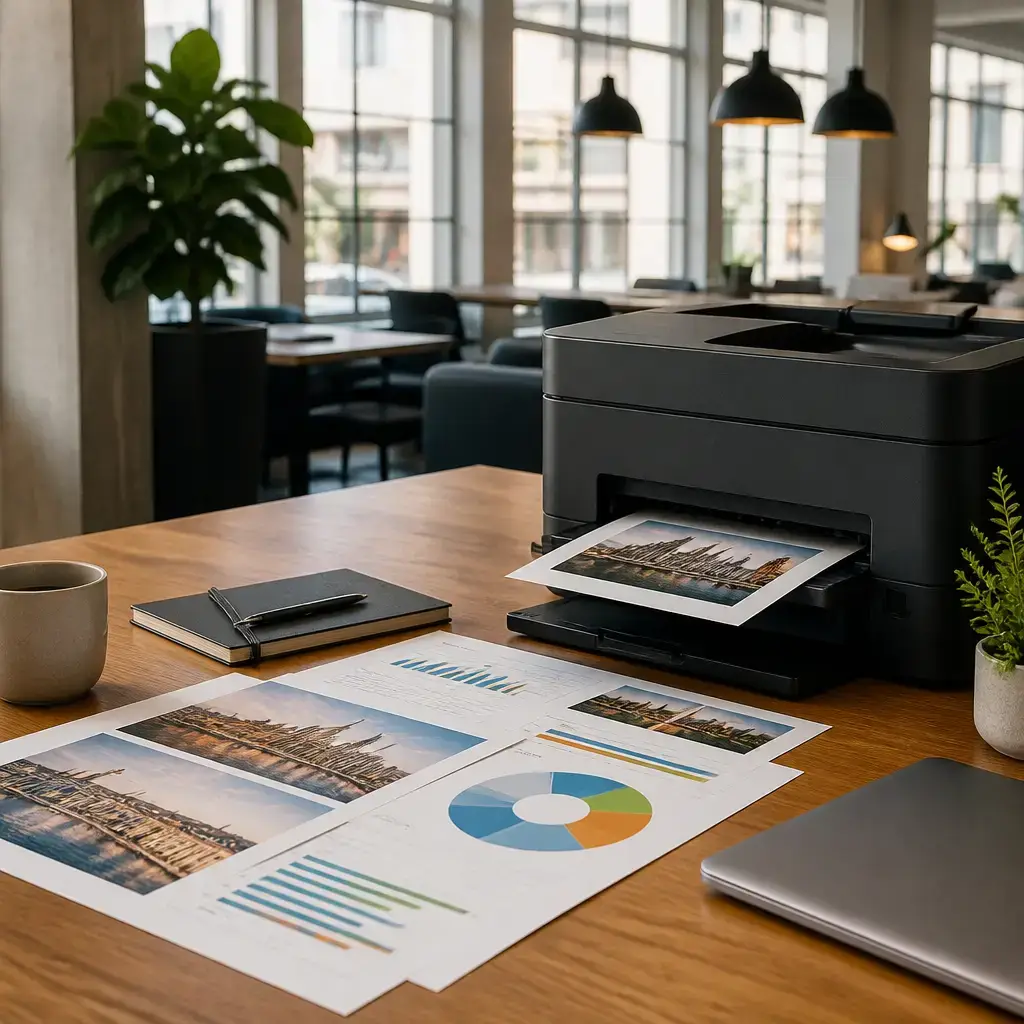
HAH doo CHEK-uhd, om doh-koo-MEN-duht EN-uh-HOL-uh BEL-uh, dair air foh STOH-uh? Have you checked whether the document contains oversized images?Det er muligt, eftersom præsentationen indeholder flere detaljerede diagrammer.
Deh air MOO-lit, EF-som preh-sen-TAH-shuh-nun EN-uh-HOL-uh FLAY-uh deh-TAHL-yuh-RAY-thuh dee-uh-GRAHM-uh. That is possible, since the presentation includes several detailed charts.Det kan måske hjælpe at komprimere dem uden at forringe den visuelle kvalitet.
Deh kan MAW-sguh YEL-buh uh kom-PREE-muh-ruh dem OO-thn uh foh-RENG-uh den vee-SOO-uh-luh kwa-lee-TAYTH. Compressing them may help without damaging the visual quality.Det vil jeg foretrække frem for at genopbygge hele præsentationen.
Deh vel yai foh-TREH-guh frem foh uh gay-noh-BYOO-guh HAY-luh preh-sen-TAH-shuh-nun. I would prefer that to rebuilding the entire deck.Send den via den delte mappe.
Sen den VEE-uh den DEL-duh MAH-buh. Send it through the shared folder.Jeg kan teste den fra min konto.
Yai kan TES-duh den frah my KUHN-toh. I can test it from my account.Det sparer mig for at gætte på tilfældige indstillinger.
Deh SBAIR-uh my foh uh GET-uh paw TEL-feh-lee en-STEL-eng-uh. That saves me from guessing at random settings.Når den er udskrevet, bør vi dokumentere løsningen for andre.
NAWR den air OO-th-SKRAY-vuhd, BUR vee doh-koo-men-TAY-ruh LOOS-nehng-en foh ON-ruh. Once it prints, we should document the fix for others.Sentence explanations
Printeren bliver ved med at afvise min fil, selv om formatet understøttes.
The printer keeps rejecting my file, although the format is supported.
- Printeren
- the printer
- bliver ved med at
- keeps on
- afvise
- reject
- min
- my
- fil
- file
- selv om
- although
- formatet
- the format
- understøttes
- is supported
More detail
Printeren means “the printer” here. It is the definite singular form of printer (“printer”): printeren uses -en, so the noun is an en-word. Danish commonly marks definiteness at the end of the noun, rather than with a separate word before it. bliver ved med at is a reusable construction meaning that an action continues: blive ved med at + infinitive. The form bliver is the present tense of blive (“become; remain”), while afvise is the infinitive after at. For example: Hun bliver ved med at ringe. — “She keeps calling.” afvise means “reject” or “refuse.” In this sentence it describes what the printer repeatedly continues to do to the file. Its infinitive form is also used after other constructions such as at afvise (“to reject”). min means “my” before a singular en-word. It agrees with the possessed noun, not with the possessor: compare min fil (“my file”), mit dokument (“my document,” with an et-word), and mine filer (“my files,” plural). fil means “file.” Its definite singular form is filen, as in Filen er stor. — “The file is large.” selv om introduces a contrast and means “although” or “even though.” It introduces the clause formatet understøttes, which presents a fact that contrasts with the printer’s continued rejection. formatet means “the format.” It is the definite singular form of format; the ending -et shows that this noun is an et-word. The same pattern appears in dokumentet (“the document”), as in the following question: Indeholder dokumentet billeder? — “Does the document contain images?” understøttes means “is supported” here. It is the present passive form of understøtte (“support”): the format receives the support rather than performing the action. The active form would be Programmet understøtter formatet. — “The program supports the format.” Together, Printeren bliver ved med at afvise min fil says “The printer keeps rejecting my file.” Selv om formatet understøttes adds “although the format is supported,” so the complete utterance is: “The printer keeps rejecting my file, although the format is supported.”
Har du tjekket, om dokumentet indeholder billeder, der er for store?
Have you checked whether the document contains oversized images?
- Har du
- have you
- tjekket
- checked
- dokumentet
- the document
- indeholder
- contains
- billeder
- images
- der er
- that are
- for store
- too large
More detail
Har du begins a yes/no question. har is the present form of have and is used here as an auxiliary; du means “you.” Danish places the auxiliary before the subject in this question pattern: Har du ...? The auxiliary combines with the following past participle to form the perfect, referring here to a check that may already have been completed. tjekket is the past participle of tjekke, “to check.” The useful pattern is har + past participle: Jeg har tjekket filen. — “I have checked the file.” The form tjekket itself does not show the person; the auxiliary and subject carry that information in this construction. dokumentet means “the document.” It is the definite singular form of dokument: et dokument means “a document,” while dokumentet means “the document.” The ending -et marks definiteness for this noun; it is not a separate word. indeholder means “contains” here. It is the present form of indeholde, “to contain” or “to include.” Danish present-tense verb forms generally do not change according to the subject’s person, so dokumentet indeholder means “the document contains,” while de indeholder means “they contain.” billeder means “images” or “pictures.” It is the plural of billede; the singular indefinite form is et billede, and the plural form is billeder. In this sentence, the plural refers to the images that the document may contain. der er introduces the relative clause describing those images: literally, “that are.” der is a relative marker here, and er is the present form of være, “to be.” Example: billeder, der er tydelige — “images that are clear.” The relative clause follows the noun it describes. for store means “too large.” store is the plural form of the adjective stor, “large”; it agrees with the plural noun billeder. The separate word for means “too” and marks an excessive degree, not merely a high degree. Compare store billeder — “large images” with for store billeder — “images that are too large.” Together, Har du tjekket asks whether the checking has been done. om introduces the thing being checked, equivalent here to “whether”: Har du tjekket, om ...? The clause dokumentet indeholder billeder says that the document contains images, and der er for store specifies that the images are too large. The complete meaning is: “Have you checked whether the document contains oversized images?”
Det er muligt, eftersom præsentationen indeholder flere detaljerede diagrammer.
That is possible, since the presentation includes several detailed charts.
- Det
- That
- er
- is
- muligt
- possible
- eftersom
- since
- præsentationen
- the presentation
- indeholder
- contains
- flere
- several
- detaljerede
- detailed
- diagrammer
- charts
More detail
Det is a neuter singular pronoun. Here it is the subject of “That is possible”; the fixed translation supports that reading, without identifying a more specific referent. Danish also uses det in patterns such as Det er vigtigt (“It is important”), where it can point to a situation or proposition. er is the present-tense form of være (“to be”). Danish present-tense verbs do not change for person or number, so the same er can occur with different subjects: Jeg er klar means “I am ready,” while De er klar means “They are ready.” muligt means “possible” here. The adjective is mulig; muligt is its neuter singular form, matching the neuter det in this construction. Compare en mulig løsning (“a possible solution”) with et muligt svar (“a possible answer”). Together, Det er muligt is a reusable way to say “That is possible” or “It is possible.” eftersom introduces the reason for the preceding statement and means “since” in the causal sense, close to “because.” It links the possibility to the clause that follows. For example, Jeg bliver hjemme, eftersom jeg er syg means “I am staying home because I am ill.” præsentationen means “the presentation.” Præsentation is the noun’s indefinite singular form; præsentationen adds the definite ending -en for “the presentation.” The ending belongs to the noun, not to a separate word. indeholder means “contains” here. Its base form is indeholde, and indeholder is the present-tense form. Danish verbs do not add a different present ending for third-person singular, so Præsentationen indeholder ... literally has “the presentation contains ...”. flere means “several” here and is used with a plural noun. It can also mean “more” when the context compares quantities, but the fixed translation selects “several.” For example, Der er flere muligheder means “There are several possibilities.” detaljerede means “detailed.” Its base form is detaljeret. The -e form is used here with the plural noun diagrammer; the adjective agrees with the plural noun. For comparison, et detaljeret diagram means “a detailed chart,” while detaljerede diagrammer means “detailed charts.” diagrammer means “charts” here. Its singular indefinite form is diagram, and its plural indefinite form is diagrammer. A definite plural is diagrammerne, meaning “the charts.” The full structure is Det er muligt (“That is possible”) + eftersom (“since”) + præsentationen indeholder (“the presentation contains”) + flere detaljerede diagrammer (“several detailed charts”). Together, the utterance means: “That is possible, since the presentation includes several detailed charts.”
Det kan måske hjælpe at komprimere dem uden at forringe den visuelle kvalitet.
Compressing them may help without damaging the visual quality.
- Det kan
- it can; may
- måske
- perhaps
- hjælpe
- help
- komprimere
- compress
- dem
- them
- uden at
- without
- forringe
- impair; damage
- visuelle
- visual
- kvalitet
- quality
More detail
Det kan gives an impersonal “it can” frame. Here det is an anticipatory subject: it does not identify a specific thing. The content of what may help is supplied by the following infinitive clause, at komprimere dem; this is why the fixed translation naturally begins “Compressing them may help.” kan is the present-tense form of kunne, “can.” With måske, the possibility is tentative, so the combined meaning is naturally “may.” Compare kan with skal, which can express obligation or an expected future action. måske means “perhaps” or “maybe.” It qualifies the possibility rather than asserting that the action will help. Example: Måske virker det. — “Maybe it works.” hjælpe is the infinitive “help.” It follows the modal kan; after a Danish modal, the following verb normally appears without at: kan hjælpe = “can help.” The at before komprimere belongs to the next infinitive clause, not to hjælpe. komprimere is the infinitive “compress.” In at komprimere dem, it names the action that may help. The verb is related to kompression (“compression”), but komprimere itself is the verb used here. Example: Det kan hjælpe at komprimere filen. — “It may help to compress the file.” dem is a plural object pronoun meaning “them.” Its form marks a plural object, while the fixed input and translation do not identify a more specific referent. It is distinct from the subject-form pronoun de, “they.” uden at introduces an infinitive construction meaning “without doing.” In uden at forringe, it presents the second action as something avoided in the stated result. This is a reusable pattern: uden at + infinitive, for example uden at ændre filen — “without changing the file.” forringe is the infinitive “impair” or “damage,” specifically reducing quality or value. Its base form is forringe; the form does not show a tense change here because it follows at. It is more precise than ødelægge (“destroy”) when the result is a decline rather than complete destruction. visuelle means “visual” here. Its base form is visuel; visuelle is used with a definite noun phrase and also in relevant plural forms. In den visuelle kvalitet, it is the adjective’s form, not a form of kvalitet, and it agrees with the definite noun phrase. kvalitet means “quality.” It is a common-gender noun. Together, den and visuelle make den visuelle kvalitet definite: “the visual quality.” The noun is singular; the definite meaning comes from the noun phrase, not from an indefinite article or a plural ending. Taken together, Det kan måske hjælpe presents a tentative possibility. at komprimere dem supplies the action that may help—compressing them—while uden at forringe den visuelle kvalitet adds the condition that this should happen without impairing the visual quality. The complete meaning is: “Compressing them may help without damaging the visual quality.”
Det vil jeg foretrække frem for at genopbygge hele præsentationen.
I would prefer that to rebuilding the entire deck.
- Det
- that
- vil jeg
- I would
- foretrække
- prefer
- frem for
- rather than
- genopbygge
- rebuild
- hele
- entire
- præsentationen
- presentation
More detail
Det means “that” here: it is an object pronoun referring to the option already under discussion, namely compressing the materials without reducing visual quality. Danish det is the neuter singular form; its grammatical form does not by itself identify the referent. vil jeg places the subject after the verb because the sentence begins with the object Det. vil is the present form of ville, which can express “would” in this preference pattern. The subject is jeg, “I”. Compare: Jeg vil foretrække det. — “I would prefer that.” foretrække is the infinitive “to prefer”. After vil, Danish uses the infinitive without an infinitive marker: vil foretrække. The useful pattern is vil + infinitive, as in Jeg vil vælge den. — “I would choose it.” frem for is the comparison construction “rather than / in preference to”. It contrasts the preferred option with the alternative introduced after it. With an action, Danish commonly uses frem for at + infinitive. genopbygge means “to rebuild” or “to reconstruct”. It is an infinitive, and gen- contributes the idea of doing something again; the base verb is bygge, “build”. Here it refers to rebuilding the presentation, not merely editing it. hele means “the entire” or “the whole”. In hele præsentationen, it emphasizes the presentation as a complete unit. Danish uses hele before a definite singular noun in this pattern: hele dagen — “the whole day.” præsentationen means “the presentation” here; the definite ending -en marks a definite common-gender singular noun. The translation’s “deck” gives the intended presentation-related meaning; the observed Danish noun itself is præsentation with the definite form præsentationen. Together, Det vil jeg foretrække means “I would prefer that”, and frem for at genopbygge hele præsentationen identifies the alternative: “rather than rebuilding the entire presentation.” The complete utterance therefore means: “I would prefer that to rebuilding the entire deck.”
Send den via den delte mappe.
Send it through the shared folder.
- Send
- send
- den
- it
- via
- through; via
- den
- the
- delte
- shared
- mappe
- folder
More detail
Send is the imperative of sende (“to send”). The imperative gives a direct instruction and normally has no written subject: Send filen. means “Send the file.” The first den is a singular common-gender object pronoun, “it.” Here it refers to the item already identified in the surrounding context. Compare det for a singular neuter-gender referent. Danish pronouns agree with the referent’s grammatical gender; this form does not itself identify what the item is. via means “through” or “via” and introduces the route or channel used for sending. For example, Hun sender dokumentet via e-mail. means “She sends the document via email.” The second den is not the pronoun “it”: it is the definite article used before a singular common-gender noun. Danish commonly marks definiteness this way when an adjective comes before the noun: den store mappe means “the large folder.” delte means “shared” here. It is the form of dele (“to share”) used as an adjective before a definite common-gender singular noun in this phrase. The ending also appears in den delte fil (“the shared file”); the adjective agrees with the noun phrase’s definiteness and number here. mappe means “folder.” It is a common-gender noun: en mappe means “a folder,” while the suffix form mappen means “the folder” when no adjective intervenes. With the adjective in this sentence, definiteness is expressed by den: den delte mappe. Together, Send gives the instruction, den supplies the object “it,” and via den delte mappe specifies the route “through the shared folder.” The complete meaning is “Send it through the shared folder.”
Jeg kan teste den fra min konto.
I can test it from my account.
- Jeg kan
- I can
- teste
- test
- den
- it
- fra
- from
- min
- my
- konto
- account
More detail
Jeg kan means “I can.” Jeg is the first-person singular pronoun “I,” and kan is the present-tense form of kunne, “can/be able to.” Danish modal verbs such as kan are followed directly by the infinitive, without at in this pattern. teste means “test” here. It is the infinitive after the modal kan; the modal carries the tense, so the verb does not take a present-tense ending here. Example: Jeg kan vente. — “I can wait.” den means “it” here. It is a third-person singular pronoun for a common-gender referent; the fixed translation identifies its intended role as the thing being tested, without identifying that thing by name. det is the corresponding singular neuter form, while de is the usual third-person plural pronoun. The choice between den and det depends on the grammatical gender of the singular referent, not simply on its physical properties. fra means “from.” It introduces the source or starting point of an action or movement. Example: Jeg arbejder fra kontoret. — “I work from the office.” min means “my” here. It is the possessive form used with a singular common-gender noun, as in min konto. With a singular neuter noun, the form is mit, and with plural nouns it is mine. The possessive identifies the account as belonging to the speaker; it does not itself express a numerical quantity. konto means “account.” It is a common-gender noun: en konto; its definite singular form is kontoen, and its plural is konti. After the possessive min, the noun appears in its ordinary singular form in min konto; the possessive phrase identifies the account without an article. Together, Jeg kan teste den expresses “I can test it,” and fra min konto specifies the source: “from my account.” The complete utterance is therefore “I can test it from my account.”
Det sparer mig for at gætte på tilfældige indstillinger.
That saves me from guessing at random settings.
- Det
- That
- sparer
- saves
- mig
- me
- for
- from
- at
- to (infinitive marker)
- gætte
- guess
- tilfældige
- random
- indstillinger
- settings
More detail
Det means “that” here and functions as the subject. It is a neuter singular form; Danish demonstratives and pronouns must match the relevant grammatical form when they inflect, but this sentence does not identify a noun that needs to be supplied as its referent. sparer is the present-tense form of spare, “to save” or “to spare.” In this sentence it describes what “that” does for the speaker. A useful reusable pattern is spare nogen for at gøre noget — “save someone from doing something.” mig is the first-person singular object form, “me.” Compare the subject form jeg: Jeg tester den means “I test it,” while Det sparer mig means “That saves me.” for introduces what the person is spared from in the pattern spare nogen for .... Here it belongs with the following infinitive phrase rather than meaning a recipient or purpose. at is the infinitive marker. It introduces gætte, just as at teste means “to test” in the preceding example. The marker is part of the construction; it is not itself a separate action. gætte is the infinitive of gætte, “guess.” With på, the construction gætte på noget means “guess at something” or “guess something.” The sentence uses at gætte på to describe the activity from which the speaker is saved. tilfældige means “random” here. It is the plural form of the adjective tilfældig, agreeing with the plural noun indstillinger. For comparison, tilfældig is “random,” and mere tilfældig is “more random”; the observed -e form is required here by the plural noun. indstillinger means “settings.” It is the plural of indstilling. The singular is en indstilling (“a setting”), while indstillinger refers to more than one setting in this sentence. Together, Det sparer mig for expresses “That saves me from,” and at gætte på tilfældige indstillinger specifies the activity avoided: guessing at random settings. The complete meaning is: “That saves me from guessing at random settings.”
Når den er udskrevet, bør vi dokumentere løsningen for andre.
Once it prints, we should document the fix for others.
- Når
- once; when
- den
- it
- udskrevet
- printed
- bør vi
- we should
- dokumentere
- document
- løsningen
- the solution; the fix
- for andre
- for others
More detail
Når introduces a time clause. In this sentence, Når X, ... means “once/when X happens,” with the main clause stating what should happen then. Compare når for a recurring or expected situation with da for a past, completed situation. den is a third-person singular pronoun used here for the thing referred to by “it.” Its form is appropriate for a common-gender singular referent; Danish uses det for a neuter singular referent. The supplied sentence does not identify that referent more specifically. udskrevet is the past participle of udskrive, “print.” With er, it forms er udskrevet, describing the state or result “is printed” / “has been printed.” The fixed translation presents this as “it prints” in the intended workflow meaning; the Danish wording itself focuses on the printing being complete. Example: Dokumentet er udskrevet. — “The document has been printed.” bør vi combines the present form bør of the modal verb burde with the subject vi, “we.” bør expresses what is advisable or expected: “should.” After a modal such as bør, the following verb normally appears in the infinitive without at. dokumentere is the infinitive of dokumentere, “document.” It follows bør and names the recommended action. Example: Vi bør dokumentere ændringen. — “We should document the change.” løsningen means “the solution” or, in this context, “the fix.” It is the definite singular form of the common-gender noun løsning: en løsning → løsningen. The definite ending is part of the noun form and identifies a particular solution or fix in the intended context. for andre means “for others.” for marks the people who are meant to benefit from or use the documentation, while andre is the plural form used substantively for “others.” Example: Det er nyttigt for andre. — “It is useful for others.” Together, Når den er udskrevet sets the condition or time: once the item has printed. bør vi dokumentere løsningen says that we should record the particular fix, and for andre says that this documentation is intended to help other people. The complete meaning is: “Once it prints, we should document the fix for others.”
Grammar Points
bliver ved med at + infinitiv
Printeren bliver ved med at afvise dokumentet.
PREN-duhn BLEE-vuh veh mehth uh OW-vee-suh doh-koo-MEN-duht.The printer keeps rejecting the document.
Efter bliver ved med at står verbet i infinitiv: afvise.
selv om + ledsætning
Selv om formatet understøttes, bliver printeren ved med at afvise dokumentet.
Selw om fohr-MAH-thud ON-uh-STUR-thuhs, BLEE-vuh PREN-duhn veh mehth uh OW-vee-suh doh-koo-MEN-duht.Although the format is supported, the printer keeps rejecting the document.
selv om indleder en ledsætning, der viser en kontrast til hovedsætningen.
Danish Vocabulary
- Gender
- neuter
- Gender
- neuter
- Gender
- common
- Gender
- neuter
- Gender
- common
Quiz
Word Order
Arrange the words in the correct order.
Send it through the shared folder.
Show Answer
Send den via den delte mappe.Spelling
Tap the letters to spell the word.
the printer
Show Answer
printerenthe format
Show Answer
formatetchecked
Show Answer
tjekketthe document