10 minutes free every day
Continue audio lessons in the app
Word explanations appear automatically in sync with the audio.
No login required · synced translations · playback with the screen locked
Choose your learning language and open this lesson in the app.

About This Lesson
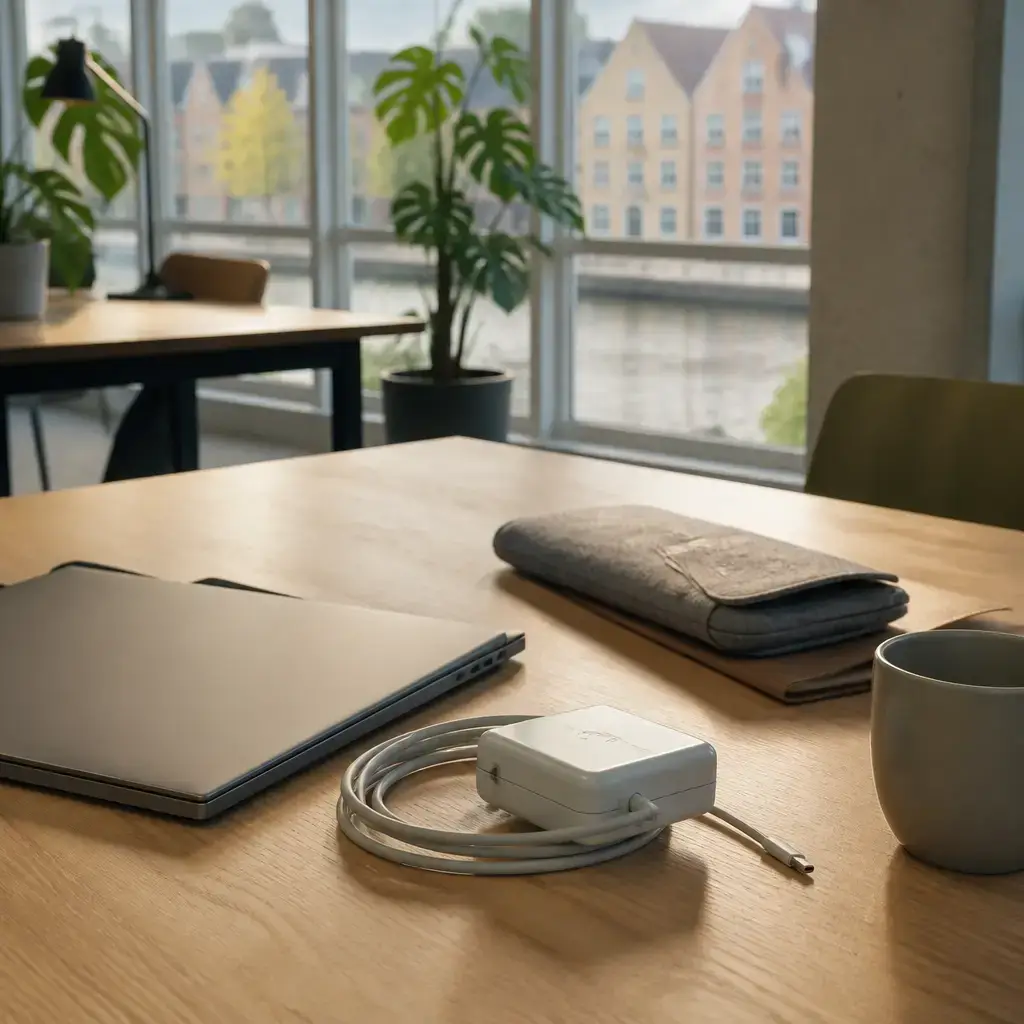
Use Borrowing a Charger and Confirming Its Return to practice Danish conversation, pronunciation, vocabulary, grammar, and quizzes.
Dialogue
Jeg har lagt min oplader et andet sted, og batteriet på min bærbare er næsten tomt.
yai hah LAHGT meen OH-plah-thuh et AH-nut stehth, aw bah-tuh-REE-ut poh meen BAIR-bah-ruh air NESS-den tohmt. I left my charger elsewhere and my laptop battery is nearly empty.Min burde passe, hvis din port bruger det nyere stik.
meen BOO-dhuh PASS-uh, vess deen pohrt BROO-uh deh NYAIR-uh steek. Mine should fit, provided your port uses the newer connector.Ja, det gør den, selv om jeg kun har brug for opladeren under denne upload.
yah, deh gohr den, selv ohm yai koon hah broo for oh-plah-thuh-un OON-uh DEN-uh UP-lohd. It does, although I only need it during this upload.Det går an, eftersom min computer allerede er fuldt opladet.
deh gohr an, ehf-tuh-SOM meen kom-PYOO-tuh ahl-uh-REH air fooldt oh-plah-THUHT. That is manageable, since my computer is already fully charged.Jeg kan give den tilbage, så snart filerne er færdige med at synkronisere.
yai kan GHEE-vuh den tuh-BYE-uh, soh snart FEE-luh-nuh air FAIR-dee-uh meh eh sungk-roh-nee-SAIR-uh. I can give it back as soon as the files finish synchronizing.Lad den blive i nærheden, for jeg får måske brug for den senere.
lahd den BLEE-vuh ee NAIR-hay-den, for yai fohr MAH-skeh broo for den SAY-nuh-uh. Please keep it nearby, because I may need it later.Jeg kan blive i nærheden, så du nemt kan få den tilbage.
yai kan BLEE-vuh ee NAIR-hay-den, soh doo nemt kan foh den tuh-BYE-uh. I can stay close by so you can get it back easily.Den aftale fungerer uden at afbryde nogen af os.
den ah-TAH-luh foon-guh-RAIR OO-den eh af-BROO-dhuh NOH-en uh ohss. That arrangement works without interrupting either of us.Sentence explanations
Jeg har lagt min oplader et andet sted, og batteriet på min bærbare er næsten tomt.
I left my charger elsewhere and my laptop battery is nearly empty.
- Jeg
- I
- har
- have
- lagt
- left; placed
- oplader
- charger
- andet
- other; different
- sted
- place
- batteriet
- the battery
- bærbare
- portable
- næsten
- nearly
- tomt
- empty
More detail
Jeg means “I” and is the first-person singular subject pronoun. It does not by itself indicate the speaker’s gender. Example: Jeg kommer nu. — “I am coming now.” har lagt is a completed-action pattern: har is the present form of have, used here as an auxiliary, and lagt is the supine form of lægge (“place; put”). Together they form the perfect, presenting the placing as completed. In this sentence, the natural translation is “left,” while the more concrete Danish meaning is “placed.” Compare Jeg lægger bogen her. — “I put the book here.” oplader is the noun “charger,” commonly used for a device charger. Its indefinite form is en oplader; the definite form is opladeren (“the charger”). In min oplader, min means “my” and agrees with this common-gender noun. andet means “another” or “different” here. It is the neuter singular form of anden, because it describes sted, which occurs as et sted. A useful pattern is en anden with a common-gender noun, et andet with a neuter noun, and andre for plural nouns. Thus et andet sted means “another place” or, naturally in this context, “elsewhere.” sted means “place.” The phrase et andet sted uses the neuter indefinite article et; the article does not itself assert a numerical count. Example: Vi mødes et andet sted. — “We will meet somewhere else.” batteriet means “the battery.” It is the definite form of the neuter noun batteri: et batteri → batteriet. The definite ending is part of the noun form, rather than a separate word. på links it to min bærbare, giving the relation “the battery of/on my laptop.” bærbare is the adjective bærbar (“portable”) used substantivally in min bærbare, with the noun “computer” understood. In everyday Danish, min bærbare can mean “my laptop,” as in the fixed translation. The form bærbare is the definite form used in this substantivized expression; the base form of the adjective is bærbar. næsten means “nearly” or “almost.” It modifies tomt, so næsten tomt means “nearly empty,” not completely empty. Example: Glasset er næsten tomt. — “The glass is nearly empty.” tomt means “empty” here and is the neuter singular form of the adjective tom. It agrees with batteriet, which is neuter singular: batteriet er tomt. With a common-gender singular noun, the predicative form is generally tom, as in Telefonen er tom (“The phone is empty”). For attributive use, the definite singular and plural form is tomme, as in den tomme telefon (“the empty phone”) and tomme telefoner (“empty phones”). The first clause is assembled as Jeg har lagt min oplader et andet sted: “I have left/placed my charger somewhere else.” og connects the two clauses. The second clause is batteriet på min bærbare er næsten tomt: er is the present form of være (“be”), and tomt agrees with batteriet. Together, the full utterance means: “I left my charger elsewhere, and my laptop battery is nearly empty.”
Min burde passe, hvis din port bruger det nyere stik.
Mine should fit, provided your port uses the newer connector.
- Min
- mine
- burde
- should
- passe
- fit
- hvis
- if
- din
- your
- port
- port
- bruger
- uses
- det
- the
- nyere
- newer
- stik
- connector
More detail
Min means “mine” here: it stands for the omitted noun phrase referring to the charger mentioned in the preceding context. Danish possessive forms agree with the thing possessed, not with the owner: min is used with a singular common-gender noun, mit with a singular neuter noun, and mine with plural nouns. Example: min oplader = “my charger”; mit stik = “my connector.” burde expresses what is expected or advisable: “should” or “ought to.” It is a modal verb and does not change for the subject. The following verb stays in its basic form: burde passe = “should fit.” Example: Den burde virke. = “It should work.” passe means “fit” in this sentence, specifically be physically compatible with the port. Its base form is passe; after a modal such as burde, Danish uses this form. Example: Kablet passer ikke. = “The cable does not fit.” hvis introduces a condition and means “if” or, in this translation, “provided.” It connects the expected result with the condition that follows: hvis ... = “if ... .” din means “your” and modifies port. It is the singular common-gender form; the corresponding neuter singular form is dit, and the plural form is dine. The form agrees with the possessed noun, not with the owner. Example: din oplader = “your charger,” but dit stik = “your connector.” port means “port.” It is a common-gender noun: en port. In din port, the possessive determiner identifies it as the other person’s port. bruger means “uses.” It is the present-tense form of bruge, “to use,” here with the singular subject din port: din port bruger ... = “your port uses ... .” Danish present tense does not add a separate ending for this third-person singular subject. Example: Porten bruger et nyt stik. = “The port uses a new connector.” det is the neuter singular determiner in det nyere stik, meaning “the” in this noun phrase. It accompanies stik, a neuter noun (et stik). Here it helps identify a particular connector rather than making a general statement about connectors. nyere means “newer.” It is the comparative form of ny, “new”; the comparison chain is ny → nyere → nyest (“new” → “newer” → “newest”). In this phrase, nyere characterizes the connector as newer than a relevant alternative, without stating how much newer it is. Example: Denne model er nyere. = “This model is newer.” stik means “connector” here. It is a neuter noun: et stik. The phrase det nyere stik therefore means “the newer connector.” Together, Min burde passe means “Mine should fit,” with the possessed charger understood from the preceding context. hvis din port bruger det nyere stik adds the condition “provided your port uses the newer connector.” The full utterance therefore means: “Mine should fit, provided your port uses the newer connector.”
Ja, det gør den, selv om jeg kun har brug for opladeren under denne upload.
It does, although I only need it during this upload.
- Ja
- yes
- det gør den
- it does
- selv om
- although
- jeg
- I
- kun
- only
- har brug for
- need
- opladeren
- the charger
- under
- during
- denne
- this
- upload
- upload
More detail
Ja means “yes” and confirms the preceding proposition. It is the ordinary affirmative response; for example, Ja, det passer. means “Yes, that is correct.” det gør den is a reusable Danish pattern meaning “it does.” Danish uses gøre (“do”) here to avoid repeating the action or description being confirmed. gør is the present-tense form of gøre; Danish present forms do not change for person or number. det and den are pronouns in this construction: the sentence does not itself state the exact referent of den, but the fixed translation supports the intended general meaning “it.” selv om introduces a contrast: “although” or “even though.” It can introduce a subordinate clause, as in Jeg går, selv om det regner. — “I am going, although it is raining.” jeg is the first-person singular pronoun “I.” It is the speaker form, contrasted with du (“you”) and han/hun (“he/she”). kun means “only” and limits the following need: the speaker’s need applies to the stated situation, not generally. Its position before har brug for gives the sense “only need.” har brug for is the fixed expression “need” (literally, “have use for”). har is the present form of have; Danish present tense does not change according to the subject. A useful pattern is Jeg har brug for tid. — “I need time.” opladeren means “the charger.” Its indefinite base form is en oplader; the ending -en marks a singular definite common-gender noun, “the charger.” For example, Jeg finder en oplader. means “I find a charger,” while Jeg finder opladeren. means “I find the charger.” under means “during” when it introduces a period or event. In this sentence it marks the time during which the charger is needed. For example, under mødet means “during the meeting.” denne means “this” and is the common-gender singular form used with the following noun. Danish also has dette with neuter singular nouns and disse with plural nouns. Here denne combines with upload as “this upload.” upload is the noun “upload.” In denne upload, it names the specific upload being referred to; the demonstrative makes it “this upload.” Together, jeg kun har brug for opladeren means “I only need the charger,” and under denne upload specifies when that need applies: “during this upload.” The whole utterance therefore means: “Yes, it does, although I only need it during this upload.” The contrast introduced by selv om connects the confirmation det gør den with the limited need expressed in the subordinate clause.
Det går an, eftersom min computer allerede er fuldt opladet.
That is manageable, since my computer is already fully charged.
- Det går an
- That is manageable
- eftersom
- since
- min
- my
- computer
- computer
- allerede
- already
- fuldt
- fully
- opladet
- charged
More detail
Det går an is a fixed Danish expression meaning that something is acceptable, possible, or manageable in the situation. Here, det is the neutral pronoun “it/that,” while går an together provides the expression’s meaning; do not interpret it as a literal statement that something is physically walking. A reusable pattern is Det går an. — “That is acceptable/manageable.” eftersom introduces the reason for the statement and corresponds here to “since” or “because.” It links the main statement to the explanation that follows. Example: Jeg bliver hjemme, eftersom jeg er syg. — “I am staying home because I am ill.” min means “my” before a singular common-gender noun. Danish possessives agree with the possessed noun: min with common gender singular, mit with neuter singular, and mine with plural nouns. In this sentence, min belongs to computer, not to the speaker’s grammatical person, which remains first person in all three forms. computer is the noun “computer.” Its common-gender singular form is en computer; the definite form is computeren (“the computer”). Example: Min computer virker. — “My computer works.” allerede means “already.” It places the charging state before the relevant reference point: the computer is fully charged by that time. Example: Hun er allerede hjemme. — “She is already at home.” fuldt means “fully” here. It is the form of fuld used adverbially to modify opladet, strengthening it from simply “charged” to “fully charged.” The base adjective is fuld; the adverbial form is fuldt in this expression. opladet means “charged” here, describing the computer’s current state. It is related to the verb oplade, “to charge”; opladet is its past participle and can also function adjectivally. The phrase fuldt opladet is a reusable way to say “fully charged,” for example: Telefonen er fuldt opladet. — “The phone is fully charged.” Together, Det går an gives the assessment “That is manageable.” eftersom then introduces the reason: min computer allerede er fuldt opladet, “my computer is already fully charged.” The complete utterance therefore means: “That is manageable, since my computer is already fully charged.”
Jeg kan give den tilbage, så snart filerne er færdige med at synkronisere.
I can give it back as soon as the files finish synchronizing.
- Jeg kan
- I can
- give
- give
- den
- it
- tilbage
- back
- så snart
- as soon as
- filerne
- the files
- er
- are
- færdige
- finished
- synkronisere
- synchronize
More detail
Jeg kan combines the subject Jeg (“I”) with kan, the present-tense form of kunne (“can; be able to”). The modal is followed by an infinitive: Jeg kan give means “I can give.” give is the infinitive of give (“to give”). After kan, Danish uses this infinitive without at. For example: Jeg kan hjælpe. — “I can help.” den is the singular common-gender object pronoun, meaning “it” here. Its specific referent is not identified by the fixed sentence; the form marks the pronoun’s grammatical type, not a particular object. tilbage means “back” and indicates return to an earlier place, person, or state. Together, give den tilbage means “give it back.” så snart introduces a time clause meaning “as soon as.” It connects the main action with the condition that follows: Jeg ringer, så snart jeg er hjemme. — “I’ll call as soon as I am home.” filerne means “the files.” The noun is fil (“file”); filer is its plural, and filerne is the definite plural, “the files.” er is the present-tense form of være (“to be”). It does not change for person or number in the present tense: jeg er, du er, and de er all use er. færdige is the plural form of the adjective færdig (“finished; done”). It agrees with plural filerne. In færdige med at ..., it expresses being finished with an activity. synkronisere is the infinitive “to synchronize.” The sequence med at synkronisere means “with synchronizing” or, naturally here, “synchronizing.” The at marks the infinitive after the preposition med; it is not part of the verb’s base form. The sentence first states the ability or permission-like possibility: Jeg kan give den tilbage — “I can give it back.” The time clause så snart filerne er færdige med at synkronisere says when that can happen: “as soon as the files finish synchronizing.” Together: “I can give it back as soon as the files finish synchronizing.”
Lad den blive i nærheden, for jeg får måske brug for den senere.
Please keep it nearby, because I may need it later.
- Lad den blive
- keep it / let it stay
- i nærheden
- nearby
- for
- because
- jeg
- I
- får … brug for
- need
- måske
- perhaps
- senere
- later
More detail
Lad den blive means “let it stay” or, in this request, “keep it.” Lad is the imperative of lade, used here to ask someone to allow a situation to continue. den is a singular third-person pronoun of the den class; here the fixed translation identifies its meaning as “it.” blive is the infinitive “stay/remain” (also “become” in other contexts). After lade, the following verb is commonly in the infinitive: Lad døren stå. — “Let the door remain open” / “Leave the door standing.” i nærheden means “nearby” or “in the vicinity.” The preposition i combines with the noun nærheden to describe a location. Jeg bor i nærheden. — “I live nearby.” for introduces the reason for the request here: “because.” It links the request to the explanation that follows. In this sentence, it is not the preposition meaning “for” in a phrase such as “a gift for her.” jeg means “I” and is the first-person singular subject pronoun. Danish uses jeg for the speaker as subject; its object form is mig: Hun ser mig. — “She sees me.” får brug for is the Danish construction få brug for, literally containing the idea of “get use for,” but in this context it means “need.” Får is the present-tense form of få; the subject jeg does not cause a special present-tense ending here. Jeg får brug for hjælp. — “I will need help” or “I need help,” depending on context. The construction is different from simply having or possessing something; it expresses that something will be needed. måske means “perhaps” or “maybe.” Here it makes the need uncertain: the speaker may need the item, but does not say that the need is definite. Måske kommer hun senere. — “Maybe she will come later.” senere means “later,” referring to a time after the relevant present or future point. It is related to the comparison of sen (“late”): sen → senere (“later”). It does not specify exactly when. Together, Lad den blive i nærheden asks that it remain nearby. for jeg får måske brug for den senere gives the reason: the speaker may need it later. The complete meaning is therefore: “Please keep it nearby, because I may need it later.”
Jeg kan blive i nærheden, så du nemt kan få den tilbage.
I can stay close by so you can get it back easily.
- Jeg kan
- I can
- blive
- stay; remain
- i nærheden
- nearby; close by
- så
- so that
- nemt
- easily
- kan
- can
- få
- get
- den
- it
- tilbage
- back
More detail
Jeg kan means “I can” here: Jeg is the first-person singular pronoun “I”, and kan is the present form of the modal verb kunne (“can; be able to”). Danish modal verbs are followed by an infinitive without at, as in Jeg kan blive (“I can stay”). Kan has the same present form with different subjects; the subject identifies who is able or willing to do something. blive is the infinitive “stay; remain”. Its useful forms include bliver (present), blev (past), and er blevet (has become/has stayed, depending on context). Here it describes remaining in a place, not becoming something. The following location phrase specifies where the speaker will remain. i nærheden means “nearby”. I is the preposition “in/at”, and nærheden is a noun meaning “the vicinity” or “the nearby area”. This phrase is a reusable way to describe location: Han er i nærheden means “He is nearby.” så introduces the purpose of the first clause here: the speaker can stay nearby so that the other person can retrieve something. It can also connect clauses with a result meaning in other contexts, so the surrounding clause determines the reading. nemt means “easily”. It is the adverb related to the adjective nem (“easy”), and it describes how the retrieval can happen. The adjective’s comparison is nem → nemmere (“easier”) → nemmest (“easiest”); nemt is the adverbial form used here. The second kan again expresses ability or possibility, but its subject is du (“you”), which is understood from the clause even though du is not included in the selected phrase. The pattern du kan can introduce an action that you are able to perform, followed by an infinitive without at. få is the infinitive “get; obtain”. In få den tilbage, it means “get it back” or “retrieve it”. Its principal forms are få (infinitive), får (present), fik (past), and fået (past participle). For example, Jeg får pakken tilbage means “I get the package back.” den is a third-person singular object pronoun meaning “it” here. Danish uses den for a singular common-gender referent and det for a singular neuter referent; the supplied sentence does not identify the exact thing referred to. In this construction, den is the object that is recovered. tilbage means “back” and indicates return to an earlier owner, place, or state. Together, få den tilbage forms the reusable pattern “get it back”; the meaning “back” comes from tilbage, not from få alone. The utterance combines Jeg kan blive i nærheden (“I can stay nearby”) with så du nemt kan få den tilbage (“so you can easily get it back”). The first clause presents the speaker’s staying nearby as a possibility or offer, and the purpose clause explains that this will make it easy for the other person to retrieve the unspecified item.
Den aftale fungerer uden at afbryde nogen af os.
That arrangement works without interrupting either of us.
- Den
- that
- aftale
- arrangement
- fungerer
- works
- uden at
- without
- afbryde
- interrupt
- nogen
- anyone
- af os
- of us
More detail
Den is the demonstrative determiner “that” here, and den aftale means “that arrangement.” Aftale is a common-gender singular noun, which is why this form of the demonstrative is used in this noun phrase. In Danish, a demonstrative such as den should not be treated as merely a general definite article; the meaning here is specifically demonstrative. A useful pattern is den + noun for “that [noun]” when the noun has this grammatical gender. aftale is the noun “arrangement” here. Depending on context, it can also mean “agreement” or “appointment.” Example: Vi har en aftale. — “We have an agreement/arrangement.” fungerer means “works” here. It is the present-tense form of fungere, “to work” or “to function.” Danish present-tense verbs do not change form to agree with the subject’s person or number, so fungerer is not a special singular form. Example: Planen fungerer. — “The plan works.” uden at introduces an action that does not occur: uden at + infinitive means “without [doing something].” The at belongs to this infinitive construction. Example: Hun gik uden at sige farvel. — “She left without saying goodbye.” afbryde is the infinitive “to interrupt.” It remains in this form after at; afbryde is also the dictionary base form. Example: Lad mig tale uden at afbryde. — “Let me speak without interrupting.” nogen is part of nogen af os. In this sentence, under the meaning supplied by the fixed translation, the whole expression refers to either of the two people included in “us.” In other contexts, nogen can mean “someone” or “anyone,” so its interpretation depends on the surrounding construction. af os means “of us.” os is the first-person plural object form, “us,” and af links that group to the subset expression. Together, nogen af os gives “either of us” in the intended reading here. Together, Den aftale fungerer means “That arrangement works.” uden at afbryde nogen af os adds the condition “without interrupting either of us.” The complete utterance is therefore: “That arrangement works without interrupting either of us.”
Grammar Points
selv om + ledsætning
Selv om batteriet er næsten tomt, går det an.
selv ohm bah-tuh-REE-ut air NESS-den tohmt, gohr deh an.Although the battery is nearly empty, it is manageable.
selv om introduces a subordinate clause expressing contrast. The verb comes after the subject in this clause.
hvis + ledsætning
Hvis batteriet er tomt, går det an.
vess bah-tuh-REE-ut air tohmt, gohr deh an.If the battery is empty, it is manageable.
hvis introduces a condition. In a fronted subordinate clause, the main clause keeps normal verb–subject order.
Danish Vocabulary
- Gender
- neuter
batteriet på min bærbare
min bærbare
lagt min oplader et andet sted
hvis din port bruger det nyere stik
det nyere stik
næsten tomt
- Gender
- common
min oplader
burde passe
- Gender
- common
din port
selv om jeg kun har brug for opladeren
- Gender
- neuter
det nyere stik
- Gender
- neuter
batteriet er næsten tomt
Quiz
Spelling
Tap the letters to spell the word.
nearly; almost
Show Answer
næstenport
Show Answer
portif; provided that
Show Answer
hvischarger