10 minutes free every day
Continue audio lessons in the app
Word explanations appear automatically in sync with the audio.
No login required · synced translations · playback with the screen locked
Choose your learning language and open this lesson in the app.

About This Lesson
Use Reporting a Kitchen Sink Leak to practice Danish conversation, pronunciation, vocabulary, grammar, and quizzes.
Dialogue
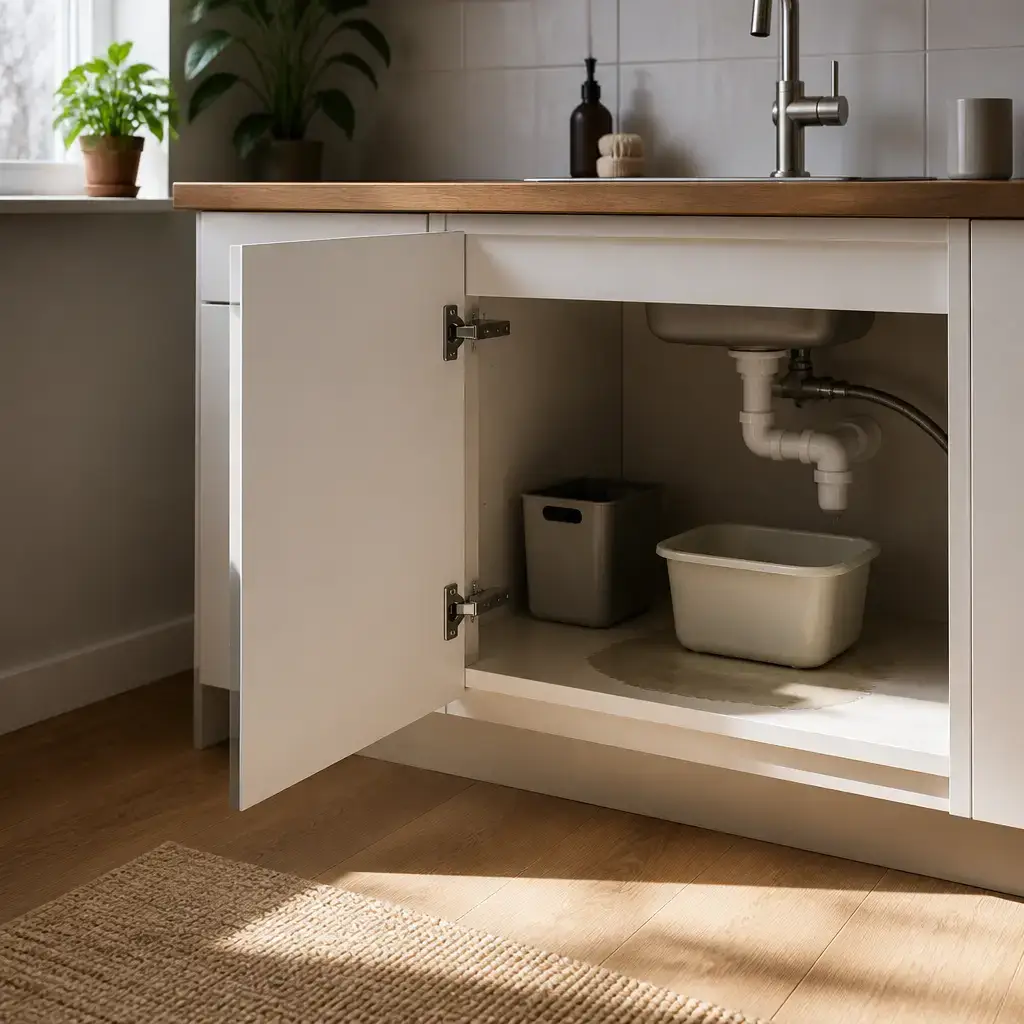
Jeg lagde mærke til, at der var ved at danne sig en fugtig plet under køkkenvasken.
YAI LEH-thuh MAIR-guh teel, uh dair vair veh uh DAN-uh sai en FOO-ti PLEHD OON-uh KUR-gen-VAS-gen. I noticed a damp patch forming under the kitchen sink.Det skal håndteres, før det beskadiger skabet.
Deh skal HAWN-teh-rehs, fur deh beh-SKAI-thuh SKAI-buh. That needs attention before it damages the cabinet.Jeg stillede en beholder der, men lækagen drypper stadig langsomt.
YAI STEL-uh-thuh en beh-HOHL-uh dair, men LAI-guh-en DRUR-buh STAI-thee LAHNG-somt. I placed a container there, but the leak is still dripping slowly.Er der opbevaret noget der, som kan blokere adgangen?
Air dair oh-beh-VAIR-uhd NOH-thuh dair, som kan bloh-GAIR-uh ANG-geng-en? Is anything stored there that could block access?Jeg ryddede området, så teknikeren nemt kan undersøge det.
YAI RUR-thuh ohm-ROH-thuh, soh teh-NEE-gair-en NEMT kan oon-SUR-uh deh. I cleared the area, so the technician can inspect it easily.Jeg kan markere det som akut, selvom planlægningen stadig kan tage tid.
YAI kan mar-GAIR-uh deh som uh-GOOD, SEL-um plan-LAI-gen-en STAI-thee kan TAI-uh TEED. I can mark it as urgent, although scheduling may still take time.Nævn venligst, at gulvet er begyndt at slå sig.
NEVN VEN-leest, uh GOOL-vuhd air beh-GURNDT uh sloh sai. Please mention that the floor is beginning to warp.Den detalje bør stå i rapporten.
Den deh-TAI-lee bur STOH ee ra-POHR-den. That detail should go in the report.Det påvirker sikkerheden og reparationsplanen.
Deh poh-VEER-kuh SEE-guh-HAY-den oh reh-pa-ra-SHOHNS-plai-nen. It affects safety and the repair plan.Sentence explanations
Jeg lagde mærke til, at der var ved at danne sig en fugtig plet under køkkenvasken.
I noticed a damp patch forming under the kitchen sink.
- Jeg
- I
- lagde mærke til
- noticed
- var ved at
- was in the process of
- danne sig
- form / take shape
- fugtig
- damp
- plet
- patch
- under
- under
- køkkenvasken
- the kitchen sink
More detail
Jeg means “I” here, the first-person singular subject. Danish uses jeg for the speaker regardless of the speaker’s gender. Example: Jeg ser det. — “I see it.” lagde mærke til is the fixed expression “noticed” or “took notice of.” It is the past form of lægge mærke til; the verb is lagde, while mærke til completes the expression. Example: Hun lagde mærke til pletten. — “She noticed the patch.” var ved at marks an action that was in progress or about to happen at the relevant past time. var is the past form of være (“be”), and ved at introduces the action. It is not simply a past tense marker for the following verb. Example: Maden var ved at blive kold. — “The food was getting cold.” danne sig means “form” or “take shape” here. danne means “form,” and sig is the reflexive pronoun, showing that the thing described is forming itself or coming into existence rather than someone forming it directly. In the fixed sentence, danne appears after at, so it is in the infinitive. Example: Der dannede sig en revne. — “A crack formed.” fugtig means “damp” or “moist.” It is a descriptive adjective modifying plet. The form fugtig is also used with a singular indefinite noun, as in en fugtig plet; other noun forms can affect adjective endings in Danish. Example: Et fugtigt håndklæde — “a damp towel.” plet means “patch” or “spot.” Here it refers to a visible damp area, not necessarily a separate object. Its definite form is pletten (“the patch”); the fixed sentence uses the indefinite form after en. Example: Jeg kan se en plet. — “I can see a spot.” under is the preposition “under” or “below.” It places the patch beneath the item named in the following phrase. Example: Katten ligger under bordet. — “The cat is under the table.” køkkenvasken means “the kitchen sink.” It is a compound: køkken (“kitchen”) + vask (“sink”), with the definite ending -en, so the whole form means “the kitchen sink.” The definiteness belongs to the compound as a whole. Example: Vandet står i køkkenvasken. — “The water is in the kitchen sink.” Together, Jeg lagde mærke til gives “I noticed.” The clause at der var ved at danne sig en fugtig plet says that a damp patch was in the process of forming: der introduces the existence of something, and var ved at places the forming in progress at the time of noticing. Finally, under køkkenvasken locates the patch beneath the kitchen sink. The complete meaning is: “I noticed a damp patch forming under the kitchen sink.”
Det skal håndteres, før det beskadiger skabet.
That needs attention before it damages the cabinet.
- Det skal
- That needs to
- håndteres
- be handled
- før
- before
- det
- it
- beskadiger
- damages
- skabet
- the cabinet
More detail
Det skal: det is a neuter singular pronoun meaning “it” here. Its exact referent is the problem under discussion; the supplied translation presents it as the thing that may damage the cabinet. Skal is the modal verb skulle. In this construction, skal expresses necessity or what needs to happen, followed by an infinitive: Det skal repareres = “It needs to be repaired.” håndteres: This is the passive form of håndtere, “to handle” or “deal with.” The ending -es forms a passive infinitive here, so skal håndteres means “needs to be handled,” rather than naming who will handle it. Compare active at håndtere problemet (“to handle the problem”) with passive problemet skal håndteres (“the problem needs to be handled”). før: This conjunction introduces an event that must occur earlier in time: “before.” A reusable pattern is før + clause, as in Luk døren, før det bliver koldt (“Close the door before it gets cold”). det: This is again the neuter singular pronoun det, now the subject of the clause after før. It refers to the same issue in the sentence and is the thing that could cause the damage. beskadiger: This is the present-tense form of beskadige, “to damage.” Danish present tense commonly has the ending -er, and this form is used with a singular subject such as det: Det beskadiger træet means “It damages the wood.” In this sentence, the present form appears in a time clause about a possible future consequence; før supplies the temporal relationship. skabet: This means “the cabinet.” The base noun is skab, “cabinet” or “cupboard”; skabet is its definite singular form. The ending -et marks definite singular for this neuter noun. Compare et skab (“a cabinet”) with skabet (“the cabinet”). Together, Det skal håndteres says that the issue needs to be dealt with. før det beskadiger skabet adds the time limit: this should happen before the issue damages the cabinet. The complete meaning is therefore “That needs attention before it damages the cabinet.”
Jeg stillede en beholder der, men lækagen drypper stadig langsomt.
I placed a container there, but the leak is still dripping slowly.
- Jeg
- I
- stillede
- placed
- beholder
- container
- der
- there
- men
- but
- lækagen
- the leak
- drypper
- drips
- stadig
- still
- langsomt
- slowly
More detail
Jeg means “I” here: it is the first-person singular subject pronoun. The subject is the person who placed the container. A useful contrast is jeg “I” versus du “you”; the verb form must match the subject. stillede is the past-tense form of stille, “to place” or “to set something down.” The useful chain is stille → stiller (present) → stillede (past) → har stillet (perfect). Example: Jeg stillede koppen på bordet. — “I placed the cup on the table.” beholder means “container.” It is a common-gender noun: en beholder; its definite singular form is beholderen, “the container,” and its plural forms are beholdere and beholderne. In this sentence, the indefinite form presents the object as a container without marking it as a previously identified specific container. der means “there” in this sentence and points to a location. Here it refers to the location understood from the situation; the supplied texts do not identify that location more specifically. Danish also uses der in other functions, such as a relative pronoun, but that is not its function here. men means “but” and connects two clauses with a contrast: the speaker placed a container, yet the leak continues to drip. Example: Jeg kommer, men jeg bliver ikke længe. — “I am coming, but I will not stay long.” lækagen means “the leak.” It is the definite singular form of the common-gender noun en lækage: en lækage “a leak” → lækagen “the leak.” The definite form presents the leak as an identifiable issue in this context. drypper is the present-tense form of dryppe, “to drip.” The present form is used for the ongoing situation described here: the leak is dripping. Example: Vandet drypper fra hanen. — “The water is dripping from the tap.” stadig means “still,” indicating that the dripping continues at the relevant time. It modifies the situation expressed by drypper; it is not part of the verb’s inflection. Example: Det regner stadig. — “It is still raining.” langsomt means “slowly.” It is the adverbial form used to describe the manner of dripping. It is related to the adjective langsom, “slow,” but the adjective and adverb have different roles: en langsom proces means “a slow process,” while drypper langsomt means “drips slowly.” Together, Jeg stillede en beholder der means “I placed a container there.” men introduces the contrast, and lækagen drypper stadig langsomt means “the leak is still dripping slowly.” The complete utterance is: “I placed a container there, but the leak is still dripping slowly.”
Er der opbevaret noget der, som kan blokere adgangen?
Is anything stored there that could block access?
- Er der
- Is there …?
- opbevaret
- stored
- noget
- anything
- der
- there
- som
- that / which
- kan
- can
- blokere
- block
- adgangen
- access
More detail
Er der is a common Danish way to ask whether something exists or is present: “Is there …?” In this sentence, er is the present form of være (“be”), and the construction places er before the subject-like element because it is a question. Pattern: Er der ...? Example: Er der kaffe? — “Is there coffee?” opbevaret means “stored” here. It is the past participle of opbevare (“store”) and describes something that has been put somewhere and remains stored there. In this question it forms a passive/result description with er: er opbevaret = “is stored.” This is not the same as the active form opbevarer, “stores.” noget means “anything” in this question. Its basic meaning is “something,” and Danish commonly uses it in questions where English uses “anything.” Example: Har du noget? — “Do you have anything?” der means “there” as a place adverb in this position. It points to the location already understood from the sentence or context. This occurrence is different in function from the der in Er der, which is part of the existential question pattern. som introduces the clause that describes noget: noget som ... means “something that ...” or, in this question, “anything that ...”. Danish som does not change form for the noun it relates to. Example: Jeg så noget som bevægede sig. — “I saw something that was moving.” kan is the present form of kunne, “can/could.” Here it expresses possibility or capability: the stored thing could block the access. Danish kan is followed directly by an infinitive, without at: kan blokere = “can block.” blokere is the infinitive “to block.” After the modal kan, Danish uses this bare infinitive: kan blokere, not kan at blokere. Example: Det kan blokere døren. — “It can block the door.” adgangen means “the access.” It is the definite singular form of the common-gender noun adgang (“access”): adgang → adgangen. The ending -en marks definiteness for this noun; it is the noun, not blokere, that carries this form. Together, Er der opbevaret noget der, som kan blokere adgangen? asks whether anything is stored there that could block access. The structure is Er der + a description of what is present (opbevaret noget der) + a relative clause identifying the relevant kind of thing (som kan blokere adgangen).
Jeg ryddede området, så teknikeren nemt kan undersøge det.
I cleared the area, so the technician can inspect it easily.
- Jeg
- I
- ryddede
- cleared
- området
- the area
- så
- so
- teknikeren
- the technician
- nemt
- easily
- kan
- can
- undersøge
- inspect
- det
- it
More detail
Jeg is the first-person singular subject pronoun: “I.” Danish uses jeg for the speaker as subject; the corresponding object form is mig, as in Hun ser mig (“She sees me”). ryddede means “cleared” here. Its base form is rydde (“to clear”); ryddede is the past form of this regular verb. It presents the clearing as completed before the result expressed by the following clause, without claiming that the inspection has already happened. Example: Jeg ryddede bordet — “I cleared the table.” området means “the area.” The base noun is område, and området is its singular definite form, formed with the ending -t. The noun is neuter: et område (“an area”), området (“the area”). The definite ending identifies a particular area rather than merely introducing an unspecified one. så here is the conjunction “so,” linking the clearing with the resulting situation that the technician can inspect the area easily. Danish så can have other functions in other contexts, but this sentence uses it to connect these two clauses. teknikeren means “the technician.” Its base noun is tekniker, and teknikeren is the singular definite form, with -en. This noun is common gender: en tekniker (“a technician”), teknikeren (“the technician”). nemt means “easily” in this sentence. It is related to the adjective nem (“easy”); nemt is the neuter form and is also used adverbially to describe an action as easy to perform. Compare Det er nemt (“It is easy”) with the practice example Han løser opgaven nemt (“He solves the task easily”). Here it describes the ease of the possible inspection. kan means “can” and is the present form of the modal verb kunne. Danish modal verbs are followed directly by an infinitive, without English to: kan undersøge means “can inspect.” Here kan expresses the possibility or ability available in the situation, while ryddede separately marks the clearing as past. undersøge means “inspect” here. It is the infinitive form of the verb and follows kan directly. Example: Teknikeren kan undersøge maskinen — “The technician can inspect the machine.” det means “it” here and is the object of undersøge. In this utterance, the fixed translation identifies the inspected object as the area. Danish det is the neuter singular third-person pronoun; its form reflects the grammatical class of its referent, not the physical meaning of “area.” Together, Jeg ryddede området says “I cleared the area.” så connects that completed action to teknikeren nemt kan undersøge det: “the technician can easily inspect it.” The complete meaning is: “I cleared the area, so the technician can inspect it easily.”
Jeg kan markere det som akut, selvom planlægningen stadig kan tage tid.
I can mark it as urgent, although scheduling may still take time.
- Jeg kan
- I can
- markere
- mark; label
- det
- it
- som
- as
- akut
- urgent
- selvom
- although
- planlægningen
- the planning; scheduling
- stadig
- still
- kan
- may
- tage
- take
- tid
- time
More detail
Jeg kan combines jeg (“I”) with kan, the present-tense form of kunne (“can; be able to”). Kan has the same form with different subjects; the subject is shown by the pronoun here. After a modal such as kan, the next verb normally appears in the infinitive: kan markere = “can mark.” markere means “to mark or label.” It is the infinitive used after kan; the finite verb would be markerer in a present-tense clause without that modal. A reusable pattern is markere noget som ..., “to mark something as ...”. det is the neuter singular third-person pronoun “it” here. The fixed translation supports this object meaning, but the supplied material does not identify exactly what det refers to. Danish pronoun form reflects grammatical features such as gender and number, not necessarily the physical nature of the referent. som introduces the status or classification assigned to the object: markere det som ... means “mark it as ...”. This use is different from som in some relative-clause patterns, where it can correspond to “that” or “which.” akut means “urgent” here. In markere det som akut, it describes the status assigned to det. The form is also used as a neuter singular adjective; a common corresponding form is akut with a common-gender noun, while plural or definite forms commonly use akutte. The exact form depends on the noun phrase or construction it modifies, not on det being a particular kind of object. selvom is a conjunction meaning “although” or “even though.” It introduces a contrasting subordinate clause: selvom ... presents information that does not cancel the main clause. For example, Jeg går, selvom det regner. means “I am going, although it is raining.” planlægningen means “the planning” or, in this context, “scheduling.” It is the definite singular form of planlægning; the ending -en marks common-gender singular definiteness. The word refers to the planning process, not to a person who plans. stadig means “still.” It indicates that the situation continues to hold at the relevant time. In planlægningen stadig kan tage tid, it modifies the clause about the scheduling process taking time. The second kan is again the present-tense form of kunne, but the fixed translation gives it the possibility meaning “may” rather than the ability meaning “can.” Danish kan can express either ability or possibility; the surrounding clause and context determine which reading is intended. tage is the infinitive of tage, “to take.” It follows the second modal: kan tage. In the expression tage tid, it means that something requires or consumes time, rather than that someone physically takes time away. tid means “time.” tage tid is a reusable expression meaning “take time” or “require time.” For example, Det kan tage tid. means “It may take time.” Together, Jeg kan markere det som akut means “I can mark it as urgent.” The conjunction selvom then adds the contrasting clause planlægningen stadig kan tage tid: the scheduling may still take time. Thus the complete utterance is: “I can mark it as urgent, although scheduling may still take time.”
Nævn venligst, at gulvet er begyndt at slå sig.
Please mention that the floor is beginning to warp.
- Nævn
- mention
- venligst
- please
- gulvet
- the floor
- begyndt
- begun
- slå sig
- warp
More detail
Nævn is the imperative of nævne, “to mention.” It gives a direct instruction to one or more listeners; the subject is understood rather than written. Compare nævner (“mentions”) for present tense and nævnte (“mentioned”) for past tense. venligst is a polite adverb meaning “please.” It softens the instruction without changing what is being requested. The reusable pattern is imperative + venligst, as in Vent venligst. — “Please wait.” gulvet means “the floor.” It is the definite singular form of gulv: gulv = “a floor/floor” and gulvet = “the floor.” The ending -et marks definiteness here; it is not an indication of a numeric quantity. The noun is neuter, which is relevant to its article and definite form. begyndt is the past participle of begynde, “to begin.” In er begyndt at ..., it forms a construction meaning that an activity or change has started and is now relevant. begynde at + infinitive is a useful pattern: Hun begyndte at grine. — “She began to laugh.” The form begyndt belongs to begynde, not to gulvet; the auxiliary er and the following at-infinitive complete the construction. slå sig is the reflexive expression used here for a surface such as a floor becoming warped or buckled. slå by itself has other uses, including “hit” or “strike,” so the meaning here comes from the expression and the inanimate subject. The pronoun sig is the reflexive form used with a third-person subject; in this sentence it refers back grammatically to gulvet, not to a separate participant. In the pattern noget slår sig, “something warps,” the subject is the thing that changes shape. Together, Nævn venligst gives the polite instruction “Please mention,” and at gulvet er begyndt at slå sig supplies what should be mentioned: “that the floor is beginning to warp.” Thus the complete utterance is: “Please mention that the floor is beginning to warp.”
Den detalje bør stå i rapporten.
That detail should go in the report.
- Den
- that
- detalje
- detail
- bør
- should
- stå
- be included
- i rapporten
- in the report
More detail
Den agrees with detalje: it is the singular common-gender form used here for “that” before the noun. The related form det is used with singular neuter nouns, while denne commonly means “this” rather than “that.” detalje means “detail” here. Its indefinite singular form is en detalje, and its definite singular form is detaljen; the definite ending shows that the noun refers to an identifiable detail in this context. Example: Jeg har en detalje. — “I have a detail.” bør is the present form of the modal verb burde and expresses what ought to happen or what is advisable. After bør, the next verb remains in the infinitive: bør stå. This is a recommendation or expectation, not a statement that the action has already happened. Example: Rapporten bør være kort. — “The report should be short.” stå literally means “stand,” but with information or text it can mean “be included,” “appear,” or “be stated” in a document. It is the infinitive selected after bør; bør stå therefore means “should be included/appear.” Example: Navnet skal stå øverst. — “The name must appear at the top.” In i rapporten, i means “in,” and rapporten is the definite singular form of rapport, “report”: en rapport → rapporten. The definite form presents the report as an identifiable document rather than introducing an unspecified report. Example: Det står i rapporten. — “It is stated in the report.” Together, Den detalje identifies the detail, bør stå says that it ought to appear or be included, and i rapporten specifies the document. The complete meaning is: “That detail should go in the report.”
Det påvirker sikkerheden og reparationsplanen.
It affects safety and the repair plan.
- Det
- It
- påvirker
- affects
- sikkerheden
- safety
- reparationsplanen
- the repair plan
More detail
Det is the Danish neuter singular form corresponding here to “it.” In the supplied context, it refers to the matter or detail being discussed. Danish also uses den for common-gender singular referents; the form is chosen by the grammatical gender of the referent, not simply by whether it is singular. påvirker means “affects” here. It is the present-tense form of påvirke (“to affect”); Danish present-tense verbs generally do not change for person or number. A reusable pattern is Det påvirker ... — “It affects ...” Example: Vejret påvirker planen. — “The weather affects the plan.” sikkerheden means “safety” here. It is the definite singular form of sikkerhed (“safety”): sikkerhed is “safety,” while sikkerheden is “the safety.” The ending -en marks definiteness for this noun; it does not itself mean a numerical quantity. og connects the two affected objects and means “and.” reparationsplanen means “the repair plan.” It is a compound noun: reparationsplan means “repair plan,” and the final -en makes the compound definite singular, “the repair plan.” The observed form is therefore built from reparationsplan plus its definite ending; it is not an inflected form of reparation alone. Together, Det påvirker gives “It affects,” and sikkerheden og reparationsplanen supplies the two things affected: “safety and the repair plan.” The complete utterance means: “It affects safety and the repair plan.”
Grammar Points
-s-passiv: håndteres
Lækagen håndteres.
LAI-guh-en HAWN-teh-rehs.The leak is handled.
Danish kan danne passiv med -s på verbet: håndtere bliver til håndteres.
selvom + ledsætning
Selvom lækagen drypper langsomt, påvirker den sikkerheden.
SEL-um LAI-guh-en DRUR-buh LAHNG-somt, poh-VEER-kuh den SEE-guh-HAY-den.Although the leak drips slowly, it affects safety.
Selvom indleder en ledsætning. I en ledsætning står verbet normalt efter grundleddet.
Danish Vocabulary
- Gender
- common
en beholder
før det beskadiger skabet
ved at danne sig
lækagen drypper stadig
en fugtig plet
Det skal håndteres
- Gender
- common
under køkkenvasken
Jeg lagde mærke til
- Gender
- common
lækagen drypper stadig
- Gender
- common
en fugtig plet
- Gender
- neuter
beskadiger skabet
Jeg stillede en beholder der
Quiz
Word Order
Arrange the words in the correct order.
That detail should go in the report.
Show Answer
Den detalje bør stå i rapporten.It affects safety and the repair plan.
Show Answer
Det påvirker sikkerheden og reparationsplanen.Spelling
Tap the letters to spell the word.
damp
Show Answer
fugtigdamage
Show Answer
beskadigerpatch
Show Answer
pletplace