10 minutes free every day
Continue audio lessons in the app
Word explanations appear automatically in sync with the audio.
No login required · synced translations · playback with the screen locked
Choose your learning language and open this lesson in the app.

About This Lesson
Use Describing a possible heating problem to practice Danish conversation, pronunciation, vocabulary, grammar, and quizzes.
Dialogue
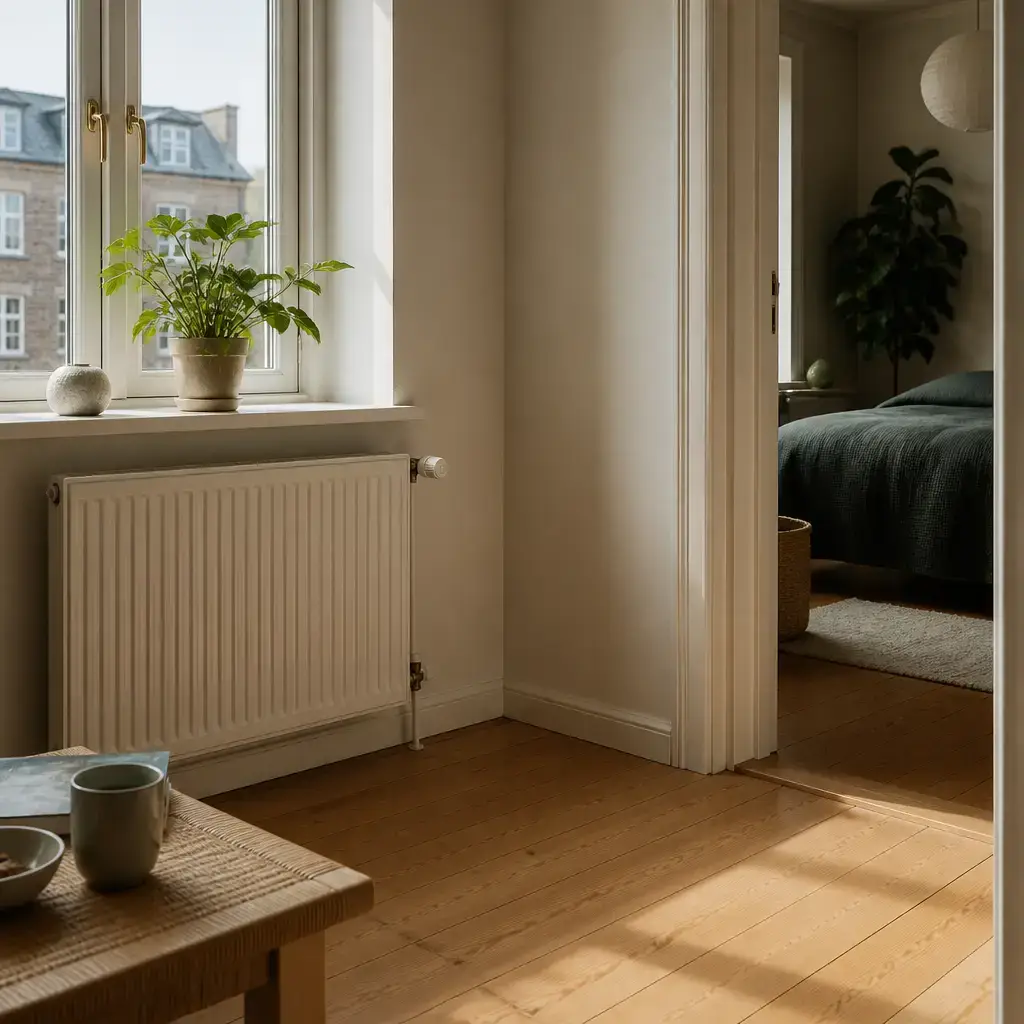
Varmen slår til, men rummet bliver aldrig behageligt.
VAHR-men s'LOHR TEEL, men ROO-met BLEE-vah AHL-dree beh-HAI-uh-lit. The heating switches on, but the room never becomes comfortable.Termostaten fungerer måske, mens radiatorventilen stadig sidder fast.
tehr-moh-STAHT-en FOONG-uh-ah MOH-skeh, mens rah-dee-oh-TAWR-ven-TEE-len STAY-thee SID-ah FAST. The thermostat may be working, while the radiator valve remains stuck.Det tænkte jeg også på, fordi røret føles varmt tæt på væggen.
Deh TENG-teh yai OH-soh poh, fohr-THEE ROOR-et FUH-les VAHRMT TATE poh VAY-en. I wondered about that, because the pipe feels warm near the wall.Så er problemet sandsynligvis cirkulationen snarere end strømmen.
Soh air proh-BLAY-met san-SOON-lee-viss sir-koo-la-SHOH-nen SNAH-ruh en STREHM-en. Then the problem is probably circulation rather than power.Kan en tekniker undersøge det uden at gå ind i alle rum?
Kan en tek-NEE-kah OON-ah-SUR-uh deh OO-den eh goh in ee AHL-eh ROOM? Could a technician check it without entering every room?Teknikeren får måske brug for adgang til at sammenligne temperaturerne i hele lejligheden.
Tek-NEE-kah-ren fohr MOH-skeh broo fohr AHD-ahng teel eh sah-men-LEE-nuh tem-pah-rah-TOO-ah-nuh ee HEE-leh LIE-lee-hay-en. They may need access to compare temperatures across the apartment.Jeg kan arrangere det, hvis teknikeren giver et rimeligt varsel.
Yai kan ah-rahn-JAIR-uh deh, viss tek-NEE-kah-ren GEE-vah et REE-meh-lel VAHR-sel. I can arrange that if they give reasonable notice.Vi bør bede om et klart tidsrum, før vi bekræfter det.
Vee buhr BAY-theh om et KLART TEES-room, fuh vee buh-KRAIF-tah deh. We should request a clear time window before we confirm.Sentence explanations
Varmen slår til, men rummet bliver aldrig behageligt.
The heating switches on, but the room never becomes comfortable.
- Varmen
- the heating
- slår til
- switches on
- men
- but
- rummet
- the room
- bliver
- becomes
- aldrig
- never
- behageligt
- comfortable
More detail
Varmen is the definite form of varme, meaning “the heat” or, in this sentence, “the heating.” The ending -en marks a singular common-gender noun in the definite form: varme → varmen. The exact meaning here is fixed by the translation and context as the heating system, not simply warmth in general. slår til is a useful verb construction meaning “switches on” here. The verb is slå; with til, the construction can describe something activating or coming into operation. In this sentence, slår is present tense, so the heating switches on in the stated situation. Keep the two words together when using this meaning: anlægget slår til means “the system switches on.” men connects two contrasting clauses and means “but.” It introduces the result that contrasts with the heating switching on. rummet is the definite form of the neuter noun rum, “room”: rum → rummet. The sentence therefore refers to the room as a specific room understood in the situation, while the form itself only expresses definiteness and neuter singular agreement. bliver is the present-tense form of blive, “become” or “remain,” depending on the construction. Here it means “becomes”: the room does not reach a comfortable state. A reusable pattern is X bliver Y, meaning “X becomes Y” when Y is a resulting state. aldrig means “never.” It places the negative time-frequency meaning over the clause: the room never becomes comfortable. It is different from ikke, which generally means “not” and does not itself express the repeated or at-any-time meaning of “never.” behageligt is the neuter singular form of the adjective behagelig, “comfortable” or “pleasant.” Its -t ending agrees with the neuter noun rummet in this predicative description. The useful adjective forms are behagelig (common gender), behageligt (neuter singular), and behagelige (plural or definite contexts); comparison is behageligere (“more comfortable”) and behageligst (“most comfortable”). Together, Varmen slår til says “The heating switches on.” men rummet bliver aldrig behageligt contrasts that event with its result: “but the room never becomes comfortable.” The complete utterance is therefore: “The heating switches on, but the room never becomes comfortable.”
Termostaten fungerer måske, mens radiatorventilen stadig sidder fast.
The thermostat may be working, while the radiator valve remains stuck.
- Termostaten
- the thermostat
- fungerer
- works; functions
- måske
- perhaps; maybe
- mens
- while
- radiatorventilen
- the radiator valve
- stadig
- still
- sidder fast
- remains stuck
More detail
Termostaten means “the thermostat” here. termostat is the base noun; termostaten is its definite singular form, marked by -en. Danish commonly places definiteness on the noun itself rather than using a separate word equivalent to “the.” fungerer is the present form of fungere, “to work” or “to function.” It can describe whether a device operates properly. Example: Ventilen fungerer. — “The valve works.” måske means “maybe” or “perhaps.” It makes the statement uncertain: the thermostat may be working, rather than asserting that it is working. mens introduces a clause happening at the same time as the first clause. It corresponds to “while” here and links the possible operation of the thermostat with the continuing condition in the second clause. radiatorventilen means “the radiator valve.” The base compound noun is radiatorventil; its definite singular form is radiatorventilen. Danish compounds are written as one word, and the definite ending appears at the end of the compound. stadig means “still.” It shows that the condition continues at the relevant time. Example: Døren er stadig lukket. — “The door is still closed.” sidder fast is a reusable Danish construction meaning “is stuck” or “remains stuck.” It uses the present form sidder of sidde (“sit”) with fast (“firmly/in place”); together they describe something that cannot move, rather than someone literally sitting. Example: Skuffen sidder fast. — “The drawer is stuck.” Together, Termostaten fungerer måske says “The thermostat may be working.” mens radiatorventilen stadig sidder fast adds the simultaneous condition “while the radiator valve remains stuck.” The complete meaning is: “The thermostat may be working, while the radiator valve remains stuck.” The two clauses concern different devices and present the valve’s stuck condition as continuing alongside the thermostat’s possible operation.
Det tænkte jeg også på, fordi røret føles varmt tæt på væggen.
I wondered about that, because the pipe feels warm near the wall.
- Det
- that
- tænkte … på
- thought about / wondered about
- jeg
- I
- også
- also
- fordi
- because
- røret
- the pipe
- føles
- feels
- varmt
- warm
- tæt på
- near / close to
- væggen
- the wall
More detail
Det is a demonstrative pronoun meaning “that” here. It is a neuter singular form, but the supplied sentence does not identify a more specific noun referent. At the beginning of the sentence, it is placed before the verb as the fronted topic. tænkte is the past-tense form of tænke, “to think.” With på, the reusable pattern tænke på noget means “think about something” or, in this context, “wonder about something.” The past form presents this thinking as completed or situated in the past. Because Det is fronted, Danish has the order Det tænkte jeg rather than the more neutral Jeg tænkte på det. jeg means “I” and identifies the speaker as the subject of tænkte. også means “also” and adds this thought to something already considered; it does not change the tense of tænkte. fordi introduces a reason clause and means “because.” The clause after it explains why the speaker also thought about that matter. røret means “the pipe.” The base noun is rør; -et marks the definite singular form for this noun: rør “a pipe” / “pipe” and røret “the pipe.” This is the noun that functions as the subject of føles. føles means “feels” here, as in how something feels or seems to the touch. It is the present-tense form of føle with the -s ending used in this sensory construction. For example, Vandet føles koldt means “The water feels cold.” varmt means “warm.” It is the neuter singular form of the adjective varm, agreeing with the neuter noun rør in this sentence: et varmt rør means “a warm pipe.” The form varm is used with common-gender singular nouns, while varmt is used with neuter singular nouns. tæt på is a reusable location phrase meaning “near” or “close to.” It introduces the place relative to which the pipe feels warm. For example, Stolen står tæt på døren means “The chair is near the door.” væggen means “the wall.” The base noun is væg, and -en marks its definite singular form: en væg “a wall” and væggen “the wall.” Here it is the reference point in the location phrase tæt på væggen. Together, Det tænkte jeg også på means “I wondered about that too” or “I also thought about that.” fordi røret føles varmt tæt på væggen gives the reason: “because the pipe feels warm near the wall.” The complete utterance therefore means: “I wondered about that, because the pipe feels warm near the wall.”
Så er problemet sandsynligvis cirkulationen snarere end strømmen.
Then the problem is probably circulation rather than power.
- Så
- then
- er
- is; be
- problemet
- the problem
- sandsynligvis
- probably
- cirkulationen
- the circulation
- snarere end
- rather than
- strømmen
- the power
More detail
Så means “then” here: it connects this conclusion to what was just discussed. It can also mean “so” in other contexts, but the intended meaning in this sentence is temporal or discourse-linking “then.” er is the present-tense form of at være (“to be”). Danish uses er with different subjects in the present; it does not change for person or number. For example, Problemet er lille means “The problem is small.” problemet means “the problem.” The base noun is problem; the ending -et marks the definite singular form, “the problem.” Danish indefinite et problem means “a problem,” while problemet identifies it as a specific problem in the discussion. sandsynligvis means “probably” and marks the speaker’s conclusion as likely rather than certain. It modifies the whole statement here, not just problemet or cirkulationen. cirkulationen means “the circulation.” Its base noun is cirkulation; -en marks definite singular for this noun. In this sentence, it refers to circulation as the likely issue being compared with strømmen. snarere end is the reusable comparison pattern “rather than.” It selects the first possibility as more likely or more appropriate than the second. For example, Hun går snarere end hun tager bussen means “She walks rather than takes the bus.” strømmen means “the power” in this fixed sentence. The base noun is strøm; -men is part of its definite singular form. The same noun can have other context-dependent meanings, but the fixed translation establishes the intended sense here as power, contrasted with circulation. Together, Så er problemet gives “Then the problem is,” and sandsynligvis cirkulationen snarere end strømmen identifies circulation as the more likely explanation instead of power. The complete meaning is: “Then the problem is probably circulation rather than power.”
Kan en tekniker undersøge det uden at gå ind i alle rum?
Could a technician check it without entering every room?
- Kan
- could; can
- tekniker
- technician
- undersøge
- check; examine
- det
- it
- uden at
- without doing
- gå … ind
- enter; go in
- alle
- all; every
- rum
- rooms
More detail
Kan is the modal verb kunne in the present tense. Here it introduces a possibility or ability: “could/can a technician…?” In Danish, the infinitive that follows a modal does not take at: Kan du hjælpe? = “Can you help?” tekniker means “technician.” This is the indefinite singular form; its definite form is teknikeren (“the technician”), and its plural is teknikere (“technicians”). The following context uses the definite form Teknikeren, referring to the technician introduced here. undersøge is the infinitive of undersøge, “to examine” or “to check.” After kan, it stays in the infinitive without at: Hun kan undersøge det. = “She can examine it.” det is a neuter singular pronoun meaning “it” here. The fixed translation identifies the intended meaning as the thing being checked, but does not specify exactly what that thing is. Its form reflects grammatical gender and number, not a particular noun supplied in the sentence. uden at introduces an action that does not happen: “without doing …”. After this construction, Danish uses at plus an infinitive. For example, uden at vente means “without waiting.” gå ind is a separable verb meaning “to go in” or, in this sentence, “to enter.” The two parts are separate in the utterance, but they form one reusable verb. Its infinitive is gå ind; a present-tense example is Han går ind. = “He goes in.” alle means “all” before the plural noun rum here, giving “every/all the rooms” in the intended translation. Danish can use alle with a plural noun to express the complete set: alle bøger = “all the books.” It is different from singular hver, “each/every,” which is used with a singular noun. rum means “rooms” here. It is the plural of rum; the same written form can also serve as the indefinite singular in Danish, so number is determined by the surrounding words. In alle rum, alle makes the plural reading clear. Together, Kan en tekniker undersøge det asks whether a technician could check the unspecified item. uden at gå ind i alle rum adds the condition that the technician would do so without entering every room. The complete meaning is: “Could a technician check it without entering every room?”
Teknikeren får måske brug for adgang til at sammenligne temperaturerne i hele lejligheden.
They may need access to compare temperatures across the apartment.
- Teknikeren
- the technician
- får måske brug for
- may need
- adgang
- access
- sammenligne
- compare
- temperaturerne
- the temperatures
- hele
- whole; entire
- lejligheden
- the apartment
More detail
Teknikeren means “the technician.” It is the definite singular form of tekniker: en tekniker = “a technician,” teknikeren = “the technician.” The definite ending -en identifies a particular technician in this sentence; it does not by itself indicate the person’s gender. får måske brug for is the reusable Danish construction “may need.” får is the present-tense form of få (“get”), but in få brug for the whole expression means “need” or “come to need.” måske means “perhaps/maybe” and makes the need uncertain. For example: Jeg får brug for hjælp. — “I will need help.” adgang means “access.” The construction få brug for adgang til ... means “need access to ...”; til introduces what the access is for or gives access to. Here, the sentence does not specify access to a particular object beyond the following activity. at sammenligne means “to compare.” sammenligne is the base form, and at marks the infinitive here: at sammenligne X = “to compare X.” Example: Vi skal sammenligne priserne. — “We need to compare the prices.” temperaturerne means “the temperatures.” It is the definite plural form of temperatur: temperaturer = “temperatures,” temperaturerne = “the temperatures.” The ending -ne marks definite plural in this form. The temperatures are the object being compared. hele means “whole” or “entire.” In hele lejligheden, it modifies the following noun and emphasizes the apartment as one complete area. Danish uses hel, helt, and hele according to the noun phrase’s grammatical form; hele is the form used here before the definite noun phrase. lejligheden means “the apartment.” It is the definite singular form of lejlighed: en lejlighed = “an apartment,” lejligheden = “the apartment.” Together, i hele lejligheden means “throughout the entire apartment”; i is not included in the selected phrase, but it locates the comparison across that area. Taken together, Teknikeren is the participant, får måske brug for expresses an uncertain need, and adgang til at sammenligne temperaturerne specifies what access is needed for. i hele lejligheden says that the temperatures are compared throughout the entire apartment. The complete meaning is: “They may need access to compare temperatures across the apartment.”
Jeg kan arrangere det, hvis teknikeren giver et rimeligt varsel.
I can arrange that if they give reasonable notice.
- Jeg kan
- I can
- arrangere
- arrange
- det
- that
- hvis
- if
- teknikeren
- the technician
- giver
- gives
- rimeligt
- reasonable
- varsel
- notice
More detail
Jeg kan means “I can.” Jeg is the first-person singular pronoun “I”. kan is the present-tense form of kunne (“can/be able to”). After a modal such as kan, Danish normally places the other verb in the infinitive without at: Jeg kan hjælpe. — “I can help.” arrangere is the infinitive “arrange”. It follows the modal kan, so it does not carry a present-tense ending here. The pattern kan + infinitive is reusable: Hun kan komme. — “She can come.” det is the neuter singular pronoun “that/it” in this sentence. Its exact referent is not specified in the fixed sentence; the translation supports the meaning “that” without identifying what “that” is. As a pronoun, it can stand for a neuter singular thing or situation in other contexts. hvis introduces a condition and means “if”. It begins the conditional clause hvis teknikeren giver et rimeligt varsel (“if the technician gives reasonable notice”). A reusable pattern is hvis + clause: Jeg kommer, hvis du ringer. — “I will come if you call.” teknikeren means “the technician”. The base noun is tekniker, and -en marks the singular definite form: en tekniker is “a technician”, while teknikeren is “the technician”. The definite form identifies a particular technician in the situation, while the sentence does not add further information about that person. giver is the present-tense form of give (“give”). Danish verb forms generally do not change for the subject’s person or number in the present, so jeg giver, du giver, and de giver use the same present form. Example: De giver besked. — “They give notice.” rimeligt means “reasonable” here. Its base form is rimelig; rimeligt is the neuter singular form agreeing with the neuter noun varsel after et: et rimeligt varsel. The comparison forms are rimeligere (“more reasonable”) and rimeligst (“most reasonable”). varsel means “notice” here, specifically advance notice. It is a neuter noun: et varsel; its singular definite form is varslet (“the notice”). In another context, varsel can refer to a warning, but “notice” is the sense supported by the fixed translation. Together, hvis introduces the condition, and teknikeren giver et rimeligt varsel says that the technician gives reasonable notice. The main clause Jeg kan arrangere det says “I can arrange that”. In full, the utterance means: “I can arrange that if the technician gives reasonable notice.”
Vi bør bede om et klart tidsrum, før vi bekræfter det.
We should request a clear time window before we confirm.
- Vi bør
- we should
- bede om
- request; ask for
- klart
- clear
- tidsrum
- time window; period
- før
- before
- bekræfter
- confirm
More detail
Vi bør means “we should.” vi is the first-person plural pronoun, “we.” bør is the modal form used for present recommendation or obligation, and it is followed by an infinitive without at: Vi bør vente. — “We should wait.” bede om means “request” or “ask for.” The verb’s base form is bede; om introduces what is being requested. After bør, bede stays in the infinitive: De bør bede om hjælp. — “They should ask for help.” klart means “clear” here. Its base form is the adjective klar; klart is its form with a neuter singular noun such as tidsrum (et tidsrum). The adjective agrees with that noun, not with the person making the request. Compare en klar plan — “a clear plan” and et klart svar — “a clear answer.” tidsrum means a “time window” or “period.” It is a neuter noun, as shown by et tidsrum. In the utterance, klart tidsrum describes a period whose boundaries or timing are clear. Et is an indefinite article; here it introduces an unspecified time window and does not by itself state a numerical count. før means “before” and introduces the later-in-time condition or event. The following clause is vi bekræfter det, “we confirm it.” Danish commonly uses a finite clause after før, as in Ring, før du går. — “Call before you leave.” bekræfter means “confirm” in this sentence. Its base form is bekræfte, and bekræfter is the present-tense form used with vi here; the present form also appears with other singular and plural subjects in standard Danish. For example, Hun bekræfter aftalen. — “She confirms the agreement.” Together, Vi bør bede om et klart tidsrum says “We should request a clear time window.” The clause før vi bekræfter det places that confirmation after the request: “before we confirm it.” Thus the complete utterance means “We should request a clear time window before we confirm.”
Grammar Points
snarere end + infinitiv
sammenligne snarere end arrangere
sah-men-LEE-nuh SNAH-ruh en ah-rahn-JAIR-uhcompare rather than arrange
Use snarere end before an infinitive to contrast two actions.
få brug for + substantiv
får brug for adgang
fohr BROO fohr AHD-ahngneed access
The fixed expression få brug for means “need” and is followed by the thing that is needed.
Danish Vocabulary
- Gender
- neuter
Varmen slår til, men rummet bliver aldrig behageligt.
Varmen slår til, men rummet bliver aldrig behageligt.
Termostaten fungerer måske, mens radiatorventilen stadig sidder fast.
Det tænkte jeg også på, fordi røret føles varmt tæt på væggen.
- Gender
- common
Termostaten fungerer måske, mens radiatorventilen stadig sidder fast.
- Gender
- neuter
Varmen slår til, men rummet bliver aldrig behageligt.
- Gender
- neuter
Det tænkte jeg også på, fordi røret føles varmt tæt på væggen.
Termostaten fungerer måske, mens radiatorventilen stadig sidder fast.
Varmen slår til, men rummet bliver aldrig behageligt.
- Gender
- common
Termostaten fungerer måske, mens radiatorventilen stadig sidder fast.
Det tænkte jeg også på, fordi røret føles varmt tæt på væggen.
- Gender
- common
Varmen slår til, men rummet bliver aldrig behageligt.
Quiz
Spelling
Tap the letters to spell the word.
comfortable
Show Answer
behageligtwork; function
Show Answer
fungererbecome
Show Answer
bliverheating