10 minutes free every day
Continue audio lessons in the app
Word explanations appear automatically in sync with the audio.
No login required · synced translations · playback with the screen locked
Choose your learning language and open this lesson in the app.

About This Lesson
Use Verifying an Unexpected Maintenance Visit to practice Danish conversation, pronunciation, vocabulary, grammar, and quizzes.
Dialogue
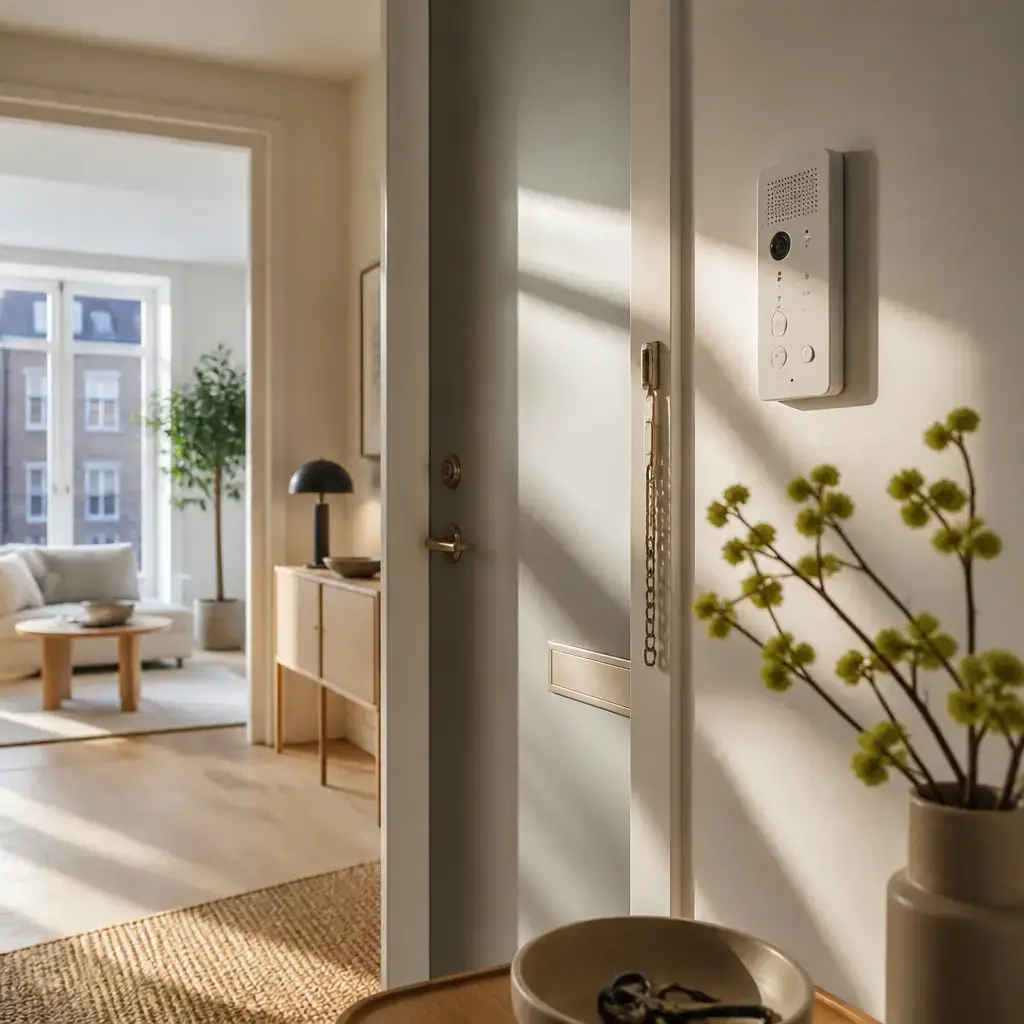
Der var nogen, der bankede på tidligere og sagde, at de var her for at inspicere ventilationen.
dair vah NOH-en, dair BANG-keh-deh poh TEE-lee-air-eh oh SAY-eh, eh dee vah hair fohr an-speh-SAY-uh ven-tee-lah-SYOHN-en. Someone knocked earlier and said they were here to inspect the ventilation.Vedligeholdelsesbesøg bliver normalt varslet gennem ejendommens system.
VED-lee-hol-dels-es-beh-SOHG blee-uh NOR-malt VARS-let JEN-em eye-en-doms sy-STEM. Maintenance visits are usually announced through the building system.Det gjorde mig forsigtig, så jeg lukkede dem ikke ind.
deh GYUR-deh my for-SIG-tee, soh yee LOO-keh dem EE-keh een. That made me cautious, so I did not let them in.Det var den rigtige beslutning. Deres tilladelse til at komme ind bør først bekræftes.
deh vah den RIG-tee beh-SLUT-ning. DARE-es tee-LAD-el-seh til at KOH-meh een bohr FURST beh-KREF-tes. That was the right call. Their authorization to enter should be verified first.Kan du tjekke, om der faktisk er planlagt en inspektion?
kan doo CHEK-keh, ohm dair FAK-tisk air plan-LAGT en an-speh-SYOHN? Could you check whether an inspection is actually scheduled?Jeg tjekker registrene og sender dig en besked via portalen.
yai CHEK-er reh-JIS-truh-neh oh SEN-er dai en beh-SKAYTH VEE-ah por-TAH-len. I will check the records and send you a message through the portal.Jeg vil helst vide det, før nogen kommer tilbage.
yai vil helst VEE-deh deh, fur NOH-en KOM-er tee-BAI. I would rather know before anyone comes back.Indtil det er bekræftet, må du ikke lukke nogen ind, medmindre du havde regnet med, at de kom.
en-TEEL deh air beh-KREF-tet, moh doo EE-keh LOO-keh NOH-en een, med-MYN-dreh doo HAH-deh RAI-net meh, eh dee kohm. Until it is confirmed, do not let anyone in unless you were expecting them.Sentence explanations
Der var nogen, der bankede på tidligere og sagde, at de var her for at inspicere ventilationen.
Someone knocked earlier and said they were here to inspect the ventilation.
- Der var
- there was/were
- nogen
- someone
- bankede på
- knocked
- tidligere
- earlier
- sagde
- said
- de var
- they were
- her
- here
- for at
- to; in order to
- inspicere
- inspect
- ventilationen
- the ventilation
More detail
Der var introduces that something or someone existed or was present in the situation. var is the past form of være (“be”); it is unchanged for person and number. In this sentence, the construction is naturally rendered as “there was.” nogen means “someone” here. It is an indefinite pronoun for one unspecified person. In other contexts, it can also mean “anyone” or “someone,” depending on the sentence; the common Danish plural form for “some” is nogle. bankede på is the past form of the reusable construction banke på, “knock on [a door or surface].” The verb banke becomes bankede for this past-tense form. Example: Hun bankede på døren. — “She knocked on the door.” tidligere means “earlier,” referring to a time before the relevant present or reference time. It is an adverb and does not change form. sagde is the past form of sige, “say.” Danish uses sagde for past time regardless of the speaker’s person or number. Example: Han sagde det. — “He said it.” de var means “they were” in the fixed translation and refers back to the person introduced by nogen. var is again the past form of være; the form itself does not show the number of the referent. her means “here,” the place associated with the speaker or the relevant location. It is an adverb and does not change form. for at introduces the purpose of an action: for at + infinitive means “to” or “in order to.” It links what the person said to the purpose of being there. inspicere is an infinitive meaning “inspect.” After for at, the infinitive states the intended purpose. Example: De kom for at inspicere taget. — “They came to inspect the roof.” ventilationen means “the ventilation.” Its base form is ventilation; the ending -en marks the definite singular form of this noun, corresponding here to “the ventilation.” Together, Der var nogen presents an unspecified person as being involved in the situation. der bankede på tidligere says that this person knocked earlier, and og sagde adds a second past action: the person said something. at de var her gives the content of what was said, namely that the person was here, while for at inspicere ventilationen gives the purpose: inspecting the ventilation. The whole utterance therefore means: “Someone knocked earlier and said they were here to inspect the ventilation.”
Vedligeholdelsesbesøg bliver normalt varslet gennem ejendommens system.
Maintenance visits are usually announced through the building system.
- Vedligeholdelsesbesøg
- maintenance visits
- normalt
- usually
- bliver … varslet
- are announced
- gennem
- through
- ejendommens
- the building’s
- system
- system
More detail
Vedligeholdelsesbesøg means “maintenance visits” here. It is a compound noun: vedligeholdelse means maintenance, and besøg means visit. In this sentence, the compound is used as an indefinite plural, as confirmed by the translation; besøg has the same form in indefinite singular and plural. Example: Vi planlægger vedligeholdelsesbesøg. — “We are planning maintenance visits.” normalt means “usually” and says that this generally happens, without claiming that it happens every time. It is an adverb related to normal (“normal”). Example: Det sker normalt om morgenen. — “It usually happens in the morning.” bliver varslet is a passive construction meaning “are announced” or “are notified.” bliver is the present-tense form of blive, and varslet is the past participle of varsle (“give notice of; notify”). The passive presents the visits as receiving the announcement rather than naming the announcer. Compare the active pattern Systemet varsler besøg. — “The system announces visits.” gennem means “through” and introduces the channel or means used for something. Example: Beskeden blev sendt gennem appen. — “The message was sent through the app.” ejendommens means “the building’s” here. It is the genitive form of the definite noun ejendommen (“the building/property”): ejendommen → ejendommens. The ending -s marks possession or association, not plural. Example: ejendommens indgang — “the building’s entrance.” system means “system.” In ejendommens system, it is the noun associated with or possessed by the building: “the building’s system.” Example: Systemet fungerer godt. — “The system works well.” Together, Vedligeholdelsesbesøg is the subject, bliver varslet says that the visits are announced in the passive voice, normalt says this generally happens, and gennem ejendommens system identifies the channel. The whole utterance therefore means: “Maintenance visits are usually announced through the building system.”
Det gjorde mig forsigtig, så jeg lukkede dem ikke ind.
That made me cautious, so I did not let them in.
- Det
- that
- gjorde
- made
- mig
- me
- forsigtig
- cautious
- så
- so
- jeg
- I
- lukkede
- closed
- dem
- them
- ikke
- not
- ind
- in
More detail
Det is a third-person singular pronoun meaning “that” here. It is the subject of gjorde; the fixed translation and context support reading it as the preceding situation or event. gjorde is the past-tense form of gøre (“make; do”). In gøre + object + adjective, it describes causing the object to have a quality: Det gjorde mig forsigtig means “That made me cautious.” The past form marks the event as past. mig is the first-person singular object form of jeg (“I”). Compare jeg for a subject with mig after a verb or preposition: Hun så mig means “She saw me.” forsigtig means “cautious” here and describes mig. In Danish, this adjective can have forms that reflect number and, where relevant, grammatical gender; forsigtig is the form used here. An opposite is uforsigtig, meaning “careless” or “incautious.” så means “so” or “therefore” here. It links the first clause as a cause to the consequence in the second clause; it is not the verb meaning “see” in this sentence. jeg is the first-person singular subject form, “I.” Danish distinguishes it from the object form mig, as in Jeg så hende (“I saw her”) versus Hun så mig (“She saw me”). lukkede is the past form of lukke, “close.” With an object and the particle ind, the construction lukke nogen ind means “let someone in,” rather than simply “close.” The object can occur between the verb and particle: lukke + object + ind. dem is the third-person plural object form, “them.” It is the object of the letting-in construction; de is the corresponding subject form. ikke is the ordinary Danish negation word, “not.” In this clause it negates the letting-in action. ind is the particle “in.” Together with lukkede and the object, it completes lukkede dem ind, meaning “let them in.” Putting the parts together, Det gjorde mig forsigtig means “That made me cautious,” and så jeg lukkede dem ikke ind means “so I did not let them in.” The whole utterance is therefore: “That made me cautious, so I did not let them in.”
Det var den rigtige beslutning. Deres tilladelse til at komme ind bør først bekræftes.
That was the right call. Their authorization to enter should be verified first.
- Det
- That
- var
- was
- rigtige
- right
- beslutning
- decision
- Deres
- their
- tilladelse
- authorization
- komme ind
- enter
- bør
- should
- først
- first
- bekræftes
- be verified
More detail
Det means “that” here. Danish det is the neuter singular form; its grammatical form does not by itself identify the specific referent. var is the past-tense form of være (“to be”). The pattern det var ... is useful for saying “that was ...” about something in the past. rigtige means “right” or “correct” here. Its base form is rigtig; rigtige is the form used with the definite noun phrase den ... beslutning. The word den and the ending in rigtige mark this as “the right decision,” not simply “a right decision.” beslutning means “decision.” Its indefinite form is en beslutning, while den ... beslutning is the definite form “the ... decision.” Together, Det var den rigtige beslutning means “That was the right decision,” rendered in the fixed translation as “That was the right call.” Deres means “their” in this sentence. Danish deres is a possessive form that does not change for the gender or number of the possessed noun. The fixed translation identifies the authorization as belonging to them. tilladelse means “permission” or “authorization.” It is a common-gender noun: en tilladelse; the definite form is tilladelsen. In this sentence it is the authorization connected with entering. komme ind means “enter” or literally “come in.” komme is the infinitive of komme, and ind is a direction particle. The pattern tilladelse til at + infinitive expresses permission or authorization to do something, as in tilladelse til at parkere — “permission to park.” bør means “should” or “ought to.” It is the present form associated with burde and is followed here by an infinitive-like verb form. The modal expresses what is advisable or required, not a statement that the verification has already happened. først means “first.” It places the verification before other relevant steps in the intended sequence. It does not mean that the authorization is being verified for the first time. bekræftes means “be confirmed” or “be verified.” It is the passive form related to bekræfte (“to confirm” or “to verify”); the -s form presents the authorization as the thing receiving the action rather than naming the verifier. Compare active nogen bekræfter tilladelsen — “someone verifies the authorization” — with passive tilladelsen bekræftes — “the authorization is verified.” The second sentence is assembled as Deres tilladelse til at komme ind (“their authorization to enter”) + bør (“should”) + først (“first”) + bekræftes (“be verified”). The complete meaning is: “Their authorization to enter should be verified first.”
Kan du tjekke, om der faktisk er planlagt en inspektion?
Could you check whether an inspection is actually scheduled?
- Kan du
- could you
- tjekke
- check
- om
- whether
- faktisk
- actually
- er planlagt
- is scheduled
- inspektion
- inspection
More detail
Kan du is a reusable way to make a request: literally “can you,” and, as in this sentence, naturally “could you.” kan is the present form of kunne (“can/be able to”), and du is the second-person singular pronoun. After a modal such as kan, the following verb uses its infinitive form. tjekke means “to check.” It is the infinitive of the regular verb tjekke; the same form follows other modal verbs: Du kan tjekke det. — “You can check it.” In the fixed sentence, it is the requested action, not a completed check. om introduces an embedded yes-or-no question. Here it means “whether,” rather than introducing a condition. A useful pattern is tjekke, om ... — “check whether ...”. faktisk means “actually” or “in fact.” It emphasizes that the speaker wants the factual status checked. Here it contributes to the embedded question about whether the inspection is scheduled. er planlagt means “is scheduled” here. er is the present form of være (“be”), and planlagt is the past participle of planlægge (“plan/schedule”). Together they form the passive expression used for something that has been planned or scheduled. Compare planlægge — “plan/schedule” and er planlagt — “is planned/scheduled.” inspektion means “inspection.” It is a common-gender noun, so its singular indefinite form is en inspektion; the article en is separate from the quoted noun and marks an indefinite singular noun, not a stated numerical count. Example: En inspektion er planlagt. — “An inspection is scheduled.” The source also contains der between om and faktisk. In der er planlagt en inspektion, der is the Danish introductory element used in this existential/passive construction; it does not identify a person or object here. The chunks therefore assemble in the actual source order as Kan du tjekke, om der faktisk er planlagt en inspektion?, meaning “Could you check whether an inspection is actually scheduled?”
Jeg tjekker registrene og sender dig en besked via portalen.
I will check the records and send you a message through the portal.
- Jeg
- I
- tjekker
- check
- registrene
- the records
- sender
- send
- dig
- you
- besked
- message
- via
- through
- portalen
- the portal
More detail
Jeg means “I” and is the first-person singular subject pronoun. It does not change for grammatical gender. Example: Jeg læser. — “I am reading.” Tjekker is the present-tense form of tjekke, “to check.” In this sentence, the present form can describe an intended or scheduled action, so the fixed translation uses “will check”; it is not a separate future inflection. Example: Jeg tjekker oplysningerne. — “I check the information.” Registrene means “the records.” It is the definite plural of register: registre is the plural, and registrene marks that plural as definite. The ending belongs to the noun, not to tjekker. Example: Jeg læser registrene. — “I read the records.” Sender is the present-tense form of sende, “to send.” As with tjekker, the present form can express a planned action in a suitable context. The subject is still Jeg, so the sentence means “I send/will send,” not “you send.” Example: Jeg sender en e-mail. — “I send an email.” Dig is the second-person singular object pronoun, “you.” It marks the recipient of the sending action. The subject form is du, while dig is used for an object: Du ser mig. — “You see me.” Besked means “message.” Here it appears in the indefinite noun phrase en besked, “a message”; the noun itself is singular. Its definite form is beskeden, “the message,” and its plural is beskeder, “messages.” Example: Jeg skriver en besked. — “I write a message.” Via means “through” or “via” and introduces the route or medium used for the action. In via portalen, it identifies the portal as the medium through which the message is sent. Portalen means “the portal.” It is the definite singular of portal: en portal is “a portal,” and portalen is “the portal.” The -en ending belongs to this noun. Example: Jeg åbner portalen. — “I open the portal.” Together, Jeg tjekker registrene gives “I will check the records,” and og sender dig en besked adds “and send you a message.” Via portalen specifies that the message will be sent through the portal. The complete utterance therefore means: “I will check the records and send you a message through the portal.”
Jeg vil helst vide det, før nogen kommer tilbage.
I would rather know before anyone comes back.
- Jeg vil
- I want to
- helst
- rather
- vide
- know
- det
- it
- før
- before
- nogen
- anyone
- kommer tilbage
- comes back
More detail
Jeg vil introduces the speaker’s preference or wish here: “I want to …”. vil is the present form of ville; with an infinitive it can express wanting to do something, while in other contexts it can express future meaning. The subject is Jeg (“I”), and Danish present-tense verb forms do not change for the subject. helst adds the preference “rather” or “preferably”. Together, Jeg vil helst is a reusable pattern meaning “I would rather …” or “I would prefer to …”. vide means “know” in the sense of having information. It is the infinitive after vil: vil vide = “want to know”. Danish commonly distinguishes vide (“know a fact or piece of information”) from kende (“know/be familiar with a person, place, or thing”). Example: Jeg vil vide sandheden. — “I want to know the truth.” det is a neuter singular pronoun meaning “it” here. Its grammatical form identifies it as neuter singular, while the fixed sentence does not specify a more concrete noun for what “it” refers to. før means “before” and introduces the event that must occur later in the time sequence. It can introduce a clause, as here: før nogen kommer tilbage = “before anyone comes back.” nogen is an indefinite pronoun meaning “anyone” in this context. It refers non-specifically to a person, without identifying who that person is. Example: Hvis nogen ringer, svarer jeg. — “If anyone calls, I will answer.” kommer tilbage means “comes back”. kommer is the present form of komme, “come”; Danish uses the same present form across subjects, so it does not change to mark “anyone” separately. tilbage adds the return meaning “back”. Example: Hun kommer tilbage senere. — “She comes back later.” As a whole, Jeg vil helst vide det expresses the speaker’s preference to have the information, and før nogen kommer tilbage sets the deadline: the knowing should happen before an unspecified person returns. The complete meaning is: “I would rather know before anyone comes back.”
Indtil det er bekræftet, må du ikke lukke nogen ind, medmindre du havde regnet med, at de kom.
Until it is confirmed, do not let anyone in unless you were expecting them.
- Indtil
- until
- det er bekræftet
- it is confirmed
- må du ikke
- do not
- lukke nogen ind
- let someone in
- medmindre
- unless
- du havde regnet med
- you were expecting
- at de kom
- that they came
More detail
Indtil introduces a time boundary: the instruction applies up to the point described in the following clause. It is a reusable subordinating conjunction. Example: Vent, indtil hun kommer. — “Wait until she comes.” det er bekræftet means “it is confirmed.” bekræftet is the past participle of bekræfte (“confirm”); with er, it forms the passive, so the sentence focuses on the confirmation rather than naming who confirms it. det is the pronoun used for the unspecified matter being confirmed here; its specific referent is not identified by the sentence. Example: Det er bekræftet. — “It is confirmed.” må du ikke is a prohibition pattern: må (“may/must”) + du (“you”) + ikke (“not”). In this use, må ... ikke means that you are not allowed to do the following action. The subject du is placed after the modal here because the clause begins with the time expression Indtil det er bekræftet; Danish main-clause word order commonly puts the finite verb before the subject after an initial clause or other fronted element. Example: I dag må du ikke køre. — “Today you must not drive.” lukke nogen ind is the reusable verb-particle construction “let someone in.” lukke is the infinitive of “close,” but with ind it means allowing a person to enter, rather than merely closing something. nogen means “someone/anyone”; in this negative instruction, the natural English equivalent is “anyone.” Example: Hun lukker gæsterne ind. — “She lets the guests in.” medmindre means “unless” and introduces an exception to the instruction. It is a conjunction, so the exception is expressed as a following clause. Example: Jeg går ikke, medmindre du kommer. — “I will not go unless you come.” du havde regnet med means “you had expected” in this context. regne med is a fixed verb-plus-preposition construction meaning “expect” or “count on”; it is not the ordinary arithmetic meaning of regne here. havde regnet is the pluperfect: the past form of have plus the participle regnet, marking the expectation as prior to the relevant past event. Example: Jeg havde regnet med det. — “I had expected that.” at de kom is a clause introduced by at (“that”). de is the plural pronoun “they/them,” referring here to the people whose entry is being considered, as reflected by “them” in the fixed translation. kom is the past-tense form of komme (“come”); in this clause it describes their coming as the event that had been expected. Example: Hun sagde, at de kom. — “She said that they were coming.” Together, Indtil det er bekræftet sets the time limit, and må du ikke lukke nogen ind gives the prohibition. medmindre du havde regnet med, at de kom adds the exception: the prohibition does not apply when you had expected those people to come. The whole utterance therefore means: “Until it is confirmed, do not let anyone in unless you were expecting them.”
Grammar Points
havde + perfektum participium
havde regnet med
HAH-deh RAI-net mehhad expected
Danish uses havde plus the past participle to form the past perfect, describing something expected before another past event.
medmindre + sætning
medmindre nogen kommer tilbage
med-MYN-dreh NOH-en KOM-er tee-BAIunless someone comes back
Medmindre introduces an exception or condition and means “unless.”
Danish Vocabulary
bankede på tidligere
- Gender
- common
den rigtige beslutning
ejendommens system
Det gjorde mig forsigtig
for at inspicere ventilationen
jeg lukkede dem ikke ind
Der var nogen
bankede på tidligere
- Gender
- common
Deres tilladelse
bliver normalt varslet
- Gender
- neuter
Vedligeholdelsesbesøg bliver normalt varslet
- Gender
- common
inspicere ventilationen
Quiz
Spelling
Tap the letters to spell the word.
to announce; to notify
Show Answer
varsletto inspect
Show Answer
inspicereearlier
Show Answer
tidligereproperty; building