10 minutes free every day
Continue audio lessons in the app
Word explanations appear automatically in sync with the audio.
No login required · synced translations · playback with the screen locked
Choose your learning language and open this lesson in the app.

About This Lesson
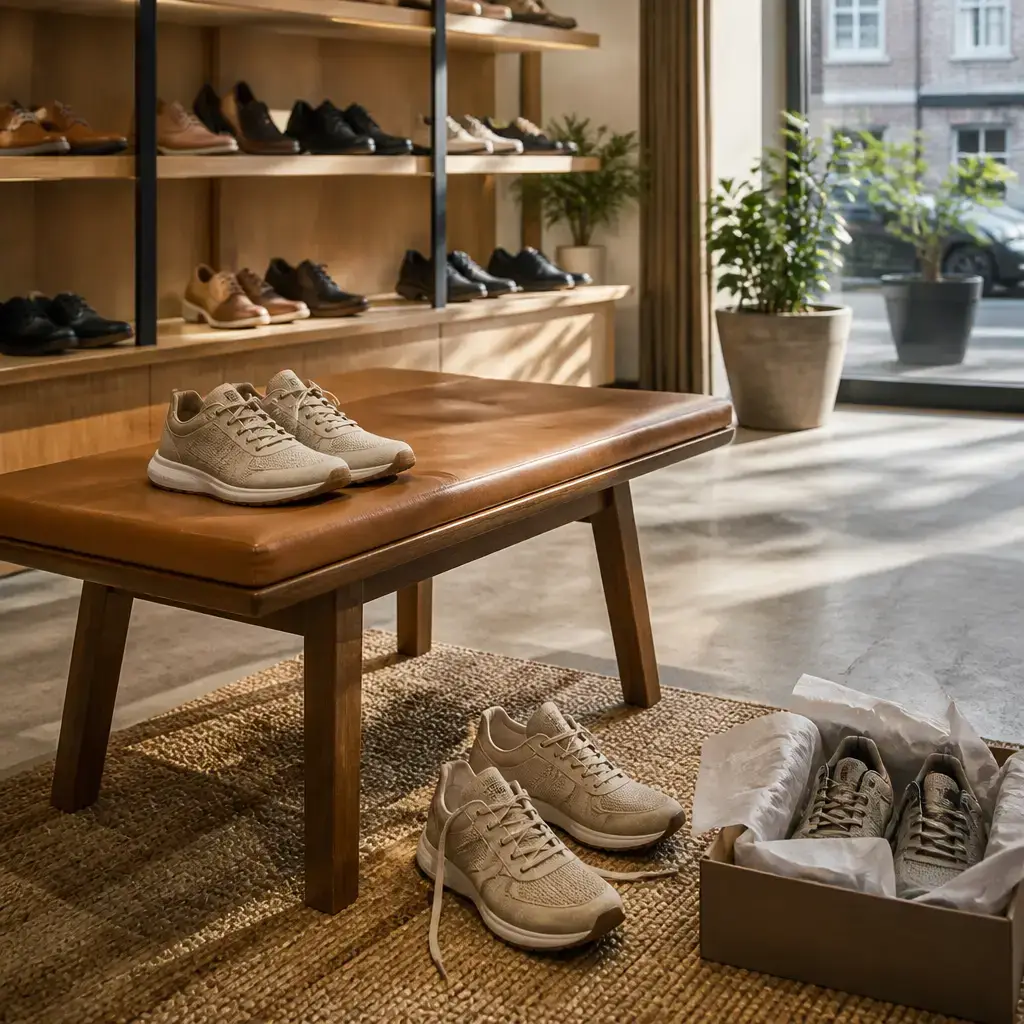
Use Trying on shoes and finding the right size to practice German conversation, pronunciation, vocabulary, grammar, and quizzes.
Dialogue
Diese Schuhe sehen bequem aus.
DEE-zuh SHOO-uh ZAY-en buh-KVAYM ous. These shoes look comfortable.Sie sind für lange Spaziergänge gemacht.
zee zint fyoor LAHNG-uh shpah-TSEER-geng-uh guh-MAHKT. They are made for long walks.Kann ich sie hier anprobieren?
kahn ikh zee heer ahn-proh-BEER-en? Can I try them on here?Ziehen Sie sie auf dieser Bank an.
TSEE-en zee zee ouf DEE-zuh BAHNK ahn. Use this bench while you put them on.Sie fühlen sich ein bisschen klein an.
zee FYOOL-en zikh ayn BIS-khen klyne ahn. They feel a little small.Probieren Sie dieses größere Paar an.
proh-BEER-en zee DEE-zuhs GRUR-suh-ruh pahr ahn. Try this larger pair.Dieses Paar fühlt sich besser an.
DEE-zuhs pahr fYOOLT zikh BES-uh. This pair feels better.Diese Größe passt Ihnen gut.
DEE-zuh GRUR-suh pahst EE-nen goot. That size looks right on you.Sentence explanations
Diese Schuhe sehen bequem aus.
These shoes look comfortable.
- Diese
- these
- Schuhe
- shoes
- sehen … aus
- look / appear
- bequem
- comfortable
More detail
Diese means “these” and points to the plural noun Schuhe here. It is the plural form of the demonstrative dies-; the ending also marks nominative case in this noun phrase. Compare dieser Schuh (“this shoe”) with diese Schuhe (“these shoes”). Schuhe means “shoes.” Its singular base form is der Schuh; the plural is die Schuhe. The noun is plural here, matching Diese. sehen ... aus is the separable verb aussehen, “to look” or “to appear.” In the present tense, the finite part sehen agrees with the plural subject, while the prefix aus moves to the end: Diese Schuhe sehen ... aus. The reusable pattern is etwas sieht + adjective + aus (“something looks + adjective”). For example: Der Plan sieht gut aus. — “The plan looks good.” bequem means “comfortable.” Here it is an adjective describing the shoes after aussehen; in this position it does not take an ending. It can also describe a noun directly: bequeme Schuhe means “comfortable shoes.” Together, Diese Schuhe identifies the shoes, and sehen bequem aus says how they appear: “These shoes look comfortable.”
Sie sind für lange Spaziergänge gemacht.
They are made for long walks.
- Sie
- they
- sind … gemacht
- are made
- für
- for
- lange
- long
- Spaziergänge
- walks
More detail
Sie means “they” here and refers to the shoes established by the supplied context. German sie can also mean “she” or “them,” while formal-address Sie is capitalized. At the beginning of a sentence, however, capitalization by itself does not distinguish these possibilities; the intended plural meaning here is supported by the translation and context. The plural subject takes sind, the present-tense plural form of sein (“to be”). gemacht is the participle of machen (“to make”): machen → gemacht. With sein, sind gemacht für ... expresses suitability: something is made or designed for a particular use. Example: Diese Tasche ist für Reisen gemacht. — “This bag is made for traveling.” für means “for” and normally takes the accusative case. Here it introduces the use or purpose for which the shoes are suitable. lange is the inflected form of lang (“long”). It describes the plural noun Spaziergänge. In für lange Spaziergänge, für requires the accusative, and because no article or other determiner marks that case, the adjective carries strong plural accusative marking: lange. Compare dative plural mit langen Spaziergängen. Example: Wir machen lange Spaziergänge. — “We take long walks.” Spaziergänge means “walks” and is the plural of Spaziergang (“walk”). The plural changes the vowel through an umlaut: Spaziergang → Spaziergänge. The phrase lange Spaziergänge therefore means “long walks.” Together, Sie sind gemacht gives “they are made,” and für lange Spaziergänge specifies the intended purpose. The complete utterance means: “They are made for long walks.”
Kann ich sie hier anprobieren?
Can I try them on here?
- Kann ich
- Can I...?
- sie
- them
- hier
- here
- anprobieren
- try on
More detail
Kann ich uses können (“can / be allowed to”) in the present tense. kann is the first-person singular form, used with ich; in a yes/no question, the finite verb comes before the subject. This asks for permission or possibility here, rather than stating that the speaker is able to do something. sie means “them” in this sentence. It is the accusative plural pronoun referring to the items already mentioned in the context. The lowercase form distinguishes it from formal Sie; its form does not show the items’ gender because it is plural. Compare: Ich sehe sie. — “I see them.” hier means “here” and identifies the place where the action would happen. Example: Kann ich hier sitzen? — “Can I sit here?” anprobieren means “to try on” clothing, shoes, or another wearable item. It is a separable verb: without a modal, Ich probiere sie an. means “I try them on.” With können, the modal is finite and anprobieren remains a full infinitive at the end of the question. The verb probieren alone generally means “try” or “taste,” so the prefix an- gives this verb its clothing-related meaning. Together, Kann ich + sie + hier + anprobieren forms a yes/no request for permission: “Can I try them on here?” The speaker asks whether trying on the previously mentioned items is permitted or possible at this place.
Ziehen Sie sie auf dieser Bank an.
Use this bench while you put them on.
- Ziehen … an
- put ... on
- Sie
- you (formal)
- sie
- them
- auf
- on
- dieser
- this
- Bank
- bench
More detail
Ziehen ... an is the separable verb anziehen, meaning “to put on” clothing. In this formal command, Ziehen is the imperative form addressed to one person with formal Sie; the separable prefix an moves to the end. The pattern is Ziehen Sie ... an. Example: Zieh die Jacke an. — “Put on the jacket.” Here, sie is the accusative plural pronoun meaning “them,” referring to the items being tried on. The lowercase spelling distinguishes it from formal Sie; Sie is capitalized because it is the formal “you.” auf dieser Bank means “on this bench.” auf takes the dative here because the phrase describes a stationary location, not movement onto the bench. dieser is the dative feminine form of diese (“this”), agreeing with feminine Bank; Bank means “bench” in this context. Together, Ziehen Sie sie ... an gives “put them on,” and auf dieser Bank specifies where to do it. The complete utterance means: “Use this bench while you put them on.” It is a formal instruction.
Sie fühlen sich ein bisschen klein an.
They feel a little small.
- Sie
- they
- fühlen … sich … an
- feel
- ein bisschen
- a little
- klein
- small
More detail
Sie means “they” here, as fixed by the translation. In German, the same capitalized form can also be formal “you,” but that is not the reading in this utterance. In the “they” reading, Sie is a third-person plural pronoun, so the finite verb is plural. fühlen ... sich ... an is the separable reflexive construction sich anfühlen, meaning “to feel” or “to seem.” The prefix an appears at the end of the clause, while fühlen carries the finite form: Sie fühlen ... an. The reflexive form sich belongs to this construction; it is not the English object “themselves” in the translation. Example: Das fühlt sich gut an. — “That feels good.” ein bisschen means “a little” and reduces the degree of the adjective that follows. It does not assert a numerical quantity. Example: Sie sprechen ein bisschen leiser. — “They speak a little more quietly.” klein means “small” here. Its basic comparison chain is klein — “small,” kleiner — “smaller,” am kleinsten — “the smallest.” The adjective describes how the subjects feel, rather than stating that the subjects themselves are necessarily small. Example: Die Schuhe fühlen sich klein an. — “The shoes feel small.” Together, Sie fühlen sich ... an gives “they feel,” ein bisschen makes the degree slight, and klein supplies the quality. The complete utterance therefore means: “They feel a little small.”
Probieren Sie dieses größere Paar an.
Try this larger pair.
- Probieren
- try
- Sie
- you (formal)
- dieses
- this
- größere
- larger
- Paar
- pair
- an
- on, as part of “try on”
More detail
Probieren is the verb form used in the formal imperative: “try.” Its base form is probieren; with formal Sie, the pattern is Probieren Sie .... Example: Probieren Sie die Jacke an. — “Try on the jacket.” Sie is the capitalized formal second-person pronoun, meaning “you” when addressing one or more people politely. It is distinct from lowercase sie, which can have other functions. In this sentence, Sie is the person being instructed. dieses means “this” and agrees with Paar, which is neuter singular. In this accusative noun phrase, the form is dieses: dieses Paar. The demonstrative identifies the pair as the one being referred to; it does not itself express a quantity. größere means “larger” here. It is the comparative form of the adjective groß (“large”): groß → größer (“larger”) → am größten (“largest”). The ending in größere is an inflection on the adjective, not on Paar; it appears here because the adjective is modifying the neuter singular noun phrase dieses Paar in the accusative. Example: Ich nehme die größere Größe. — “I’ll take the larger size.” Paar is a neuter noun meaning “pair.” Its plural is Paare. In this sentence, it refers to the pair identified by dieses größere Paar. an is the separable prefix of anprobieren, “to try on.” In the finite verb construction, the prefix moves to the end: Probieren Sie ... an. The verb is therefore not just general “try”; with an item of clothing or footwear, anprobieren means “try on.” Example: Sie probiert die Schuhe an. — “She is trying on the shoes.” Together, Probieren Sie ... an forms a formal instruction to try something on. The object is dieses größere Paar: “this larger pair.” Thus the complete utterance means: “Try this larger pair.”
Dieses Paar fühlt sich besser an.
This pair feels better.
- Dieses
- this
- Paar
- pair
- fühlt … sich … an
- feels
- besser
- better
More detail
Dieses refers to a singular neuter noun here: das Paar, so the demonstrative has the form dieses. The same demonstrative pattern changes with the noun’s grammatical gender and case; for example, dieser Schuh means “this shoe,” while diese Größe means “this size.” Paar means “pair.” It is a neuter noun, so its basic article is das: das Paar. In this sentence it is the subject, and the verb form is singular because one pair is being treated as the subject. fühlt sich ... an comes from the separable verb sich anfühlen, “to feel” or “to feel like.” In the fixed sentence, fühlt is the third-person singular present form of anfühlen; sich is the reflexive pronoun required by this verb construction. The separable particle an appears at the end of the clause. A reusable pattern is Das fühlt sich ... an (“That feels ...”). Example: Der Stoff fühlt sich weich an. — “The fabric feels soft.” besser is the comparative form of gut: gut (“good”) → besser (“better”) → am besten (“best”). Here it compares the pair’s feel with an understood alternative or earlier state. The word itself does not specify what that alternative is. Example: Diese Schuhe fühlen sich besser an. — “These shoes feel better.” Together, Dieses Paar is the subject, and fühlt sich ... an says how it feels. Placing besser between the verb’s two parts gives the complete meaning: “This pair feels better.”
Diese Größe passt Ihnen gut.
That size looks right on you.
- Diese
- this
- Größe
- size
- passt
- fits; suits
- Ihnen
- you (formal)
- gut
- well; right
More detail
Diese means “this” here and agrees with Größe: feminine, singular, nominative. The form changes with the noun and grammatical case; for example, dieser Schuh means “this shoe,” while diese Größe means “this size.” Größe is the feminine noun meaning “size.” Its plural is Größen: zwei Größen means “two sizes.” The noun is the subject of the sentence: it is the size that is being evaluated. passt is the present-tense, third-person singular form of passen, “to fit” or “to suit.” With a thing as subject, passen commonly takes the person it fits or suits in the dative: Der Mantel passt mir. — “The coat fits me.” The form passt matches the singular subject Diese Größe; the infinitive is passen. Ihnen is the capitalized formal “you” in the dative. In this construction, it identifies the person for whom the size fits or suits. Formal Ihnen has the same written form for formal singular and formal plural address; the fixed translation presents the intended meaning as “you.” gut is the adverb “well” here, describing how the size fits or suits the person. In this sentence, passt gut naturally means “fits well” or “looks right.” It is not an adjective modifying Größe; the noun is already identified by Diese Größe. Together, Diese Größe is the subject, passt expresses suitability, Ihnen marks the person affected in the dative, and gut evaluates the fit. The whole utterance therefore means “That size looks right on you,” or more literally, “This size fits you well.”
Grammar Points
passt Ihnen gut
passt Ihnen gut
pahst EE-nen gootfits you well
German uses the dative pronoun Ihnen in this expression for formal “you.”
ein bisschen größer
ein bisschen größer
ayn BIS-khen GRUR-zuha little larger
ein bisschen softens a comparative adjective and means “a little” or “slightly.”
German Vocabulary
Quiz
Word Order
Arrange the words in the correct order.
These shoes look comfortable.
Show Answer
Diese Schuhe sehen bequem aus.They are made for long walks.
Show Answer
Sie sind für lange Spaziergänge gemacht.Can I try them on here?
Show Answer
Kann ich sie hier anprobieren?Spelling
Tap the letters to spell the word.
walks
Show Answer
Spaziergängetry on
Show Answer
anprobierenmade
Show Answer
gemachtlong