10 minutes free every day
Continue audio lessons in the app
Word explanations appear automatically in sync with the audio.
No login required · synced translations · playback with the screen locked
Choose your learning language and open this lesson in the app.

About This Lesson
Use Planning tomorrow's breakfast to practice German conversation, pronunciation, vocabulary, grammar, and quizzes.
Dialogue
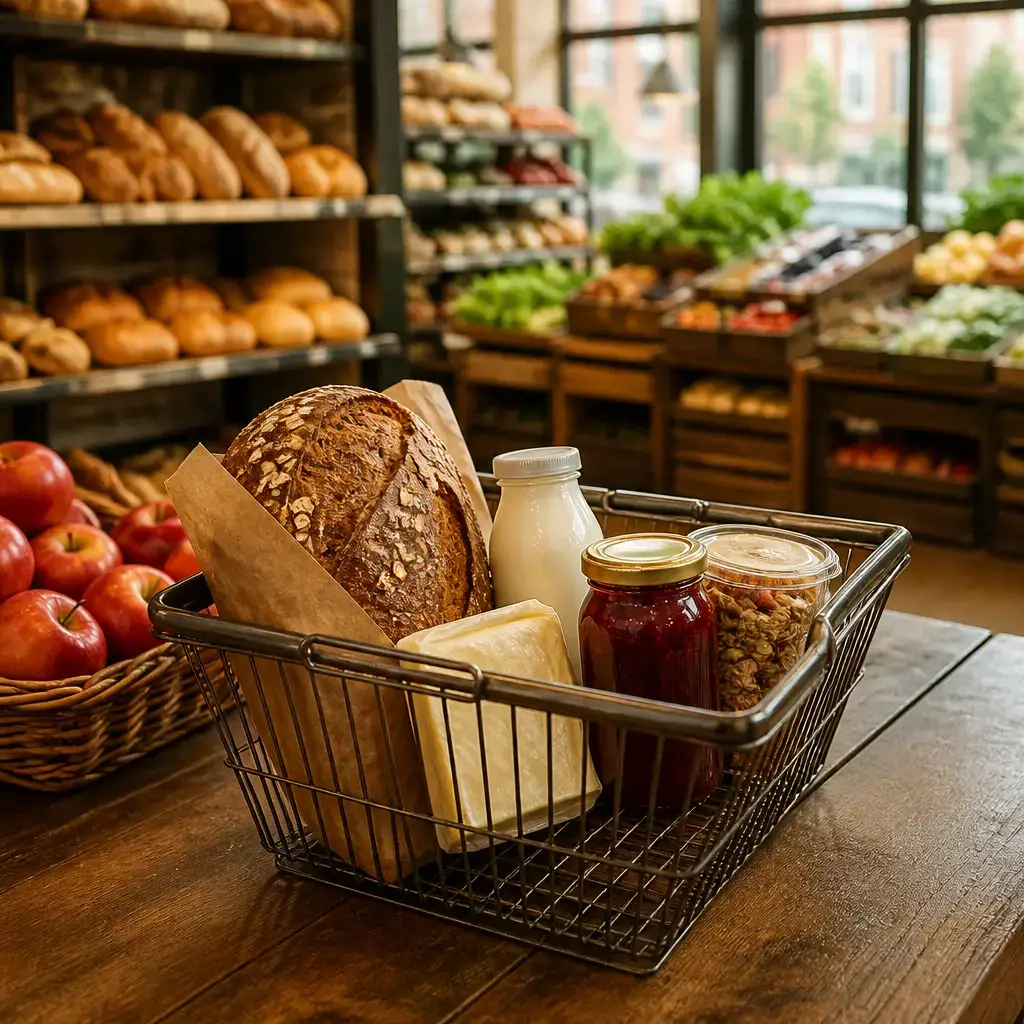
Was sollen wir heute kaufen?
vass ZOL-len veer HOY-tuh KOW-fen? What should we buy today?Wir brauchen Sachen für das Frühstück morgen.
veer BROW-khen ZAH-khen fyoor dahs FROO-shtook MOR-gen. We need things for tomorrow's breakfast.Dann brauchen wir Brot und Butter.
dahn BROW-khen veer BROHT oont BUHT-er. Then we need bread and butter.Brauchen wir auch Joghurt?
BROW-khen veer owkh YOH-goort? Do we need yogurt too?Ich möchte ihn mit Erdbeermarmelade essen.
ikh MURKH-tuh een mit AIRT-bair-mar-muh-LAH-duh ESS-en. I want to eat it with strawberry jam.Dann kaufen wir Joghurt und Marmelade.
dahn KOW-fen veer YOH-goort oont mar-muh-LAH-duh. Then let's get yogurt and jam.Sentence explanations
Was sollen wir heute kaufen?
What should we buy today?
- Was
- what
- sollen wir
- should we
- heute
- today
- kaufen
- buy
More detail
Was asks for a thing or things: “what.” It is an interrogative pronoun, so it stands in for the item or items being asked about. Compare wer (“who”) for a person. Example: Was brauchst du? — “What do you need?” sollen wir combines the modal verb sollen with the subject pronoun wir (“we”). In this question, sollen expresses what is advisable or expected: “should.” sollen is the first-person plural present form used with wir; its infinitive is also sollen. In a German question beginning with a question word, the finite verb comes before the subject: Was sollen wir ...? Example: Sollen wir gehen? — “Should we go?” heute is the time adverb “today.” It identifies the day relevant to the proposed action. Example: Wir arbeiten heute. — “We are working today.” kaufen means “to buy.” It is the infinitive, the form used with the modal verb sollen. With wir without a modal, the present-tense form is wir kaufen; after sollen, the infinitive remains kaufen and appears at the end of this question. Example: Wir sollen Brot kaufen. — “We should buy bread.” Together, Was asks which thing or things, sollen wir asks what is advisable for “us,” heute sets the time, and kaufen names the action. The complete utterance means: “What should we buy today?”
Wir brauchen Sachen für das Frühstück morgen.
We need things for tomorrow's breakfast.
- Wir
- we
- brauchen
- need
- Sachen
- things
- Frühstück
- breakfast
- morgen
- tomorrow
More detail
Wir means “we” here: the first-person plural subject. It includes the speaker and at least one other person, but the sentence does not identify exactly who those people are. Compare ich (“I”) for one speaker and ihr (“you” plural) for the people being addressed. Example: Wir lernen Deutsch. — “We are learning German.” brauchen means “need.” In the sentence, it is the present-tense form used with wir; the infinitive is also brauchen, so the form is identical to the dictionary form. A useful present-tense pattern is ich brauche, du brauchst, er/sie braucht, wir brauchen. Example: Wir brauchen Wasser. — “We need water.” Sachen means “things” or “items.” It is the plural of the noun Sache (“thing”); the plural form is marked by -n here. German nouns are capitalized. Example: Die Sachen sind hier. — “The things are here.” für introduces what something is intended or needed for. It is a preposition that takes the accusative case: für das Frühstück means “for breakfast,” not simply “breakfast” by itself. The neuter noun Frühstück has the accusative article das, which looks the same as its nominative article. Example: Das ist für dich. — “That is for you.” Frühstück means “breakfast.” It is a neuter noun: das Frühstück. In this sentence it is the meal for which the things are needed. Example: Das Frühstück ist fertig. — “Breakfast is ready.” morgen means “tomorrow.” It is a time adverb and does not change for person, number, or gender. Here it specifies which breakfast is meant: breakfast occurring tomorrow. Example: Wir arbeiten morgen. — “We are working tomorrow.” The meaningful structure is Wir brauchen ... (“We need ...”), followed by Sachen (“things”). für das Frühstück says what the things are for, and morgen identifies the breakfast as tomorrow’s. Together, Wir brauchen Sachen für das Frühstück morgen. means “We need things for tomorrow’s breakfast.”
Dann brauchen wir Brot und Butter.
Then we need bread and butter.
- Dann
- Then
- brauchen
- need
- wir
- we
- Brot
- bread
- Butter
- butter
More detail
Dann means “then” here, linking this statement to the earlier situation and placing the need in that subsequent context. It is an adverb and does not change form. brauchen means “need” here. The form is present tense and agrees with wir (first-person plural). Useful forms include ich brauche (“I need”), du brauchst (“you need”), and wir brauchen (“we need”). Example: Wir brauchen Wasser. — “We need water.” wir is the first-person plural subject pronoun, “we.” It is the subject of brauchen; the speaker includes at least one other person. Unlike the object forms uns (“us”), wir marks the subject role. Example: Wir lernen Deutsch. — “We are learning German.” Brot means “bread.” Its usual dictionary form is das Brot; German commonly uses this neuter noun without an article when referring to bread as an uncounted substance or food item, as here. Its plural is die Brote, used for loaves or types of bread. Example: Ich kaufe Brot. — “I am buying bread.” Butter means “butter.” Its usual article is feminine die Butter. Like many food substances, it can appear without an article when referring to it generally or as an ingredient. Example: Die Butter ist weich. — “The butter is soft.” The pattern is Dann + present-tense verb + subject + object: Dann brauchen wir means “Then we need,” and Brot und Butter names the two coordinated objects. Together, Dann brauchen wir Brot und Butter. means “Then we need bread and butter.”
Brauchen wir auch Joghurt?
Do we need yogurt too?
- Brauchen
- need
- wir
- we
- auch
- too; also
- Joghurt
- yogurt
More detail
Brauchen means “need” here. Its base form is brauchen; with wir in the present tense, the form is also brauchen. In a yes/no question, the finite verb comes first: Brauchen wir ...? means “Do we need ...?” A reusable example is Brauchen wir Wasser? — “Do we need water?” wir means “we.” It is the first-person plural personal pronoun, used when the speaker includes themself and at least one other person. The verb form after wir is brauchen, as in Wir brauchen Brot. — “We need bread.” auch means “too” or “also.” Here it adds yogurt to something already being considered as needed. Its position can affect what it emphasizes, so in Brauchen wir auch ...? it naturally contributes the meaning “Do we need ... too?” Joghurt means “yogurt.” It is a German noun and is capitalized. In this sentence it names the thing whose necessity is being asked about. A reusable example is Ich kaufe Joghurt. — “I’m buying yogurt.” Together, Brauchen wir auch Joghurt? forms a yes/no question: the verb brauchen comes first, followed by the subject wir, then auch, and finally the noun Joghurt. The complete meaning is “Do we need yogurt too?”
Ich möchte ihn mit Erdbeermarmelade essen.
I want to eat it with strawberry jam.
- Ich möchte
- I want / I would like
- ihn
- it
- mit
- with
- Erdbeermarmelade
- strawberry jam
- essen
- eat
More detail
Ich möchte expresses “I want” or, more gently, “I would like.” möchte is the first-person singular form used to express a present wish; it is related to mögen, but here it is not the ordinary meaning “like.” The subject is Ich (“I”). A reusable pattern is Ich möchte + infinitive: Ich möchte schlafen. — “I would like to sleep.” ihn means “it” here. It is the accusative singular form of the personal pronoun for a masculine grammatical referent and marks the direct object of essen. The form contrasts with er (“he,” subject) and ihm (“to him,” dative). The English translation identifies the object as “it,” but does not specify its exact referent. mit means “with.” It is a preposition that normally requires the dative case: mit dem ... for a masculine or neuter noun, mit der ... for a feminine noun, and mit den ... for plural nouns. In this sentence it introduces what accompanies or is added to the eating: mit Erdbeermarmelade. Erdbeermarmelade means “strawberry jam.” It is a compound noun made from Erdbeere (“strawberry”) and Marmelade (“jam”); the final part determines the compound’s grammatical gender, so it is feminine: die Erdbeermarmelade. A related reusable compound is Aprikosenmarmelade — “apricot jam.” essen means “eat.” This is the infinitive, the form used after möchte; in a simple present sentence with ich, the verb is ich esse: Ich esse Brot. — “I eat bread.” In the fixed sentence, essen stays at the end because it is the infinitive dependent on möchte. Together, Ich möchte ihn mit Erdbeermarmelade essen means “I want to eat it with strawberry jam.” The structure is subject + möchte + direct object + mit-phrase + infinitive: the speaker expresses a wish, identifies what is to be eaten with ihn, adds the accompaniment or addition with mit Erdbeermarmelade, and places the dependent infinitive essen at the end.
Dann kaufen wir Joghurt und Marmelade.
Then let's get yogurt and jam.
- Dann
- then
- kaufen
- buy; get
- wir
- we
- Joghurt
- yogurt
- Marmelade
- jam
More detail
Dann means “then” here: it places the proposed action after something already understood. It is a time adverb and can also stand at the beginning of a German main clause. kaufen is the infinitive “to buy.” In the sentence, it appears as kaufen because the subject is wir (“we”): the present-tense first-person plural form has the same spelling as the infinitive. Example: Wir kaufen Brot. — “We are buying bread.” In this context, the present-tense statement is naturally understood as a proposal, matching “Then let’s get…”. wir is the first-person plural subject, “we.” German main clauses normally put the finite verb in the second position. Because Dann occupies the first position, kaufen comes before wir: Dann kaufen wir …. Joghurt means “yogurt.” It is used here as a food noun without an article, referring to yogurt as an uncounted item or substance. Example: Wir kaufen Joghurt. — “We’re buying yogurt.” Marmelade means “jam.” It is also used here without an article as a food substance. Its usual gender is feminine: die Marmelade; that gender is not visible in this article-free form. Example: Ich esse Marmelade. — “I eat jam.” The conjunction und joins the two things being bought: Joghurt und Marmelade means “yogurt and jam.” The structure is Dann + finite verb + subject + coordinated objects. Together, Dann kaufen wir Joghurt und Marmelade. means “Then let’s get yogurt and jam.”
Grammar Points
möchte + Infinitiv
möchte essen
MURKH-tuh ESS-enwant to eat
möchte expresses a polite or tentative wish; the second verb stays in the infinitive.
German Vocabulary
Brauchen wir auch Joghurt?
Wir brauchen Sachen für das Frühstück morgen.
Dann brauchen wir Brot und Butter.
Dann brauchen wir Brot und Butter.
Dann brauchen wir Brot und Butter.
Wir brauchen Sachen für das Frühstück morgen.
Wir brauchen Sachen für das Frühstück morgen.
Was sollen wir heute kaufen?
Was sollen wir heute kaufen?
Wir brauchen Sachen für das Frühstück morgen.
Wir brauchen Sachen für das Frühstück morgen.
Was sollen wir heute kaufen?
Quiz
Word Order
Arrange the words in the correct order.
What should we buy today?
Show Answer
Was sollen wir heute kaufen?Then we need bread and butter.
Show Answer
Dann brauchen wir Brot und Butter.Do we need yogurt too?
Show Answer
Brauchen wir auch Joghurt?Spelling
Tap the letters to spell the word.
thing
Show Answer
Sachento need
Show Answer
brauchento buy
Show Answer
kaufentomorrow