10 minutes free every day
Continue audio lessons in the app
Word explanations appear automatically in sync with the audio.
No login required · synced translations · playback with the screen locked
Choose your learning language and open this lesson in the app.

About This Lesson
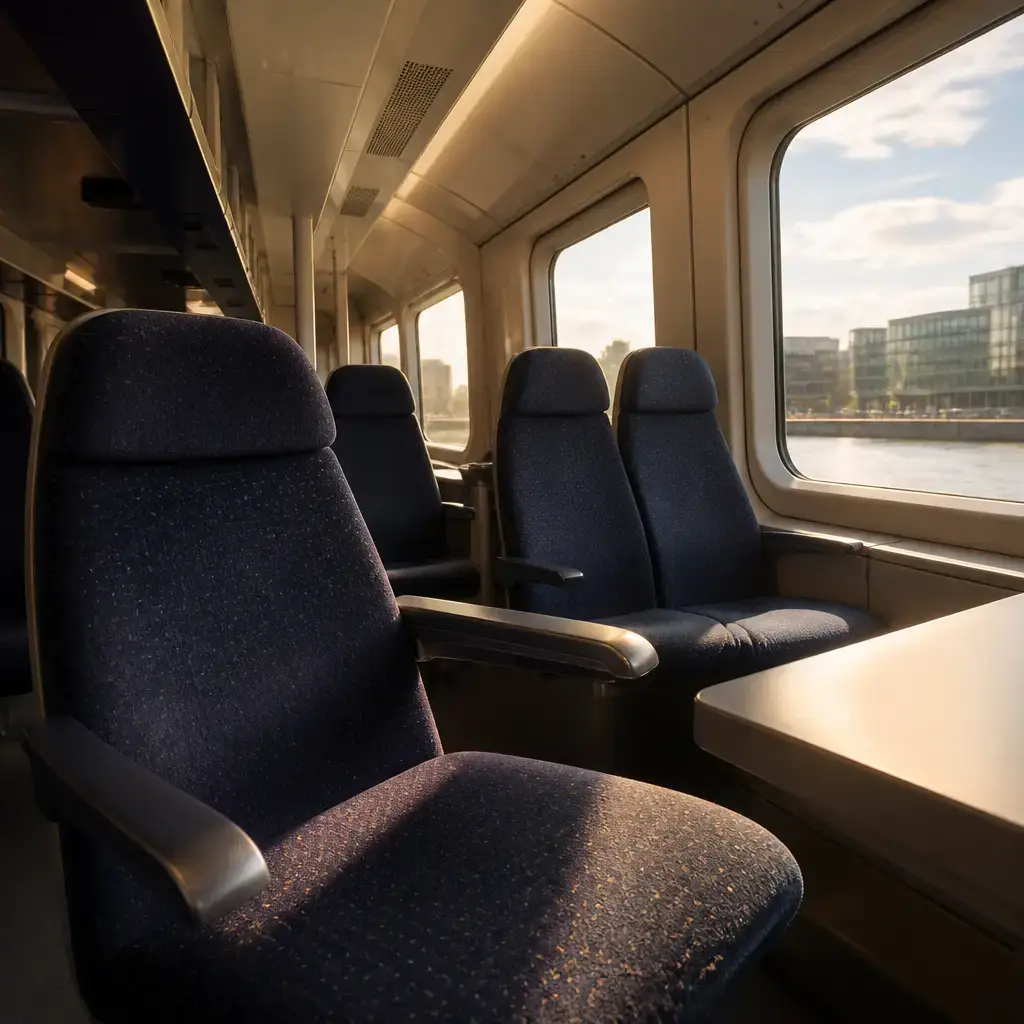
Use Finding Seats on a Train to practice German conversation, pronunciation, vocabulary, grammar, and quizzes.
Dialogue
Im Zug ist es kühl.
im TSOOK ist ess KEWL. It feels cool inside the train.Weiter hinten sind freie Plätze.
VY-ter HIN-ten zint FRY-uh PLET-suh. There are open seats farther in.Nach dem vielen Laufen möchte ich sitzen.
NAHKH daym FEE-len LOW-fen MURSH-tuh ikh ZIT-sen. I want to sit after all that walking.Diese Sitze sind bequem.
DEE-zuh ZIT-suh zint beh-KVAYM. These seats are comfortable.Die Fahrt ist auch ruhig.
DEE FAHRT ist owkh ROO-ikh. The ride feels quiet too.Kannst du von dort die Anzeige für den Bahnhof sehen?
KAHNST doo fon dort dee AHN-tsy-guh fyoor dayn BAHN-hohf ZAY-en? Can you see the station display from there?Wir haben noch drei Haltestellen.
VEER HAH-ben nokh dry HALL-tuh-SHTEL-en. We have three more stops.Dann können wir uns noch ein bisschen ausruhen, bevor wir aussteigen.
DAHN KUR-nen VEER oons nokh ine BIS-shen OWS-roo-en, beh-FOHR VEER OWS-shty-gen. Then we can rest a little before we get off.Sentence explanations
Im Zug ist es kühl.
It feels cool inside the train.
- Im Zug
- inside the train
- ist
- is
- es
- it
- kühl
- cool
More detail
Im Zug means “inside the train.” Im is the contraction of in dem; here in takes the dative because it describes a stationary location, and Zug is masculine, so dem is used. Example: Ich bin im Zug. — “I am on the train.” ist is the third-person singular present form of sein (“to be”). It agrees with es in this sentence. The present tense states the current condition. es is an impersonal subject in the expression es ist kühl. It does not identify a particular person or object; together with the adjective, it presents the surrounding temperature or atmosphere as cool. Example: Draußen ist es warm. — “It is warm outside.” kühl is an adjective meaning “cool,” milder than “cold.” Its comparative form is kühler (“cooler”); the observed form is the basic form because the sentence makes no comparison. Together, Im Zug sets the location, and es ist kühl describes the current condition there: “It feels cool inside the train.”
Weiter hinten sind freie Plätze.
There are open seats farther in.
- Weiter hinten
- farther in
- freie
- open; available
- Plätze
- seats
More detail
Weiter hinten means “farther back” or, in this setting, “farther in.” weiter is the comparative form of weit (“far/wide”): weit → weiter → am weitesten. Here it describes a location farther along the inside of the train, not a comparison of physical width. hinten means “at the back/in the rear.” Together, weiter hinten places something farther toward the back than the current reference point. freie means “open” here in the sense of “available.” Its base form is the adjective frei. In freie Plätze, the adjective has the ending -e because it modifies the plural noun Plätze in this noun phrase without a determiner that marks the case. The form is not a verb and does not mean that the seats are physically unobstructed in every possible context. Example: Ist dieser Platz frei? — “Is this seat available?” Plätze means “seats” here. Its singular is der Platz, and its plural is die Plätze; the vowel changes from a to ä, and the plural ending is -e. Platz can also mean “place” or “space,” so the surrounding word freie and the train context identify the intended sense as available seats. Example: Zwei Plätze sind noch frei. — “Two seats are still available.” The sentence uses sind, the plural form of sein (“to be”), with the plural subject freie Plätze. German places the location phrase Weiter hinten first, then the verb sind, followed by the subject phrase freie Plätze. In this context, the construction Weiter hinten sind ... presents something located farther inside: “Farther in, there are ...” Assembled, Weiter hinten + sind + freie Plätze means: “There are open seats farther in.”
Nach dem vielen Laufen möchte ich sitzen.
I want to sit after all that walking.
- Nach dem
- after the
- vielen
- much
- Laufen
- walking
- möchte ich
- I would like
- sitzen
- sit
More detail
Nach dem means “after the” here. nach takes the dative for a time or sequence relation, so dem is the dative form of the neuter definite article das: das → dem after nach. The article is part of the phrase introducing the nominalized activity Laufen. vielen describes Laufen in this sentence. The nominalized infinitive Laufen is neuter and means “walking” as an activity; with the dative phrase nach dem, the adjective has the ending -en: dem vielen Laufen. viel means “much” or “a lot of,” while viele is used with plural countable nouns, so they are not interchangeable in every context. Laufen is the capitalized nominalized infinitive of laufen, “to walk” or “to run,” with the intended meaning “walking” here. German commonly turns an infinitive into a noun by capitalizing it and treating it as neuter: laufen → das Laufen. Example: Nach dem Schwimmen bin ich müde. — “After swimming, I am tired.” möchte ich expresses “I would like” or “I want” in this sentence. möchte is the first-person singular form of mögen in the subjunctive-II form used to express a wish politely; ich is the subject “I.” The subject comes after the verb here because the sentence begins with the time phrase. In a main clause, the finite verb remains in second position: Heute möchte ich bleiben. — “Today I would like to stay.” sitzen is the infinitive “to sit.” It follows möchte, so möchte ich sitzen means “I want to sit” or, more politely, “I would like to sit.” The infinitive stays at the end of this main clause. sitzen describes being seated; the related verb setzen means “to seat oneself” or “to put something into a sitting position,” so the two forms should not be treated as interchangeable. Together, Nach dem vielen Laufen gives the time and reason-like background “after all that walking,” möchte ich states the speaker’s wish, and sitzen gives the desired action. The complete utterance therefore means: “I want to sit after all that walking.”
Diese Sitze sind bequem.
These seats are comfortable.
- Diese
- these
- Sitze
- seats
- bequem
- comfortable
More detail
Diese means “these” here and points to more than one nearby or understood item. It is the plural nominative form of the demonstrative determiner dies-, agreeing with the subject Sitze; the plural form is diese for all grammatical genders. Example: Diese Bücher sind neu. — “These books are new.” Sitze is the plural of the masculine noun Sitz, “seat.” The noun is capitalized because German nouns are capitalized. The same spelling can also be the verb form sitze, “I sit,” but the capital letter and its position before sind show that Sitze is the noun here. Example: Die Sitze sind frei. — “The seats are free.” bequem means “comfortable” in this sentence. It is an adjective used after the linking verb sein, so it describes the subject without an adjective ending: Die Sitze sind bequem. Before a noun, the form changes according to the noun phrase, for example bequeme Sitze — “comfortable seats.” Its comparison is bequem (comfortable), bequemer (more comfortable), am bequemsten (most comfortable). The structure is Diese Sitze + sind + bequem: the demonstrative and plural noun form the subject, sind is the plural present form of sein (“are”), and bequem gives the subject’s condition. Together, the utterance means “These seats are comfortable.”
Die Fahrt ist auch ruhig.
The ride feels quiet too.
- Fahrt
- ride; journey
- ist
- is
- auch
- also; too
- ruhig
- quiet; calm
More detail
Fahrt means a ride or journey here. Its base form is die Fahrt; the noun is feminine, which is why the definite article is die in this subject phrase. The same noun can refer to the trip or the act of traveling, depending on context. Example: Die Fahrt war lang. — “The journey was long.” ist is the present-tense third-person singular form of sein (“to be”). It agrees with the singular subject die Fahrt. A useful contrast is Die Fahrten sind ruhig. — “The rides are quiet,” where plural Fahrten takes sind, not ist. auch adds this statement to something already understood or mentioned: “also” or “too.” Its exact scope depends on placement, but here it contributes the additive meaning “too” to the statement about the ride. ruhig is an adjective meaning “quiet” or “calm” here. After sein, it is used predicatively and does not take an ending: Die Fahrt ist ruhig, not an inflected attributive form. Example: Der Raum ist ruhig. — “The room is quiet.” Together, Die Fahrt is the subject, ist ruhig describes its state, and auch adds this description to the surrounding information. The complete utterance means: “The ride feels quiet too.”
Kannst du von dort die Anzeige für den Bahnhof sehen?
Can you see the station display from there?
- Kannst du
- Can you …?
- von dort
- from there
- Anzeige
- display
- Bahnhof
- station
- sehen
- see
More detail
Kannst du combines kannst, the present-tense second-person singular form of können (“can/be able to”), with du (“you”). In this question, it asks about the other person’s ability or possibility. The infinitive belonging to kannst appears at the end: sehen. Example: Kannst du Deutsch lesen? — “Can you read German?” von dort means “from there.” von commonly marks the starting point or location from which something is viewed or happens, while dort is an uninflected adverb meaning “there.” Example: Man kann von dort den See sehen. — “You can see the lake from there.” Anzeige is a feminine noun meaning “display” here: die Anzeige. It can refer to an information display, such as one showing travel information. Its plural is Anzeigen. Example: Die Anzeige ist gut lesbar. — “The display is easy to read.” Bahnhof is a masculine noun meaning “station” in this context: der Bahnhof. In für den Bahnhof, the preposition für requires the accusative case, so masculine der becomes den; the noun itself remains Bahnhof. für den Bahnhof specifies that the display is for the station. Example: Wir gehen zum Bahnhof. — “We are going to the station.” sehen means “see.” It is the infinitive used after modal können; the conjugated modal carries the person and tense, while sehen stays in the infinitive and is placed at the end of this question. Example: Ich kann die Anzeige sehen. — “I can see the display.” Together, Kannst du ... sehen? forms a yes-or-no question asking whether the listener can see something. von dort gives the viewing location, and die Anzeige für den Bahnhof identifies what is being seen. Thus the whole utterance means: “Can you see the station display from there?”
Wir haben noch drei Haltestellen.
We have three more stops.
- haben
- have
- noch
- more; still
- drei
- three
- Haltestellen
- stops
More detail
haben is the present-tense form of haben (“to have”) for wir (“we”): ich habe, du hast, er/sie/es hat, wir haben. Here it expresses what remains on the journey, so “we have” means that three stops remain, not that the speakers own stops. noch adds the idea of something remaining or additional. In this sentence, noch drei Haltestellen means “three more stops” before the speakers get off. Compare the reusable pattern noch + number + noun for a quantity that remains: noch zwei Minuten = “two more minutes.” drei is the number “three.” It does not change for grammatical gender. After a number greater than one, the noun is plural in this phrase. Haltestellen means “stops” here, specifically public-transport stops. Its singular base form is die Haltestelle; Haltestellen is the plural form. The noun is feminine in the singular, but that gender is not visible in this plural form. Together, Wir haben noch drei Haltestellen. means “We have three more stops.” The structure is subject + haben + noch + number + plural noun: the speakers have three stops remaining before they get off.
Dann können wir uns noch ein bisschen ausruhen, bevor wir aussteigen.
Then we can rest a little before we get off.
- Dann
- then
- können wir
- we can
- uns
- ourselves
- noch
- still; more
- ein bisschen
- a little
- ausruhen
- rest
- bevor
- before
- aussteigen
- get off
More detail
Dann places the situation after something already discussed: “then.” It is a time adverb and can also introduce a main clause. können wir combines können with wir. können is the modal verb “can/be able to”; wir is the first-person plural subject “we.” With a modal, the other verb normally stays in the infinitive at the end of the main clause: Wir können warten. — “We can wait.” uns is the first-person plural reflexive pronoun here, referring back to the subject wir. The verb is used as sich ausruhen (“to rest”), so the subject and the person resting are the same. Compare the useful pattern Ich ruhe mich aus — “I rest” and Wir ruhen uns aus — “We rest.” noch means “still” or “some more” in this sentence. With a time or amount expression, it indicates that the activity can continue or happen additionally before the stated later event: Wir bleiben noch fünf Minuten. — “We are staying for five more minutes.” ein bisschen means “a little” or “a bit.” It expresses a small amount or degree; the indefinite article here does not by itself assert a numerical count. Ich bin ein bisschen müde. — “I am a little tired.” ausruhen is the infinitive of the reflexive verb sich ausruhen, “to rest.” Its separable prefix appears separated in a finite main clause: Wir ruhen uns aus. With the modal können, however, the infinitive remains whole at the end: Wir können uns ausruhen. — “We can rest.” bevor means “before” and introduces a clause describing the later event. In this subordinate clause, the finite verb goes to the end: Bevor wir gehen, essen wir. — “Before we leave, we eat.” aussteigen means “to get off” in the intended context. It is also a separable verb; in a finite main clause, Wir steigen aus. means “We get off.” Here it is an infinitive after bevor, so it appears as the complete form at the end of its clause: bevor wir aussteigen — “before we get off.” Together, Dann können wir gives “Then we can,” uns noch ein bisschen ausruhen gives “rest a little more,” and bevor wir aussteigen gives “before we get off.” The whole utterance therefore means: “Then we can rest a little before we get off.”
Grammar Points
Adjektivendung im Plural: freie + Pluralnomen
freie Plätze
FRY-uh PLET-suhfree seats
Before a plural noun, the adjective ends in -e: freie Plätze.
Reflexives Verb: sich ausruhen
uns ausruhen
oons OWS-roo-ento rest
The verb ausruhen is used with a reflexive pronoun, such as uns.
German Vocabulary
Quiz
Word Order
Arrange the words in the correct order.
It feels cool inside the train.
Show Answer
Im Zug ist es kühl.There are open seats farther in.
Show Answer
Weiter hinten sind freie Plätze.These seats are comfortable.
Show Answer
Diese Sitze sind bequem.Spelling
Tap the letters to spell the word.
cool
Show Answer
kühlseat
Show Answer
Sitzeseat; place
Show Answer
Plätzecomfortable