10 minutes free every day
Continue audio lessons in the app
Word explanations appear automatically in sync with the audio.
No login required · synced translations · playback with the screen locked
Choose your learning language and open this lesson in the app.

About This Lesson
Use Finding the right counter at city hall to practice German conversation, pronunciation, vocabulary, grammar, and quizzes.
Dialogue
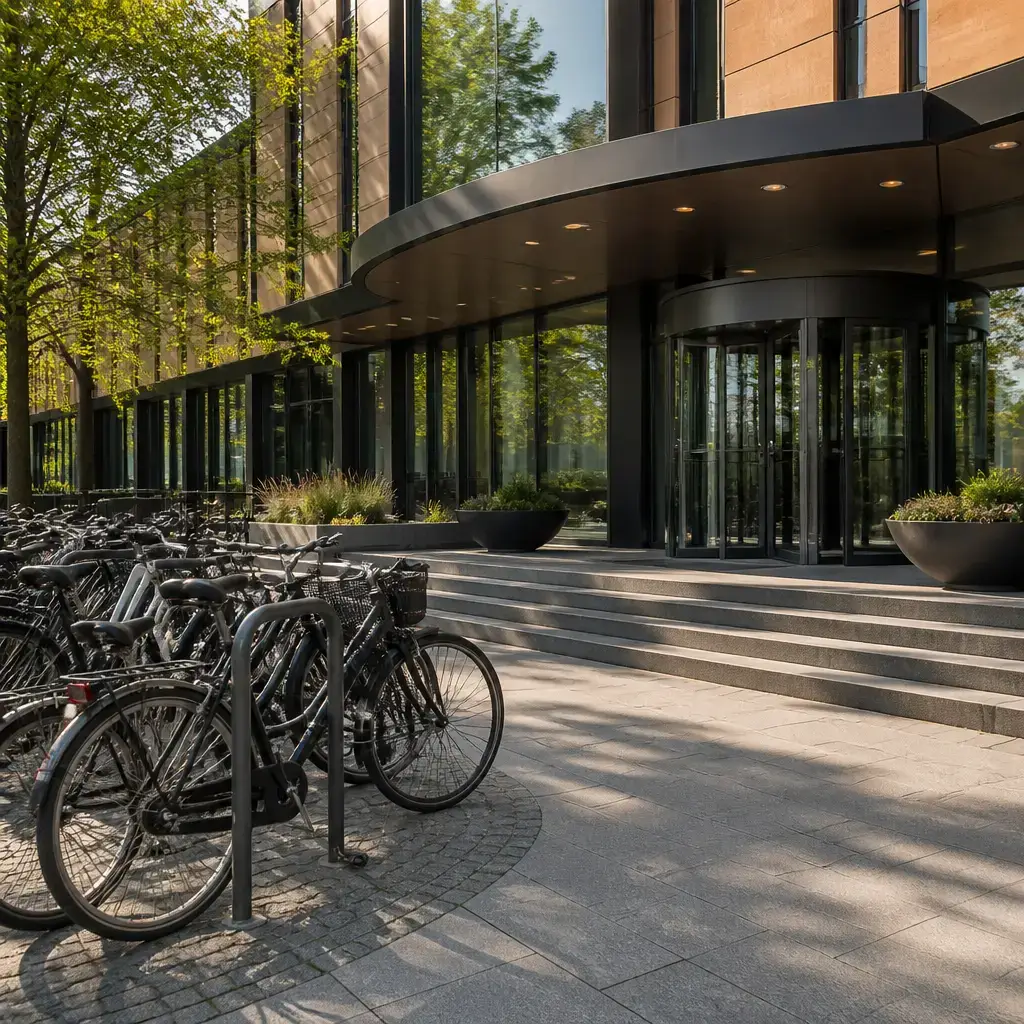
Ich war noch nie in diesem Rathaus.
ikh vahr nokh NEE in DEE-zem RAH-howss. I have never been inside this city hall before.Das Gebäude ist schöner, als ich erwartet habe.
dahss guh-BOY-duh ist SHUR-nuh, ahls ikh air-VAR-tet HAH-buh. The building is nicer than I expected.Der Eingang ist neben dem Fahrradparkplatz.
dair EYE-ngahng ist NAY-ben daym FAHR-raht-park-plahts. The entrance is beside the bicycle parking area.Viele Leute sind mit dem Fahrrad gekommen.
FEE-luh LOY-tuh zint mitt daym FAHR-raht guh-KOM-men. A lot of people came by bike.Das ergibt Sinn.
dahss air-GEEPT zinn. That makes sense.Das ist einfacher, als auf den Bus zu warten.
dahss ist EYE-nfah-kher, ahls owf dayn booss tsoo VAR-ten. It is easier than waiting for the bus.Beim nächsten Mal könnten wir auch hierher radeln.
bime NEKH-sten mahl KURN-ten veer owkh HEER-hair RAH-deln. Next time, we could ride here too.Dann können wir die Fahrräder in der Nähe des Eingangs abstellen.
dahn KURN-en veer dee FAHR-ray-der in dair NAY-uh dayz EYE-ngahngs AHP-shtel-len. Then we can leave the bikes close to the entrance.Vorerst gehen wir hinein und suchen den richtigen Schalter.
fohr-AIRST GAY-en veer hin-EYE-n oont ZOO-khen dayn RIKH-tih-gen SHAL-tuh. For now, let's go inside and find the right counter.Sentence explanations
Ich war noch nie in diesem Rathaus.
I have never been inside this city hall before.
- Ich
- I
- war
- was
- noch nie
- never before
- diesem
- this
- Rathaus
- city hall
More detail
Ich is the first-person singular pronoun, “I.” It is the subject of the sentence, so it is in the nominative case. The corresponding object form is mich, as in Er sieht mich (“He sees me”). war is the past-tense form of sein (“to be”) for ich: ich bin = “I am,” ich war = “I was.” German often uses this simple past form in statements about past experience; the English translation naturally uses “have never been.” noch nie is the reusable combination “never before” or “not ever up to that point.” In this sentence it makes the experience negative: the speaker has not previously been at the stated place. Compare schon einmal (“ever/already once”) in a question such as Warst du schon einmal dort? (“Have you ever been there?”). diesem means “this” in the form required here. It is the dative masculine or neuter singular form of the demonstrative dies-; the form is selected because the location phrase uses in with the dative for a static location. The related form dieser is used for masculine nominative singular, as in dieser Mann (“this man”). Rathaus means “city hall” or “town hall.” It is a neuter noun: das Rathaus. In this sentence, in diesem Rathaus means “in this city hall,” with Rathaus in the dative after locative in; the dative form of this noun has no visible ending change. A useful pattern is in + dative for being located in a place, while in + accusative can mark movement into a place: Ich bin in dem Rathaus (“I am in the city hall”) versus Ich gehe in das Rathaus (“I go into the city hall”). Together, Ich war states the speaker’s past presence, noch nie says that it had never happened before, and in diesem Rathaus identifies the location. The whole utterance means: “I have never been inside this city hall before.”
Das Gebäude ist schöner, als ich erwartet habe.
The building is nicer than I expected.
- Das
- the
- Gebäude
- building
- ist
- is
- schöner
- nicer
- als
- than
- ich
- I
- erwartet
- expected
- habe
- have
More detail
Das is the definite article used here with a singular neuter noun in the nominative case. The form of the article depends on the noun’s gender, number, and case; das Gebäude is the useful combination. This is the article, not the demonstrative meaning “that” in this sentence. Gebäude means “building.” It is a neuter noun: das Gebäude. The same form is used for singular and plural, while the article distinguishes them: das Gebäude “the building” and die Gebäude “the buildings.” ist is the third-person singular present form of sein (“to be”): sein → ist. It links the subject to a description, as in Das Gebäude ist alt. — “The building is old.” schöner is the comparative form of the adjective schön (“nice,” “beautiful”): schön → schöner → am schönsten (“nice/beautiful” → “nicer/more beautiful” → “the nicest/most beautiful”). Here it describes the building as exceeding the speaker’s expectation, rather than making an absolute claim that it is the nicest possible building. als introduces the standard of comparison after a comparative: schöner als ... means “nicer than ...”. Do not confuse this use with wenn (“if/when”), which introduces a condition or time clause. Example: Das Zimmer ist größer als die Küche. — “The room is bigger than the kitchen.” ich is the first-person singular pronoun “I.” It is the subject of the comparison clause, so the speaker is the person whose expectation is being compared with the building’s actual appearance. erwartet is the past participle of erwarten (“to expect”): erwarten → erwartet. With the auxiliary haben, it forms the perfect tense. In this sentence, the expectation is understood from the comparison: the building is nicer than the speaker expected it to be. habe is the first-person singular present form of haben (“to have”): haben → ich habe. Together with erwartet, it forms ich ... erwartet habe, “I have expected” in the German perfect construction. Because this is a clause introduced by als, the finite auxiliary habe comes at the end: als ich ... erwartet habe. The participle remains before the auxiliary. Together, Das Gebäude ist schöner says “The building is nicer,” and als ich erwartet habe supplies the comparison “than I expected.” The complete utterance therefore means: “The building is nicer than I expected.”
Der Eingang ist neben dem Fahrradparkplatz.
The entrance is beside the bicycle parking area.
- Eingang
- entrance
- ist neben
- is beside
- Fahrradparkplatz
- bicycle parking area
More detail
Eingang means “entrance” here. Its base form is der Eingang; the noun is masculine, so the subject phrase uses der in the nominative singular: Der Eingang (“the entrance”). A useful related word is Ausgang (“exit”), but it is a separate noun, not another form of Eingang. Example: Der Eingang ist offen. — “The entrance is open.” ist neben contains ist, the third-person singular present form of sein (“to be”), and neben, meaning “beside/next to.” With a stationary location, neben takes the dative: neben dem .... The form ist agrees with the singular subject Der Eingang; it is not the form of the following noun. Example: Der Tisch ist neben dem Fenster. — “The table is beside the window.” Fahrradparkplatz means “bicycle parking area.” It is a compound noun: Fahrrad (“bicycle”) + Parkplatz (“parking space/parking area”). The compound is masculine, so its dative singular form after neben is dem Fahrradparkplatz. The ending is carried by the article dem; the noun itself does not change here. Example: Das Auto steht neben dem Fahrradparkplatz. — “The car is parked beside the bicycle parking area.” Together, Der Eingang is the subject, ist neben states its stationary location, and dem Fahrradparkplatz identifies the location beside which it is situated. The complete meaning is: “The entrance is beside the bicycle parking area.”
Viele Leute sind mit dem Fahrrad gekommen.
A lot of people came by bike.
- Viele
- many; a lot of
- Leute
- people
- mit dem Fahrrad
- by bike
- sind … gekommen
- came
More detail
Viele means “many” or “a lot of” and is the plural form used with Leute. It agrees with the plural noun here; the singular form is viel in contexts such as viel Zeit (“a lot of time”). Leute means “people.” It is a plural-only noun in ordinary use, so it refers to people as a group rather than forming a regular singular by adding an ending. Example: Viele Leute warten. — “Many people are waiting.” mit dem Fahrrad expresses the means of transport: “by bike” or “by bicycle.” mit takes the dative case, and dem is the dative form of the definite article for the neuter noun Fahrrad. The pattern mit dem + vehicle can describe traveling by a particular vehicle: mit dem Zug — “by train.” sind is the present-tense plural form of sein (“to be”). Here it functions as the auxiliary in the German perfect tense, not as the main verb “are.” gekommen is the past participle of kommen (“to come”). German uses sein as the perfect auxiliary with movement verbs such as kommen: Sie ist gekommen. — “She came.” Together, Viele Leute is the subject, sind gekommen states in the perfect tense that they came, and mit dem Fahrrad specifies how they traveled. The whole utterance therefore means “A lot of people came by bike.”
Das ergibt Sinn.
That makes sense.
- Das
- that / it
- ergibt Sinn
- makes sense
More detail
Das is a standalone demonstrative pronoun meaning “that” here. It points to the situation or content being evaluated, rather than naming a specific noun. In this sentence it is the subject. Example: Das ist klar. — “That is clear.” ergibt Sinn is the reusable German expression “makes sense.” ergibt is the present-tense third-person singular form of ergeben; the base form is ergeben. Sinn is the noun “sense” or “meaning” (der Sinn). The pattern is [subject] ergibt Sinn: Diese Erklärung ergibt Sinn. — “This explanation makes sense.” Together, Das ergibt Sinn. says that the referenced situation or content is understandable or logically coherent: “That makes sense.”
Das ist einfacher, als auf den Bus zu warten.
It is easier than waiting for the bus.
- Das ist
- It is
- einfacher
- easier
- als
- than
- Bus
- bus
- warten
- wait
More detail
Das ist uses sein (“to be”) in the present tense: ist is the third-person singular form. Here Das is a neutral pronoun referring generally to the situation or activity being evaluated; the fixed translation supports the impersonal meaning “It is,” without identifying a more specific noun. einfacher means “easier here.” It is the comparative form of einfach (“easy”): einfach → einfacher → am einfachsten (“easiest”). Because it follows sein as a predicate adjective, it has no adjective ending in this form. A reusable example is Dieser Weg ist einfacher. — “This route is easier.” als introduces what the comparison is made with, corresponding to “than” after a comparative. The pattern is X ist einfacher als Y — “X is easier than Y.” Bus is the noun “bus.” In this sentence it appears inside auf den Bus, the object of warten auf (“to wait for”). Bus is masculine; den marks the masculine accusative form here. The preposition belongs to the verb pattern, not to a spatial movement meaning in this use. Example: Ich warte auf den Zug. — “I am waiting for the train.” warten is the verb “to wait.” Its base form is the infinitive, and the construction here is zu warten, “to wait,” within the comparison. German commonly uses warten auf plus an accusative object: auf den Bus warten means “wait for the bus.” Together, als auf den Bus zu warten means “than waiting for the bus.” The full structure is Das ist einfacher, als ... zu ...: Das evaluates the relevant situation as einfacher, and the als phrase names the alternative activity used for comparison. Thus the complete utterance means: “It is easier than waiting for the bus.”
Beim nächsten Mal könnten wir auch hierher radeln.
Next time, we could ride here too.
- Beim nächsten Mal
- next time
- könnten wir
- we could
- auch
- also; too
- hierher
- here, toward this place
- radeln
- cycle; ride a bike
More detail
Beim nächsten Mal means “next time.” Beim is the contraction of bei dem; bei requires the dative here, so dem and the adjective form nächsten belong with the neuter noun Mal. The phrase is a reusable time expression: Beim nächsten Mal ... = “Next time ...”. Nächsten is an inflected form of nächste, not a form of Mal; the useful comparison chain is nah → näher → am nächsten / der, die, das nächste, although this expression conventionally means the next occasion. könnten wir expresses “we could.” Könnten is the Konjunktiv II form of können for wir; it presents the action as a possibility or suggestion rather than a definite plan. The infinitive that this modal governs comes later: Wir könnten heute länger bleiben. = “We could stay longer today.” With a different subject, the form changes: Ich könnte ... = “I could ...”. auch adds “also” or “too” to the proposal. In this sentence it indicates that riding here is an additional possibility, alongside the already discussed option of waiting for the bus. Its exact emphasis can shift with position, but here it contributes the idea “too” without changing the direction expressed by hierher. hierher means “to here,” that is, toward the relevant place. It combines hier (“here”) with the directional element -her. Contrast hier (“here,” location) with hierher (“to here,” movement toward here). Example: Komm hierher! = “Come here!” The specific place is understood from the situation; the word itself marks direction toward the speaker’s or discourse-centered location. radeln means “to cycle” or “to ride a bike.” It is the infinitive used after könnten; the modal carries the person and mood marking, while radeln remains in the infinitive. Example: Wir radeln zum Eingang. = “We cycle to the entrance.” Together, könnten wir ... radeln gives the reusable pattern Wir könnten ... radeln (“We could cycle ...”). hierher radeln specifies cycling toward here, and auch marks that as an additional possibility. The complete utterance therefore means: “Next time, we could ride here too.”
Dann können wir die Fahrräder in der Nähe des Eingangs abstellen.
Then we can leave the bikes close to the entrance.
- Dann
- then
- können wir
- we can
- Fahrräder
- bikes
- Nähe
- vicinity
- Eingangs
- entrance
- abstellen
- leave or park
More detail
Dann means “then” here and places the action after the situation already mentioned. It can also introduce a consequence: Dann gehen wir. = “Then we’ll go.” können wir means “we can.” können is the present-tense form of können for wir; the modal verb expresses ability or possibility. With a following infinitive, it creates a reusable pattern: Wir können warten. = “We can wait.” The infinitive goes to the end of the clause. Fahrräder means “bikes” here. Its singular base form is das Fahrrad; Fahrräder is its plural form. The noun is the object of abstellen, so it is in the accusative plural, although this plural form does not visibly differ from its nominative plural form. Nähe means “vicinity” or “nearby area.” Its base form is the feminine noun die Nähe. In in der Nähe, in describes a location, so the phrase uses the dative: der Nähe. A reusable example is Das Café ist in der Nähe. = “The café is nearby.” Eingangs is the genitive singular form of der Eingang, “the entrance.” In der Nähe des Eingangs, it identifies what the vicinity is near: “near the entrance.” The genitive article is des, and the masculine noun adds -s: des Eingangs. The base noun is not Eingangs but Eingang. abstellen means “to leave or park” an object in a particular place. It is a separable verb: in a finite main clause, ab separates from stellen, as in Wir stellen die Fahrräder dort ab. = “We leave the bikes there.” After the modal können, however, the complete infinitive abstellen remains at the end. Together, Dann können wir gives “Then we can.” die Fahrräder in der Nähe des Eingangs gives “the bikes close to the entrance,” with the location phrase placed before the final infinitive. abstellen then gives “leave or park” and closes the clause. The full utterance therefore means: “Then we can leave the bikes close to the entrance.”
Vorerst gehen wir hinein und suchen den richtigen Schalter.
For now, let's go inside and find the right counter.
- Vorerst
- for now
- gehen
- go
- wir
- we
- hinein
- inside
- suchen
- look for
- richtigen
- right
- Schalter
- counter
More detail
Vorerst means “for now” or “for the time being.” It sets a temporary time frame; it does not itself express a permanent decision. gehen is the base form “to go.” Here it is the first-person plural form gehen with wir: German present-tense forms use the same form for “we go” and “we are going.” Example: Wir gehen nach Hause. — “We are going home.” wir means “we,” the first-person plural subject pronoun. It identifies the speaker together with at least one other participant, but it does not specify exactly how many people are included. hinein adds movement inward, so gehen ... hinein means “go inside” or “go in.” It is directional: it describes going into an interior space, rather than simply being there. Example: Gehen Sie hinein. — “Go inside.” suchen is the base form “to look for” or “to search for.” In wir suchen, it is the present-tense form used with wir. The object of the search follows: etwas suchen means “to look for something.” richtigen means “right” in the sense of the correct or intended one here. Its base form is the adjective richtig. The ending in richtigen is caused by the surrounding noun phrase: den marks a masculine singular accusative object, and the adjective takes -en after this definite article. Example: Wir suchen den richtigen Weg. — “We are looking for the right route.” Schalter means “counter” here, as in a service or reception counter. The form is also the base form; its singular and plural forms are both Schalter, so number is shown by other words when needed. In this sentence, den richtigen Schalter is the object of suchen, meaning “the right counter.” Together, wir gehen hinein means “we go inside,” and wir suchen den richtigen Schalter means “we look for the right counter.” With Vorerst setting the time frame, the whole utterance means: “For now, let’s go inside and find the right counter.” The coordinated verbs share the subject wir; the English “let’s” conveys the suggested joint action expressed by this first-person plural wording.
Grammar Points
schön → schöner
schöner
SHUR-nuhnicer; more beautiful
The ending -er forms the comparative: schöner means “nicer” or “more beautiful.”
dieser → diesem nach neben
neben diesem
NAY-ben DAY-zembeside this
In a location phrase with neben, dieser can change to diesem in the dative.
German Vocabulary
Quiz
Word Order
Arrange the words in the correct order.
The entrance is beside the bicycle parking area.
Show Answer
Der Eingang ist neben dem Fahrradparkplatz.That makes sense.
Show Answer
Das ergibt Sinn.Spelling
Tap the letters to spell the word.
city hall
Show Answer
Rathausbuilding
Show Answer
Gebäudethis
Show Answer
diesementrance