10 minutes free every day
Continue audio lessons in the app
Word explanations appear automatically in sync with the audio.
No login required · synced translations · playback with the screen locked
Choose your learning language and open this lesson in the app.

About This Lesson
Use Following signs to the registration desk to practice German conversation, pronunciation, vocabulary, grammar, and quizzes.
Dialogue
Ich kann das Veranstaltungsschild an der Wand sehen.
ikh KAHN dahs fer-ahn-SHTAHL-toongs-shilt ahn dair VAHNT ZAY-en I can see the event sign on the wall.Auf dem Schild steht, dass der Anmeldeschalter oben ist.
owf daym shilt shtayt, dahs dair AN-mel-duh-SHAHL-ter OH-ben ist It says the desk is upstairs.Der Weg nach oben ist leicht zu finden.
dair VAYK nahkh OH-ben ist LYKHt tsoo FIN-den The way upstairs is easy to follow.Das Schild hilft sehr.
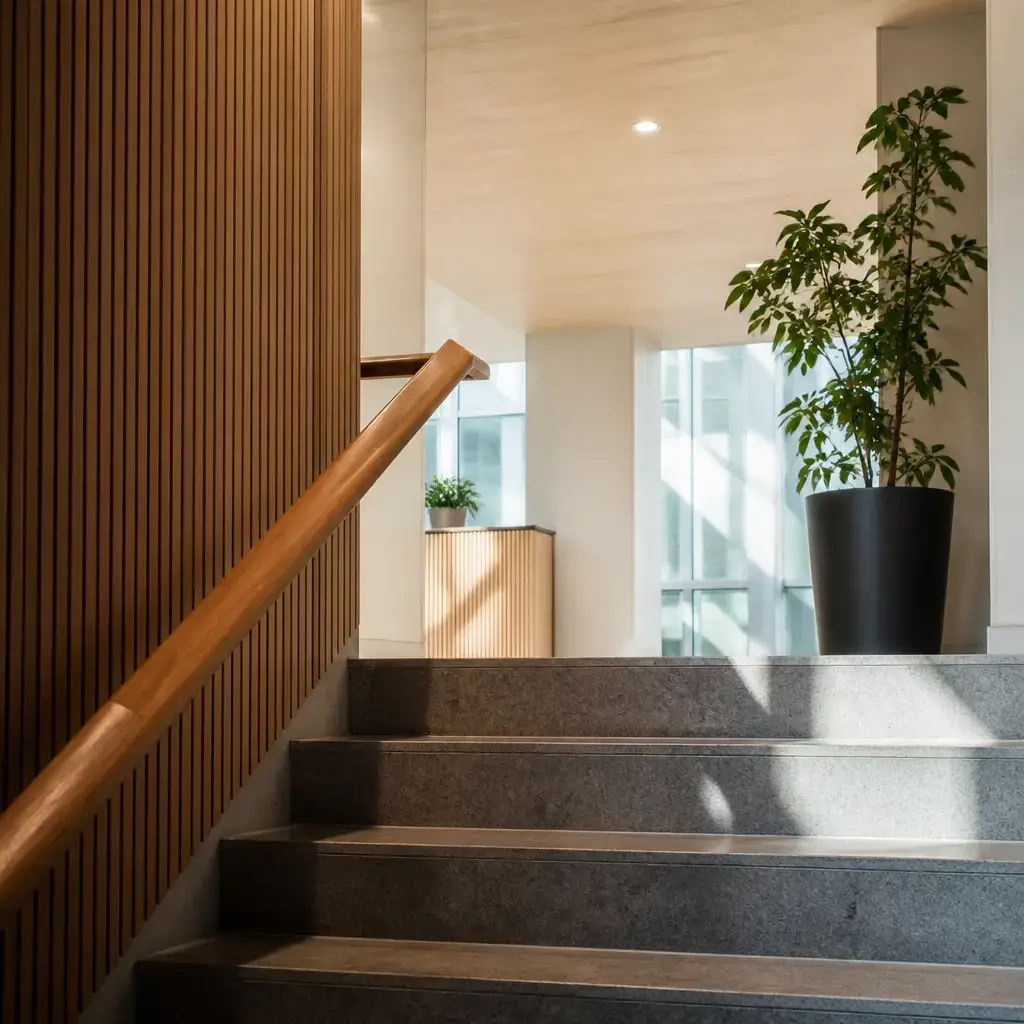
dahs shilt hilft zair The sign helps a lot.Der Treppenabsatz ist gleich vor uns.
dair TREP-en-ap-sahts ist GLYKH fohr oons The landing is just ahead.Dann sollte der Anmeldeschalter ganz in der Nähe sein.
dahn SHOOL-te dair AN-mel-duh-SHAHL-ter gahnts in dair NEH-uh zine Then the registration desk should be close.Gehen wir, bevor die Schlange länger wird.
GAY-en veer, buh-FOHR dee SHLAHNG-uh LENG-er veert Let's go before the line gets longer.Ich halte das Formular bereit.
ikh HAHL-teh dahs for-moo-LAHR buh-RITE I will keep the form ready.Sentence explanations
Ich kann das Veranstaltungsschild an der Wand sehen.
I can see the event sign on the wall.
- Ich kann
- I can
- Veranstaltungsschild
- event sign
- Wand
- wall
- sehen
- see
More detail
Ich kann contains kann, the first-person singular present form of können (“can, be able to”). With ich, the form is kann; other forms include du kannst and sie können. Here it expresses the speaker’s ability or possibility, as in the fixed translation “I can see.” In a modal-verb pattern, the other verb stays in the infinitive and goes to the end: Ich kann den Weg sehen. — “I can see the way.” Veranstaltungsschild is a compound noun: Veranstaltung means “event” and Schild means “sign.” Its meaning here is an event sign, and the complete compound is neuter: das Veranstaltungsschild. The form das is unchanged here in the accusative, because neuter das has the same form for nominative and accusative. The following context also uses Schild for the sign. Wand means “wall.” It is a feminine noun: die Wand. In the expression an der Wand, der is the feminine singular dative form after an; the phrase describes a fixed location, so it means “on the wall” here. With an and a change of location, German instead uses the accusative: Ich hänge das Bild an die Wand. — “I hang the picture on the wall.” sehen is the infinitive “to see.” Its base form is sehen; a useful present-tense contrast is ich sehe (“I see”) and er sieht (“he sees”). After the modal kann, the infinitive remains sehen, rather than taking a finite ending. Together, Ich kann + das Veranstaltungsschild + an der Wand + sehen gives: “I can see the event sign on the wall.” The modal verb comes early, while the infinitive sehen closes the clause; the object is the event sign, and an der Wand states its location.
Auf dem Schild steht, dass der Anmeldeschalter oben ist.
It says the desk is upstairs.
- Auf dem Schild
- on the sign
- steht
- says; is written
- dass
- that
- der Anmeldeschalter
- the registration desk
- oben
- upstairs; up above
- ist
- is
More detail
Auf dem Schild means “on the sign.” auf takes the dative here because the phrase describes a fixed location, not movement onto the sign. dem is the dative form of the definite article for the neuter noun Schild (“sign”): das Schild → dem Schild. Example: Das Bild hängt auf dem Schild. — “The picture is hanging on the sign.” steht is the present-tense third-person singular form of stehen (“to stand”). With a sign, German commonly uses stehen for text that is written or displayed there, so its meaning here is “says” or “is written.” Example: Auf dem Zettel steht „Montag“. — “The note says ‘Monday.’” dass introduces a subordinate clause meaning “that.” In this clause, the finite verb goes to the end. The pattern is ..., dass [subject] [other information] [verb]. der Anmeldeschalter means “the registration desk.” Schalter is a masculine noun, so its nominative definite article is der; the article marks a definite noun, not a numerical count. Anmeldeschalter is a compound noun: Anmeldung means “registration,” and Schalter means “counter” or “desk.” Example: Der Schalter ist links. — “The desk is on the left.” oben is an adverb meaning “upstairs” or “up above.” It describes location and does not inflect for gender or number. It can also be contrasted with unten (“downstairs; below”). Example: Das Büro ist oben. — “The office is upstairs.” ist is the third-person singular present form of sein (“to be”). The subject is der Anmeldeschalter, so the clause says that the registration desk is upstairs. In the dass clause, ist appears at the end, as required by this subordinate-clause pattern. Together, Auf dem Schild steht means “The sign says” or literally “On the sign stands [written information].” dass der Anmeldeschalter oben ist adds the content of the sign: “that the registration desk is upstairs.” The complete utterance therefore means “It says the desk is upstairs,” with the sign as the understood source of the information.
Der Weg nach oben ist leicht zu finden.
The way upstairs is easy to follow.
- Weg
- way
- nach oben
- upstairs / upward
- leicht
- easy
- zu finden
- to find
More detail
Weg means a way, path, or route. In the sentence, Der Weg is the masculine singular noun phrase: der is the definite article, and Weg is the noun. The plural is Wege. Example: Der Weg ist lang. — “The path is long.” nach oben expresses direction toward a higher place: “upstairs” or “upward.” nach is commonly used with oben for this directional meaning. Example: Wir gehen nach oben. — “We are going upstairs.” leicht describes the way as easy. Its opposite is schwer (“difficult” or “hard”). The comparative is leichter (“easier”), as in Dieser Weg ist leichter. — “This way is easier.” zu finden is the infinitive “to find,” formed from finden with zu. The verb finden has the useful present-tense forms ich finde, du findest, and er/sie findet. Here, zu finden completes the adjective construction ist leicht zu finden: literally, the way is easy to find; with the fixed translation, this is understood as easy to follow. Together, Der Weg nach oben means “the way upstairs,” and ist leicht zu finden says that this way is easy to locate or follow. The whole utterance therefore means: “The way upstairs is easy to follow.”
Das Schild hilft sehr.
The sign helps a lot.
- Schild
- sign
- hilft
- helps
- sehr
- a lot
More detail
Schild means “sign” here. Its base form is das Schild, a neuter noun; the article das marks this noun as neuter in the singular. Its plural is die Schilder. Example: Das Schild ist gut sichtbar. — “The sign is clearly visible.” hilft is the present-tense form of helfen for er, sie, or es—and therefore also for the singular neuter subject das Schild. The vowel changes from e in helfen to i in hilft: helfen → er/sie/es hilft. Example: Der Weg hilft nicht. — “The path does not help.” In this sentence, hilft means that the sign is useful or provides help; the sentence does not state a separate recipient of that help. sehr intensifies what follows it. With the verb hilft, sehr strengthens the degree of helping, giving the intended meaning “a lot” or “very much.” It is not the adjective “helpful” itself. Example: Sie hilft sehr. — “She helps a lot.” Together, Das Schild is the singular neuter subject, hilft says that it provides help, and sehr intensifies that action. The complete meaning is: “The sign helps a lot.”
Der Treppenabsatz ist gleich vor uns.
The landing is just ahead.
- Treppenabsatz
- landing
- ist
- is
- gleich vor uns
- just ahead of us
More detail
Treppenabsatz means “landing,” specifically the level area at the top or bottom of a flight of stairs. Its base form is der Treppenabsatz; the article shows that this noun is masculine. The plural is die Treppenabsätze. Example: Der Treppenabsatz ist breit. — “The landing is wide.” ist is the present-tense third-person singular form of sein (“to be”). It agrees with the singular subject der Treppenabsatz. The useful present-tense pattern is ich bin, du bist, er/sie/es ist. Example: Der Schalter ist dort. — “The desk is there.” gleich vor uns means “just ahead of us.” Here gleich contributes the meaning “just” or “right,” strengthening the location, while vor expresses a position in front of something. uns is the first-person plural pronoun in the form used after vor for this location: “us.” Compare vor uns (“in front of us”) with hinter uns (“behind us”). Example: Die Tür ist gleich vor uns. — “The door is just ahead of us.” Together, Der Treppenabsatz ist gleich vor uns. says that the landing is just ahead of the speaker and the speaker’s companions.
Dann sollte der Anmeldeschalter ganz in der Nähe sein.
Then the registration desk should be close.
- Dann
- then
- sollte
- should
- Anmeldeschalter
- registration desk
- ganz
- quite
- in der Nähe
- nearby
- sein
- be
More detail
Dann means “then” and links this statement to what has just been established. It can also introduce a consequence: Dann gehen wir. — “Then we’ll go.” sollte is the finite form of sollen used with the singular subject der Anmeldeschalter. In this sentence, the fixed translation supports the expectation meaning “should be.” The form is ambiguous in isolation: sollte can be the first- or third-person singular Präteritum form, or the corresponding Konjunktiv II form; here the subject identifies the person, while the intended meaning is the expectation expressed by “should.” Useful forms include ich soll, du sollst, er/sie/es soll, and plural wir sollen; the Konjunktiv-II form with wir is wir sollten. Example: Der Schalter sollte dort sein. — “The desk should be there.” Anmeldeschalter is a compound noun meaning “registration desk” or “registration counter.” Its article is masculine: der Anmeldeschalter. The final component, Schalter, determines the compound’s grammatical gender here; German compounds are written as one word. Anmeldung is a related noun meaning “registration” or “check-in,” but it is not the base noun of the observed compound as a whole. ganz intensifies the location phrase here, giving “quite” or “very.” In this use it does not mean “whole” or “complete.” Example: Das ist ganz nah. — “That is very close.” in der Nähe is a reusable phrase meaning “nearby” or “in the vicinity.” Nähe is feminine, so its definite article changes from die Nähe to dative der Nähe after in when the phrase describes a stationary location. For direction toward the vicinity, German uses in die Nähe: “to the vicinity.” sein is the infinitive “to be.” It remains at the end because sollte is the finite modal verb: Der Schalter sollte dort sein. — “The desk should be there.” Together, Dann means “then,” der Anmeldeschalter is the subject, sollte ... sein expresses an expectation, and ganz in der Nähe gives its expected location. The whole utterance means: “Then the registration desk should be close.”
Gehen wir, bevor die Schlange länger wird.
Let's go before the line gets longer.
- Gehen wir
- let’s go
- bevor
- before
- Schlange
- line; queue
- länger
- longer
- wird
- gets; becomes
More detail
Gehen wir uses the present-tense form gehen (“to go”) with wir (“we”) in verb-first order. In this pattern, the word order makes a suggestion or exhortation: Gehen wir! means “Let’s go!” This is different from the ordinary statement Wir gehen (“We are going” / “We go”). Example: Warten wir. — “Let’s wait.” bevor introduces a time clause meaning “before.” It sends the finite verb to the end of its clause in standard German. The pattern is bevor + subject + other information + finite verb. Example: Ruf mich an, bevor du gehst. — “Call me before you leave.” Schlange is a feminine noun. In this utterance, the fixed translation identifies it as a line or queue, not an animal. Its article and adjective forms in other sentences follow feminine-noun grammar: die Schlange, eine lange Schlange. Example: Die Schlange ist kurz. — “The line is short.” länger is the comparative form of the adjective lang (“long”): lang → länger (“longer”). Here it is a predicative adjective after wird, so it has no adjective ending. The comparative says that the line will have greater length than it has now or than a relevant comparison point. Example: Der Weg wird länger. — “The route gets longer.” wird is the third-person singular present form of werden (“to become,” “to get,” and also an auxiliary in other constructions). Here it expresses a change of state: the line becomes longer. The subject is die Schlange, which is singular, so the form is wird; with a plural subject, the form is werden, as in Die Wege werden länger. — “The routes get longer.” Together, Gehen wir gives the suggestion “Let’s go.” The time clause bevor die Schlange länger wird specifies the point before which the action should happen: before the line gets longer. Thus the whole utterance means “Let’s go before the line gets longer.”
Ich halte das Formular bereit.
I will keep the form ready.
- Ich
- I
- halte
- keep; hold
- das
- the
- Formular
- form
- bereit
- ready
More detail
Ich means “I,” the first-person singular pronoun. It identifies the speaker as the subject. A useful contrast is du (“you,” singular informal): Ich halte das Formular bereit. — “I keep the form ready.” halte is the first-person singular present form of halten (“to hold; to keep”): ich halte, du hältst, er/sie hält. Here, with an object and bereit, it means “keep something ready,” not simply “hold” it. The sentence uses the present form; in the supplied translation, its intended meaning is rendered as “will keep.” das is the definite article “the.” It marks Formular as neuter singular in the accusative here, because Formular is the direct object of halte. The neuter article has the same form in nominative and accusative: das Formular can therefore be recognized by the sentence role as the object. Formular is the noun “form” or “document form.” Its useful plural is Formulare: Die Formulare sind bereit. — “The forms are ready.” bereit means “ready” or “prepared.” In etwas bereit halten, it describes the state in which something is kept. It appears without an adjective ending here because it is used as the complement in this fixed verb-plus-adjective construction. fertig can also mean “ready” in some contexts, but it often emphasizes completion, whereas bereit emphasizes availability or preparedness. Together, Ich halte das Formular bereit follows the reusable pattern Ich halte [object] bereit: “I keep [object] ready.” Thus the speaker says that they will keep the form ready, with das Formular as the thing being kept ready and bereit describing its state.
Grammar Points
werden + Komparativ
wird länger
veert LENG-ergets longer
werden + comparative adjective describes a change: something becomes more or increasingly so.
Gehen wir
Gehen wir
GAY-en veerLet's go.
German forms this suggestion with the verb first, followed by wir.
German Vocabulary
Quiz
Word Order
Arrange the words in the correct order.
The sign helps a lot.
Show Answer
Das Schild hilft sehr.The landing is just ahead.
Show Answer
Der Treppenabsatz ist gleich vor uns.I will keep the form ready.
Show Answer
Ich halte das Formular bereit.Spelling
Tap the letters to spell the word.
see
Show Answer
sehenstand; say on a sign
Show Answer
stehtsign
Show Answer
Schildwall