10 minutes free every day
Continue audio lessons in the app
Word explanations appear automatically in sync with the audio.
No login required · synced translations · playback with the screen locked
Choose your learning language and open this lesson in the app.

About This Lesson
Use Finding the event registration desk to practice German conversation, pronunciation, vocabulary, grammar, and quizzes.
Dialogue
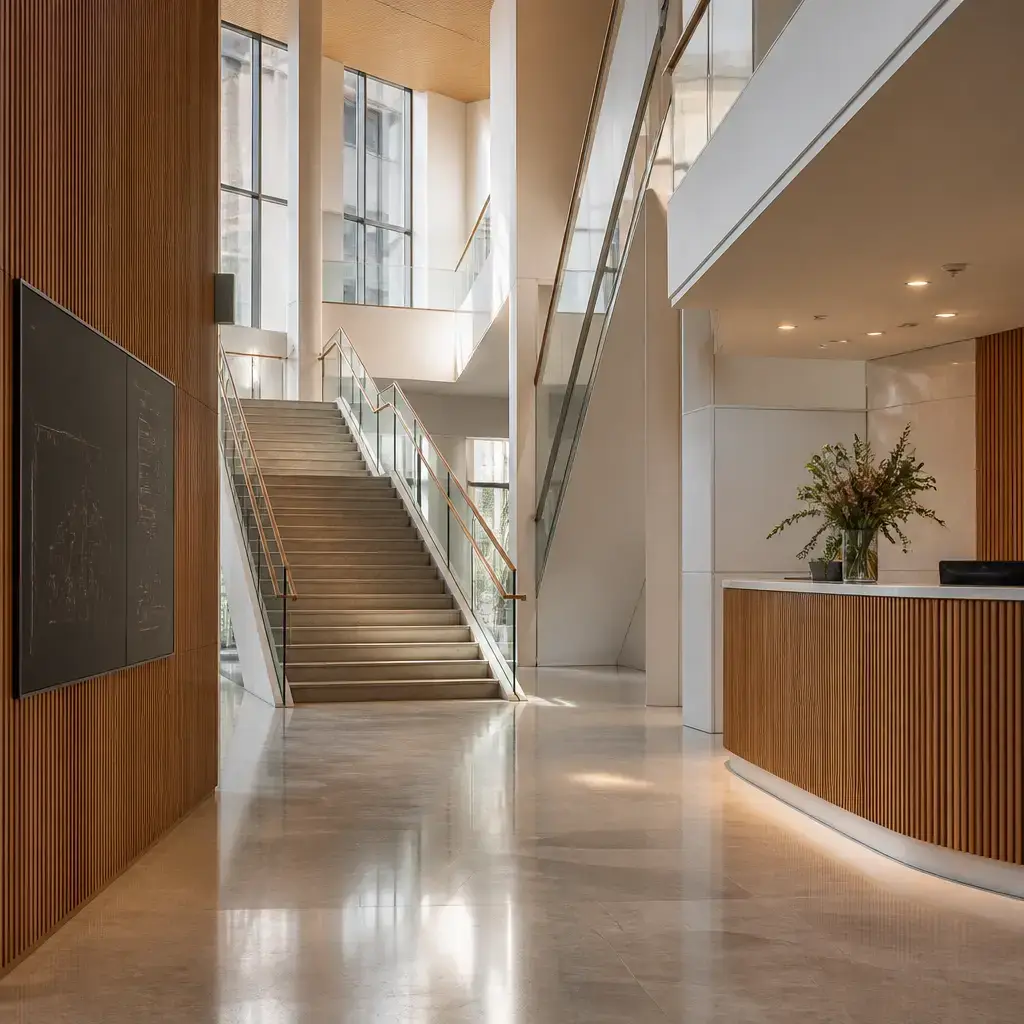
Dieses Gebäude wirkt innen sehr sauber.
DEE-zəs guh-BOY-duh veerkt IN-ən zair ZOW-buh. This building feels very clean inside.Durch die hohe Decke wirkt die Lobby offen.
DOORCH dee HOH-uh DEK-uh veerkt dee LAW-bee AWF-ən. The high ceiling makes the lobby feel open.Suchen wir den Anmeldeschalter für die Veranstaltung.
ZOO-khen veer dane AN-mel-deh-SHAWL-tuh fyoor dee fair-AN-shtal-toong. Let's find the event desk for registration.Ich schaue in den Gebäudeplan an der Wand.
ikh SHOW-uh in dane guh-BOY-duh-plahn an dair vahnt. I'll check the building directory by the wall.Auf dem Plan steht: Der Anmeldeschalter ist oben.
OWF daym plahn shtayt: dair AN-mel-deh-SHAWL-tuh ist OH-bən. It says the event desk is upstairs.Nehmen wir die Rolltreppe oder die Treppe?
NAY-men veer dee ROLL-trep-uh OH-dair dee TREP-uh? Should we take the escalator or the stairs?Nehmen wir die Treppe; sie ist gleich hier.
NAY-men veer dee TREP-uh; zee ist glykh heer. Let's take the stairs; they are right here.Die Holztreppe lässt den Ort warm wirken.
dee HOHLTS-trep-uh lest dane awrt varm VEER-kən. The wooden stairs make the place feel warm.Sentence explanations
Dieses Gebäude wirkt innen sehr sauber.
This building feels very clean inside.
- Dieses
- this
- Gebäude
- building
- wirkt
- seems; feels
- innen
- inside
- sehr
- very
- sauber
- clean
More detail
Dieses points to a specific thing already identifiable in the situation. Here it is the demonstrative form agreeing with the subject noun Gebäude: dieses Gebäude is neuter singular in the nominative. The form changes with the noun's grammatical gender, number, and case; for example, diese Tür means “this door,” while diese Gebäude means “these buildings.” Gebäude means “building.” Its singular and plural forms are both Gebäude; the article or another determiner shows the number: ein Gebäude “a building,” zwei Gebäude “two buildings.” In this sentence, Dieses identifies it as one specific building. wirkt is the third-person singular present form of wirken. In this use, wirken means “to seem” or “to give an impression,” rather than “to work” or “to have an effect” in another use. The subject is the building, so the form is wirkt; the infinitive is wirken. Example: Der Raum wirkt hell. — “The room seems bright.” innen is an adverb meaning “inside” or “on the inside.” It specifies where the described impression applies. Unlike an adjective modifying a noun, it does not agree with Gebäude. sehr is an intensifier meaning “very.” It strengthens the adjective that follows: sehr sauber means “very clean.” sauber means “clean.” Here it is a predicative adjective after wirkt, so it describes the impression the building gives and remains in the basic form rather than taking an adjective ending. Its comparative is sauberer “cleaner,” and its superlative is commonly am saubersten “cleanest.” Example: Die Küche wirkt sauber. — “The kitchen looks clean.” Together, Dieses Gebäude identifies the subject, wirkt presents an impression, innen limits that impression to the inside, and sehr sauber describes its strong degree. The complete meaning is: “This building feels very clean inside.”
Durch die hohe Decke wirkt die Lobby offen.
The high ceiling makes the lobby feel open.
- Durch
- because of
- hohe
- high
- Decke
- ceiling
- wirkt
- seems; feels
- Lobby
- lobby
- offen
- open
More detail
Durch introduces the cause here: durch + accusative means “because of” or “as a result of,” not physical movement through. The phrase durch die hohe Decke therefore identifies the high ceiling as the reason for the impression. hohe is the inflected form of the adjective hoch (“high”). In die hohe Decke, it describes the feminine singular noun Decke (“ceiling”); after the definite article die in this form, the adjective takes the ending -e. The noun Decke is feminine: die Decke. wirkt is the third-person singular present form of wirken. In this sentence, wirken means “seem” or “give an impression,” rather than “work” in the sense of functioning. The subject is die Lobby, so the form is wirkt. For example: Der Raum wirkt freundlich. — “The room seems friendly.” Lobby is a feminine noun, normally used with die: die Lobby. Here it names the place that gives the impression of being open. offen is a predicate adjective after wirken, so it remains uninflected: Die Lobby wirkt offen. — “The lobby seems open.” Together, Durch die hohe Decke gives the cause, wirkt expresses the resulting impression, and die Lobby offen describes that impression: “The high ceiling makes the lobby feel open.”
Suchen wir den Anmeldeschalter für die Veranstaltung.
Let's find the event desk for registration.
- Suchen wir
- let’s look for
- Anmeldeschalter
- registration desk
- für
- for
- Veranstaltung
- event
More detail
Suchen wir uses suchen (“to look for, search”) in the first-person plural form used for a suggestion: “let’s look for …”. German places the verb first in this pattern, followed by wir (“we”). Compare Wir suchen ... (“We are looking for ...”), which is a statement rather than this suggestion. Anmeldeschalter means “registration desk/counter” here. It is a masculine compound noun: der Anmeldeschalter. The first part relates to Anmeldung (“registration”), and Schalter can mean a service counter. In this sentence the noun is the direct object of suchen, so the masculine singular article appears as den: der Anmeldeschalter → den Anmeldeschalter. für introduces what something is intended for and requires the accusative case. In für die Veranstaltung, it connects the desk with the event. The feminine singular article die has the same form in the nominative and accusative here; the case is shown by the preposition’s requirement, not by a visible change in die. Veranstaltung means “event” in this sentence. It is a feminine noun: die Veranstaltung. The form is unchanged after für because feminine singular die looks the same in the nominative and accusative. For example, Wir besuchen die Veranstaltung. means “We are attending the event.” Together, Suchen wir + den Anmeldeschalter + für die Veranstaltung means “Let’s look for the registration desk for the event.”
Ich schaue in den Gebäudeplan an der Wand.
I'll check the building directory by the wall.
- Ich
- I
- schaue
- look / check
- in den
- into the
- Gebäudeplan
- building plan / directory
- an der Wand
- by the wall
More detail
Ich is the first-person singular pronoun, meaning “I.” It identifies the speaker as the person doing the checking. In German, the same form is used whether the speaker is male or female. schaue comes from schauen, “to look.” Here it is the present-tense first-person singular form: ich schaue. In this sentence, schauen in ... means looking into or checking a plan. Example: Ich schaue in den Kalender. — “I’m checking the calendar.” in den combines the preposition in with the masculine accusative article den. The accusative appears here because the phrase presents the object being looked into or consulted: in den Gebäudeplan. This is different from a location reading such as in dem Gebäudeplan (“in the building plan”), where in takes the dative. Gebäudeplan is a masculine compound noun: Gebäude (“building”) + Plan (“plan”). Its basic meaning is a plan or directory of a building. The masculine forms include der Gebäudeplan (nominative), den Gebäudeplan (accusative), and dem Gebäudeplan (dative). Example: Der Gebäudeplan hängt dort. — “The building plan is hanging there.” an der Wand means “by/on the wall.” Wand is feminine, so the dative form after the location use of an is der Wand: an der Wand. The phrase describes where the building plan is located, not a movement toward the wall. Compare the location phrase Das Schild ist an der Wand. — “The sign is on the wall.” Together, Ich schaue gives “I’ll check / I’m looking,” in den Gebäudeplan identifies the building plan being consulted, and an der Wand locates that plan. The complete utterance therefore means: “I’ll check the building directory by the wall.”
Auf dem Plan steht: Der Anmeldeschalter ist oben.
It says the event desk is upstairs.
- Auf dem Plan
- on the plan
- steht
- says; is written
- Anmeldeschalter
- registration or event desk
- oben
- upstairs
More detail
Auf dem Plan means “on the plan.” auf takes the dative here because this describes a fixed location, not movement toward a surface. dem is the dative form of the definite article for the masculine noun Plan; a movement context can use the accusative, for example Ich lege den Zettel auf den Plan (“I put the note onto the plan”). steht is the third-person singular present form of stehen (“to stand”). In this information-display construction, German uses stehen for text that is written or displayed: Auf dem Schild steht „Ausgang“ means “The sign says ‘Exit.’” Here, steht does not describe the desk physically standing. Its grammatical subject is the written statement introduced after the colon, not Der Anmeldeschalter; the desk is the subject of ist in that statement. Anmeldeschalter is a compound noun: Anmeldung refers to registration or checking in, and Schalter is a service counter or desk. German nouns are capitalized, and the compound is masculine: der Anmeldeschalter. In this sentence, the fixed translation identifies it as the event desk. A related reusable compound is Ticketschalter (“ticket counter”), which names a different kind of desk. oben means “upstairs” or “up above.” It is an adverb, so it does not change for number or gender. In this sentence it gives the desk’s location. The contrasting location word unten means “downstairs” or “below.” Together, Auf dem Plan steht introduces information shown on the plan, and Der Anmeldeschalter ist oben states what that information says: “The event desk is upstairs.”
Nehmen wir die Rolltreppe oder die Treppe?
Should we take the escalator or the stairs?
- Nehmen wir
- shall we take?
- die Rolltreppe
- the escalator
- die Treppe
- the stairs
More detail
Nehmen wir combines the verb nehmen (“to take”) with wir (“we”). nehmen is the present-tense form used with wir; placing the verb before the subject makes a yes/no question here: “Shall we take …?” This is a reusable question pattern: Nehmen wir ...? = “Shall we take ...?” die Rolltreppe means “the escalator.” Rolltreppe is a feminine noun, so its definite article is die in this form. The compound contains Treppe (“stairs” or “staircase”), but Rolltreppe specifically means “escalator.” die Treppe means “the stairs” or “the staircase.” Treppe is a feminine noun and is grammatically singular in this phrase, even though English commonly uses the plural “stairs” for this meaning. The article die marks the definite noun phrase here. Together, Nehmen wir die Rolltreppe oder die Treppe? asks the listener to choose between two ways of going: “Should we take the escalator or the stairs?” The utterance itself asks for that choice; it does not state that either option is upstairs.
Nehmen wir die Treppe; sie ist gleich hier.
Let's take the stairs; they are right here.
- Nehmen wir
- let’s take
- die Treppe
- the stairs
- sie
- they
- ist
- is
- gleich hier
- right here
More detail
Nehmen wir is the first-person plural imperative, used to make a suggestion such as “let’s take …”. It has the same form as the present-tense wir nehmen, but here its function is a suggestion, not a statement. Example: Nehmen wir den Bus. — “Let’s take the bus.” die Treppe means “the stairs” or “staircase” here. Treppe is a feminine noun, and die is its definite article in the accusative singular, marking what is being taken. German uses a singular noun here, although English commonly translates it as plural “the stairs.” In the preceding context, this is the option contrasted with die Rolltreppe, “the escalator.” sie means “they” in the fixed translation and refers here to the staircase. Grammatically, it is a feminine singular nominative pronoun because it stands for feminine singular die Treppe; English uses “they” because “the stairs” is conventionally plural in this translation. ist is the third-person singular present form of sein, “to be.” Its subject here is sie, referring to die Treppe. Useful present-tense forms include ich bin, du bist, sie ist, and wir sind. gleich hier is a location expression meaning “right here.” In this sentence, gleich intensifies the immediacy of hier; it does not mean “equal.” Example: Der Eingang ist gleich hier. — “The entrance is right here.” Together, Nehmen wir die Treppe proposes taking the stairs, and sie ist gleich hier says that the staircase is right here. The complete meaning is: “Let’s take the stairs; they are right here.”
Die Holztreppe lässt den Ort warm wirken.
The wooden stairs make the place feel warm.
- Holztreppe
- wooden staircase
- lässt
- makes
- Ort
- place
- warm
- warm
- wirken
- seem; feel
More detail
Holztreppe means “wooden staircase.” It is a compound noun: Holz means “wood” and Treppe means “staircase,” with the whole compound referring to one staircase made of or associated with wood. German nouns are capitalized, and the compound’s grammatical gender is inherited from its final part: die Treppe, so die Holztreppe is feminine. Example: Die Holztreppe ist alt. — “The wooden staircase is old.” lässt is the third-person singular present form of lassen (“to let; make; leave”). In this sentence, lassen has the causative pattern jemanden/etwas + infinitive: it says that something causes or allows a result. The subject is Die Holztreppe, so the present-tense form is lässt. Example: Der Film lässt mich lachen. — “The film makes me laugh.” Ort means “place” or “location.” Here it is the noun in den Ort, the accusative form after lassen because the place is the thing being made to have a certain appearance or effect. Its base form is der Ort; the definite article changes to den in the masculine accusative. Example: Ich kenne den Ort. — “I know the place.” warm is the adjective “warm.” Here it describes the resulting impression or state of den Ort; it is not inflected because it follows wirken in the pattern etwas wirkt + adjective. Its comparison is warm – wärmer – am wärmsten (“warm – warmer – warmest”). Example: Das Licht wirkt warm. — “The light seems warm.” wirken is the infinitive “to seem” or “to appear,” and with an adjective it describes how something comes across: etwas wirkt + adjective. After the finite form lässt, the infinitive stays at the end: lässt ... wirken. In this sentence, warm wirken means “seem/feel warm,” not “actively make something warm.” Example: Der Raum wirkt ruhig. — “The room seems calm.” Together, Die Holztreppe is the subject, lässt introduces a causative construction, and den Ort warm wirken means “makes the place seem or feel warm.” The complete utterance is therefore: “The wooden stairs make the place feel warm.”
Grammar Points
die hohe Decke
Die hohe Decke wirkt sauber.
dee HOH-uh DEK-uh veerkt ZOW-buh.The high ceiling seems clean.
Nach dem bestimmten Artikel erhält das Adjektiv bei einem femininen Nomen die Endung -e.
Gebäudeplan
Der Gebäudeplan steht an der Wand.
dair guh-BOY-duh-plahn shtayt an dair vahnt.The building directory is on the wall.
Deutsche Nomen können zu einem zusammengesetzten Wort verbunden werden; das letzte Wort bestimmt das Geschlecht.
German Vocabulary
Suchen wir den Anmeldeschalter für die Veranstaltung.
Durch die hohe Decke wirkt die Lobby offen.
Dieses Gebäude wirkt innen sehr sauber.
Ich schaue in den Gebäudeplan an der Wand.
Durch die hohe Decke wirkt die Lobby offen.
Dieses Gebäude wirkt innen sehr sauber.
Durch die hohe Decke wirkt die Lobby offen.
Durch die hohe Decke wirkt die Lobby offen.
Dieses Gebäude wirkt innen sehr sauber.
Ich schaue in den Gebäudeplan an der Wand.
Suchen wir den Anmeldeschalter für die Veranstaltung.
Dieses Gebäude wirkt innen sehr sauber.
Quiz
Word Order
Arrange the words in the correct order.
This building feels very clean inside.
Show Answer
Dieses Gebäude wirkt innen sehr sauber.Spelling
Tap the letters to spell the word.
building
Show Answer
Gebäudehigh; tall
Show Answer
hoheopen
Show Answer
offeninside