10 minutes free every day
Continue audio lessons in the app
Word explanations appear automatically in sync with the audio.
No login required · synced translations · playback with the screen locked
Choose your learning language and open this lesson in the app.

About This Lesson
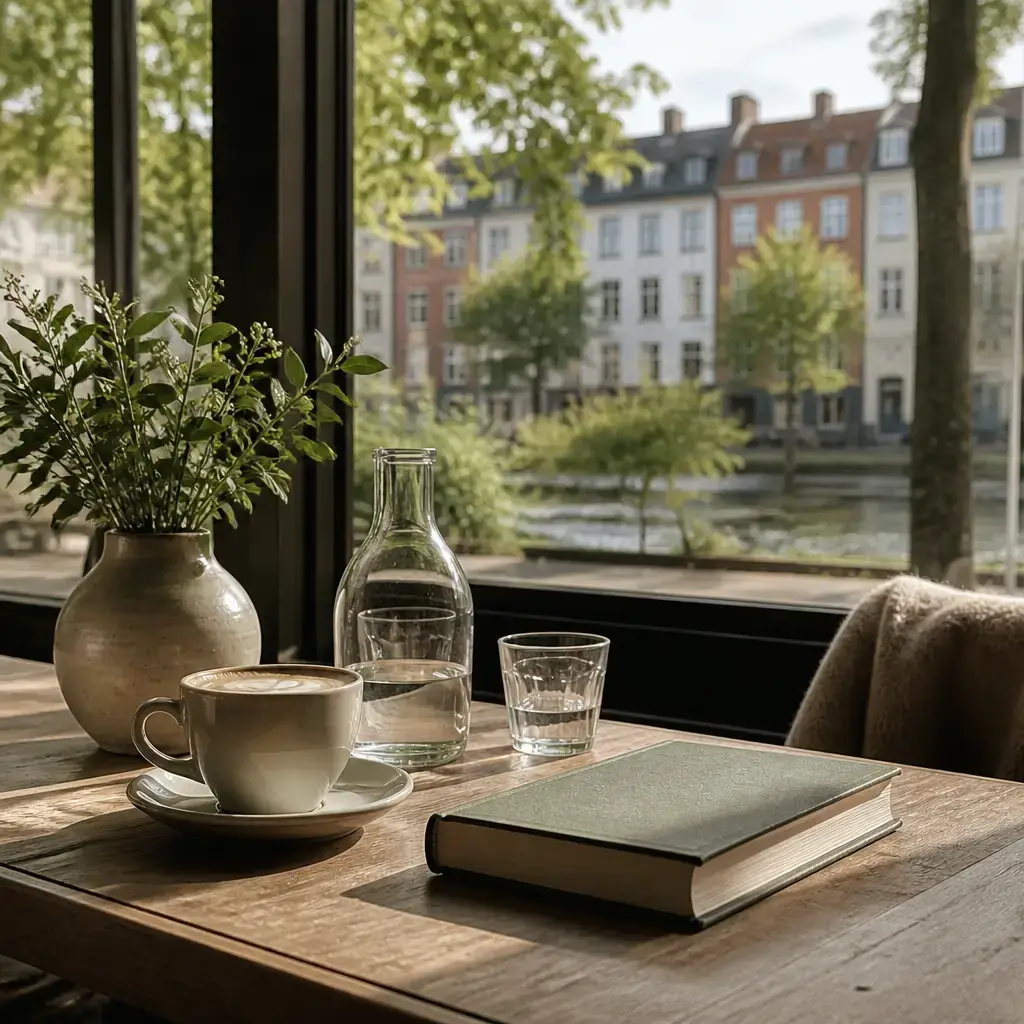
Use Meeting at a quiet cafe to practice German conversation, pronunciation, vocabulary, grammar, and quizzes.
Dialogue
Möchtest du dich in einem Café treffen?
MURKH-test doo dikh in EYE-nem ka-FAY TREFF-en? Would you like to meet at a cafe?Das klingt entspannend.
dahs KLINKT ent-SHPAN-ent. That sounds relaxing.Welches Café magst du?
VEL-khes ka-FAY mahkst doo? Which cafe do you like?Ich mag das ruhige Café am Park.
ikh mahk dahs ROO-ee-guh ka-FAY ahm park. I like the quiet one near the park.Lass uns uns dort treffen und die Ruhe genießen.
lahs oons oons dort TREFF-en oont dee ROO-uh guh-NEE-sen. Let's meet there and enjoy the quiet.Ich kann ein Buch mitbringen.
ikh kahn ayn bookh MIT-bring-en. I can bring a book.Wir können dort eine Weile lesen.
veer KURN-en dort EYE-nuh VY-luh LAY-zen. We can read there for a while.Das wäre eine schöne Pause.
dahs VAIR-uh EYE-nuh SHURN-uh POW-zuh. That would be a nice break.Sentence explanations
Möchtest du dich in einem Café treffen?
Would you like to meet at a cafe?
- Möchtest du
- would you like
- dich … treffen
- meet
- Café
- café
More detail
Möchtest du is a reusable way to ask whether someone would like to do something. möchtest is the second-person singular form used for a wish or polite invitation; it is related to mögen (“to like”). du is the informal singular “you.” Example: Möchtest du kommen? — “Would you like to come?” dich ... treffen contains the accusative reflexive pronoun dich and the infinitive treffen (“to meet”). dich is the second-person singular reflexive form, used when the action is connected to the person addressed. The related forms include mich with ich and uns with wir: Wir treffen uns morgen. — “We are meeting tomorrow.” In this fixed utterance, the supplied translation gives the intended meaning “meet.” Café is a noun meaning “café” or “coffee shop.” In in einem Café, in expresses a location, so the noun phrase uses the dative: einem is the dative form of the neuter indefinite article for das Café. The phrase means “at a café”; it does not by itself assert a numerical count. Together, Möchtest du ... treffen? asks whether the addressed person would like to meet, and in einem Café specifies the meeting place: “Would you like to meet at a café?”
Das klingt entspannend.
That sounds relaxing.
- Das
- That
- klingt
- sounds
- entspannend
- relaxing
More detail
Das is a standalone demonstrative pronoun meaning “that” here. It refers to the proposal or situation expressed in the preceding utterance, rather than identifying a specific noun from the sentence itself. German demonstratives can also appear as der, die, or das when they agree with an identified noun; this use is pronoun-like and points to an idea or situation. klingt is the third-person singular present form of klingen (“to sound”). The pattern Das klingt + adjective gives an impression: “That sounds …” It describes how something seems based on the information available, not necessarily an actual sound. Compare Das klingt gut. — “That sounds good.” entspannend means “relaxing” here. It is the present participle of entspannen (“to relax”) used as an adjective: something relaxing produces or encourages relaxation. As a predicate adjective after klingt, it has no attributive ending. Do not confuse it with entspannt (“relaxed”), which describes the person or thing that is already in a relaxed state: Ich bin entspannt. — “I am relaxed.” Together, Das identifies the preceding proposal or situation, klingt presents an impression of it, and entspannend characterizes that impression. The complete meaning is “That sounds relaxing.”
Welches Café magst du?
Which cafe do you like?
- Welches
- which
- Café
- café
- magst
- like
- du
- you
More detail
Welches means “which” here and identifies one choice from a set of cafés. It is the neuter singular form of the question determiner welcher; with Café, the form is welches in both nominative and accusative. Compare Welcher Park? (“Which park?”) and Welche Stadt? (“Which city?”). Example: Welches Buch liest du? — “Which book are you reading?” Café is the noun “café.” In German it is neuter: das Café; its plural is die Cafés. In this sentence, Café is the object of magst, so the question asks which café is liked. magst is the second-person singular present form of mögen, “to like.” The subject is du, so the verb uses the du form: du magst. Other present forms include ich mag (“I like”), sie mögen (“they like”), and formal Sie mögen (“you like”). Example: Du magst Kaffee. — “You like coffee.” du is the informal singular subject pronoun “you.” It is used for one person addressed informally. For several people addressed informally, German uses ihr; for formal address to one or more people, it uses Sie. Together, Welches Café asks which café is being selected, magst du says that the person addressed likes it, and the complete utterance means “Which café do you like?” It is a straightforward informal question.
Ich mag das ruhige Café am Park.
I like the quiet one near the park.
- Ich
- I
- mag
- like
- das
- the
- ruhige
- quiet
- Café
- café
- am
- by the
- Park
- park
More detail
Ich means “I.” It is the first-person singular pronoun, used for the speaker. In German, the subject form is ich; the object form is mich, as in Sie sieht mich (“She sees me”). mag is the first-person singular present form of mögen (“to like”). The verb changes its stem in the singular: ich mag, du magst, er/sie/es mag; the plural forms include wir mögen. Here it expresses a present preference, not ability. Example: Ich mag Tee. — “I like tea.” das is the definite article “the” for the neuter noun Café here. It also marks the noun phrase as neuter in this form; for this noun, nominative and accusative look the same. Do not confuse this article with the demonstrative pronoun das, which can mean “that” when it stands independently. ruhige is the adjective form of ruhig (“quiet, calm”). In das ruhige Café, the ending -e appears because the adjective is before a neuter singular noun with the definite article das. The comparison is ruhig (“quiet”), ruhiger (“quieter”), am ruhigsten (“quietest”). Example: Der Park ist ruhig. — “The park is quiet.” Café is a neuter noun meaning “café” or “coffee shop.” Its usual article is das: das Café. In the fixed sentence, it is the place being liked and is also the noun that das ruhige describes. am is the contraction of an dem. In am Park, it introduces a location associated with the park; here the café is near or by the park. The phrase an dem Park is possible in more formal or emphatic wording, but am Park is the normal compact form. Example: Wir sitzen am Fenster. — “We are sitting by the window.” Park is a masculine noun meaning “park,” with the article der: der Park. After an for a stationary location, German uses the dative, so the underlying phrase is an dem Park, contracted to am Park. This differs from movement toward the park, where the accusative can be used: Wir gehen an den Park. — “We go to the park.” Together, Ich mag states the speaker’s present preference. das ruhige Café identifies the quiet café, and am Park locates it near the park. The complete meaning is: “I like the quiet café near the park.” The supplied translation says “the quiet one”; in context, that “one” refers to the café identified in the German sentence and the preceding question.
Lass uns uns dort treffen und die Ruhe genießen.
Let's meet there and enjoy the quiet.
- Lass uns
- let's
- treffen
- meet
- dort
- there
- Ruhe
- quiet
- genießen
- enjoy
More detail
Lass uns is a fixed German way to make a suggestion: “let’s …”. Lass is the imperative singular form of lassen (“to let”), while uns means “us” here. The whole construction, rather than lass alone, introduces a joint action. Example: Lass uns gehen. — “Let’s go.” treffen means “to meet”. In uns treffen, uns indicates that the participants meet one another; German commonly uses sich/uns/euch with this meaning depending on the subject. The infinitive treffen stays unchanged after Lass uns. Example: Wir treffen uns morgen. — “We are meeting tomorrow.” dort means “there”, referring to a place understood from the situation. It is an adverb and does not change for number or gender. Example: Der Schlüssel liegt dort. — “The key is there.” Ruhe is the noun meaning “quiet” or “calm” in this sentence. Its base form is die Ruhe; the article shows that it is feminine, while Ruhe itself does not change here. In die Ruhe genießen, die Ruhe is the object of genießen. The related adjective is ruhig (“quiet, calm”), as in the earlier phrase das ruhige Café; ruhige is an inflected form of ruhig, not a form of Ruhe. genießen means “to enjoy” and is an infinitive here, coordinated with treffen after Lass uns. Its present-tense forms include ich genieße, du genießt, and wir genießen; the spelling change in these forms belongs to the verb genießen. Example: Wir genießen den Sonnenschein. — “We enjoy the sunshine.” Together, Lass uns introduces the suggestion, uns treffen expresses meeting one another, dort specifies the place, and die Ruhe genießen adds the second coordinated action. The complete meaning is: “Let’s meet there and enjoy the quiet.”
Ich kann ein Buch mitbringen.
I can bring a book.
- Ich kann
- I can
- Buch
- book
- mitbringen
- bring along
More detail
Ich kann means “I can.” Ich is the first-person singular pronoun “I.” kann is the present-tense first-person singular form of the modal verb können (“can, be able to”). With a modal verb, the other verb normally stays in the infinitive and goes to the end: Ich kann warten. — “I can wait.” Buch means “book.” Its base form is the noun das Buch; it is neuter, and its plural is die Bücher. Here, ein Buch is the direct object of the action. The article ein marks an indefinite noun, but the sentence itself does not specify a number beyond referring to a book. mitbringen means “bring along” or “bring with one.” It is a separable verb built from mit- and bringen. In this sentence it remains as the infinitive mitbringen because it follows the modal kann; in a clause without the modal, the parts separate: Ich bringe ein Buch mit. — “I bring a book along.” Together, Ich kann + ein Buch + mitbringen gives “I can bring a book.” The modal expresses ability or possibility, ein Buch is the item being brought, and mitbringen describes bringing it along to the relevant place. The infinitive at the end is a characteristic word order for a main clause containing a modal verb.
Wir können dort eine Weile lesen.
We can read there for a while.
- Wir können
- we can
- dort
- there
- eine Weile
- for a while
- lesen
- read
More detail
Wir können means “we can” here. wir is the first-person plural pronoun, and können is the present-tense form of können for wir. With a modal verb such as können, the other verb stays in the infinitive and goes to the end of the clause: Wir können lesen = “We can read.” Compare Ich kann lesen = “I can read”; the modal form changes with the subject. dort means “there,” indicating a place. It is an adverb, so it does not change for number or grammatical gender. A reusable pattern is Wir können dort ... = “We can ... there.” eine Weile means “for a while.” Weile is a feminine noun meaning a period of time, and eine is its indefinite article in this duration expression. The phrase does not state a numeric count. For example, Wir warten eine Weile. means “We wait for a while.” lesen means “to read.” This is the infinitive, the base form used after können; it does not carry the present-tense person ending in this construction. Without the modal, the finite forms include ich lese (“I read”) and wir lesen (“we read”). Together, Wir können dort eine Weile lesen. means “We can read there for a while.” The modal können expresses ability or possibility, dort gives the location, eine Weile gives the duration, and lesen remains at the end as the infinitive required by the modal construction.
Das wäre eine schöne Pause.
That would be a nice break.
- Das
- that
- wäre
- would be
- schöne
- nice; beautiful
- Pause
- break
More detail
Das is the German demonstrative pronoun meaning “that” here. It is the subject and refers to an understood thing or situation; the fixed sentence does not identify a more specific referent. In this use, das is neuter singular nominative. German also has other demonstrative forms, such as dieser for “this” with a masculine singular noun. wäre is the Konjunktiv II form of sein (“to be”), used here for a hypothetical or proposed assessment: “would be.” A useful contrast is ist (“is”) versus wäre (“would be”). Example: Das wäre gut. — “That would be good.” schöne comes from the adjective schön, meaning “nice” or “beautiful.” In eine schöne Pause, the adjective has the ending -e because it describes a feminine singular noun in the nominative case after the indefinite article eine. The adjective itself is not derived from Pause. Example: ein schöner Tag — “a nice day.” Pause is a feminine noun meaning “break” or “pause.” Its definite article is die: die Pause; in this sentence, the feminine singular nominative phrase uses eine Pause. Example: Wir machen eine Pause. — “We are taking a break.” Together, Das wäre presents an understood thing or situation as a hypothetical or suggested assessment, and eine schöne Pause describes it as “a nice break.” The whole utterance means “That would be a nice break.”
Grammar Points
Möchtest du + Infinitiv?
Möchtest du dich treffen?
MURKH-test doo dikh TREFF-en?Would you like to meet?
möchten steht mit einem Infinitiv. Das konjugierte Verb steht auf Position 2, der Infinitiv am Satzende.
Welches + sächliches Nomen
Welches Café klingt entspannend?
VEL-khes ka-FAY KLINKT ent-SHPAN-ent?Which cafe sounds relaxing?
Bei sächlichen Nomen verwendet man im Nominativ welches, zum Beispiel: welches Café.
German Vocabulary
Welches Café magst du?
Das klingt entspannend.
Lass uns uns dort treffen und die Ruhe genießen.
Das klingt entspannend.
Ich kann ein Buch mitbringen.
Möchtest du dich in einem Café treffen?
Welches Café magst du?
Ich mag das ruhige Café am Park.
Lass uns uns dort treffen und die Ruhe genießen.
Ich mag das ruhige Café am Park.
Möchtest du dich in einem Café treffen?
Welches Café magst du?
Quiz
Word Order
Arrange the words in the correct order.
That sounds relaxing.
Show Answer
Das klingt entspannend.Which cafe do you like?
Show Answer
Welches Café magst du?I can bring a book.
Show Answer
Ich kann ein Buch mitbringen.Spelling
Tap the letters to spell the word.
to sound
Show Answer
klingtto like
Show Answer
magstwhich
Show Answer
Welchescafe