10 minutes free every day
Continue audio lessons in the app
Word explanations appear automatically in sync with the audio.
No login required · synced translations · playback with the screen locked
Choose your learning language and open this lesson in the app.

About This Lesson
Use Planning a Movie at Home to practice German conversation, pronunciation, vocabulary, grammar, and quizzes.
Dialogue
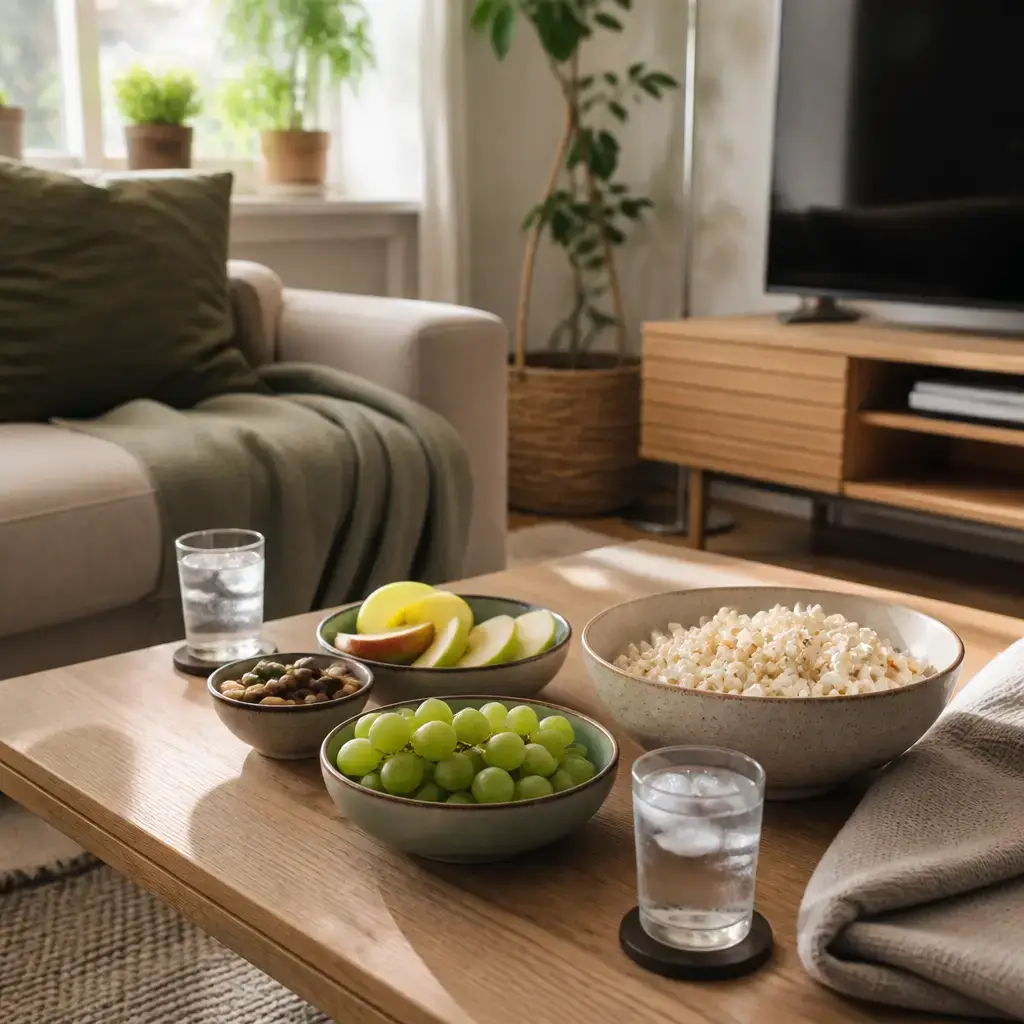
Wie wäre es mit einem Film zu Hause?
vee VAIR-uh ess mit EYE-nem fillm tsoo HOW-zuh How about a movie at home?Das klingt schön und einfach.
dass klinkt shurn oont EYE-nfakh That sounds nice and easy.Lass uns einen kurzen Film auswählen.
lass oons EYE-nen KOORTS-en fillm OWS-vay-len Let's choose a short movie.Dann sind wir fertig, bevor es spät wird.
dahn zint veer FAIR-tikh, beh-FOHR ess shpayt veert Then we can finish before it gets late.Ich kann etwas Obst mitbringen.
ikh kahn ET-vahs ohpst MIT-bring-en I can bring some fruit.Ein leichter Snack wäre schön.
ine LYE-kht-er snak VAIR-uh shurn A light snack would be nice.Soll ich auch Tee mitbringen?
zoll ikh owkh tay MIT-bring-en Should I bring tea too?Tee wäre auch schön.
tay VAIR-uh owkh shurn Tea would be nice too.Sentence explanations
Wie wäre es mit einem Film zu Hause?
How about a movie at home?
- Wie wäre es
- How about it? / What do you think?
- Film
- film / movie
- zu Hause
- at home
More detail
Wie wäre es is a common German way to make a suggestion: Wie wäre es mit ...? means “How about ...?” or “What do you think of ...?” Here wäre is the Konjunktiv II form of sein (“to be”), used to make the suggestion less direct. The reusable pattern is Wie wäre es mit + dative? Example: Wie wäre es mit einem Spaziergang? — “How about a walk?” Film is the masculine noun “film/movie.” In this sentence it appears as einem Film after mit; mit requires the dative, so the masculine indefinite article is einem rather than ein. The noun itself remains Film. Example: Ich sehe einen Film. — “I am watching a movie.” zu Hause is the fixed expression “at home.” It describes being at home, while nach Hause means movement toward home: Ich bin zu Hause. — “I am at home”; Ich gehe nach Hause. — “I am going home.” Together, Wie wäre es mit einem Film zu Hause? proposes watching a movie at home: “How about a movie at home?” The suggestion is phrased as a question, so it invites the other person’s agreement rather than giving a direct instruction.
Das klingt schön und einfach.
That sounds nice and easy.
- Das
- that
- klingt
- sounds
- schön
- nice
- und
- and
- einfach
- easy
More detail
Das means “that” here and points back to the suggested plan or idea in the conversation. As a demonstrative pronoun, it stands independently rather than modifying a noun. Its form is neuter singular; the specific referent is the preceding suggestion, not a newly stated noun. klingt is the present-tense third-person singular form of klingen, “to sound.” The pattern Das klingt ... is a reusable way to give an impression of something: Das klingt gut. — “That sounds good.” This is different from hören, which generally means “to hear” or “to listen.” schön means “nice” here. After klingen, it describes the impression something gives, as in Das klingt schön. — “That sounds nice.” Because it is used predicatively after the verb, it has no adjective ending in this sentence. und connects the two descriptions without changing either one: X klingt schön und einfach means “X sounds nice and easy.” einfach means “easy” here. It is another predicative adjective describing the suggested plan or idea, and therefore also has no adjective ending. Its meaning can contrast with schwierig (“difficult”), but in this sentence it describes the suggestion as easy rather than difficult. Together, Das klingt schön und einfach. says that the preceding suggestion gives the speaker an impression of being both nice and easy: “That sounds nice and easy.”
Lass uns einen kurzen Film auswählen.
Let's choose a short movie.
- Lass uns
- Let's
- kurzen
- short
- Film
- movie
- auswählen
- choose
More detail
Lass uns is the German way to make a suggestion meaning “let’s …”. Lass is the imperative of lassen (“let/allow”) addressed with du; uns is the object pronoun “us”. Together, this construction introduces an action the speaker proposes doing with the addressee. For example: Lass uns anfangen. — “Let’s start.” kurzen describes the movie as short. Its base form is kurz. Here it has the ending -en because Film is masculine and appears in the accusative after the masculine indefinite article einen: einen kurzen Film. The adjective changes form to agree with the noun phrase and its grammatical case; kurz itself is the base form. Example: Wir sehen einen langen Film. — “We’re watching a long movie.” Film means “movie” or “film”. Its base form is Film, and its plural is Filme. In this sentence it is masculine and is the direct object of the selection: einen Film is accusative. Example: Der Film beginnt bald. — “The movie starts soon.” auswählen means “to choose” or “to select”. It is a separable verb: in a finite main clause, the prefix aus separates, as in Wir wählen einen Film aus. — “We choose a movie.” After Lass uns, the verb remains in the infinitive at the end: Lass uns einen Film auswählen. The sentence builds as Lass uns + einen kurzen Film + auswählen: “Let’s choose a short movie.” The suggestion concerns choosing the movie, and kurzen specifies that the chosen movie should be short.
Dann sind wir fertig, bevor es spät wird.
Then we can finish before it gets late.
- Dann
- then
- sind wir
- we are
- fertig
- finished; done
- bevor
- before
- es
- it
- spät
- late
- wird
- becomes; gets
More detail
Dann means “then” and places the situation in sequence. It can also introduce a main clause, as here. When it comes first, the finite verb follows it before the subject: Dann sind wir .... Sind wir is the form of sein (“to be”) for wir (“we”): ich bin, du bist, er/sie/es ist, wir sind. The order sind wir is not a special verb form; it results from putting Dann first and placing the finite verb in the second position of the main clause. Example: Dann gehen wir nach Hause. — “Then we go home.” Fertig is an adjective meaning “finished” or “done.” In this sentence, wir sind fertig describes the group as being done. It does not itself mean “finish” as an action; the verb for that action is fertig werden or beenden, depending on the intended construction. Example: Wir sind bald fertig. — “We’ll be done soon.” Bevor introduces a clause meaning “before.” In a bevor clause, the finite verb goes to the end. The pattern is bevor + subject + other elements + finite verb. Example: Wir gehen, bevor es dunkel wird. — “We leave before it gets dark.” Es is the subject pronoun in the subordinate clause. Here it is the impersonal “it” used in the expression “it gets late”; the sentence does not identify a separate concrete object called “it.” Spät means “late.” In es spät wird, it describes the time as late. As an adjective, it can also modify a noun: ein später Termin — “a late appointment.” In the fixed sentence, it is used predicatively with wird. Wird is the third-person singular present form of werden (“to become,” “to get”): ich werde, du wirst, er/sie/es wird, wir werden. Here werden expresses a change into a state, so es spät wird means “it gets late.” This present form can describe a future situation when the subordinate clause refers to a later time. Example: Es wird kalt. — “It gets cold” or “It is getting cold.” Together, Dann sind wir fertig means “Then we are done,” and bevor es spät wird adds the time limit “before it gets late.” The complete utterance therefore means: “Then we can finish before it gets late.”
Ich kann etwas Obst mitbringen.
I can bring some fruit.
- Ich kann
- I can
- etwas
- some
- Obst
- fruit
- mitbringen
- bring along
More detail
Ich kann expresses “I can”: kann is the first-person singular form of the modal verb können. In a main clause, a modal verb is conjugated while the other verb remains in the infinitive at the end. Example: Ich kann helfen. — “I can help.” etwas means “some” here, referring to an unspecified amount rather than stating a precise count. It is an indefinite quantity word, not an article that itself asserts “one.” Example: Ich trinke etwas Wasser. — “I drink some water.” Obst means “fruit” in the sense of fruit as food or a general quantity. It is a neuter noun: das Obst. It is commonly used as a mass or collective noun, so the sentence does not specify individual pieces or a number. Example: Das Obst ist frisch. — “The fruit is fresh.” mitbringen means “to bring along” or “to bring with oneself.” It is the infinitive of the separable verb mitbringen; its base verb is bringen, while mit- adds the idea of bringing something along. With the modal kann, it stays as the full infinitive at the end: Ich kann einen Snack mitbringen. — “I can bring a snack along.” Together, Ich kann + etwas Obst + mitbringen produces: “I can bring some fruit.” The speaker presents bringing an unspecified amount of fruit as something they are able or willing to do.
Ein leichter Snack wäre schön.
A light snack would be nice.
- leichter
- light
- Snack
- snack
- wäre schön
- would be nice
More detail
leichter describes the snack as light. Its base form is leicht; here leichter is not the comparative “lighter.” It is the adjective’s masculine, singular, nominative form before Snack after the indefinite article ein: ein leichter Snack. In another context, the comparative is also leichter, so the surrounding noun phrase distinguishes the meaning here. Example: Ein leichter Salat ist gut. — “A light salad is good.” Snack is a masculine noun meaning “snack.” Its plural is Snacks; the borrowed noun keeps the same stem, with the plural ending -s. In this sentence, ein leichter Snack is the subject in the nominative case. Example: Der Snack ist fertig. — “The snack is ready.” wäre schön combines wäre, the Konjunktiv II form of sein (“to be”), with the adjective schön (“nice” or “pleasant”). Wäre presents the evaluation as hypothetical or desirable: literally, “would be nice.” The adjective schön is predicative here, so it has no ending. Example: Das wäre schön. — “That would be nice.” Together, ein leichter Snack is the thing being evaluated, and wäre schön says that having or providing such a snack would be desirable. The complete meaning is: “A light snack would be nice.”
Soll ich auch Tee mitbringen?
Should I bring tea too?
- Soll ich
- should I
- auch
- too; also
- Tee
- tea
- mitbringen
- bring along
More detail
Soll ich combines the first-person form soll of sollen with ich. Here it asks whether the speaker is expected or should do something; in this question, the natural English meaning is “Should I …?” In a yes/no question, the conjugated verb comes before the subject: Soll ich …? Compare the statement pattern Ich soll … (“I am supposed to …”). auch means “too” or “also” and adds this action or item to something already relevant. Its exact scope depends on context; here it contributes the additional sense in “bring tea too.” Tee is the noun “tea.” German nouns are capitalized. The usual gender is masculine, der Tee; without an article, this form does not show whether it is nominative or accusative. In this sentence, Tee is the thing being brought and therefore functions as the object of mitbringen. A simple example is Ich trinke Tee. — “I drink tea.” mitbringen is the infinitive “to bring along” or “to bring with one.” It is a separable verb: in a main-clause statement, the finite part is separated and mit goes to the end, as in Ich bringe Tee mit. — “I’m bringing tea along.” After the modal verb soll, however, the complete infinitive stays at the end: Soll ich Tee mitbringen? Together, the pattern Soll ich + [thing] + mitbringen? asks whether the speaker should bring a specified thing along. Thus Soll ich auch Tee mitbringen? means “Should I bring tea too?” It is a reusable, neutral way to offer or check whether one should bring an additional item.
Tee wäre auch schön.
Tea would be nice too.
- Tee
- tea
- wäre
- would be
- auch
- too; also
- schön
- nice
More detail
Tee means “tea” here. It is a masculine German noun and is capitalized. In this sentence it is a bare subject, so no article or case ending is visible on the noun; Tee itself does not change because it is the subject. Example: Ich trinke Tee. — “I drink tea.” wäre is the Konjunktiv II form of sein (“to be”). This form is used for ich and for singular third-person subjects such as er, sie, and es; the plural form is wären. Here, wäre presents the evaluation as “would be.” A useful form chain is sein — ist (“is”) — wäre (“would be”). Example: Das wäre gut. — “That would be good.” auch means “also” or “too.” Here it adds tea as another appealing option. Its position can affect emphasis, but in this sentence it comes before schön and contributes the meaning “too.” schön is the basic form of the adjective meaning “nice” or “pleasant.” After a form of sein, it is predicative, so it has no adjective ending here. Its comparison forms are schön (“nice”), schöner (“nicer”), and am schönsten (“nicest” or “most pleasant”). Together, Tee is the subject, wäre expresses “would be,” auch adds “too,” and schön gives the evaluation. The complete meaning is: “Tea would be nice too.”
Grammar Points
Wie wäre es mit + Dativ?
Wie wäre es mit einem Film?
vee VAIR-uh ess mit EYE-nem fillmHow about a movie?
Nach „mit“ steht der Dativ: „ein Film“ wird zu „einem Film“.
bevor + Nebensatz: Verb am Ende
Bevor es spät wird, bringen wir Obst mit.
beh-FOHR ess shpayt veert, BRING-en veer ohpst mitBefore it gets late, we bring fruit along.
In einem Nebensatz mit „bevor“ steht das konjugierte Verb am Ende: „spät wird“.
German Vocabulary
einen kurzen Film auswählen
bevor es spät wird
Dann sind wir fertig.
Das klingt schön und einfach.
Dann sind wir fertig.
mit einem Film
Das klingt schön und einfach.
einen kurzen Film
Lass uns einen kurzen Film auswählen.
Das klingt schön.
Wie wäre es mit einem Film zu Hause?
einem Film zu Hause
Quiz
Word Order
Arrange the words in the correct order.
That sounds nice and easy.
Show Answer
Das klingt schön und einfach.Let's choose a short movie.
Show Answer
Lass uns einen kurzen Film auswählen.I can bring some fruit.
Show Answer
Ich kann etwas Obst mitbringen.Spelling
Tap the letters to spell the word.
short
Show Answer
kurzento sound
Show Answer
klingtmovie; film
Show Answer
Filmto choose; to select