10 minutes free every day
Continue audio lessons in the app
Word explanations appear automatically in sync with the audio.
No login required · synced translations · playback with the screen locked
Choose your learning language and open this lesson in the app.

About This Lesson
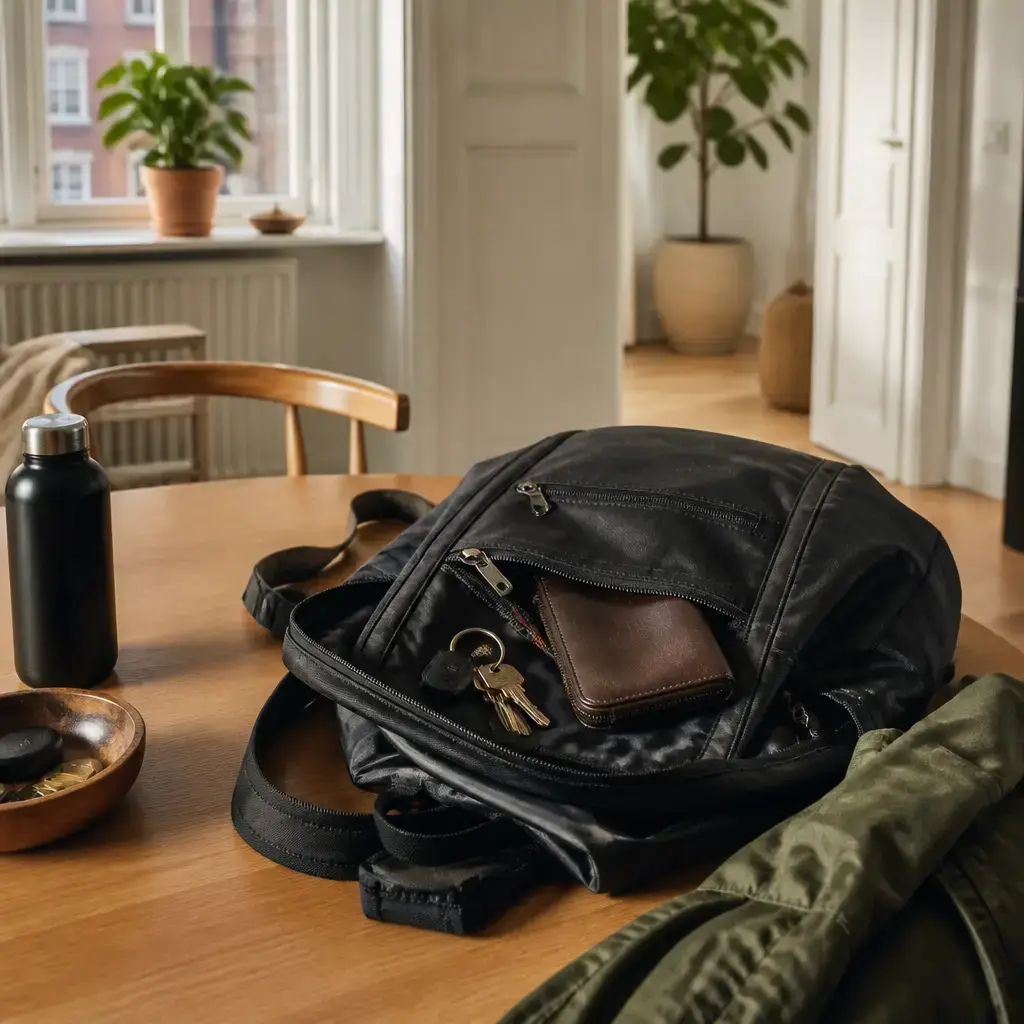
Use Finding a Wallet and Keys to practice German conversation, pronunciation, vocabulary, grammar, and quizzes.
Dialogue
Ich kann meine Geldbörse nicht finden.
ikh kan MY-nuh GELT-bur-zuh nikht FIN-den. I can't find my wallet.Hast du in deinem Rucksack nachgesehen?
hast doo in DYE-num ROOK-zak NAKH-guh-ZAY-en? Did you check inside your backpack?Ich habe schon in der Vordertasche nachgesehen.
ikh HAH-buh shohn in dair FOR-der-tah-shuh NAKH-guh-ZAY-en. I checked the front pocket already.Schau in die kleine Tasche am Reißverschluss.
shou in dee KLY-nuh TAH-shuh am RYES-fair-shlooss. Try the small pocket near the zipper.Ich habe sie dort gefunden.
ikh HAH-buh zee dort guh-FOON-den. I found it there.Mach den Reißverschluss zu, bevor du gehst.
makh den RYES-fair-shlooss tsoo, buh-FOHR doo gayst. Close the zipper before you go.Ich brauche noch meine Schlüssel.
ikh BROW-khuh nokh MY-nuh SHLISS-ul. I still need my keys.Sie sind in der Seitentasche.
zee zint in dair ZYE-tun-tah-shuh. They're in the side pocket.Sentence explanations
Ich kann meine Geldbörse nicht finden.
I can't find my wallet.
- Ich kann
- I can
- meine
- my
- Geldbörse
- wallet
- nicht
- not
- finden
- find
More detail
Ich kann means “I can” here: kann is the first-person singular present form of können (“can, be able to”). With a modal verb such as können, the other verb stays in the infinitive and normally goes to the end of the clause. Compare Ich kann kommen. — “I can come.” meine means “my” before Geldbörse. The possessive base form is mein; here it has the ending -e because Geldbörse is feminine singular and is the object of finden in the accusative. In this particular noun phrase, feminine singular nominative and accusative have the same meine form. For example, Meine Tasche ist hier. — “My bag is here.” Geldbörse means “wallet” or “purse.” It is a feminine noun, so its dictionary form is written with a capital letter: die Geldbörse. The compound contains Geld (“money”) and Börse (“purse/wallet”), but Geldbörse is the useful complete noun for this meaning. nicht means “not.” Here it negates the intended finding: the speaker is unable to find the wallet. Its position before the final infinitive is part of how the negated verb phrase is formed in this sentence. finden is the infinitive “to find.” Its base form is finden; after kann, it remains uninflected at the end: Ich kann ... finden. The finite form without a modal would be Ich finde meine Geldbörse nicht. — “I can’t find my wallet.” Together, Ich kann places the modal meaning “I can,” meine Geldbörse identifies what the speaker is looking for, nicht negates the finding, and final finden completes the modal construction. The whole utterance is therefore “I can’t find my wallet.”
Hast du in deinem Rucksack nachgesehen?
Did you check inside your backpack?
- Hast du
- have you
- in
- in; inside
- Rucksack
- backpack
- nachgesehen
- checked; looked
More detail
Hast du is the reusable question frame “have you …?”: hast is the second-person singular present form of haben, and du is “you.” In a German yes/no question, the finite verb comes first. Here hast is the auxiliary; it combines with the participle at the end of the question. Example: Hast du gegessen? — “Have you eaten?” in means “in” or “inside.” With a place where someone or something is located, it is used with the dative case. The nearby phrase in deinem Rucksack therefore means “inside your backpack”: deinem marks the dative form of “your” before the masculine noun Rucksack. With movement into something, in can instead be used with the accusative: Ich lege das Buch in den Rucksack. — “I put the book into the backpack.” Rucksack means “backpack.” Its basic singular form is der Rucksack; its plural is die Rucksäcke. In this sentence, the noun is singular and appears in the dative phrase deinem Rucksack. Example: Mein Rucksack ist schwer. — “My backpack is heavy.” nachgesehen is the participle of the separable verb nachsehen, meaning “to check” or “to look.” In the perfect tense, this verb uses haben: Du hast nachgesehen — “You checked.” In the question, the participle remains at the end: Hast du nachgesehen? — “Did you check?” The prefix nach- is separated in some finite forms, as in Du siehst nach; it is combined again in the participle nachgesehen. Together, Hast du + in deinem Rucksack + nachgesehen asks whether the listener checked inside their backpack. The perfect construction presents the checking as a completed action, while in deinem Rucksack specifies where it took place.
Ich habe schon in der Vordertasche nachgesehen.
I checked the front pocket already.
- Ich habe
- I have
- schon
- already
- in der
- in the
- Vordertasche
- front pocket
- nachgesehen
- checked
More detail
Ich habe gives the subject Ich (“I”) with the present-tense auxiliary habe (“have”). In this sentence, habe helps form the German perfect tense; it is not the main action by itself. The same pattern is reusable: Ich habe ... = “I have ...” when followed by a past participle in a completed-action statement. schon means “already” here. It places the checking before the relevant present point. It commonly appears with a perfect-tense statement to emphasize that an action has happened by now. in der means “in the” for a location. in takes the dative here because the sentence describes where the checking occurred, not movement into the pocket. The feminine noun Vordertasche therefore appears as der after in: in der Vordertasche. For movement into a pocket, German uses the accusative pattern in die ..., as in in die Tasche (“into the pocket/bag”). Vordertasche means “front pocket.” It is a compound noun: Vorder- identifies the front position, and Tasche means “pocket” or “bag,” depending on context. The compound is feminine, so its article is die in the basic form: die Vordertasche; after location in, it is in der Vordertasche. nachgesehen is the past participle of the separable verb nachsehen, meaning “to check” or “to look in.” In the perfect, the auxiliary and participle are separated in the sentence: Ich habe ... nachgesehen. The participle keeps the prefix nach- attached. In a present-tense main clause, the same verb separates: Ich sehe in der Vordertasche nach (“I check in the front pocket”). Together, Ich habe ... schon ... nachgesehen forms “I already checked ...,” while in der Vordertasche specifies the location. The complete utterance means: “I checked the front pocket already.”
Schau in die kleine Tasche am Reißverschluss.
Try the small pocket near the zipper.
- Schau
- look
- kleine
- small
- Tasche
- Reißverschluss
- zipper
More detail
Schau is the informal singular imperative of schauen (“to look” or “to check”). It addresses one person directly: Schau! means “Look!” In this sentence, the instruction is to check a particular pocket; the fixed translation renders that naturally as “Try the … pocket.” kleine means “small” here. Its base form is klein; the ending -e appears because the adjective describes the feminine singular noun Tasche in this definite-article phrase: die kleine Tasche. The adjective agrees with the noun phrase rather than carrying the noun’s meaning itself. Tasche means “pocket” in this context; it can also mean “bag” in other contexts. Its plural is Taschen. Here, the fixed translation and the surrounding pocket context support the “pocket” meaning. Reißverschluss means “zipper.” It is a masculine noun: der Reißverschluss. In am Reißverschluss, am is the contraction of an dem; the dative form is required by this location phrase. The phrase identifies the zipper as the place beside or at which the pocket is located. The phrase in die kleine Tasche uses in with the accusative because the instruction directs the looking into the pocket; with a feminine noun, the definite article is die in both nominative and accusative. am Reißverschluss adds the location reference “near the zipper.” Together, Schau in die kleine Tasche am Reißverschluss. means “Try the small pocket near the zipper.”
Ich habe sie dort gefunden.
I found it there.
- Ich habe
- I have
- sie
- it
- dort
- there
- gefunden
- found
More detail
Ich habe combines the first-person pronoun Ich (“I”) with the present-tense first-person singular form habe of haben (“have”). Here, habe is the auxiliary in the German perfect, not the main meaning “possess.” The perfect commonly uses a present-tense auxiliary plus a past participle. The auxiliary changes with the subject: du hast (“you have”), er/sie hat (“he/she has”). sie means “it” here, as fixed by the translation. Because the translation identifies one thing as the object, this is the accusative singular feminine form of the German personal pronoun: the corresponding German noun is grammatically feminine, although the English pronoun “it” does not show that gender. The specific referent is not identified by the sentence. German sie can also have other functions, including plural “them” or feminine singular “her,” but those are not the intended reading here. dort means “there,” indicating the location connected with the finding. It contrasts with hier (“here”). Example: Ich wohne dort. — “I live there.” gefunden is the past participle of finden (“to find”). The useful form chain is finden → gefunden; gefunden is not derived from haben. Together with haben, it forms the perfect: Ich habe gefunden means “I have found” and, in this context, “I found.” Example: Sie hat den Schlüssel gefunden. — “She found the key.” Together, Ich habe marks the speaker as the actor and forms the perfect, sie is the thing found, dort gives its location, and gefunden supplies the finding event. The whole utterance therefore means “I found it there.”
Mach den Reißverschluss zu, bevor du gehst.
Close the zipper before you go.
- Mach … zu
- close
- Reißverschluss
- zipper
- bevor
- before
- gehst
- go
More detail
Mach ... zu is the informal singular imperative of the separable verb zumachen, “to close.” In this sentence, Mach comes first and the particle zu appears at the end of the command around the object: Mach den Reißverschluss zu. The form addresses one person informally. A useful contrast is Mach die Tür zu. — “Close the door.” Reißverschluss means “zipper.” Its base form is the noun der Reißverschluss; here, den shows the masculine accusative form because the zipper is the object being closed. The noun itself is unchanged in this form. Example: Der Reißverschluss ist kaputt. — “The zipper is broken.” bevor introduces a time clause meaning “before.” It places the action in the main clause earlier than the action in the time clause. In the clause after bevor, the finite verb goes to the end: bevor du gehst — “before you go.” gehst is the second-person singular present form of gehen, “to go.” The subject du identifies the person addressed, and gehst agrees with du; gehen is the base form. Example: Du gehst jetzt. — “You are going now.” Together, Mach den Reißverschluss zu gives the command “Close the zipper.” bevor du gehst adds the time condition “before you go.” The complete utterance is therefore: “Close the zipper before you go.”
Ich brauche noch meine Schlüssel.
I still need my keys.
- Ich
- I
- brauche
- need
- noch
- still
- meine
- my
- Schlüssel
- keys
More detail
Ich means “I” here and is the first-person singular subject. German personal pronouns change with grammatical role: ich is the subject form, while mich is used for a direct object. Example: Ich sehe den Schlüssel. — “I see the key.” brauche is the first-person singular present form of brauchen (“to need”). The present-tense pattern is ich brauche, du brauchst, er/sie braucht; the ending shows who needs something. Example: Ich brauche Hilfe. — “I need help.” noch means “still” here. It shows that the need continues at this point. In other contexts, noch can also mean “yet” or “another,” so its exact meaning comes from the sentence. meine is the possessive determiner meaning “my.” It agrees with the noun phrase it determines: mein Schlüssel is singular masculine, while meine Schlüssel is plural. The form meine is used here because Schlüssel is plural; it also appears with some feminine singular nouns, so the form alone does not always identify number. Schlüssel means “keys” here. Its singular is der Schlüssel and its plural is die Schlüssel; the spelling stays the same, while the article shows the number. In this sentence, the plural noun phrase is the direct object of brauche, so it is in the accusative, but the plural form Schlüssel itself does not visibly change. Example: Ich suche meine Schlüssel. — “I am looking for my keys.” Together, Ich brauche noch meine Schlüssel. means “I still need my keys.” The subject is Ich, brauche states the need, noch marks that the need continues, and meine Schlüssel identifies the keys needed. The sentence is a reusable pattern: [person] braucht [possessive determiner] [thing]; add noch when the need is still continuing.
Sie sind in der Seitentasche.
They're in the side pocket.
- Sie
- they
- sind
- are
- in der
- in the
- Seitentasche
- side pocket
More detail
Sie means “they” here and refers to the keys. In German, this form is also used for formal “you,” but the fixed translation and context establish the plural third-person reading here. It is capitalized because it begins the sentence; capitalization alone does not determine the meaning. sind is the present-tense plural form of sein (“to be”): sein → sind. With Sie meaning “they,” it gives “they are.” The same form is also used with the formal singular “you,” so the pronoun and context determine the reading. in der expresses a stationary location here: “in the.” For this use, in takes the dative when the sentence describes location rather than movement into a place. der is the dative singular form of the feminine article; it agrees with Seitentasche, whose base noun is feminine (die Seitentasche). For movement into the pocket, German would use the accusative instead: in die Seitentasche (“into the side pocket”). Seitentasche means “side pocket.” It is a compound noun built from Seite (“side”) and Tasche (“pocket” or “bag”); the final part, Tasche, determines the noun’s grammatical gender, so the article is feminine: die Seitentasche. As a German noun, it is capitalized. Example: Die Seitentasche ist leer. — “The side pocket is empty.” Together, Sie sind gives “they are,” in der marks a stationary location, and Seitentasche identifies that location. The complete utterance therefore means: “They’re in the side pocket.”
Grammar Points
Trennbare Verben: Verb + ... + Präfix
Mach die Tasche zu.
MAKH dee TAH-shuh tsoo.Close the bag.
Bei trennbaren Verben steht der Präfix im Hauptsatz am Satzende: zumachen → Mach ... zu.
bevor + Nebensatz: Verb am Ende
Bevor du gehst, schau dort.
buh-FOHR doo gayst, shou dort.Before you go, look there.
Nach bevor steht ein Nebensatz; das konjugierte Verb steht am Ende: bevor du gehst.
German Vocabulary
Quiz
Word Order
Arrange the words in the correct order.
I can't find my wallet.
Show Answer
Ich kann meine Geldbörse nicht finden.Did you check inside your backpack?
Show Answer
Hast du in deinem Rucksack nachgesehen?I found it there.
Show Answer
Ich habe sie dort gefunden.Spelling
Tap the letters to spell the word.
wallet
Show Answer
Geldbörsealready
Show Answer
schonpocket; bag
Show Answer
Tascheto check; to look inside