10 minutes free every day
Continue audio lessons in the app
Word explanations appear automatically in sync with the audio.
No login required · synced translations · playback with the screen locked
Choose your learning language and open this lesson in the app.

About This Lesson
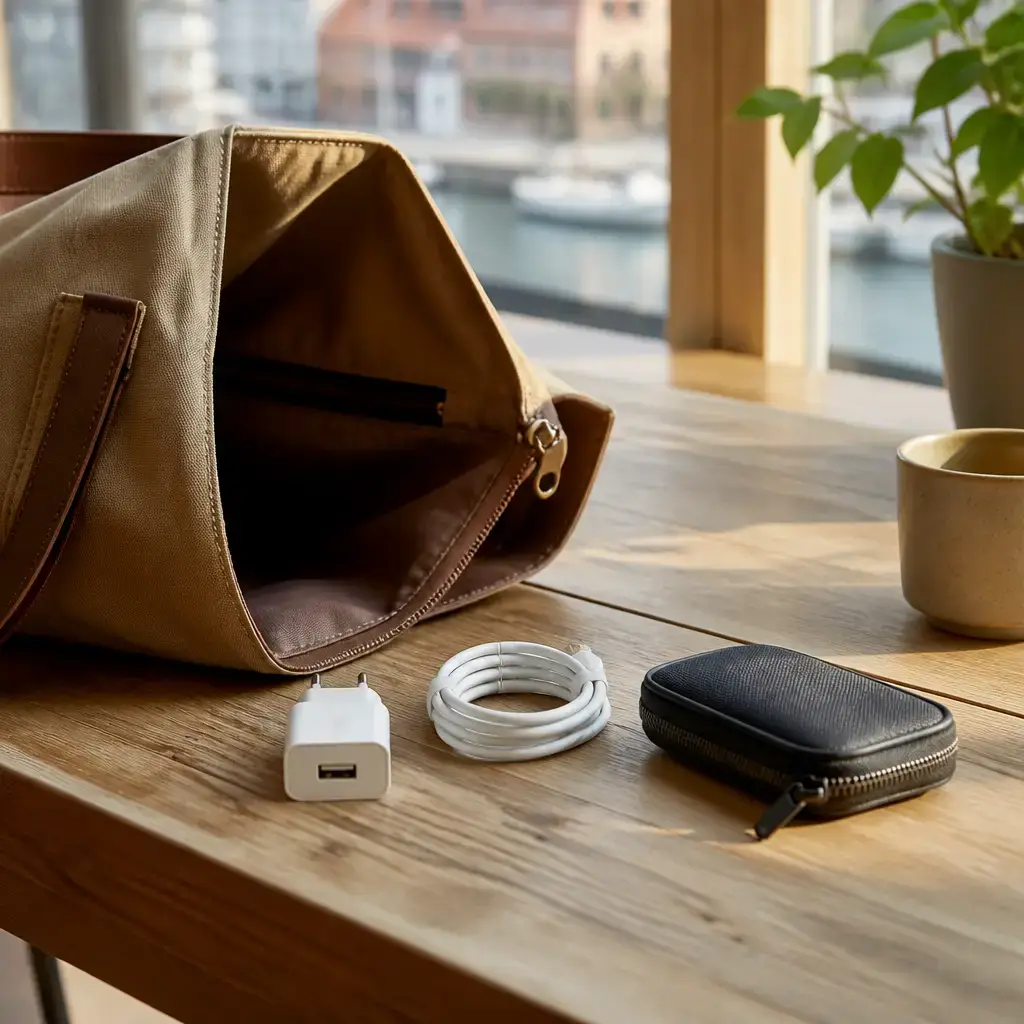
Use Borrowing a phone charger to practice German conversation, pronunciation, vocabulary, grammar, and quizzes.
Dialogue
Kann ich mir dein Handy-Ladegerät ausleihen?
kahn ikh meer dine HEN-dee LAH-duh-guh-RATE OWS-LYE-en? Can I borrow your phone charger?Es ist in der Innentasche meiner Tasche.
ess ist in dair IN-en-TAH-shuh MY-nuh TAH-shuh. It's in the inside pocket of my bag.Ist das Kabel dabei?
ist dahss KAH-bell dah-BYE? Is the cable with it?Das Kabel ist in dem kleinen Etui.
dahss KAH-bell ist in daym KLY-nun eh-TWEE. The cable is in the small case.Ich habe beides gefunden.
ikh HAH-buh BY-duss guh-FOON-den. I found both.Bitte leg das Kabel zurück ins Etui.
BIT-uh layk dahss KAH-bell tsoo-RUEK ins eh-TWEE. Please put the cable back in the case.Ich gebe alles zurück, bevor ich gehe.
ikh GAY-buh AH-less tsoo-RUEK, beh-FOHR ikh GAY-uh. I'll return everything before I leave.Das passt für mich.
dahss pahst fyoor mikh. That works for me.Sentence explanations
Kann ich mir dein Handy-Ladegerät ausleihen?
Can I borrow your phone charger?
- Kann ich
- can I
- mir
- for myself
- dein
- your
- Handy-Ladegerät
- phone charger
- ausleihen
- borrow
More detail
Kann ich forms a yes/no question with the modal verb können (“can, be able to”). Here kann is the first-person singular form with ich; the infinitive ausleihen stays at the end of the question. A useful pattern is Kann ich ...? = “Can I ...?” mir is the dative form of the first-person pronoun, meaning “to/for me” here. With sich etwas ausleihen, the person who borrows is expressed in the dative: Ich leihe mir ein Buch aus. = “I borrow a book.” The form mir is used with ich; it is not the object being borrowed. dein means “your” and shows that the charger belongs to the person addressed. Its form changes with the noun’s grammatical features: for example, dein Ladegerät is used with this neuter noun, while deine Tasche uses a different form with a feminine noun. The possessive form agrees with the noun it accompanies, while the owner is the person being addressed. Handy-Ladegerät is a compound noun: Handy means “mobile phone,” and Ladegerät means “charger.” In German compounds, the final element is the head, so Ladegerät determines the noun’s grammatical gender; das Ladegerät is neuter. A reusable example is mein Handy-Ladegerät = “my phone charger.” ausleihen means “borrow” when someone takes something temporarily and intends to return it. It is a separable verb: in a regular main clause, Ich leihe mir das Ladegerät aus. = “I borrow the charger.” After the modal kann, the infinitive remains together at the end: Kann ich mir das Ladegerät ausleihen? A related but different verb is verleihen, “lend,” which describes the owner’s action. Together, Kann ich + mir + dein Handy-Ladegerät + ausleihen asks whether the speaker may borrow the addressee’s phone charger. The speaker is the person who would borrow it, and dein marks the charger as belonging to the person addressed.
Es ist in der Innentasche meiner Tasche.
It's in the inside pocket of my bag.
- Es ist
- it is
- in
- in
- der
- the
- Innentasche
- inside pocket
- meiner
- my
- Tasche
- bag
More detail
Es ist means “it is” here. ist is the third-person singular present form of sein (“to be”): sein → ist. German uses es as a neuter singular subject pronoun; the fixed translation supports the meaning “it,” without requiring a more specific referent. in means “in.” With a static location, as here, in takes the dative case. With movement into a place, the same preposition can take the accusative instead: Das Kabel ist in der Tasche (“The cable is in the bag”) contrasts with Ich lege das Kabel in die Tasche (“I put the cable into the bag”). der is the feminine singular dative form of the definite article, “the.” It is used here because in describes a location, and Innentasche is feminine: die Innentasche in the basic form becomes in der Innentasche for a static location. Innentasche means “inside pocket.” It is a compound noun built from innen (“inside”) and Tasche (“bag” or “pocket,” depending on context). The whole compound is feminine: die Innentasche. A useful example is Die Schlüssel sind in der Innentasche. — “The keys are in the inside pocket.” meiner means “my” in the form required before the following noun here. It is the genitive feminine singular form of the possessive determiner mein (“my”): die Innentasche meiner Tasche literally has the structure “the inside pocket of my bag.” The ending belongs to meiner, while Tasche is the noun whose possession is being expressed. Tasche means “bag” in this sentence. It is a feminine noun: die Tasche. In the phrase meiner Tasche, the genitive form expresses that the inside pocket belongs to or is part of the speaker’s bag. The same word can refer to a pocket in other contexts, so the fixed translation establishes “bag” here. Together, Es ist identifies the location of “it,” in der Innentasche gives the static location “in the inside pocket,” and meiner Tasche specifies which inside pocket: “of my bag.” The complete meaning is “It’s in the inside pocket of my bag.”
Ist das Kabel dabei?
Is the cable with it?
- Ist
- is
- Kabel
- cable
- dabei
- with it; included
More detail
Ist is the third-person singular present form of sein (“to be”): sein → ist. In a German yes/no question, the finite verb comes first, so Ist das Kabel ...? corresponds to “Is the cable ...?” The form ist is used with a singular subject; plural subjects use sind, as in Sind die Kabel dabei? (“Are the cables included?”). Kabel means “cable.” Its base form is also Kabel; the noun is neuter, so the definite article is das: das Kabel. Its plural is die Kabel, with the same noun form: ein Kabel (“a cable”), zwei Kabel (“two cables”). dabei is an adverb meaning “with it” or “included” here. In this question it asks whether the cable is included with the relevant item, matching the fixed translation. A reusable pattern is Ist [singular thing] dabei? (“Is [singular thing] included?”). For example: Ist die Anleitung dabei? — “Is the instruction manual included?” Together, Ist places the finite verb first to form a yes/no question, das Kabel identifies the item, and dabei asks whether it is included with the relevant item: “Is the cable with it?”
Das Kabel ist in dem kleinen Etui.
The cable is in the small case.
- Das
- the
- Kabel
- cable
- ist
- is
- in dem
- in the
- kleinen
- small
- Etui
- case
More detail
Das is the definite article “the” here. It is nominative singular neuter, agreeing with Kabel; German articles vary with gender, number, and case, so the form is not chosen from singularity alone. Kabel means “cable.” Its base form is Kabel, and it is a neuter noun: das Kabel. In this sentence it is the subject, so it is in the nominative case. Example: Das Kabel ist lang. — “The cable is long.” ist is the third-person singular present form of sein (“to be”): sein → ist. It links the subject with its location here. Example: Der Schlüssel ist dort. — “The key is there.” in dem means “in the” and marks a location inside something. For a fixed location, in takes the dative case. dem is the dative singular form of the definite article for masculine and neuter nouns. In everyday German, in dem can often contract to im, but in dem is the form actually used here. kleinen means “small” here. Its base form is klein; the ending -en is the adjective’s form in this dative singular phrase after the definite article: in dem kleinen .... Example: Ich bin in dem kleinen Raum. — “I am in the small room.” Etui means “case” or “pouch.” It is a neuter noun, das Etui, and after in dem it is dative singular: dem Etui. The noun itself has no visible ending change in this form. Example: Das Etui ist auf dem Tisch. — “The case is on the table.” Together, Das Kabel is the subject, ist states its location, and in dem kleinen Etui gives that location. The complete meaning is: “The cable is in the small case.” This is a statement about a fixed position, which is why the location phrase uses the dative after in.
Ich habe beides gefunden.
I found both.
- Ich habe
- I have
- beides
- both
- gefunden
- found
More detail
Ich habe is the first-person singular form of haben: ich habe means “I have.” Here it works as the auxiliary for the German perfect tense, not as a separate statement of possession. With a suitable past participle, haben describes a completed event. The subject is ich (“I”), so habe is the form used with first-person singular. beides means “both” when the two items are treated as things. It is a pronoun, so it stands for the two relevant items rather than repeating their names. German also has beide with an explicitly expressed plural noun; beides is used independently for “both things.” The sentence does not itself name the two items. gefunden is the past participle of finden (“to find”). It is an irregular form: finden → gefunden, rather than a regular participle formed with the usual regular pattern. In the perfect tense, gefunden appears with the auxiliary haben. Together, Ich habe beides gefunden. uses the pattern ich habe + object pronoun + past participle: “I found both.” The auxiliary habe marks the speaker and helps form the completed-event construction, beides is the thing found, and gefunden supplies the finding event.
Bitte leg das Kabel zurück ins Etui.
Please put the cable back in the case.
- Bitte
- please
- leg
- put
- Kabel
- cable
- zurück
- back
- ins
- into the
- Etui
- case
More detail
Bitte makes the utterance a polite request. It can appear at the beginning or end of a German request. Example: Bitte warte. — “Please wait.” leg is the informal singular imperative of legen (“to lay/put”). It addresses one person using the informal du form. The verb legen is used for placing something in a lying or horizontal position; stellen is commonly used for placing something upright. Example: Leg das Buch auf den Tisch. — “Put the book on the table.” Kabel means “cable.” Its full noun phrase here is das Kabel: Kabel is a neuter noun, and das marks the definite singular form. The object is in the accusative because legen places it somewhere. Example: Ich nehme das Kabel. — “I take the cable.” zurück means “back” or “back again.” Together with legen, it forms the separable verb zurücklegen in the sense “to put back.” In the imperative, the verb part appears as leg and the separable element appears later: Leg das Kabel zurück. — “Put the cable back.” ins Etui means “into the case.” ins is the contraction of in das. With movement into a destination, in takes the accusative here; Etui is a neuter noun, so das Etui becomes ins Etui. Example: Sie legt den Schlüssel ins Etui. — “She puts the key into the case.” The sentence assembles as Bitte + the informal imperative leg + the object das Kabel + the separable element zurück + the destination ins Etui: “Please put the cable back in the case.”
Ich gebe alles zurück, bevor ich gehe.
I'll return everything before I leave.
- gebe … zurück
- return; give back
- alles
- everything
- bevor
- before
- gehe
- leave; go
More detail
gebe … zurück is the separated form of zurückgeben, “to give back” or “to return.” gebe is the first-person singular present form of geben used in this separable verb; zurück appears at the end of the main clause. The subject is ich, so the form is gebe, not a form for another person. Example: Ich gebe das Buch zurück. — “I return the book.” alles means “everything” here and functions as the object of zurückgeben. It is an indefinite pronoun, so it refers broadly to the things being returned rather than naming them individually. Example: Ich nehme alles. — “I take everything.” bevor introduces a clause meaning “before.” In German, this subordinating conjunction places the conjugated verb at the end of its clause. The reusable pattern is ..., bevor + subject + verb. gehe is the first-person singular present form of gehen, “to go.” In this sentence, the fixed translation shows that it means “leave” in the relevant context. Example: Ich gehe jetzt. — “I’m leaving now.” Together, Ich gebe alles zurück means “I’ll return everything,” and bevor ich gehe adds the time relation “before I leave.” The complete utterance therefore means “I’ll return everything before I leave.” The present-tense forms can express a future action when the intended event is understood from the situation.
Das passt für mich.
That works for me.
- Das
- That
- passt
- works
- für mich
- for me
More detail
Das means “that” here. It is a demonstrative pronoun in the nominative singular neuter form. German demonstratives change with grammatical gender, number, and case: for example, der can be masculine nominative, die feminine nominative or plural nominative, and das neuter nominative. In this sentence, the specific thing referred to by Das is not identified, so learn the reusable pattern Das ... as “That ...” without assigning it a particular referent. passt is the third-person singular present form of passen (“to fit,” “to suit,” or, as here, “to work/be acceptable”). The form matches the singular subject Das: Das passt = “That works.” Other useful present forms are ich passe, du passt, and wir passen. In this meaning, passen commonly appears with für plus a person: Das passt für mich. — “That works for me.” für mich means “for me.” für takes the accusative case, so the first-person pronoun is mich, not nominative ich. Compare Ich passe (“I fit / I suit,” depending on context) with Das passt für mich (“That works for me”); the person who benefits or approves is expressed after für. Together, Das identifies something as “that,” passt says it works or is suitable, and für mich specifies the person for whom it works. The complete utterance therefore means “That works for me.”
Grammar Points
Bevor + Nebensatz: Das Verb steht am Ende.
Bevor ich gehe, gebe ich alles zurück.
beh-FOHR ikh GAY-uh, GAY-buh ikh AH-less tsoo-RUEK.Before I leave, I give everything back.
Nach „bevor“ steht das konjugierte Verb am Ende des Nebensatzes.
Trennbares Verb: zurückgeben → gebe ... zurück
Ich gebe alles zurück.
ikh GAY-buh AH-less tsoo-RUEK.I give everything back.
Bei „zurückgeben“ steht „zurück“ im Hauptsatz am Satzende.
German Vocabulary
mir dein Handy-Ladegerät ausleihen
habe beides gefunden
dein Handy-Ladegerät
in der Innentasche
in dem kleinen Etui
Bitte leg das Kabel zurück
meiner Tasche
Ich gebe alles zurück
Quiz
Word Order
Arrange the words in the correct order.
Can I borrow your phone charger?
Show Answer
Kann ich mir dein Handy-Ladegerät ausleihen?Is the cable with it?
Show Answer
Ist das Kabel dabei?I found both.
Show Answer
Ich habe beides gefunden.Spelling
Tap the letters to spell the word.
both
Show Answer
beidessmall
Show Answer
kleinenborrow
Show Answer
ausleihenwith it; included