10 minutes free every day
Continue audio lessons in the app
Word explanations appear automatically in sync with the audio.
No login required · synced translations · playback with the screen locked
Choose your learning language and open this lesson in the app.

About This Lesson
Use Checking a Bag Before Leaving to practice German conversation, pronunciation, vocabulary, grammar, and quizzes.
Dialogue
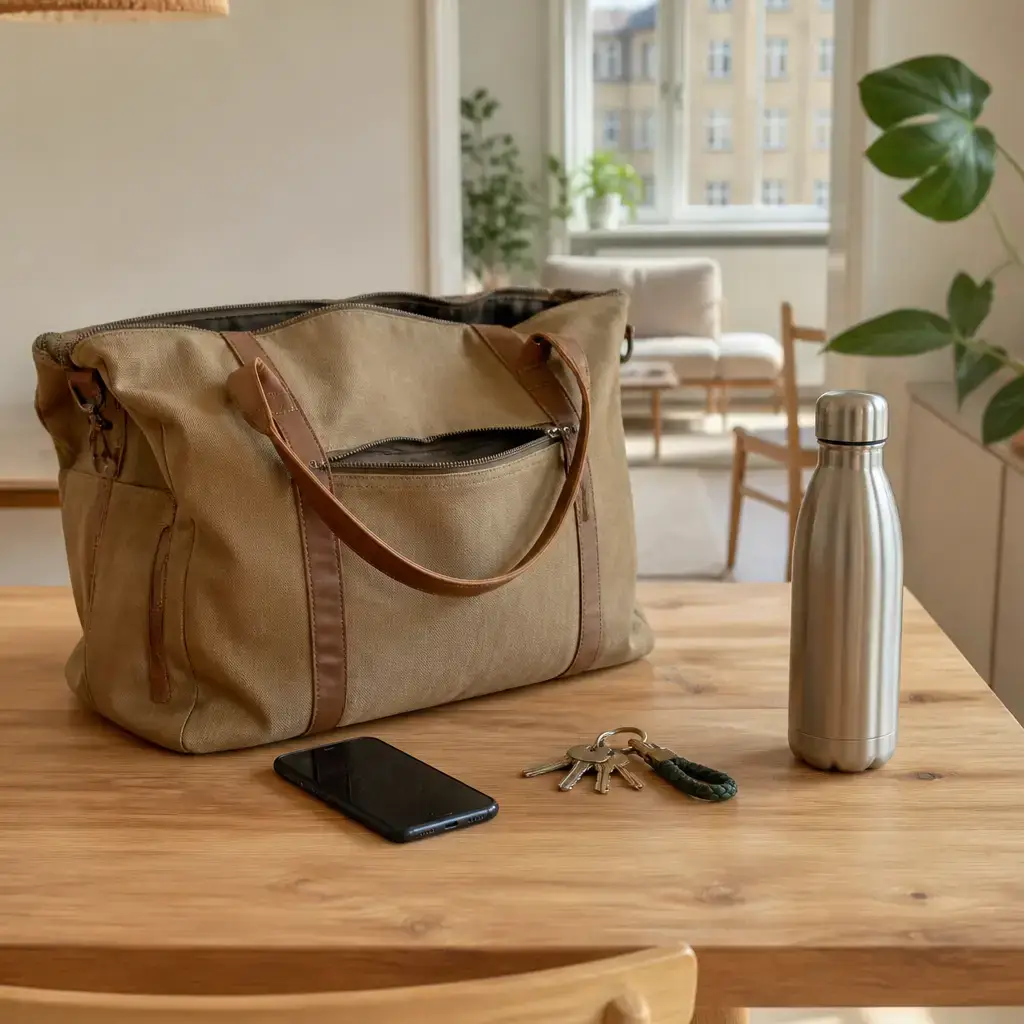
Können wir schauen, ob meine Tasche fertig ist?
KUR-nen veer SHOW-en, op MY-nuh TASH-uh FAIR-tikh ist? Can we make sure my bag is ready?Leg zuerst die wichtigen Sachen auf den Tisch.
LAYK tsoo-AIRST dee VIKH-tih-gen ZAH-khen owf dayn TISH. Put the important things on the table first.Mein Handy ist in der vorderen Tasche.
mine HEN-dee ist in dair FOR-dair-en TASH-uh. My phone is in the front pocket.Wo hast du deine Schlüssel hingelegt?
voh hahst doo DYE-nuh SHLUE-sel HIN-guh-LAYKТ? Where did you put your keys?Sie liegen neben meinem Handy.
zee LEE-gen NAY-ben MY-nem HEN-dee. They are next to my phone.Brauchst du auch deine Wasserflasche?
BROWKHST doo owkh DYE-nuh VAH-ser-FLAH-shuh? Do you also need your water bottle?Ja, sie ist schon im Hauptfach.
yah, zee ist shohn im HOWPT-fakh. Yes, it is already in the main pocket.Dann hast du alles, was du brauchst.
dahn hahst doo AH-les, vahs doo BROWKHST. Then you have what you need.Sentence explanations
Können wir schauen, ob meine Tasche fertig ist?
Can we make sure my bag is ready?
- Können wir
- can we
- schauen
- look; check
- ob
- whether
- meine
- my
- Tasche
- bag
- fertig
- ready
- ist
- is
More detail
Können wir combines the present-tense form können with the subject wir. können means “can” here and expresses ability or a proposed possibility; wir means “we.” In a yes/no question, the conjugated verb comes before the subject: Können wir ...? For example: Können wir anfangen? — “Can we start?” schauen is the infinitive “look.” In schauen, ob ..., it contributes the practical meaning “check” or “make sure,” rather than referring only to visual looking. Because können is the conjugated modal verb, schauen remains an infinitive and follows it: Können wir schauen ...? ob introduces an indirect yes/no question, meaning “whether” or “if.” It places the conjugated verb of its subordinate clause at the end. The reusable pattern is schauen, ob + clause: Ich schaue, ob die Tür offen ist. — “I’ll check whether the door is open.” meine is the possessive form meaning “my.” It agrees with the noun it modifies. Here it accompanies Tasche, which is feminine singular and functions as the subject of the subordinate clause, so the form is meine. The possessive stem also appears in forms such as mein Bruder (“my brother”) and meinen Bruder (“my brother” as an object); the ending changes with the noun’s grammatical case and gender/number. Tasche is the noun “bag.” Its base form is die Tasche; its plural is die Taschen. In this sentence, meine Tasche is the thing whose state is being checked. Example: Meine Tasche ist hier. — “My bag is here.” fertig is the adjective “ready” here. It is used after sein as a predicative adjective, so it has no adjective ending: Die Tasche ist fertig. — “The bag is ready.” The same adjective can describe something completed in other contexts, but the fixed translation supports the “ready” meaning here. ist is the third-person singular present form of sein, “to be.” Its subject is meine Tasche, which is singular: Die Tasche ist fertig. The infinitive is sein, and other present forms include ich bin (“I am”) and wir sind (“we are”). Together, Können wir schauen asks whether the speakers can check something. ob meine Tasche fertig ist specifies what they will check: whether the speaker’s bag is ready. The subordinate clause ends with ist, giving the whole meaning “Can we make sure my bag is ready?”
Leg zuerst die wichtigen Sachen auf den Tisch.
Put the important things on the table first.
- Leg
- put; place
- zuerst
- first
- wichtigen
- important
- Sachen
- things
- auf
- onto
- Tisch
- table
More detail
Leg is the informal singular imperative of legen (“to put” or “to lay”). It addresses one person and gives a direct instruction. Compare legen for the infinitive and Leg ...! for the corresponding command. Example: Leg das Buch hierhin. — “Put the book here.” zuerst means “first” in the sense of doing this before the other relevant actions. It is an adverb and does not change form. Example: Lies zuerst die Anleitung. — “Read the instructions first.” wichtigen is the adjective wichtig (“important”) with the ending -en. In die wichtigen Sachen, the definite article and the plural noun produce the weak plural adjective form. The base form is wichtig; the observed form is not a verb or a noun. Sachen is the plural of Sache (“thing” or “matter”). Here it refers to the things that should be put somewhere. Example: Die Sachen liegen dort. — “The things are there.” auf is a two-way preposition. In auf den Tisch, it marks movement toward a destination, so the destination is expressed with the accusative: den Tisch. Compare the stationary location auf dem Tisch: Das Buch liegt auf dem Tisch. — “The book is on the table.” Tisch is a masculine noun meaning “table”; its plural is Tische. In the fixed utterance, it is the destination after auf, so the definite article is accusative masculine singular: den Tisch. Together, Leg supplies the command, zuerst tells the listener to do it first, die wichtigen Sachen identifies what to move, and auf den Tisch identifies the destination. The whole utterance therefore means: “Put the important things on the table first.”
Mein Handy ist in der vorderen Tasche.
My phone is in the front pocket.
- Mein
- my
- Handy
- mobile phone
- ist
- is
- in der
- in the
- vorderen
- front
- Tasche
More detail
Mein means “my” here and is the possessive determiner agreeing with Handy. Handy is neuter: das Handy; in the nominative singular, the possessive form is mein without an ending. For example: Mein Buch ist hier. — “My book is here.” Handy means “mobile phone” in this sentence. Its plural is Handys. The word is a noun and is normally written with a capital letter in German. ist is the third-person singular present form of sein (“to be”): sein → ist. It links the phone with its location. For example: Das Handy ist dort. — “The phone is there.” in der means “in the” here. in takes the dative when it describes a fixed location, rather than movement into a location. der is the dative feminine singular form of the definite article; Tasche is feminine: die Tasche. vorderen describes the pocket as the front one. It is an inflected form of the adjective vorder- (“front”), and the ending -en appears because the adjective follows the definite article in the dative feminine phrase in der vorderen Tasche. This form describes position toward the front; it is not the comparative form of the adjective. Tasche means “pocket” in this sentence. It can also mean “bag” in other contexts; the fixed translation supports “pocket” here. Its plural is Taschen. For example: Die Tasche ist leer. — “The pocket is empty.” Together, Mein Handy identifies the thing, ist states its location, and in der vorderen Tasche gives that fixed location. The complete meaning is: “My phone is in the front pocket.”
Wo hast du deine Schlüssel hingelegt?
Where did you put your keys?
- Wo
- where
- hast du
- have you
- deine
- your
- Schlüssel
- keys
- hingelegt
- put
More detail
Wo asks for a place: “where.” It is a question adverb, so it does not change for number or gender. Example: Wo ist mein Handy? — “Where is my phone?” hast du contains the second-person singular form hast of haben (“to have”) and the subject pronoun du (“you”). In this question, hast is the auxiliary for the past construction completed by hingelegt; it does not mean that the action is possession. German main-clause questions commonly put the finite verb before the subject: Hast du ...? deine means “your” here and agrees with Schlüssel in its grammatical form. The possessive determiner is based on dein; deine is used with feminine singular nouns and with plural nouns in the relevant cases. Here it marks a plural noun, and the whole noun phrase is the accusative object of hingelegt. Schlüssel means “keys” here. Its singular is der Schlüssel and its plural is die Schlüssel; the noun itself has the same visible form in both numbers, so the determiner deine and the meaning identify the plural here. Example: Ich habe einen Schlüssel. — “I have a key.” hingelegt is the past participle of the separable verb hinlegen, “to put/place something down.” Its parts are hin- plus legen; the participle is formed as hingelegt, not by treating hin as an independent word in this sentence. With the auxiliary hast, it forms the German perfect: Du hast die Schlüssel hingelegt. — “You put the keys down.” Together, Wo asks for the location, hast du ... hingelegt asks about a completed act of putting something somewhere, and deine Schlüssel is the object being placed. The complete meaning is: “Where did you put your keys?”
Sie liegen neben meinem Handy.
They are next to my phone.
- Sie
- they
- liegen
- are lying; are located
- neben
- next to
- meinem
- my
- Handy
- phone
More detail
Sie means “they” here, as fixed by the translation. It is a third-person plural personal pronoun. German also uses capitalized Sie for formal “you,” but that is not the intended reading in this sentence. liegen means “are lying” or, more generally here, “are located.” Its base form is liegen; in the present tense, the third-person plural form is also liegen: sie liegen = “they are lying/located.” This verb presents the items as being in a location, rather than describing someone putting them there. neben means “next to” or “beside.” For a stationary location, it is used with the dative case: neben + dative. With movement toward a position, the same preposition can take the accusative instead. Example: Ich stelle das Buch neben die Lampe. — “I put the book next to the lamp.” meinem means “my” in the form required here. Its base possessive form is mein; meinem is the dative singular neuter form. It agrees grammatically with Handy, not with the owner. Possessive forms change according to the noun phrase’s case, gender, and number. Handy means “mobile phone” or “cell phone” in German. Its base form is das Handy, so it is neuter. After stationary neben, the dative form of the noun phrase is used: neben meinem Handy (“next to my phone”). Together, Sie liegen says that the items are located there, and neben meinem Handy specifies the location. The complete utterance means: “They are next to my phone.”
Brauchst du auch deine Wasserflasche?
Do you also need your water bottle?
- Brauchst
- need
- du
- you
- auch
- also
- deine
- your
- Wasserflasche
- water bottle
More detail
Brauchst is the second-person singular present form of brauchen, “to need.” The present-tense forms are ich brauche, du brauchst, and sie braucht. Here it comes first because German yes/no questions commonly place the finite verb before the subject: Brauchst du ...? — “Do you need ...?” du means “you” for one person in an informal setting. It is the subject here, and Brauchst carries the matching second-person singular ending. The formal form for addressing one person is Sie, with the verb form brauchen: Brauchen Sie ...? — “Do you need ...?” auch means “also” or “too.” In this sentence it adds the idea that the water bottle is included among the things needed. Its exact position can vary with emphasis, but Brauchst du auch ...? is a natural way to ask whether this item is needed as well. deine is the possessive determiner meaning “your” when addressing one informal person. It agrees with the noun it determines, not with the owner: deine Wasserflasche uses the feminine singular form because die Flasche is feminine. The whole noun phrase is the object of brauchst; for a feminine singular noun, deine has the same form in the accusative as in the nominative. Compare dein Handy with the neuter noun das Handy, and deinen Rucksack with the masculine accusative noun phrase den Rucksack. Wasserflasche means “water bottle.” It is a compound noun: Wasser + Flasche; the final part determines its grammatical gender, so it is die Wasserflasche. German nouns are capitalized. A reusable plural is Wasserflaschen — “water bottles.” Together, Brauchst du asks “Do you need ...?”, auch adds “also,” and deine Wasserflasche supplies the object. The complete utterance therefore means, “Do you also need your water bottle?”
Ja, sie ist schon im Hauptfach.
Yes, it is already in the main pocket.
- Ja
- yes
- sie
- it
- ist
- is
- schon
- already
- im
- in the
- Hauptfach
- main pocket
More detail
Ja means “yes” and confirms the preceding question. It is a common standalone response. sie means “it” here. In this use, it is the third-person singular feminine pronoun in the subject position. German pronouns match the grammatical gender and number of their referent; the fixed translation gives the intended English meaning. Do not confuse lowercase sie with capitalized Sie, which can mean formal “you,” or with sie meaning “they” in another context. ist is the third-person singular present form of sein (“to be”): ich bin, du bist, sie/er/es ist. Example: Das Buch ist hier. — “The book is here.” schon means “already” here. It presents the situation as true before the relevant expectation or reference point. Example: Sie ist schon da. — “She is already there.” im is the contraction of in dem (“in the”). Here, in describes a stationary location, so the location phrase is in the dative case. Example: im Zimmer means “in the room.” Hauptfach means “main pocket” or “main compartment” here. It is a neuter noun: das Hauptfach. In the dative singular location phrase, the article is dem, while the noun itself remains Hauptfach: dem Hauptfach; this appears as im Hauptfach because in dem contracts to im. The compound contains Haupt- (“main”) and Fach (“compartment” or “section”). Example: Das Handy ist im Hauptfach. — “The phone is in the main compartment.” Together, Ja confirms the question, sie ist schon says “it is already,” and im Hauptfach gives the location. The complete utterance is: “Yes, it is already in the main pocket.”
Dann hast du alles, was du brauchst.
Then you have what you need.
- Dann
- then
- hast
- have
- du
- you
- alles
- everything
- was
- what; that which
- brauchst
- need
More detail
Dann means “then” and places the statement after an understood earlier point in time or sequence. Example: Dann gehen wir. — “Then we’ll go.” hast is the present-tense second-person singular form of haben (“to have”): ich habe, du hast, er/sie/es hat. Here it means having something available, not necessarily physically holding it. du is the informal second-person singular subject pronoun, “you.” The verb form hast matches du; together, du hast means “you have.” alles means “everything” or “all that.” It is a neuter singular pronoun form. Here it is the thing that du has; the sentence does not specify its individual contents. was introduces the clause that specifies alles: “what” or “that which.” In alles, was ..., German commonly uses was after an indefinite pronoun such as alles, rather than a gendered relative-pronoun form. Here it is not a question word. Within the relative clause, was is the object of brauchst, while du is the subject. brauchst is the present-tense second-person singular form of brauchen (“to need”): ich brauche, du brauchst, er/sie/es braucht. Its subject is du, and its object is the relative pronoun was, referring back to alles. Example: Du brauchst Ruhe. — “You need rest.” The structure is Dann + du hast + alles, followed by the relative clause was du brauchst (“what you need”). The comma marks that relative clause. Together, the utterance means: “Then you have what you need.”
Grammar Points
legen vs. liegen: Bewegung und Position
Leg die Tasche auf den Tisch. Die Tasche liegt neben dem Handy.
LAYK dee TASH-uh owf dayn TISH. dee TASH-uh leekt NAY-ben daym HEN-dee.Put the bag on the table. The bag is next to the mobile phone.
legen beschreibt eine Bewegung; liegen beschreibt eine feste Position.
ob + Verb am Ende
Schau, ob alles fertig ist.
SHOW, op AH-les FAIR-tikh ist.Check whether everything is ready.
Nach ob steht das konjugierte Verb im Nebensatz am Ende.
German Vocabulary
Quiz
Word Order
Arrange the words in the correct order.
Where did you put your keys?
Show Answer
Wo hast du deine Schlüssel hingelegt?They are next to my phone.
Show Answer
Sie liegen neben meinem Handy.Do you also need your water bottle?
Show Answer
Brauchst du auch deine Wasserflasche?Spelling
Tap the letters to spell the word.
bag; pocket
Show Answer
Tascheready; finished
Show Answer
fertigfirst
Show Answer
zuerstthing