10 minutes free every day
Continue audio lessons in the app
Word explanations appear automatically in sync with the audio.
No login required · synced translations · playback with the screen locked
Choose your learning language and open this lesson in the app.

About This Lesson
Use A short fresh-air break at work to practice German conversation, pronunciation, vocabulary, grammar, and quizzes.
Dialogue
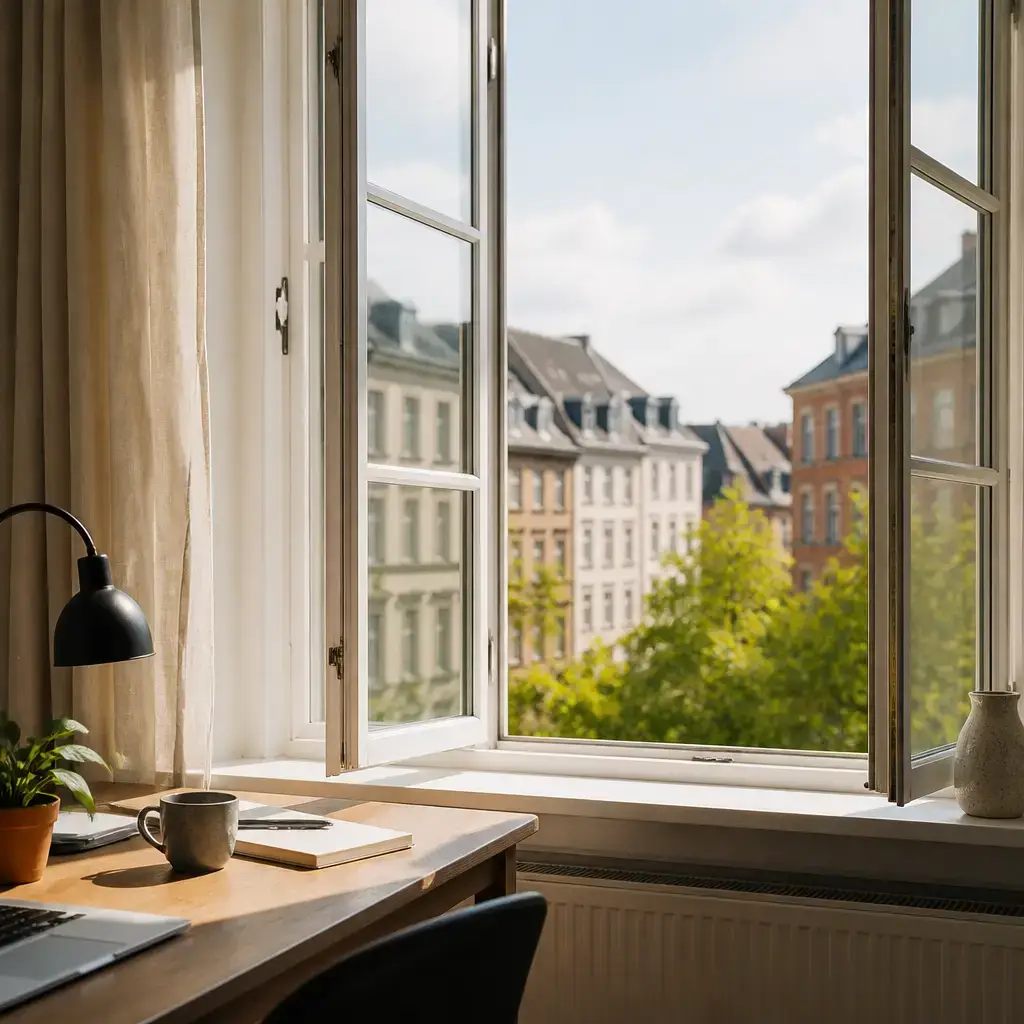
Ich fühle mich an meinem Schreibtisch müde.
ikh FOO-luh mish an MY-nem SHRIBE-tish MYOO-duh. I feel tired at my desk.Lass uns für einen Moment das Fenster öffnen.
lahss oons fyoor EYE-nen moh-MENT dahss FEN-stur UHRF-nen. Let's open the window for a moment.Ich brauche frische Luft.
ikh BROW-khuh FRISH-uh LOOFT. I need some fresh air.Die Luft draußen fühlt sich kühl an.
dee LOOFT DROW-sen fyoolt zikh KYOOL an. The air outside feels cool.Können wir uns am Fenster ausruhen?
KUR-nun veer oons am FEN-stur OWS-roo-en? Can we rest by the window?Wir können hier eine kurze Pause machen.
veer KUR-nun heer EYE-nuh KUR-tsuh POW-zuh MAKH-en. We can take a short break here.Ich bin jetzt weniger müde.
ikh bin yetst VAY-ni-gur MYOO-duh. I feel less tired now.Lass uns bald wieder arbeiten gehen.
lahss oons bahlt VEE-dur AR-bye-ten GAY-en. Let's go back to work soon.Sentence explanations
Ich fühle mich an meinem Schreibtisch müde.
I feel tired at my desk.
- Ich
- I
- fühle mich
- feel
- Schreibtisch
- desk
- müde
- tired
More detail
Ich means “I” here, the first-person singular subject. German uses ich for the speaker as the subject; its corresponding object form is mich, as in the reflexive expression that follows. fühle mich is the first-person singular form of the reflexive verb sich fühlen, “to feel.” fühle comes from fühlen; mich is the reflexive pronoun that matches the subject ich. Together, Ich fühle mich ... means “I feel ...”. The reflexive pronoun changes with the subject: Du fühlst dich ... means “You feel ...”. an meinem Schreibtisch means “at my desk.” Schreibtisch is a masculine noun meaning “desk” (der Schreibtisch). In this location phrase, an is followed by the dative, so der becomes dem, and the possessive form is meinem: an meinem Schreibtisch. The phrase identifies the speaker’s location; it does not mean that the desk itself is tired. müde means “tired.” It is an adjective used after fühlen to describe the speaker’s state. In Ich fühle mich müde, it remains müde rather than taking an adjective ending. A reusable example is Sie fühlt sich müde. — “She feels tired.” Putting the parts together, Ich fühle mich gives “I feel,” an meinem Schreibtisch specifies where the speaker is, and müde states the speaker’s condition. The complete meaning is: “I feel tired at my desk.”
Lass uns für einen Moment das Fenster öffnen.
Let's open the window for a moment.
- Lass uns
- let’s
- für
- for
- Moment
- moment
- Fenster
- window
- öffnen
- open
More detail
Lass uns is the reusable German suggestion pattern “let’s …”. Lass is the singular imperative of lassen (“to let”); with uns (“us”) and an infinitive, it invites the speaker and listener to do the action together. The infinitive comes at the end: Lass uns warten. — “Let’s wait.” für means “for” here and normally takes the accusative case. The phrase für einen Moment therefore means “for a moment,” expressing a short duration. Moment is a masculine noun: nominative der Moment, accusative einen Moment. The article einen reflects the noun’s masculine accusative form; it does not by itself assert a numeric count. Fenster means “window.” It is a neuter noun: das Fenster is both nominative and accusative in the singular, so the form of das does not change here. In this sentence, das Fenster is the thing being opened. öffnen means “to open.” This is its infinitive form, used after Lass uns; it stays at the end of the clause. Example: Wir öffnen die Tür. — “We open the door.” Together, Lass uns + für einen Moment + das Fenster + öffnen gives: “Let’s open the window for a moment.” The suggestion includes both speaker and listener, specifies the window as the object, and limits the action to a short time.
Ich brauche frische Luft.
I need some fresh air.
- Ich
- I
- brauche
- need
- frische
- fresh
- Luft
- air
More detail
Ich means “I” here: the speaker is the experiencer of the need. It is the first-person singular personal pronoun. Compare du (“you,” singular informal) and wir (“we”). Example: Ich lerne Deutsch. — “I am learning German.” brauche is the present-tense first-person singular form of brauchen, “to need.” The verb stem is brauch-, with the ending -e for ich: ich brauche. Example: Ich brauche Wasser. — “I need water.” In this sentence, brauche expresses the speaker’s current need, not a command. frische describes the air as fresh. Its base form is the adjective frisch; here it appears as frische because it modifies the feminine noun Luft in this noun phrase. Example: frische Milch — “fresh milk.” The adjective changes form according to the grammatical environment; frisch is the uninflected form used, for example, after sein: Die Milch ist frisch. — “The milk is fresh.” Luft means “air.” It is a feminine noun: die Luft. In this sentence it is an uncountable substance, so German uses no article; the fixed translation’s “some” reflects the natural English meaning rather than a separately stated quantity. Example: Die Luft ist warm. — “The air is warm.” Together, Ich brauche (“I need”) and frische Luft (“fresh air”) form the complete meaning: “I need some fresh air.” The adjective comes before the noun, and frische Luft is the thing that is needed. The sentence is a straightforward, everyday statement of a current need.
Die Luft draußen fühlt sich kühl an.
The air outside feels cool.
- Luft
- air
- draußen
- outside; outdoors
- fühlt … sich … an
- feels
- kühl
- cool; cool to the touch
More detail
Luft means “air” here. The noun is feminine: die Luft. Its plural is die Lüfte, although ordinary everyday speech usually uses Luft as an uncountable substance, as in frische Luft (“fresh air”). Example: Die Luft ist frisch. — “The air is fresh.” draußen is an adverb meaning “outside” or “outdoors.” It describes the location of the air, not a change in the noun Luft; it does not take noun gender or plural endings. A useful contrast is drinnen (“inside”). Example: Draußen ist es kalt. — “It is cold outside.” fühlt sich ... an comes from the separable verb sich anfühlen, “to feel” in the sense of having a perceptible quality. In the fixed sentence, fühlt is the third-person singular present form because die Luft is the singular subject. The reflexive part sich refers back to that subject, and the separable prefix an moves to the end of this main clause. Pattern: Etwas fühlt sich ... an. — “Something feels ...”. Example: Der Stoff fühlt sich weich an. — “The fabric feels soft.” kühl means “cool,” describing a mildly low temperature or a cool sensation. It is used here as a predicative adjective after sich anfühlen, so it has no ending: fühlt sich kühl an. The base form is kühl; a useful comparison is kühler (“cooler”), and the opposite is warm (“warm”). Example: Das Wasser fühlt sich kühl an. — “The water feels cool.” Together, Die Luft draußen identifies the subject and its location, while fühlt sich kühl an says that this air gives a cool sensation. The complete meaning is: “The air outside feels cool.”
Können wir uns am Fenster ausruhen?
Can we rest by the window?
- Können wir
- Can we...?
- uns
- ourselves
- am
- at the
- Fenster
- window
- ausruhen
- rest
More detail
Können wir asks whether the subject wir has the ability or permission to do something. können is the modal verb können (“can, be able to”); in this present-tense question, können is the finite form for wir. The other verb stays in the infinitive at the end: Können wir hier bleiben? — “Can we stay here?” The verb comes before the subject because this is a yes/no question. uns is the reflexive pronoun used with wir. It refers back to the subject, so wir ... uns ausruhen means “we rest” with the reflexive form required by sich ausruhen. Compare Ich ruhe mich aus — “I am resting.” The pronoun changes with the subject: wir ... uns, but ich ... mich. am is the contraction of an dem. Here it expresses a location: “by/at the.” The preposition an takes the dative for a stationary location, and dem is the dative form of the masculine or neuter definite article. In am Fenster, Fenster is neuter (das Fenster), so its dative article is dem: an dem Fenster → am Fenster. Fenster means “window.” Its base form is das Fenster; the noun itself does not change in this singular dative phrase, while the article carries the case marking. Example: Das Fenster ist offen. — “The window is open.” ausruhen means “to rest” or “to take a rest.” It is a separable verb built from aus- and ruhen. In the infinitive after a modal verb, it remains together at the end: Wir können uns ausruhen. — “We can rest.” In a simple present-tense main clause without a modal, the prefix separates: Wir ruhen uns aus. — “We are resting.” Together, Können wir uns ausruhen? means “Can we rest?” and am Fenster specifies the place. The complete utterance is therefore “Can we rest by the window?”
Wir können hier eine kurze Pause machen.
We can take a short break here.
- Wir können
- we can
- hier
- here
- kurze
- short
- Pause
- break
- machen
- make/do
More detail
Wir können means “we can” here. können is the present-tense form of the modal verb können for wir; it expresses ability or possibility. In a main clause, the modal is finite in the second position, while the other verb goes to the end. Example: Wir können morgen anfangen. — “We can start tomorrow.” hier means “here” and locates the activity at the relevant place. It is an adverb, so it does not change form. Example: Wir warten hier. — “We are waiting here.” kurze describes Pause as short. Its base form is the adjective kurz; in eine kurze Pause, the adjective has the ending -e. Here the noun phrase is the accusative object of machen, and kurze is feminine singular because Pause is feminine. Example: Wir machen eine lange Pause. — “We take a long break.” Pause is a feminine noun meaning “break,” especially a period when an activity stops. German nouns are capitalized. Its plural is Pausen. Example: Die Pause beginnt jetzt. — “The break starts now.” machen means “make” or “do”; in this sentence, the expression eine Pause machen means “take a break.” It is the infinitive placed at the end because können is the modal verb. Example: Ich mache eine Pause. — “I am taking a break.” Together, Wir können + hier + eine kurze Pause + machen gives “We can take a short break here.” The modal expresses what is possible for the speaker and the other person or people referred to by wir; hier gives the place, eine kurze Pause names the activity, and machen completes the modal construction. The sentence is a straightforward, neutral way to suggest or state this possibility.
Ich bin jetzt weniger müde.
I feel less tired now.
- Ich bin
- I am
- jetzt
- now
- weniger
- less
- müde
- tired
More detail
Ich bin is the first-person singular present form of sein (“to be”): ich bin = “I am.” With an adjective after it, German describes the speaker’s current state. Example: Ich bin bereit. — “I am ready.” jetzt means “now” and places the state in the present moment. Example: Jetzt bin ich wach. — “Now I am awake.” weniger is the comparative form of wenig (“little” or “not much”) and means “less” here. It reduces the degree of the following adjective: weniger müde = “less tired.” This is different from mehr (“more”). Example: Ich bin heute weniger nervös. — “I am less nervous today.” müde is an adjective meaning “tired.” After sein, it is used predicatively and has no adjective ending in this sentence. Example: Wir sind müde. — “We are tired.” Together, Ich bin jetzt weniger müde says that the speaker’s present state is a lower degree of tiredness than before or than at another comparison point: “I feel less tired now.”
Lass uns bald wieder arbeiten gehen.
Let's go back to work soon.
- Lass uns
- let’s
- bald
- soon
- wieder
- again; back
- arbeiten
- work
- gehen
- go
More detail
Lass uns is the reusable German way to propose a shared action: Lass uns + infinitive means “let’s …”. Lass is the informal singular imperative of lassen (“let”); uns is the first-person plural object pronoun, referring to the speaker and the addressee together. For example: Lass uns anfangen. — “Let’s start.” bald means “soon”, referring to a relatively near time without specifying an exact time. It is different from spät (“late”): Wir kommen bald. — “We’re coming soon.” wieder adds the idea of repetition or a return to a previous activity or state. Here it supports “back” in “go back to work”. Its position before arbeiten gehen makes it part of the description of the proposed return to working. For example: Sie arbeitet wieder. — “She is working again.” arbeiten is the infinitive of arbeiten, “to work”. German uses the infinitive here because it follows the proposal construction and forms part of the activity being proposed. The verb’s present-tense forms include ich arbeite (“I work”) and sie arbeitet (“she works”). gehen is the infinitive of gehen, “to go”. In arbeiten gehen, it combines with another infinitive to mean going in order to work, or going to work. For example: Wir gehen einkaufen. — “We’re going shopping.” Together, Lass uns introduces a joint proposal, bald places it soon, wieder signals a return or repetition, and arbeiten gehen expresses going to work. The whole utterance therefore means: “Let’s go back to work soon.”
Grammar Points
sich anfühlen: sich ... anfühlen
Die frische Luft fühlt sich kühl an.
dee FRISH-uh LOOFT fyoolt zikh KYOOL an.The fresh air feels cool.
In a main clause, the separable prefix an moves to the end: fühlt sich ... an.
Lass uns + Infinitiv
Lass uns jetzt ausruhen.
lahss oons yetst OWS-roo-en.Let's rest now.
Use Lass uns followed by the infinitive to make a suggestion for a shared action.
German Vocabulary
Quiz
Word Order
Arrange the words in the correct order.
I need some fresh air.
Show Answer
Ich brauche frische Luft.Can we rest by the window?
Show Answer
Können wir uns am Fenster ausruhen?I feel less tired now.
Show Answer
Ich bin jetzt weniger müde.Spelling
Tap the letters to spell the word.
to open
Show Answer
öffnendesk
Show Answer
Schreibtischmoment
Show Answer
Momentto need