10 minutes free every day
Continue audio lessons in the app
Word explanations appear automatically in sync with the audio.
No login required · synced translations · playback with the screen locked
Choose your learning language and open this lesson in the app.

About This Lesson
Use Taking a short break to practice German conversation, pronunciation, vocabulary, grammar, and quizzes.
Dialogue
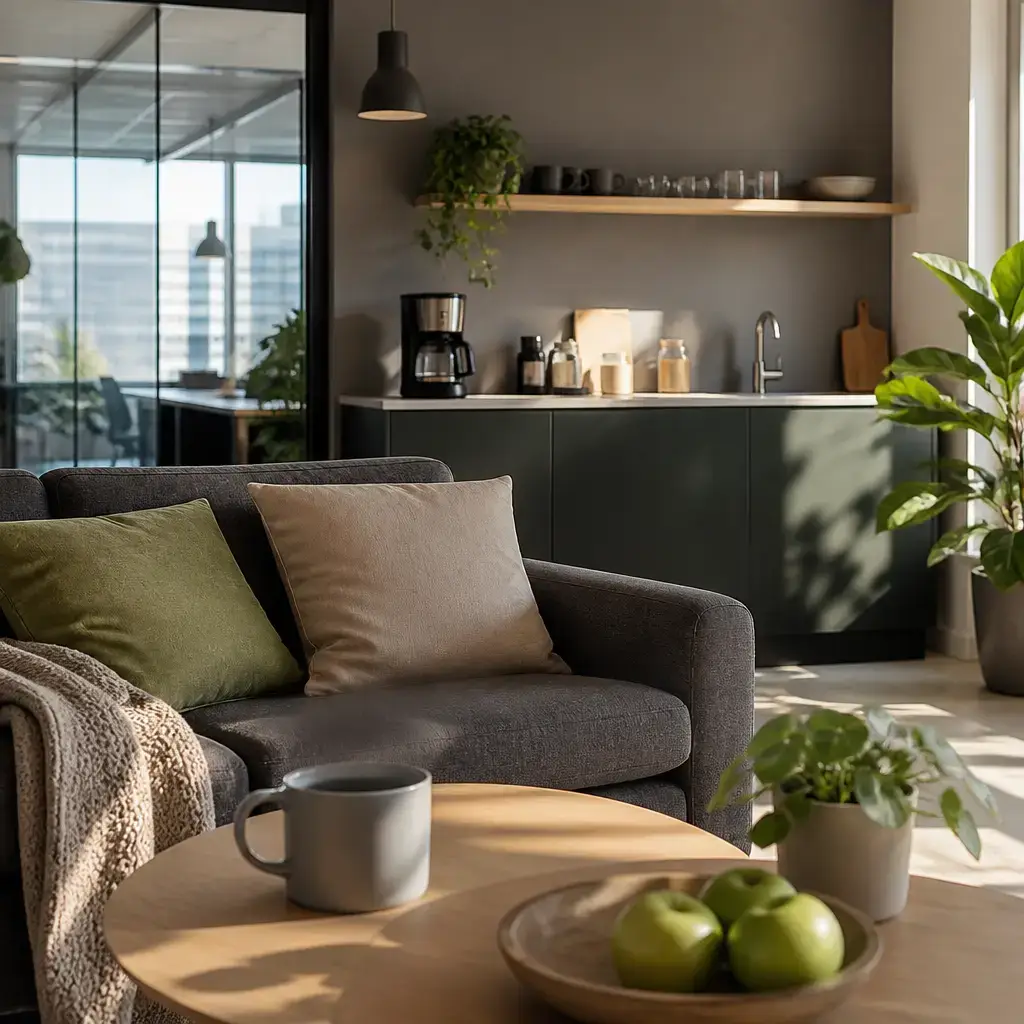
Ich brauche eine kurze Pause.
ikh BROW-khuh EYE-nuh KOORT-suh POW-zuh I need a short break.Setzen wir uns aufs Sofa.
ZET-sen veer oons owfs ZOH-fah Let's sit on the sofa.Kann ich etwas Kaffee bekommen?
kahn ikh ET-vahs kah-FAY beh-KOM-en Can I get some coffee?In der Küche ist Kaffee.
in dair KUE-khuh ist kah-FAY There is coffee in the kitchen.Ich hole mir Kaffee, nachdem ich mich ein bisschen gestreckt habe.
ikh HOH-luh meer kah-FAY, NAKH-dem ikh mikh EYE-n BIS-khen geh-SHTREKT HAH-buh I'll get some after I stretch a little.Dehnen hilft, wenn man müde ist.
DAY-nen hilft, ven mahn MYOO-duh ist Stretching helps when you feel tired.Dieser Raum ist ruhig.
DEE-zuh ROWM ist ROO-ikh This room is quiet.Wir können uns hier eine Weile ausruhen.
veer KURN-en oons heer EYE-nuh VY-luh OWS-roo-en We can rest here for a while.Sentence explanations
Ich brauche eine kurze Pause.
I need a short break.
- Ich
- I
- brauche
- need
- kurze
- short
- Pause
- break
More detail
Ich means “I.” It is the first-person singular pronoun, used for the speaker. Its form does not change for grammatical gender. For example: Ich lerne. — “I am learning.” brauche is the present-tense first-person singular form of brauchen, “to need.” The ending matches Ich: ich brauche. For example: Ich brauche Wasser. — “I need water.” kurze means “short” here. Its base form is kurz; useful comparison forms are kürzer (“shorter”) and am kürzesten (“shortest”). In eine kurze Pause, the adjective has the ending -e because it describes the feminine accusative singular noun Pause after the indefinite article eine. Pause means “break” or “period of rest.” It is a feminine noun: die Pause; its plural is die Pausen. In this sentence, Pause is the object needed by brauchen, so it appears in the accusative: eine Pause. The article eine identifies an unspecified break; it does not by itself state a numeric count. Together, Ich brauche eine kurze Pause. means “I need a short break.” The pattern Ich brauche + [thing] is reusable for expressing that the speaker needs something: Ich brauche eine kurze Pause.
Setzen wir uns aufs Sofa.
Let's sit on the sofa.
- Setzen wir uns
- Let's sit down
- aufs
- onto the
- Sofa
- sofa
More detail
Setzen wir uns is a reusable way to make a suggestion addressed to a group including the speaker: “Let’s sit down.” The verb is setzen, “to seat/place,” and with the reflexive pronoun uns it describes the people placing themselves in a seated position. wir is the first-person plural subject, and uns is the matching first-person plural reflexive form. German uses sitzen for the resulting state “be sitting,” but sich setzen for the action of sitting down. Example: Setzen wir uns hierhin. — “Let’s sit down here.” aufs is the contracted form of auf das. Here, auf expresses movement toward a surface or destination, so it is followed by the accusative article das; the contraction produces aufs. This is different from auf dem, used for a location: Wir sitzen auf dem Sofa. — “We are sitting on the sofa.” The form aufs therefore contributes “onto the,” while the suggestion and action come from the preceding words. Sofa is a neuter noun meaning “sofa.” Its ordinary definite article is das: das Sofa. In this sentence, das is contained in the contraction aufs, and the noun names the destination surface. Example: Ich setze mich aufs Sofa. — “I sit down on the sofa.” Together, Setzen wir uns makes a first-person plural suggestion to sit down, and aufs Sofa specifies the destination: onto the sofa. The complete meaning is “Let’s sit on the sofa.”
Kann ich etwas Kaffee bekommen?
Can I get some coffee?
- Kann ich
- can I
- etwas
- some
- Kaffee
- coffee
- bekommen
- get
More detail
Kann ich combines kann, the first-person singular present form of können (“can, be able to”), with ich (“I”). In this question, it asks whether the speaker is allowed or able to receive something; the exact English “Can I …?” is the intended reading. The form kann is used with ich; for example, Kann ich kommen? means “Can I come?” etwas means “some” here because it refers to an unspecified amount of the mass noun Kaffee. It does not itself state a precise quantity. The same word can also mean “something” in other contexts, as in Ich höre etwas. — “I hear something.” Kaffee is the noun “coffee.” Its base form is Kaffee; the noun is masculine, with the article der in the basic form. In this sentence, the article is omitted because etwas Kaffee presents an unspecified amount, and Kaffee has the same visible form in the relevant case: Ich trinke Kaffee. — “I drink coffee.” bekommen is the infinitive meaning “get” or “receive.” After the conjugated modal verb kann, the infinitive remains at the end of the question. Compare Ich bekomme Kaffee. — “I get coffee” or “I receive coffee,” depending on context. Here, bekommen describes receiving the coffee rather than preparing it. Together, Kann ich asks for permission or possibility, etwas Kaffee specifies an unspecified amount of coffee, and the final infinitive bekommen states what the speaker wants to receive. The complete utterance therefore means “Can I get some coffee?”
In der Küche ist Kaffee.
There is coffee in the kitchen.
- In
- in
- Küche
- kitchen
- ist
- is; is present
- Kaffee
- coffee
More detail
In means “in” here and introduces a location. With a fixed location, German uses the dative after the two-way preposition in; movement into a place would normally use the accusative instead. Example: In der Tasche ist ein Schlüssel. — “There is a key in the bag.” Küche means “kitchen.” It is feminine: die Küche in the basic form, and der Küche here because the location phrase is dative singular. The source wording is therefore In der Küche, “in the kitchen.” ist is the third-person singular present form of sein, “to be.” In this location pattern, In [place] ist [thing] presents something as being present there; the sense “there is” comes from the whole construction, not from ist alone. Example: Im Zimmer ist ein Tisch. — “There is a table in the room.” Kaffee means “coffee.” It is a masculine noun, but when referring to coffee as a substance, German commonly uses it without an article, as here. With an individual serving or a countable amount, an article or quantity expression can be added, for example Ein Kaffee ist fertig. — “A coffee is ready.” Together, In der Küche gives the location, ist states presence, and Kaffee names what is present. The complete utterance means “There is coffee in the kitchen.”
Ich hole mir Kaffee, nachdem ich mich ein bisschen gestreckt habe.
I'll get some after I stretch a little.
- hole mir
- get myself
- Kaffee
- coffee
- nachdem
- after
- mich
- myself
- ein bisschen
- a little
- gestreckt
- stretched
- habe
- have
More detail
hole mir: The finite form hole is first-person singular present of holen, “to get/fetch.” German present tense can describe a planned near-future action, which gives the intended “I’ll get” here. mir is the first-person singular dative pronoun, used here for the person obtaining something for themself; it is not the direct object. A reusable pattern is Ich hole mir ... = “I’ll get myself ...” or “I’ll get ... for myself.” Kaffee: This noun means “coffee.” In this sentence it is the thing being obtained; in the given context, the translation identifies it as the item referred to by “some.” German often uses a mass noun such as Kaffee without an article when speaking generally or referring to an unspecified amount. nachdem: This subordinating conjunction means “after” and introduces an event that must happen before the event in the main clause. In a clause introduced by nachdem, the finite verb goes to the end. mich: mich is the first-person singular accusative pronoun, “me,” and here it belongs to the reflexive expression mich strecken, “to stretch oneself.” Its form is accusative, while mir earlier is dative; they are different case forms of the same first-person singular pronoun system. The pronoun refers to the speaker in this sentence. ein bisschen: This compact expression means “a little” or “a bit.” It limits the extent of the stretching. It can also be used with other activities, for example: Ich warte ein bisschen. — “I’ll wait a little.” gestreckt: This is the past participle of strecken, “to stretch.” With mich, the phrase mich gestreckt means “stretched myself.” The form gestreckt is used with the auxiliary habe to form the perfect construction inside the nachdem clause. habe: habe is the first-person singular present form of haben, “to have.” Here it is an auxiliary, not a separate possession meaning: mich gestreckt habe is “have stretched myself.” Because this is a subordinate clause introduced by nachdem, habe appears at the end. Together, nachdem ich mich ein bisschen gestreckt habe means “after I stretch a little” in the fixed translation. Literally, its German perfect construction presents the stretching as completed before the main action. The main clause Ich hole mir Kaffee says that the speaker will get coffee for themself. Combined in the source order, the utterance means: “I’ll get some after I stretch a little.”
Dehnen hilft, wenn man müde ist.
Stretching helps when you feel tired.
- Dehnen
- stretching
- hilft
- helps
- wenn man
- when you / when one
- müde
- tired
- ist
- is
More detail
Dehnen means “stretching” here. It is the capitalized infinitive used as a noun, so it functions as the subject: “stretching” as an activity. The underlying verb is dehnen (“to stretch”); compare Ich dehne mich (“I stretch”). hilft is the present-tense third-person singular form of helfen (“to help”). The singular form agrees with Dehnen, treated here as one activity. The verb helfen commonly takes a dative person or thing when that recipient is stated, as in Das hilft mir (“That helps me”). In this sentence, no recipient is specified. wenn man introduces a general condition: “when you” or “when one.” man is an indefinite personal pronoun for people in general, not the specific masculine pronoun Mann (“man” as an adult male). In the subordinate clause introduced by wenn, the finite verb goes to the end. müde is the predicate adjective “tired.” After a form of sein, it describes the subject without an adjective ending: Ich bin müde (“I am tired”), Sie ist müde (“She is tired”). ist is the third-person singular present form of sein (“to be”). Its subject in the clause is man, giving man ist (“one is” / “you are” in a general statement). The form sein is the base infinitive; its present forms include ich bin, du bist, and er/sie/es ist. Together, Dehnen hilft says “Stretching helps,” and wenn man müde ist adds the condition “when you feel tired.” Because wenn introduces the condition clause, ist appears at the end: wenn man müde ist. The complete utterance is therefore: “Stretching helps when you feel tired.”
Dieser Raum ist ruhig.
This room is quiet.
- Dieser
- this
- Raum
- room
- ist
- is
- ruhig
- quiet
More detail
Dieser means “this” here and is the masculine singular nominative form of the demonstrative dies-. It agrees with Raum, the subject: dieser is used with masculine singular nominative nouns, while related forms include diese and dieses in other gender or number combinations. Example: Dieser Tisch ist groß. — “This table is big.” Raum means “room.” It is a masculine noun: der Raum. Its plural is Räume, with an umlaut. Example: Der Raum ist hell. — “The room is bright.” ist means “is” here. It is the third-person singular present form of sein (“to be”): sein → ist. German uses it with a singular subject such as der Raum. Example: Der Raum ist warm. — “The room is warm.” ruhig means “quiet” here. It is an adjective describing the room. After ist, a predicative adjective appears in its basic form, without an adjective ending. Example: Das Kind ist ruhig. — “The child is quiet.” Together, Dieser Raum means “this room,” ist links the subject to a description, and ruhig supplies that description. The whole utterance therefore means “This room is quiet.”
Wir können uns hier eine Weile ausruhen.
We can rest here for a while.
- Wir können
- we can
- uns
- ourselves
- hier
- here
- eine Weile
- for a while
- ausruhen
- rest
More detail
Wir können means “we can.” Wir is the first-person plural subject, and können is the present-tense form of können for wir. With a modal verb such as können, the other verb stays in the infinitive and appears later in the clause: Wir können warten. — “We can wait.” uns means “ourselves” here. It is the reflexive pronoun that matches the subject wir; the verb is sich ausruhen (“to rest”), so the forms correspond as follows: ich ruhe mich aus (“I rest”), wir ruhen uns aus (“we rest”). The pronoun changes with the subject, rather than referring to a separate group of people. hier means “here,” locating the resting at the place understood in the situation. It can be reused in sentences such as Wir bleiben hier. — “We are staying here.” eine Weile means “for a while,” describing the duration. This expression does not state a precise measured amount of time. eine and Weile form the noun phrase used for this duration expression; Weile is feminine, with the form eine here. Example: Ich warte eine Weile. — “I’ll wait for a while.” ausruhen means “to rest.” It is the infinitive of the separable, reflexive verb sich ausruhen; in a finite main clause, the prefix separates: Wir ruhen uns aus. — “We rest.” After the modal können, the complete infinitive remains together at the end: Wir können uns ausruhen. Together, Wir können ... ausruhen expresses the ability or possibility to rest, uns shows that the subject is resting, hier gives the location, and eine Weile gives the duration. The complete utterance therefore means: “We can rest here for a while.”
Grammar Points
sich auf etwas setzen
sich auf etwas setzen
zikh owf ET-vahs ZET-sento sit down on something
The reflexive pronoun sich belongs with setzen; auf introduces what you sit on.
aufs + noun
aufs Sofa
owfs ZOH-fahonto the sofa
aufs combines auf + das and is used before a neuter noun.
German Vocabulary
on the sofa
get some coffee
I need a short break
some coffee
in the kitchen
some coffee
in the kitchen
a short break
a short break
Let's sit down
Let's sit down
on the sofa
Quiz
Word Order
Arrange the words in the correct order.
I need a short break.
Show Answer
Ich brauche eine kurze Pause.Let's sit on the sofa.
Show Answer
Setzen wir uns aufs Sofa.Can I get some coffee?
Show Answer
Kann ich etwas Kaffee bekommen?Spelling
Tap the letters to spell the word.
to need
Show Answer
brauchesofa
Show Answer
Sofacoffee
Show Answer
Kaffeesome; something