10 minutes free every day
Continue audio lessons in the app
Word explanations appear automatically in sync with the audio.
No login required · synced translations · playback with the screen locked
Choose your learning language and open this lesson in the app.

About This Lesson
Use Borrowing Small Tools to practice German conversation, pronunciation, vocabulary, grammar, and quizzes.
Dialogue
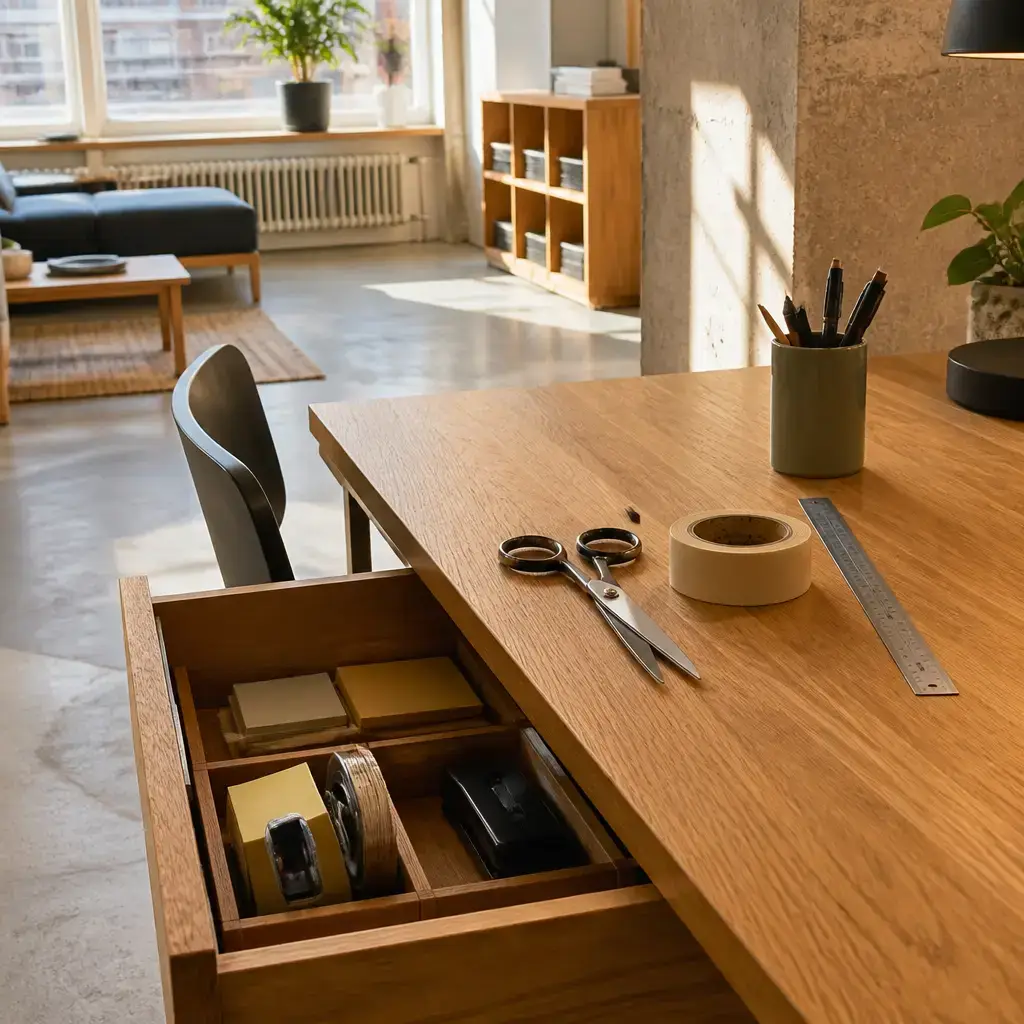
Kann ich die Schere benutzen?
kan ikh dee SHAY-ruh beh-NOOT-sen? Can I use the scissors?Nimm sie und halte die Klingen nach unten.
nim zee oont HAL-tuh dee KLIHNG-en nahkh OON-ten. Take these and keep the blades pointed down.Ich brauche auch etwas Klebeband.
ikh BROW-khuh owkh ET-vahs KLAY-buh-bahnt. I also need some tape.Das Klebeband ist in der Schublade.
dahs KLAY-buh-bahnt ist in dair SHOO-blah-duh. The tape is in the drawer.Hast du auch ein Lineal?
hahst doo owkh eye-n lee-neh-AHL? Do you have a ruler too?Ja, es liegt auf meinem Schreibtisch.
yah, ess leekt owf MY-nem SHRIBE-tish. Yes, it is on my desk.Du kannst es von dort nehmen.
doo kahnst ess fohn dort NAY-men. You can take it from there.Ich bringe alles zurück, wenn ich fertig bin.
ikh BRING-uh AH-less tsoo-ROOK, venn ikh FAIR-tikh bin. I will return everything when I finish.Leg das Lineal oben hin, damit ich es später finden kann.
lek dahs lee-neh-AHL OH-ben hin, dah-MIT ikh ess SHPAY-ter FIN-den kahn. Leave the ruler on top so I can find it later.Sentence explanations
Kann ich die Schere benutzen?
Can I use the scissors?
- Kann ich
- Can I…?
- die Schere
- the scissors
- benutzen
- use
More detail
Kann ich is the question pattern for asking whether the speaker is allowed or able to do something. kann is the present-tense first-person singular form of können (“can”); ich identifies the speaker. In a question, the finite verb comes first: Kann ich ...? For example: Kann ich hier sitzen? — “Can I sit here?” die Schere means “the scissors” here. Schere is a feminine singular noun, so its definite article is die in the nominative and accusative singular. German uses this noun in the singular even though English normally says “scissors.” The form die is therefore determined by the noun’s grammatical gender and its case here, not by a numeric count. For example: Ich nehme die Schere. — “I’m taking the scissors.” benutzen means “to use.” It is the infinitive, and it remains at the end of this question because kann is the finite modal verb. The reusable pattern is Kann ich + [object] + [infinitive]? For example: Kann ich deinen Stift benutzen? — “Can I use your pen?” Benutzen is a non-separable verb; its prefix does not split off in this construction. Together, Kann ich die Schere benutzen? asks, “Can I use the scissors?” The modal kann expresses the request about permission or possibility, die Schere is the object being used, and benutzen names the requested action. The word order places the finite verb first for the yes/no question and the infinitive at the end.
Nimm sie und halte die Klingen nach unten.
Take these and keep the blades pointed down.
- Nimm
- take
- sie
- these
- halte
- keep
- Klingen
- blades
- nach unten
- downward
More detail
Nimm is the informal singular imperative of nehmen (“to take”). The imperative addresses one person directly and normally omits the subject pronoun: Nimm das. means “Take that.” sie is an object pronoun here. With the supplied translation, it means “these” and refers to the items being taken; the preceding context identifies those items as the scissors. The pronoun itself does not show whether the referent is a person or an object, so its concrete referent comes from the context and translation. halte is the informal singular imperative of halten (“to hold” or “to keep”). Nimm ... und halte ... gives two instructions to the same person. In this sentence, halten describes maintaining an orientation rather than simply possessing something. die Klingen means “the blades.” Klingen is the plural of Klinge (“blade”); the plural form does not add a gender distinction of its own. The definite article die marks this as a specific plural noun phrase. In the sentence, the blades are the part whose orientation is being specified. nach unten is a direction phrase meaning “downward” or “toward the bottom.” With halten, it specifies the direction in which the blades should point. It is not itself an adjective agreeing with Klingen. Together, Nimm sie means “Take these,” and halte die Klingen nach unten means “keep the blades pointed down.” The whole utterance is therefore an informal two-part instruction: take the referenced items and maintain their blades in a downward orientation.
Ich brauche auch etwas Klebeband.
I also need some tape.
- Ich
- I
- brauche
- need
- auch
- also
- etwas
- some
- Klebeband
- tape
More detail
Ich is the first-person singular pronoun, “I.” It refers to the speaker. German pronouns change with grammatical role; ich is the subject form, while mich is used for a direct object. Example: Ich lerne. — “I am learning.” brauche means “need” here. It is the first-person singular present form of brauchen (“to need”): ich brauche, du brauchst, er/sie/es braucht. The ending -e marks the ich form in this verb. Example: Ich brauche Hilfe. — “I need help.” auch means “also” or “too.” It adds this need to another relevant fact or need. Its position can affect what it emphasizes, but here it modifies the statement as a whole: the speaker needs tape in addition to something already relevant. Example: Ich brauche auch Wasser. — “I also need water.” etwas means “some” or “a bit of” before an uncounted quantity. It does not specify an exact amount. In this sentence it presents the tape as an unspecified quantity rather than as a counted item. Example: Ich möchte etwas Brot. — “I would like some bread.” Klebeband means “tape,” specifically adhesive tape. It is a German compound noun: Klebe- relates to sticking or gluing, and Band means “band” or “strip,” but the compound is learned as the noun for adhesive tape. It is normally neuter, so the definite article is das: das Klebeband. Example: Das Klebeband ist hier. — “The tape is here.” Together, Ich brauche gives “I need,” auch adds “also,” and etwas Klebeband gives “some tape.” The complete utterance means: “I also need some tape.”
Das Klebeband ist in der Schublade.
The tape is in the drawer.
- Das
- the (neuter singular)
- Klebeband
- tape
- ist
- is
- in
- in
- der
- the (feminine singular)
- Schublade
- drawer
More detail
Das is the definite article used here with a singular neuter noun in the subject position. It agrees with Klebeband: das Klebeband. The article changes with gender, number, and grammatical case; for example, die Schublade is feminine, but das Klebeband is neuter. Klebeband means tape. It is a neuter noun, so its definite article is das. In the preceding sentence, etwas Klebeband means “some tape”; after the tape has been identified, das Klebeband refers to that tape as a specific item. ist is the third-person singular present form of sein (“to be”): sein → ist. It links the subject to its location here. Example: Das Buch ist hier. — “The book is here.” in introduces the location. With a static location, German uses the dative after in; with movement into a place, in can instead take the accusative. Example: Das Buch ist in der Tasche. — “The book is in the bag.” der is the dative singular form of the feminine definite article. The noun is feminine: die Schublade in the basic form, but in der Schublade for a location. This is a case change, not a change in the noun’s gender. Schublade means drawer. Its definite form is die Schublade when it is the subject or a basic noun phrase, and der Schublade after in for a stationary location. Together, Das Klebeband is the subject, ist says where it is, and in der Schublade gives its location. The complete meaning is: “The tape is in the drawer.”
Hast du auch ein Lineal?
Do you have a ruler too?
- Hast du
- do you have
- auch
- too; also
- Lineal
- ruler
More detail
Hast du is the reusable yes/no-question pattern “do you have …?” The verb is haben (“to have”); with du, its present-tense form is hast. German places the finite verb first in a yes/no question: Hast du Zeit? — “Do you have time?” This question structure does not itself express past time. auch means “too” or “also.” Here it adds the sense that a ruler is included in what the speaker is asking about. Its position can vary in German, but its exact placement can affect emphasis. Example: Ich habe auch einen Stift. — “I also have a pen.” Lineal is the noun “ruler.” Its base form is Lineal; the plural is Lineale. It is a neuter noun: das Lineal. In this sentence it is the object of haben, so the indefinite article is ein: ein Lineal. Here ein marks an indefinite noun, not a stated numerical count. Together, Hast du + auch + ein Lineal forms Hast du auch ein Lineal? — “Do you have a ruler too?” The verb-first order marks a yes/no question, auch adds “too,” and ein Lineal names the thing being possessed.
Ja, es liegt auf meinem Schreibtisch.
Yes, it is on my desk.
- Ja
- yes
- es
- it
- liegt
- is lying
- meinem
- my
- Schreibtisch
- desk
More detail
Ja means “yes” and confirms the preceding question. It is a reusable affirmative response; for example, Ja, ich habe ein Buch. means “Yes, I have a book.” es means “it” here. This is the German third-person singular neuter pronoun in the sentence’s subject position. Its specific referent is the item being discussed; the form itself does not identify that item by name. liegt comes from liegen, “to lie” or “to be situated.” It is the present-tense third-person singular form: liegen → er/sie/es liegt. German commonly uses liegen for an object’s location when it is lying or situated somewhere, rather than using a general equivalent of English “is.” For example, Das Buch liegt auf dem Tisch. means “The book is lying on the table.” meinem is the possessive determiner from mein, “my.” Here it is the dative masculine singular form, agreeing with the masculine noun Schreibtisch after the location use of auf: mein Schreibtisch becomes auf meinem Schreibtisch. The dative form marks the fixed location in this phrase; it does not state a quantity. Schreibtisch means “desk.” It is a masculine noun: der Schreibtisch. In the compound, Schreib- relates to writing and Tisch means “table,” but the complete word means “desk.” The location phrase auf meinem Schreibtisch means “on my desk.” With auf describing a stationary location, German uses the dative here. This contrasts with movement toward a place, where auf can take the accusative, as in the example Ich lege das Buch auf den Schreibtisch. — “I put the book on the desk.” Together, es liegt says that the item is situated there, and auf meinem Schreibtisch specifies the location. The complete utterance is: “Yes, it is on my desk.”
Du kannst es von dort nehmen.
You can take it from there.
- Du kannst
- you can
- es
- it
- von dort
- from there
- nehmen
- take
More detail
Du kannst means “you can” here. Du is the informal singular “you” form, and kannst is the present-tense second-person singular form of können (“can, be able to”). The modal verb expresses ability or permission in this sentence; the exact English “can” is fixed by the translation. With a modal verb, German places the other verb in the infinitive at the end: Du kannst ... nehmen. es is the accusative form of the neuter personal pronoun “it.” Here it refers to the item already mentioned as being on the speaker’s desk, matching the fixed translation and the preceding context. The form es itself does not identify the item by name; its neuter grammatical form and its object role are what are visible here. Example: Ich sehe es. — “I see it.” von dort means “from there.” von is the preposition “from” and takes the dative; dort is the location word “there.” Together they specify the source location. A reusable contrast is von hier — “from here.” nehmen is the infinitive “to take.” Its base form is nehmen; after the modal kannst, it remains an infinitive rather than carrying the person marking. The conjugated modal carries the second-person marking, while nehmen stays at the end of the clause. Example: Du kannst das Buch nehmen. — “You can take the book.” Together, Du kannst marks the addressee’s ability or permission, es is the item being taken, von dort gives its source location, and nehmen supplies the main action. The complete meaning is: “You can take it from there.”
Ich bringe alles zurück, wenn ich fertig bin.
I will return everything when I finish.
- bringe … zurück
- return
- alles
- everything
- wenn
- when
- fertig
- finished
More detail
bringe ... zurück is the separable verb zurückbringen, meaning “to bring back” or “to return” something. In the main clause, bringe is the first-person singular present form of bringen, agreeing with ich; the separable part zurück moves to the end of the clause. German present tense can refer to the future when a future time is clear from context. Here, wenn ich fertig bin supplies that time, so the intended meaning is “I will return.” Example: Ich bringe das Buch zurück. — “I’ll return the book.” alles means “everything” and is an indefinite pronoun here: it refers to the entire relevant set of things without naming them individually. Its form is the same for nominative and accusative, but in this sentence it is the object of bringe ... zurück. Example: Ich sehe alles. — “I see everything.” wenn introduces a subordinate clause meaning “when” here. It can also mean “if” in other contexts, so the surrounding meaning determines the reading. A German subordinate clause introduced by wenn places its finite verb at the end. fertig means “finished” in this sentence: it describes the state reached by the person referred to by ich. It can also mean “ready” in other contexts, but “finished” fits the fixed translation. bin is the first-person singular form of sein (“to be”), and it appears at the end because of the wenn-clause word order. Example: Wenn ich fertig bin, komme ich. — “When I’m finished, I’ll come.” Together, Ich bringe alles zurück means “I will return everything,” and wenn ich fertig bin specifies when this will happen: “when I finish.” The complete utterance is therefore: “I will return everything when I finish.”
Leg das Lineal oben hin, damit ich es später finden kann.
Leave the ruler on top so I can find it later.
- Leg
- put/leave
- das Lineal
- the ruler
- oben hin
- on top
- damit ich
- so that I
- es
- it
- später
- later
- finden
- find
- kann
- can
More detail
Leg is the singular informal imperative form of legen, “to lay” or “to put.” With the separated element hin, the construction is related to hinlegen, “to put down/put over there.” The command addresses one person. legen describes placing something, unlike liegen, “to lie” or “be located,” which describes position without the act of placing. das Lineal means “the ruler.” Lineal is a neuter noun, so its definite article is das here. An indefinite form is ein Lineal (“a ruler”). oben hin places the object on or at a higher position, here “on top.” oben means “above/on top,” and hin contributes the directional placement associated with hinlegen. The reusable pattern is Leg [something] oben hin — “Put [something] on top.” damit ich introduces the purpose of the command: “so that I …”. In a clause introduced by damit, the finite verb normally comes at the end. ich is the first-person singular pronoun for the speaker. es is the neuter accusative pronoun “it.” In this utterance, it refers back to das Lineal; the neuter form agrees with that noun, and es is the object of finden. später means “later.” It places the finding at a later time than the placing described in the command. finden is the infinitive “to find.” For example, Ich finde den Schlüssel. means “I find the key.” With a modal verb in this subordinate clause, finden remains in the infinitive at the end. kann is the first-person singular form of können, “can” or “be able to.” The subject ich determines this form. In damit ich es später finden kann, kann expresses the speaker’s ability to find it, while finden names the possible action. The complete utterance combines Leg das Lineal oben hin (“Put the ruler on top”) with damit ich es später finden kann (“so that I can find it later”). It asks one person to place the ruler on top so that the speaker can find it later.
Grammar Points
Imperativ (du): Verbstamm ohne -en
Nimm die Schere und halte die Klingen unten.
nim dee SHAY-ruh oont HAL-tuh dee KLIHNG-en OON-ten.Take the scissors and hold the blades down.
German uses special short forms for informal commands: nehmen → Nimm, halten → halte.
Trennbares Verb im Imperativ: Verb ... Präfix
Leg das Lineal oben hin.
lek dahs lee-neh-AHL OH-ben hin.Put the ruler down on top.
With hinlegen, the prefix hin moves to the end in a command: Leg ... hin.
German Vocabulary
Kann ich die Schere benutzen?
Ich brauche auch etwas Klebeband.
Nimm sie und halte die Klingen nach unten.
Ich brauche auch etwas Klebeband.
Halte die Klingen nach unten.
Ja, es liegt auf meinem Schreibtisch.
Hast du auch ein Lineal?
Nimm sie und halte die Klingen nach unten.
Kann ich die Schere benutzen?
Es liegt auf meinem Schreibtisch.
Das Klebeband ist in der Schublade.
Halte die Klingen nach unten.
Quiz
Word Order
Arrange the words in the correct order.
Can I use the scissors?
Show Answer
Kann ich die Schere benutzen?I also need some tape.
Show Answer
Ich brauche auch etwas Klebeband.The tape is in the drawer.
Show Answer
Das Klebeband ist in der Schublade.Spelling
Tap the letters to spell the word.
down; below
Show Answer
untento need
Show Answer
braucheto take
Show Answer
Nimmto use