10 minutes free every day
Continue audio lessons in the app
Word explanations appear automatically in sync with the audio.
No login required · synced translations · playback with the screen locked
Choose your learning language and open this lesson in the app.

About This Lesson
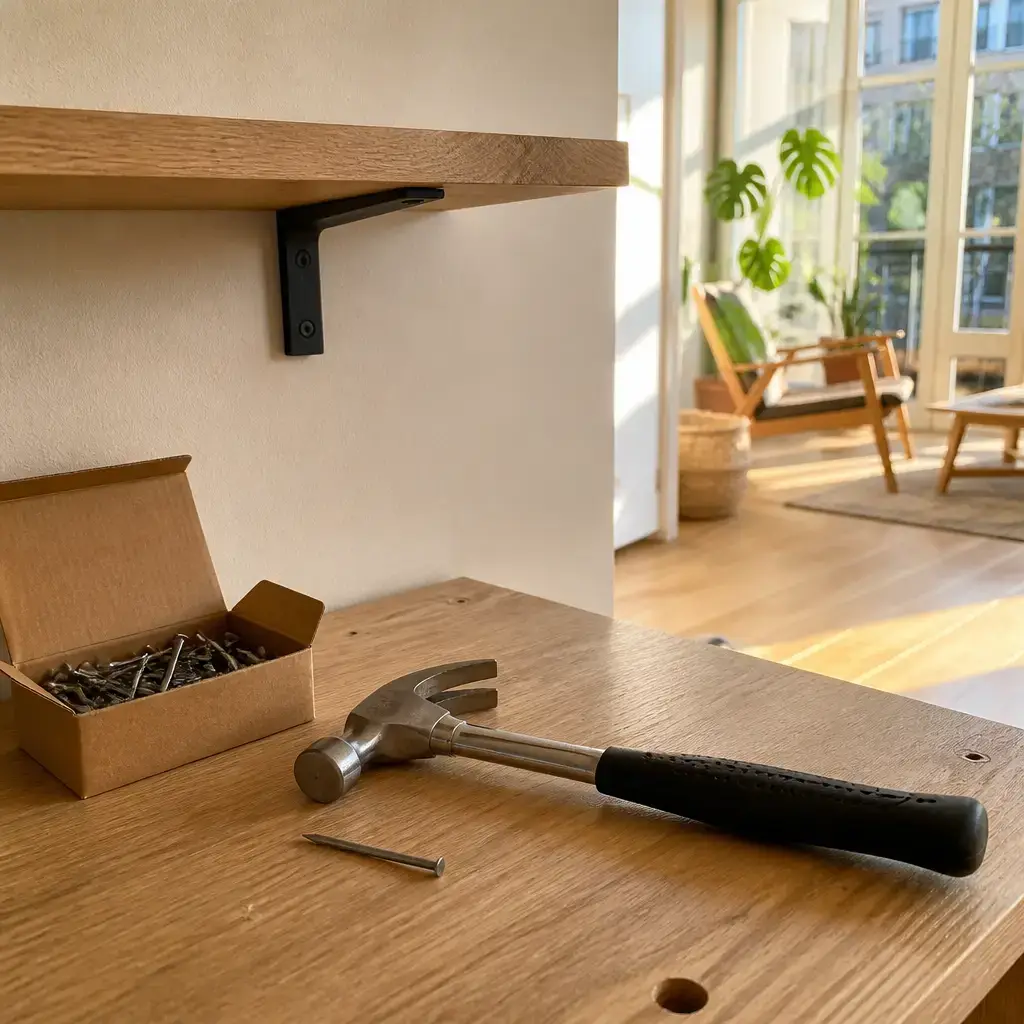
Use Borrowing a Hammer and Nails to practice German conversation, pronunciation, vocabulary, grammar, and quizzes.
Dialogue
Hast du einen Hammer, den ich benutzen kann?
hast doo EYE-nen HAM-er, dane ikh beh-NOOT-sen kahn? Do you have a hammer I can use?Benutze diesen hier, aber halte den Griff fest.
beh-NOOT-suh DEE-zen heer, AH-ber HAL-tuh dane grif fest. Use this one, but grip the handle firmly.Ich brauche ihn, um dieses Regal zu reparieren.
ikh BROW-khuh een, oom DEE-zes reh-GAHL tsoo reh-pah-REE-ren. I need it to fix this shelf.Brauchst du auch Nägel?
BROWKHST doo owkh NAY-gel? Do you also need any nails?Ein Nagel würde helfen.
ine NAH-gel VUR-duh HEL-fen. One nail would help.Sie sind in der Kiste neben dir.
zee zint in dare KIS-tuh NAY-ben deer. They are in the box beside you.Ich bringe den Hammer zurück, wenn ich fertig bin.
ikh BRING-uh dane HAM-er tsoo-RUEK, ven ikh FER-tikh bin. I will return the hammer when I finish.Leg ihn hier zu den anderen Werkzeugen, wenn du fertig bist.
LEHK een heer tsoo dane AHN-deh-ren VAIRK-tsoy-gen, ven doo FER-tikh bist. Leave it here with the other tools when you are done.Sentence explanations
Hast du einen Hammer, den ich benutzen kann?
Do you have a hammer I can use?
- Hast du
- do you have
- Hammer
- hammer
- benutzen
- use
- kann
- can
More detail
Hast du is the verb-first pattern for a yes/no question: hast is the 2nd-person singular present form of haben (“to have”), and du is “you.” A statement such as Du hast ... becomes Hast du ...? by putting the finite verb first. Hammer means “hammer.” It is a masculine noun, so the indefinite article appears as einen in the accusative: einen Hammer. The article marks the hammer as the object of haben; it does not by itself state a numerical count. benutzen means “to use.” Here it is the infinitive in the relative clause den ich benutzen kann. Example: Ich kann dieses Werkzeug benutzen. — “I can use this tool.” kann is the 1st-person singular present form of können, “can” or “be able to.” With a modal verb such as können, the other verb stays in the infinitive, and that infinitive normally goes to the end of the clause: ich kann ... benutzen. The relative clause den ich benutzen kann describes the hammer: den refers back to the masculine noun Hammer and is accusative because it is the object of benutzen; ich is the subject. In the main question, Hast du einen Hammer ...? asks whether the listener has such a hammer. Together, the utterance means: “Do you have a hammer that I can use?”
Benutze diesen hier, aber halte den Griff fest.
Use this one, but grip the handle firmly.
- Benutze
- use
- diesen hier
- this one here
- halte … fest
- grip firmly
- Griff
- handle
More detail
Benutze is the informal singular imperative of benutzen (“to use”). It addresses one person directly: Benutze den Hammer. — “Use the hammer.” This is a command, not a past-tense form. diesen hier means “this one here.” Diesen is the masculine singular accusative form of the demonstrative dieser; the translation and preceding context support the hammer as the selected item. Hier adds a pointing or locating emphasis. Compare masculine nominative dieser with masculine accusative diesen: Ich nehme diesen. — “I’ll take this one.” halte ... fest is the separated form of festhalten, meaning “to hold firmly” or “to grip.” Halte is the informal singular imperative, while fest is the separable particle placed at the end of the clause. Example: Halte das Seil fest. — “Hold the rope firmly.” Griff is a masculine noun meaning “handle” or “grip.” In den Griff, the masculine singular accusative article marks it as the direct object of festhalten: Der Griff ist fest. — “The handle is firm.” Here, fest is part of the verb festhalten, not an adjective modifying Griff. The complete pattern is Benutze [object], aber halte [object] fest: “Use [object], but hold [object] firmly.” In this utterance, Benutze diesen hier selects the item, and halte den Griff fest instructs the listener to grip its handle firmly. Together: “Use this one, but grip the handle firmly.”
Ich brauche ihn, um dieses Regal zu reparieren.
I need it to fix this shelf.
- Ich
- I
- brauche
- need
- ihn
- it
- um … zu
- in order to
- dieses
- this
- Regal
- shelf
- reparieren
- repair
More detail
Ich is the first-person singular pronoun, “I.” It identifies the speaker as the person who needs something and carries the subject role here. A useful contrast is du (“you,” singular informal): Ich repariere das Regal. — “I repair the shelf.” brauche means “need” here. It is the first-person singular present form of brauchen; the infinitive is brauchen, and ich brauche means “I need.” The form changes with the subject: du brauchst means “you need,” while sie brauchen can mean “they need” or the formal “you need.” ihn means “it” in the fixed translation. Grammatically, it is the accusative singular masculine form of the third-person pronoun: er is the nominative form and ihn is used when the pronoun is the object of an action or need. The fixed sentence and translation do not uniquely name the concrete object represented by ihn; they establish that the speaker needs that object. For example: Ich sehe ihn. — “I see him/it,” with the exact referent supplied by context. um ... zu introduces a purpose infinitive: “in order to ...” or simply “to ...” in this sentence. The two parts belong together even though dieses Regal occurs between them. In the pattern um ... zu + infinitive, the understood subject of the purpose is normally the same as the subject of the main clause here: the speaker needs the object in order for the speaker to repair the shelf. dieses means “this” and is the demonstrative form used here with the neuter singular accusative noun Regal. Its form reflects the grammatical properties of Regal and its object role in reparieren; it does not itself assert a numerical quantity. Compare dieser with a masculine noun and diese with a feminine or plural noun, in the relevant cases. Regal means “shelf” or “shelving unit” here. It is a neuter noun, so its dictionary form includes the article das: das Regal. In this sentence, dieses Regal is the object of reparieren, which is why the demonstrative has the neuter singular accusative form dieses. Example: Das Regal ist neu. — “The shelf is new.” reparieren means “to repair.” It is an infinitive, and it follows zu in the purpose construction, giving zu reparieren — “to repair.” The same infinitive can be used independently after a modal or in a dictionary entry, but here um ... zu reparieren expresses the intended purpose. Together, Ich brauche ihn means “I need it.” The purpose construction um dieses Regal zu reparieren adds “to repair this shelf.” Thus the complete utterance means “I need it to fix this shelf,” with the object represented by ihn understood from the surrounding context.
Brauchst du auch Nägel?
Do you also need any nails?
- Brauchst
- need
- du
- you
- auch
- also
- Nägel
- nails
More detail
Brauchst is the second-person singular present form of brauchen, “to need.” The base form is brauchen; with du, its present-tense form is du brauchst. In a yes/no question, the finite verb comes first: Brauchst du ...? = “Do you need ...?” du means “you” and is the informal singular second-person pronoun. It identifies the person being asked, while Brauchst carries the matching second-person singular verb form. auch means “also” or “too.” It adds the idea that nails are included in what is needed, alongside something already relevant. Its position here is between the subject and the noun phrase: Brauchst du auch ...? Nägel means “nails” here. It is the plural of Nagel; the vowel changes from a to ä in this plural: der Nagel → die Nägel. The question uses the plural form, and German has no separate word in this phrase corresponding exactly to English “any”; the English wording “any nails” conveys the open-ended question about whether nails are needed. Together, Brauchst du auch Nägel? forms a yes/no question: “Do you also need any nails?” The structure is finite verb + subject + also + noun phrase, a reusable German pattern for asking whether someone needs an additional item. The supplied context connects the need with repairing the shelf, but this sentence itself asks specifically whether nails are also needed.
Ein Nagel würde helfen.
One nail would help.
- Ein
- a/an
- Nagel
- nail
- würde
- would
- helfen
- help
More detail
Ein is the indefinite article used here with the singular masculine noun Nagel in the subject position. It means “a/an”; in this sentence, the fixed translation makes the intended quantity one nail, but an indefinite article by itself does not always assert a numerical count. The form changes with grammatical case and gender: for example, ein Nagel (nominative masculine) contrasts with eine Schraube (nominative feminine) and ein Brett (nominative neuter). Nagel means “nail” here. Its plural is Nägel, as in the preceding question Brauchst du auch Nägel? (“Do you also need any nails?”). The singular form in the fixed utterance matches the explicitly translated meaning “one nail.” würde is the form of werden used to express the conditional meaning “would” here. It is followed by the infinitive at the end of the clause. The useful pattern is würde + infinitive: Das würde helfen. means “That would help.” This form presents the help as a possible or hypothetical result rather than simply stating Das hilft (“That helps”). helfen is the infinitive “to help.” With würde, it remains in the infinitive: würde helfen. In a present-tense statement, the form with a third-person singular subject is hilft, as in Ein Nagel hilft (“A nail helps”). Together, Ein Nagel is the subject, and würde helfen says that its help would be a possible result. The complete utterance therefore means “One nail would help.”
Sie sind in der Kiste neben dir.
They are in the box beside you.
- Sie
- they
- sind
- are
- Kiste
- box
- neben dir
- beside you
More detail
Sie means “they” here. In this use, it is the third-person plural pronoun, so it refers to more than one person or thing without naming the referent. German also has sie for “she” and “they,” while capitalized Sie can mean formal singular or plural “you”; the fixed translation establishes the intended reading here as “they.” sind is the present-tense plural form of sein (“to be”): sein → sind. It agrees with plural Sie and expresses “are” in this sentence. The form sind is also used with wir (“we”) and sie (“they”), while singular forms include bin (“am”) and ist (“is”). Kiste means “box” or “crate.” Its base noun is feminine: die Kiste. After in here, der Kiste is the dative form of the feminine noun phrase. With a location, in takes the dative: in der Kiste means “in the box.” For movement into the box, German uses the accusative instead: in die Kiste (“into the box”). neben dir means “beside you.” neben expresses location next to something or someone here, and dir is the dative form of the second-person singular pronoun du (“you”). The dative form is required because neben describes a fixed location in this phrase. For example, Der Stuhl steht neben dir. means “The chair is beside you.” Together, Sie sind gives “they are,” in der Kiste gives the location “in the box,” and neben dir adds the nearby reference “beside you.” The complete utterance therefore means: “They are in the box beside you.”
Ich bringe den Hammer zurück, wenn ich fertig bin.
I will return the hammer when I finish.
- Ich
- I
- bringe … zurück
- return
- Hammer
- hammer
- wenn
- when
- fertig
- finished; done
- bin
- am
More detail
Ich means “I” here: the first-person singular subject, the person who will return the hammer. German subject pronouns include ich (“I”), du (“you,” singular), and sie (“they” or “she,” depending on context). The supplied translation identifies the actor as the speaker. bringe ... zurück comes from the separable verb zurückbringen, “to return” or literally “to bring back.” In the present tense, its parts separate in a main clause: Ich bringe den Hammer zurück. The verb form bringe is the first-person singular present form of bringen; zurück supplies the “back” part. German present tense can refer to a future event when the time is clear, so this form corresponds here to “I will return.” Compare the reusable pattern Ich bringe X zurück. — “I return/will return X.” den Hammer is the direct object: the thing being returned. Hammer is a masculine noun, and den is the masculine accusative form of the definite article der (“the”). The accusative marks the object of bringe ... zurück; it is not a marker of quantity. The noun’s plural is Hämmer, but this sentence refers to one identified hammer. wenn introduces a condition or time clause. In this sentence it means “when,” linking the return to the point at which the speaker is finished. A useful pattern is wenn + clause, with the finite verb placed at the end of that subordinate clause. fertig means “finished” or “done.” Here it describes the speaker’s state, not the hammer’s condition. It is a predicative adjective after sein, so it has no adjective ending in this use. For example, Ich bin fertig. means “I am done.” bin is the first-person singular present form of sein, “to be”: ich bin, du bist, er/sie ist. In the subordinate clause wenn ich fertig bin, bin comes last, as is typical for a German subordinate clause introduced by wenn. Together, Ich bringe den Hammer zurück says “I will return the hammer,” and wenn ich fertig bin specifies when: “when I finish” or more literally “when I am done.” The complete utterance is therefore: “I will return the hammer when I finish.”
Leg ihn hier zu den anderen Werkzeugen, wenn du fertig bist.
Leave it here with the other tools when you are done.
- Leg
- leave; put
- ihn
- it
- hier
- here
- zu
- to; with
- anderen
- other
- Werkzeugen
- tools
- wenn
- when
- fertig
- done; finished
More detail
Leg is the singular informal imperative of legen, “to lay” or “to put.” The short imperative Leg! is common; the longer Lege! is also possible in some styles. Here it gives the instruction to put something somewhere. ihn is the accusative singular masculine form of er (“he/it” for a masculine noun). In this sentence, the fixed translation and the preceding context identify it as the hammer. The accusative form marks the item being put: Ich sehe ihn means “I see it/him.” hier means “here,” identifying the location near the speaker or the relevant place. It is an adverb and does not change form. zu introduces the destination or group with which something is placed. With a dative noun phrase, zu den anderen Werkzeugen means “with/among the other tools” here. The same preposition can also express going to a person or place, as in Ich gehe zu Anna (“I am going to Anna”). anderen means “other” in the phrase “the other tools.” It is the inflected form of ander-; here it has the plural dative ending because it accompanies Werkzeugen after zu. The form is not the noun’s base form. Werkzeugen is the plural dative form of das Werkzeug, “tool.” The plural is Werkzeuge, and the dative plural adds -n: mit Werkzeugen means “with tools.” wenn introduces a condition or time clause. With the fixed translation, it means “when”: Wenn ich fertig bin, gehe ich. — “When I am done, I leave.” German places the finite verb at the end of this subordinate clause, so bist follows fertig in wenn du fertig bist. du is the informal singular subject pronoun, “you.” bist is the second-person singular present form of sein, “to be.” Together, du ... bist means “you are”; the subject and verb surround the predicate adjective in this subordinate clause. fertig means “done” or “finished.” It is an adjective used here as a predicate after sein, so it does not receive an ending: Du bist fertig means “You are done.” As a whole, Leg ihn hier gives the instruction “Put it here,” and zu den anderen Werkzeugen specifies that it should be placed with the other tools. The final clause wenn du fertig bist adds the time condition “when you are done.” Thus the utterance means: “Leave it here with the other tools when you are done.”
Grammar Points
zurückbringen → bringe ... zurück
bringe ... zurück
BRING-uh ... tsoo-RUEKto return
This separable verb splits in a sentence: the prefix zurück moves to the end.
German Vocabulary
Benutze diesen hier, aber halte den Griff fest.
Ich brauche ihn, um dieses Regal zu reparieren.
Benutze diesen hier, aber halte den Griff fest.
Benutze diesen hier, aber halte den Griff fest.
Hast du einen Hammer, den ich benutzen kann?
Benutze diesen hier, aber halte den Griff fest.
Hast du einen Hammer, den ich benutzen kann?
Ein Nagel würde helfen.
Sie sind in der Kiste neben dir.
Brauchst du auch Nägel?
Ich brauche ihn, um dieses Regal zu reparieren.
Ich brauche ihn, um dieses Regal zu reparieren.
Quiz
Word Order
Arrange the words in the correct order.
Do you also need any nails?
Show Answer
Brauchst du auch Nägel?One nail would help.
Show Answer
Ein Nagel würde helfen.Spelling
Tap the letters to spell the word.
firmly
Show Answer
festto use
Show Answer
Benutzeshelf
Show Answer
Regalto have