10 minutes free every day
Continue audio lessons in the app
Word explanations appear automatically in sync with the audio.
No login required · synced translations · playback with the screen locked
Choose your learning language and open this lesson in the app.

About This Lesson
Use Cleaning up spilled water to practice German conversation, pronunciation, vocabulary, grammar, and quizzes.
Dialogue
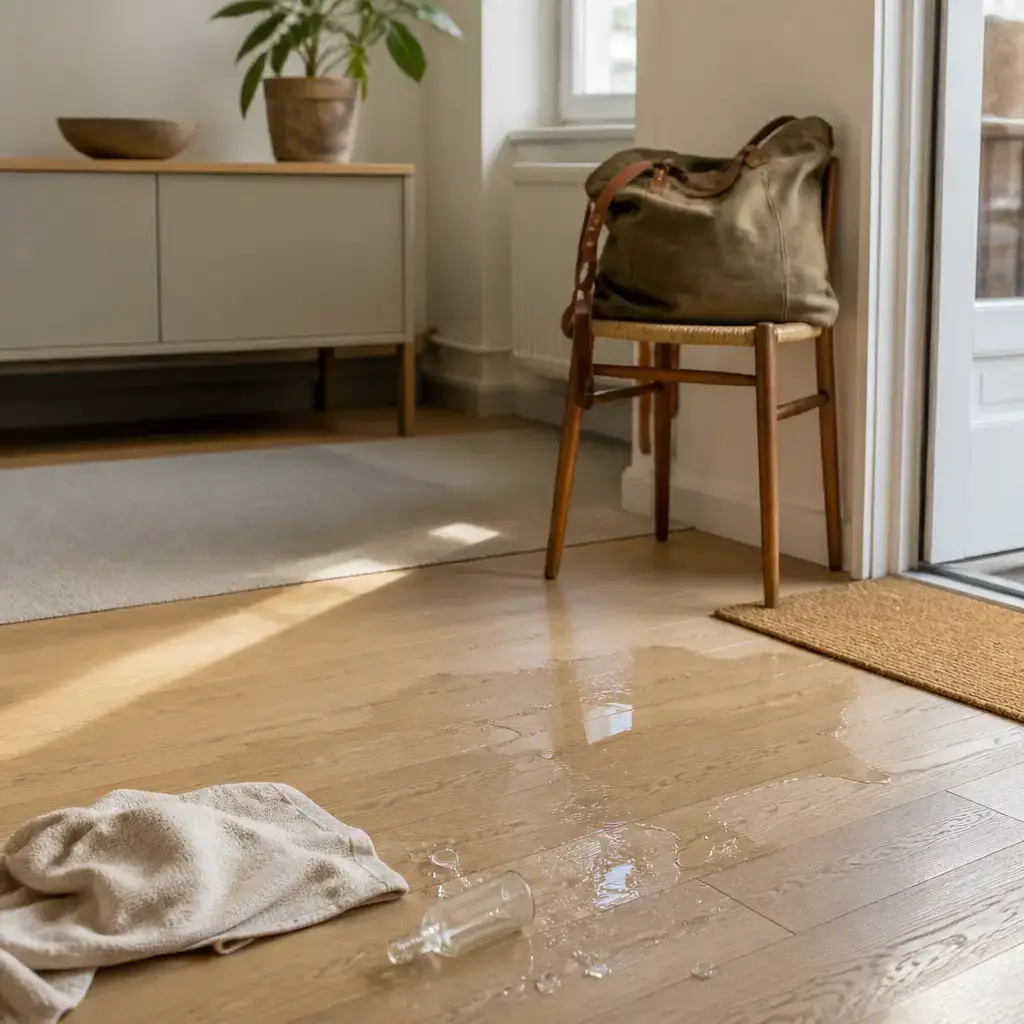
Auf dem Boden ist Wasser.
owf daym BOH-den ist VAH-ser There is water on the floor.Das Wasser läuft zur Tür.
dahs VAH-ser loyft tsoor TEWR It is spreading toward the door.Die kleine Flasche ist kaputtgegangen.
dee KLY-nuh FLAH-shuh ist kah-POOT-guh-gahng-en The small bottle broke.Ich hole ein trockenes Handtuch.
ikh HOH-luh ayn TROK-uh-nes HAHNT-tooKH I will get a dry towel.Kannst du zuerst die Tasche bewegen?
kahnst doo tsoo-AIRST dee TAH-shuh buh-VAY-gen Can you move the bag first?Ich lege sie auf den Stuhl.
ikh LAY-guh zee owf dayn SHTOOL I will put it on the chair.Dann können wir den Boden sauber machen.
dahn KUR-nen veer dayn BOH-den ZOW-ber MAKH-en Then we can clean the floor.Die Tasche bleibt dort trocken.
dee TAH-shuh blypt dort TROK-en The bag will stay dry there.Sentence explanations
Auf dem Boden ist Wasser.
There is water on the floor.
- Boden
- floor
- ist
- is
- Wasser
- water
More detail
Boden means “floor” here. Its base form is der Boden; after auf in a location meaning “on,” it appears as dem Boden, the dative form of the masculine noun. Compare auf dem Boden (“on the floor”) with a movement meaning such as auf den Boden (“onto the floor”), where the case changes because the question is where something is versus where it is going. ist is the third-person singular present form of sein (“to be”): sein → ist. A useful example is Das Wasser ist kalt. — “The water is cold.” Wasser means “water.” It is normally an uncountable neuter noun: das Wasser. In this sentence it appears without an article because the statement presents water as an unspecified substance rather than counting individual units. The related form Wässer can refer to different kinds or bodies of water in contexts where a plural is appropriate, but it is not the ordinary form for water as a substance. Together, Auf dem Boden gives the location, while ist Wasser states that water is present there. German places the location first and uses ist with Wasser, producing the meaning “There is water on the floor.”
Das Wasser läuft zur Tür.
It is spreading toward the door.
- Das
- the
- Wasser
- water
- läuft
- flows / spreads
- zur Tür
- toward the door
More detail
Das is the neuter nominative form of the definite article, meaning “the” here. It belongs with Wasser in das Wasser. The article form reflects the noun phrase’s neuter gender and its nominative subject role. Wasser means “water” here. It is commonly used without an indefinite article when referring to water as a substance or to an unspecified amount. Example: Wasser ist wichtig. — “Water is important.” läuft is the present-tense third-person singular form of laufen (“to run”). With a liquid such as water, laufen can describe flowing or spreading rather than a person running. The form chain is laufen → läuft for “he, she, or it runs/flows.” Example: Das Wasser läuft aus der Flasche. — “The water is flowing out of the bottle.” zur Tür expresses movement toward the door. zur is the contraction of zu der; zu takes the dative, and der is the dative form used with the feminine noun Tür (“door”). The noun’s basic form is die Tür; der Tür occurs here because of zu. Example: Sie geht zur Tür. — “She goes to the door.” Together, Das Wasser means “the water,” läuft means “is flowing/spreading,” and zur Tür means “toward the door.” The whole utterance is therefore: “The water is spreading toward the door.”
Die kleine Flasche ist kaputtgegangen.
The small bottle broke.
- kleine
- small
- Flasche
- bottle
- kaputtgegangen
- broke
More detail
kleine means “small” here. Its base form is klein; before the feminine singular noun Flasche, after the definite article Die, it appears as the weakly inflected form kleine. Comparison uses kleiner (“smaller”) and am kleinsten (“smallest”). Flasche means “bottle.” Its base form is the noun itself, with feminine grammatical gender: die Flasche. Its plural is die Flaschen (“the bottles”). kaputtgegangen is the past participle of kaputtgehen, meaning “to break” or “to become broken.” German forms this perfect construction with sein: ist kaputtgegangen. The verb describes the bottle’s change of state; it does not by itself say who caused the breakage. For example: Das Glas ist kaputtgegangen. — “The glass broke.” Together, Die kleine Flasche means “the small bottle,” and ist kaputtgegangen means “broke” in the fixed translation. The full utterance therefore means “The small bottle broke.”
Ich hole ein trockenes Handtuch.
I will get a dry towel.
- Ich
- I
- hole
- get
- ein
- a
- trockenes
- dry
- Handtuch
- towel
More detail
Ich means “I” here: it is the first-person singular subject, the person carrying out the action. The same pronoun is used whether the action is happening now or is understood as planned for the near future. hole is the first-person singular present form of holen, “to get” or “to fetch.” The present form can refer to a future action when the context makes that timing clear, which is why the fixed translation uses “will get.” For example: Ich hole Wasser. — “I’ll get water.” ein is the indefinite article in the form required here. It does not by itself assert a numerical count; it introduces an unspecified towel. In this phrase, its form reflects the neuter accusative noun that follows. trockenes means “dry” and describes Handtuch. Its base form is trocken. The ending -es marks the adjective as neuter accusative in ein trockenes Handtuch; the ending belongs to the adjective, not to the noun. For comparison: trocken means “dry,” trockener means “drier,” and am trockensten means “driest.” Handtuch means “towel.” It is a neuter noun, so the phrase uses ein and the adjective form trockenes in the accusative: ein trockenes Handtuch. Example: Das Handtuch ist trocken. — “The towel is dry.” Together, Ich hole identifies the speaker as the person fetching something, and ein trockenes Handtuch identifies the object as an unspecified dry towel. The complete utterance means “I will get a dry towel.”
Kannst du zuerst die Tasche bewegen?
Can you move the bag first?
- Kannst du
- can you
- zuerst
- first
- Tasche
- bag
- bewegen
- move
More detail
Kannst du combines the present-tense form kannst of können (“can, be able to”) with the subject pronoun du (“you”). können is a modal verb: ich kann, du kannst, er/sie kann. In this yes/no question, the conjugated modal comes first, followed by the subject. The other verb stays in the infinitive at the end: Kannst du ... bewegen? means “Can you ... move?” This asks about ability or willingness in this situation; it is not itself the verb meaning “move.” zuerst means “first” or “before anything else.” It is an adverb, so it does not change for person, number, or gender. Example: Ich mache zuerst die Tür zu. — “I close the door first.” Tasche is the noun “bag.” Its base form is die Tasche; the plural is die Taschen. In the utterance, die Tasche is the singular accusative object of bewegen: the bag is the thing being moved. The article is not included in the selected quote, but it shows the noun’s feminine grammatical gender and its singular accusative form; the feminine singular article remains die in the nominative and accusative. Example: Ich sehe die Tasche. — “I see the bag.” bewegen is the infinitive “to move.” Its present-tense forms include ich bewege, du bewegst, and er/sie bewegt; the infinitive is used here because können is the modal verb. In a modal construction, the modal is conjugated and the other verb remains at the end in the infinitive: Du kannst die Tasche bewegen. — “You can move the bag.” Together, Kannst du supplies the question pattern, zuerst specifies the order, die Tasche is the object, and bewegen names the action. The complete utterance therefore means “Can you move the bag first?”
Ich lege sie auf den Stuhl.
I will put it on the chair.
- Ich
- I
- lege
- put/place
- sie
- it
- Stuhl
- chair
More detail
Ich is the first-person singular pronoun meaning “I” and is the subject of the sentence. German uses ich for the speaker as the actor; its object form is mich, as in Er sieht mich (“He sees me”). lege is the first-person singular present form of legen, “to lay” or “to put something down.” The pattern is ich lege (“I put / I am putting”). German present tense can also refer to a planned or imminent future action, so the fixed translation “I will put it” fits here. legen describes placing something in a lying or horizontal position; stellen is commonly used for putting something upright. sie means “it” here and refers to the bag supported by the preceding context. It is the feminine singular accusative form of the pronoun because Tasche is feminine and is the thing being moved. The same written form can have other grammatical uses in German, including “she” or plural “they,” but this sentence and translation support the singular object reading. Stuhl means “chair.” With the definite article, the phrase is den Stuhl, “the chair.” Stuhl is masculine: the masculine accusative article is den, while the nominative form is der Stuhl. The preposition auf takes the accusative here because legen expresses movement to a place or a change of position: auf den Stuhl means “onto the chair.” For a stationary location, German uses the dative instead: Das Buch liegt auf dem Stuhl (“The book is on the chair”). Together, Ich lege sie auf den Stuhl means “I will put it onto the chair.” The speaker is the one doing the placing, sie is the object being placed, and auf den Stuhl gives the destination. The following context’s Dann (“Then”) is consistent with this planned action occurring before the next action.
Dann können wir den Boden sauber machen.
Then we can clean the floor.
- Dann
- then
- können wir
- we can
- Boden
- floor
- sauber
- clean
- machen
- make; do
More detail
Dann means “then” here and links the sentence to an earlier or understood point in time or sequence. It can also introduce a result in other contexts, but here the fixed translation supports the time/sequence meaning. können wir expresses “we can.” können is the modal verb “can, be able to”; können is also its infinitive/base form, while wir können is the present-tense form for “we.” With a modal verb, the other verb normally appears as an infinitive at the end of the clause. Example: Wir können warten. — “We can wait.” Boden means “floor” here. Its base form is the masculine noun der Boden. In den Boden, the article shows masculine accusative, because the floor is the direct object of the cleaning action. Example: Ich sehe den Boden. — “I see the floor.” sauber means “clean.” Here it describes the resulting state of the floor. It is an adjective, and after machen in this pattern it remains sauber, without an adjective ending. Example: Wir machen den Tisch sauber. — “We clean the table.” machen means “make” or “do”; in this sentence it is used in the pattern etwas sauber machen, “to clean something” literally by making it clean. It is the infinitive because it follows the modal verb können. Example: Sie können das Fenster sauber machen. — “They can clean the window.” Together, den Boden sauber machen means “clean the floor”: den Boden is what is affected, and sauber states the result. Because können is the modal verb, machen stays at the end in the infinitive. Thus Dann können wir den Boden sauber machen. means “Then we can clean the floor.”
Die Tasche bleibt dort trocken.
The bag will stay dry there.
- Tasche
- bag
- bleibt
- stays; remains
- dort
- there
- trocken
- dry
More detail
Tasche means “bag” here. It is a feminine noun: die Tasche is singular, while the plural is die Taschen. The noun itself does not show the case here; the article die marks the nominative singular form in this sentence. Example: Die Tasche ist neu. — “The bag is new.” bleibt is the third-person singular present form of bleiben, “to stay” or “to remain”: ich bleibe, du bleibst, sie bleibt. It describes continuing in a state or place. German present tense can also refer to a future situation when the context supports it, which matches “will stay” in the fixed translation. Example: Er bleibt zu Hause. — “He is staying at home.” dort is an adverb meaning “there,” referring to a place indicated by the situation. It does not change for gender, number, or case. Example: Das Buch liegt dort. — “The book is there.” trocken means “dry.” After bleiben, it is a predicative adjective describing the continuing state of the bag, so it has no adjective ending here. Example: Die Kleidung bleibt trocken. — “The clothes stay dry.” Together, Die Tasche is the subject, bleibt says that its state continues, dort identifies the place, and trocken names the continuing state. The complete meaning is: “The bag will stay dry there.”
Grammar Points
Adjektivendung vor dem Nomen: kleine Flasche
kleine Flasche
KLY-nuh FLAH-shuhsmall bottle
German adjectives before nouns change their ending; kleine agrees with the feminine noun Flasche.
German Vocabulary
Kannst du zuerst die Tasche bewegen?
Auf dem Boden ist Wasser.
Die kleine Flasche ist kaputtgegangen.
Ich hole ein trockenes Handtuch.
Ich hole ein trockenes Handtuch.
Die kleine Flasche ist kaputtgegangen.
Die kleine Flasche ist kaputtgegangen.
Das Wasser läuft zur Tür.
Ich hole ein trockenes Handtuch.
Das Wasser läuft zur Tür.
Auf dem Boden ist Wasser.
Kannst du zuerst die Tasche bewegen?
Quiz
Word Order
Arrange the words in the correct order.
There is water on the floor.
Show Answer
Auf dem Boden ist Wasser.It is spreading toward the door.
Show Answer
Das Wasser läuft zur Tür.The small bottle broke.
Show Answer
Die kleine Flasche ist kaputtgegangen.Spelling
Tap the letters to spell the word.
to get
Show Answer
holewater
Show Answer
Wassersmall
Show Answer
kleinebottle